Japan Agricultural Pyrethroids Market Size & Growth Rate
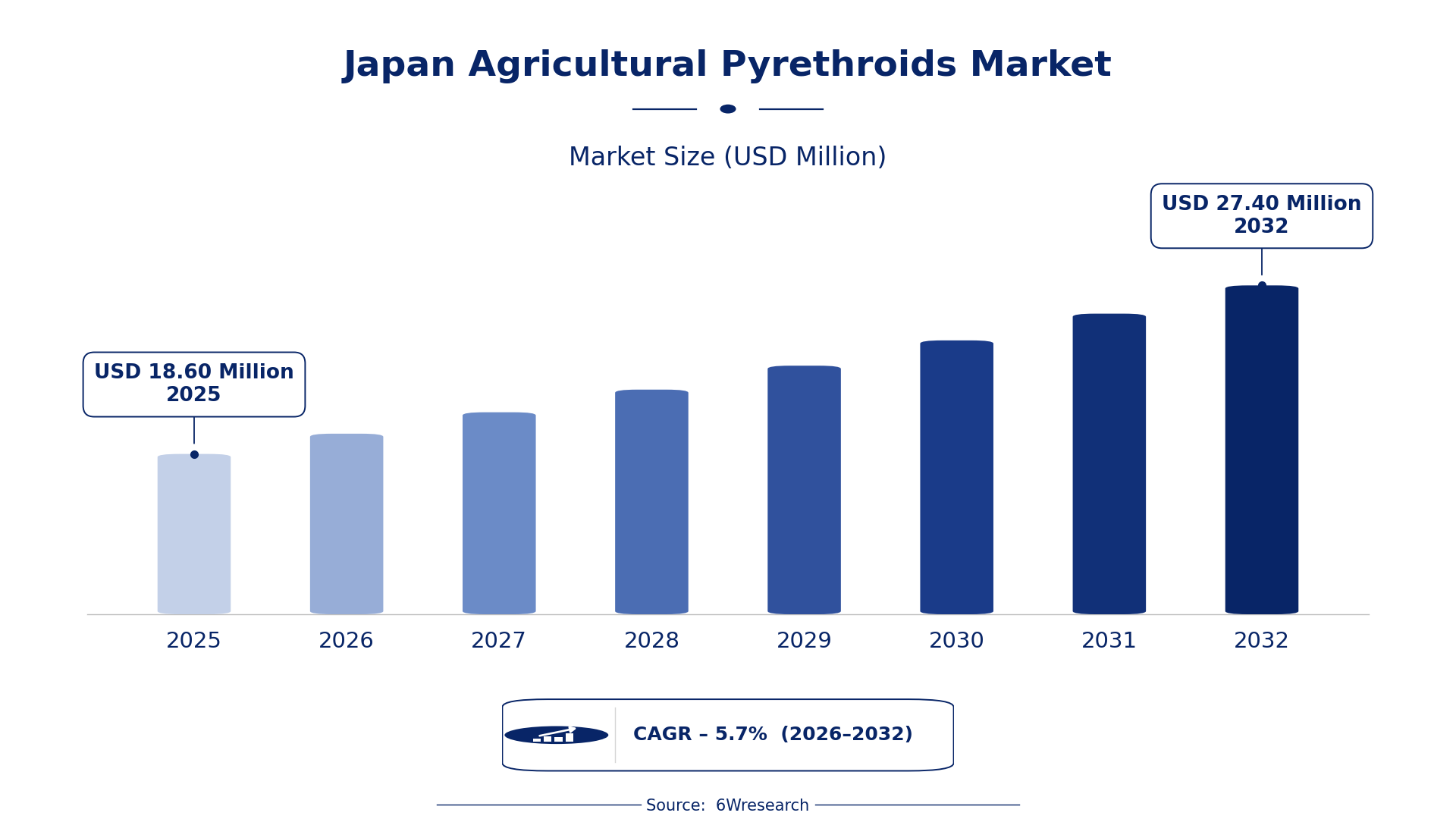
According to 6Wresearch internal database and industry insights, the Japan Agricultural Pyrethroids Market was valued at USD 18.60 Million in 2025 and is projected to reach USD 27.40 Million by 2032, growing at a CAGR of approximately 5.7% during 2026–2032.
Japan Agricultural Pyrethroids Market Highlights
| Report Metric | Details |
| Report Name | Japan Agricultural Pyrethroids Market (2026-2032) |
| Market Size 2025 | USD 18.60 Million |
| Market Size 2032 | USD 27.40 Million |
| Absolute Growth 2025–2032 | USD 8.80 Million |
| CAGR 2026–2032 | 5.7% |
| Peak Annual Growth | 6.8% in 2032 |
| Forecast Period | 2026–2032 |
| Historical Data | 2022–2025 |
| Base Year | 2025 |
| Leading Product Type, 2025 | Insecticides (38% share) |
| Leading Formulation, 2025 | Liquid (43% share) |
| Leading Application Area, 2025 | Crop Protection (37% share) |
| Leading Distribution Channel, 2025 | Agrochemical Distributors (42% share) |
| Leading End User, 2025 | Farmers (51% share) |
| Fastest-Growing Product Type | Low-toxicity Pyrethroids (8.1% CAGR) |
| Fastest-Growing Application Area | Horticulture (7.3% CAGR) |
| Fastest-Growing Distribution Channel | Retail Stores (7.7% CAGR) |
| Fastest-Growing End User | Sustainable Farms (7.8% CAGR) |
| Growing Sector | Crop Protection |
| Key End Users | Farmers, Agricultural Cooperatives, Horticulturists, Agrochemical Distributors |
Japan Agricultural Pyrethroids Market Year-wise Growth Rate and Key Drivers (2022–2032)
This graph illustrates the annual growth rates of the market from 2022 to 2032, highlighting a steady upward trajectory and projected market expansion over the forecast period.
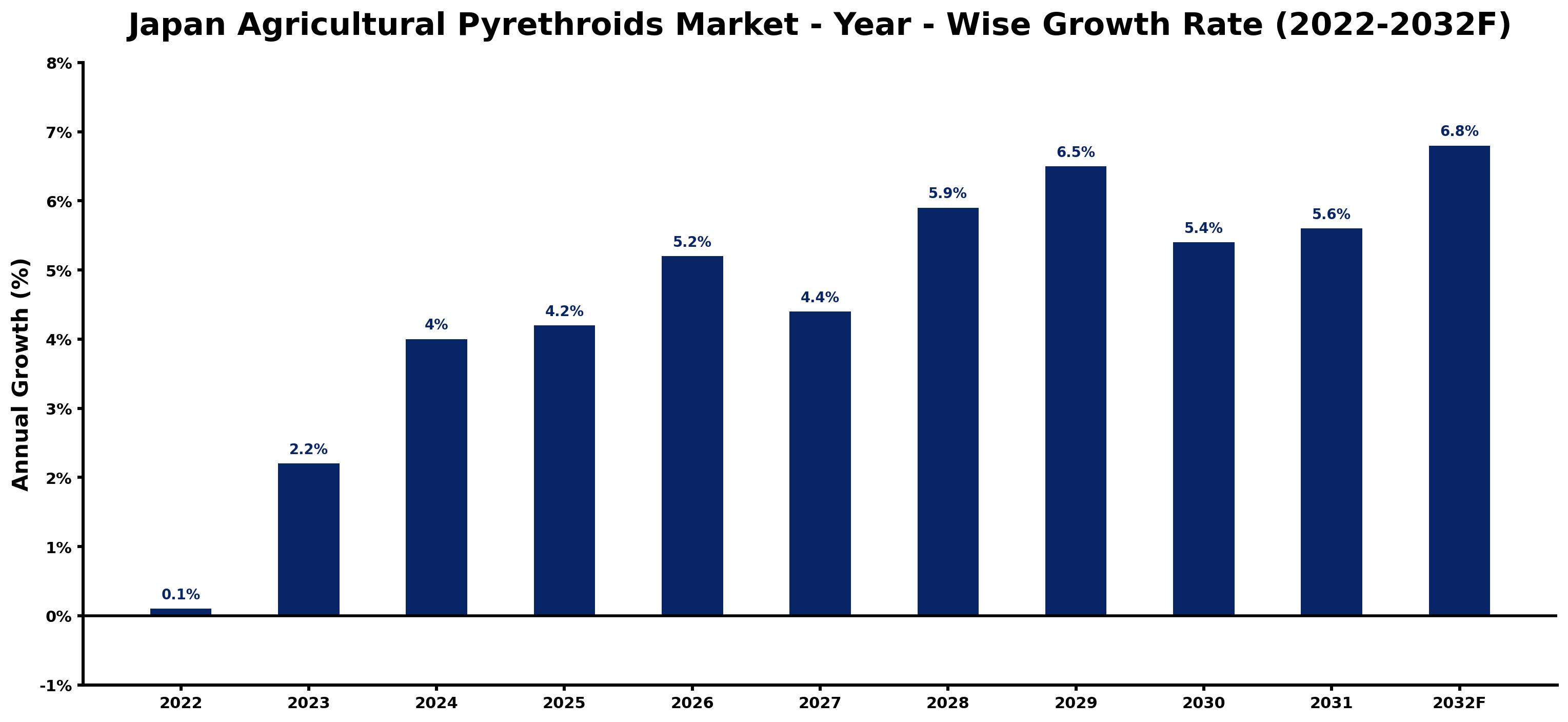
The yearly estimates that follow link every growth rate to its principal driver, so readers can see why the pace changed in each period.
| Year | Estimated Annual Growth (%) | Market Rationale |
| 2022 | 0.1 | The agricultural sector showed minimal growth due to stable pest management practices. |
| 2023 | 2.2 | Increased awareness of sustainable practices led to faster growth in demand for pyrethroids. |
| 2024 | 4.0 | The introduction of new formulations contributed to a rise in market activity. |
| 2025 | 4.2 | Crop production demands drove growth as farmers sought effective pest control solutions. |
| 2026 | 5.2 | Growing interest in low-toxicity options is expected to support a positive market shift. |
| 2027 | 4.4 | Market growth is projected to slow as farmers adjust to new pest management technologies. |
| 2028 | 5.9 | The rising popularity of horticulture will boost demand for agricultural pyrethroids. |
| 2029 | 6.5 | Increased production of rice and vegetables is expected to stimulate higher usage of insecticides. |
| 2030 | 5.4 | A slight slowdown is projected as market saturation begins affecting growth rates. |
| 2031 | 5.6 | Demand will rise again as farmers adapt to changing pest challenges. |
| 2032 | 6.8 | The introduction of advanced pest management technologies is expected to spur growth. |
Note: Market size estimations and growth projections presented in this report are based on 6Wresearch's proprietary forecasting methodology, utilizing the latest available industry data, government publications, and primary research inputs.
Japan Agricultural Pyrethroids Market Synopsis
Agricultural pyrethroids are synthetic insecticides derived from natural pyrethrins found in chrysanthemum flowers. These products are primarily used for pest control in crop protection, horticulture, and stored grains. The Japan Agricultural Pyrethroids Market is expanding due to rising demand from over 2 million farmers and agricultural cooperatives. In 2022, Japan produced approximately 8 million tons of rice, driving the need for effective pest control solutions. The introduction of sustainable pest management initiatives is further supporting market growth as technology advances.
Market Dynamics Impact Analysis (2026–2032)
| Factor | Type | Impact | Primary Segment Affected |
| Rising interest in sustainable farming practices | Driver | High | Low-toxicity Pyrethroids |
| Increased crop production in regions like Kanto | Driver | High | Crop Protection |
| Growing demand for organic farming solutions | Opportunity | Medium | Organic Farming |
| Expansion of horticulture as a key agricultural area | Opportunity | Medium | Horticulture |
| Regulatory challenges in pesticide approvals | Restraint | High | Insecticides |
| Limited awareness of low-toxicity alternatives among farmers | Restraint | Medium | Low-toxicity Pyrethroids |
| Aging farmer population impacting workforce availability | Challenge | High | Farmers |
| Competition from alternative pest control methods | Challenge | Medium | Crop Protection |
Evaluation of Drivers in Japan Agricultural Pyrethroids Market (2026–2032)
Below are the drivers that matter most for revenue growth, with supporting evidence.
| Drivers | Primary Segment Affected | Why It Matters (Evidence) |
| Increased crop yields from effective pest control | Crop Protection | In 2022, Japan produced approximately 8 million tons of rice, driving demand for insecticides. |
| Higher investment in agricultural technology | Insecticides | Investment in agricultural technology reached 200 billion yen in 2022, improving pest management capabilities. |
| Growing awareness of pest management in stored grains | Stored Grains | With the horticulture sector valued at approximately 1 trillion yen, effective pest control is necessary for maintaining quality. |
| Expansion of agricultural cooperatives for collective purchasing | Agricultural Cooperatives | Japan has over 1,000 agricultural cooperatives, facilitating bulk purchases of agricultural pyrethroids. |
| Adoption of low-toxicity formulations for sustainable practices | Low-toxicity Pyrethroids | Sustainable farming practices encourage the use of low-toxicity options, appealing to environmentally conscious farmers. |
Volumes grow on the back of increased crop yields, with Japan producing around 8 million tons of rice in 2022, which drives demand for effective pest control solutions. Investment in agricultural technology reached 200 billion yen, improving pest management capabilities. The horticulture sector, valued at approximately 1 trillion yen, underscores the need for effective pest management in maintaining quality. The presence of over 1,000 agricultural cooperatives facilitates bulk purchasing, further boosting market demand. The shift towards environmentally friendly options is encouraging farmers to adopt low-toxicity pyrethroids, appealing to their sustainability goals.
Evaluation of Restraints in Japan Agricultural Pyrethroids Market
These are the pressures that could keep growth below its potential.
| Market Restraint | Primary Segment Affected | Why It Matters (Evidence) |
| Regulatory hurdles in pesticide approvals | Insecticides | The Chemical Substances Control Law requires thorough evaluation, delaying product availability for farmers. |
| Limited knowledge of low-toxicity alternatives | Low-toxicity Pyrethroids | Many farmers remain unaware of low-toxicity options, limiting their adoption in pest management. |
| Aging farmer population affecting workforce | Farmers | With the average age of farmers over 66 years, workforce availability is declining, impacting agricultural productivity. |
| Competition from alternative pest control methods | Crop Protection | Emerging pest control technologies may divert attention from traditional pyrethroid usage among farmers. |
| Market saturation in certain regions | Crop Protection | As pest management solutions become commonplace, growth rates may begin to plateau. |
Japan Agricultural Pyrethroids Market Challenges
Producers face high input costs due to limited domestic raw material supply for pyrethroid synthesis, increasing prices for farmers. Buyers encounter difficulties in sourcing effective pest control solutions, as the average age of farmers exceeds 66 years, which delays the adoption of modern practices. Technology adoption lags, with only 200 billion yen invested in agricultural technology in 2022, restricting efficient pest management for producers. Compliance with agricultural regulations demands substantial time and resources, costing buyers up to three months in delays for product availability.
Trends in the Japan Agricultural Pyrethroids Market
The following changes are redrawing the Japan Agricultural Pyrethroids Market.
- Launch of Sustainable Pest Management Program: In 2023, Japan initiated a programme to promote sustainable pest management, encouraging the use of low-toxicity pyrethroids. This initiative is expected to increase the adoption rate of environmentally friendly solutions among farmers.
- Shift Towards Low-Toxicity Pyrethroids: There is a growing trend towards the use of low-toxicity pyrethroids in pest management, driven by sustainable farming practices. This shift is evident as farmers increasingly seek environmentally friendly options for pest control.
- Expansion of Horticulture in Kanto Region: The Kanto region is experiencing growth in horticulture, with increasing demand for effective pest management solutions. This trend is vital for maintaining the quality of produce in this key agricultural area.
- Increase in Agricultural Cooperatives: The number of agricultural cooperatives in Japan has surpassed 1,000, facilitating collective purchasing among farmers. This growth supports better access to agricultural pyrethroids and improves pest management capabilities.
Investment Opportunities in the Japan Agricultural Pyrethroids Market
Where to invest in the Japan Agricultural Pyrethroids Market: the main openings are set out below.
- Timing for Sustainable Solutions: With a target to increase organic farmland to 3% by 2030, there is a growing need for low-toxicity pyrethroids. Farmers seeking organic certification can benefit from these products, improving their pest management strategies.
- Supply of Low-Toxicity Pyrethroids: The demand for low-toxicity pyrethroids is rising as farmers adopt sustainable practices. This presents an opportunity for suppliers to invest in formulations that meet organic standards, particularly in regions like Kanto.
- Gap in Knowledge on Sustainable Practices: With over 2 million farmers in Japan, there is a significant gap in knowledge regarding sustainable pest management. Educational programs can bridge this gap, leading to increased adoption of effective pest control methods.
- Entry through Agricultural Cooperatives: Partnering with agricultural cooperatives can facilitate entry into the market, given their collective purchasing power. This approach allows suppliers to reach a wider audience and improve product distribution.
Government Initiatives in the Japan Agricultural Pyrethroids Market
The Agricultural Chemicals Regulation Law governs pesticide use in Japan, requiring rigorous testing and evaluation of new products. This law ensures that agricultural pyrethroids meet safety standards, protecting both farmers and consumers. The Ministry of Agriculture, Forestry and Fisheries oversees compliance with these regulations, ensuring that only approved products are available in the market.
The Green Growth Strategy aims to promote sustainable practices in agriculture. The Ministry of Agriculture, Forestry and Fisheries is responsible for implementing this strategy, which includes funding for pest management solutions. This initiative supports farmers in adopting environmentally friendly practices.
Future Insight of the Japan Agricultural Pyrethroids Market
Emerging agricultural technology will reshape demand for agricultural pyrethroids by 2032, enhancing pest management strategies. Sustainable pest management initiatives will promote the use of low-toxicity pyrethroids, aligning with environmental standards. The target to expand organic farmland to 3% by 2030 will open new avenues for eco-friendly products. As Japan's agricultural exports reached 1.5 trillion yen in 2022, suppliers will need to adapt to meet the rising demand for sustainable agricultural solutions.
Market Segmentation Analysis
Japan Agricultural Pyrethroids Market report covers a detailed analysis of the following market segments:
By Product Type – Insecticides Lead, Low-toxicity Pyrethroids Expected to Grow Fastest
According to Ayushi Shukla, Senior Research Analyst at 6Wresearch, with 38% of product type revenue in 2025, Insecticides was the largest category. Insecticides hold the largest share in Japan due to their widespread use among over 2 million farmers for effective pest control in crops. The agricultural sector relies heavily on these products to ensure high yields, particularly in major production areas like the Kanto region. Low-toxicity Pyrethroids are set to record the highest CAGR in this split, 8.1% over 2026–2032. Low-toxicity Pyrethroids are experiencing rapid growth as farmers increasingly adopt sustainable pest management practices, supported by government initiatives launched in 2023. This shift reflects a broader trend towards environmentally friendly agricultural methods, ensuring their continued relevance in the market. Suppliers should focus on developing low-toxicity options to meet the growing demand for sustainable pest management.
By Formulation – Liquid Leads and Records the Fastest Growth
Liquid held 43% of the Japan Agricultural Pyrethroids Market by formulation in 2025. Liquid formulations dominate the market as they are the most common and user-friendly option for application in agricultural settings. Their ease of use appeals to farmers who require efficient solutions for pest control on their farms. The same category is also set to grow fastest, at a CAGR of 8.4% during 2026–2032. The liquid formulation is also the fastest-growing segment, as it remains the preferred choice for new products introduced in the market. This trend is likely to continue as farmers seek convenient and effective pest management solutions. Suppliers must prioritise the development of liquid formulations to align with market preferences and growth opportunities.
By Application Area – Crop Protection Leads, Horticulture Expected to Grow Fastest
Crop Protection took 37% of application area revenue in 2025, more than any other category. Crop Protection leads the market due to its critical role in ensuring the productivity of Japan's agricultural sector, which produced approximately 8 million tons of rice in 2022. Farmers depend on these products to maintain high crop yields across various agricultural zones. Over 2026–2032, Horticulture is expected to post the fastest growth, at a CAGR of 7.3%. Horticulture is the fastest-growing application area, driven by the increasing value of the horticulture sector, which was estimated at around 1 trillion yen in 2021. This growth indicates a rising demand for effective pest control in maintaining healthy plants. Suppliers should consider targeting horticultural applications to capitalise on this expanding segment.
By Distribution Channel – Agrochemical Distributors Lead, Retail Stores Expected to Grow Fastest
In 2025, Agrochemical Distributors led the distribution channel split with a 42% share. Agrochemical Distributors hold the largest share in the market because they have established networks that ensure timely delivery of agricultural pyrethroids to farmers across Japan. Their direct relationships with over 2 million farmers facilitate efficient product distribution, making them the preferred choice for pest control solutions. Retail Stores are projected to grow fastest, at a CAGR of 7.7% during 2026–2032. Retail Stores are witnessing rapid growth as they provide convenient access to pest control products for small-scale users, catering to the needs of local farmers. This shift towards accessibility indicates a growing trend among consumers seeking immediate solutions for pest management. Suppliers should focus on strengthening partnerships with retail stores to enhance market reach and better serve the needs of small-scale agricultural users.
By End User – Farmers Lead, Sustainable Farms Expected to Grow Fastest
Farmers accounted for 51% of the market by end user in 2025. Farmers represent the largest end user group of agricultural pyrethroids, as they directly apply these products for effective pest management in their fields. With over 2 million farmers actively engaged in agriculture, their demand significantly influences market dynamics. Sustainable Farms are set to record the highest CAGR in this split, 7.8% over 2026–2032. Sustainable Farms are experiencing rapid growth due to the increasing emphasis on environmentally responsible practices and organic farming. This trend suggests a rising demand for low-toxicity pest control solutions that align with sustainable agricultural methods. Suppliers need to adapt their product offerings to meet the specific requirements of sustainable farms to take advantage of this growing market segment.
Key Attractiveness of the Report
- 10 Years of Market Numbers
- Historical Data Starting from 2022 to 2025
- Base Year 2025
- Forecast Data until 2032
- Key Performance Indicators Impacting the Market
- Major Upcoming Developments and Projects
Key Highlights of the Report:
- Japan Agricultural Pyrethroids Market Outlook
- Market Size of Japan Agricultural Pyrethroids Market, 2025
- Forecast of Japan Agricultural Pyrethroids Market, 2032
- Historical Data and Forecast of Japan Agricultural Pyrethroids Market Revenues & Volume for the Period 2022-2032F
- Japan Agricultural Pyrethroids Market Trend Evolution
- Japan Agricultural Pyrethroids Market Drivers and Challenges
- Japan Agricultural Pyrethroids Market Price Trends
- Japan Agricultural Pyrethroids Market Porter's Five Forces
- Japan Agricultural Pyrethroids Market Industry Life Cycle
- Historical Data and Forecast of Japan Agricultural Pyrethroids Market Revenues & Volume By Product Type for the Period 2022-2032F
- Historical Data and Forecast of Japan Agricultural Pyrethroids Market Revenues & Volume By Insecticides for the Period 2022-2032F
- Historical Data and Forecast of Japan Agricultural Pyrethroids Market Revenues & Volume By Concentrates for the Period 2022-2032F
- Historical Data and Forecast of Japan Agricultural Pyrethroids Market Revenues & Volume By Emulsifiable Concentrates for the Period 2022-2032F
- Historical Data and Forecast of Japan Agricultural Pyrethroids Market Revenues & Volume By Low-toxicity Pyrethroids for the Period 2022-2032F
- Historical Data and Forecast of Japan Agricultural Pyrethroids Market Revenues & Volume By Formulation for the Period 2022-2032F
- Historical Data and Forecast of Japan Agricultural Pyrethroids Market Revenues & Volume By Liquid for the Period 2022-2032F
- Historical Data and Forecast of Japan Agricultural Pyrethroids Market Revenues & Volume By Powder for the Period 2022-2032F
- Historical Data and Forecast of Japan Agricultural Pyrethroids Market Revenues & Volume By Spray for the Period 2022-2032F
- Historical Data and Forecast of Japan Agricultural Pyrethroids Market Revenues & Volume By Granules for the Period 2022-2032F
- Historical Data and Forecast of Japan Agricultural Pyrethroids Market Revenues & Volume By Application Area for the Period 2022-2032F
- Historical Data and Forecast of Japan Agricultural Pyrethroids Market Revenues & Volume By Crop Protection for the Period 2022-2032F
- Historical Data and Forecast of Japan Agricultural Pyrethroids Market Revenues & Volume By Stored Grains for the Period 2022-2032F
- Historical Data and Forecast of Japan Agricultural Pyrethroids Market Revenues & Volume By Horticulture for the Period 2022-2032F
- Historical Data and Forecast of Japan Agricultural Pyrethroids Market Revenues & Volume By Organic Farming for the Period 2022-2032F
- Historical Data and Forecast of Japan Agricultural Pyrethroids Market Revenues & Volume By Distribution Channel for the Period 2022-2032F
- Historical Data and Forecast of Japan Agricultural Pyrethroids Market Revenues & Volume By Agrochemical Distributors for the Period 2022-2032F
- Historical Data and Forecast of Japan Agricultural Pyrethroids Market Revenues & Volume By Direct Sales for the Period 2022-2032F
- Historical Data and Forecast of Japan Agricultural Pyrethroids Market Revenues & Volume By Retail Stores for the Period 2022-2032F
- Historical Data and Forecast of Japan Agricultural Pyrethroids Market Revenues & Volume By Specialty Suppliers for the Period 2022-2032F
- Historical Data and Forecast of Japan Agricultural Pyrethroids Market Revenues & Volume By End User for the Period 2022-2032F
- Historical Data and Forecast of Japan Agricultural Pyrethroids Market Revenues & Volume By Farmers for the Period 2022-2032F
- Historical Data and Forecast of Japan Agricultural Pyrethroids Market Revenues & Volume By Warehouses for the Period 2022-2032F
- Historical Data and Forecast of Japan Agricultural Pyrethroids Market Revenues & Volume By Agricultural Cooperatives for the Period 2022-2032F
- Historical Data and Forecast of Japan Agricultural Pyrethroids Market Revenues & Volume By Sustainable Farms for the Period 2022-2032F
- Japan Agricultural Pyrethroids Market Import Export Trade Statistics
- Market Opportunity Assessment By Product Type
- Market Opportunity Assessment By Formulation
- Market Opportunity Assessment By Application Area
- Market Opportunity Assessment By Distribution Channel
- Market Opportunity Assessment By End User
- Japan Agricultural Pyrethroids Market Top Companies Market Share
- Japan Agricultural Pyrethroids Market Competitive Benchmarking By Technical and Operational Parameters
- Japan Agricultural Pyrethroids Market Company Profiles
- Japan Agricultural Pyrethroids Market Key Strategic Recommendations
Market Covered
Segments analysed in this report are listed below.
By Product Type
- Insecticides
- Concentrates
- Emulsifiable Concentrates
- Low-toxicity Pyrethroids
By Formulation
- Liquid
- Powder
- Spray
- Granules
By Application Area
- Crop Protection
- Stored Grains
- Horticulture
- Organic Farming
By Distribution Channel
- Agrochemical Distributors
- Direct Sales
- Retail Stores
- Specialty Suppliers
By End User
- Farmers
- Warehouses
- Agricultural Cooperatives
- Sustainable Farms






































