Japan Agriculture Carbon Sequestration Market Size & Growth Rate
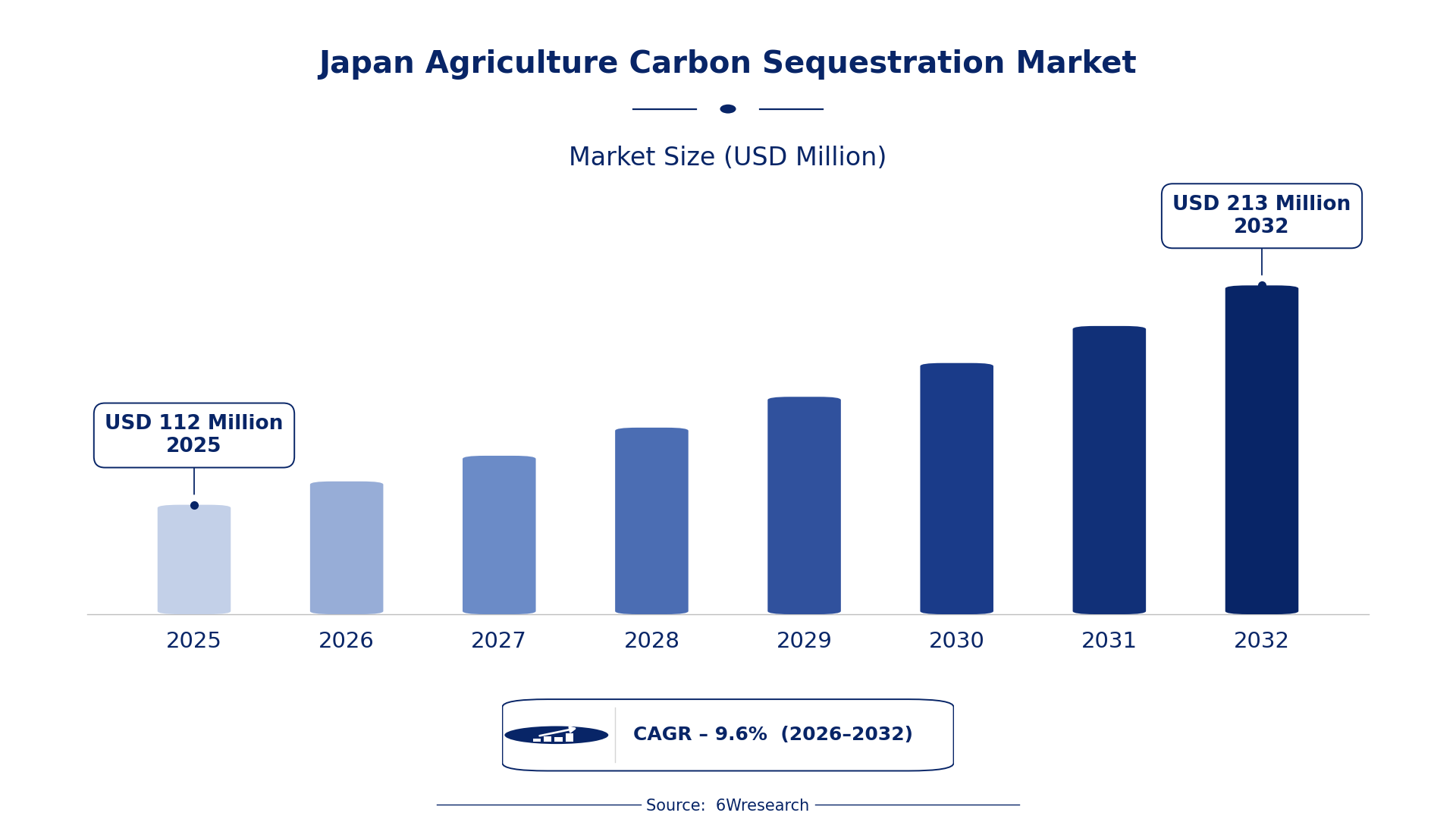
According to 6Wresearch internal database and industry insights, the Japan Agriculture Carbon Sequestration Market was valued at USD 112 Million in 2025 and is projected to reach USD 213 Million by 2032, growing at a CAGR of approximately 9.6% during 2026–2032.
Japan Agriculture Carbon Sequestration Market Highlights
| Report Metric | Details |
| Report Name | Japan Agriculture Carbon Sequestration Market (2026-2032) |
| Market Size 2025 | USD 112 Million |
| Market Size 2032 | USD 213 Million |
| Absolute Growth 2025–2032 | USD 101 Million |
| CAGR 2026–2032 | 9.6% |
| Peak Annual Growth | 10.6% in 2029 |
| Forecast Period | 2026–2032 |
| Historical Data | 2022–2025 |
| Base Year | 2025 |
| Leading Method Type, 2025 | Soil Carbon Capture (46% share) |
| Leading Technology, 2025 | Regenerative Farming (51% share) |
| Leading Application Area, 2025 | Farmland (39% share) |
| Leading Distribution Channel, 2025 | Agri Consultants (43% share) |
| Leading End User, 2025 | Farmers (38% share) |
| Fastest-Growing Method Type | Biochar Application (13.7% CAGR) |
| Fastest-Growing Technology | Biomass Processing (14.0% CAGR) |
| Fastest-Growing Application Area | Crop Fields (11.4% CAGR) |
| Fastest-Growing Distribution Channel | Input Suppliers (12.7% CAGR) |
| Fastest-Growing End User | Agricultural Producers (12.3% CAGR) |
| Growing Sector | Crop Fields |
| Key End Users | Farmland, Crop Fields, Soil Health, Emission Tracking |
Japan Agriculture Carbon Sequestration Market Year-wise Growth Rate and Key Drivers (2022–2032)
This graph illustrates the annual growth rates of the market from 2022 to 2032, highlighting a steady upward trajectory and projected market expansion over the forecast period.
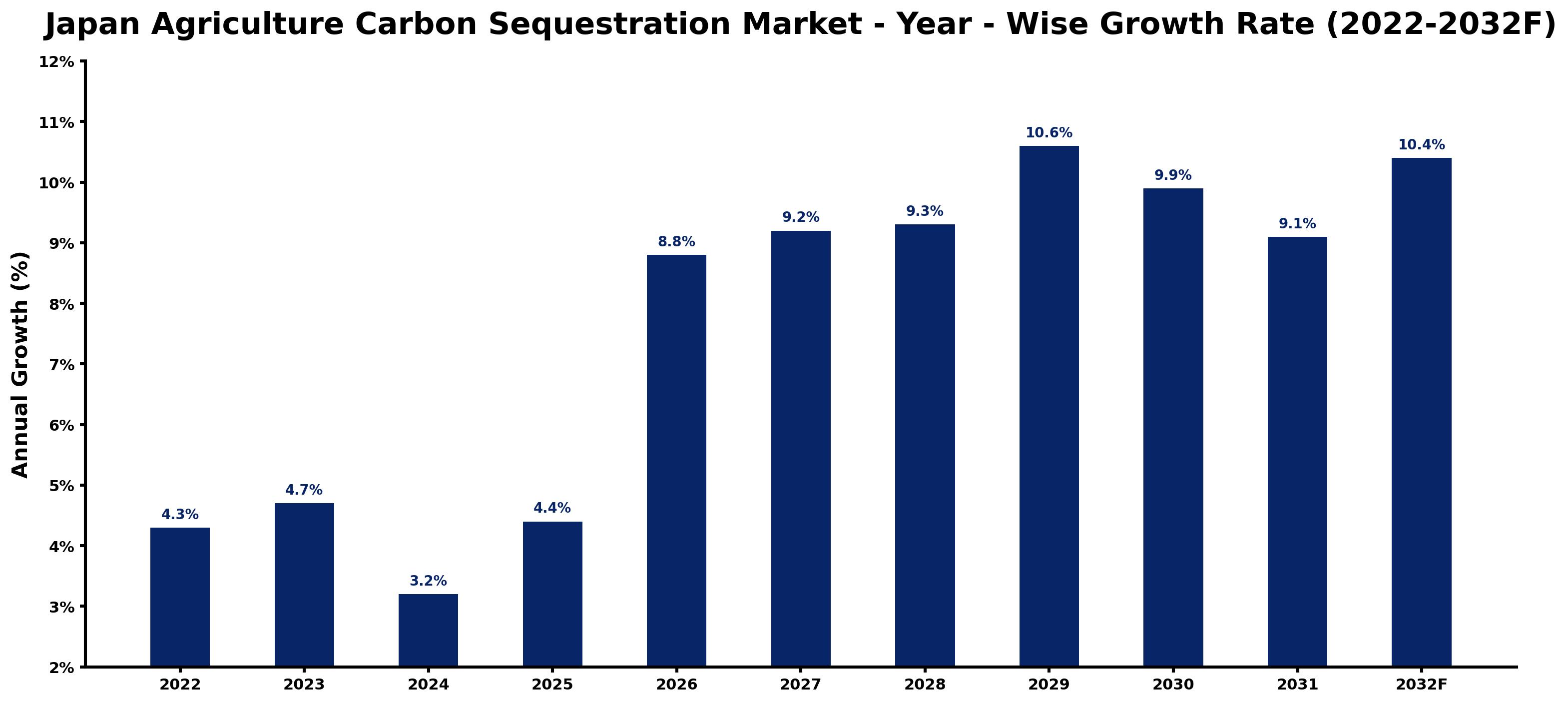
Year by year, the estimates below pair each growth rate with the development that shaped it.
| Year | Estimated Annual Growth (%) | Market Rationale |
| 2022 | 4.3 | The market showed steady growth as farmers adopted carbon sequestration practices. |
| 2023 | 4.7 | Increased awareness of sustainable agriculture led to faster adoption rates among farmers. |
| 2024 | 3.2 | A slowdown occurred as farmers faced challenges in implementing new practices. |
| 2025 | 4.4 | Growth accelerated again as more farmers engaged in carbon farming initiatives. |
| 2026 | 8.8 | Demand is projected to surge as investments in sustainable agriculture programs yield results. |
| 2027 | 9.2 | The market will continue to grow as regenerative practices gain popularity among farmers. |
| 2028 | 9.3 | Further growth is anticipated to be driven by advancements in carbon monitoring technologies. |
| 2029 | 10.6 | The peak growth year will see widespread adoption of biochar application methods. |
| 2030 | 9.9 | A slowdown in growth will be observed as the market begins to stabilise. |
| 2031 | 9.1 | Growth is expected to continue slowing as the market matures and competition increases. |
| 2032 | 10.4 | Demand will increase again as new technologies and practices emerge. |
Note: Market size estimations and growth projections presented in this report are based on 6Wresearch's proprietary forecasting methodology, utilizing the latest available industry data, government publications, and primary research inputs.
Japan Agriculture Carbon Sequestration Market Synopsis
Agriculture carbon sequestration involves capturing and storing carbon in agricultural soils through methods like cover cropping and biochar application. This practice improves soil health and reduces greenhouse gas emissions while boosting agricultural productivity. The Japan Agriculture Carbon Sequestration Market is expanding due to rising demand from domestic farmers and agribusinesses focused on sustainability. Government initiatives, such as promoting carbon farming, and the increasing adoption of regenerative practices are driving this growth. In 2022, Japan reported a 10% increase in cover cropping practices, reflecting the growing commitment to sustainable agriculture.
Market Dynamics Impact Analysis (2026–2032)
| Factor | Type | Impact | Primary Segment Affected |
| Increasing adoption of regenerative practices among farmers | Driver | High | Regenerative Farming |
| Government support for carbon farming initiatives | Driver | High | Soil Carbon Capture |
| Growing demand for sustainable agricultural practices | Opportunity | High | Biochar Application |
| Expansion of carbon monitoring technologies in agriculture | Opportunity | Medium | Carbon Monitoring |
| Limited awareness among some farmers about carbon sequestration benefits | Restraint | Medium | Cover Cropping |
| High initial costs associated with implementing carbon sequestration practices | Restraint | High | Biochar Application |
| Inconsistent availability of technical expertise for farmers | Challenge | Medium | Agri Consultants |
| Competition from alternative sustainable practices | Challenge | High | Sustainable Practices |
Evaluation of Drivers in Japan Agriculture Carbon Sequestration Market (2026–2032)
The main growth drivers and the segments they affect most are set out below.
| Drivers | Primary Segment Affected | Why It Matters (Evidence) |
| Increased investment in sustainable agriculture programs | Soil Carbon Capture | The government allocated ¥5 billion for sustainable agriculture programs, encouraging farmers to adopt carbon sequestration practices. |
| Growing number of farmers engaged in regenerative practices | Regenerative Farming | Approximately 200,000 farmers are now implementing regenerative practices, leading to higher demand for carbon sequestration methods. |
| Rising awareness of greenhouse gas emissions reduction | Biochar Application | Biochar application is recognised under government initiatives, prompting farmers to invest in its application. |
| Integration of carbon monitoring technologies into farms | Carbon Monitoring | By 2025, carbon monitoring technologies are projected to be integrated into 30% of farms, increasing demand for related services. |
| Support from agricultural cooperatives for sustainable practices | Cover Cropping | Agricultural cooperatives promote sustainable farming practices, boosting adoption rates among farmers. |
Orders keep climbing as the number of farmers engaged in regenerative practices rises, creating demand for effective carbon sequestration methods. Agricultural cooperatives promote sustainable practices, enhancing the overall market for agriculture carbon sequestration. Approximately 200,000 farmers are now implementing regenerative practices, further solidifying the demand for these methods.
Evaluation of Restraints in Japan Agriculture Carbon Sequestration Market
The main factors holding the market back are set out below.
| Market Restraint | Primary Segment Affected | Why It Matters (Evidence) |
| Limited awareness among farmers about carbon sequestration benefits | Cover Cropping | Many farmers remain unaware of the benefits of cover cropping for carbon sequestration, limiting its adoption. |
| High initial costs associated with implementing carbon sequestration practices | Biochar Application | Farmers face high upfront costs when adopting biochar application methods, with expenses reaching up to ¥50,000 per hectare. |
| Inconsistent availability of technical expertise for farmers | Agri Consultants | A lack of sufficient agri consultants restricts farmers' access to guidance on carbon practices, affecting implementation rates. |
| Regulatory complexities in adopting new practices | Sustainable Practices | Farmers encounter regulatory hurdles that complicate the implementation of sustainable practices, leading to delays in adoption. |
| Competition from alternative sustainable practices | Regenerative Farming | Farmers may choose other sustainable practices over carbon sequestration methods, affecting market growth. |
Japan Agriculture Carbon Sequestration Market Challenges
Producers struggle with outdated carbon monitoring technologies, which limits their ability to accurately measure carbon sequestration and delays compliance with government initiatives. Distributors face challenges with inconsistent supply chains for biochar, causing project implementation delays that can extend timelines for sustainable farming practices by several months. Complex guidelines under ISO 14064 create regulatory hurdles, resulting in confusion and increased costs for producers striving to meet sustainability standards. Buyers are impacted by rising costs linked to sustainable practices, as the government’s ¥5 billion allocation for agriculture programs may not sufficiently alleviate the financial pressures of adopting new methods.
Trends in the Japan Agriculture Carbon Sequestration Market
The trends below show where the Japan Agriculture Carbon Sequestration Market is heading.
- Increase in Biochar Adoption: In 2023, biochar application gained traction among farmers, with a reported 10% increase in its adoption. This shift reflects a growing recognition of its benefits for soil health and carbon sequestration, particularly in regions like Hokkaido.
- Shift Towards Digital Carbon Monitoring: By 2025, the integration of carbon monitoring technologies into 30% of farms will transform data management in agriculture. This change will improve farmers' ability to track carbon levels effectively, especially in urban agriculture initiatives in Tokyo.
- Growth of Regenerative Farming Practices: Since 2022, regenerative farming practices have seen increased adoption, with farmers focusing on sustainable methods. This trend aligns with Japan's agricultural emissions target aiming for a 26% reduction by 2030, particularly in the Tohoku region.
- Expansion of Government Support Programs: The government allocated ¥5 billion for sustainable agriculture programs in 2023, reflecting a commitment to promoting carbon sequestration. This funding is expected to boost farmer participation in carbon farming initiatives across various prefectures.
Investment Opportunities in the Japan Agriculture Carbon Sequestration Market
The opportunities below stand out in the Japan Agriculture Carbon Sequestration Market for new entrants and existing suppliers.
- Farmers Seeking Carbon Sequestration Solutions: Farmers are increasingly looking for effective carbon sequestration solutions. Partnering with agri consultants can facilitate access to necessary expertise and resources for implementation, especially in rural areas where support is crucial.
- Entry into the Biochar Market: With biochar application gaining recognition, there is an opportunity to supply biochar products to farmers. Collaborating with agricultural cooperatives can ease market entry, particularly in regions with high agricultural activity.
- Investment in Carbon Monitoring Technologies: The anticipated growth of carbon monitoring technologies presents an opportunity for suppliers. Engaging with farmers directly can help in providing tailored solutions to meet their needs, particularly in urban agriculture settings.
- Support for Sustainable Practices: As the government promotes sustainable agriculture, there is a chance to invest in educational programs for farmers. Establishing partnerships with local agricultural bodies can facilitate this effort, enhancing knowledge and implementation.
Government Initiatives in the Japan Agriculture Carbon Sequestration Market
The Ministry of Agriculture, Forestry and Fisheries has recently promoted carbon farming initiatives, building on previous laws such as the Japanese Agricultural Standards (JAS) that set guidelines for sustainable practices. This new focus provides clearer pathways for farmers to adopt carbon sequestration methods and improve soil health, contributing to Japan's agricultural emissions reduction target of 26% by 2030.
In 2023, the government allocated ¥5 billion for sustainable agriculture programs, administered by the Ministry of Agriculture, Forestry and Fisheries. This funding aims to support farmers in implementing carbon sequestration practices, thereby contributing to Japan's agricultural emissions reduction target of 26% by 2030.
Future Insight of the Japan Agriculture Carbon Sequestration Market
Investment in carbon monitoring technologies will surge, driving demand among 200,000 farmers engaged in regenerative practices. The integration of digital platforms for carbon tracking will streamline processes, enhancing operational efficiency for buyers and suppliers. Urban agriculture initiatives supported by local governments will expand, creating new opportunities for sustainable farming. As Japan aims for a 26% reduction in agricultural emissions by 2030, the push for compliance will accelerate the adoption of advanced agricultural techniques across the sector.
Market Segmentation Analysis
Japan Agriculture Carbon Sequestration Market report covers a detailed analysis of the following market segments:
By Method Type – Soil Carbon Capture Leads, Biochar Application Expected to Grow Fastest
According to Vasu Joshi, Associate Consultant at 6Wresearch, Soil Carbon Capture took 46% of method type revenue in 2025, more than any other category. Soil carbon capture holds the largest share due to its essential role in enhancing soil carbon levels, which is vital for improving soil fertility. The Ministry of Agriculture, Forestry and Fisheries actively promotes carbon farming initiatives that focus on this method, ensuring widespread adoption among farmers. Over 2026–2032, Biochar Application is expected to post the fastest growth, at a CAGR of 13.7%. The biochar application segment is experiencing rapid growth as it is increasingly recognised under the Japanese Greenhouse Gas Reduction Program, which incentivises its use. This method is gaining traction among farmers looking to improve soil quality and sequester carbon effectively, indicating a shift towards more sustainable practices. Suppliers should focus on developing products that support soil carbon capture to meet the growing demand.
By Technology – Regenerative Farming Leads, Biomass Processing Expected to Grow Fastest
Regenerative Farming held 51% of the Japan Agriculture Carbon Sequestration Market by technology in 2025. Regenerative farming leads the technology segment as it promotes practices that enhance carbon sequestration, making it a preferred choice among farmers. The involvement of approximately 200,000 farmers in regenerative practices illustrates its widespread acceptance and implementation, solidifying its market position. Biomass Processing is set to record the highest CAGR in this split, 14.0% over 2026–2032. Biomass processing is witnessing the fastest growth due to its related benefits in carbon capture, appealing to farmers seeking alternative methods. As more farmers adopt regenerative practices, the demand for biomass processing technologies is expected to rise, further expanding this segment. Buyers may benefit from investing in biomass processing technologies to complement their regenerative farming efforts.
By Application Area – Farmland Leads, Crop Fields Expected to Grow Fastest
Farmland accounted for 39% of the market by application area in 2025. Farmland is the primary area for implementing carbon sequestration, accounting for a substantial portion of Japan's 4.5 million hectares of agricultural land. This focus on farmland aligns with national strategies for sustainable agriculture and carbon management. The quickest growth will come from Crop Fields, forecast to expand at a CAGR of 11.4% between 2026 and 2032. Crop fields are experiencing the fastest growth as they become key targets for carbon management practices, particularly with the increasing adoption of cover cropping. The emphasis on improving crop yields while managing carbon levels is driving this trend. Suppliers should tailor their offerings to address the specific needs of crop fields to capitalise on this growth opportunity.
By Distribution Channel – Agri Consultants Lead, Input Suppliers Expected to Grow Fastest
In 2025, Agri Consultants led the distribution channel split with a 43% share. Agri consultants dominate the distribution channel as they provide essential expertise in implementing carbon practices, influencing a significant portion of the agricultural sector. Their role in advising around 50% of farmers showcases their impact on the adoption of carbon sequestration methods, reinforcing their market leadership. Input Suppliers are projected to grow fastest, at a CAGR of 12.7% during 2026–2032. Input suppliers are rapidly growing as they supply the necessary materials for carbon sequestration, responding to the increasing demand for sustainable agricultural inputs. Their role is becoming more critical as farmers seek reliable sources for effective carbon management, indicating a robust growth trajectory. Suppliers should strengthen partnerships with input suppliers to enhance their market reach and support carbon sequestration initiatives.
By End User – Farmers Lead, Agricultural Producers Expected to Grow Fastest
With 38% of end user revenue in 2025, Farmers was the largest category. Farmers represent the largest end user group for carbon sequestration methods, directly engaging in practices that improve soil health and productivity. Their active participation is crucial for achieving Japan's agricultural emissions targets, highlighting their importance in the market. Over 2026–2032, Agricultural Producers are expected to post the fastest growth, at a CAGR of 12.3%. Agricultural producers are the fastest-growing end user segment as they increasingly adopt practices that support carbon capture, driven by the need for sustainable production methods. This shift is expected to continue as producers seek to align with national sustainability goals, indicating a strong future demand. Suppliers must focus on developing solutions tailored to the specific needs of agricultural producers to capture this emerging market.
Key Attractiveness of the Report
- 10 Years of Market Numbers
- Historical Data Starting from 2022 to 2025
- Base Year 2025
- Forecast Data until 2032
- Key Performance Indicators Impacting the Market
- Major Upcoming Developments and Projects
Key Highlights of the Report:
- Japan Agriculture Carbon Sequestration Market Outlook
- Market Size of Japan Agriculture Carbon Sequestration Market, 2025
- Forecast of Japan Agriculture Carbon Sequestration Market, 2032
- Historical Data and Forecast of Japan Agriculture Carbon Sequestration Market Revenues & Volume for the Period 2022-2032F
- Japan Agriculture Carbon Sequestration Market Trend Evolution
- Japan Agriculture Carbon Sequestration Market Drivers and Challenges
- Japan Agriculture Carbon Sequestration Market Price Trends
- Japan Agriculture Carbon Sequestration Market Porter's Five Forces
- Japan Agriculture Carbon Sequestration Market Industry Life Cycle
- Historical Data and Forecast of Japan Agriculture Carbon Sequestration Market Revenues & Volume By Method Type for the Period 2022-2032F
- Historical Data and Forecast of Japan Agriculture Carbon Sequestration Market Revenues & Volume By Soil Carbon Capture for the Period 2022-2032F
- Historical Data and Forecast of Japan Agriculture Carbon Sequestration Market Revenues & Volume By Biochar Application for the Period 2022-2032F
- Historical Data and Forecast of Japan Agriculture Carbon Sequestration Market Revenues & Volume By Cover Cropping for the Period 2022-2032F
- Historical Data and Forecast of Japan Agriculture Carbon Sequestration Market Revenues & Volume By Carbon Monitoring for the Period 2022-2032F
- Historical Data and Forecast of Japan Agriculture Carbon Sequestration Market Revenues & Volume By Technology for the Period 2022-2032F
- Historical Data and Forecast of Japan Agriculture Carbon Sequestration Market Revenues & Volume By Regenerative Farming for the Period 2022-2032F
- Historical Data and Forecast of Japan Agriculture Carbon Sequestration Market Revenues & Volume By Biomass Processing for the Period 2022-2032F
- Historical Data and Forecast of Japan Agriculture Carbon Sequestration Market Revenues & Volume By Sustainable Practices for the Period 2022-2032F
- Historical Data and Forecast of Japan Agriculture Carbon Sequestration Market Revenues & Volume By Digital Platforms for the Period 2022-2032F
- Historical Data and Forecast of Japan Agriculture Carbon Sequestration Market Revenues & Volume By Application Area for the Period 2022-2032F
- Historical Data and Forecast of Japan Agriculture Carbon Sequestration Market Revenues & Volume By Farmland for the Period 2022-2032F
- Historical Data and Forecast of Japan Agriculture Carbon Sequestration Market Revenues & Volume By Crop Fields for the Period 2022-2032F
- Historical Data and Forecast of Japan Agriculture Carbon Sequestration Market Revenues & Volume By Soil Health for the Period 2022-2032F
- Historical Data and Forecast of Japan Agriculture Carbon Sequestration Market Revenues & Volume By Emission Tracking for the Period 2022-2032F
- Historical Data and Forecast of Japan Agriculture Carbon Sequestration Market Revenues & Volume By Distribution Channel for the Period 2022-2032F
- Historical Data and Forecast of Japan Agriculture Carbon Sequestration Market Revenues & Volume By Agri Consultants for the Period 2022-2032F
- Historical Data and Forecast of Japan Agriculture Carbon Sequestration Market Revenues & Volume By Input Suppliers for the Period 2022-2032F
- Historical Data and Forecast of Japan Agriculture Carbon Sequestration Market Revenues & Volume By Extension Services for the Period 2022-2032F
- Historical Data and Forecast of Japan Agriculture Carbon Sequestration Market Revenues & Volume By Software Providers for the Period 2022-2032F
- Historical Data and Forecast of Japan Agriculture Carbon Sequestration Market Revenues & Volume By End User for the Period 2022-2032F
- Historical Data and Forecast of Japan Agriculture Carbon Sequestration Market Revenues & Volume By Farmers for the Period 2022-2032F
- Historical Data and Forecast of Japan Agriculture Carbon Sequestration Market Revenues & Volume By Agricultural Producers for the Period 2022-2032F
- Historical Data and Forecast of Japan Agriculture Carbon Sequestration Market Revenues & Volume By Growers for the Period 2022-2032F
- Historical Data and Forecast of Japan Agriculture Carbon Sequestration Market Revenues & Volume By Agribusinesses for the Period 2022-2032F
- Japan Agriculture Carbon Sequestration Market Import Export Trade Statistics
- Market Opportunity Assessment By Method Type
- Market Opportunity Assessment By Technology
- Market Opportunity Assessment By Application Area
- Market Opportunity Assessment By Distribution Channel
- Market Opportunity Assessment By End User
- Japan Agriculture Carbon Sequestration Market Top Companies Market Share
- Japan Agriculture Carbon Sequestration Market Competitive Benchmarking By Technical and Operational Parameters
- Japan Agriculture Carbon Sequestration Market Company Profiles
- Japan Agriculture Carbon Sequestration Market Key Strategic Recommendations
Market Covered
The following segment groups are covered in the report.
By Method Type
- Soil Carbon Capture
- Biochar Application
- Cover Cropping
- Carbon Monitoring
By Technology
- Regenerative Farming
- Biomass Processing
- Sustainable Practices
- Digital Platforms
By Application Area
- Farmland
- Crop Fields
- Soil Health
- Emission Tracking
By Distribution Channel
- Agri Consultants
- Input Suppliers
- Extension Services
- Software Providers
By End User
- Farmers
- Agricultural Producers
- Growers
- Agribusinesses






































