Japan Agriculture Termite Control Market Size & Growth Rate
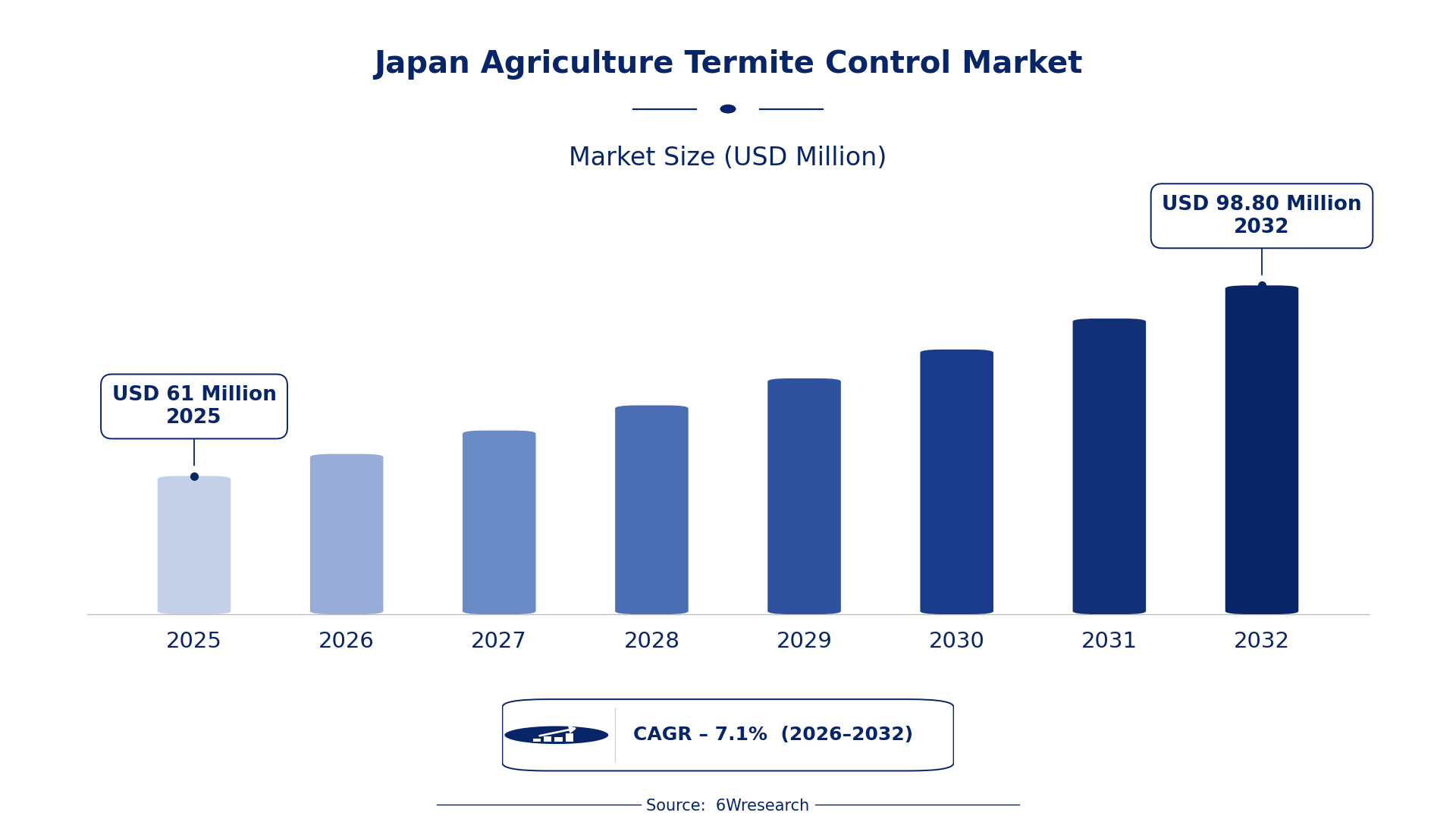
According to 6Wresearch internal database and industry insights, the Japan Agriculture Termite Control Market was valued at USD 61 Million in 2025 and is projected to reach USD 98.80 Million by 2032, growing at a CAGR of approximately 7.1% during 2026–2032.
Japan Agriculture Termite Control Market Highlights
| Report Metric | Details |
| Report Name | Japan Agriculture Termite Control Market (2026-2032) |
| Market Size 2025 | USD 61 Million |
| Market Size 2032 | USD 98.80 Million |
| Absolute Growth 2025–2032 | USD 37.80 Million |
| CAGR 2026–2032 | 7.1% |
| Peak Annual Growth | 7.8% in 2027 |
| Forecast Period | 2026–2032 |
| Historical Data | 2022–2025 |
| Base Year | 2025 |
| Leading Product / Solution, 2025 | Termiticides (44% share) |
| Leading Functionality, 2025 | Pest Suppression (38% share) |
| Leading Application Area, 2025 | Crop Protection (37% share) |
| Leading Distribution Channel, 2025 | Direct Sales (44% share) |
| Leading End User, 2025 | Farmers (42% share) |
| Fastest-Growing Product / Solution | Biological Control Agents (9.9% CAGR) |
| Fastest-Growing Functionality | Infestation Management (9.0% CAGR) |
| Fastest-Growing Application Area | Agricultural Storage (8.3% CAGR) |
| Fastest-Growing Distribution Channel | Service Providers (9.2% CAGR) |
| Fastest-Growing End User | Agricultural Cooperatives (8.9% CAGR) |
| Growing Sector | Agriculture |
| Key End Users | Farmers, Agricultural Cooperatives, Grain Storage Operators, Large Farms |
Japan Agriculture Termite Control Market Year-wise Growth Rate and Key Drivers (2022–2032)
This graph illustrates the annual growth rates of the market from 2022 to 2032, highlighting a steady upward trajectory and projected market expansion over the forecast period.
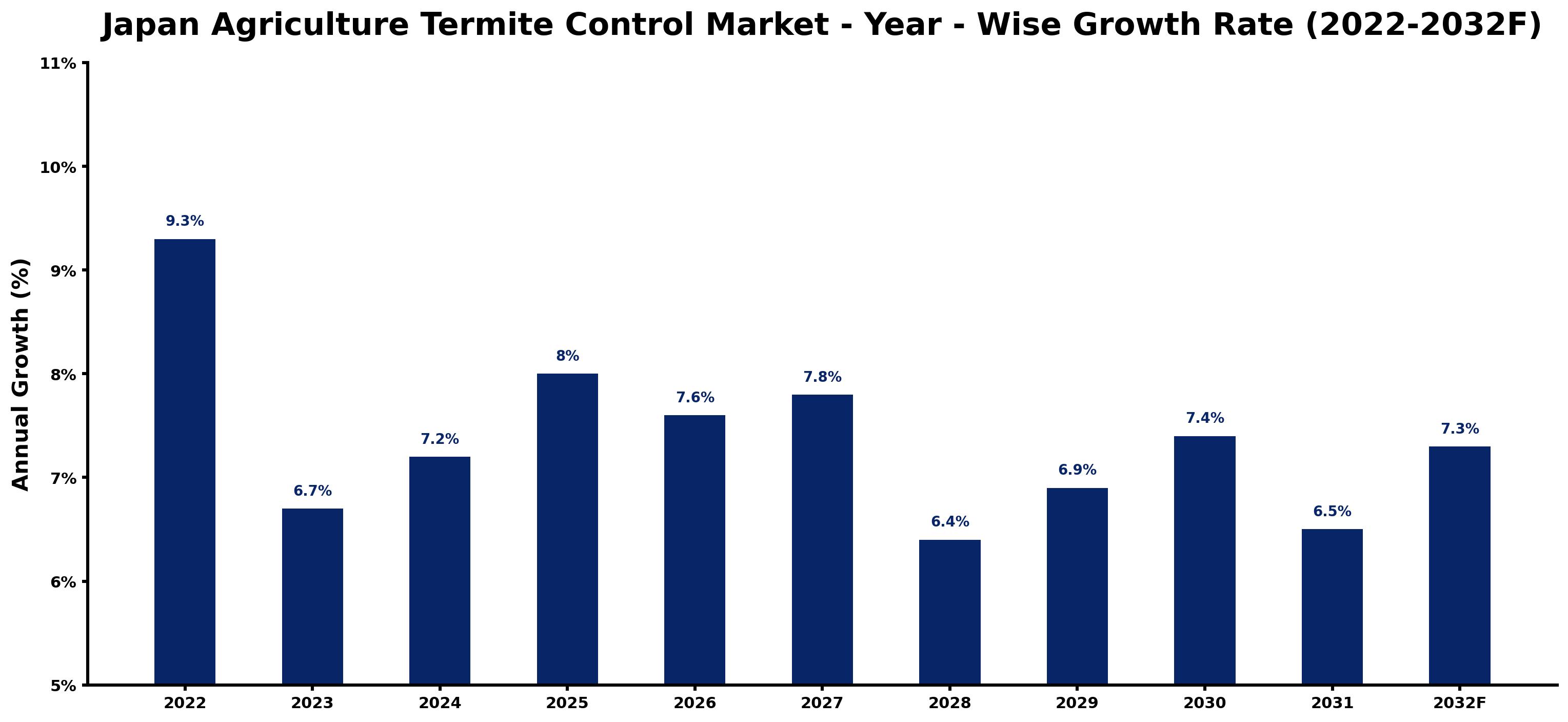
The table below sets out the estimated growth rate for each year and the main factor behind it.
| Year | Estimated Annual Growth (%) | Market Rationale |
| 2022 | 9.3 | The market experienced strong demand due to heightened awareness of pest management. |
| 2023 | 6.7 | Growth slowed as farmers adjusted to new pest control techniques and products. |
| 2024 | 7.2 | Increased adoption of biological control agents spurred faster growth in pest management. |
| 2025 | 8.0 | Demand rose as agricultural cooperatives expanded their pest control offerings. |
| 2026 | 7.6 | Growth is expected to slow as market saturation begins to impact new product uptake. |
| 2027 | 7.8 | Demand is expected to surge due to rising pest issues and effective pest control campaigns. |
| 2028 | 6.4 | Growth is projected to slow as the market stabilises after rapid expansions in previous years. |
| 2029 | 6.9 | Increased investments in pest monitoring technologies will boost market growth. |
| 2030 | 7.4 | Demand is expected to rise as farmers seek to improve crop yields through effective pest management. |
| 2031 | 6.5 | Growth is projected to slow as the market matures and competition intensifies among suppliers. |
| 2032 | 7.3 | Demand is expected to rise as sustainable pest management practices gain traction. |
Note: Market size estimations and growth projections presented in this report are based on 6Wresearch's proprietary forecasting methodology, utilizing the latest available industry data, government publications, and primary research inputs.
Japan Agriculture Termite Control Market Synopsis
Agriculture termite control involves using chemical and biological agents to manage termite populations that threaten crops and agricultural infrastructure. The Japan Agriculture Termite Control Market is growing, driven by the extensive agricultural area of over 4 million hectares and the average rice yield of approximately 5 tons per hectare. Factors such as the ageing farmer population and the involvement of agricultural cooperatives in pest control distribution are further stimulating market expansion.
Market Dynamics Impact Analysis (2026–2032)
| Factor | Type | Impact | Primary Segment Affected |
| Rising pest issues due to climate change | Driver | High | Termiticides |
| Growing adoption of biological control agents in organic farming | Driver | High | Biological Control Agents |
| Increasing demand for sustainable pest management solutions | Opportunity | High | Fumigation Services |
| Expansion of agricultural cooperatives enhancing product distribution | Opportunity | Medium | Direct Sales |
| High costs associated with advanced pest control technologies | Restraint | High | Monitoring Devices |
| Limited awareness of eco-friendly pest control methods among farmers | Restraint | Medium | Soil Treatment |
| Rising operational costs impacting farmers' pest control budgets | Challenge | High | Pest Suppression |
| Capacity constraints in pest control service providers | Challenge | Medium | Fumigation Services |
Evaluation of Drivers in Japan Agriculture Termite Control Market (2026–2032)
The main growth drivers and the segments they affect most are set out below.
| Drivers | Primary Segment Affected | Why It Matters (Evidence) |
| Increased pest infestations | Termiticides | The average yield of rice in Japan is around 5 tons per hectare, necessitating effective pest control to protect crops. |
| Growing adoption of biological agents in organic farming | Biological Control Agents | The use of biological control agents has increased by 15% among organic farmers in Japan, reflecting a shift towards sustainable practices. |
| Demand for effective crop protection measures | Crop Protection | Pest suppression measures are vital for maintaining the quality of Japan's agricultural exports, which contribute significantly to the economy. |
| Investment in pest monitoring technologies | Monitoring Devices | Monitoring devices are employed in over 30% of large farms for pest management, improving detection and response times. |
| Support from agricultural cooperatives | Direct Sales | The Japan Agricultural Cooperatives Association aids farmers in pest control education, enhancing their purchasing decisions. |
What keeps demand rising is the increasing pest infestations affecting agricultural yields, with the average rice yield in Japan being around 5 tons per hectare. The growing adoption of biological control agents reflects a shift towards sustainable practices, particularly in organic farming, with a 15% increase in usage. Investment in pest monitoring technologies has become essential, with over 30% of large farms employing these devices to improve pest management. Agricultural cooperatives support distribution, ensuring farmers have access to necessary pest control solutions. Effective crop protection measures are vital for maintaining the quality of agricultural exports, driving further demand for pest control products.
Evaluation of Restraints in Japan Agriculture Termite Control Market
Several factors work against faster growth; the main ones are summarised below.
| Market Restraint | Primary Segment Affected | Why It Matters (Evidence) |
| High costs of advanced pest control technologies | Monitoring Devices | The average farmer's budget is strained by the high costs associated with advanced pest control technologies, which can exceed JPY 1,000,000 annually. |
| Limited awareness of eco-friendly pest control methods | Soil Treatment | Many farmers lack knowledge about the benefits of eco-friendly pest control methods, hindering adoption, with less than 20% currently using these solutions. |
| Operational costs impacting pest control budgets | Pest Suppression | Rising operational costs are forcing farmers to cut back on pest control expenditures, impacting their overall productivity. |
| Capacity constraints in service providers | Fumigation Services | Service providers face capacity challenges, limiting their ability to meet increasing demand, particularly in urban areas like Tokyo. |
| Regulatory compliance costs for pest control products | Termiticides | Compliance with regulations increases costs for producers, affecting pricing and availability, with costs rising by approximately 15%. |
Japan Agriculture Termite Control Market Challenges
A shortage of skilled pest management professionals hampers effective termite control, delaying treatment for agricultural operators. Rising costs of termiticides, driven by production expenses and regulatory compliance, can increase expenses by up to 20% for farmers. Limited access to timely pest control solutions poses a risk for agricultural cooperatives, potentially resulting in crop losses; with an average rice yield of around 5 tons per hectare, this can severely affect revenue. Stringent regulations from the Ministry of Agriculture, Forestry and Fisheries can extend the approval process for new pest control products, obstructing their market entry.
Trends in the Japan Agriculture Termite Control Market
Below are the shifts with the largest effect on the Japan Agriculture Termite Control Market.
- Shift towards Biological Control Agents: In 2023, the adoption of biological control agents surged among organic farmers, with a 15% increase in usage. This shift reflects a growing preference for sustainable pest management solutions in Japan, particularly in regions with high agricultural activity.
- Rise of Advanced Monitoring Technologies: The Kansai region is experiencing a rise in the use of advanced pest monitoring technologies, with over 30% of large farms implementing these systems to improve pest management and reduce infestations.
- Increased Focus on Sustainable Practices: The 2023 national initiative to promote sustainable pest management practices is driving farmers to adopt eco-friendly solutions, aligning with global trends in agriculture and improving pest control effectiveness.
- Growth in Agricultural Cooperatives' Role: Agricultural cooperatives are increasingly central to pest control distribution, with their collective purchasing power improving access to effective solutions for farmers, boosting overall agricultural productivity.
Investment Opportunities in the Japan Agriculture Termite Control Market
Below are the investment opportunities with the strongest case in the Japan Agriculture Termite Control Market.
- Investment in Eco-friendly Pest Control Solutions: With the government allocating funds for eco-friendly pest control methods, there is a growing opportunity for suppliers to invest in sustainable products, particularly in regions with high agricultural activity, such as Kansai.
- Expansion of Fumigation Services: The rising pest issues in urban agriculture create an opportunity for fumigation service providers to expand their offerings, especially in metropolitan areas like Tokyo, where demand is increasing.
- Development of Advanced Monitoring Devices: The increasing demand for pest monitoring technologies presents an opportunity for suppliers to develop effective devices, targeting large farms that require efficient pest management solutions, with a market potential exceeding USD 10 million.
- Collaboration with Agricultural Cooperatives: Now is an ideal time for businesses to collaborate with agricultural cooperatives, utilising their distribution networks to reach farmers effectively and improve product accessibility, particularly in rural areas.
Government Initiatives in the Japan Agriculture Termite Control Market
In 2023, Japan launched a national initiative to promote sustainable pest management practices, building on existing regulations such as the Water Supply Act and Sewerage Act. This initiative adds emphasis on eco-friendly solutions, encouraging producers to adopt sustainable practices in pest control. The government allocated JPY 1 billion for research on eco-friendly pest control methods, aiming to improve pest management efficiency across the agricultural sector.
The Ministry of Agriculture, Forestry and Fisheries oversees pest control regulations and funds research on eco-friendly pest control methods. This agency plays a critical role in approving pest control products and ensuring compliance with national standards, which directly impacts the availability of effective solutions for farmers. In 2023, the ministry approved 15 new pest control products, enhancing options for agricultural operators.
Future Insight of the Japan Agriculture Termite Control Market
The rollout of advanced pest monitoring systems in grain storage facilities will reshape agricultural practices by 2032, allowing for more effective infestation management. Increased government funding for research on eco-friendly pest control methods will provide suppliers and farmers with sustainable options. The implementation of JIS A 1901 standards will raise quality benchmarks for termiticides, benefiting suppliers and boosting buyer confidence. Enhanced training programmes for agricultural cooperatives will refine pest management approaches, improving outcomes for farmers.
Market Segmentation Analysis
Japan Agriculture Termite Control Market report covers a detailed analysis of the following market segments:
By Product / Solution – Termiticides Lead, Biological Control Agents Expected to Grow Fastest
According to Prakhar Dixit, Senior Research Analyst at 6Wresearch, Termiticides held 44% of the Japan Agriculture Termite Control Market by product / solution in 2025. Termiticides hold the largest share as they are essential for effective pest control in agriculture, particularly for farmers who rely on them to protect their crops. The adherence to JIS A 1901 standards ensures that these products meet stringent quality requirements, reinforcing their dominance in the market. Biological Control Agents are projected to grow fastest, at a CAGR of 9.9% during 2026–2032. The growth of biological control agents is propelled by the rising adoption of eco-friendly practices among organic farmers, reflecting a shift towards sustainable methods. Government funding allocated in 2023 for research on sustainable pest control methods further accelerates this trend, indicating a strong future for this segment. Suppliers should prioritise the development of eco-friendly products to align with the rising demand for sustainable pest management solutions.
By Functionality – Pest Suppression Leads, Infestation Management Expected to Grow Fastest
In 2025, Pest Suppression led the functionality split with a 38% share. Pest suppression is the leading functionality as it is essential for maintaining crop health and ensuring high agricultural yields. This importance is underscored by the average yield of rice in Japan, which is around 5 tons per hectare, necessitating effective pest control measures. Over 2026–2032, Infestation Management is expected to post the fastest growth, at a CAGR of 9.0%. Infestation management is experiencing rapid growth due to the rising need for controlling termite populations in agricultural settings. The increasing pest issues have led to a 15% rise in the use of fumigation services over the past three years, highlighting the urgency of this functionality. Buyers must prioritise effective infestation management strategies to safeguard their crops against pest threats.
By Application Area – Crop Protection Leads, Agricultural Storage Expected to Grow Fastest
Crop Protection accounted for 37% of the market by application area in 2025. Crop protection is the leading application area as it is vital for safeguarding agricultural produce from pest threats, which is critical for maintaining yield quality. With over 4 million hectares of farmland in Japan, effective pest control measures are essential to protect these valuable resources. Agricultural Storage is set to record the highest CAGR in this split, 8.3% over 2026–2032. Agricultural storage is witnessing the fastest growth due to an urgent need to protect stored grains from pest infestations, which can lead to significant losses. The investment in advanced pest monitoring systems within grain storage facilities highlights the increasing focus on preserving agricultural products. Suppliers should focus on enhancing their agricultural storage solutions to meet the increasing need for effective pest management.
By Distribution Channel – Direct Sales Leads, Service Providers Expected to Grow Fastest
Direct Sales took 44% of distribution channel revenue in 2025, more than any other category. Direct sales are the primary distribution channel, allowing pest control products to be delivered directly to farmers who require tailored solutions for their specific needs. This method ensures that farmers receive the necessary support and guidance for effective pest management. The quickest growth will come from Service Providers, forecast to expand at a CAGR of 9.2% between 2026 and 2032. Service providers are the fastest-growing distribution channel, as they offer specialised pest control services that cater to the unique requirements of farmers. The complexity of pest issues has led to a greater reliance on these expert services, driving their rapid growth. Suppliers should explore partnerships with service providers to enhance their market reach and service offerings.
By End User – Farmers Lead, Agricultural Cooperatives Expected to Grow Fastest
With 42% of end user revenue in 2025, Farmers was the largest category. Farmers represent the largest user group of termite control products, as they depend on effective pest management for their agricultural operations. The agricultural sector employs approximately 3.5 million people in Japan, underscoring the critical role of farmers in this market. Agricultural Cooperatives are projected to grow fastest, at a CAGR of 8.9% during 2026–2032. Agricultural cooperatives are the fastest-growing end user segment, leveraging their collective purchasing power to secure pest control solutions for their members. Their increasing involvement in supporting farmers through education and resource sharing is becoming more significant in the market. Suppliers should engage with agricultural cooperatives to leverage their collective purchasing power and expand their market presence.
Key Attractiveness of the Report
- 10 Years of Market Numbers
- Historical Data Starting from 2022 to 2025
- Base Year 2025
- Forecast Data until 2032
- Key Performance Indicators Impacting the Market
- Major Upcoming Developments and Projects
Key Highlights of the Report:
- Japan Agriculture Termite Control Market Outlook
- Market Size of Japan Agriculture Termite Control Market, 2025
- Forecast of Japan Agriculture Termite Control Market, 2032
- Historical Data and Forecast of Japan Agriculture Termite Control Market Revenues & Volume for the Period 2022-2032F
- Japan Agriculture Termite Control Market Trend Evolution
- Japan Agriculture Termite Control Market Drivers and Challenges
- Japan Agriculture Termite Control Market Price Trends
- Japan Agriculture Termite Control Market Porter's Five Forces
- Japan Agriculture Termite Control Market Industry Life Cycle
- Historical Data and Forecast of Japan Agriculture Termite Control Market Revenues & Volume By Product / Solution for the Period 2022-2032F
- Historical Data and Forecast of Japan Agriculture Termite Control Market Revenues & Volume By Termiticides for the Period 2022-2032F
- Historical Data and Forecast of Japan Agriculture Termite Control Market Revenues & Volume By Biological Control Agents for the Period 2022-2032F
- Historical Data and Forecast of Japan Agriculture Termite Control Market Revenues & Volume By Fumigation Services for the Period 2022-2032F
- Historical Data and Forecast of Japan Agriculture Termite Control Market Revenues & Volume By Monitoring Devices for the Period 2022-2032F
- Historical Data and Forecast of Japan Agriculture Termite Control Market Revenues & Volume By Functionality for the Period 2022-2032F
- Historical Data and Forecast of Japan Agriculture Termite Control Market Revenues & Volume By Soil Treatment for the Period 2022-2032F
- Historical Data and Forecast of Japan Agriculture Termite Control Market Revenues & Volume By Pest Suppression for the Period 2022-2032F
- Historical Data and Forecast of Japan Agriculture Termite Control Market Revenues & Volume By Infestation Management for the Period 2022-2032F
- Historical Data and Forecast of Japan Agriculture Termite Control Market Revenues & Volume By Early Detection for the Period 2022-2032F
- Historical Data and Forecast of Japan Agriculture Termite Control Market Revenues & Volume By Application Area for the Period 2022-2032F
- Historical Data and Forecast of Japan Agriculture Termite Control Market Revenues & Volume By Crop Protection for the Period 2022-2032F
- Historical Data and Forecast of Japan Agriculture Termite Control Market Revenues & Volume By Plantations for the Period 2022-2032F
- Historical Data and Forecast of Japan Agriculture Termite Control Market Revenues & Volume By Agricultural Storage for the Period 2022-2032F
- Historical Data and Forecast of Japan Agriculture Termite Control Market Revenues & Volume By Farm Land for the Period 2022-2032F
- Historical Data and Forecast of Japan Agriculture Termite Control Market Revenues & Volume By Distribution Channel for the Period 2022-2032F
- Historical Data and Forecast of Japan Agriculture Termite Control Market Revenues & Volume By Direct Sales for the Period 2022-2032F
- Historical Data and Forecast of Japan Agriculture Termite Control Market Revenues & Volume By Distributors for the Period 2022-2032F
- Historical Data and Forecast of Japan Agriculture Termite Control Market Revenues & Volume By Service Providers for the Period 2022-2032F
- Historical Data and Forecast of Japan Agriculture Termite Control Market Revenues & Volume By Online Platforms for the Period 2022-2032F
- Historical Data and Forecast of Japan Agriculture Termite Control Market Revenues & Volume By End User for the Period 2022-2032F
- Historical Data and Forecast of Japan Agriculture Termite Control Market Revenues & Volume By Farmers for the Period 2022-2032F
- Historical Data and Forecast of Japan Agriculture Termite Control Market Revenues & Volume By Large Farms for the Period 2022-2032F
- Historical Data and Forecast of Japan Agriculture Termite Control Market Revenues & Volume By Grain Storage Operators for the Period 2022-2032F
- Historical Data and Forecast of Japan Agriculture Termite Control Market Revenues & Volume By Agricultural Cooperatives for the Period 2022-2032F
- Japan Agriculture Termite Control Market Import Export Trade Statistics
- Market Opportunity Assessment By Product / Solution
- Market Opportunity Assessment By Functionality
- Market Opportunity Assessment By Application Area
- Market Opportunity Assessment By Distribution Channel
- Market Opportunity Assessment By End User
- Japan Agriculture Termite Control Market Top Companies Market Share
- Japan Agriculture Termite Control Market Competitive Benchmarking By Technical and Operational Parameters
- Japan Agriculture Termite Control Market Company Profiles
- Japan Agriculture Termite Control Market Key Strategic Recommendations
Market Covered
Segments analysed in this report are listed below.
By Product / Solution
- Termiticides
- Biological Control Agents
- Fumigation Services
- Monitoring Devices
By Functionality
- Soil Treatment
- Pest Suppression
- Infestation Management
- Early Detection
By Application Area
- Crop Protection
- Plantations
- Agricultural Storage
- Farm Land
By Distribution Channel
- Direct Sales
- Distributors
- Service Providers
- Online Platforms
By End User
- Farmers
- Large Farms
- Grain Storage Operators
- Agricultural Cooperatives






































