Japan AI In Computer Vision Market Size & Growth Rate
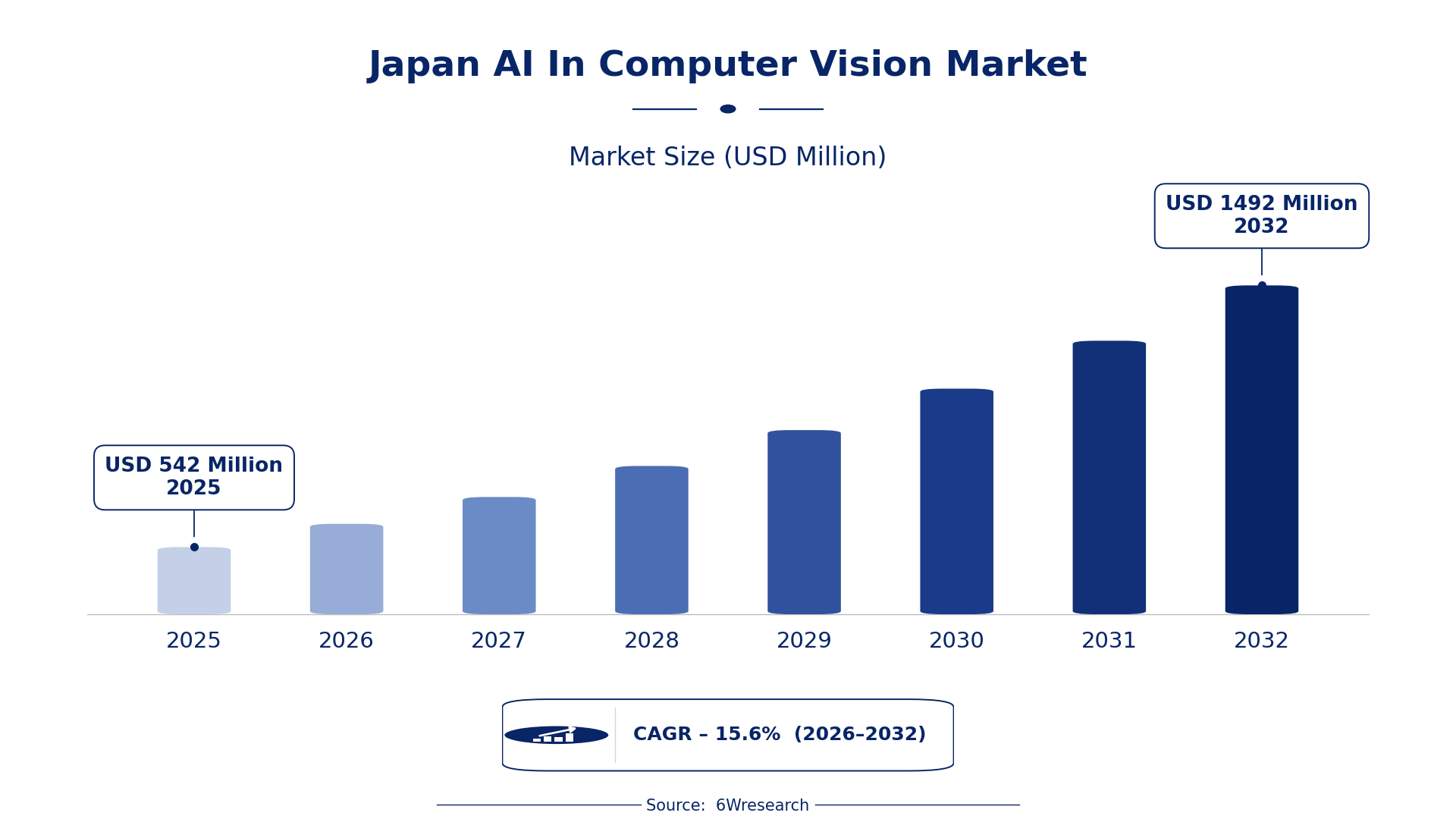
According to 6Wresearch internal database and industry insights, the Japan AI In Computer Vision Market was valued at USD 542 Million in 2025 and is projected to reach USD 1,492 Million by 2032, growing at a CAGR of approximately 15.6% during 2026–2032.
Japan AI In Computer Vision Market Highlights
| Report Metric | Details |
| Report Name | Japan AI In Computer Vision Market (2026-2032) |
| Market Size 2025 | USD 542 Million |
| Market Size 2032 | USD 1,492 Million |
| Absolute Growth 2025–2032 | USD 950 Million |
| CAGR 2026–2032 | 15.6% |
| Peak Annual Growth | 19.1% in 2026 |
| Forecast Period | 2026–2032 |
| Historical Data | 2022–2025 |
| Base Year | 2025 |
| Leading Component, 2025 | Software (56% share) |
| Leading Function, 2025 | Inference (58% share) |
| Leading Application, 2025 | Industrial (64% share) |
| Leading End Use, 2025 | Healthcare (27% share) |
| Fastest-Growing Function | Training (18.9% CAGR) |
| Fastest-Growing Application | Non-industrial (19.6% CAGR) |
| Fastest-Growing End Use | Automotive (20.9% CAGR) |
| Growing Sector | Non-industrial |
| Key End Users | Industrial, Non-industrial |
Japan AI In Computer Vision Market Year-wise Growth Rate and Key Drivers (2022–2032)
This graph illustrates the annual growth rates of the market from 2022 to 2032, highlighting a steady upward trajectory and projected market expansion over the forecast period.
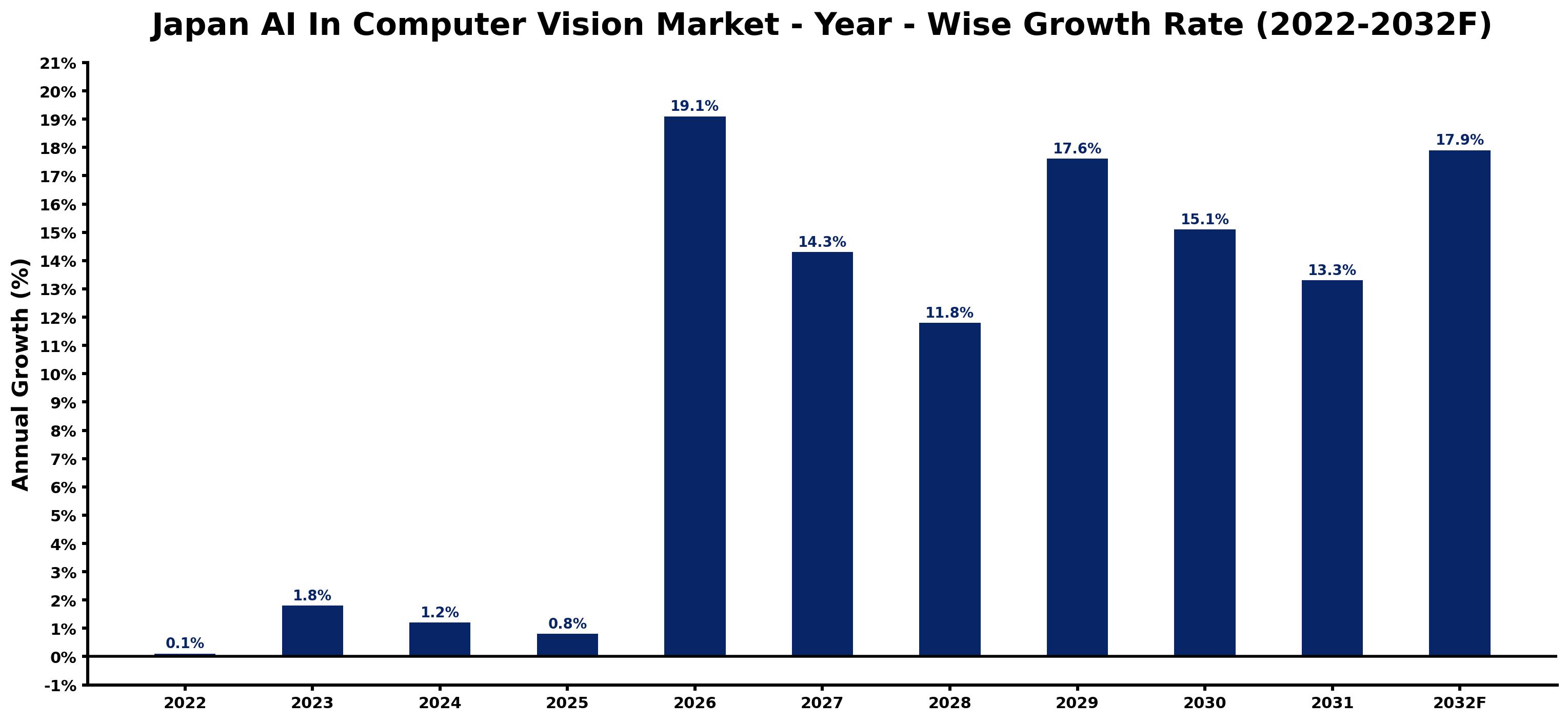
The yearly estimates that follow link every growth rate to its principal driver, so readers can see why the pace changed in each period.
| Year | Estimated Annual Growth (%) | Market Rationale |
| 2022 | 0.1 | The market showed minimal growth due to limited adoption of AI technologies. |
| 2023 | 1.8 | Growth accelerated as healthcare applications began to integrate AI solutions more widely. |
| 2024 | 1.2 | Growth slowed as the market adjusted to initial implementations and user feedback. |
| 2025 | 0.8 | A further slowdown occurred as companies reassessed their AI strategies and investments. |
| 2026 | 19.1 | Demand surged as investments in AI technologies unlocked new applications. |
| 2027 | 14.3 | Growth slowed as the market matured and competition intensified among providers. |
| 2028 | 11.8 | The market continued to grow, driven by ongoing technological advancements and user adoption. |
| 2029 | 17.6 | A faster growth rate emerged as automotive applications began to dominate AI usage. |
| 2030 | 15.1 | Growth slowed as the market stabilised, with established players consolidating their positions. |
| 2031 | 13.3 | The market experienced a slowdown as saturation in certain sectors began to occur. |
| 2032 | 17.9 | Demand rose again as new applications in healthcare and automotive expanded. |
Note: Market size estimations and growth projections presented in this report are based on 6Wresearch's proprietary forecasting methodology, utilizing the latest available industry data, government publications, and primary research inputs.
Japan AI In Computer Vision Market Synopsis
AI in Computer Vision enables machines to interpret visual information using algorithms and deep learning techniques. In Japan, this technology is actively applied in sectors such as healthcare and automotive, with over 5 million vehicles produced annually. The Japan AI In Computer Vision Market is expanding due to rising investments in automation technologies, particularly in manufacturing, and government initiatives that improve productivity across industries.
Market Dynamics Impact Analysis (2026–2032)
| Factor | Type | Impact | Primary Segment Affected |
| Growing investment in AI technologies in manufacturing and healthcare sectors | Driver | High | Industrial |
| Increased demand for real-time decision-making in healthcare diagnostics | Driver | High | Healthcare |
| Expansion of AI applications in automotive sector | Opportunity | High | Automotive |
| Rising integration of AI in consumer electronics | Opportunity | Medium | Consumer Electronics |
| High initial costs of AI implementation in small businesses | Restraint | High | Industrial |
| Limited availability of skilled professionals in AI technologies | Restraint | Medium | Healthcare |
| Compliance with evolving AI regulations and standards | Challenge | High | Healthcare |
| Capacity constraints in scaling AI solutions across industries | Challenge | Medium | Industrial |
Evaluation of Drivers in Japan AI In Computer Vision Market (2026–2032)
Key forces behind demand, with the segment each one moves most, are listed below.
| Drivers | Primary Segment Affected | Why It Matters (Evidence) |
| Investments in automation technologies | Industrial | Japan's manufacturing sector invests heavily, with a projected increase in automation spending by 2025. |
| Growing healthcare applications for diagnostics | Healthcare | With over 1,000 hospitals using AI technologies, demand for diagnostic imaging is projected to rise by 30% by 2025. |
| Advancements in automotive technologies | Automotive | The automotive sector is a major user, producing over 5 million vehicles annually, driving demand for AI in advanced driver-assistance systems. |
| Rising consumer electronics integration | Consumer Electronics | The Consumer Electronics Association of Japan reported a 25% increase in AI-integrated devices in 2023. |
| Government initiatives supporting AI research | Healthcare | The Japanese government allocated funds for AI research in healthcare applications, promoting innovation and adoption. |
Demand is primarily driven by investments in automation technologies, with Japan's manufacturing sector expected to significantly increase its spending. The adoption of AI technologies in healthcare is expanding, as hospitals seek to improve diagnostic imaging capabilities. The automotive sector's production of over 5 million vehicles annually fuels the need for advanced driver-assistance systems. The integration of AI in consumer electronics is rising, marked by a notable increase in reported AI-integrated devices.
Evaluation of Restraints in Japan AI In Computer Vision Market
The table below lists the restraints and the evidence behind each.
| Market Restraint | Primary Segment Affected | Why It Matters (Evidence) |
| Supply shortages due to high demand | Healthcare | High demand from buyers in healthcare leads to supply shortages, causing delays for hospitals in acquiring AI diagnostic tools. |
| Rising costs of AI technology development | Industrial | Increasing costs burden suppliers, forcing them to raise prices, impacting buyers' budgets for AI solutions. |
| Limited integration of advanced technologies | Automotive | The integration of advanced technologies in existing systems hampers efficiency, affecting operational productivity. |
| Competition among providers | Consumer Electronics | Intensified competition limits market share for new entrants, affecting their ability to gain traction. |
| Regulatory compliance challenges | Healthcare | Strict regulations can slow down the deployment of AI technologies, delaying benefits to healthcare providers. |
Japan AI In Computer Vision Market Challenges
Rapid technological advancements create supply shortages, as local suppliers struggle to keep pace with rising demand from buyers in healthcare and manufacturing. This results in delays for hospitals, which may face longer wait times for AI diagnostic tools, potentially impacting patient outcomes. Increasing development costs burden suppliers, forcing them to raise prices, which compels buyers to allocate larger budgets for AI solutions. Limited integration of AI technologies into existing systems reduces operational efficiency, causing clinics to miss opportunities for improved patient care and productivity gains.
Trends in the Japan AI In Computer Vision Market
The shifts below are changing how Japan AI In Computer Vision Market products are bought and supplied.
- Shift in Healthcare Diagnostics: Healthcare providers are increasingly adopting AI technologies for diagnostics, with over 1,000 hospitals utilizing these systems. This shift is set to improve patient care and operational efficiency.
- Rise of AI in Automotive Applications: The automotive sector is witnessing a surge in AI integration, particularly in advanced driver-assistance systems, driven by the production of over 5 million vehicles annually.
- Increased AI Integration in Consumer Electronics: Consumer electronics are increasingly incorporating AI features, with a reported 25% rise in AI-integrated devices in 2023, improving user experience and functionality.
- Government Support for AI Research: Government initiatives are bolstering AI research, with funding allocated for healthcare applications, driving innovation and adoption in the sector.
Investment Opportunities in the Japan AI In Computer Vision Market
Investors looking at the Japan AI In Computer Vision Market should consider the following areas.
- Growing Demand for AI in Healthcare: With the healthcare sector projected to adopt AI in 30% of diagnostic imaging by 2025, there is a strong opportunity for technology providers to meet this demand.
- Investment in Automotive AI Technologies: The automotive sector's production of over 5 million vehicles annually presents opportunities for suppliers of AI technologies, particularly in advanced driver-assistance systems.
- Expansion of AI in Manufacturing: Japan's manufacturing sector is investing heavily in automation technologies, creating opportunities for suppliers of AI solutions to improve productivity.
- Consumer Electronics Market Expansion: The rise in AI-integrated devices indicates a growing market for suppliers, particularly in smart devices, as consumer demand continues to increase.
Government Initiatives in the Japan AI In Computer Vision Market
The Semiconductor and Digital Industry Strategy, launched by METI in June 2021, aims to secure domestic semiconductor manufacturing, thereby improving the capabilities of AI technologies in Japan. This measure builds on previous efforts to strengthen the technology sector and boost competitiveness.
In 2023, the Japanese government allocated substantial funds for AI research in healthcare applications, administered by the Ministry of Internal Affairs and Communications, supporting innovation and adoption in the sector.
Future Insight of the Japan AI In Computer Vision Market
A policy-driven shift will transform AI applications in Japan by 2032, focusing on greater integration across various sectors. Government initiatives will drive AI adoption in healthcare, with projections indicating that 30% of diagnostic imaging will incorporate AI technologies. The Tokyo metropolitan area will remain a hub for AI research, fostering collaboration among academic institutions and industry. Increased funding for AI research will enhance capabilities in multiple sectors, creating new opportunities for suppliers and improving service delivery for buyers.
Market Segmentation Analysis
Japan AI In Computer Vision Market report covers a detailed analysis of the following market segments:
By Component – Software Leads and Records the Fastest Growth
According to Sachin Kumar Rai, Senior Research Analyst at 6Wresearch, Software held 56% of the Japan AI In Computer Vision Market by component in 2025. Software holds the largest share as it is essential for executing algorithms necessary for various applications. The integration of software solutions in over 1,000 hospitals enhances patient care through effective data processing and management. Software is also forecast to expand faster than any other category, at a CAGR of 17.7% over 2026–2032. The software segment is also the fastest-growing, as continuous advancements in algorithms necessitate increasingly sophisticated software tools. This growth is particularly evident in the manufacturing sector, where automation relies heavily on robust software capabilities. Suppliers should prioritise software development to meet the rising demand across diverse sectors.
By Function – Inference Leads, Training Expected to Grow Fastest
The largest function category in 2025 was Inference, at 58% of revenue. Inference leads in share because it is crucial for real-time decision-making in sectors such as security and healthcare. The demand for immediate insights from visual data, especially in metropolitan areas like Tokyo, drives its widespread adoption. Training is set to record the highest CAGR in this split, 18.9% over 2026–2032. Training is growing rapidly as it is vital for developing models that enhance inference capabilities. The increase in research initiatives, particularly those supported by national institutions, significantly contributes to this growth. Buyers must focus on training capabilities to fully leverage the latest advancements in technology.
By Application – Industrial Leads, Non-industrial Expected to Grow Fastest
In 2025, Industrial led the application split with a 64% share. Industrial applications dominate the market as they are extensively utilised in manufacturing automation, a key area for Japan's economy. The Smart Manufacturing Strategy launched by the government underscores the importance of technology in boosting productivity within this sector. The quickest growth will come from Non-industrial, forecast to expand at a CAGR of 19.6% between 2026 and 2032. Non-industrial applications are experiencing the fastest growth due to rising consumer demand for integrated devices. Reports indicate a notable increase in the adoption of technology in everyday products, reflecting changing consumer preferences. Suppliers should consider expanding into non-industrial applications to capitalise on emerging consumer trends.
By End Use – Healthcare Leads, Automotive Expected to Grow Fastest
With 27% of end use revenue in 2025, Healthcare was the largest category. Healthcare is the leading end-use segment due to its critical reliance on AI for medical imaging and diagnostics, with projections indicating AI adoption in 30% of diagnostic imaging by 2025. The substantial investment in healthcare AI by the government further supports this dominance. Automotive is projected to grow fastest, at a CAGR of 20.9% during 2026–2032. The automotive sector is the fastest-growing end-use segment, driven by the need for advanced driver-assistance systems in over 5 million vehicles produced annually. Government initiatives to improve logistics efficiency also contribute to this growth. Suppliers must align their strategies to cater to the expanding needs of the automotive sector while maintaining strong offerings in healthcare.
Key Attractiveness of the Report
- 10 Years of Market Numbers
- Historical Data Starting from 2022 to 2025
- Base Year 2025
- Forecast Data until 2032
- Key Performance Indicators Impacting the Market
- Major Upcoming Developments and Projects
Key Highlights of the Report:
- Japan AI In Computer Vision Market Outlook
- Market Size of Japan AI In Computer Vision Market, 2025
- Forecast of Japan AI In Computer Vision Market, 2032
- Historical Data and Forecast of Japan AI In Computer Vision Revenues & Volume for the Period 2022-2032
- Japan AI In Computer Vision Market Trend Evolution
- Japan AI In Computer Vision Market Drivers and Challenges
- Japan AI In Computer Vision Price Trends
- Japan AI In Computer Vision Porter's Five Forces
- Japan AI In Computer Vision Industry Life Cycle
- Historical Data and Forecast of Japan AI In Computer Vision Market Revenues & Volume By Component for the Period 2022-2032
- Historical Data and Forecast of Japan AI In Computer Vision Market Revenues & Volume By Hardware for the Period 2022-2032
- Historical Data and Forecast of Japan AI In Computer Vision Market Revenues & Volume By Software for the Period 2022-2032
- Historical Data and Forecast of Japan AI In Computer Vision Market Revenues & Volume By Function for the Period 2022-2032
- Historical Data and Forecast of Japan AI In Computer Vision Market Revenues & Volume By Training for the Period 2022-2032
- Historical Data and Forecast of Japan AI In Computer Vision Market Revenues & Volume By Inference for the Period 2022-2032
- Historical Data and Forecast of Japan AI In Computer Vision Market Revenues & Volume By Application for the Period 2022-2032
- Historical Data and Forecast of Japan AI In Computer Vision Market Revenues & Volume By Industrial for the Period 2022-2032
- Historical Data and Forecast of Japan AI In Computer Vision Market Revenues & Volume By Non-industrial for the Period 2022-2032
- Historical Data and Forecast of Japan AI In Computer Vision Market Revenues & Volume By End Use for the Period 2022-2032
- Historical Data and Forecast of Japan AI In Computer Vision Market Revenues & Volume By Automotive for the Period 2022-2032
- Historical Data and Forecast of Japan AI In Computer Vision Market Revenues & Volume By Consumer Electronics for the Period 2022-2032
- Historical Data and Forecast of Japan AI In Computer Vision Market Revenues & Volume By Healthcare for the Period 2022-2032
- Historical Data and Forecast of Japan AI In Computer Vision Market Revenues & Volume By Retail for the Period 2022-2032
- Historical Data and Forecast of Japan AI In Computer Vision Market Revenues & Volume By Security & Surveillance for the Period 2022-2032
- Historical Data and Forecast of Japan AI In Computer Vision Market Revenues & Volume By Manufacturing for the Period 2022-2032
- Historical Data and Forecast of Japan AI In Computer Vision Market Revenues & Volume By Agriculture for the Period 2022-2032
- Historical Data and Forecast of Japan AI In Computer Vision Market Revenues & Volume By Transportation & Logistics for the Period 2022-2032
- Japan AI In Computer Vision Import Export Trade Statistics
- Market Opportunity Assessment By Component
- Market Opportunity Assessment By Function
- Market Opportunity Assessment By Application
- Market Opportunity Assessment By End Use
- Japan AI In Computer Vision Top Companies Market Share
- Japan AI In Computer Vision Competitive Benchmarking By Technical and Operational Parameters
- Japan AI In Computer Vision Company Profiles
- Japan AI In Computer Vision Key Strategic Recommendations
Market Covered
Coverage by segment is as follows.
By Component
- Hardware
- Software
By Function
- Training
- Inference
By Application
- Industrial
- Non-industrial
By End Use
- Automotive
- Consumer Electronics
- Healthcare
- Retail
- Security & Surveillance
- Manufacturing
- Agriculture
- Transportation & Logistics






































