Japan Air Filter Media Market Size & Growth Rate
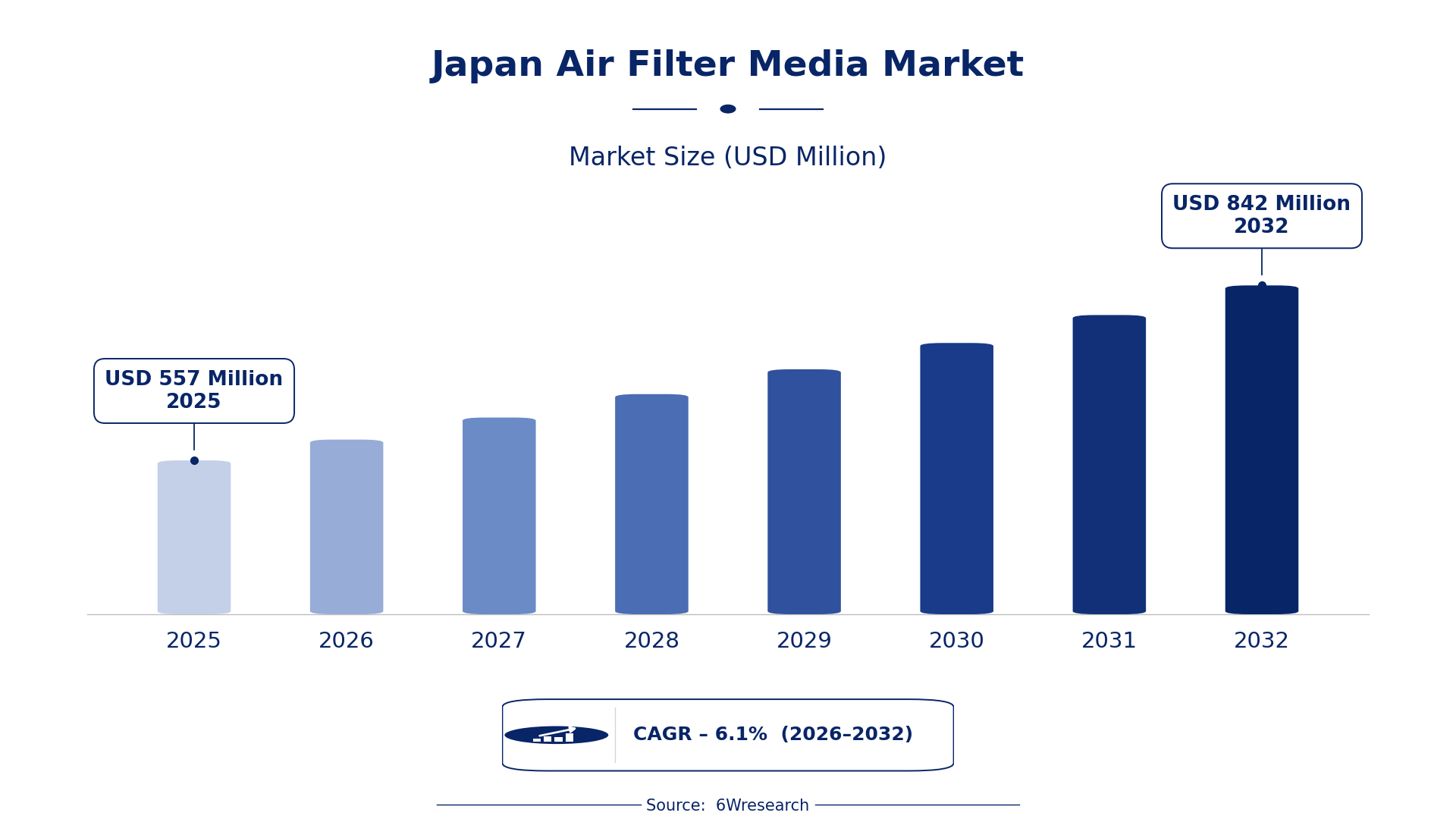
According to 6Wresearch internal database and industry insights, the Japan Air Filter Media Market was valued at USD 557 Million in 2025 and is projected to reach USD 842 Million by 2032, growing at a CAGR of approximately 6.1% during 2026–2032.
Japan Air Filter Media Market Highlights
| Report Metric | Details |
| Report Name | Japan Air Filter Media Market (2026-2032) |
| Market Size 2025 | USD 557 Million |
| Market Size 2032 | USD 842 Million |
| Absolute Growth 2025–2032 | USD 285 Million |
| CAGR 2026–2032 | 6.1% |
| Peak Annual Growth | 8.2% in 2032 |
| Forecast Period | 2026–2032 |
| Historical Data | 2022–2025 |
| Base Year | 2025 |
| Leading Type, 2025 | Nonwoven Fabrics (54% share) |
| Leading End Use Industry, 2025 | Food & Beverage (45% share) |
| Fastest-Growing Type | Fiberglass (8.8% CAGR) |
| Fastest-Growing End Use Industry | Chemical (9.3% CAGR) |
| Growing Sector | Chemical |
| Key End Users | Food & Beverage, Pharmaceutical, Chemical, Power Generation |
Japan Air Filter Media Market Year-wise Growth Rate and Key Drivers (2022–2032)
This graph illustrates the annual growth rates of the market from 2022 to 2032, highlighting a steady upward trajectory and projected market expansion over the forecast period.
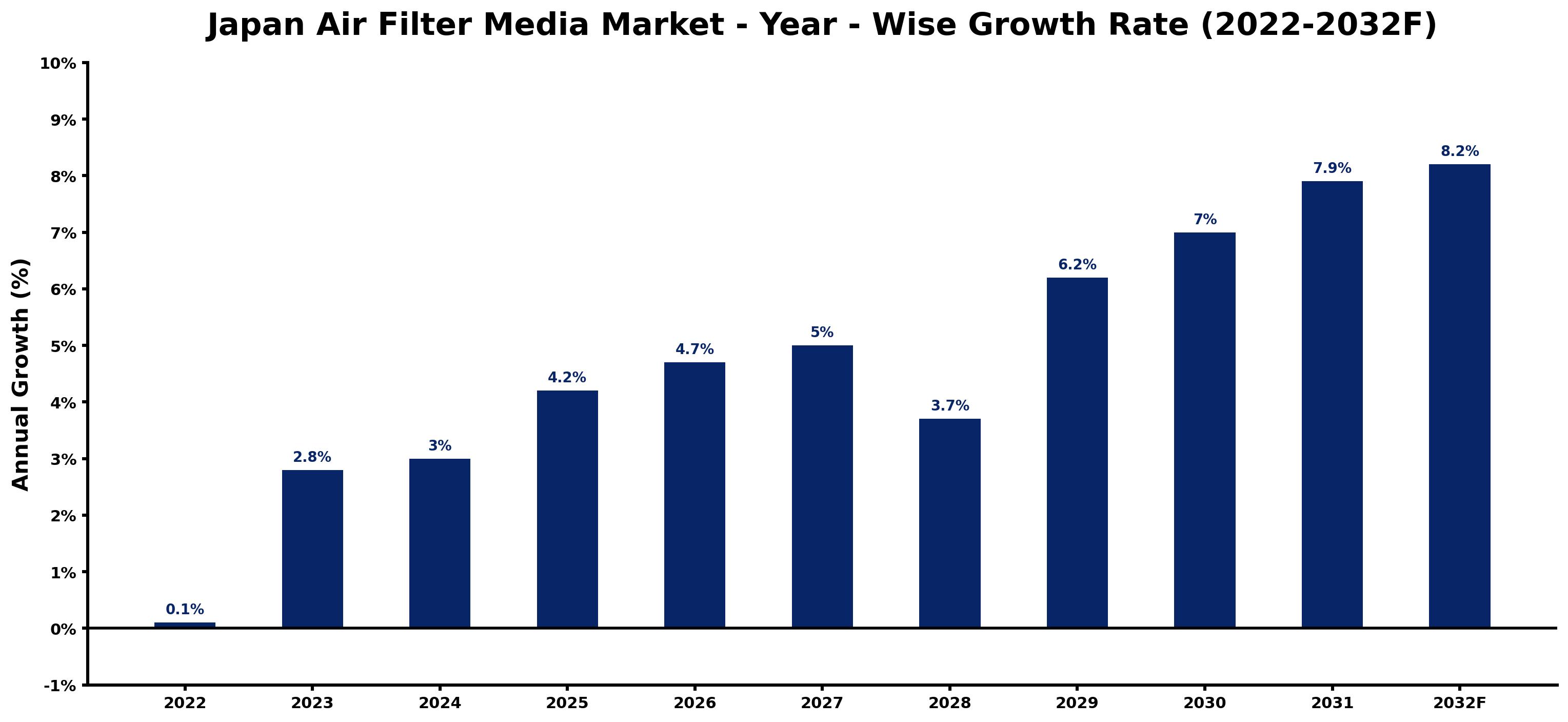
For each year, the table pairs the estimated growth rate with the leading influence on demand, showing how the drivers changed across the period.
| Year | Estimated Annual Growth (%) | Market Rationale |
| 2022 | 0.1 | Demand for air filter media was stable, reflecting ongoing industrial activity in Japan. |
| 2023 | 2.8 | Growth accelerated as the Tokyo metropolitan area increased its industrial output and air quality concerns rose. |
| 2024 | 3.0 | Continued investment in air filtration technologies supported further growth in the market. |
| 2025 | 4.2 | The food and beverage industry's high standards for air quality drove demand for air filter media. |
| 2026 | 4.7 | Increased focus on energy efficiency in industrial applications is expected to spur demand for advanced filtration solutions. |
| 2027 | 5.0 | The pharmaceutical sector's stringent air quality requirements will contribute to rising demand for air filter media. |
| 2028 | 3.7 | Growth is projected to slow slightly as the market adjusts to previous high demand levels while still expanding. |
| 2029 | 6.2 | The chemical industry's focus on safety and compliance will lead to increased purchases of air filter media. |
| 2030 | 7.0 | Investment in power generation facilities aimed at reducing emissions will boost the demand for filter media. |
| 2031 | 7.9 | Growing awareness of air quality issues among consumers and industries is expected to drive further demand increases. |
| 2032 | 8.2 | The projected peak growth reflects the culmination of investments in energy-efficient air filtration technologies. |
Note: Market size estimations and growth projections presented in this report are based on 6Wresearch's proprietary forecasting methodology, utilizing the latest available industry data, government publications, and primary research inputs.
Japan Air Filter Media Market Synopsis
Air filter media captures airborne particles and contaminants, commonly made from nonwoven fabrics, fiberglass, or filter paper. The Japan Air Filter Media Market is propelled by the food and beverage industry, valued at over 20 trillion JPY, which requires high-quality air filtration. Industrial activities in the Tokyo metropolitan area and strict air quality requirements in the pharmaceutical sector further stimulate market growth. A recent government initiative promoting energy-efficient air filtration technologies supports this upward trend, underscoring the growing importance of air quality across various sectors.
Market Dynamics Impact Analysis (2026–2032)
| Factor | Type | Impact | Primary Segment Affected |
| Rising industrial output in the Tokyo metropolitan area | Driver | High | Nonwoven Fabrics |
| Stringent air quality regulations in the pharmaceutical sector | Driver | High | Fiberglass |
| Growing investments in energy-efficient technologies | Opportunity | High | Filter Paper |
| Increased demand for air quality solutions in food processing | Opportunity | High | Food & Beverage |
| High compliance costs for air quality standards | Restraint | Medium | Chemical |
| Limited awareness of advanced filtration technologies | Restraint | Medium | Pharmaceutical |
| Rising costs of raw materials for production | Challenge | High | Power Generation |
| Capacity constraints in manufacturing facilities | Challenge | High | Metal & Mining |
Evaluation of Drivers in Japan Air Filter Media Market (2026–2032)
Demand rests on the following drivers, each shown with the segment it touches most.
| Drivers | Primary Segment Affected | Why It Matters (Evidence) |
| Increased industrial activity in the Tokyo metropolitan area | Nonwoven Fabrics | This region's demand for effective air filtration solutions drives purchases of nonwoven fabrics, accounting for 54% of the market share. |
| Stringent air quality requirements in the pharmaceutical sector | Fiberglass | The need for maintaining sterile environments in pharmaceutical production boosts the demand for durable fiberglass filter media, which is critical for compliance with regulations. |
| Growing investments in energy-efficient technologies | Filter Paper | The push for energy efficiency in various sectors leads to increased adoption of filter paper in specific applications, improving overall filtration performance. |
| High standards in the food and beverage industry | Food & Beverage | The industry's valuation at over 20 trillion JPY necessitates reliable air filtration solutions to ensure product quality and safety. |
| Focus on safety and compliance in the chemical industry | Chemical | The chemical sector's emphasis on controlling airborne contaminants drives demand for high-performance air filter media, ensuring regulatory compliance. |
Most of the extra volume comes from the Tokyo metropolitan area, where industrial activity drives demand for effective air filtration solutions. Approximately 1.5 million air filters are installed in industrial applications, reflecting the need for improved air quality. The food and beverage industry, valued at over 20 trillion JPY, requires high-quality filtration to maintain product integrity. The chemical industry prioritises safety compliance, increasing demand for air filter media. Investments in energy-efficient technologies are expected to drive the adoption of advanced filtration solutions, particularly in the pharmaceutical sector, where strict air quality standards are critical.
Evaluation of Restraints in Japan Air Filter Media Market
The table below lists the restraints and the evidence behind each.
| Market Restraint | Primary Segment Affected | Why It Matters (Evidence) |
| High costs of upgrading air filtration systems | Pharmaceutical | Buyers in the pharmaceutical sector face significant expenses when upgrading outdated air filtration technology, risking non-compliance with air quality regulations. |
| Delays in project implementation due to workforce shortages | Food & Beverage | Delays in project implementation arise from skills shortages in the workforce, particularly affecting the food and beverage industry, where projects can be postponed by several months. |
| Rising raw material costs for nonwoven fabrics | Nonwoven Fabrics | Increasing raw material costs for nonwoven fabrics raise production expenses for suppliers, forcing them to pass on price increases to buyers. |
| Pressure from imported alternatives | Fiberglass | Local manufacturers face pressure from increased competition with imported alternatives, impacting their market share and pricing strategies. |
| Regulatory compliance costs | Chemical | The chemical industry incurs additional costs to ensure compliance with stringent air quality regulations, affecting overall profitability. |
Japan Air Filter Media Market Challenges
Producers in the food and beverage industry face challenges with outdated air filtration technology, leading to non-compliance with strict air quality regulations. This issue stems from the high costs associated with upgrading systems, potentially resulting in fines of up to 10 million JPY for facilities. Skills shortages in the workforce delay project implementations, particularly affecting the pharmaceutical sector, where projects can be postponed by several months. Rising raw material costs for nonwoven fabrics increase production expenses for suppliers, forcing them to raise prices by 15% for buyers, impacting their procurement budgets.
Trends in the Japan Air Filter Media Market
Below are the shifts with the largest effect on the Japan Air Filter Media Market.
- Shift towards Energy-Efficient Air a leading supplier: Japan is increasingly adopting energy-efficient air filtration technologies, driven by the government's 2023 program promoting such solutions. This shift is expected to reduce operational costs for industries, particularly in pharmaceuticals, where air quality is paramount.
- Transition from Fiberglass to Nonwoven Fabrics: There is a notable transition from fiberglass to nonwoven fabrics in air filter media applications, as nonwoven options provide higher efficiency. This change is evident in the food and beverage sector, which values quality and performance.
- Emergence of Smart Air Filter Technologies: Smart air filter technologies are emerging in Japan, integrating IoT capabilities for real-time monitoring. This trend is gaining traction in industrial applications, with approximately 1.5 million air filters installed, enhancing operational efficiency.
- Prioritisation of Compliance in Chemical Industry: The chemical industry is prioritising compliance with air quality regulations, leading to increased demand for high-performance air filter media. This trend is driven by safety concerns, with companies focusing on maintaining regulatory standards.
Investment Opportunities in the Japan Air Filter Media Market
The following opportunities in the Japan Air Filter Media Market pair current demand with a clear way in.
- Investment in Advanced a leading supplier Systems: Investment in advanced filtration systems is crucial now, especially in the pharmaceutical sector, which requires stringent air quality controls. The market is projected to reach approximately 842 million USD by 2032, presenting opportunities for suppliers.
- Supply of Energy-Efficient Air Filters: Supplying energy-efficient air filters is a timely opportunity, particularly in the power generation sector, which is investing heavily in emission reduction technologies. Collaborating with local manufacturers can facilitate market entry.
- Expansion of Nonwoven Fabric Production: Expanding production capabilities for nonwoven fabrics is a key opportunity, as they dominate the market share. The Tokyo metropolitan area, a major industrial hub, is ideal for establishing new facilities.
- Development of Smart Air a leading supplier Solutions: Developing smart air filtration solutions that integrate IoT technology is a significant opportunity. The growing emphasis on real-time monitoring in various sectors, including food and beverage, supports this trend.
Government Initiatives in the Japan Air Filter Media Market
The Chemical Substances Control Law, enacted in 1973, mandates the evaluation and control of new and existing chemical substances used in manufacturing and importation. This law ensures that air filter media producers comply with safety standards, impacting their production processes and material selection. The PRTR Law of 1999 requires businesses to report releases and transfers of designated chemical substances, further enforcing accountability in the industry.
The Ministry of the Environment oversees regulations related to air quality and filtration standards, approving technologies that meet stringent criteria. The agency supports initiatives aimed at promoting energy-efficient air filtration technologies, providing funding for projects that enhance compliance and improve air quality.
Future Insight of the Japan Air Filter Media Market
By 2032, the Japanese government will enforce stricter air quality standards, compelling suppliers to adopt ISO 16890 compliance. The promotion of energy-efficient air filtration technologies will lower operational costs for buyers in various sectors, including food and beverage. Investments in advanced filtration systems will improve emission controls, benefiting the chemical industry. As the installed base of air filters is projected to reach approximately 2 million units, suppliers will need to innovate continuously to meet evolving market demands.
Market Segmentation Analysis
Japan Air Filter Media Market report covers a detailed analysis of the following market segments:
By Type – Nonwoven Fabrics Lead, Fiberglass Expected to Grow Fastest
According to Ravi Bhandari, Research Head at 6Wresearch, Nonwoven Fabrics held 54% of the Japan Air Filter Media Market by type in 2025. Nonwoven fabrics dominate the air filter media market in Japan due to their high efficiency in capturing airborne particles and contaminants. Their extensive use in critical sectors like food and beverage, which values quality air filtration, underscores their importance in maintaining air quality standards. Over 2026–2032, Fiberglass is expected to post the fastest growth, at a CAGR of 8.8%. Fiberglass is experiencing rapid growth because of its durability and effective filtration performance, making it increasingly sought after in various industries. The rising investment in advanced air filtration systems, particularly in power generation, is likely to propel this segment's expansion further. This indicates that suppliers must focus on enhancing nonwoven fabric offerings while also investing in fiberglass technologies to meet evolving market demands.
By End Use Industry – Food & Beverage Leads, Chemical Expected to Grow Fastest
Food & Beverage took 45% of end use industry revenue in 2025, more than any other category. The food and beverage industry leads the market, valued at over 20 trillion JPY, which drives the demand for high-quality air filtration solutions. This sector's rigorous air quality standards create a consistent requirement for effective air filter media. Chemical is set to record the highest CAGR in this split, 9.3% over 2026–2032. The chemical industry is the fastest-growing segment, focusing on controlling airborne contaminants in production environments. Heightened regulatory scrutiny and safety standards are compelling this sector to adopt advanced filtration technologies at an accelerated pace. Buyers in the chemical industry should invest in advanced air filtration solutions to ensure compliance with regulations and improve operational safety.
Key Attractiveness of the Report
- 10 Years of Market Numbers
- Historical Data Starting from 2022 to 2025
- Base Year 2025
- Forecast Data until 2032
- Key Performance Indicators Impacting the Market
- Major Upcoming Developments and Projects
Key Highlights of the Report:
- Japan Air Filter Media Market Outlook
- Market Size of Japan Air Filter Media Market, 2025
- Forecast of Japan Air Filter Media Market, 2032
- Historical Data and Forecast of Japan Air Filter Media Revenues & Volume for the Period 2022-2032
- Japan Air Filter Media Market Trend Evolution
- Japan Air Filter Media Market Drivers and Challenges
- Japan Air Filter Media Price Trends
- Japan Air Filter Media Porter's Five Forces
- Japan Air Filter Media Industry Life Cycle
- Historical Data and Forecast of Japan Air Filter Media Market Revenues & Volume By Type for the Period 2022-2032
- Historical Data and Forecast of Japan Air Filter Media Market Revenues & Volume By Nonwoven Fabrics for the Period 2022-2032
- Historical Data and Forecast of Japan Air Filter Media Market Revenues & Volume By Fiberglass for the Period 2022-2032
- Historical Data and Forecast of Japan Air Filter Media Market Revenues & Volume By Filter Paper for the Period 2022-2032
- Historical Data and Forecast of Japan Air Filter Media Market Revenues & Volume By End Use Industry for the Period 2022-2032
- Historical Data and Forecast of Japan Air Filter Media Market Revenues & Volume By Food & Beverage for the Period 2022-2032
- Historical Data and Forecast of Japan Air Filter Media Market Revenues & Volume By Metal & Mining for the Period 2022-2032
- Historical Data and Forecast of Japan Air Filter Media Market Revenues & Volume By Chemical for the Period 2022-2032
- Historical Data and Forecast of Japan Air Filter Media Market Revenues & Volume By Pharmaceutical for the Period 2022-2032
- Historical Data and Forecast of Japan Air Filter Media Market Revenues & Volume By Power Generation for the Period 2022-2032
- Japan Air Filter Media Import Export Trade Statistics
- Market Opportunity Assessment By Type
- Market Opportunity Assessment By End Use Industry
- Japan Air Filter Media Top Companies Market Share
- Japan Air Filter Media Competitive Benchmarking By Technical and Operational Parameters
- Japan Air Filter Media Company Profiles
- Japan Air Filter Media Key Strategic Recommendations
Market Covered
The study includes the following segmentation.
By Type
- Nonwoven Fabrics
- Fiberglass
- Filter Paper
By End Use Industry
- Food & Beverage
- Metal & Mining
- Chemical
- Pharmaceutical
- Power Generation































