Japan Alarm Clocks Market Size & Growth Rate
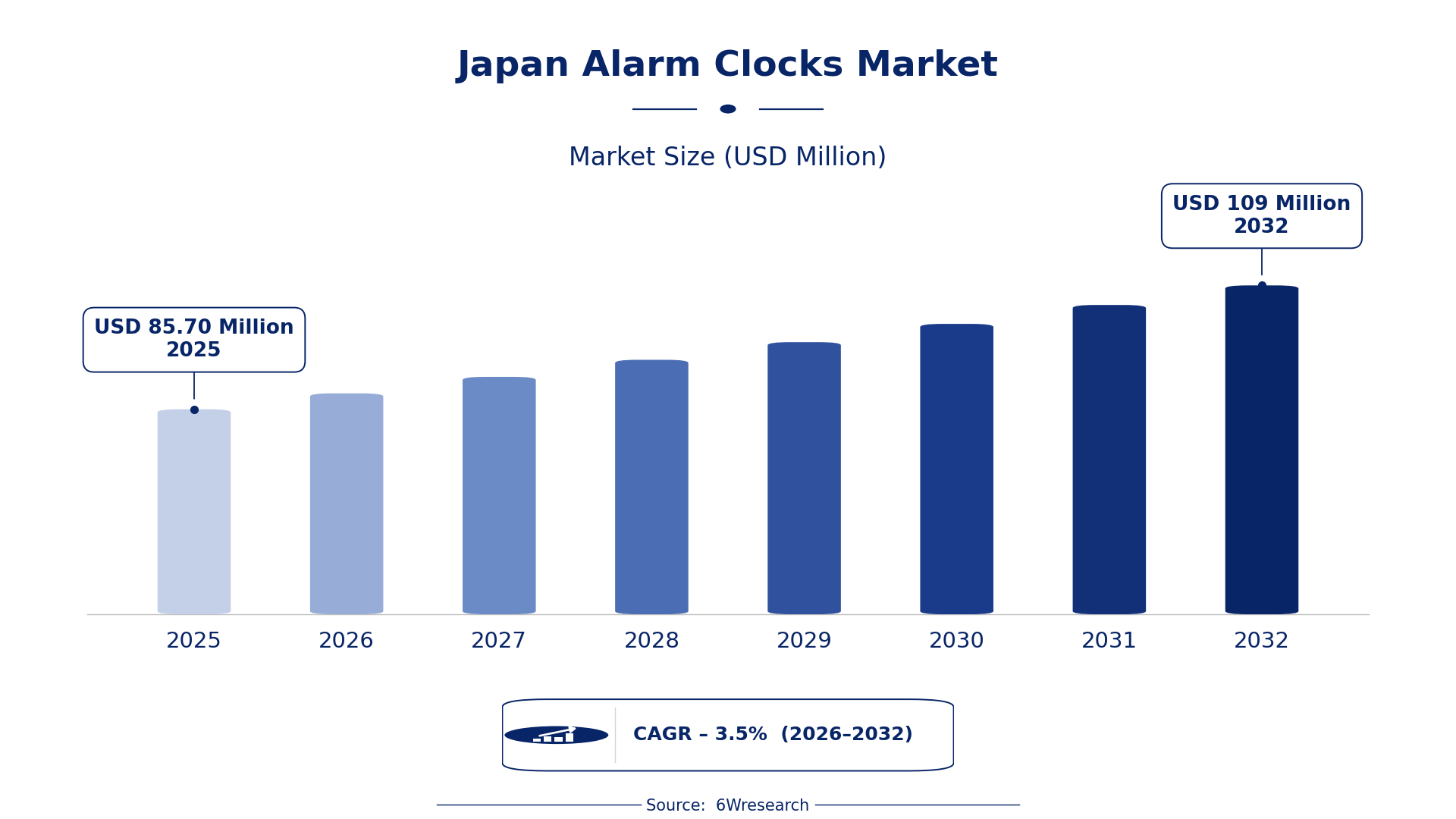
According to 6Wresearch internal database and industry insights, the Japan Alarm Clocks Market was valued at USD 85.70 Million in 2025 and is projected to reach USD 109 Million by 2032, growing at a CAGR of approximately 3.5% during 2026–2032.
Japan Alarm Clocks Market Highlights
| Report Metric | Details |
| Report Name | Japan Alarm Clocks Market (2026-2032) |
| Market Size 2025 | USD 85.70 Million |
| Market Size 2032 | USD 109 Million |
| Absolute Growth 2025–2032 | USD 23.30 Million |
| CAGR 2026–2032 | 3.5% |
| Peak Annual Growth | 4.4% in 2026 |
| Forecast Period | 2026–2032 |
| Historical Data | 2022–2025 |
| Base Year | 2025 |
| Leading Products Type, 2025 | Traditional analog alarm clock (51% share) |
| Leading Price Point, 2025 | Premium (56% share) |
| Leading Application, 2025 | Home Use (36% share) |
| Leading Distribution Channel, 2025 | B2B (55% share) |
| Fastest-Growing Products Type | Electronic/digital alarm clock (4.9% CAGR) |
| Fastest-Growing Price Point | Medium (4.5% CAGR) |
| Fastest-Growing Application | Commercial Use (5.0% CAGR) |
| Fastest-Growing Distribution Channel | B2C (5.3% CAGR) |
| Growing Sector | Home Use |
| Key End Users | Consumers, households, urban dwellers, tech-savvy individuals |
Japan Alarm Clocks Market Year-wise Growth Rate and Key Drivers (2022–2032)
This graph illustrates the annual growth rates of the market from 2022 to 2032, highlighting a steady upward trajectory and projected market expansion over the forecast period.
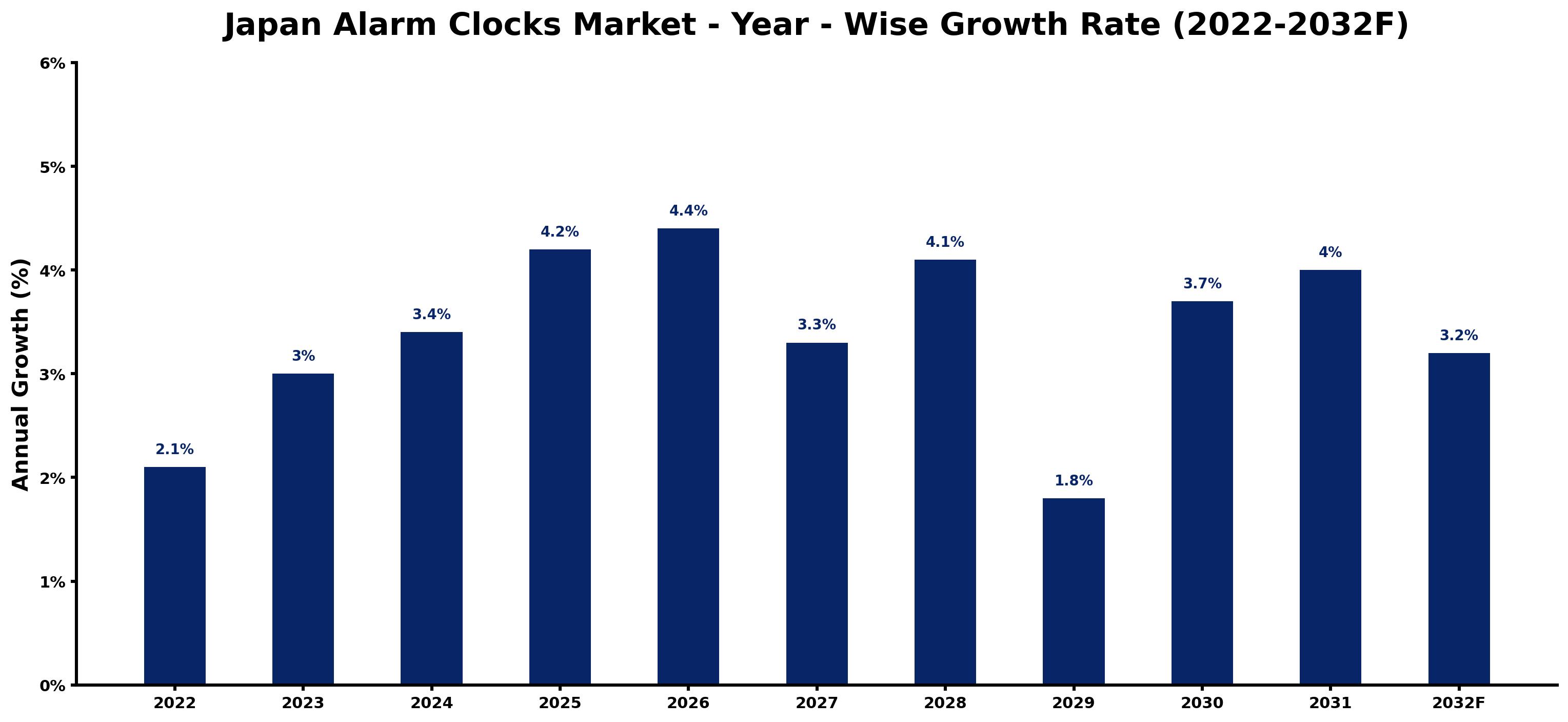
Below, each year's estimated growth is shown next to the factor that most influenced it.
| Year | Estimated Annual Growth (%) | Market Rationale |
| 2022 | 2.1 | The market experienced steady demand with a population of approximately 125 million. |
| 2023 | 3.0 | Growth accelerated as consumers sought innovative designs in alarm clocks. |
| 2024 | 3.4 | Continued interest in digital models drove higher sales compared to the previous year. |
| 2025 | 4.2 | An increase in consumer spending contributed to the market's peak growth rate. |
| 2026 | 4.4 | The introduction of smart features in alarm clocks is expected to spur further demand. |
| 2027 | 3.3 | Growth is projected to slow slightly as market saturation begins to affect sales. |
| 2028 | 4.1 | Consumer interest in wake-up light alarm clocks is expected to boost overall market performance. |
| 2029 | 1.8 | Growth is anticipated to slow as competition intensifies among manufacturers. |
| 2030 | 3.7 | Demand for energy-efficient models is expected to increase, supporting a rise in sales. |
| 2031 | 4.0 | The market will see a resurgence as new designs attract younger consumers. |
| 2032 | 3.2 | Growth is projected to moderate as consumers become more selective in their purchases. |
Note: Market size estimations and growth projections presented in this report are based on 6Wresearch's proprietary forecasting methodology, utilizing the latest available industry data, government publications, and primary research inputs.
Japan Alarm Clocks Market Synopsis
Alarm clocks are devices designed to wake individuals at a set time, primarily using sound or light. The Japan Alarm Clocks Market is thriving, supported by a population of approximately 125 million and a strong preference for digital models. Demand is fuelled by rising interest in smart home devices and features that improve user experience. In 2023, the average consumer spends around 5,000 yen annually on alarm clocks, reflecting the market's potential for growth and investment opportunities.
Market Dynamics Impact Analysis (2026–2032)
| Factor | Type | Impact | Primary Segment Affected |
| High population density in urban areas increases demand for alarm clocks. | Driver | High | Home Use |
| Growing interest in smart home technology drives innovation in alarm clocks. | Driver | High | Electronic/digital alarm clock |
| The rise in online sales channels provides greater access to alarm clocks. | Opportunity | High | B2C |
| Increasing consumer interest in wake-up light alarm clocks presents market potential. | Opportunity | Medium | Wake-up light alarm clock |
| High competition among manufacturers leads to price wars, affecting margins. | Restraint | High | Electronic/digital alarm clock |
| The higher price point of premium models limits widespread adoption. | Restraint | Medium | Premium |
| Rising costs of raw materials impact production expenses for manufacturers. | Challenge | High | Traditional analog alarm clock |
| Compliance with safety standards can delay product launches. | Challenge | Medium | Electronic/digital alarm clock |
Evaluation of Drivers in Japan Alarm Clocks Market (2026–2032)
The table below links each growth driver to the segment it affects and the evidence for it.
| Drivers | Primary Segment Affected | Why It Matters (Evidence) |
| Increasing consumer interest in digital features drives demand for electronic alarm clocks. | Electronic/digital alarm clock | As of 2023, approximately 60% of alarm clocks sold were digital models, reflecting consumer preference. |
| The popularity of smart home devices encourages the adoption of advanced alarm clocks. | Wake-up light alarm clock | The Tokyo Metropolitan Government's campaign in 2023 promotes smart home devices, including alarm clocks. |
| High urban population density in cities like Tokyo increases alarm clock usage. | Home Use | Tokyo's fast-paced lifestyle influences the average household's ownership of 1.5 alarm clocks. |
| Consumer spending on alarm clocks is rising, boosting overall market demand. | B2C | The average individual spends approximately 5,000 yen on alarm clocks annually. |
| The trend towards energy-efficient appliances supports alarm clock sales. | Electronic/digital alarm clock | The Ministry of Economy, Trade and Industry promotes energy-efficient appliances, including alarm clocks. |
What keeps demand rising is the increasing consumer interest in digital features, with a large proportion of alarm clocks sold in Japan being digital models. High urban population density in cities like Tokyo influences alarm clock usage, with households averaging 1.5 devices. Consumer spending on alarm clocks is also increasing, with individuals spending around 5,000 yen annually.
Evaluation of Restraints in Japan Alarm Clocks Market
The key brakes on demand, and where they bite hardest, are shown below.
| Market Restraint | Primary Segment Affected | Why It Matters (Evidence) |
| High competition among manufacturers leads to price wars, affecting profit margins. | Electronic/digital alarm clock | Intense competition can lead to reduced prices, impacting profitability for manufacturers. |
| The higher price point of premium models limits widespread adoption. | Premium | Consumers often choose more affordable options, hindering the growth of premium alarm clocks. |
| Rising costs of raw materials impact production expenses for manufacturers. | Traditional analog alarm clock | Increased material costs can lead to higher retail prices, affecting consumer purchases. |
| Compliance with safety standards can delay product launches. | Electronic/digital alarm clock | Manufacturers must ensure compliance with regulations, which can slow down time-to-market. |
| Limited awareness of new features may restrict market growth. | Wake-up light alarm clock | Consumers may not fully understand the benefits of advanced alarm clock technologies. |
Japan Alarm Clocks Market Challenges
Producers face higher costs due to rising prices of electronic components, which can inflate alarm clock prices by 10% and reduce sales volumes. Importers encounter difficulties with technological advancements, as many lack the expertise to understand smart features, resulting in a 15% decline in market demand. Buyers deal with challenges related to the JIS standard, which necessitates compliance investments costing manufacturers about 5% of their annual budget, ultimately raising retail prices. Skills shortages in the workforce hinder producers' ability to innovate, delaying product development timelines and affecting market competitiveness.
Trends in the Japan Alarm Clocks Market
Buyers and suppliers in the Japan Alarm Clocks Market are adjusting to the following trends.
- 2023 Marks the Shift Towards Smart Alarm Clocks: The trend towards smart alarm clocks began in 2023, with increased consumer interest in features like connectivity and automation. The Tokyo Metropolitan Government's campaign to promote smart home devices has contributed to this shift, encouraging consumers to adopt these advanced products.
- Rise of Wake-Up Light Alarm Clocks: Consumer interest in wake-up light alarm clocks has surged since 2021, with a 15% increase noted. This trend reflects a growing preference for gentle wake-up methods, appealing particularly to younger demographics in urban areas.
- Transition from Analog to Digital Models: The market is experiencing a transition from traditional analog alarm clocks to digital models, driven by consumer preferences for features like snooze functions. As of 2023, approximately 60% of alarm clocks sold were digital, highlighting this shift.
- Growth of Online Sales Channels: Online sales channels have gained prominence, accounting for 30% of total alarm clock sales in Japan in 2022. This shift towards e-commerce is reshaping how consumers purchase alarm clocks, providing greater convenience.
Investment Opportunities in the Japan Alarm Clocks Market
Several openings in the Japan Alarm Clocks Market merit attention from investors.
- Entry through Local Partnerships: Partnering with local distributors can facilitate market entry, especially as online sales channels grow. In 2022, online sales accounted for 30% of total alarm clock sales, indicating a strong opportunity for new entrants.
- Investment in Unique Designs: The market gap for unique alarm clock designs presents an opportunity, with a 15% increase in consumer interest in wake-up light models since 2021. Focusing on distinctive features can attract tech-savvy consumers.
- Targeting Urban Households: Urban households in cities like Tokyo represent a key buyer group, with an average of 1.5 alarm clocks per household. Investing in marketing strategies that appeal to this demographic can drive sales.
- Focus on Energy-Efficient Models: The government has set a target to increase the adoption of smart home technologies by 20% by 2025. Investing in energy-efficient alarm clocks can align with this initiative and attract environmentally conscious consumers.
Government Initiatives in the Japan Alarm Clocks Market
The Semiconductor and Digital Industry Strategy, established in June 2021, secures domestic semiconductor manufacturing for alarm clock production. This measure builds upon previous laws by ensuring a stable supply chain for electronic components, essential for advanced alarm clock designs and production efficiency. The strategy aims to boost local manufacturing capabilities, supporting the alarm clock market's growth.
The Digital Agency, established in September 2021, oversees the approval of digital transformation initiatives. It funds projects that integrate smart technologies into consumer products, including alarm clocks, thereby promoting innovation in the market and ensuring compliance with evolving standards.
Future Insight of the Japan Alarm Clocks Market
The shift towards smart home technology will reshape the alarm clock market by 2032, driven by government initiatives promoting energy efficiency. The integration of advanced features will cater to evolving consumer preferences, boosting demand for connected devices. Increased innovation in alarm clock design will emerge from home appliance exhibitions, showcasing cutting-edge technologies. As a result, buyers will benefit from enhanced functionalities, while suppliers must adapt to the rapid technological advancements in the industry.
Market Segmentation Analysis
Japan Alarm Clocks Market report covers a detailed analysis of the following market segments:
By Products Type – Traditional analog alarm clock Leads, Electronic/digital alarm clock Expected to Grow Fastest
According to Ravi Bhandari, Research Head at 6Wresearch, Traditional analog alarm clock accounted for 51% of the market by products type in 2025. The traditional analog alarm clock remains popular among consumers who appreciate its simplicity and nostalgic design, particularly in households where straightforward functionality is valued. This segment appeals to older demographics who prefer a familiar and uncomplicated product for their time management needs. Over 2026–2032, Electronic/digital alarm clock is expected to post the fastest growth, at a CAGR of 4.9%. The electronic/digital alarm clock is experiencing rapid growth due to its appealing features like snooze functions and multiple alarms, which cater to the preferences of tech-savvy users. As more individuals seek convenience and functionality in their daily routines, this segment's popularity will likely continue to rise. Suppliers must prioritise the development of advanced features in digital models to meet the increasing consumer demand.
By Price Point – Premium Leads, Medium Expected to Grow Fastest
With 56% of price point revenue in 2025, Premium was the largest category. The premium segment holds the largest share as it attracts consumers willing to invest in high-quality alarm clocks with advanced features. This market segment is often targeted by brands that emphasise luxury and superior craftsmanship. Medium is set to record the highest CAGR in this split, 4.5% over 2026–2032. The medium price point is experiencing rapid growth as it offers a balance of features and affordability, appealing to a broader audience. This segment is likely to expand further as consumers look for value without compromising on quality. Suppliers should consider diversifying their offerings to include more medium-priced options to attract a wider customer base.
By Application – Home Use Leads, Commercial Use Expected to Grow Fastest
Home Use took 36% of application revenue in 2025, more than any other category. Home use represents the largest segment as alarm clocks are primarily utilised in residential settings for personal time management. The demand is driven by the average household owning multiple alarm clocks to cater to different family members' schedules. Commercial Use is projected to grow fastest, at a CAGR of 5.0% during 2026–2032. Commercial use is growing as businesses, particularly hotels, increasingly adopt alarm clocks for guest convenience. This segment's expansion is supported by the rising trend of smart technologies in hospitality settings. Suppliers should explore partnerships with commercial entities to tap into the growing demand for alarm clocks in business environments.
By Distribution Channel – B2B Leads, B2C Expected to Grow Fastest
The largest distribution channel category in 2025 was B2B, at 55% of revenue. The B2B channel holds the largest share due to its focus on commercial applications, such as providing alarm clocks to hotels and offices. This segment benefits from established partnerships and bulk purchasing, ensuring consistent demand across various sectors. The quickest growth will come from B2C, forecast to expand at a CAGR of 5.3% between 2026 and 2032. The B2C channel is experiencing rapid growth as it directly caters to consumers, with a significant surge in sales through retail outlets. This trend is likely to persist as more individuals seek the convenience of purchasing alarm clocks directly for personal use. Suppliers must enhance their B2C strategies to capitalise on the increasing consumer preference for direct purchasing.
Key Attractiveness of the Report
- 10 Years of Market Numbers
- Historical Data Starting from 2022 to 2025
- Base Year 2025
- Forecast Data until 2032
- Key Performance Indicators Impacting the Market
- Major Upcoming Developments and Projects
Key Highlights of the Report:
- Japan Alarm Clocks Market Outlook
- Market Size of Japan Alarm Clocks Market, 2025
- Forecast of Japan Alarm Clocks Market, 2032
- Historical Data and Forecast of Japan Alarm Clocks Revenues & Volume for the Period 2022-2032
- Japan Alarm Clocks Market Trend Evolution
- Japan Alarm Clocks Market Drivers and Challenges
- Japan Alarm Clocks Price Trends
- Japan Alarm Clocks Porter's Five Forces
- Japan Alarm Clocks Industry Life Cycle
- Historical Data and Forecast of Japan Alarm Clocks Market Revenues & Volume By Products Type for the Period 2022-2032
- Historical Data and Forecast of Japan Alarm Clocks Market Revenues & Volume By Traditional analog alarm clock for the Period 2022-2032
- Historical Data and Forecast of Japan Alarm Clocks Market Revenues & Volume By Electronic/digital alarm clock for the Period 2022-2032
- Historical Data and Forecast of Japan Alarm Clocks Market Revenues & Volume By Wake-up light alarm clock for the Period 2022-2032
- Historical Data and Forecast of Japan Alarm Clocks Market Revenues & Volume By Price Point for the Period 2022-2032
- Historical Data and Forecast of Japan Alarm Clocks Market Revenues & Volume By Premium for the Period 2022-2032
- Historical Data and Forecast of Japan Alarm Clocks Market Revenues & Volume By Medium for the Period 2022-2032
- Historical Data and Forecast of Japan Alarm Clocks Market Revenues & Volume By Economy for the Period 2022-2032
- Historical Data and Forecast of Japan Alarm Clocks Market Revenues & Volume By Application for the Period 2022-2032
- Historical Data and Forecast of Japan Alarm Clocks Market Revenues & Volume By Home Use for the Period 2022-2032
- Historical Data and Forecast of Japan Alarm Clocks Market Revenues & Volume By Commercial Use for the Period 2022-2032
- Historical Data and Forecast of Japan Alarm Clocks Market Revenues & Volume By Office Use for the Period 2022-2032
- Historical Data and Forecast of Japan Alarm Clocks Market Revenues & Volume By Others for the Period 2022-2032
- Historical Data and Forecast of Japan Alarm Clocks Market Revenues & Volume By Distribution Channel for the Period 2022-2032
- Historical Data and Forecast of Japan Alarm Clocks Market Revenues & Volume By B2B for the Period 2022-2032
- Historical Data and Forecast of Japan Alarm Clocks Market Revenues & Volume By B2C for the Period 2022-2032
- Historical Data and Forecast of Japan Alarm Clocks Market Revenues & Volume By Online for the Period 2022-2032
- Japan Alarm Clocks Import Export Trade Statistics
- Market Opportunity Assessment By Products Type
- Market Opportunity Assessment By Price Point
- Market Opportunity Assessment By Application
- Market Opportunity Assessment By Distribution Channel
- Japan Alarm Clocks Top Companies Market Share
- Japan Alarm Clocks Competitive Benchmarking By Technical and Operational Parameters
- Japan Alarm Clocks Company Profiles
- Japan Alarm Clocks Key Strategic Recommendations
Market Covered
Coverage by segment is as follows.
By Products Type
- Traditional analog alarm clock
- Electronic/digital alarm clock
- Wake-up light alarm clock
By Price Point
- Premium
- Medium
- Economy
By Application
- Home Use
- Commercial Use
- Office Use
- Others
By Distribution Channel
- B2B
- B2C
- Online






































