Japan Analytical Chemistry Market Size & Growth Rate
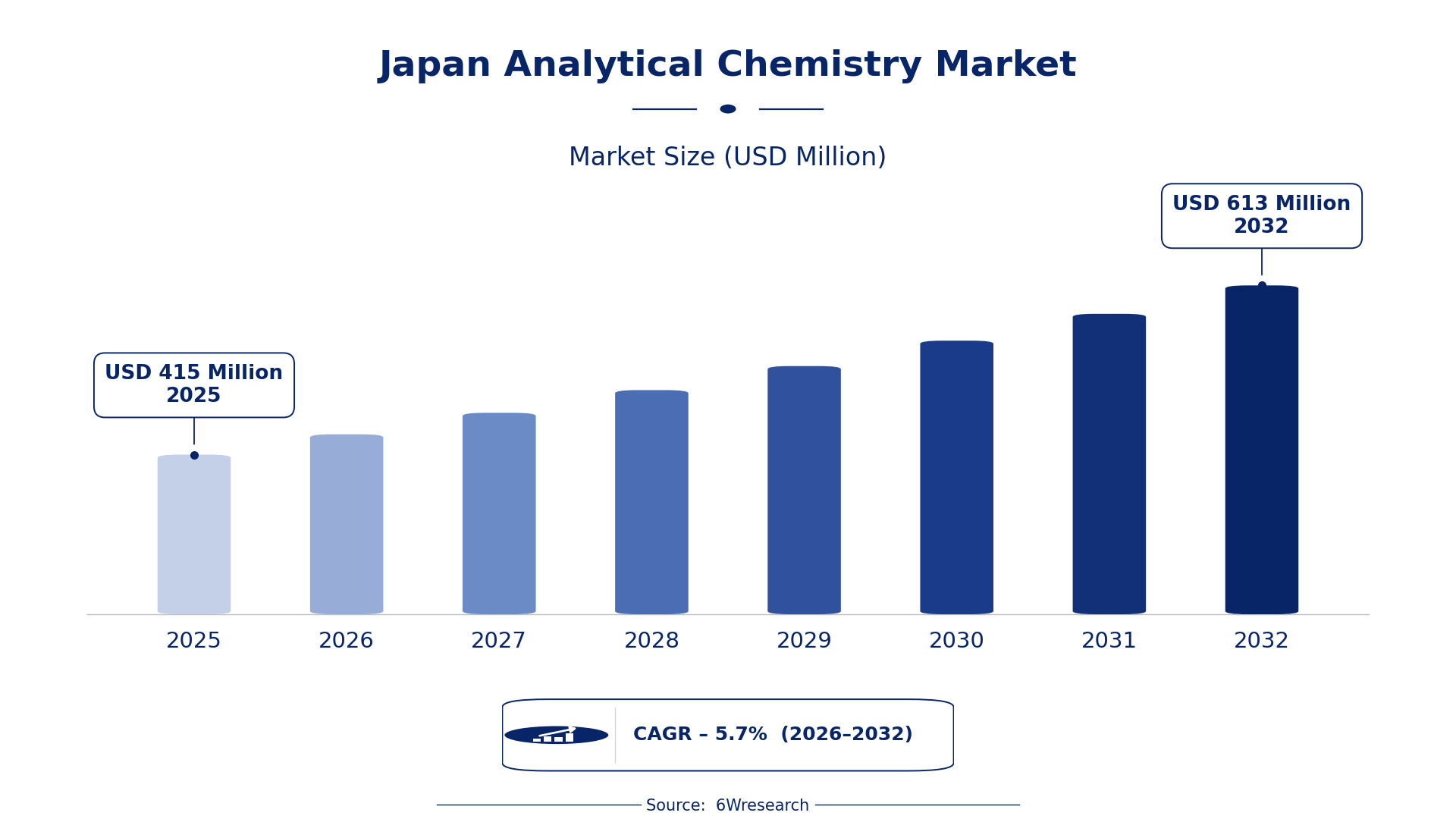
According to 6Wresearch internal database and industry insights, the Japan Analytical Chemistry Market was valued at USD 415 Million in 2025 and is projected to reach USD 613 Million by 2032, growing at a CAGR of approximately 5.7% during 2026–2032.
Japan Analytical Chemistry Market Highlights
| Report Metric | Details |
| Report Name | Japan Analytical Chemistry Market (2026-2032) |
| Market Size 2025 | USD 415 Million |
| Market Size 2032 | USD 613 Million |
| Absolute Growth 2025–2032 | USD 198 Million |
| CAGR 2026–2032 | 5.7% |
| Peak Annual Growth | 6.5% in 2029 |
| Forecast Period | 2026–2032 |
| Historical Data | 2022–2025 |
| Base Year | 2025 |
| Leading Application Type, 2025 | Clinical Chemistry (47% share) |
| Leading Technique Used, 2025 | Chromatography (46% share) |
| Leading Distribution Channel, 2025 | Diagnostic Tool Suppliers (50% share) |
| Leading End User, 2025 | Hospitals (48% share) |
| Fastest-Growing Application Type | Environmental Testing (7.5% CAGR) |
| Fastest-Growing Technique Used | Mass Spectrometry (7.3% CAGR) |
| Fastest-Growing Distribution Channel | Government Contracts (7.4% CAGR) |
| Fastest-Growing End User | Environmental Agencies (7.2% CAGR) |
| Growing Sector | Healthcare diagnostics |
| Key End Users | Hospitals, Forensic Labs, Environmental Agencies, Food Quality Labs |
Japan Analytical Chemistry Market Year-wise Growth Rate and Key Drivers (2022–2032)
This graph illustrates the annual growth rates of the market from 2022 to 2032, highlighting a steady upward trajectory and projected market expansion over the forecast period.
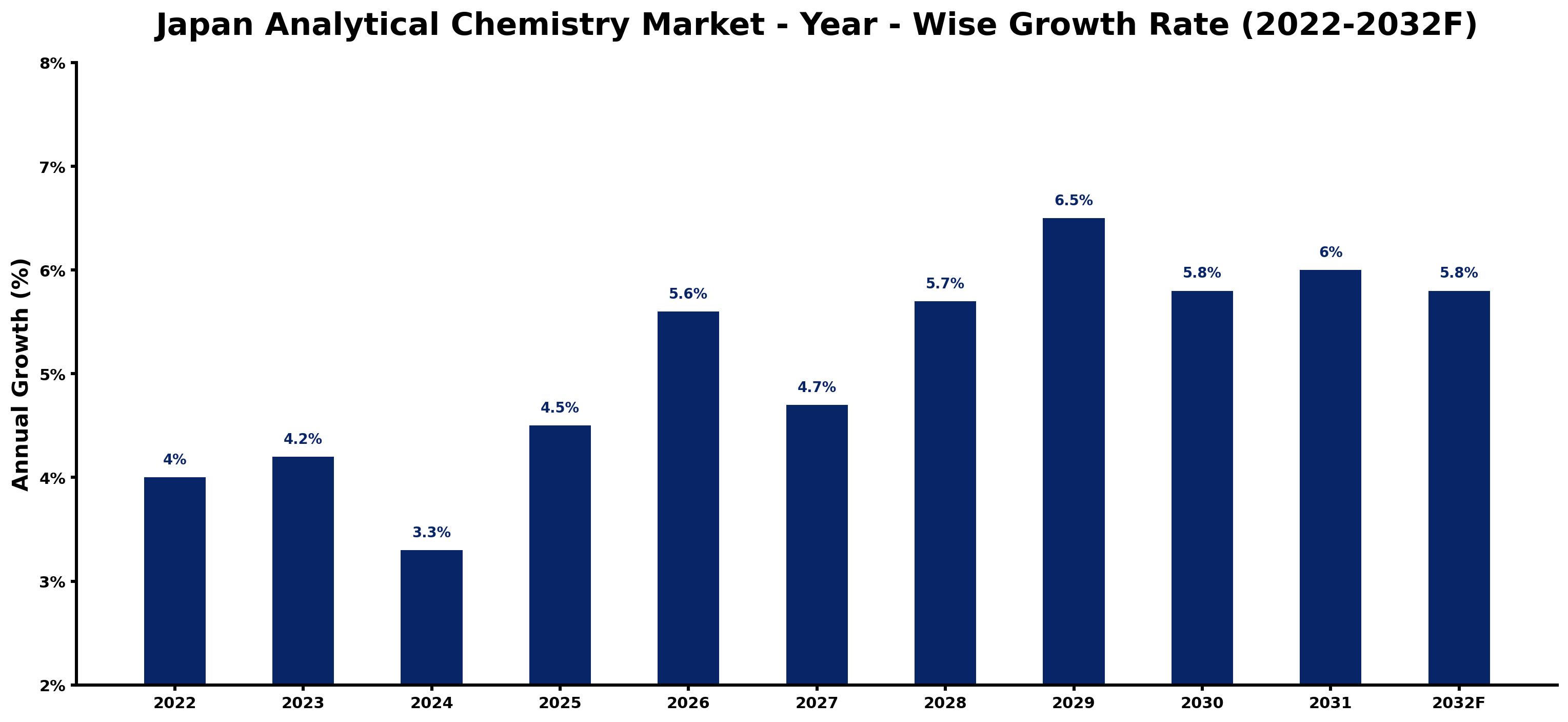
Year by year, the estimates below pair each growth rate with the development that shaped it.
| Year | Estimated Annual Growth (%) | Market Rationale |
| 2022 | 4.0 | The market experienced steady growth due to consistent demand from hospitals and laboratories. |
| 2023 | 4.2 | Growth accelerated as healthcare facilities increased their investments in diagnostic tools. |
| 2024 | 3.3 | The market saw a slowdown as some sectors adjusted to previous expansions. |
| 2025 | 4.5 | Demand surged again as hospitals expanded their analytical capabilities in diagnostics. |
| 2026 | 5.6 | Environmental agencies are expected to enhance testing protocols for pollution monitoring. |
| 2027 | 4.7 | A slight slowdown is projected as market adjustments take place after rapid growth. |
| 2028 | 5.7 | The market is anticipated to rebound with faster growth driven by advancements in analytical techniques. |
| 2029 | 6.5 | Peak growth is projected as demand for mass spectrometry in forensic labs surges. |
| 2030 | 5.8 | The market is expected to slow slightly as growth stabilises after reaching peak levels. |
| 2031 | 6.0 | Demand will increase again as hospitals continue to adopt advanced analytical methods. |
| 2032 | 5.8 | The market is projected to experience a slowdown as growth rates normalise after rapid expansions. |
Note: Market size estimations and growth projections presented in this report are based on 6Wresearch's proprietary forecasting methodology, utilizing the latest available industry data, government publications, and primary research inputs.
Japan Analytical Chemistry Market Synopsis
Analytical chemistry focuses on the qualitative and quantitative analysis of substances through techniques like chromatography and spectroscopy. Its main applications include clinical diagnostics, environmental monitoring, food quality assurance, and forensic analysis. The Japan Analytical Chemistry Market is expanding, driven by demand from over 8,000 hospitals and advanced forensic labs in the Tokyo region. Recent government initiatives to improve environmental testing capabilities and the increasing focus on food safety are propelling market growth, with the food safety testing sector valued at around 300 million USD in 2022.
Market Dynamics Impact Analysis (2026–2032)
| Factor | Type | Impact | Primary Segment Affected |
| Increasing healthcare investments | Driver | High | Clinical Chemistry |
| Growing environmental concerns | Driver | High | Environmental Testing |
| Expansion of forensic analysis capabilities | Opportunity | High | Forensic Analysis |
| Rising food safety regulations | Opportunity | High | Food Safety Testing |
| High costs of advanced equipment | Restraint | Medium | Chromatography |
| Limited access to cutting-edge technology | Restraint | Medium | Spectroscopy |
| Shortage of skilled professionals | Challenge | High | Clinical Chemistry |
| Regulatory compliance complexities | Challenge | Medium | Environmental Testing |
Evaluation of Drivers in Japan Analytical Chemistry Market (2026–2032)
The table below links each growth driver to the segment it affects and the evidence for it.
| Drivers | Primary Segment Affected | Why It Matters (Evidence) |
| Rising investments in healthcare diagnostics | Clinical Chemistry | Japan has over 8,000 hospitals utilizing analytical chemistry for diagnostics, increasing demand for related tools. |
| Improved environmental testing protocols | Environmental Testing | Environmental agencies conduct over 5,000 tests annually for pollution monitoring, driving demand for analytical tools. |
| Increased funding for forensic technologies | Forensic Analysis | The Tokyo region is a hub for forensic labs employing advanced analytical techniques, boosting procurement of equipment. |
| Growing food safety regulations | Food Safety Testing | Food safety regulations require testing for over 200 contaminants in food products, increasing testing demand. |
| Adoption of mass spectrometry | Mass Spectrometry | Approximately 90% of forensic labs in Japan use mass spectrometry for drug analysis, improving accuracy. |
Purchasing is picking up as Japan's healthcare sector invests heavily in diagnostics, with over 8,000 hospitals driving demand for analytical tools. Forensic labs in the Tokyo region employ sophisticated techniques, increasing procurement of equipment. The widespread use of mass spectrometry in forensic labs underscores the growing reliance on precise methods.
Evaluation of Restraints in Japan Analytical Chemistry Market
Several factors work against faster growth; the main ones are summarised below.
| Market Restraint | Primary Segment Affected | Why It Matters (Evidence) |
| High costs associated with advanced analytical equipment | Chromatography | The initial investment for chromatography systems can exceed 10 million JPY, limiting access for smaller labs. |
| Limited availability of modern technology | Spectroscopy | Access to advanced spectroscopy tools is restricted in rural areas, affecting laboratories' operational capabilities. |
| Shortage of skilled professionals in analytical chemistry | Clinical Chemistry | The lack of trained personnel in hospitals hampers effective use of analytical tools, impacting patient diagnostics. |
| Complex regulatory compliance processes | Environmental Testing | Navigating regulatory requirements can delay the implementation of new testing technologies, increasing costs for labs. |
| Dependence on imported analytical instruments | Forensic Analysis | Import dependency can lead to supply chain disruptions, affecting timely access to essential tools for law enforcement. |
Japan Analytical Chemistry Market Challenges
Forensic labs in Japan struggle with a shortage of skilled technicians, causing delays in drug analysis and affecting law enforcement case resolutions. Many facilities rely on outdated technology, which hampers testing efficiency and raises operational costs for healthcare providers. Regulatory requirements from the Ministry of Health, Labour and Welfare necessitate frequent updates, leading to potential fines for non-compliant labs. Supply chain disruptions for analytical instruments have increased lead times by 20%, complicating hospitals' efforts to acquire essential diagnostic tools promptly.
Trends in the Japan Analytical Chemistry Market
Several trends are reshaping the Japan Analytical Chemistry Market; the most important are set out below.
- Shift towards Advanced Forensic Techniques: In 2023, the Japanese government launched a program to improve forensic analysis capabilities, increasing funding by 50 million JPY. This shift is driving demand for advanced analytical tools in forensic labs.
- Transition from Traditional to Modern Testing Methods: The adoption of ISO 17025 standards in laboratories has increased, ensuring quality and reliability in testing. This change is essential for maintaining high standards in clinical diagnostics.
- Emergence of Environmental Testing Innovations: Since 2023, new environmental testing technologies have been developed, improving pollution assessment capabilities. Approximately 5,000 tests are conducted annually, reflecting the growing importance of environmental safety.
- Growing Focus on Food Safety Compliance: Food safety regulations have become more stringent, requiring thorough testing for contaminants. In 2022, the food safety testing market was valued at approximately 300 million USD, highlighting its importance.
Investment Opportunities in the Japan Analytical Chemistry Market
The opportunities below stand out in the Japan Analytical Chemistry Market for new entrants and existing suppliers.
- Gap in Advanced Analytical Tools: With the food safety testing market valued at 300 million USD, there is an opportunity for suppliers to provide advanced analytical tools to food quality labs. Partnering with local distributors can facilitate market entry.
- Increased Government Contracts for Environmental Testing: The Japanese government has increased contracts for environmental testing tools by 15% since 2021. Suppliers can benefit by establishing joint ventures with local firms to meet this rising demand.
- Investment in Forensic Lab Upgrades: Forensic labs in the Tokyo region require modern analytical equipment to improve their capabilities. Suppliers should consider direct partnerships with these labs to capitalise on the growing need.
- Expansion of Clinical Chemistry Services: Hospitals are expanding their analytical chemistry services, driven by the need for accurate diagnostics. Investing in diagnostic tool suppliers can provide access to this growing market.
Government Initiatives in the Japan Analytical Chemistry Market
The GX Promotion Act, introduced in 2023, establishes a foundation for improving analytical chemistry standards in Japan. This act complements existing laws like the PMD Act, which regulates the quality of medical devices and pharmaceuticals, ensuring that analytical tools meet stringent requirements.
In 2023, the government allocated 50 million JPY for research in analytical chemistry applications, overseen by the Ministry of Health, Labour and Welfare. This funding aims to support advancements in clinical diagnostics and environmental testing, improving overall industry capabilities.
Future Insight of the Japan Analytical Chemistry Market
By 2032, Japan will see a shift in analytical chemistry driven by government initiatives and technological advancements. The Japanese government has launched a program to enhance environmental testing capabilities, which will improve testing accuracy and efficiency. New ISO standards will ensure higher quality in laboratory results, benefiting both buyers and suppliers. Increased investment in research will lead to innovative testing techniques, creating opportunities for suppliers to expand their product offerings.
Market Segmentation Analysis
Japan Analytical Chemistry Market report covers a detailed analysis of the following market segments:
By Application Type – Clinical Chemistry Leads, Environmental Testing Expected to Grow Fastest
According to Saurav Kr Singh, Senior Research Analyst at 6Wresearch, in 2025, Clinical Chemistry led the application type split with a 47% share. Clinical chemistry holds the largest share due to its critical role in diagnosing diseases and monitoring health, with over 8,000 hospitals relying on these services. The standards set by the Ministry of Health, Labour and Welfare ensure that clinical practices maintain high quality, solidifying this segment's position. Environmental Testing is set to record the highest CAGR in this split, 7.5% over 2026–2032. The environmental testing segment is experiencing rapid growth, spurred by a government initiative launched in 2023 to enhance capabilities in pollution assessment. With over 5,000 tests conducted annually, the urgency for environmental evaluations is becoming increasingly apparent. Suppliers must focus on developing products that meet the evolving regulatory requirements in environmental testing.
By Technique Used – Chromatography Leads, Mass Spectrometry Expected to Grow Fastest
With 46% of technique used revenue in 2025, Chromatography was the largest category. Chromatography leads the market due to its widespread application in laboratories for separating mixtures, essential for various analytical processes. Its extensive use in over 1,200 food quality labs highlights its importance in ensuring compliance with safety standards. Over 2026–2032, Mass Spectrometry is expected to post the fastest growth, at a CAGR of 7.3%. Mass spectrometry is the fastest-growing technique, primarily due to its vital role in precise molecular analysis across multiple sectors. Its application in approximately 90% of forensic labs for drug analysis illustrates its rising significance in the market. Suppliers should prioritise advancements in mass spectrometry technologies to cater to the increasing demand for precision in analytical testing.
By Distribution Channel – Diagnostic Tool Suppliers Lead, Government Contracts Expected to Grow Fastest
Diagnostic Tool Suppliers accounted for 50% of the market by distribution channel in 2025. Diagnostic tool suppliers dominate the market as they provide essential equipment necessary for healthcare facilities, ensuring effective patient diagnostics. The notable 15% increase in government contracts for analytical tools since 2021 further cements their leading role in the distribution landscape. The quickest growth will come from Government Contracts, forecast to expand at a CAGR of 7.4% between 2026 and 2032. Government contracts represent the fastest-growing distribution channel, fuelled by heightened procurement of analytical tools to support public health initiatives. The allocation of 50 million JPY in 2023 for research in analytical chemistry applications underscores this trend. This shift indicates that suppliers should adapt their strategies to align with government procurement processes and specifications.
By End User – Hospitals Lead, Environmental Agencies Expected to Grow Fastest
Hospitals took 48% of end user revenue in 2025, more than any other category. Hospitals are the primary end users of analytical chemistry, employing these techniques for patient care in a country with a population of approximately 125 million. The substantial demand for healthcare diagnostics in Japan significantly contributes to the large share held by hospitals in this market. Environmental Agencies are projected to grow fastest, at a CAGR of 7.2% during 2026–2032. Environmental agencies are the fastest-growing end user group, increasingly employing analytical chemistry for regulatory compliance and pollution monitoring. The government's focus on enhancing environmental testing capabilities is driving these agencies to expand their analytical functions. This growth suggests that suppliers should tailor their offerings to meet the specific needs of environmental agencies.
Key Attractiveness of the Report
- 10 Years of Market Numbers
- Historical Data Starting from 2022 to 2025
- Base Year 2025
- Forecast Data until 2032
- Key Performance Indicators Impacting the Market
- Major Upcoming Developments and Projects
Key Highlights of the Report:
- Japan Analytical Chemistry Market Outlook
- Market Size of Japan Analytical Chemistry Market, 2025
- Forecast of Japan Analytical Chemistry Market, 2032
- Historical Data and Forecast of Japan Analytical Chemistry Revenues & Volume for the Period 2022-2032F
- Japan Analytical Chemistry Market Trend Evolution
- Japan Analytical Chemistry Market Drivers and Challenges
- Japan Analytical Chemistry Price Trends
- Japan Analytical Chemistry Porter's Five Forces
- Japan Analytical Chemistry Industry Life Cycle
- Historical Data and Forecast of Japan Analytical Chemistry Market Revenues & Volume By Application Type for the Period 2022-2032F
- Historical Data and Forecast of Japan Analytical Chemistry Market Revenues & Volume By Clinical Chemistry for the Period 2022-2032F
- Historical Data and Forecast of Japan Analytical Chemistry Market Revenues & Volume By Forensic Analysis for the Period 2022-2032F
- Historical Data and Forecast of Japan Analytical Chemistry Market Revenues & Volume By Environmental Testing for the Period 2022-2032F
- Historical Data and Forecast of Japan Analytical Chemistry Market Revenues & Volume By Food Safety Testing for the Period 2022-2032F
- Historical Data and Forecast of Japan Analytical Chemistry Market Revenues & Volume By Technique Used for the Period 2022-2032F
- Historical Data and Forecast of Japan Analytical Chemistry Market Revenues & Volume By Chromatography for the Period 2022-2032F
- Historical Data and Forecast of Japan Analytical Chemistry Market Revenues & Volume By Spectroscopy for the Period 2022-2032F
- Historical Data and Forecast of Japan Analytical Chemistry Market Revenues & Volume By Electrochemical for the Period 2022-2032F
- Historical Data and Forecast of Japan Analytical Chemistry Market Revenues & Volume By Mass Spectrometry for the Period 2022-2032F
- Historical Data and Forecast of Japan Analytical Chemistry Market Revenues & Volume By Distribution Channel for the Period 2022-2032F
- Historical Data and Forecast of Japan Analytical Chemistry Market Revenues & Volume By Diagnostic Tool Suppliers for the Period 2022-2032F
- Historical Data and Forecast of Japan Analytical Chemistry Market Revenues & Volume By Government Contracts for the Period 2022-2032F
- Historical Data and Forecast of Japan Analytical Chemistry Market Revenues & Volume By Online Equipment Platforms for the Period 2022-2032F
- Historical Data and Forecast of Japan Analytical Chemistry Market Revenues & Volume By OEMs for the Period 2022-2032F
- Historical Data and Forecast of Japan Analytical Chemistry Market Revenues & Volume By End User for the Period 2022-2032F
- Historical Data and Forecast of Japan Analytical Chemistry Market Revenues & Volume By Hospitals for the Period 2022-2032F
- Historical Data and Forecast of Japan Analytical Chemistry Market Revenues & Volume By Forensic Labs for the Period 2022-2032F
- Historical Data and Forecast of Japan Analytical Chemistry Market Revenues & Volume By Environmental Agencies for the Period 2022-2032F
- Historical Data and Forecast of Japan Analytical Chemistry Market Revenues & Volume By Food Quality Labs for the Period 2022-2032F
- Japan Analytical Chemistry Import Export Trade Statistics
- Market Opportunity Assessment By Application Type
- Market Opportunity Assessment By Technique Used
- Market Opportunity Assessment By Distribution Channel
- Market Opportunity Assessment By End User
- Japan Analytical Chemistry Top Companies Market Share
- Japan Analytical Chemistry Competitive Benchmarking By Technical and Operational Parameters
- Japan Analytical Chemistry Company Profiles
- Japan Analytical Chemistry Key Strategic Recommendations
Market Covered
The report covers the following segments.
By Application Type
- Clinical Chemistry
- Forensic Analysis
- Environmental Testing
- Food Safety Testing
By Technique Used
- Chromatography
- Spectroscopy
- Electrochemical
- Mass Spectrometry
By Distribution Channel
- Diagnostic Tool Suppliers
- Government Contracts
- Online Equipment Platforms
- OEMs
By End User
- Hospitals
- Forensic Labs
- Environmental Agencies
- Food Quality Labs































