Japan Animal Feed Ethoxyquin Market Size & Growth Rate
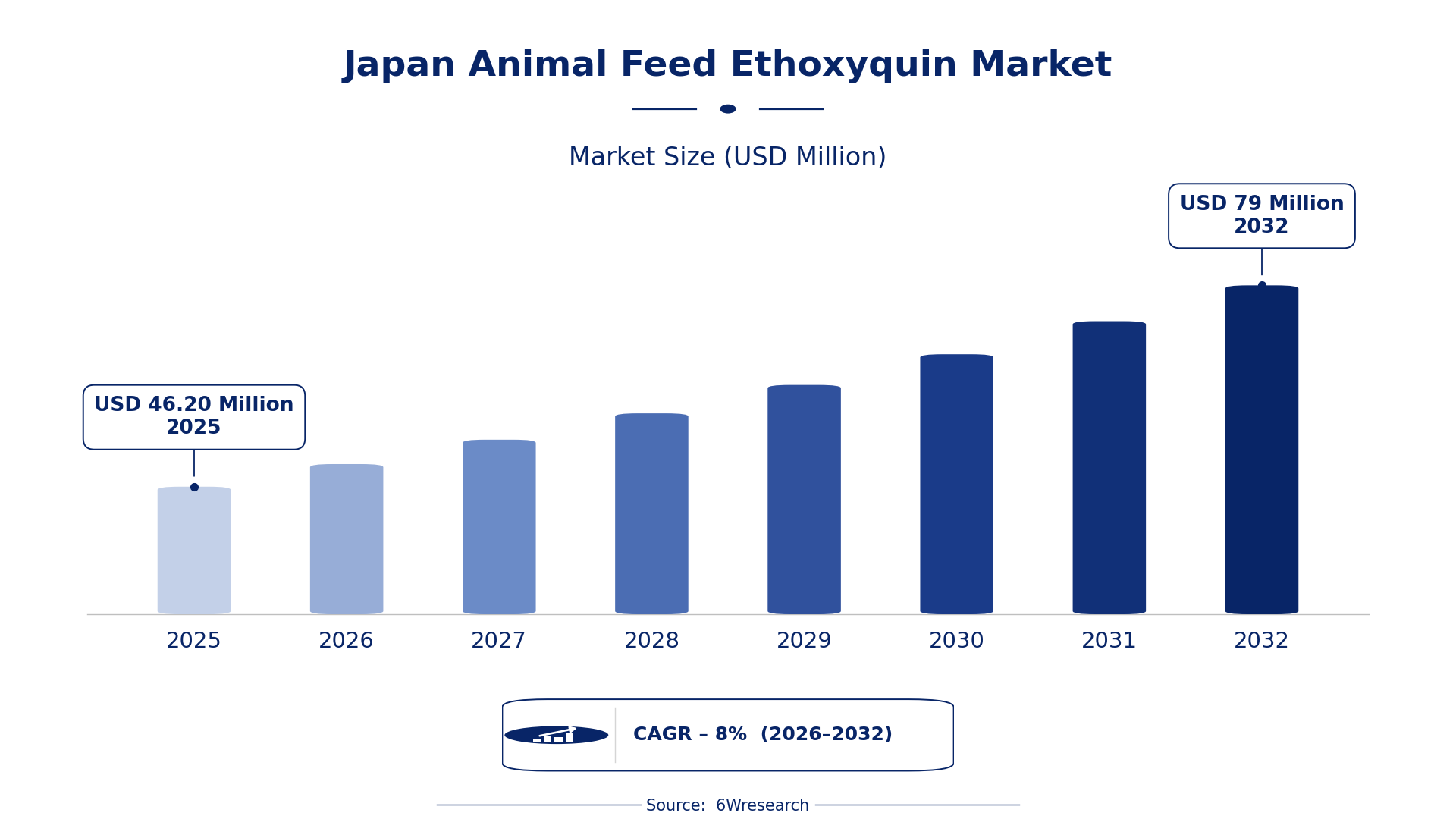
According to 6Wresearch internal database and industry insights, the Japan Animal Feed Ethoxyquin Market was valued at USD 46.20 Million in 2025 and is projected to reach USD 79 Million by 2032, growing at a CAGR of approximately 8% during 2026–2032.
Japan Animal Feed Ethoxyquin Market Highlights
| Report Metric | Details |
| Report Name | Japan Animal Feed Ethoxyquin Market (2026-2032) |
| Market Size 2025 | USD 46.20 Million |
| Market Size 2032 | USD 79 Million |
| Absolute Growth 2025–2032 | USD 32.80 Million |
| CAGR 2026–2032 | 8% |
| Peak Annual Growth | 8.9% in 2027 |
| Forecast Period | 2026–2032 |
| Historical Data | 2022–2025 |
| Base Year | 2025 |
| Leading Feed Type, 2025 | Pellet Feed (38% share) |
| Leading Preservative Use, 2025 | Ethoxyquin (100% share) |
| Leading Animal Type, 2025 | Poultry (33% share) |
| Leading Distribution Channel, 2025 | Feed Suppliers (44% share) |
| Leading End User, 2025 | Farmers (47% share) |
| Fastest-Growing Feed Type | Supplemental Feed (11.2% CAGR) |
| Fastest-Growing Animal Type | Aquaculture (11.6% CAGR) |
| Fastest-Growing Distribution Channel | Online Platforms (10.8% CAGR) |
| Fastest-Growing End User | Fish Farms (10.3% CAGR) |
| Growing Sector | Aquaculture |
| Key End Users | Farmers, Ranchers, Fish Farms |
Japan Animal Feed Ethoxyquin Market Year-wise Growth Rate and Key Drivers (2022–2032)
This graph illustrates the annual growth rates of the market from 2022 to 2032, highlighting a steady upward trajectory and projected market expansion over the forecast period.
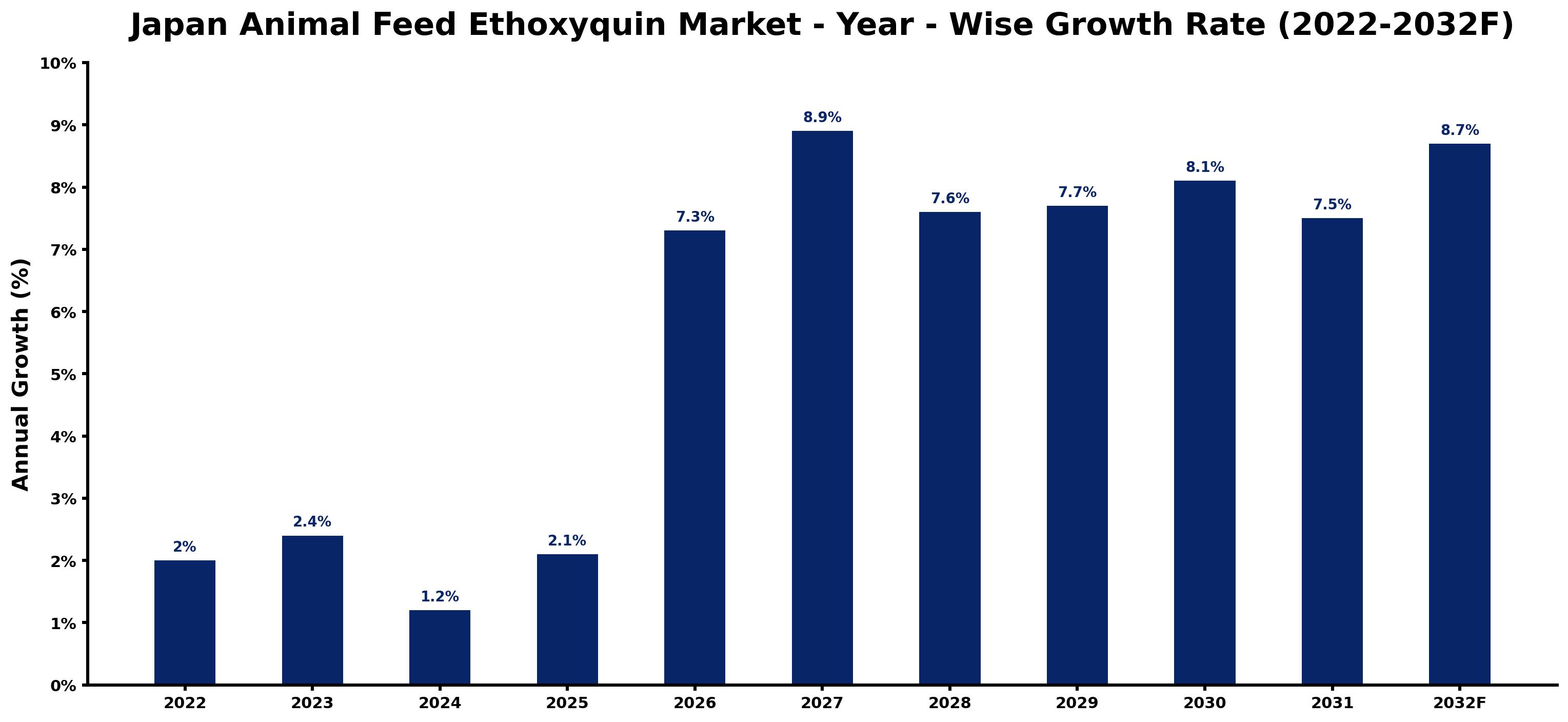
For each year, the table pairs the estimated growth rate with the leading influence on demand, showing how the drivers changed across the period.
| Year | Estimated Annual Growth (%) | Market Rationale |
| 2022 | 2.0 | The market showed stable growth, reflecting consistent demand from livestock producers. |
| 2023 | 2.4 | Growth accelerated due to increased poultry production and feed safety awareness. |
| 2024 | 1.2 | A slowdown occurred as feed prices rose, impacting purchasing decisions. |
| 2025 | 2.1 | Demand rebounded as farmers sought quality feed to support livestock health. |
| 2026 | 7.3 | Growth surged as aquaculture expanded, driving higher ethoxyquin use. |
| 2027 | 8.9 | The peak growth year was fuelled by rising exports and feed safety standards. |
| 2028 | 7.6 | A slight slowdown followed as market conditions stabilised after rapid growth. |
| 2029 | 7.7 | Growth resumed as online platforms gained traction in feed distribution. |
| 2030 | 8.1 | Demand increased with advancements in feed formulations and production techniques. |
| 2031 | 7.5 | Growth moderated as the market adjusted to previous rapid expansions. |
| 2032 | 8.7 | A resurgence in demand is expected as aquaculture and livestock sectors expand. |
Note: Market size estimations and growth projections presented in this report are based on 6Wresearch's proprietary forecasting methodology, utilizing the latest available industry data, government publications, and primary research inputs.
Japan Animal Feed Ethoxyquin Market Synopsis
Animal Feed Ethoxyquin is a synthetic antioxidant used to preserve the quality of animal feed. It is produced through chemical synthesis and is widely applied in various animal feed types, especially in poultry and aquaculture. The Japan Animal Feed Ethoxyquin Market is expanding due to rising livestock production, a focus on feed safety, and increasing demand from aquaculture. With over 1,500 registered poultry farms and aquaculture production reaching 500,000 tons in 2022, the market is set for further growth as new regulations improve quality control.
Market Dynamics Impact Analysis (2026–2032)
| Factor | Type | Impact | Primary Segment Affected |
| Rising poultry production drives demand for high-quality feed additives. | Driver | High | Poultry |
| Expansion of aquaculture necessitates improved feed preservation methods. | Driver | High | Aquaculture |
| Growing online sales channels present new market entry opportunities. | Opportunity | High | Online Platforms |
| Increased focus on sustainable livestock practices opens avenues for investment. | Opportunity | Medium | Feed Suppliers |
| Rising feed ingredient costs may limit purchasing power for farmers. | Restraint | High | Farmers |
| Compliance with stringent feed safety regulations can increase operational costs. | Restraint | Medium | Feed Suppliers |
| Limited capacity for local production may hinder supply chain efficiency. | Challenge | High | Feed Suppliers |
| Compliance with evolving regulations can delay product approvals. | Challenge | Medium | Feed Suppliers |
Evaluation of Drivers in Japan Animal Feed Ethoxyquin Market (2026–2032)
The following drivers explain most of the expected growth.
| Drivers | Primary Segment Affected | Why It Matters (Evidence) |
| Increased poultry production | Poultry | Japan has over 1,500 registered poultry farms, driving demand for high-quality feed additives to support growth. |
| Expansion of aquaculture | Aquaculture | Aquaculture production reached 500,000 tons in 2022, necessitating improved feed preservation methods. |
| Rising consumer awareness of feed safety | Feed Suppliers | The average annual consumption of animal feed in Japan is around 10 million tons, increasing demand for quality assurance. |
| Technological advancements in feed formulations | Mixed Feed | Innovations in feed production improve nutritional content, appealing to farmers seeking better livestock health. |
| Growth of online sales channels | Online Platforms | Online sales of animal feed increased by 15% last year, providing new distribution opportunities. |
What keeps demand rising is the expansion of the poultry sector, with over 1,500 registered farms boosting the need for high-quality feed additives. The average annual consumption of animal feed in Japan is around 10 million tons, reflecting a growing focus on feed safety. The expansion of aquaculture production necessitates effective preservation methods to maintain feed quality, further driving demand for ethoxyquin. Technological advancements in feed formulations improve nutritional content, appealing to farmers seeking to enhance livestock health. Online sales of animal feed increased by 15% last year, creating new distribution channels for suppliers.
Evaluation of Restraints in Japan Animal Feed Ethoxyquin Market
The key brakes on demand, and where they bite hardest, are shown below.
| Market Restraint | Primary Segment Affected | Why It Matters (Evidence) |
| Rising feed ingredient costs | Farmers | Increased feed prices limit farmers' purchasing power, affecting their ability to buy quality feed. |
| Compliance with stringent regulations | Feed Suppliers | Adhering to feed safety regulations raises operational costs for suppliers, impacting profit margins. |
| Limited local production capacity | Feed Suppliers | Insufficient local production capacity can lead to supply chain inefficiencies and delays. |
| Market volatility in feed prices | Farmers | Fluctuating feed prices create uncertainty, making it difficult for farmers to plan budgets. |
| Evolving regulations on feed additives | Feed Suppliers | Changes in regulations can delay product approvals, affecting market entry timelines. |
Japan Animal Feed Ethoxyquin Market Challenges
Producers face high production costs due to rising raw material prices, inflating expenses by up to 20% and squeezing profit margins. Local distributors encounter fierce competition from imported additives, forcing them to reduce prices, which can compromise quality and erode buyers' trust in domestic options. Many producers lack access to modern preservation technology, leading to a 15% increase in spoilage rates that negatively impacts the nutritional quality of livestock feed. Supply chain disruptions, exacerbated by recent regulatory changes, can delay deliveries by weeks, compelling buyers to maintain larger inventories and incur additional storage costs.
Trends in the Japan Animal Feed Ethoxyquin Market
Several trends are reshaping the Japan Animal Feed Ethoxyquin Market; the most important are set out below.
- Shift towards Online Sales Channels: The Tokyo region is experiencing a notable shift towards online sales channels for animal feed, with a 15% increase in online sales last year. This trend allows suppliers to reach a broader customer base and streamline distribution.
- Transition to Sustainable Practices: Japan's livestock sector is increasingly adopting sustainable practices, supported by a government subsidy program for sustainable livestock practices. This initiative aims to improve environmental responsibility while meeting growing consumer demand for sustainable products.
- Emergence of Advanced Feed Formulations: The year 2023 marked a notable shift towards advanced feed formulations that improve nutritional content. This change is driven by the need for better livestock health and productivity, appealing to farmers seeking competitive advantages.
- Increased Focus on Feed Safety Standards: The introduction of a new feed safety program in 2023 highlights the growing emphasis on quality control. This initiative aims to ensure that feed products meet stringent safety standards, benefiting both producers and consumers.
Investment Opportunities in the Japan Animal Feed Ethoxyquin Market
Investors looking at the Japan Animal Feed Ethoxyquin Market should consider the following areas.
- Partnerships with Feed Suppliers: Now is an opportune time to establish partnerships with feed suppliers, as the market is expanding rapidly. With over 200 registered companies in Japan, collaborations can improve distribution and market reach.
- Investment in Sustainable Practices: With the Japanese government offering subsidies for sustainable livestock practices, investing in eco-friendly feed production is timely. This approach aligns with consumer preferences and regulatory trends, providing a competitive edge.
- Development of Online Sales Platforms: The 15% increase in online sales presents an opportunity to develop dedicated online platforms for animal feed. This can streamline purchasing for farmers and increase market penetration.
- Focus on Quality Control Solutions: As the new feed safety program emphasises quality control, there is a growing demand for solutions that ensure compliance. Suppliers can invest in technologies that improve traceability and safety in feed production.
Government Initiatives in the Japan Animal Feed Ethoxyquin Market
The Food Sanitation Act amendment, fully applied in June 2021, mandates HACCP-based hygiene management for food businesses. This regulation requires producers to implement rigorous quality control measures to ensure feed safety and compliance with industry standards. The amendment aims to enhance consumer confidence in feed products by ensuring that safety protocols are strictly followed.
In 2023, a new feed safety program was launched with a budget of 500 million yen, overseen by the Ministry of Agriculture, Forestry and Fisheries. This initiative aims to improve feed quality control and ensure that animal feed products meet safety regulations, benefiting producers and consumers alike.
Future Insight of the Japan Animal Feed Ethoxyquin Market
Buyers in the livestock sector will see improved feed safety standards by 2032, driven by the new feed safety program that enhances quality control measures. Adoption of advanced preservation technologies will significantly reduce spoilage rates, enabling suppliers to offer fresher products. Growth in online sales channels will provide buyers with easier access to a broader range of feed options, streamlining procurement. The government's subsidy program for sustainable practices will encourage suppliers to adopt eco-friendly methods, aligning with consumer preferences for sustainable solutions.
Market Segmentation Analysis
Japan Animal Feed Ethoxyquin Market report covers a detailed analysis of the following market segments:
By Feed Type – Pellet Feed Leads, Supplemental Feed Expected to Grow Fastest
According to Navya, Research Analyst at 6Wresearch, Pellet Feed took 38% of feed type revenue in 2025, more than any other category. Pellet Feed holds the largest share as it is widely used for its stability and ease of handling, particularly among the over 1,500 registered poultry farms in Japan. This feed type is essential for preserving the nutritional quality of animal diets, especially in poultry production. Over 2026–2032, Supplemental Feed is expected to post the fastest growth, at a CAGR of 11.2%. Supplemental Feed is witnessing rapid growth because it provides additional nutrients that are increasingly sought after in animal diets, reflecting a heightened focus on animal health. The rising awareness of nutritional benefits is propelling this segment's expansion. Suppliers should prioritise the development of supplemental feed options to meet the growing demand from farmers.
By Preservative Use – Ethoxyquin Leads and Records the Fastest Growth
The largest preservative use category in 2025 was Ethoxyquin, at 100% of revenue. Ethoxyquin is the leading preservative in the market, essential for preserving feed quality and recognised under JIS standards for feed additives. Its critical role in maintaining the nutritional integrity of animal feed makes it a preferred choice among feed producers. Its lead should widen, with a projected CAGR of 8.0% during 2026–2032, the highest in this split. Ethoxyquin continues to grow rapidly as its importance in feed preservation is increasingly acknowledged, especially with the implementation of new feed safety programs focusing on quality control. This recognition will likely lead to a wider adoption of Ethoxyquin in various feed applications. This trend indicates that suppliers should ensure consistent quality and compliance with safety standards to maintain market position.
By Animal Type – Poultry Leads, Aquaculture Expected to Grow Fastest
Poultry held 33% of the Japan Animal Feed Ethoxyquin Market by animal type in 2025. Poultry leads the market due to its significant use in feed aimed at promoting growth, supported by Japan's robust poultry farming sector. The strong demand from this sector reinforces its dominant position in the market. Aquaculture is set to record the highest CAGR in this split, 11.6% over 2026–2032. Aquaculture is the fastest-growing segment, driven by the need to maintain high feed quality in fish farming, which produced 500,000 tons in 2022. The increasing recognition of aquaculture as a sustainable food source is fuelling this growth. Suppliers should explore opportunities to diversify their product offerings to cater to the specific needs of aquaculture operations.
By Distribution Channel – Feed Suppliers Lead, Online Platforms Expected to Grow Fastest
Feed Suppliers accounted for 44% of the market by distribution channel in 2025. Feed Suppliers dominate the distribution channel as they are the primary distributors of animal feed products, serving a broad network of farmers and aquaculture facilities. With over 200 registered companies, this segment benefits from established relationships and logistical capabilities. The quickest growth will come from Online Platforms, forecast to expand at a CAGR of 10.8% between 2026 and 2032. Online Platforms are experiencing the fastest growth, with a 15% increase in sales over the last year, indicating a shift towards digital purchasing among feed buyers. This trend underscores the importance of convenience and accessibility in feed procurement. Suppliers should focus on enhancing their online sales strategies to capture the expanding segment of digital consumers.
By End User – Farmers Lead, Fish Farms Expected to Grow Fastest
In 2025, Farmers led the end user split with a 47% share. Farmers represent the largest end user group as the main consumers of animal feed, relying on consistent supply for their livestock and poultry operations. Their substantial demand drives the overall market for animal feed in Japan. Over 2026–2032, Fish Farms are expected to post the fastest growth, at a CAGR of 10.3%. Fish Farms are the fastest-growing end user segment, critical for aquaculture feed applications, which are becoming increasingly important as the demand for sustainable seafood rises. This growth is indicative of a broader trend towards aquaculture in food production. Suppliers should tailor their products to meet the specific needs of fish farms to capitalise on this growth opportunity.
Key Attractiveness of the Report
- 10 Years of Market Numbers
- Historical Data Starting from 2022 to 2025
- Base Year 2025
- Forecast Data until 2032
- Key Performance Indicators Impacting the Market
- Major Upcoming Developments and Projects
Key Highlights of the Report:
- Japan Animal Feed Ethoxyquin Market Outlook
- Market Size of Japan Animal Feed Ethoxyquin Market, 2025
- Forecast of Japan Animal Feed Ethoxyquin Market, 2032
- Historical Data and Forecast of Japan Animal Feed Ethoxyquin Market Revenues & Volume for the Period 2022-2032F
- Japan Animal Feed Ethoxyquin Market Trend Evolution
- Japan Animal Feed Ethoxyquin Market Drivers and Challenges
- Japan Animal Feed Ethoxyquin Market Price Trends
- Japan Animal Feed Ethoxyquin Market Porter's Five Forces
- Japan Animal Feed Ethoxyquin Market Industry Life Cycle
- Historical Data and Forecast of Japan Animal Feed Ethoxyquin Market Revenues & Volume By Feed Type for the Period 2022-2032F
- Historical Data and Forecast of Japan Animal Feed Ethoxyquin Market Revenues & Volume By Pellet Feed for the Period 2022-2032F
- Historical Data and Forecast of Japan Animal Feed Ethoxyquin Market Revenues & Volume By Mash Feed for the Period 2022-2032F
- Historical Data and Forecast of Japan Animal Feed Ethoxyquin Market Revenues & Volume By Mixed Feed for the Period 2022-2032F
- Historical Data and Forecast of Japan Animal Feed Ethoxyquin Market Revenues & Volume By Supplemental Feed for the Period 2022-2032F
- Historical Data and Forecast of Japan Animal Feed Ethoxyquin Market Revenues & Volume By Preservative Use for the Period 2022-2032F
- Historical Data and Forecast of Japan Animal Feed Ethoxyquin Market Revenues & Volume By Ethoxyquin for the Period 2022-2032F
- Historical Data and Forecast of Japan Animal Feed Ethoxyquin Market Revenues & Volume By Ethoxyquin for the Period 2022-2032F
- Historical Data and Forecast of Japan Animal Feed Ethoxyquin Market Revenues & Volume By Ethoxyquin for the Period 2022-2032F
- Historical Data and Forecast of Japan Animal Feed Ethoxyquin Market Revenues & Volume By Ethoxyquin for the Period 2022-2032F
- Historical Data and Forecast of Japan Animal Feed Ethoxyquin Market Revenues & Volume By Animal Type for the Period 2022-2032F
- Historical Data and Forecast of Japan Animal Feed Ethoxyquin Market Revenues & Volume By Poultry for the Period 2022-2032F
- Historical Data and Forecast of Japan Animal Feed Ethoxyquin Market Revenues & Volume By Livestock for the Period 2022-2032F
- Historical Data and Forecast of Japan Animal Feed Ethoxyquin Market Revenues & Volume By Aquaculture for the Period 2022-2032F
- Historical Data and Forecast of Japan Animal Feed Ethoxyquin Market Revenues & Volume By Dairy Animals for the Period 2022-2032F
- Historical Data and Forecast of Japan Animal Feed Ethoxyquin Market Revenues & Volume By Distribution Channel for the Period 2022-2032F
- Historical Data and Forecast of Japan Animal Feed Ethoxyquin Market Revenues & Volume By Feed Suppliers for the Period 2022-2032F
- Historical Data and Forecast of Japan Animal Feed Ethoxyquin Market Revenues & Volume By Online Platforms for the Period 2022-2032F
- Historical Data and Forecast of Japan Animal Feed Ethoxyquin Market Revenues & Volume By Distributors for the Period 2022-2032F
- Historical Data and Forecast of Japan Animal Feed Ethoxyquin Market Revenues & Volume By Direct Sales for the Period 2022-2032F
- Historical Data and Forecast of Japan Animal Feed Ethoxyquin Market Revenues & Volume By End User for the Period 2022-2032F
- Historical Data and Forecast of Japan Animal Feed Ethoxyquin Market Revenues & Volume By Farmers for the Period 2022-2032F
- Historical Data and Forecast of Japan Animal Feed Ethoxyquin Market Revenues & Volume By Ranchers for the Period 2022-2032F
- Historical Data and Forecast of Japan Animal Feed Ethoxyquin Market Revenues & Volume By Fish Farms for the Period 2022-2032F
- Historical Data and Forecast of Japan Animal Feed Ethoxyquin Market Revenues & Volume By Farmers for the Period 2022-2032F
- Japan Animal Feed Ethoxyquin Market Import Export Trade Statistics
- Market Opportunity Assessment By Feed Type
- Market Opportunity Assessment By Preservative Use
- Market Opportunity Assessment By Animal Type
- Market Opportunity Assessment By Distribution Channel
- Market Opportunity Assessment By End User
- Japan Animal Feed Ethoxyquin Market Top Companies Market Share
- Japan Animal Feed Ethoxyquin Market Competitive Benchmarking By Technical and Operational Parameters
- Japan Animal Feed Ethoxyquin Market Company Profiles
- Japan Animal Feed Ethoxyquin Market Key Strategic Recommendations
Market Covered
Segments analysed in this report are listed below.
By Feed Type
- Pellet Feed
- Mash Feed
- Mixed Feed
- Supplemental Feed
By Preservative Use
- Ethoxyquin
By Animal Type
- Poultry
- Livestock
- Aquaculture
- Dairy Animals
By Distribution Channel
- Feed Suppliers
- Online Platforms
- Distributors
- Direct Sales
By End User
- Farmers
- Ranchers
- Fish Farms






































