Japan Animal Feed Plant Based Protein Isolate Market Size & Growth Rate
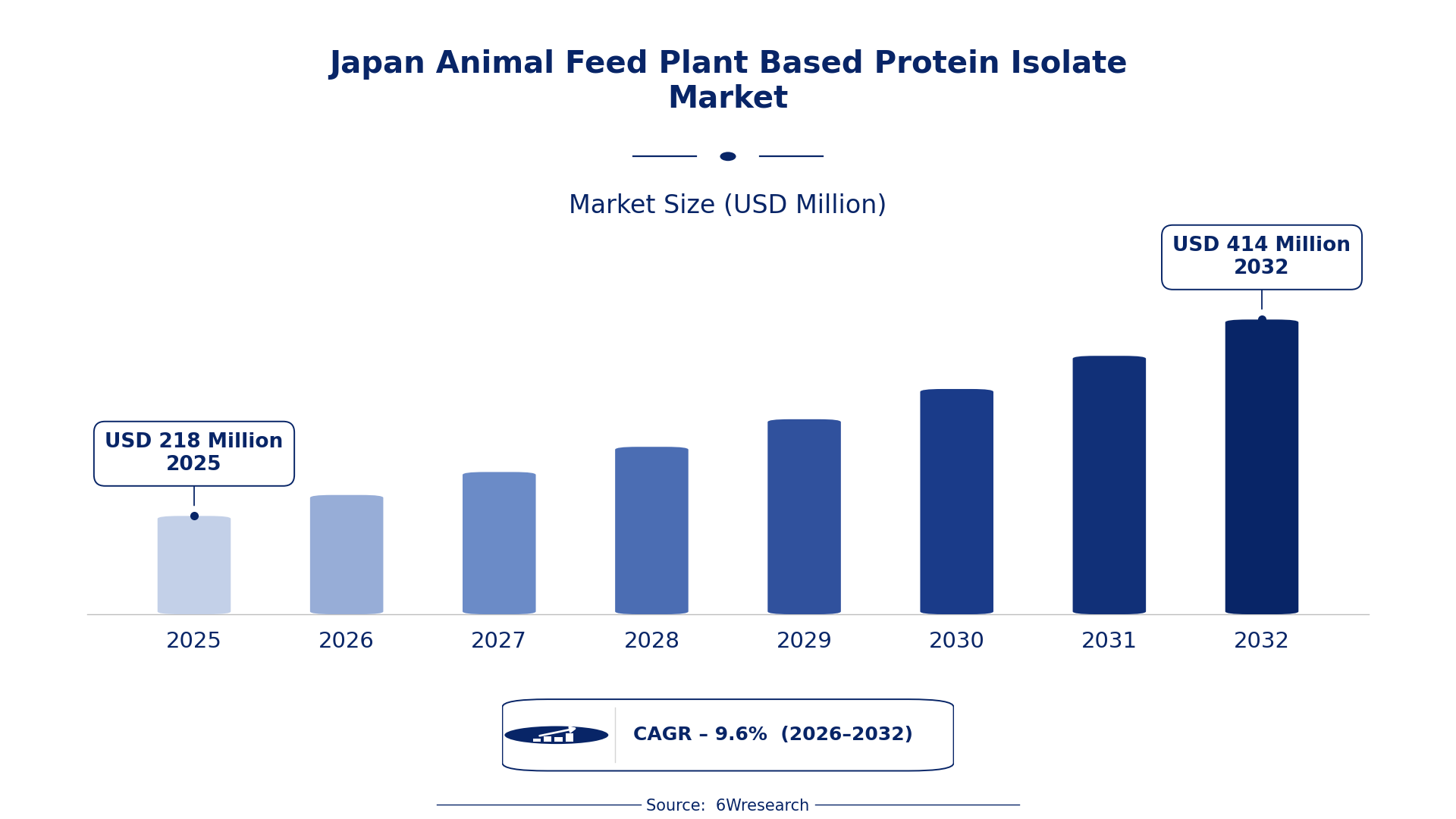
According to 6Wresearch internal database and industry insights, the Japan Animal Feed Plant Based Protein Isolate Market was valued at USD 218 Million in 2025 and is projected to reach USD 414 Million by 2032, growing at a CAGR of approximately 9.6% during 2026–2032.
Japan Animal Feed Plant Based Protein Isolate Market Highlights
| Report Metric | Details |
| Report Name | Japan Animal Feed Plant Based Protein Isolate Market (2026-2032) |
| Market Size 2025 | USD 218 Million |
| Market Size 2032 | USD 414 Million |
| Absolute Growth 2025–2032 | USD 196 Million |
| CAGR 2026–2032 | 9.6% |
| Peak Annual Growth | 10.7% in 2028 |
| Forecast Period | 2026–2032 |
| Historical Data | 2022–2025 |
| Base Year | 2025 |
| Leading Product Type, 2025 | Soy Protein Isolate (32% share) |
| Leading Protein Source, 2025 | Soy (44% share) |
| Leading Form, 2025 | Powder (43% share) |
| Leading Distribution Channel, 2025 | Direct Sales (40% share) |
| Leading End User, 2025 | Livestock Farms (39% share) |
| Fastest-Growing Product Type | Pea Protein (13.3% CAGR) |
| Fastest-Growing Protein Source | Pea (13.7% CAGR) |
| Fastest-Growing Form | Granules (14.1% CAGR) |
| Fastest-Growing Distribution Channel | Online Platforms (12.6% CAGR) |
| Fastest-Growing End User | Poultry Farms (12.2% CAGR) |
| Growing Sector | Livestock and Aquaculture |
| Key End Users | Livestock Farms, Poultry Farms, Dairy Farms, Aquaculture |
Japan Animal Feed Plant Based Protein Isolate Market Year-wise Growth Rate and Key Drivers (2022–2032)
This graph illustrates the annual growth rates of the market from 2022 to 2032, highlighting a steady upward trajectory and projected market expansion over the forecast period.
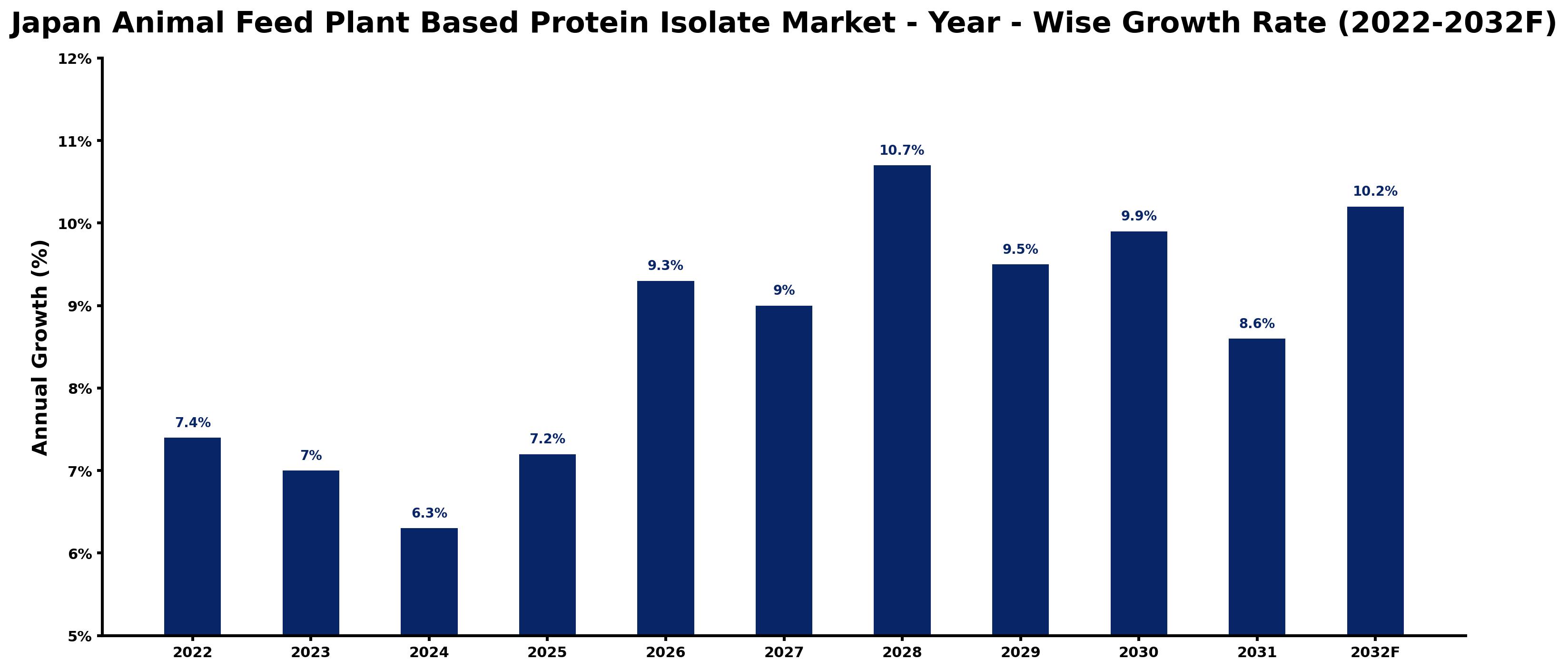
For each year, the table pairs the estimated growth rate with the leading influence on demand, showing how the drivers changed across the period.
| Year | Estimated Annual Growth (%) | Market Rationale |
| 2022 | 7.4 | The market showed strong growth due to high demand from livestock farms. |
| 2023 | 7.0 | Demand growth slowed slightly as market conditions stabilised after previous peaks. |
| 2024 | 6.3 | Growth continued to decelerate as the market adjusted to earlier expansions. |
| 2025 | 7.2 | A resurgence in demand from poultry farms contributed to faster growth. |
| 2026 | 9.3 | Increased adoption of plant-based proteins in aquaculture is expected to drive growth. |
| 2027 | 9.0 | Growth is projected to slow as the market begins to normalise after rapid expansion. |
| 2028 | 10.7 | The peak growth year will be driven by heightened demand for sustainable feed alternatives. |
| 2029 | 9.5 | Demand growth is expected to decelerate as the market matures and competition increases. |
| 2030 | 9.9 | Growth will pick up again as new facilities begin operation in the sector. |
| 2031 | 8.6 | A slight slowdown is projected as market conditions stabilise and mature. |
| 2032 | 10.2 | Continued growth is expected as the focus on sustainability intensifies. |
Note: Market size estimations and growth projections presented in this report are based on 6Wresearch's proprietary forecasting methodology, utilizing the latest available industry data, government publications, and primary research inputs.
Japan Animal Feed Plant Based Protein Isolate Market Synopsis
Animal Feed Plant Based Protein Isolate is derived from plant sources like soy and peas, processed to maximise protein content for animal nutrition. Its primary applications include improving growth rates and feed efficiency in livestock and aquaculture. The Japan Animal Feed Plant Based Protein Isolate Market is expanding due to rising demand from livestock farms, particularly for poultry, alongside government initiatives promoting sustainable feed alternatives. In 2023, a new programme was launched to support the adoption of plant-based proteins, further driving market growth.
Market Dynamics Impact Analysis (2026–2032)
| Factor | Type | Impact | Primary Segment Affected |
| Rising demand for sustainable feed alternatives | Driver | High | Soy Protein Isolate |
| Increased adoption of plant-based proteins in aquaculture | Driver | High | Pea Protein |
| Growing livestock sector valuing sustainable protein sources | Opportunity | High | Aquaculture |
| Emerging interest in plant-based proteins among poultry farms | Opportunity | High | Poultry Farms |
| Regulatory compliance costs for animal feed producers | Restraint | High | Soy Protein Isolate |
| Competition from traditional animal protein sources | Restraint | Medium | Pea Protein |
| High production costs for plant-based protein processing | Challenge | High | Algae Protein |
| Limited consumer awareness of plant-based feed benefits | Challenge | Medium | Mixed Plant Protein |
Evaluation of Drivers in Japan Animal Feed Plant Based Protein Isolate Market (2026–2032)
Key forces behind demand, with the segment each one moves most, are listed below.
| Drivers | Primary Segment Affected | Why It Matters (Evidence) |
| Increased livestock production | Soy Protein Isolate | The livestock sector in Japan, valued at approximately 1 trillion yen, drives demand for soy protein as a primary feed ingredient. |
| Sustainability initiatives in aquaculture | Pea Protein | Aquaculture production in Japan reached around 600,000 tons in 2022, increasing the demand for sustainable protein sources. |
| Nutritional benefits of plant-based proteins | Dairy Farms | Dairy farms commonly use soy protein isolate to improve milk production, contributing to the growth of the market. |
| Consumer preference for sustainable food sources | Poultry Farms | Poultry farms are increasingly adopting plant-based proteins due to lower environmental impacts compared to traditional feeds. |
| Government support for research on plant-based proteins | Aquaculture | The Japanese government promotes research on plant-based proteins, supporting their adoption in aquaculture. |
Behind the steady rise in orders sits the increasing livestock production in Japan, valued at approximately 1 trillion yen, which drives demand for soy protein isolate as a primary feed ingredient. The aquaculture sector is increasingly interested in sustainable protein sources, with production reaching around 600,000 tons in 2022. Dairy farms utilise soy protein isolate to improve milk production, further boosting the market. Poultry farms are adopting plant-based proteins due to their lower environmental impact, while ongoing research into these proteins supports their integration into aquaculture.
Evaluation of Restraints in Japan Animal Feed Plant Based Protein Isolate Market
The following restraints limit how fast demand can grow.
| Market Restraint | Primary Segment Affected | Why It Matters (Evidence) |
| High compliance costs for regulatory standards | Soy Protein Isolate | Producers face considerable expenses to meet JIS standards for animal feed quality and safety. |
| Competition from traditional protein sources | Pea Protein | Traditional animal proteins dominate the market, limiting the growth of plant-based alternatives. |
| Limited awareness of plant-based feed benefits | Algae Protein | Many farmers remain unaware of the advantages of incorporating algae protein into their feed. |
| Production costs for plant-based proteins | Mixed Plant Protein | High processing costs for plant-based proteins can deter some producers from switching from traditional sources. |
| Market maturity leading to slower growth | Soy Protein Isolate | As the market matures, growth rates are expected to stabilise, limiting rapid expansion. |
Japan Animal Feed Plant Based Protein Isolate Market Challenges
Availability of plant-based protein isolates is constrained by domestic production, which only meets part of the demand, causing delays for livestock farms. Rising production costs, driven by inflation and increased raw material prices, can inflate feed prices by up to 15%, straining budgets for producers. Technological limitations in extraction methods restrict efficiency, resulting in lower yields and higher costs for feed manufacturers. Intense competition from alternative protein sources, such as insect meal, threatens market share, compelling suppliers to innovate rapidly to maintain profitability.
Trends in the Japan Animal Feed Plant Based Protein Isolate Market
The trends below show where the Japan Animal Feed Plant Based Protein Isolate Market is heading.
- Shift Towards Sustainable Feed Solutions: In 2023, Japan launched a programme promoting sustainable animal feed alternatives, reflecting a growing trend. The livestock sector is increasingly adopting plant-based proteins, with the market for these solutions expected to reach USD 414 million by 2032.
- Rising Popularity of Pea Protein: Pea protein is gaining traction in Japan due to its lower environmental impact compared to soy. This shift is reflected as its market share is projected to grow at a CAGR of 13.7% through 2032.
- Transition from Traditional to Plant-Based Proteins: The livestock sector is moving from traditional animal proteins to plant-based options, driven by sustainability concerns. This change is supported by government initiatives aimed at promoting plant-based feed alternatives.
- Increase in Direct Sales Channels: Direct sales remain the dominant distribution channel, holding a 40% share in 2025. This trend is supported by the growing demand for plant-based protein isolates among livestock farms.
Investment Opportunities in the Japan Animal Feed Plant Based Protein Isolate Market
The following opportunities in the Japan Animal Feed Plant Based Protein Isolate Market pair current demand with a clear way in.
- Livestock Farms Seeking Sustainable Solutions: Livestock farms in Japan are increasingly looking for sustainable feed options, with the market for plant-based protein isolates projected to reach USD 414 million by 2032. Suppliers can enter this market through partnerships with local farms.
- Aquaculture Facilities Adopting Plant-Based Proteins: Aquaculture facilities are actively seeking sustainable protein sources to meet environmental goals. The growing demand for plant-based proteins presents an opportunity for suppliers to expand their offerings.
- Poultry Farms Embracing New Feed Solutions: Poultry farms are increasingly adopting plant-based proteins to improve feed efficiency. This trend creates opportunities for suppliers to invest in new protein formulations tailored for poultry.
- Emerging Online Platforms for Specialty Products: Online platforms are becoming a key distribution channel for specialty plant-based protein products. Suppliers can capitalise on this trend by establishing a strong online presence.
Government Initiatives in the Japan Animal Feed Plant Based Protein Isolate Market
The amendment to the Food Sanitation Act, fully applied in June 2021, mandates HACCP-based hygiene management for food businesses, improving safety standards for animal feed producers. This law complements the Industrial Standardization Act, which governs JIS product and test standards, ensuring quality in animal feed production.
The Digital Agency oversees the implementation of regulations for animal feed, approving new products and funding research initiatives. This agency plays an important role in promoting sustainable practices in the animal feed sector.
Future Insight of the Japan Animal Feed Plant Based Protein Isolate Market
Japan's 2023 programme promoting sustainable animal feed alternatives will drive the adoption of plant-based protein isolates in livestock nutrition. By 2032, advancements in extraction technology are expected to increase protein yields by 20%, benefiting producers. The government’s support for research into alternative protein sources will improve feed production quality and efficiency. As the livestock sector increasingly integrates plant-based proteins, suppliers will need to adjust their strategies to align with new sustainability standards.
Market Segmentation Analysis
Japan Animal Feed Plant Based Protein Isolate Market report covers a detailed analysis of the following market segments:
By Product Type – Soy Protein Isolate Leads, Pea Protein Expected to Grow Fastest
According to Vasu Joshi, Associate Consultant at 6Wresearch, the largest product type category in 2025 was Soy Protein Isolate, at 32% of revenue. Soy Protein Isolate holds the largest share as it is the primary protein source for livestock feed, particularly in poultry farming. This segment benefits from a well-established supply chain and strong demand from local farms adhering to JIS standards. The quickest growth will come from Pea Protein, forecast to expand at a CAGR of 13.3% between 2026 and 2032. Pea Protein is experiencing rapid growth due to its high digestibility and amino acid profile, appealing to environmentally conscious producers. The recent government programme promoting sustainable alternatives further accelerates its adoption in the market. Suppliers should focus on expanding their offerings in pea protein to capture the growing demand.
By Protein Source – Soy Leads, Pea Expected to Grow Fastest
With 44% of protein source revenue in 2025, Soy was the largest category. Soy holds the largest share in the market as it is the primary protein source for animal feed formulations, particularly in livestock farms. Its established use and familiarity among farmers in Japan solidify its dominant position. Over 2026–2032, Pea is expected to post the fastest growth, at a CAGR of 13.7%. Pea is experiencing rapid growth as a sustainable alternative, driven by rising environmental awareness and the government's backing for research into plant-based proteins. This trend is expected to accelerate as more farmers seek eco-friendly options. Suppliers should expand their product lines to include sustainable protein sources to align with market shifts.
By Form – Powder Leads, Granules Expected to Grow Fastest
Powder took 43% of form revenue in 2025, more than any other category. Powder is the leading form of protein isolate due to its ease of mixing in feed, making it the preferred choice among livestock farmers. Its widespread use across various animal nutrition applications reinforces its market dominance. Granules are projected to grow fastest, at a CAGR of 14.1% during 2026–2032. Granules are gaining traction as they cater to specific applications in animal feed, appealing to niche markets that require tailored solutions. This growth is likely to continue as demand for specialised feed formulations increases. Suppliers should consider developing granule products to meet the specific needs of targeted applications in the animal feed sector.
By Distribution Channel – Direct Sales Leads, Online Platforms Expected to Grow Fastest
Direct Sales accounted for 40% of the market by distribution channel in 2025. Direct Sales is the predominant distribution channel for farm supply, allowing farmers to purchase products directly from manufacturers. This approach ensures competitive pricing and direct access to product information, reinforcing its leading position in the market. Online Platforms are set to record the highest CAGR in this split, 12.6% over 2026–2032. Online Platforms are rapidly expanding as a distribution channel, catering to the increasing digitalisation of purchasing behaviours among farmers. The convenience and accessibility of online shopping are driving this segment's swift growth. Suppliers must strengthen their online sales strategies to capture the growing segment of digital consumers in the market.
By End User – Livestock Farms Lead, Poultry Farms Expected to Grow Fastest
In 2025, Livestock Farms led the end user split with a 39% share. Livestock Farms represent the primary consumers of protein isolates, employing these products extensively to improve growth rates and feed efficiency. The substantial livestock sector in Japan, valued at approximately 1 trillion yen, reinforces the significance of this user segment. The quickest growth will come from Poultry Farms, forecast to expand at a CAGR of 12.2% between 2026 and 2032. Poultry Farms are rapidly integrating plant-based proteins, motivated by their nutritional benefits and improved feed conversion rates. With Japan's aquaculture production reaching around 600,000 tons in 2022, the poultry segment is set for accelerated growth as demand for poultry increases. This indicates that suppliers should focus on the poultry sector to capitalise on the rising need for plant-based protein solutions.
Key Attractiveness of the Report
- 10 Years of Market Numbers
- Historical Data Starting from 2022 to 2025
- Base Year 2025
- Forecast Data until 2032
- Key Performance Indicators Impacting the Market
- Major Upcoming Developments and Projects
Key Highlights of the Report:
- Japan Animal Feed Plant Based Protein Isolate Market Outlook
- Market Size of Japan Animal Feed Plant Based Protein Isolate Market, 2025
- Forecast of Japan Animal Feed Plant Based Protein Isolate Market, 2032
- Historical Data and Forecast of Japan Animal Feed Plant Based Protein Isolate Market Revenues & Volume for the Period 2022-2032F
- Japan Animal Feed Plant Based Protein Isolate Market Trend Evolution
- Japan Animal Feed Plant Based Protein Isolate Market Drivers and Challenges
- Japan Animal Feed Plant Based Protein Isolate Market Price Trends
- Japan Animal Feed Plant Based Protein Isolate Market Porter's Five Forces
- Japan Animal Feed Plant Based Protein Isolate Market Industry Life Cycle
- Historical Data and Forecast of Japan Animal Feed Plant Based Protein Isolate Market Revenues & Volume By Product Type for the Period 2022-2032F
- Historical Data and Forecast of Japan Animal Feed Plant Based Protein Isolate Market Revenues & Volume By Soy Protein Isolate for the Period 2022-2032F
- Historical Data and Forecast of Japan Animal Feed Plant Based Protein Isolate Market Revenues & Volume By Pea Protein for the Period 2022-2032F
- Historical Data and Forecast of Japan Animal Feed Plant Based Protein Isolate Market Revenues & Volume By Algae Protein for the Period 2022-2032F
- Historical Data and Forecast of Japan Animal Feed Plant Based Protein Isolate Market Revenues & Volume By Mixed Plant Protein for the Period 2022-2032F
- Historical Data and Forecast of Japan Animal Feed Plant Based Protein Isolate Market Revenues & Volume By Protein Source for the Period 2022-2032F
- Historical Data and Forecast of Japan Animal Feed Plant Based Protein Isolate Market Revenues & Volume By Soy for the Period 2022-2032F
- Historical Data and Forecast of Japan Animal Feed Plant Based Protein Isolate Market Revenues & Volume By Pea for the Period 2022-2032F
- Historical Data and Forecast of Japan Animal Feed Plant Based Protein Isolate Market Revenues & Volume By Algae for the Period 2022-2032F
- Historical Data and Forecast of Japan Animal Feed Plant Based Protein Isolate Market Revenues & Volume By Multi-Source for the Period 2022-2032F
- Historical Data and Forecast of Japan Animal Feed Plant Based Protein Isolate Market Revenues & Volume By Form for the Period 2022-2032F
- Historical Data and Forecast of Japan Animal Feed Plant Based Protein Isolate Market Revenues & Volume By Powder for the Period 2022-2032F
- Historical Data and Forecast of Japan Animal Feed Plant Based Protein Isolate Market Revenues & Volume By Granules for the Period 2022-2032F
- Historical Data and Forecast of Japan Animal Feed Plant Based Protein Isolate Market Revenues & Volume By Pellets for the Period 2022-2032F
- Historical Data and Forecast of Japan Animal Feed Plant Based Protein Isolate Market Revenues & Volume By Meal for the Period 2022-2032F
- Historical Data and Forecast of Japan Animal Feed Plant Based Protein Isolate Market Revenues & Volume By Distribution Channel for the Period 2022-2032F
- Historical Data and Forecast of Japan Animal Feed Plant Based Protein Isolate Market Revenues & Volume By Direct Sales for the Period 2022-2032F
- Historical Data and Forecast of Japan Animal Feed Plant Based Protein Isolate Market Revenues & Volume By Online Platforms for the Period 2022-2032F
- Historical Data and Forecast of Japan Animal Feed Plant Based Protein Isolate Market Revenues & Volume By Distributors for the Period 2022-2032F
- Historical Data and Forecast of Japan Animal Feed Plant Based Protein Isolate Market Revenues & Volume By Specialty Suppliers for the Period 2022-2032F
- Historical Data and Forecast of Japan Animal Feed Plant Based Protein Isolate Market Revenues & Volume By End User for the Period 2022-2032F
- Historical Data and Forecast of Japan Animal Feed Plant Based Protein Isolate Market Revenues & Volume By Livestock Farms for the Period 2022-2032F
- Historical Data and Forecast of Japan Animal Feed Plant Based Protein Isolate Market Revenues & Volume By Poultry Farms for the Period 2022-2032F
- Historical Data and Forecast of Japan Animal Feed Plant Based Protein Isolate Market Revenues & Volume By Dairy Farms for the Period 2022-2032F
- Historical Data and Forecast of Japan Animal Feed Plant Based Protein Isolate Market Revenues & Volume By Aquaculture for the Period 2022-2032F
- Japan Animal Feed Plant Based Protein Isolate Market Import Export Trade Statistics
- Market Opportunity Assessment By Product Type
- Market Opportunity Assessment By Protein Source
- Market Opportunity Assessment By Form
- Market Opportunity Assessment By Distribution Channel
- Market Opportunity Assessment By End User
- Japan Animal Feed Plant Based Protein Isolate Market Top Companies Market Share
- Japan Animal Feed Plant Based Protein Isolate Market Competitive Benchmarking By Technical and Operational Parameters
- Japan Animal Feed Plant Based Protein Isolate Market Company Profiles
- Japan Animal Feed Plant Based Protein Isolate Market Key Strategic Recommendations
Market Covered
This report examines the market across the segments below.
By Product Type
- Soy Protein Isolate
- Pea Protein
- Algae Protein
- Mixed Plant Protein
By Protein Source
- Soy
- Pea
- Algae
- Multi-Source
By Form
- Powder
- Granules
- Pellets
- Meal
By Distribution Channel
- Direct Sales
- Online Platforms
- Distributors
- Specialty Suppliers
By End User
- Livestock Farms
- Poultry Farms
- Dairy Farms
- Aquaculture






































