Japan Antique Trade Market Size & Growth Rate
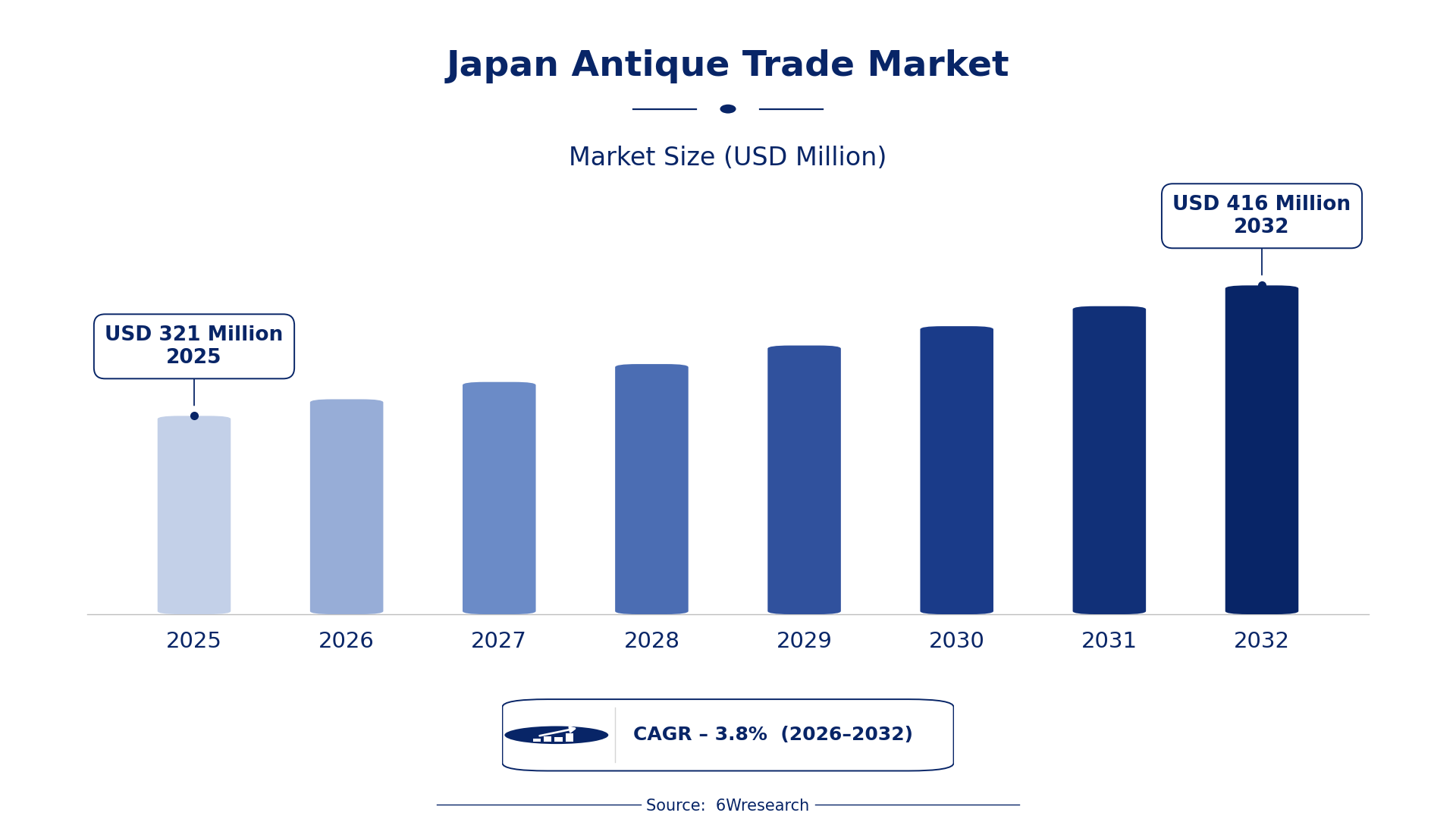
According to 6Wresearch internal database and industry insights, the Japan Antique Trade Market was valued at USD 321 Million in 2025 and is projected to reach USD 416 Million by 2032, growing at a CAGR of approximately 3.8% during 2026–2032.
Japan Antique Trade Market Highlights
| Report Metric | Details |
| Report Name | Japan Antique Trade Market (2026-2032) |
| Market Size 2025 | USD 321 Million |
| Market Size 2032 | USD 416 Million |
| Absolute Growth 2025–2032 | USD 95 Million |
| CAGR 2026–2032 | 3.8% |
| Peak Annual Growth | 4.7% in 2028 |
| Forecast Period | 2026–2032 |
| Historical Data | 2022–2025 |
| Base Year | 2025 |
| Leading Distribution Channel, 2025 | Online (54% share) |
| Growing Sector | Cultural preservation |
| Key End Users | Collectors, galleries, auction houses, cultural institutions |
Japan Antique Trade Market Year-wise Growth Rate and Key Drivers (2022–2032)
This graph illustrates the annual growth rates of the market from 2022 to 2032, highlighting a steady upward trajectory and projected market expansion over the forecast period.
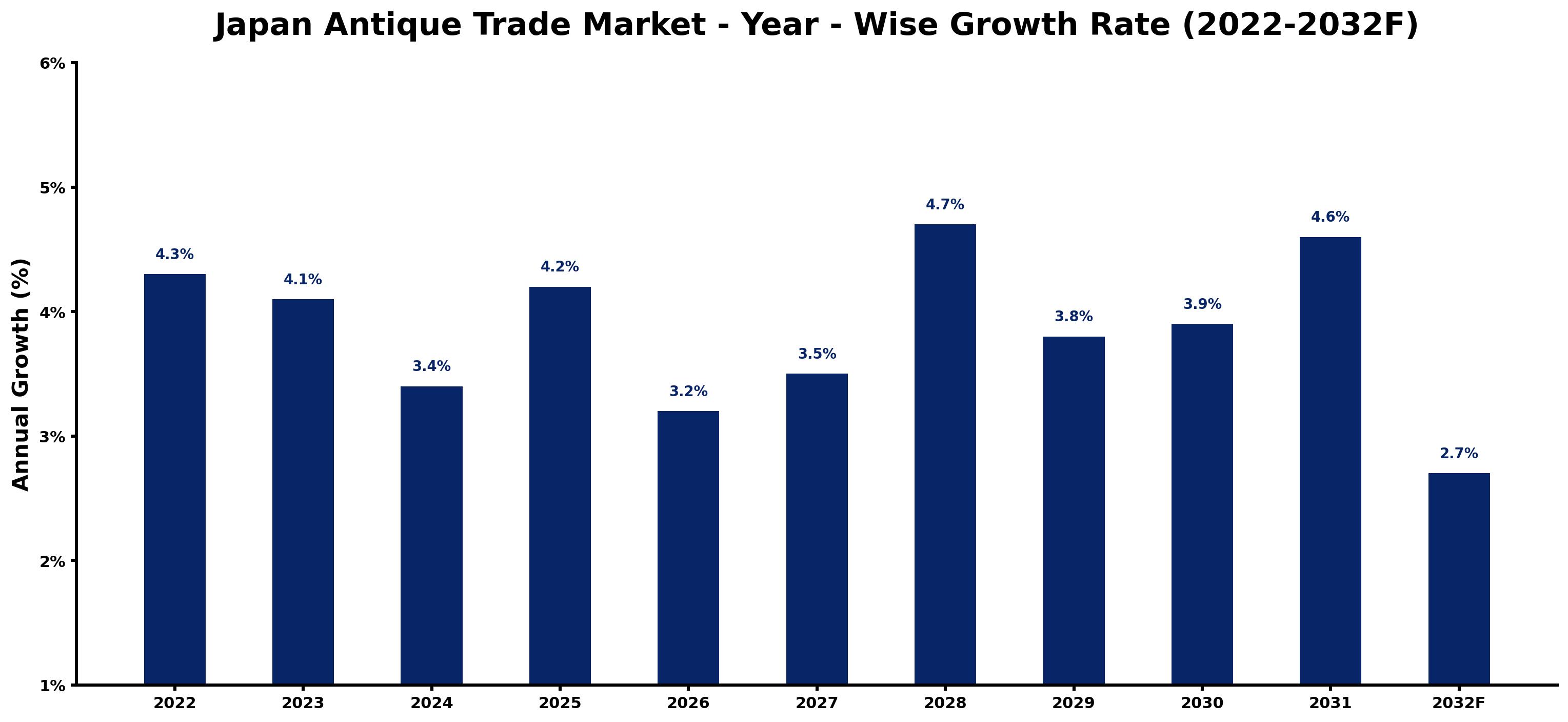
For each year, the table pairs the estimated growth rate with the leading influence on demand, showing how the drivers changed across the period.
| Year | Estimated Annual Growth (%) | Market Rationale |
| 2022 | 4.3 | The market experienced strong activity due to high collector interest and numerous auction events. |
| 2023 | 4.1 | Demand growth slowed as collectors became more discerning in their purchases. |
| 2024 | 3.4 | Market growth continued to decelerate as economic uncertainties affected consumer spending. |
| 2025 | 4.2 | Increased participation in online auctions stimulated renewed interest in antique acquisitions. |
| 2026 | 3.2 | Growth is expected to slow as the market adjusts to heightened online competition. |
| 2027 | 3.5 | Demand for unique collectibles is projected to rise, driving renewed interest among buyers. |
| 2028 | 4.7 | The peak growth year will see a surge in cultural tourism boosting antique purchases significantly. |
| 2029 | 3.8 | Growth is expected to slow as the market stabilises after the peak in 2028. |
| 2030 | 3.9 | Increased digital engagement will continue to support steady growth in online sales. |
| 2031 | 4.6 | Demand will rise again as collectors seek rare items in the marketplace. |
| 2032 | 2.7 | Growth is projected to slow as market saturation begins to affect new buyer engagement. |
Note: Market size estimations and growth projections presented in this report are based on 6Wresearch's proprietary forecasting methodology, utilizing the latest available industry data, government publications, and primary research inputs.
Japan Antique Trade Market Synopsis
The antique trade involves the buying and selling of vintage items, collectibles, and historical artifacts through auctions, galleries, and online platforms. This market is expanding as domestic collectors and international buyers drive demand. Factors such as increased digital engagement, cultural heritage tourism programmes, and a growing interest in unique collectibles are contributing to market growth, with online sales experiencing a notable increase of 15% in 2022, particularly in the Tokyo Metropolitan Area.
Market Dynamics Impact Analysis (2026–2032)
| Factor | Type | Impact | Primary Segment Affected |
| Growing interest in cultural heritage tourism | Driver | High | Online |
| Increased digital engagement in antique sales | Driver | High | Online |
| Rising number of registered antique dealers | Opportunity | Medium | Offline |
| Expansion of online platforms for antique sales | Opportunity | High | Online |
| Economic uncertainties affecting collector spending | Restraint | High | Offline |
| Competition from modern reproductions | Restraint | Medium | Offline |
| Challenges in authenticating antiques | Challenge | High | Offline |
| High costs associated with restoration and preservation | Challenge | Medium | Offline |
Evaluation of Drivers in Japan Antique Trade Market (2026–2032)
The main growth drivers and the segments they affect most are set out below.
| Drivers | Primary Segment Affected | Why It Matters (Evidence) |
| Increased digital engagement in antique sales | Online | Online antique sales grew by 15% in 2022, attracting more buyers through accessible platforms. |
| Cultural heritage tourism initiatives | Offline | The 2023 government programme promoting cultural heritage tourism is projected to boost local antique purchases. |
| Growing collector interest in unique items | Offline | The average age of antique collectors is around 60 years, indicating a stable demand for vintage items. |
| Expansion of online auction platforms | Online | The annual Tokyo Art Antique Fair attracts thousands of visitors, increasing interest in online bidding. |
| Increased number of registered antique dealers | Offline | With over 1,000 registered dealers in 2022, the market is becoming more competitive. |
Orders keep climbing as increased digital engagement in antique sales has led to a 15% growth in online sales in 2022. The average age of antique collectors in Japan is around 60 years, indicating a stable demand for vintage items. The annual Tokyo Art Antique Fair attracts thousands of visitors, stimulating interest in online bidding. With over 1,000 registered dealers in 2022, the market is becoming increasingly competitive.
Evaluation of Restraints in Japan Antique Trade Market
Several factors work against faster growth; the main ones are summarised below.
| Market Restraint | Primary Segment Affected | Why It Matters (Evidence) |
| Economic uncertainties affecting collector spending | Offline | Economic uncertainties have led to cautious spending among collectors, impacting overall sales and limiting market growth. |
| Challenges in authenticating antiques | Offline | Complex authentication processes can deter potential buyers, slowing transactions and reducing sales opportunities. |
| High costs associated with restoration and preservation | Offline | Restoration costs can be prohibitive, discouraging collectors from purchasing certain antiques and affecting market dynamics. |
| Competition from modern reproductions | Offline | The rise of modern reproductions poses a challenge to the authenticity of antique sales, impacting buyer confidence. |
| Limited awareness of antique value among younger buyers | Online | Younger buyers may lack knowledge of antique value, affecting their purchasing decisions and limiting market expansion. |
Japan Antique Trade Market Challenges
In Japan, producers encounter delays in selling historical artifacts due to stringent regulations overseen by the Antique Dealers Association, which can extend transaction times by several weeks and increase costs for over 1,000 registered dealers. Local importers face fierce competition from international online platforms, forcing them to lower prices and reducing profit margins by up to 20%. A shortage of skilled appraisers hampers accurate antique valuation, risking financial losses for buyers who may overpay. The average age of collectors is around 60 years, signalling a shrinking customer base that threatens future sales for all market players.
Trends in the Japan Antique Trade Market
The shifts below are changing how Japan Antique Trade Market products are bought and supplied.
- Shift Towards Online Platforms: The Tokyo Metropolitan Area is experiencing a shift towards online platforms for antique sales, with a 15% growth in online sales in 2022. This trend is making antiques more accessible to a broader audience.
- Increased Interest in Cultural Heritage: Domestic collectors are increasingly focused on cultural heritage, driven by the government's 2023 tourism programme. This initiative will improve the visibility and sales of local antiques.
- Growing Demand for Unique Collectibles: As collectors seek unique items, the average age of antique collectors around 60 years is driving demand for rare antiques that reflect personal history and culture.
- Expansion of Auction Events: The annual Tokyo Art Antique Fair, attracting thousands of visitors, has broadened its reach, encouraging more online participation and increasing overall sales.
Investment Opportunities in the Japan Antique Trade Market
Investors looking at the Japan Antique Trade Market should consider the following areas.
- Collectors Seeking Unique Items: Collectors in Japan are increasingly looking for unique antiques, with the market estimated at USD 321 million in 2025. Investing in rare collectibles can attract serious buyers seeking one-of-a-kind pieces.
- Partnerships with Local Artisans: With the Kyoto region known for traditional crafts, establishing partnerships with local artisans can improve product offerings and attract collectors. Collaborating can create unique items that appeal to the market.
- Digital Platforms for Wider Reach: The online antique market is growing, with a 15% increase in sales in 2022. Investing in digital platforms can help sellers reach a broader audience and improve sales opportunities.
- Cultural Heritage Tourism Initiatives: The 2023 government programme promoting cultural heritage tourism presents an opportunity for antique dealers to engage with tourists. By aligning offerings with this initiative, dealers can attract new customers.
Government Initiatives in the Japan Antique Trade Market
The Antique Trade Market in Japan is significantly influenced by the Cultural Property Protection Law, enacted in 1950, which mandates strict regulations for the preservation and trade of antiques. This law ensures that buyers must verify the authenticity and provenance of antiques, impacting their purchasing decisions. Additionally, the Industrial Standardization Act governs the standards for antique preservation, compelling producers to adhere to specific guidelines that improve the quality and marketability of their items.
The Consumer Affairs Agency oversees the enforcement of the Act against Unjustifiable Premiums and Misleading Representations, which protects buyers from deceptive practices in the antique trade. This agency approves regulations that ensure transparency in pricing and authenticity claims, building consumer confidence. The Digital Agency, established in September 2021, supports the digital transformation of the antique trade, facilitating online sales and expanding market reach for both buyers and sellers.
Future Insight of the Japan Antique Trade Market
By 2032, buyers will increasingly favour online platforms for antique purchases, reflecting a broader digital shift in consumer behaviour. The government's cultural heritage tourism programme will attract more international collectors, expanding market opportunities. The JIS Z 8401 standard will improve preservation practices, ensuring higher quality for buyers. With ¥500 million allocated for cultural property preservation, suppliers will gain enhanced support for maintaining the integrity of antiques.
Market Segmentation Analysis
Japan Antique Trade Market report covers a detailed analysis of the following market segments:
By Distribution Channel – Online Leads and Records the Fastest Growth
According to Ravi Bhandari, Research Head at 6Wresearch, Online took 54% of distribution channel revenue in 2025, more than any other category. The online segment commands the largest share because it provides a platform for a diverse range of buyers and sellers, facilitating easy access to unique antiques. The rise of various online platforms has enabled antique dealers to connect with customers well beyond their local markets. Online is also forecast to expand faster than any other category, at a CAGR of 4.8% over 2026–2032. Online sales are experiencing rapid growth, evidenced by a 15% increase in 2022 due to heightened digital engagement. As younger generations, who are more comfortable with technology, begin to participate in the antique market, this trend is expected to continue. This means that suppliers should prioritise their online strategies to effectively reach and engage the growing number of digital collectors.
Key Attractiveness of the Report
- 10 Years of Market Numbers
- Historical Data Starting from 2022 to 2025
- Base Year 2025
- Forecast Data until 2032
- Key Performance Indicators Impacting the Market
- Major Upcoming Developments and Projects
Key Highlights of the Report:
- Japan Antique Trade Market Outlook
- Market Size of Japan Antique Trade Market, 2025
- Forecast of Japan Antique Trade Market, 2032
- Historical Data and Forecast of Japan Antique Trade Revenues & Volume for the Period 2022-2032
- Japan Antique Trade Market Trend Evolution
- Japan Antique Trade Market Drivers and Challenges
- Japan Antique Trade Price Trends
- Japan Antique Trade Porter's Five Forces
- Japan Antique Trade Industry Life Cycle
- Historical Data and Forecast of Japan Antique Trade Market Revenues & Volume By Distribution Channel for the Period 2022-2032
- Historical Data and Forecast of Japan Antique Trade Market Revenues & Volume By Online for the Period 2022-2032
- Historical Data and Forecast of Japan Antique Trade Market Revenues & Volume By Offline for the Period 2022-2032
- Japan Antique Trade Import Export Trade Statistics
- Market Opportunity Assessment By Distribution Channel
- Japan Antique Trade Top Companies Market Share
- Japan Antique Trade Competitive Benchmarking By Technical and Operational Parameters
- Japan Antique Trade Company Profiles
- Japan Antique Trade Key Strategic Recommendations
Market Covered
This report examines the market across the segments below.
By Distribution Channel
- Online
- Offline































