Japan aquaculture fertilizer Market Size & Growth Rate
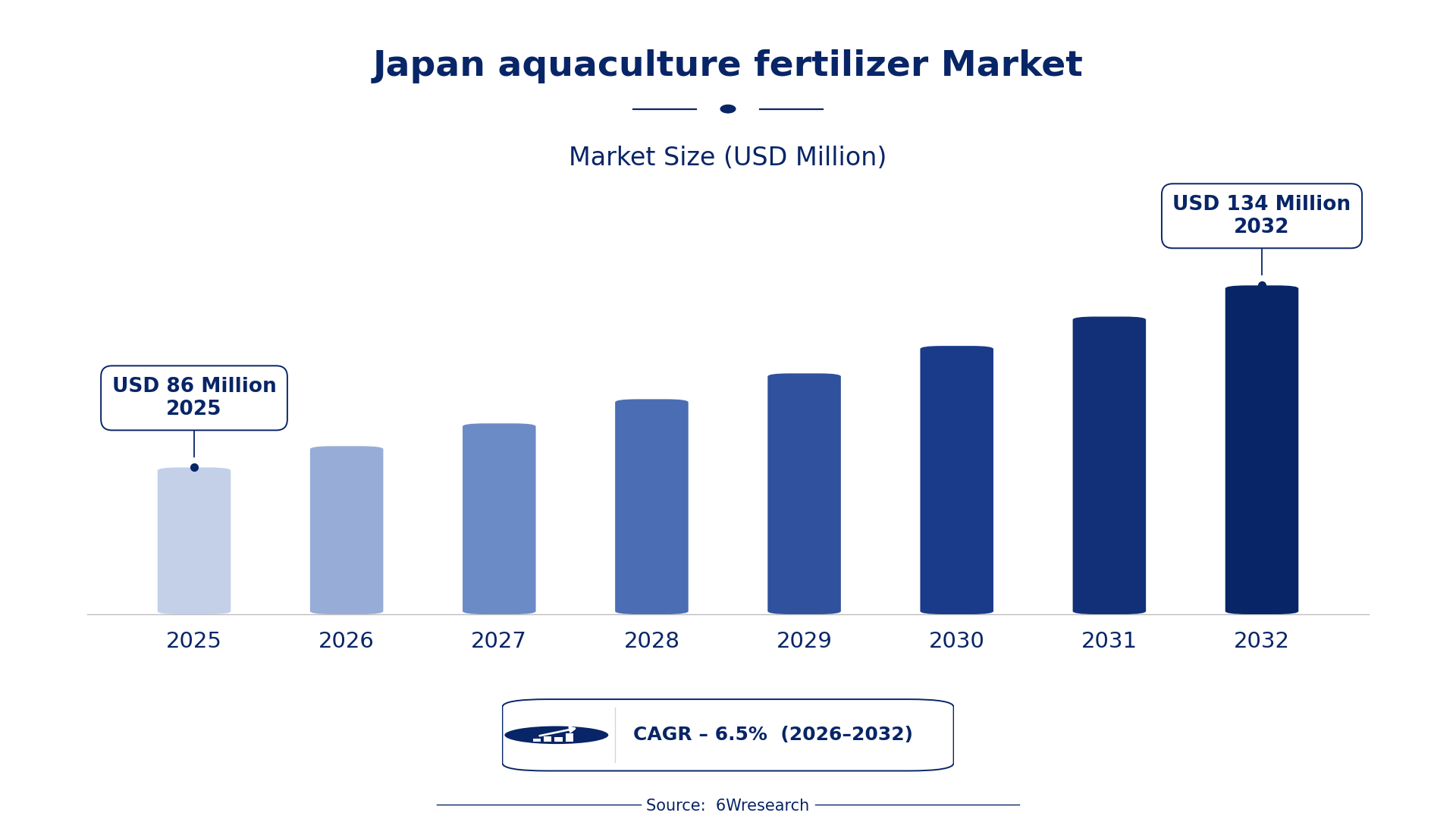
According to 6Wresearch internal database and industry insights, the Japan aquaculture fertilizer Market was valued at USD 86 Million in 2025 and is projected to reach USD 134 Million by 2032, growing at a CAGR of approximately 6.5% during 2026–2032.
Japan aquaculture fertilizer Market Highlights
| Report Metric | Details |
| Report Name | Japan aquaculture fertilizer Market (2026-2032) |
| Market Size 2025 | USD 86 Million |
| Market Size 2032 | USD 134 Million |
| Absolute Growth 2025–2032 | USD 48 Million |
| CAGR 2026–2032 | 6.5% |
| Peak Annual Growth | 7.5% in 2028 |
| Forecast Period | 2026–2032 |
| Historical Data | 2022–2025 |
| Base Year | 2025 |
| Leading Fertilizer Type, 2025 | Organic Fertilizers (50% share) |
| Leading Nutrient Type, 2025 | Nitrogen-rich (38% share) |
| Leading Application Area, 2025 | Fish Ponds (45% share) |
| Leading Distribution Channel, 2025 | Agro-dealers (51% share) |
| Leading End User, 2025 | Fish Farmers (44% share) |
| Fastest-Growing Fertilizer Type | Biofertilizers (9.4% CAGR) |
| Fastest-Growing Nutrient Type | Microbial (9.0% CAGR) |
| Fastest-Growing Application Area | Hatcheries (7.7% CAGR) |
| Fastest-Growing Distribution Channel | Online Platforms (8.6% CAGR) |
| Fastest-Growing End User | Hatchery Operators (8.3% CAGR) |
| Growing Sector | aquaculture |
| Key End Users | fish farmers, aquaculture farms, hatchery operators, aquaculture operators |
Japan aquaculture fertilizer Market Year-wise Growth Rate and Key Drivers (2022–2032)
This graph illustrates the annual growth rates of the market from 2022 to 2032, highlighting a steady upward trajectory and projected market expansion over the forecast period.
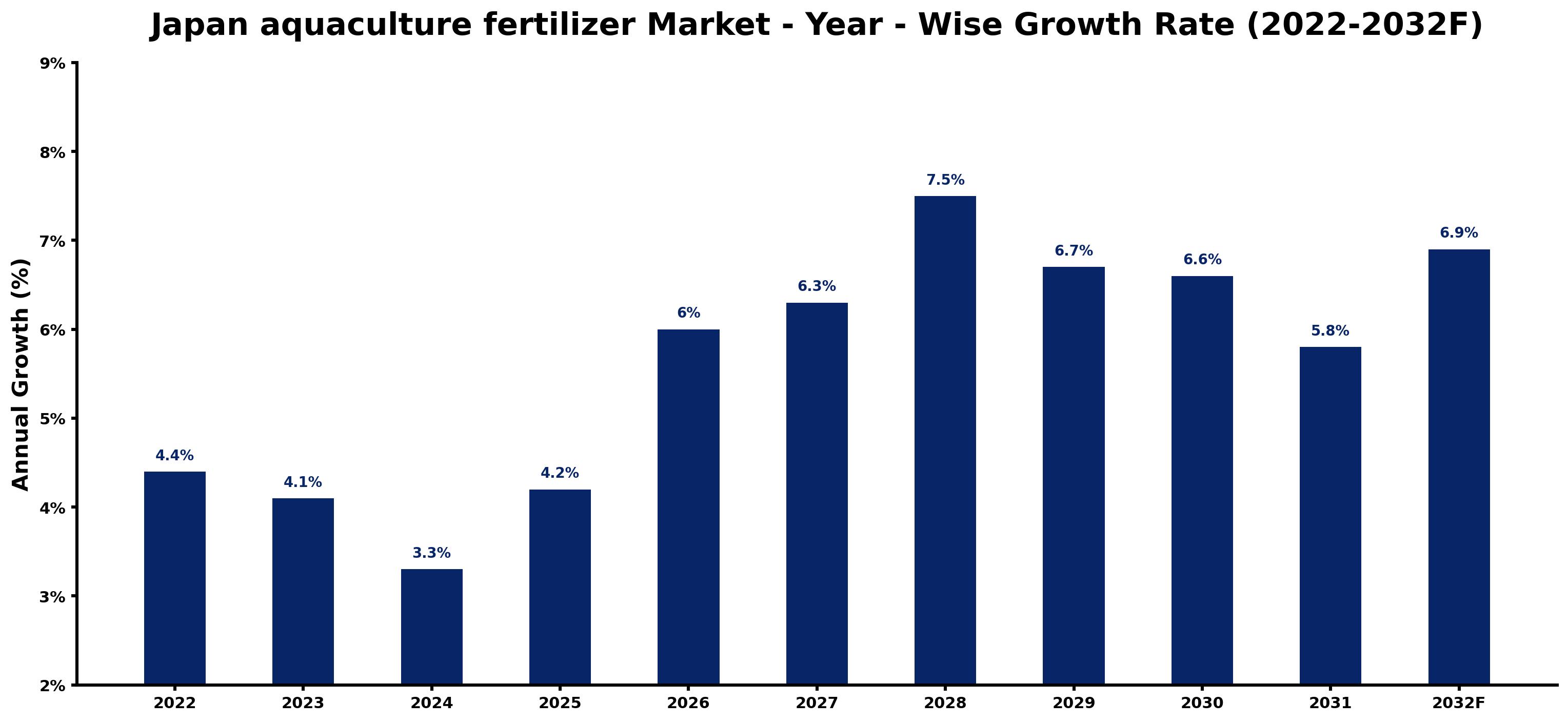
The table below sets out the estimated growth rate for each year and the main factor behind it.
| Year | Estimated Annual Growth (%) | Market Rationale |
| 2022 | 4.4 | Demand from fish farmers supported growth in aquaculture fertilizer use. |
| 2023 | 4.1 | Growth slowed as suppliers faced increased competition and market adjustments. |
| 2024 | 3.3 | Fish farmers continued to adapt to market conditions, resulting in further slowdown. |
| 2025 | 4.2 | An uptick in organic fertilizer adoption led to faster growth in this year. |
| 2026 | 6.0 | The introduction of new fertilizer types is expected to spur demand among aquaculture farms. |
| 2027 | 6.3 | Rising employment in the aquaculture sector is projected to contribute to market expansion. |
| 2028 | 7.5 | Peak annual growth will be driven by heightened demand for sustainable practices. |
| 2029 | 6.7 | Growth is expected to slow as market saturation begins to impact new purchases. |
| 2030 | 6.6 | The market will continue to grow but at a reduced rate due to increased costs. |
| 2031 | 5.8 | Growth is projected to slow as buyers focus on cost-effective solutions. |
| 2032 | 6.9 | A resurgence in demand for new fertilizers is expected to boost growth. |
Note: Market size estimations and growth projections presented in this report are based on 6Wresearch's proprietary forecasting methodology, utilizing the latest available industry data, government publications, and primary research inputs.
Japan aquaculture fertilizer Market Synopsis
Aquaculture fertilizers support the growth of aquatic organisms and improve water quality, primarily used by fish and shrimp farmers. The Japan Aquaculture Fertilizer Market is expanding due to rising seafood production, with the sector producing 1.5 million tons in 2022. The increasing adoption of organic fertilizers, now used in 30% of aquaculture farms, along with the Fisheries Agency's promotion of sustainable practices, are key factors driving this growth.
Market Dynamics Impact Analysis (2026–2032)
| Factor | Type | Impact | Primary Segment Affected |
| Rising seafood production | Driver | High | Organic Fertilizers |
| Increased adoption of organic fertilizers | Driver | High | Biofertilizers |
| Growing demand for sustainable aquaculture practices | Opportunity | High | Liquid Fertilizers |
| Expansion of online sales channels | Opportunity | Medium | Agro-dealers |
| High costs of raw materials | Restraint | High | Inorganic Fertilizers |
| Limited awareness of fertilizer benefits among farmers | Restraint | Medium | Biofertilizers |
| Compliance with updated JIS standards | Challenge | High | Liquid Fertilizers |
| Capacity constraints in production facilities | Challenge | Medium | Organic Fertilizers |
Evaluation of Drivers in Japan aquaculture fertilizer Market (2026–2032)
The factors lifting demand, and the evidence behind each, are summarised below.
| Drivers | Primary Segment Affected | Why It Matters (Evidence) |
| Increased seafood production in Japan | Organic Fertilizers | The aquaculture sector produced 1.5 million tons of seafood in 2022, driving demand for fertilizers. |
| Growing use of organic fertilizers | Biofertilizers | Organic fertilizers are now used in 30% of aquaculture farms, improving nutrient delivery. |
| Rising demand for sustainable practices | Liquid Fertilizers | The Fisheries Agency's promotion of sustainable aquaculture practices is leading to increased fertilizer use. |
| Expansion of online sales channels | Agro-dealers | Online sales of aquaculture fertilizers rose by 20% in 2023, allowing more farmers to access products. |
| Technological advancements in fertilizer formulations | Nitrogen-rich | Innovations in nitrogen-rich fertilizers are improving growth rates of aquatic organisms. |
Volumes grow on the back of increased seafood production, with the aquaculture sector producing 1.5 million tons in 2022, which drives fertilizer demand. The rising use of organic fertilizers is evident, as 30% of aquaculture farms have adopted them, enhancing nutrient delivery. The promotion of sustainable practices has led to increased use of liquid fertilizers, while advancements in fertilizer formulations are improving growth rates. The expansion of online sales channels, with a 20% rise in 2023, allows more farmers to access products conveniently.
Evaluation of Restraints in Japan aquaculture fertilizer Market
Below are the constraints most often cited by buyers and suppliers, with the segment each affects.
| Market Restraint | Primary Segment Affected | Why It Matters (Evidence) |
| High costs of raw materials | Inorganic Fertilizers | Rising prices for essential raw materials are limiting production capacity and increasing prices for buyers. |
| Limited awareness of fertilizer benefits among farmers | Biofertilizers | Many farmers remain unaware of the advantages of using biofertilizers, hindering market growth. |
| Compliance with updated JIS standards | Liquid Fertilizers | Producers must meet new JIS standards, increasing operational costs and delays. |
| Capacity constraints in production facilities | Organic Fertilizers | Limited production capacity is preventing suppliers from meeting the growing demand. |
| Market saturation in certain regions | Nitrogen-rich | Increased competition in established markets is slowing growth as suppliers vie for market share. |
Japan aquaculture fertilizer Market Challenges
Domestic fish farmers face inconsistent supply of aquaculture fertilizers, leading to potential harvest delays of up to three weeks. Suppliers struggle with outdated technology, which limits production efficiency and raises costs by 15%, directly impacting buyers' profit margins. Compliance with updated JIS standards introduces additional hurdles, causing delays that can disrupt operations for approximately 4,000 farms. Buyers also contend with fluctuating prices, compelling them to reduce production and reconsider investments, ultimately affecting the sustainability of their operations.
Trends in the Japan aquaculture fertilizer Market
The shifts below are changing how Japan aquaculture fertilizer Market products are bought and supplied.
- Rise in Organic Fertilizer Usage: Organic fertilizers are increasingly adopted in aquaculture, with 30% of farms using them in 2022. This shift supports sustainable practices and improves water quality.
- Growth of Online Sales Channels: Online platforms for aquaculture fertilizers have seen a 20% increase in sales in 2023, allowing farmers to access products more conveniently.
- Shift Towards Sustainable Practices: The Fisheries Agency's promotion of sustainable aquaculture practices is driving demand for eco-friendly fertilizers, aligning with global trends towards environmental responsibility.
- Increased Focus on Nutrient Management: Fish farmers are prioritising nutrient management, particularly in hatcheries, leading to a 7.7% CAGR in this application area as they seek to optimise production.
Investment Opportunities in the Japan aquaculture fertilizer Market
The following areas offer the clearest openings for investors and suppliers in the Japan aquaculture fertilizer Market.
- Partnerships with Local Suppliers: Collaborating with local suppliers can help companies penetrate the aquaculture market, especially in regions like Shizuoka, which has a strong aquaculture presence.
- Investment in Biofertilizers: With biofertilizers growing rapidly, investing in this segment offers potential, particularly among hatchery operators seeking sustainable solutions.
- Expansion in Online Sales: The rise in online sales, which grew by 20% in 2023, presents an opportunity for suppliers to reach fish farmers more effectively.
- Focus on Aquaculture Farms: Investing in products tailored for aquaculture farms, which are major consumers, can yield high returns as the sector continues to grow.
Government Initiatives in the Japan aquaculture fertilizer Market
The Economic Security Promotion Act, enacted in 2022, supports supply-chain resilience for critical products, including aquaculture fertilizers. This law complements previous regulations by ensuring that producers have access to necessary materials, thereby stabilising supply and supporting market growth.
The Fisheries Agency implements the Economic Security Promotion Act by funding initiatives that improve aquaculture practices. In 2023, the agency allocated ¥2 billion for development projects, benefiting over 4,000 aquaculture farms across Japan.
Future Insight of the Japan aquaculture fertilizer Market
By 2032, domestic fish farmers will increasingly adopt liquid fertilizers, projected to account for 25% of the market share, improving nutrient delivery. The Fisheries Agency's promotion of sustainable practices will drive the use of organic fertilizers, aligning with consumer demand for eco-friendly solutions. Technological advancements in aquaculture will improve production efficiency, reducing costs and boosting yields. The rise of online sales platforms will enable buyers to access a broader range of fertilizers, streamlining procurement and supporting sector growth.
Market Segmentation Analysis
Japan aquaculture fertilizer Market report covers a detailed analysis of the following market segments:
By Fertilizer Type – Organic Fertilizers Lead, Biofertilizers Expected to Grow Fastest
According to Ayushi Shukla, Senior Research Analyst at 6Wresearch, Organic Fertilizers held 50% of the Japan aquaculture fertilizer Market by fertilizer type in 2025. Organic fertilizers hold the largest market share as they improve soil and water quality in aquaculture systems, appealing to fish farmers focused on sustainability. With 30% of aquaculture farms in Japan using these fertilizers, their adoption underscores a commitment to eco-friendly practices. Over 2026–2032, Biofertilizers are expected to post the fastest growth, at a CAGR of 9.4%. Biofertilizers are experiencing rapid growth because they enhance microbial activity in water, crucial for maintaining optimal conditions in aquaculture. The Fisheries Agency of Japan's promotion of sustainable practices is significantly contributing to this segment's swift expansion. Suppliers should focus on developing organic and biofertilizer products to cater to the increasing demand from environmentally conscious fish farmers.
By Nutrient Type – Nitrogen-rich Leads, Microbial Expected to Grow Fastest
In 2025, Nitrogen-rich led the nutrient type split with a 38% share. Nitrogen-rich fertilizers dominate the market as they effectively support the growth of aquatic plants and organisms essential for fish farming. This nutrient type is vital for maintaining healthy ecosystems in fish ponds, which are the primary application areas for aquaculture. The quickest growth will come from Microbial, forecast to expand at a CAGR of 9.0% between 2026 and 2032. Microbial fertilizers are rapidly gaining popularity due to their role in enhancing water quality and nutrient cycling, which are critical for hatcheries. The rising awareness of sustainable practices among hatchery operators is significantly propelling this segment's growth. Buyers are likely to increasingly seek nitrogen-rich and microbial fertilizers to ensure optimal growth conditions in their aquaculture operations.
By Application Area – Fish Ponds Lead, Hatcheries Expected to Grow Fastest
Fish Ponds took 45% of application area revenue in 2025, more than any other category. Fish ponds are the leading application area for aquaculture fertilizers, as they are the primary environments where fish farming occurs. This segment benefits from the large number of aquaculture farms in Japan, which rely heavily on fertilizers to maintain productivity. Hatcheries are set to record the highest CAGR in this split, 7.7% over 2026–2032. Hatcheries are the fastest-growing application area as they support the early life stages of aquatic organisms, requiring specific nutrient inputs. The focus on breeding species like yellowtail and sea bream in hatcheries is driving this growth. Suppliers should tailor their products to meet the specific needs of hatcheries, which are becoming increasingly important in aquaculture.
By Distribution Channel – Agro-dealers Lead, Online Platforms Expected to Grow Fastest
The largest distribution channel category in 2025 was Agro-dealers, at 51% of revenue. Agro-dealers are the primary distribution channel for aquaculture fertilizers, connecting suppliers directly with fish farmers. Their established networks and expertise in agricultural products make them a reliable source for buyers in the market. Online Platforms are projected to grow fastest, at a CAGR of 8.6% during 2026–2032. Online platforms are quickly becoming a preferred distribution channel, with a reported 20% increase in online sales in the Tokyo region. This trend highlights a shift in purchasing behaviours among fish farmers towards more convenient and accessible options. Suppliers must enhance their online presence to effectively capture the growing segment of buyers who prefer digital purchasing options.
By End User – Fish Farmers Lead, Hatchery Operators Expected to Grow Fastest
With 44% of end user revenue in 2025, Fish Farmers was the largest category. Fish farmers constitute the largest end user group of aquaculture fertilizers, as they directly apply these products to boost their production. With over 100,000 people employed in the aquaculture industry, this group represents a significant market segment. Over 2026–2032, Hatchery Operators are expected to post the fastest growth, at a CAGR of 8.3%. Hatchery operators are the fastest-growing end user group, utilising fertilizers specifically for breeding and rearing aquatic organisms. The increasing focus on improving hatchery outputs is driving heightened demand for specialised fertilizers. Suppliers should consider developing targeted products for hatchery operators to capitalise on this expanding segment.
Key Attractiveness of the Report
- 10 Years of Market Numbers
- Historical Data Starting from 2022 to 2025
- Base Year 2025
- Forecast Data until 2032
- Key Performance Indicators Impacting the Market
- Major Upcoming Developments and Projects
Key Highlights of the Report:
- Japan aquaculture fertilizer Market Outlook
- Market Size of Japan aquaculture fertilizer Market, 2025
- Forecast of Japan aquaculture fertilizer Market, 2032
- Historical Data and Forecast of Japan aquaculture fertilizer market Revenues & Volume for the Period 2022-2032F
- Japan aquaculture fertilizer Market Trend Evolution
- Japan aquaculture fertilizer Market Drivers and Challenges
- Japan aquaculture fertilizer market Price Trends
- Japan aquaculture fertilizer market Porter's Five Forces
- Japan aquaculture fertilizer market Industry Life Cycle
- Historical Data and Forecast of Japan aquaculture fertilizer Market Revenues & Volume By Fertilizer Type for the Period 2022-2032F
- Historical Data and Forecast of Japan aquaculture fertilizer Market Revenues & Volume By Organic Fertilizers for the Period 2022-2032F
- Historical Data and Forecast of Japan aquaculture fertilizer Market Revenues & Volume By Inorganic Fertilizers for the Period 2022-2032F
- Historical Data and Forecast of Japan aquaculture fertilizer Market Revenues & Volume By Biofertilizers for the Period 2022-2032F
- Historical Data and Forecast of Japan aquaculture fertilizer Market Revenues & Volume By Liquid Fertilizers for the Period 2022-2032F
- Historical Data and Forecast of Japan aquaculture fertilizer Market Revenues & Volume By Nutrient Type for the Period 2022-2032F
- Historical Data and Forecast of Japan aquaculture fertilizer Market Revenues & Volume By Nitrogen-rich for the Period 2022-2032F
- Historical Data and Forecast of Japan aquaculture fertilizer Market Revenues & Volume By Phosphorus-based for the Period 2022-2032F
- Historical Data and Forecast of Japan aquaculture fertilizer Market Revenues & Volume By Microbial for the Period 2022-2032F
- Historical Data and Forecast of Japan aquaculture fertilizer Market Revenues & Volume By Mixed Nutrients for the Period 2022-2032F
- Historical Data and Forecast of Japan aquaculture fertilizer Market Revenues & Volume By Application Area for the Period 2022-2032F
- Historical Data and Forecast of Japan aquaculture fertilizer Market Revenues & Volume By Fish Ponds for the Period 2022-2032F
- Historical Data and Forecast of Japan aquaculture fertilizer Market Revenues & Volume By Shrimp Farming for the Period 2022-2032F
- Historical Data and Forecast of Japan aquaculture fertilizer Market Revenues & Volume By Hatcheries for the Period 2022-2032F
- Historical Data and Forecast of Japan aquaculture fertilizer Market Revenues & Volume By Algae Growth for the Period 2022-2032F
- Historical Data and Forecast of Japan aquaculture fertilizer Market Revenues & Volume By Distribution Channel for the Period 2022-2032F
- Historical Data and Forecast of Japan aquaculture fertilizer Market Revenues & Volume By Agro-dealers for the Period 2022-2032F
- Historical Data and Forecast of Japan aquaculture fertilizer Market Revenues & Volume By Direct Sales for the Period 2022-2032F
- Historical Data and Forecast of Japan aquaculture fertilizer Market Revenues & Volume By Cooperative Supply for the Period 2022-2032F
- Historical Data and Forecast of Japan aquaculture fertilizer Market Revenues & Volume By Online Platforms for the Period 2022-2032F
- Historical Data and Forecast of Japan aquaculture fertilizer Market Revenues & Volume By End User for the Period 2022-2032F
- Historical Data and Forecast of Japan aquaculture fertilizer Market Revenues & Volume By Fish Farmers for the Period 2022-2032F
- Historical Data and Forecast of Japan aquaculture fertilizer Market Revenues & Volume By Aquaculture Farms for the Period 2022-2032F
- Historical Data and Forecast of Japan aquaculture fertilizer Market Revenues & Volume By Hatchery Operators for the Period 2022-2032F
- Historical Data and Forecast of Japan aquaculture fertilizer Market Revenues & Volume By Aquaculture Operators for the Period 2022-2032F
- Japan aquaculture fertilizer market Import Export Trade Statistics
- Market Opportunity Assessment By Fertilizer Type
- Market Opportunity Assessment By Nutrient Type
- Market Opportunity Assessment By Application Area
- Market Opportunity Assessment By Distribution Channel
- Market Opportunity Assessment By End User
- Japan aquaculture fertilizer market Top Companies Market Share
- Japan aquaculture fertilizer market Competitive Benchmarking By Technical and Operational Parameters
- Japan aquaculture fertilizer market Company Profiles
- Japan aquaculture fertilizer market Key Strategic Recommendations
Market Covered
This report examines the market across the segments below.
By Fertilizer Type
- Organic Fertilizers
- Inorganic Fertilizers
- Biofertilizers
- Liquid Fertilizers
By Nutrient Type
- Nitrogen-rich
- Phosphorus-based
- Microbial
- Mixed Nutrients
By Application Area
- Fish Ponds
- Shrimp Farming
- Hatcheries
- Algae Growth
By Distribution Channel
- Agro-dealers
- Direct Sales
- Cooperative Supply
- Online Platforms
By End User
- Fish Farmers
- Aquaculture Farms
- Hatchery Operators
- Aquaculture Operators






































