Japan Aquaculture Monitoring Devices Market Size & Growth Rate
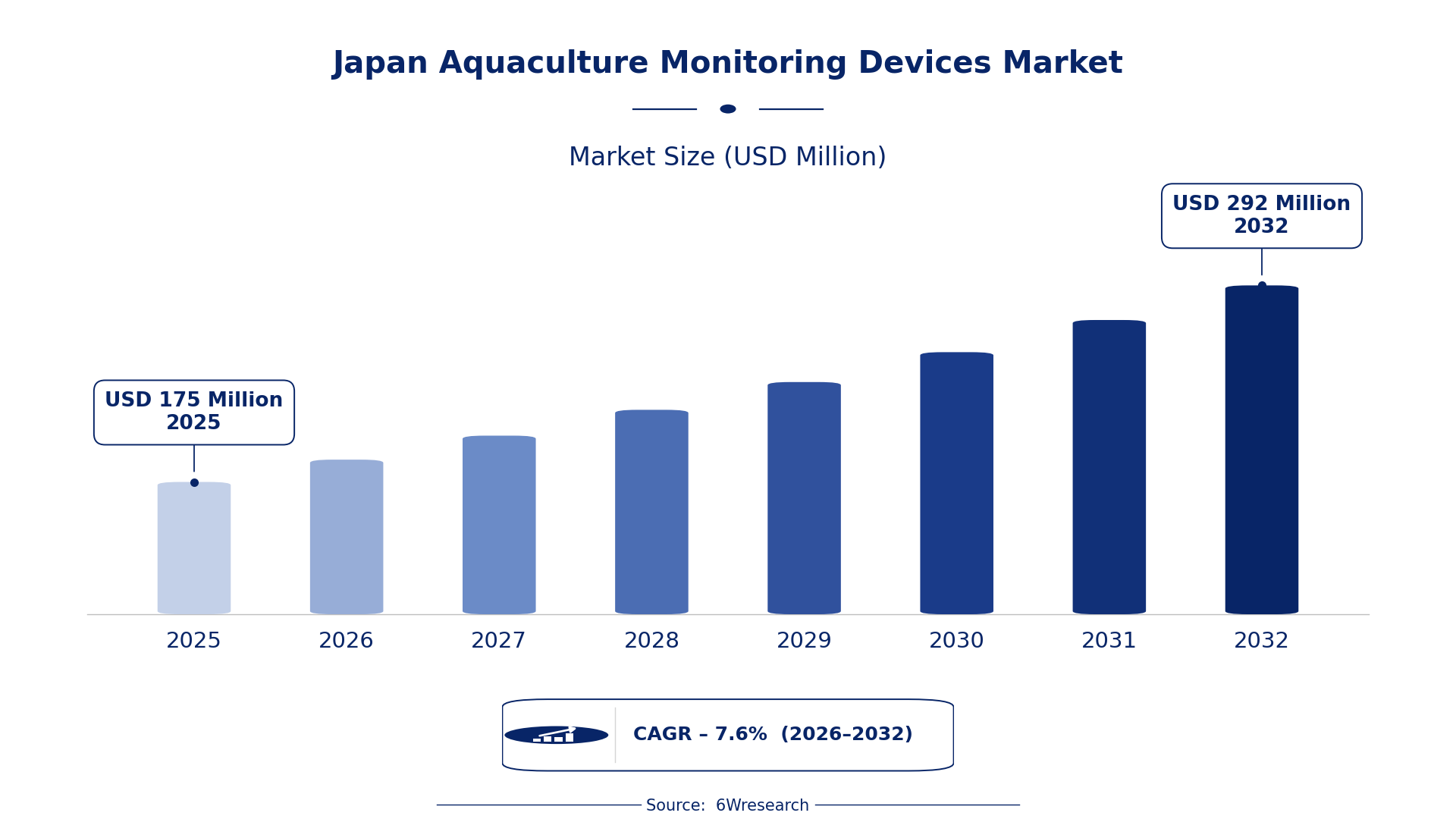
According to 6Wresearch internal database and industry insights, the Japan Aquaculture Monitoring Devices Market was valued at USD 175 Million in 2025 and is projected to reach USD 292 Million by 2032, growing at a CAGR of approximately 7.6% during 2026–2032.
Japan Aquaculture Monitoring Devices Market Highlights
| Report Metric | Details |
| Report Name | Japan Aquaculture Monitoring Devices Market (2026-2032) |
| Market Size 2025 | USD 175 Million |
| Market Size 2032 | USD 292 Million |
| Absolute Growth 2025–2032 | USD 117 Million |
| CAGR 2026–2032 | 7.6% |
| Peak Annual Growth | 8.5% in 2029 |
| Forecast Period | 2026–2032 |
| Historical Data | 2022–2025 |
| Base Year | 2025 |
| Leading Device Type, 2025 | Water Quality Sensors (45% share) |
| Leading Monitoring Parameter, 2025 | pH (41% share) |
| Leading Technology Used, 2025 | IoT + Wireless (48% share) |
| Leading Distribution Channel, 2025 | Equipment Distributors (43% share) |
| Leading End User Industry, 2025 | Aquaculture Firms (38% share) |
| Fastest-Growing Device Type | Camera Systems (10.7% CAGR) |
| Fastest-Growing Monitoring Parameter | Fish Behavior (10.3% CAGR) |
| Fastest-Growing Technology Used | Cloud Analytics (10.9% CAGR) |
| Fastest-Growing Distribution Channel | Online Stores (9.4% CAGR) |
| Fastest-Growing End User Industry | Smart Aquafarms (9.8% CAGR) |
| Growing Sector | Aquaculture |
| Key End Users | Aquaculture Firms, Research Labs, Shrimp Farms, Smart Aquafarms |
Japan Aquaculture Monitoring Devices Market Year-wise Growth Rate and Key Drivers (2022–2032)
This graph illustrates the annual growth rates of the market from 2022 to 2032, highlighting a steady upward trajectory and projected market expansion over the forecast period.
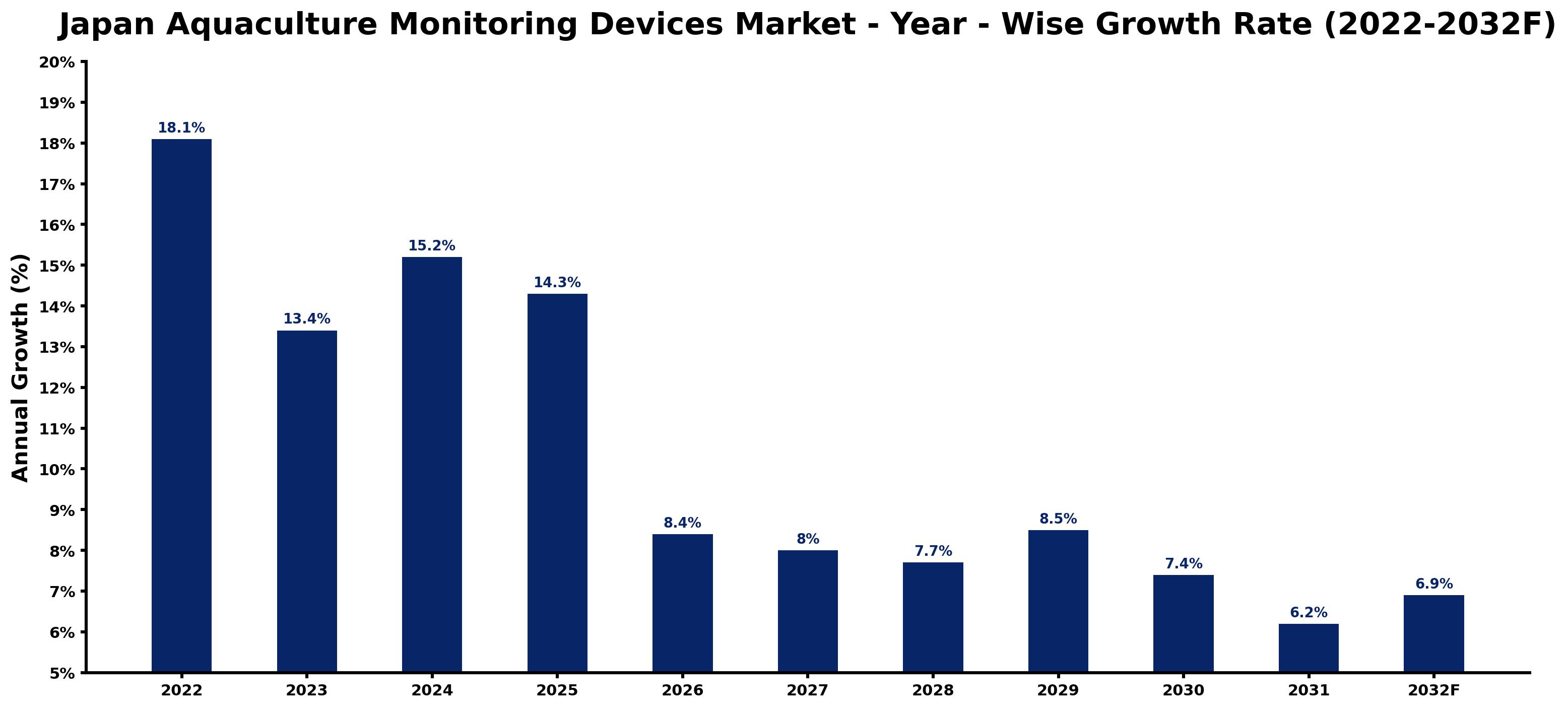
The yearly estimates that follow link every growth rate to its principal driver, so readers can see why the pace changed in each period.
| Year | Estimated Annual Growth (%) | Market Rationale |
| 2022 | 18.1 | The market experienced strong demand due to increased aquaculture production. |
| 2023 | 13.4 | Growth slowed as firms adjusted to new technologies and market conditions. |
| 2024 | 15.2 | Demand picked up as aquaculture firms invested in advanced monitoring solutions. |
| 2025 | 14.3 | The market continued to grow as firms sought to optimise feeding efficiency. |
| 2026 | 8.4 | Growth is expected to slow as market saturation begins to affect new technology adoption. |
| 2027 | 8.0 | Growth will decelerate as firms focus on cost management strategies. |
| 2028 | 7.7 | Demand is projected to remain steady as the industry adapts to evolving environmental conditions. |
| 2029 | 8.5 | Growth is expected to accelerate again as firms embrace IoT technologies for monitoring. |
| 2030 | 7.4 | A slowdown will occur as competition intensifies among technology providers. |
| 2031 | 6.2 | Growth will continue to slow as market conditions stabilise and mature. |
| 2032 | 6.9 | Demand is expected to rise as sustainability becomes a priority in aquaculture. |
Note: Market size estimations and growth projections presented in this report are based on 6Wresearch's proprietary forecasting methodology, utilizing the latest available industry data, government publications, and primary research inputs.
Japan Aquaculture Monitoring Devices Market Synopsis
Aquaculture monitoring devices are essential tools for managing aquatic environments in fish farming, utilising sensors, cameras, and data analytics technologies. The Japan Aquaculture Monitoring Devices Market is expanding, supported by over 1,000 domestic firms and research labs focusing on sustainable practices. The adoption of IoT technologies is increasing, with the Ministry of Agriculture, Forestry and Fisheries backing innovation programs. This growth is driven by rising demand for water quality sensors and feeding systems, which are vital for optimising production and ensuring environmental health.
Market Dynamics Impact Analysis (2026–2032)
| Factor | Type | Impact | Primary Segment Affected |
| Rising adoption of IoT technologies | Driver | High | Water Quality Sensors |
| Increased focus on sustainable aquaculture practices | Driver | High | Feeding Systems |
| Growing need for real-time monitoring solutions | Opportunity | High | IoT + Wireless |
| Expansion of aquaculture firms in key regions | Opportunity | High | Aquaculture Firms |
| Limited awareness of advanced technologies | Restraint | Medium | Camera Systems |
| High initial investment costs for advanced monitoring devices | Restraint | High | Data Loggers |
| Competition from alternative aquaculture practices | Challenge | Medium | Feeding Systems |
| Technological obsolescence due to rapid advancements | Challenge | High | Water Quality Sensors |
Evaluation of Drivers in Japan Aquaculture Monitoring Devices Market (2026–2032)
The following drivers explain most of the expected growth.
| Drivers | Primary Segment Affected | Why It Matters (Evidence) |
| Increased aquaculture production | Water Quality Sensors | Japan's aquaculture production reached 600,000 tons in 2022, driving demand for monitoring devices. |
| Focus on optimising feed usage | Feeding Systems | Shrimp farms produce 100,000 tons annually, necessitating efficient feeding systems. |
| Growing interest in sustainable practices | Data Loggers | Research labs in Japan focus on sustainable aquaculture practices, increasing demand for data logging solutions. |
| Technological advancements in monitoring | IoT + Wireless | Aquaculture firms are adopting IoT technologies at a rate of 30% annually, improving monitoring capabilities. |
| Rising environmental concerns | Camera Systems | Environmental monitoring is a key focus in Japan's aquaculture strategy, boosting demand for camera systems. |
What keeps demand rising is the increased aquaculture production, which reached 600,000 tons in 2022, prompting firms to invest in monitoring devices. Optimising feed usage is particularly important in shrimp farms that produce substantial quantities annually, which drives the need for feeding systems. Research labs are focusing on sustainable practices, resulting in heightened demand for data loggers. The growing adoption of IoT technologies enables real-time monitoring and improves operational efficiency. Environmental concerns are also motivating aquaculture firms to seek camera systems for effective management of aquatic health.
Evaluation of Restraints in Japan Aquaculture Monitoring Devices Market
The following restraints limit how fast demand can grow.
| Market Restraint | Primary Segment Affected | Why It Matters (Evidence) |
| Limited awareness of advanced technologies | Camera Systems | Many aquaculture firms lack knowledge about the benefits of advanced monitoring technologies, hindering adoption. |
| High initial investment costs | Data Loggers | The upfront costs associated with data loggers deter smaller firms from investing in advanced solutions. |
| Resistance to change in traditional practices | Feeding Systems | Some aquaculture firms prefer traditional methods, limiting the uptake of modern feeding systems. |
| Regulatory hurdles for new technologies | Water Quality Sensors | Compliance with standards can delay the introduction of new monitoring devices. |
| Market saturation in certain regions | IoT + Wireless | In key aquaculture areas, the market is becoming saturated, slowing growth for IoT solutions. |
Japan Aquaculture Monitoring Devices Market Challenges
Aquaculture firms face a shortage of skilled technicians, which hampers their ability to implement advanced monitoring systems effectively. This issue arises from Japan's ageing population, with 29.3% of citizens aged 65 or older, leading to fewer young professionals entering the workforce. Suppliers encounter challenges with technology adoption, as only 30% of firms are integrating IoT solutions annually, delaying the deployment of efficient systems. High costs of advanced monitoring devices can consume up to 15% of operational budgets for smaller firms, restricting their competitiveness in the market. Increased competition from international players forces local producers to reduce prices, adversely impacting their profit margins.
Trends in the Japan Aquaculture Monitoring Devices Market
Several trends are reshaping the Japan Aquaculture Monitoring Devices Market; the most important are set out below.
- Shift from Manual to Automated Monitoring: The aquaculture sector is increasingly adopting IoT technologies for real-time monitoring, as observed in Ibaraki Prefecture, where adoption rates are rising by 30% annually.
- Transition to Automated Feeding Systems: Aquaculture firms are incorporating automated timers into feeding systems, particularly in shrimp farms, which produce 100,000 tons annually, improving efficiency and minimising waste.
- Emergence of Cloud Analytics for Data Management: Cloud analytics is becoming crucial for data management in aquaculture, with usage increasing in Tokyo Bay area research labs, improving data accessibility and analysis.
- Prioritisation of Environmental Monitoring: Environmental monitoring has become a key focus in Japan, driven by the Fisheries Agency's initiatives, resulting in increased demand for water quality sensors.
Investment Opportunities in the Japan Aquaculture Monitoring Devices Market
The opportunities below stand out in the Japan Aquaculture Monitoring Devices Market for new entrants and existing suppliers.
- Gap in Advanced Monitoring Solutions: With aquaculture production reaching 600,000 tons, there exists a gap in advanced monitoring solutions, particularly in Ibaraki Prefecture, where firms can invest in new technologies.
- Need for Enhanced Feeding Efficiency: The shrimp farming sector, producing 100,000 tons annually, requires improved feeding systems, creating an opportunity for suppliers to develop effective solutions.
- Growing Demand for Sustainable Practices: As research labs concentrate on sustainability, there is a rising demand for data loggers, especially among aquaculture firms aiming to improve their practices.
- Expansion of Smart Aquafarms: With the aquaculture market expanding, investment in smart aquafarms is essential, particularly as firms seek to adopt IoT technologies for enhanced efficiency.
Government Initiatives in the Japan Aquaculture Monitoring Devices Market
The PMD Act, established in 2014, regulates the approval and quality of medical devices, including aquaculture monitoring devices, ensuring compliance with safety standards. This legislation complements the Industrial Standardization Act, which governs product standards, thereby enhancing consumer trust in these technologies.
Aquaculture firms benefit from the Ministry of Agriculture, Forestry and Fisheries' innovation programmes, which provide funding for the adoption of advanced monitoring devices. This support encourages firms to invest in technologies that improve sustainability and efficiency.
Future Insight of the Japan Aquaculture Monitoring Devices Market
By 2032, government support will drive a transformation in Japan's aquaculture sector, encouraging technology adoption and innovation. As firms increasingly implement IoT solutions, aquaculture production could exceed 800,000 tons, significantly boosting supply capabilities. Research initiatives will prioritise sustainable practices, making environmental monitoring critical for operational success. The adoption of automated feeding systems will streamline resource management, benefiting both buyers and suppliers by increasing efficiency and reducing waste.
Market Segmentation Analysis
Japan Aquaculture Monitoring Devices Market report covers a detailed analysis of the following market segments:
By Device Type – Water Quality Sensors Lead, Camera Systems Expected to Grow Fastest
According to Saurav Kr Singh, Senior Research Analyst at 6Wresearch, the largest device type category in 2025 was Water Quality Sensors, at 45% of revenue. Water quality sensors are crucial for maintaining aquatic health, making them indispensable for aquaculture firms. Their extensive application is particularly noticeable in the Ibaraki Prefecture, a significant centre for aquaculture activities. Camera Systems are set to record the highest CAGR in this split, 10.7% over 2026–2032. Camera systems are rapidly gaining popularity as they provide essential insights into fish behaviour, which is vital for effective management. This trend is supported by the industry's transition towards advanced monitoring technologies, which enhances operational efficiency. Suppliers should focus on improving camera system offerings to meet the rising demand.
By Monitoring Parameter – pH Leads, Fish Behavior Expected to Grow Fastest
pH accounted for 41% of the market by monitoring parameter in 2025. Monitoring pH levels is essential for ensuring water quality, which directly affects the health of aquatic life. This parameter is a primary concern for aquaculture firms throughout Japan, highlighting its importance in maintaining optimal farming conditions. Fish Behavior is projected to grow fastest, at a CAGR of 10.3% during 2026–2032. The focus on monitoring fish behaviour is increasing as research labs seek to gain deeper insights into aquatic life. This trend is reinforced by initiatives from the National Fisheries University, which underscores the need for advanced observational tools. Buyers will benefit from investing in technologies that enhance fish behaviour monitoring capabilities.
By Technology Used – IoT + Wireless Leads, Cloud Analytics Expected to Grow Fastest
In 2025, IoT + Wireless led the technology used split with a 48% share. IoT and wireless technologies enable real-time monitoring, making them the preferred choice among aquaculture firms. Their ability to provide immediate data on aquatic environments is particularly valuable in regions with intensive aquaculture practices. Over 2026–2032, Cloud Analytics is expected to post the fastest growth, at a CAGR of 10.9%. Cloud analytics is becoming increasingly vital as it supports efficient data management and analysis in aquaculture. The industry's shift towards data-driven decision-making is significantly accelerating the growth of this technology. Suppliers must prioritise cloud analytics solutions to address the evolving needs of aquaculture businesses.
By Distribution Channel – Equipment Distributors Lead, Online Stores Expected to Grow Fastest
Equipment Distributors took 43% of distribution channel revenue in 2025, more than any other category. Equipment distributors serve as the main channel for aquaculture monitoring devices, ensuring that firms have access to essential technologies. Their established networks facilitate the distribution of critical equipment across Japan's aquaculture sector. The quickest growth will come from Online Stores, forecast to expand at a CAGR of 9.4% between 2026 and 2032. Online stores are emerging as a rapidly expanding channel, providing easier access for aquaculture firms to purchase monitoring devices. This trend reflects the increasing digitalisation of the procurement process within the industry. Suppliers should enhance their online presence to capture the growing market share through digital sales channels.
By End User Industry – Aquaculture Firms Lead, Smart Aquafarms Expected to Grow Fastest
Aquaculture Firms held 38% of the Japan Aquaculture Monitoring Devices Market by end user industry in 2025. Aquaculture firms are the primary users of monitoring devices, as they require these tools to maintain productivity and sustainability in fish farming. Their substantial contribution to Japan's aquaculture production underscores their central role in this market. Smart Aquafarms are set to record the highest CAGR in this split, 9.8% over 2026–2032. Smart aquafarms are quickly gaining traction as they integrate advanced technologies for improved management. This trend indicates a shift towards more sustainable and efficient farming practices within the industry. Suppliers should tailor their offerings to meet the specific needs of smart aquafarms.
Key Attractiveness of the Report
- 10 Years of Market Numbers
- Historical Data Starting from 2022 to 2025
- Base Year 2025
- Forecast Data until 2032
- Key Performance Indicators Impacting the Market
- Major Upcoming Developments and Projects
Key Highlights of the Report:
- Japan Aquaculture Monitoring Devices Market Outlook
- Market Size of Japan Aquaculture Monitoring Devices Market, 2025
- Forecast of Japan Aquaculture Monitoring Devices Market, 2032
- Historical Data and Forecast of Japan Aquaculture Monitoring Devices Revenues & Volume for the Period 2022-2032F
- Japan Aquaculture Monitoring Devices Market Trend Evolution
- Japan Aquaculture Monitoring Devices Market Drivers and Challenges
- Japan Aquaculture Monitoring Devices Price Trends
- Japan Aquaculture Monitoring Devices Porter's Five Forces
- Japan Aquaculture Monitoring Devices Industry Life Cycle
- Historical Data and Forecast of Japan Aquaculture Monitoring Devices Market Revenues & Volume By Device Type for the Period 2022-2032F
- Historical Data and Forecast of Japan Aquaculture Monitoring Devices Market Revenues & Volume By Water Quality Sensors for the Period 2022-2032F
- Historical Data and Forecast of Japan Aquaculture Monitoring Devices Market Revenues & Volume By Feeding Systems for the Period 2022-2032F
- Historical Data and Forecast of Japan Aquaculture Monitoring Devices Market Revenues & Volume By Camera Systems for the Period 2022-2032F
- Historical Data and Forecast of Japan Aquaculture Monitoring Devices Market Revenues & Volume By Data Loggers for the Period 2022-2032F
- Historical Data and Forecast of Japan Aquaculture Monitoring Devices Market Revenues & Volume By Monitoring Parameter for the Period 2022-2032F
- Historical Data and Forecast of Japan Aquaculture Monitoring Devices Market Revenues & Volume By pH, DO, Salinity for the Period 2022-2032F
- Historical Data and Forecast of Japan Aquaculture Monitoring Devices Market Revenues & Volume By Feed Dispersion for the Period 2022-2032F
- Historical Data and Forecast of Japan Aquaculture Monitoring Devices Market Revenues & Volume By Fish Behavior for the Period 2022-2032F
- Historical Data and Forecast of Japan Aquaculture Monitoring Devices Market Revenues & Volume By Environmental Data for the Period 2022-2032F
- Historical Data and Forecast of Japan Aquaculture Monitoring Devices Market Revenues & Volume By Technology Used for the Period 2022-2032F
- Historical Data and Forecast of Japan Aquaculture Monitoring Devices Market Revenues & Volume By IoT + Wireless for the Period 2022-2032F
- Historical Data and Forecast of Japan Aquaculture Monitoring Devices Market Revenues & Volume By Automated Timers for the Period 2022-2032F
- Historical Data and Forecast of Japan Aquaculture Monitoring Devices Market Revenues & Volume By Underwater Imaging for the Period 2022-2032F
- Historical Data and Forecast of Japan Aquaculture Monitoring Devices Market Revenues & Volume By Cloud Analytics for the Period 2022-2032F
- Historical Data and Forecast of Japan Aquaculture Monitoring Devices Market Revenues & Volume By Distribution Channel for the Period 2022-2032F
- Historical Data and Forecast of Japan Aquaculture Monitoring Devices Market Revenues & Volume By Equipment Distributors for the Period 2022-2032F
- Historical Data and Forecast of Japan Aquaculture Monitoring Devices Market Revenues & Volume By Online Stores for the Period 2022-2032F
- Historical Data and Forecast of Japan Aquaculture Monitoring Devices Market Revenues & Volume By Direct Sales for the Period 2022-2032F
- Historical Data and Forecast of Japan Aquaculture Monitoring Devices Market Revenues & Volume By Tech Suppliers for the Period 2022-2032F
- Historical Data and Forecast of Japan Aquaculture Monitoring Devices Market Revenues & Volume By End User Industry for the Period 2022-2032F
- Historical Data and Forecast of Japan Aquaculture Monitoring Devices Market Revenues & Volume By Aquaculture Firms for the Period 2022-2032F
- Historical Data and Forecast of Japan Aquaculture Monitoring Devices Market Revenues & Volume By Shrimp Farms for the Period 2022-2032F
- Historical Data and Forecast of Japan Aquaculture Monitoring Devices Market Revenues & Volume By Smart Aquafarms for the Period 2022-2032F
- Historical Data and Forecast of Japan Aquaculture Monitoring Devices Market Revenues & Volume By Research Labs for the Period 2022-2032F
- Japan Aquaculture Monitoring Devices Import Export Trade Statistics
- Market Opportunity Assessment By Device Type
- Market Opportunity Assessment By Monitoring Parameter
- Market Opportunity Assessment By Technology Used
- Market Opportunity Assessment By Distribution Channel
- Market Opportunity Assessment By End User Industry
- Japan Aquaculture Monitoring Devices Top Companies Market Share
- Japan Aquaculture Monitoring Devices Competitive Benchmarking By Technical and Operational Parameters
- Japan Aquaculture Monitoring Devices Company Profiles
- Japan Aquaculture Monitoring Devices Key Strategic Recommendations
Market Covered
Coverage by segment is as follows.
By Device Type
- Water Quality Sensors
- Feeding Systems
- Camera Systems
- Data Loggers
By Monitoring Parameter
- pH
- DO
- Salinity
- Feed Dispersion
- Fish Behavior
- Environmental Data
By Technology Used
- IoT + Wireless
- Automated Timers
- Underwater Imaging
- Cloud Analytics
By Distribution Channel
- Equipment Distributors
- Online Stores
- Direct Sales
- Tech Suppliers
By End User Industry
- Aquaculture Firms
- Shrimp Farms
- Smart Aquafarms
- Research Labs






































