Japan Aquaculture Nutrition Market Size & Growth Rate
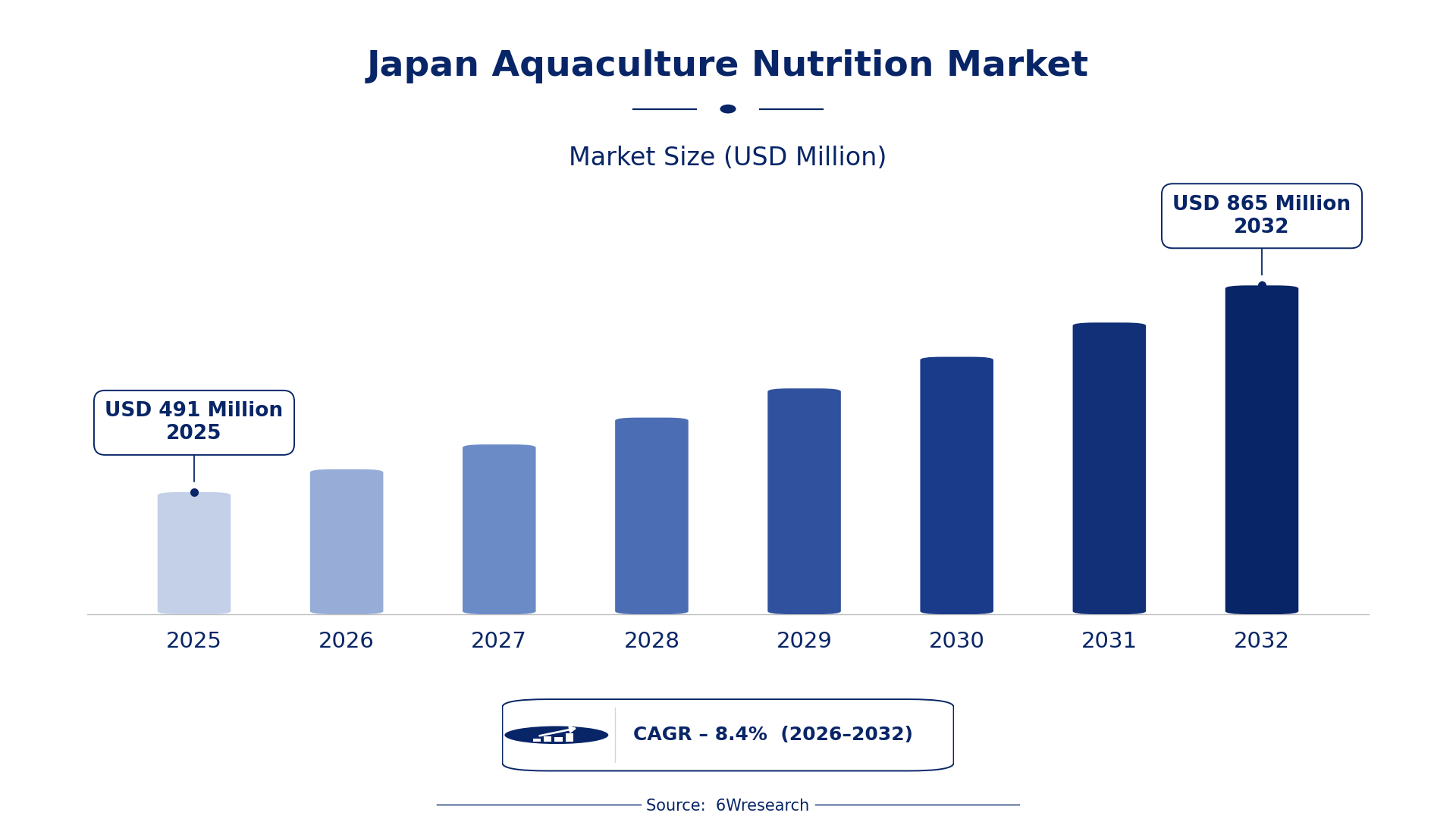
According to 6Wresearch internal database and industry insights, the Japan Aquaculture Nutrition Market was valued at USD 491 Million in 2025 and is projected to reach USD 865 Million by 2032, growing at a CAGR of approximately 8.4% during 2026–2032.
Japan Aquaculture Nutrition Market Highlights
| Report Metric | Details |
| Report Name | Japan Aquaculture Nutrition Market (2026-2032) |
| Market Size 2025 | USD 491 Million |
| Market Size 2032 | USD 865 Million |
| Absolute Growth 2025–2032 | USD 374 Million |
| CAGR 2026–2032 | 8.4% |
| Peak Annual Growth | 9.4% in 2028 |
| Forecast Period | 2026–2032 |
| Historical Data | 2022–2025 |
| Base Year | 2025 |
| Leading Nutrition Type, 2025 | Protein Concentrates (35% share) |
| Leading Species Application, 2025 | Carnivorous Fish (49% share) |
| Leading Form Type, 2025 | Pellet (46% share) |
| Leading Distribution Channel, 2025 | Aquafeed Suppliers (40% share) |
| Leading End User Industry, 2025 | Commercial Fish Farms (48% share) |
| Fastest-Growing Nutrition Type | Vitamin Mixes (11.9% CAGR) |
| Fastest-Growing Species Application | Crustaceans (11.4% CAGR) |
| Fastest-Growing Form Type | Granule (12.3% CAGR) |
| Fastest-Growing Distribution Channel | Online Retailers (11.0% CAGR) |
| Fastest-Growing End User Industry | Shrimp Hatcheries (10.9% CAGR) |
| Growing Sector | Crustaceans |
| Key End Users | Carnivorous Fish, Crustaceans, All Species, Mollusks |
Japan Aquaculture Nutrition Market Year-wise Growth Rate and Key Drivers (2022–2032)
This graph illustrates the annual growth rates of the market from 2022 to 2032, highlighting a steady upward trajectory and projected market expansion over the forecast period.
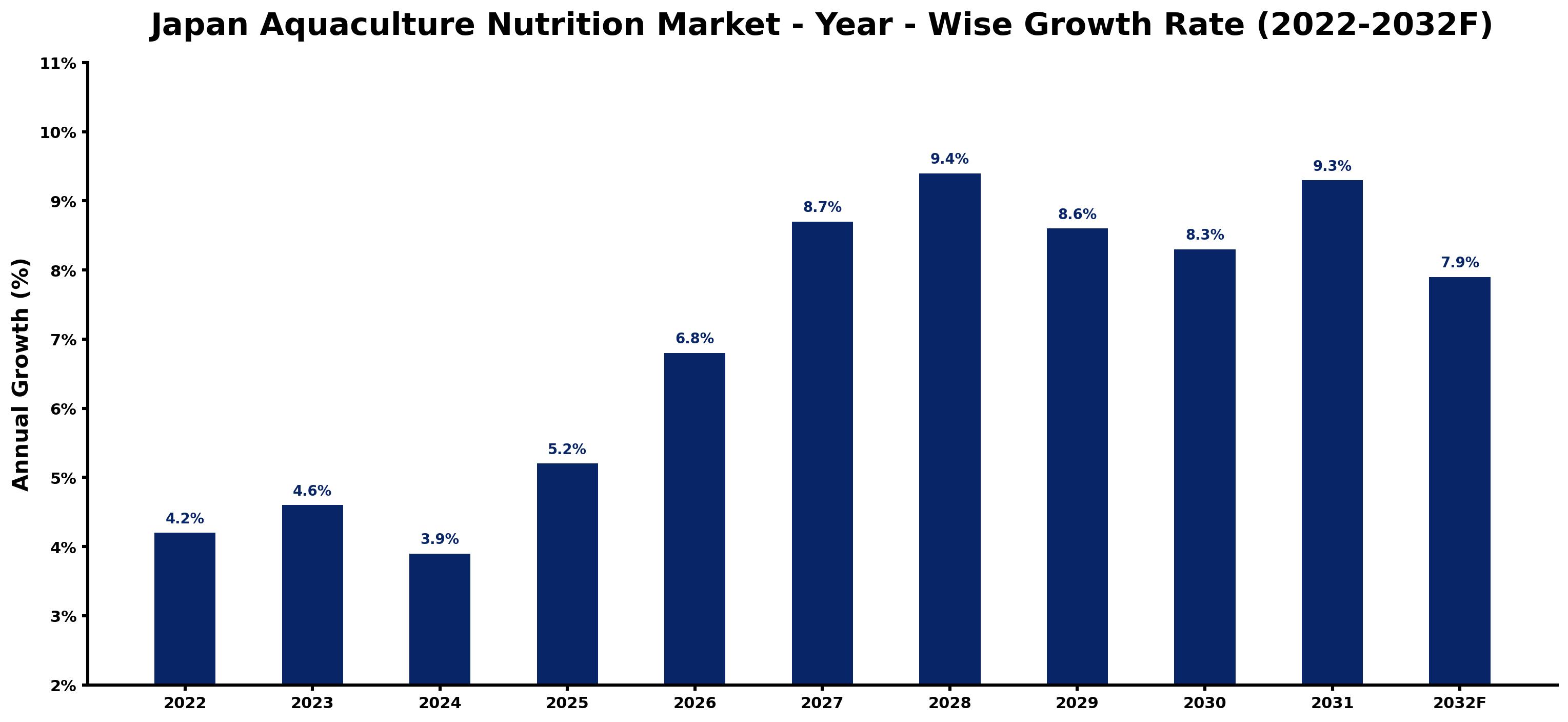
Year by year, the estimates below pair each growth rate with the development that shaped it.
| Year | Estimated Annual Growth (%) | Market Rationale |
| 2022 | 4.2 | The market showed steady growth due to ongoing aquaculture activities. |
| 2023 | 4.6 | Demand increased as fish consumption continued to rise among consumers. |
| 2024 | 3.9 | Growth slowed slightly as feed prices began to stabilise in the market. |
| 2025 | 5.2 | Higher production targets boosted demand for aquaculture nutrition products. |
| 2026 | 6.8 | Investment in feed efficiency programmes is expected to accelerate purchasing from fish farms. |
| 2027 | 8.7 | Rising seafood demand will lead to increased purchases of aquaculture nutrition. |
| 2028 | 9.4 | The market is projected to peak as new technologies improve feed efficiency. |
| 2029 | 8.6 | Growth is anticipated to slow as market saturation begins to affect purchasing patterns. |
| 2030 | 8.3 | Demand is expected to remain strong, but growth rates will normalise after the peak. |
| 2031 | 9.3 | Purchasing will surge again as innovations in nutrition are adopted widely. |
| 2032 | 7.9 | Growth is projected to decelerate as the market matures and competition intensifies. |
Note: Market size estimations and growth projections presented in this report are based on 6Wresearch's proprietary forecasting methodology, utilizing the latest available industry data, government publications, and primary research inputs.
Japan Aquaculture Nutrition Market Synopsis
Aquaculture nutrition encompasses feed components that promote the growth and health of aquatic species, primarily derived from natural ingredients like fish meal and plant proteins. The Japan Aquaculture Nutrition Market is growing due to increasing seafood demand, with the aquaculture sector employing over 20,000 individuals. A programme launched in 2023 aimed at improving feed efficiency will stimulate purchases from commercial fish farms, which hold a substantial share of the market.
Market Dynamics Impact Analysis (2026–2032)
| Factor | Type | Impact | Primary Segment Affected |
| Rising seafood consumption drives demand for aquaculture nutrition products. | Driver | High | Protein Concentrates |
| Investment in sustainable aquaculture practices increases feed efficiency. | Driver | High | Vitamin Mixes |
| The growing popularity of aquaculture among consumers creates new market opportunities. | Opportunity | High | Commercial Fish Farms |
| Technological advancements in feed formulations open avenues for suppliers. | Opportunity | Medium | Aquafeed Suppliers |
| Fluctuating prices of raw materials can impact profit margins for producers. | Restraint | High | Lipid Additives |
| Limited awareness of nutritional benefits may restrict market growth. | Restraint | Medium | Amino Acid Supplements |
| Aging workforce in aquaculture may lead to labour shortages. | Challenge | High | All Species |
| Competition from imported aquaculture nutrition products poses risks. | Challenge | Medium | Granule |
Evaluation of Drivers in Japan Aquaculture Nutrition Market (2026–2032)
Demand rests on the following drivers, each shown with the segment it touches most.
| Drivers | Primary Segment Affected | Why It Matters (Evidence) |
| Increased seafood consumption drives demand for Protein Concentrates. | Protein Concentrates | Japan's average fish consumption is 25 kg per capita, leading to higher aquaculture feed requirements. |
| Sustainable practices boost the market for Vitamin Mixes. | Vitamin Mixes | The Fisheries Agency promotes sustainable aquaculture, increasing the need for essential vitamins. |
| Technological advancements increase demand for Amino Acid Supplements. | Amino Acid Supplements | Research supports improved feed conversion efficiency, resulting in higher purchases of these supplements. |
| Rising demand for healthy seafood drives Lipid Additives. | Lipid Additives | The average price of aquaculture feed is around ¥30,000 per ton, prompting producers to improve feed quality. |
| Growing commercial fish farms increase need for all nutrition types. | All Species | With approximately 3,000 commercial fish farms in Japan, demand for diverse nutrition is rising. |
Purchasing is picking up as seafood consumption remains high, with an average of 25 kg per capita. The push for sustainable practices is driving demand for Vitamin Mixes. Research supports the use of Amino Acid Supplements, which improve feed conversion efficiency. As feed prices hover around ¥30,000 per ton, producers are investing in Lipid Additives to enhance quality. With around 3,000 commercial fish farms, the demand for all nutrition types is rising.
Evaluation of Restraints in Japan Aquaculture Nutrition Market
Below are the constraints most often cited by buyers and suppliers, with the segment each affects.
| Market Restraint | Primary Segment Affected | Why It Matters (Evidence) |
| Fluctuating raw material prices affect profit margins for Lipid Additives. | Lipid Additives | The average price of aquaculture feed at ¥30,000 per ton can squeeze margins for producers. |
| Limited awareness of nutritional benefits restricts market growth for Amino Acid Supplements. | Amino Acid Supplements | Many fish farmers lack knowledge about the advantages of specific amino acids in feed. |
| Aging workforce in aquaculture leads to potential labour shortages for All Species. | All Species | The average age of aquaculture farmers in Japan is 55 years, risking future production capacity. |
| Competition from imported products challenges local producers in Granule. | Granule | Imported aquaculture nutrition products can offer lower prices, affecting local market share. |
| Regulatory compliance costs can burden suppliers of Protein Concentrates. | Protein Concentrates | Producers must adhere to strict regulations, which increases operational costs. |
Japan Aquaculture Nutrition Market Challenges
Aquaculture producers are contending with rising feed costs, averaging ¥35,000 per ton, which strains budgets and compresses profit margins for fish farms. Regulatory complexities emerge from stringent guidelines enforced by the Ministry of Agriculture, Forestry and Fisheries, potentially delaying project approvals and raising operational costs for suppliers. Technological limitations persist, as many farms lack access to advanced feed formulations, which can hinder productivity and growth rates for buyers. Skills shortages are apparent, with the average age of aquaculture farmers at 55 years, posing risks to workforce sustainability and innovation within the industry.
Trends in the Japan Aquaculture Nutrition Market
These developments are changing demand patterns in the Japan Aquaculture Nutrition Market.
- Shift towards Sustainable Aquaculture Practices: The Japanese aquaculture industry is increasingly adopting sustainable practices, driven by the Fisheries Agency's initiatives. In 2023, a programme was launched to improve feed efficiency, promoting eco-friendly methods among fish farms.
- Transition from Traditional to Advanced Feed Formulations: Since 2023, aquaculture nutrition has shifted towards advanced formulations, utilising probiotics and specific vitamins. This change is reflected in the growing adoption of ISO 14001 standards by many farms.
- Emergence of Online Retail Channels for Aquaculture Nutrition: Online Retailers have gained traction since 2022, with an 11% growth rate projected. This shift enables easier access to aquaculture nutrition products for fish farmers across Japan.
- Increased Focus on Nutritional Research and Development: The Japan Fisheries Research and Education Agency has intensified research efforts since 2022, focusing on improving aquaculture nutrition. This initiative aims to improve feed efficiency and health outcomes for aquatic species.
Investment Opportunities in the Japan Aquaculture Nutrition Market
The following opportunities in the Japan Aquaculture Nutrition Market pair current demand with a clear way in.
- Timing for Investment: With Japan's aquaculture market projected to grow, suppliers should invest in advanced feed formulations to meet increasing demand. The commercial fish farms are major buyers, and partnerships with local distributors can facilitate market entry.
- Supply of Probiotics: Now is the ideal time to supply probiotics for aquaculture nutrition, as their use is increasing. The Kinki region is a key area for aquaculture production, providing opportunities for local partnerships.
- Focus on Vitamin Mixes: The growing awareness of nutritional benefits creates an opportunity for suppliers of Vitamin Mixes. Targeting commercial fish farms that are expanding their offerings can lead to successful market penetration.
- Granule Feed Expansion: Investing in the production of granule feeds is timely, as demand is rising. Collaborating with aquafeed suppliers can enhance distribution and market presence.
Government Initiatives in the Japan Aquaculture Nutrition Market
The PRTR Law (1999) mandates businesses to report releases of designated chemical substances, contributing to the regulatory framework for aquaculture producers. This law complements the Chemical Substances Control Law (1973), which requires evaluation and control of chemical substances used in aquaculture, ensuring safety and compliance in production practices.
In 2023, the Japanese government allocated ¥2 billion to promote sustainable aquaculture practices, overseen by the Ministry of Agriculture, Forestry and Fisheries. This funding aims to improve feed efficiency and encourage environmentally friendly methods among fish farms.
Future Insight of the Japan Aquaculture Nutrition Market
Technological advancements in feed formulations are set to reshape demand for aquaculture nutrition by 2032, allowing producers to improve growth rates. The introduction of programmes focused on enhancing feed efficiency will boost productivity across the sector. Increased adoption of ISO 14001 standards will encourage sustainable practices, appealing to environmentally conscious buyers. With Japan aiming for a 10% increase in aquaculture production by 2025, suppliers must adapt to meet the growing seafood demands.
Market Segmentation Analysis
Japan Aquaculture Nutrition Market report covers a detailed analysis of the following market segments:
By Nutrition Type – Protein Concentrates Lead, Vitamin Mixes Expected to Grow Fastest
According to Saurav Kr Singh, Senior Research Analyst at 6Wresearch, Protein Concentrates took 35% of nutrition type revenue in 2025, more than any other category. Protein concentrates serve as a fundamental protein source in aquafeeds, fulfilling the dietary requirements of various aquatic species. Their critical role is underscored by the Japanese government's commitment to enhancing aquaculture feed efficiency, ensuring sustained demand. The quickest growth will come from Vitamin Mixes, forecast to expand at a CAGR of 11.9% between 2026 and 2032. The surge in vitamin mixes is driven by their crucial function in supporting growth and immune health in aquatic species, particularly as the government targets a 10% increase in aquaculture production by 2025. This focus on health will likely propel demand further. Suppliers should focus on developing vitamin mix products to meet the rising market demand.
By Species Application – Carnivorous Fish Leads, Crustaceans Expected to Grow Fastest
The largest species application category in 2025 was Carnivorous Fish, at 49% of revenue. Carnivorous fish represent a significant portion of aquaculture production in Japan, necessitating specialised feeds that cater to their specific nutritional needs. The Kinki region, prominent for its fish farming, plays a vital role in maintaining this segment's strong market position. Crustaceans are projected to grow fastest, at a CAGR of 11.4% during 2026–2032. Crustaceans are experiencing rapid growth due to their specific nutritional requirements for optimal growth and reproduction, increasingly recognised by hatcheries. As shrimp farming expands, the demand for tailored feeds for crustaceans is expected to rise sharply. Buyers should invest in crustacean-specific feeds to meet the growing production demands.
By Form Type – Pellet Leads, Granule Expected to Grow Fastest
With 46% of form type revenue in 2025, Pellet was the largest category. Pelleted feeds are the most common form used in aquaculture, providing easy feeding and efficient nutrient delivery to aquatic species. Their widespread adoption across commercial fish farms underscores their critical role in the industry. Granule is set to record the highest CAGR in this split, 12.3% over 2026–2032. Granules are gaining traction as they cater to specific feeding strategies in aquaculture, particularly for species with unique dietary needs. The shift towards granule forms is likely to accelerate as farms seek tailored feeding solutions. Suppliers must diversify their product lines to include granule options to meet evolving feeding strategies.
By Distribution Channel – Aquafeed Suppliers Lead, Online Retailers Expected to Grow Fastest
Aquafeed Suppliers accounted for 40% of the market by distribution channel in 2025. Aquafeed suppliers are the main distributors of aquaculture nutrition products, effectively connecting manufacturers with fish farms. Their established networks and industry expertise solidify their leading position in the distribution channel. Over 2026–2032, Online Retailers are expected to post the fastest growth, at a CAGR of 11.0%. Online retailers are quickly becoming a preferred purchasing channel for aquaculture nutrition, driven by the increasing digitalisation of the market and consumer preferences for convenience. This trend is anticipated to accelerate as more buyers seek online solutions. Suppliers should enhance their online presence to leverage the expanding e-commerce market for aquaculture nutrition.
By End User Industry – Commercial Fish Farms Lead, Shrimp Hatcheries Expected to Grow Fastest
Commercial Fish Farms held 48% of the Japan Aquaculture Nutrition Market by end user industry in 2025. Commercial fish farms are the primary consumers of aquaculture nutrition products, reflecting the industry's scale and the need for a reliable supply. With around 3,000 commercial fish farms in Japan, this segment is crucial to the market's dynamics. The quickest growth will come from Shrimp Hatcheries, forecast to expand at a CAGR of 10.9% between 2026 and 2032. Shrimp hatcheries are experiencing notable growth due to their essential role in the early stages of shrimp development, which is vital for meeting increasing seafood demand. As the aquaculture sector grows, the focus on shrimp hatcheries will intensify. Buyers in the shrimp hatchery sector should prioritise high-quality nutrition products to ensure optimal growth and yield.
Key Attractiveness of the Report
- 10 Years of Market Numbers
- Historical Data Starting from 2022 to 2025
- Base Year 2025
- Forecast Data until 2032
- Key Performance Indicators Impacting the Market
- Major Upcoming Developments and Projects
Key Highlights of the Report:
- Japan Aquaculture Nutrition Market Outlook
- Market Size of Japan Aquaculture Nutrition Market, 2025
- Forecast of Japan Aquaculture Nutrition Market, 2032
- Historical Data and Forecast of Japan Aquaculture Nutrition Revenues & Volume for the Period 2022-2032F
- Japan Aquaculture Nutrition Market Trend Evolution
- Japan Aquaculture Nutrition Market Drivers and Challenges
- Japan Aquaculture Nutrition Price Trends
- Japan Aquaculture Nutrition Porter's Five Forces
- Japan Aquaculture Nutrition Industry Life Cycle
- Historical Data and Forecast of Japan Aquaculture Nutrition Market Revenues & Volume By Nutrition Type for the Period 2022-2032F
- Historical Data and Forecast of Japan Aquaculture Nutrition Market Revenues & Volume By Protein Concentrates for the Period 2022-2032F
- Historical Data and Forecast of Japan Aquaculture Nutrition Market Revenues & Volume By Lipid Additives for the Period 2022-2032F
- Historical Data and Forecast of Japan Aquaculture Nutrition Market Revenues & Volume By Vitamin Mixes for the Period 2022-2032F
- Historical Data and Forecast of Japan Aquaculture Nutrition Market Revenues & Volume By Amino Acid Supplements for the Period 2022-2032F
- Historical Data and Forecast of Japan Aquaculture Nutrition Market Revenues & Volume By Species Application for the Period 2022-2032F
- Historical Data and Forecast of Japan Aquaculture Nutrition Market Revenues & Volume By Carnivorous Fish for the Period 2022-2032F
- Historical Data and Forecast of Japan Aquaculture Nutrition Market Revenues & Volume By Crustaceans for the Period 2022-2032F
- Historical Data and Forecast of Japan Aquaculture Nutrition Market Revenues & Volume By All Species for the Period 2022-2032F
- Historical Data and Forecast of Japan Aquaculture Nutrition Market Revenues & Volume By Mollusks for the Period 2022-2032F
- Historical Data and Forecast of Japan Aquaculture Nutrition Market Revenues & Volume By Form Type for the Period 2022-2032F
- Historical Data and Forecast of Japan Aquaculture Nutrition Market Revenues & Volume By Pellet for the Period 2022-2032F
- Historical Data and Forecast of Japan Aquaculture Nutrition Market Revenues & Volume By Granule for the Period 2022-2032F
- Historical Data and Forecast of Japan Aquaculture Nutrition Market Revenues & Volume By Powder for the Period 2022-2032F
- Historical Data and Forecast of Japan Aquaculture Nutrition Market Revenues & Volume By Liquid for the Period 2022-2032F
- Historical Data and Forecast of Japan Aquaculture Nutrition Market Revenues & Volume By Distribution Channel for the Period 2022-2032F
- Historical Data and Forecast of Japan Aquaculture Nutrition Market Revenues & Volume By Aquafeed Suppliers for the Period 2022-2032F
- Historical Data and Forecast of Japan Aquaculture Nutrition Market Revenues & Volume By Online Retailers for the Period 2022-2032F
- Historical Data and Forecast of Japan Aquaculture Nutrition Market Revenues & Volume By Feed Distributors for the Period 2022-2032F
- Historical Data and Forecast of Japan Aquaculture Nutrition Market Revenues & Volume By Direct Sales for the Period 2022-2032F
- Historical Data and Forecast of Japan Aquaculture Nutrition Market Revenues & Volume By End User Industry for the Period 2022-2032F
- Historical Data and Forecast of Japan Aquaculture Nutrition Market Revenues & Volume By Commercial Fish Farms for the Period 2022-2032F
- Historical Data and Forecast of Japan Aquaculture Nutrition Market Revenues & Volume By Shrimp Hatcheries for the Period 2022-2032F
- Historical Data and Forecast of Japan Aquaculture Nutrition Market Revenues & Volume By Aquaculture Integrators for the Period 2022-2032F
- Historical Data and Forecast of Japan Aquaculture Nutrition Market Revenues & Volume By Shellfish Growers for the Period 2022-2032F
- Japan Aquaculture Nutrition Import Export Trade Statistics
- Market Opportunity Assessment By Nutrition Type
- Market Opportunity Assessment By Species Application
- Market Opportunity Assessment By Form Type
- Market Opportunity Assessment By Distribution Channel
- Market Opportunity Assessment By End User Industry
- Japan Aquaculture Nutrition Top Companies Market Share
- Japan Aquaculture Nutrition Competitive Benchmarking By Technical and Operational Parameters
- Japan Aquaculture Nutrition Company Profiles
- Japan Aquaculture Nutrition Key Strategic Recommendations
Market Covered
The study includes the following segmentation.
By Nutrition Type
- Protein Concentrates
- Lipid Additives
- Vitamin Mixes
- Amino Acid Supplements
By Species Application
- Carnivorous Fish
- Crustaceans
- All Species
- Mollusks
By Form Type
- Pellet
- Granule
- Powder
- Liquid
By Distribution Channel
- Aquafeed Suppliers
- Online Retailers
- Feed Distributors
- Direct Sales
By End User Industry
- Commercial Fish Farms
- Shrimp Hatcheries
- Aquaculture Integrators
- Shellfish Growers






































