Japan Aquatic Animal Market Size & Growth Rate
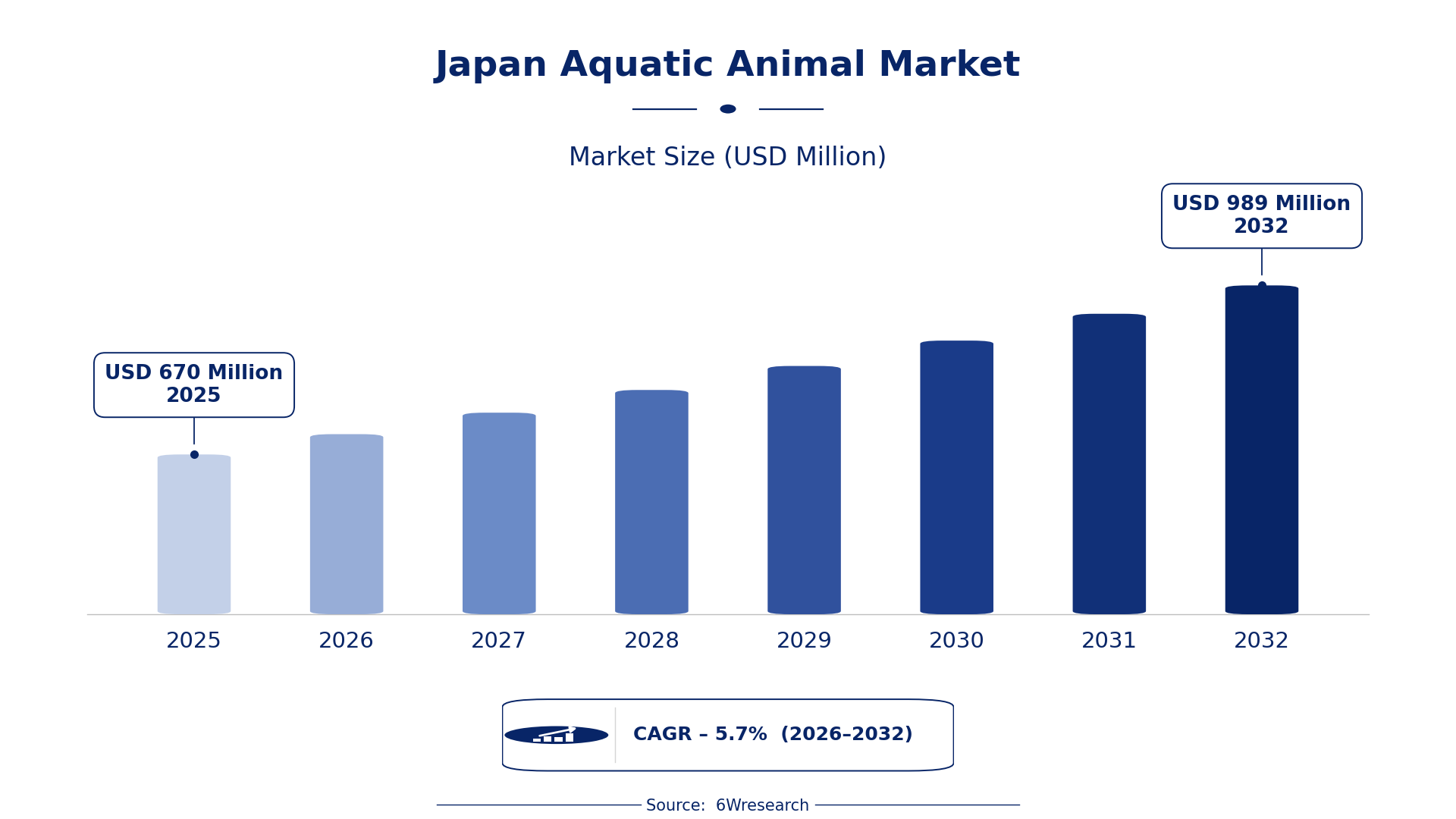
According to 6Wresearch internal database and industry insights, the Japan Aquatic Animal Market was valued at USD 670 Million in 2025 and is projected to reach USD 989 Million by 2032, growing at a CAGR of approximately 5.7% during 2026–2032.
Japan Aquatic Animal Market Highlights
| Report Metric | Details |
| Report Name | Japan Aquatic Animal Market (2026-2032) |
| Market Size 2025 | USD 670 Million |
| Market Size 2032 | USD 989 Million |
| Absolute Growth 2025–2032 | USD 319 Million |
| CAGR 2026–2032 | 5.7% |
| Peak Annual Growth | 6.7% in 2028 |
| Forecast Period | 2026–2032 |
| Historical Data | 2022–2025 |
| Base Year | 2025 |
| Leading Animal Type, 2025 | Edible Fish (41% share) |
| Leading Species Group, 2025 | Freshwater (41% share) |
| Leading Market Use, 2025 | Consumption (41% share) |
| Leading Distribution Channel, 2025 | Fish Markets (35% share) |
| Leading End User, 2025 | Food Processing Companies (45% share) |
| Fastest-Growing Animal Type | Crustaceans (7.8% CAGR) |
| Fastest-Growing Market Use | Aquaculture (7.7% CAGR) |
| Fastest-Growing Distribution Channel | Aquafarm Networks (7.0% CAGR) |
| Fastest-Growing End User | Restaurants (7.3% CAGR) |
| Growing Sector | Aquaculture |
| Key End Users | Food Processing Companies, Restaurants, Seafood Exporters |
Japan Aquatic Animal Market Year-wise Growth Rate and Key Drivers (2022–2032)
This graph illustrates the annual growth rates of the market from 2022 to 2032, highlighting a steady upward trajectory and projected market expansion over the forecast period.
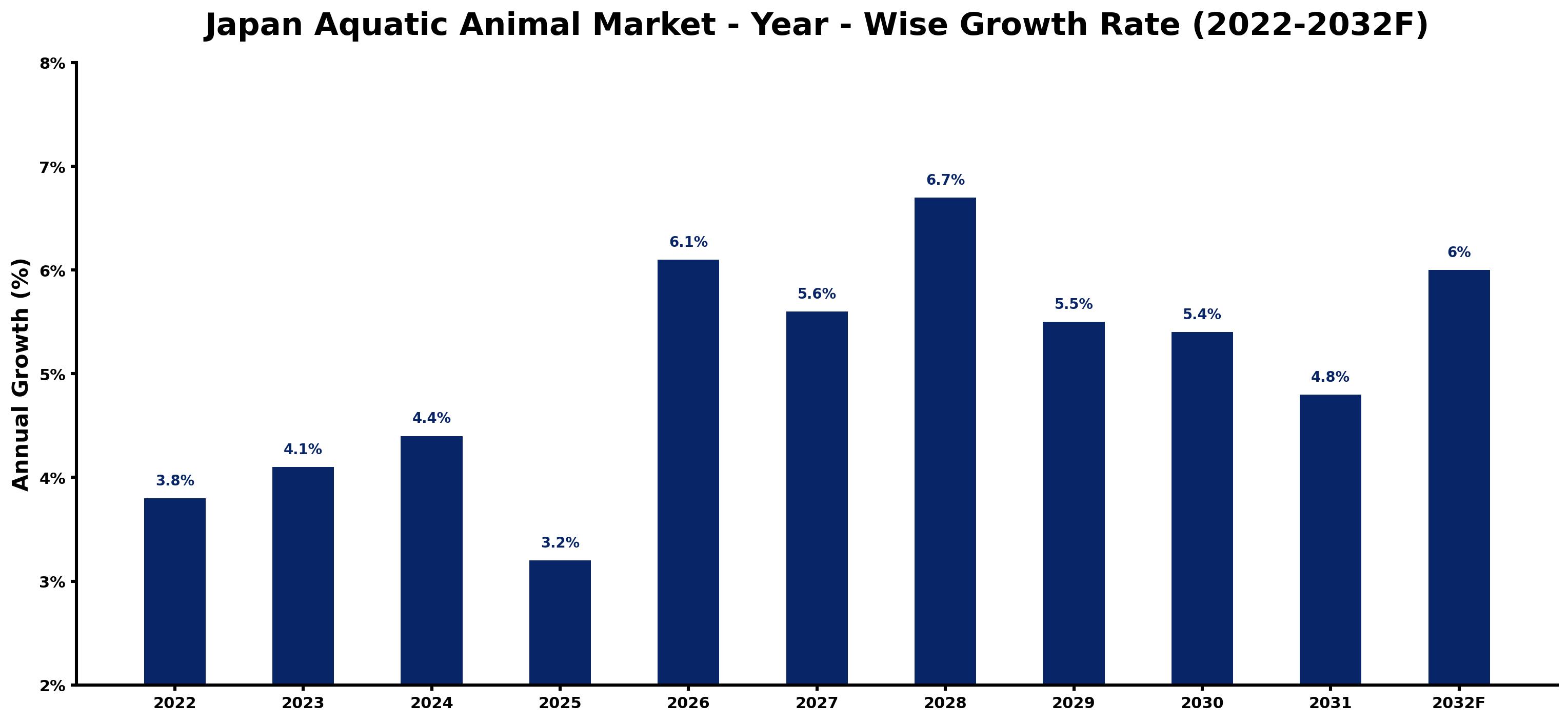
For each year, the table pairs the estimated growth rate with the leading influence on demand, showing how the drivers changed across the period.
| Year | Estimated Annual Growth (%) | Market Rationale |
| 2022 | 3.8 | The market experienced steady growth, reflecting strong demand for seafood products. |
| 2023 | 4.1 | Growth accelerated due to increased consumption of seafood among households and restaurants. |
| 2024 | 4.4 | The market continued to expand as aquaculture production improved and consumer preferences shifted. |
| 2025 | 3.2 | Growth slowed as market saturation in some areas began to impact expansion rates. |
| 2026 | 6.1 | Demand surged as aquaculture initiatives gained traction, boosting production capabilities. |
| 2027 | 5.6 | Growth moderated slightly due to market adjustments following previous rapid expansion. |
| 2028 | 6.7 | The peak growth year is driven by heightened interest in sustainable seafood practices. |
| 2029 | 5.5 | Growth slowed as the market stabilised following the peak in aquaculture investment. |
| 2030 | 5.4 | Demand continues to moderate as the market adjusts to new consumption patterns. |
| 2031 | 4.8 | Growth slows as competition intensifies among seafood suppliers. |
| 2032 | 6.0 | The market rebounds with renewed interest in aquaculture and seafood exports. |
Note: Market size estimations and growth projections presented in this report are based on 6Wresearch's proprietary forecasting methodology, utilizing the latest available industry data, government publications, and primary research inputs.
Japan Aquatic Animal Market Synopsis
Aquatic animals in Japan encompass a variety of species including ornamental fish, edible fish, crustaceans, and shellfish, primarily sourced from aquaculture and wild fisheries. Annual seafood consumption in Japan reaches approximately 25 million tons, with demand driven by rising household spending and the expansion of aquaculture farms. The Fisheries Agency's 5-year plan launched in 2023 aims to improve aquaculture sustainability, further stimulating market growth through enhanced practices and compliance with safety standards.
Market Dynamics Impact Analysis (2026–2032)
| Factor | Type | Impact | Primary Segment Affected |
| Increasing household spending on seafood products | Driver | High | Consumption |
| Expansion of aquaculture farms in coastal regions | Driver | High | Aquaculture |
| Growth in sustainable seafood initiatives | Opportunity | Medium | Aquaculture |
| Rising demand for high-quality seafood exports | Opportunity | Medium | Commercial Fisheries |
| Market saturation in certain seafood segments | Restraint | Medium | Edible Fish |
| Regulatory compliance costs for seafood producers | Restraint | High | Aquaculture |
| Competition from imported seafood products | Challenge | High | Edible Fish |
| Fluctuations in seafood prices due to supply chain issues | Challenge | Medium | Consumption |
Evaluation of Drivers in Japan Aquatic Animal Market (2026–2032)
Key forces behind demand, with the segment each one moves most, are listed below.
| Drivers | Primary Segment Affected | Why It Matters (Evidence) |
| Increased household spending on seafood products | Consumption | The average household spends around 30,000 JPY annually on seafood, driving demand in food markets. |
| Expansion of aquaculture farms | Aquaculture | Japan has over 2,000 registered aquaculture farms, boosting local production capabilities. |
| Growing interest in sustainable seafood | Aquaculture | Sustainable seafood practices are increasing consumer awareness and demand, supported by various NGOs. |
| Rising seafood exports to international markets | Commercial Fisheries | Japan is a leading exporter of high-quality seafood products, especially to the U.S. and Europe. |
| Popularity of aquarium ownership | Ornamental Fish | Millions of households in Japan own aquariums, driving demand for ornamental fish. |
The strongest pull on demand comes from increased household spending on seafood products, with the average household spending around 30,000 JPY annually. The presence of over 2,000 registered aquaculture farms boosts local production capabilities, meeting rising consumer needs. Interest in sustainable seafood is clear, as various organisations promote practices that raise awareness among consumers. The growth of seafood exports to international markets stimulates demand, with Japan being a leading exporter of high-quality seafood products. The popularity of aquarium ownership, with millions of households participating, further drives demand for ornamental fish.
Evaluation of Restraints in Japan Aquatic Animal Market
Several factors work against faster growth; the main ones are summarised below.
| Market Restraint | Primary Segment Affected | Why It Matters (Evidence) |
| Regulatory compliance costs for seafood producers | Aquaculture | Producers face high costs to meet standards set by the JIS, impacting profitability. |
| Competition from imported seafood products | Edible Fish | Imported seafood can be cheaper, affecting local producers' market share. |
| Fluctuations in seafood prices due to supply chain issues | Consumption | Supply chain disruptions can lead to price volatility, affecting consumer purchasing. |
| Environmental concerns impacting aquaculture practices | Aquaculture | Sustainability issues may lead to stricter regulations, increasing operational costs. |
| Limited access to advanced aquaculture technology | Aquaculture | Producers struggle with outdated systems, affecting efficiency and output. |
Japan Aquatic Animal Market Challenges
Technology gaps hinder aquaculture efficiency, resulting in production inconsistencies that can delay supply for seafood distributors. Buyers experience price fluctuations, with average costs rising by 15% during peak demand, complicating budgeting for restaurants. Regulatory compliance with JIS standards creates hurdles, causing delays in product availability for retailers and impacting their ability to meet consumer demand. Increased competition from international markets pressures local suppliers to lower prices, which can shrink profit margins and limit investment in sustainable practices for producers.
Trends in the Japan Aquatic Animal Market
Buyers and suppliers in the Japan Aquatic Animal Market are adjusting to the following trends.
- Shift towards Sustainable Aquaculture Practices: Japan is increasingly adopting sustainable aquaculture practices, as seen in the Fisheries Agency's 5-year plan launched in 2023 to improve sustainability. This shift is projected to enhance production efficiency and reduce environmental impact.
- Growth of Online Seafood Sales: The rise of e-commerce platforms is transforming seafood distribution, with online sales accounting for 15% of total seafood sales in 2023, reflecting changing consumer preferences.
- Increased Demand for High-Quality Seafood: Restaurants are prioritising high-quality seafood, with a reported 20% increase in demand for premium products. This trend is reshaping supplier strategies across the market.
- Expansion of Aquafarm Networks: Aquafarm networks are expanding rapidly, with a 30% increase in new facilities in coastal regions. This growth supports sustainable fish supply and enhances local economies.
Investment Opportunities in the Japan Aquatic Animal Market
The following opportunities in the Japan Aquatic Animal Market pair current demand with a clear way in.
- Joint Ventures with Local Producers: Now is an ideal time for foreign investors to form joint ventures with local aquaculture producers, as Japan aims to increase aquaculture production by 10% by 2025.
- Investment in Aquaculture Technology: With aquaculture production reaching 1.2 million tons in 2022, there is a gap in technology investment. Collaborating with local aquafarm networks can improve production efficiency.
- Focus on Export Markets: Japan's seafood export market is growing, especially to the U.S. and Europe. Investing in quality assurance and compliance can help local producers capture more international market share.
- Development of Sustainable Seafood Products: The demand for sustainable seafood is rising, with various organisations promoting practices. Suppliers can capitalise on this trend by developing eco-friendly seafood products.
Government Initiatives in the Japan Aquatic Animal Market
The Fisheries Agency's 5-year plan launched in 2023 aims to improve aquaculture sustainability, building on previous regulations like the Food Sanitation Act amendment of 2018. This plan encourages producers to adopt sustainable practices, ensuring compliance with safety standards and improving product quality.
In 2023, the Fisheries Agency allocated 1 billion JPY to support aquaculture development, focusing on sustainability and innovation. This funding is projected to benefit local aquaculture farms and improve production capabilities.
Future Insight of the Japan Aquatic Animal Market
Advancements in automated feeding systems will boost production efficiency by 20% by 2032, benefiting both buyers and suppliers. The Fisheries Agency's five-year plan will improve sustainability practices, aligning with global seafood standards and expanding market access for local producers. The Seafood Expo in Tokyo will continue to showcase innovations, fostering collaboration among stakeholders. Growing consumer awareness of sustainable seafood will drive demand for responsibly sourced products, encouraging suppliers to prioritise quality and sustainability.
Market Segmentation Analysis
Japan Aquatic Animal Market report covers a detailed analysis of the following market segments:
By Animal Type – Edible Fish Leads, Crustaceans Expected to Grow Fastest
According to Saurav Kr Singh, Senior Research Analyst at 6Wresearch, Edible Fish accounted for 41% of the market by animal type in 2025. Edible fish holds the largest share in Japan as it is a staple in the national diet, with millions of households consuming seafood regularly. The Tokyo Fish Market plays a crucial role, handling thousands of tons of edible fish daily, reinforcing its dominance. Over 2026–2032, Crustaceans are expected to post the fastest growth, at a CAGR of 7.8%. Crustaceans are experiencing rapid growth due to rising culinary trends and a shift towards diverse seafood options among consumers. This is evidenced by the average household's increased annual expenditure on seafood, indicating a growing preference for crustaceans. Suppliers should enhance their crustacean offerings to meet the rising consumer interest in diverse seafood options.
By Species Group – Freshwater Leads and Records the Fastest Growth
Freshwater held 41% of the Japan Aquatic Animal Market by species group in 2025. Freshwater species dominate the market as they are widely used in both aquaculture and home aquariums, appealing to a broad range of consumers. The aquaculture production of 1.2 million tons in 2022 highlights the importance of freshwater species in the industry. Its lead should widen, with a projected CAGR of 7.2% during 2026–2032, the highest in this split. Freshwater species are also the fastest-growing segment, benefiting from increased aquaculture activities and consumer interest in sustainable practices. The Japanese government's target to boost aquaculture production by 10% by 2025 will further solidify this growth. Buyers should consider investing in freshwater species due to their increasing availability and popularity.
By Market Use – Consumption Leads, Aquaculture Expected to Grow Fastest
The largest market use category in 2025 was Consumption, at 41% of revenue. Consumption is the leading use of aquatic animals in Japan, supported by the country's annual seafood consumption of approximately 25 million tons. The cultural importance of seafood as a dietary staple further cements this segment's top position. Aquaculture is projected to grow fastest, at a CAGR of 7.7% during 2026–2032. Aquaculture is the fastest-growing use, driven by government initiatives focused on improving sustainability in seafood production. The Fisheries Agency's recent five-year plan aims to significantly enhance aquaculture practices and output, contributing to its rapid growth. Suppliers should adapt their strategies to align with aquaculture developments to leverage the expanding market.
By Distribution Channel – Fish Markets Lead, Aquafarm Networks Expected to Grow Fastest
With 35% of distribution channel revenue in 2025, Fish Markets was the largest category. Fish markets are the primary sales channel for edible fish, serving as major hubs for seafood distribution in urban areas like Tokyo. The high volume of seafood transactions at these markets underscores their significance in the supply chain. Aquafarm Networks are set to record the highest CAGR in this split, 7.0% over 2026–2032. Aquafarm networks are growing rapidly as they provide a sustainable source of fish, reflecting consumer preferences for environmentally responsible options. The increasing establishment of these networks indicates a shift towards more sustainable distribution methods. Suppliers must adapt to the rising importance of aquafarm networks to ensure a competitive edge.
By End User – Food Processing Companies Lead, Restaurants Expected to Grow Fastest
In 2025, Food Processing Companies led the end user split with a 45% share. Food processing companies are the primary buyers of aquatic animals, integrating these products into a wide variety of food items. Their essential role in the supply chain ensures a steady demand for edible fish across multiple sectors. Over 2026–2032, Restaurants are expected to post the fastest growth, at a CAGR of 7.3%. Restaurants are the fastest-growing end user segment, fuelled by a rising trend towards seafood dishes in dining establishments. The increasing consumer interest in gourmet seafood experiences is likely to sustain this segment's growth. Suppliers should focus on tailored offerings for restaurants to capitalise on the growing demand for seafood in the dining sector.
Key Attractiveness of the Report
- 10 Years of Market Numbers
- Historical Data Starting from 2022 to 2025
- Base Year 2025
- Forecast Data until 2032
- Key Performance Indicators Impacting the Market
- Major Upcoming Developments and Projects
Key Highlights of the Report:
- Japan Aquatic Animal Market Outlook
- Market Size of Japan Aquatic Animal Market, 2025
- Forecast of Japan Aquatic Animal Market, 2032
- Historical Data and Forecast of Japan Aquatic Animal Revenues & Volume for the Period 2022-2032F
- Japan Aquatic Animal Market Trend Evolution
- Japan Aquatic Animal Market Drivers and Challenges
- Japan Aquatic Animal Price Trends
- Japan Aquatic Animal Porter's Five Forces
- Japan Aquatic Animal Industry Life Cycle
- Historical Data and Forecast of Japan Aquatic Animal Market Revenues & Volume By Animal Type for the Period 2022-2032F
- Historical Data and Forecast of Japan Aquatic Animal Market Revenues & Volume By Ornamental Fish for the Period 2022-2032F
- Historical Data and Forecast of Japan Aquatic Animal Market Revenues & Volume By Edible Fish for the Period 2022-2032F
- Historical Data and Forecast of Japan Aquatic Animal Market Revenues & Volume By Crustaceans for the Period 2022-2032F
- Historical Data and Forecast of Japan Aquatic Animal Market Revenues & Volume By Shellfish for the Period 2022-2032F
- Historical Data and Forecast of Japan Aquatic Animal Market Revenues & Volume By Species Group for the Period 2022-2032F
- Historical Data and Forecast of Japan Aquatic Animal Market Revenues & Volume By Tropical for the Period 2022-2032F
- Historical Data and Forecast of Japan Aquatic Animal Market Revenues & Volume By Freshwater for the Period 2022-2032F
- Historical Data and Forecast of Japan Aquatic Animal Market Revenues & Volume By Saltwater for the Period 2022-2032F
- Historical Data and Forecast of Japan Aquatic Animal Market Revenues & Volume By Marine for the Period 2022-2032F
- Historical Data and Forecast of Japan Aquatic Animal Market Revenues & Volume By Market Use for the Period 2022-2032F
- Historical Data and Forecast of Japan Aquatic Animal Market Revenues & Volume By Decorative for the Period 2022-2032F
- Historical Data and Forecast of Japan Aquatic Animal Market Revenues & Volume By Consumption for the Period 2022-2032F
- Historical Data and Forecast of Japan Aquatic Animal Market Revenues & Volume By Aquaculture for the Period 2022-2032F
- Historical Data and Forecast of Japan Aquatic Animal Market Revenues & Volume By Commercial Fisheries for the Period 2022-2032F
- Historical Data and Forecast of Japan Aquatic Animal Market Revenues & Volume By Distribution Channel for the Period 2022-2032F
- Historical Data and Forecast of Japan Aquatic Animal Market Revenues & Volume By Pet Stores for the Period 2022-2032F
- Historical Data and Forecast of Japan Aquatic Animal Market Revenues & Volume By Fish Markets for the Period 2022-2032F
- Historical Data and Forecast of Japan Aquatic Animal Market Revenues & Volume By Aquafarm Networks for the Period 2022-2032F
- Historical Data and Forecast of Japan Aquatic Animal Market Revenues & Volume By Direct Supply for the Period 2022-2032F
- Historical Data and Forecast of Japan Aquatic Animal Market Revenues & Volume By End User for the Period 2022-2032F
- Historical Data and Forecast of Japan Aquatic Animal Market Revenues & Volume By Aquarium Owners for the Period 2022-2032F
- Historical Data and Forecast of Japan Aquatic Animal Market Revenues & Volume By Food Processing Companies for the Period 2022-2032F
- Historical Data and Forecast of Japan Aquatic Animal Market Revenues & Volume By Seafood Exporters for the Period 2022-2032F
- Historical Data and Forecast of Japan Aquatic Animal Market Revenues & Volume By Restaurants for the Period 2022-2032F
- Japan Aquatic Animal Import Export Trade Statistics
- Market Opportunity Assessment By Animal Type
- Market Opportunity Assessment By Species Group
- Market Opportunity Assessment By Market Use
- Market Opportunity Assessment By Distribution Channel
- Market Opportunity Assessment By End User
- Japan Aquatic Animal Top Companies Market Share
- Japan Aquatic Animal Competitive Benchmarking By Technical and Operational Parameters
- Japan Aquatic Animal Company Profiles
- Japan Aquatic Animal Key Strategic Recommendations
Market Covered
The study includes the following segmentation.
By Animal Type
- Ornamental Fish
- Edible Fish
- Crustaceans
- Shellfish
By Species Group
- Tropical
- Freshwater
- Saltwater
- Marine
By Market Use
- Decorative
- Consumption
- Aquaculture
- Commercial Fisheries
By Distribution Channel
- Pet Stores
- Fish Markets
- Aquafarm Networks
- Direct Supply
By End User
- Aquarium Owners
- Food Processing Companies
- Seafood Exporters
- Restaurants






































