Japan Artificial Intelligence (AI) Market Size & Growth Rate
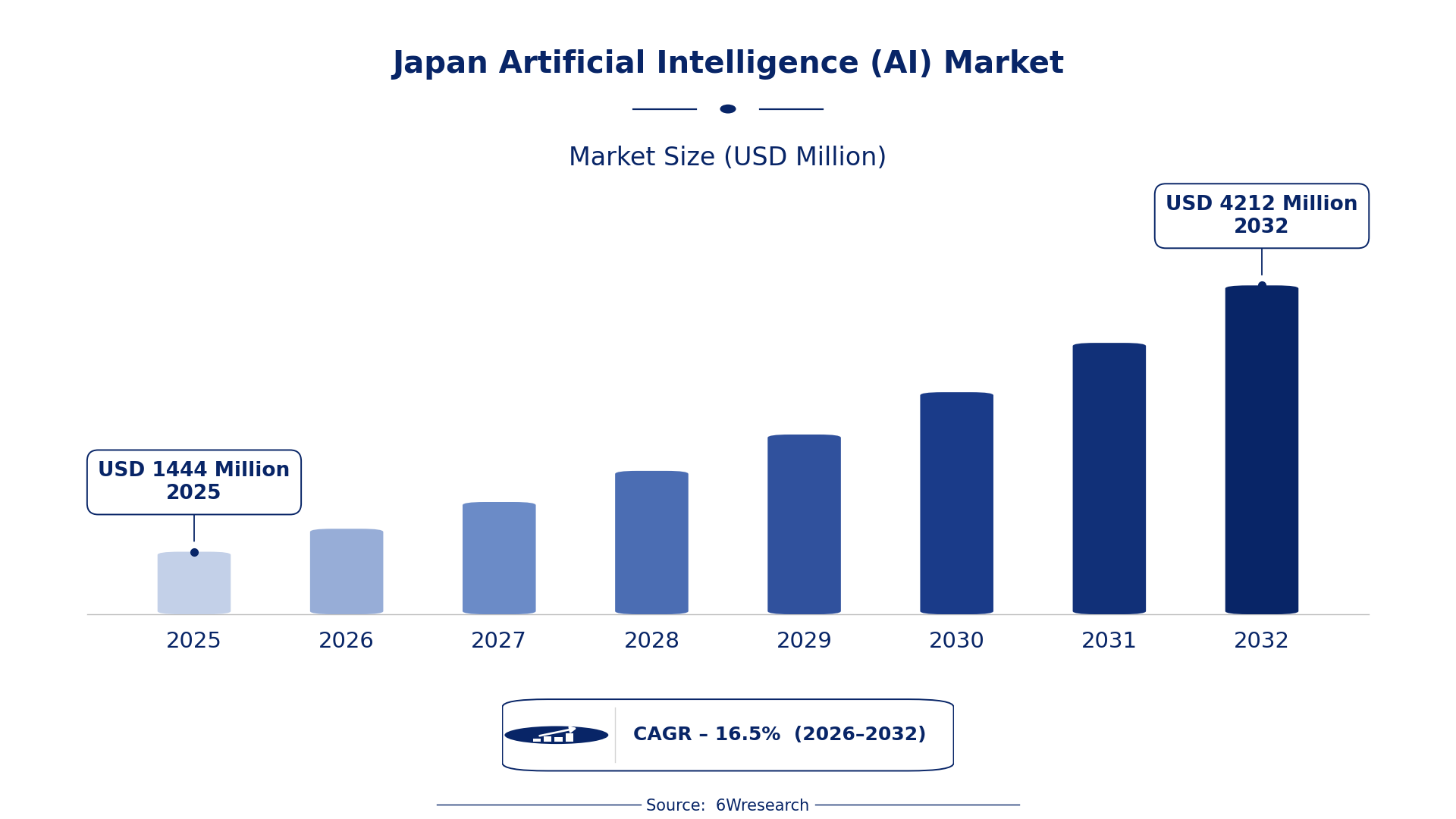
According to 6Wresearch internal database and industry insights, the Japan Artificial Intelligence (AI) Market was valued at USD 1,444 Million in 2025 and is projected to reach USD 4,212 Million by 2032, growing at a CAGR of approximately 16.5% during 2026–2032.
Japan Artificial Intelligence (AI) Market Highlights
| Report Metric | Details |
| Report Name | Japan Artificial Intelligence (AI) Market (2026-2032) |
| Market Size 2025 | USD 1,444 Million |
| Market Size 2032 | USD 4,212 Million |
| Absolute Growth 2025–2032 | USD 2,768 Million |
| CAGR 2026–2032 | 16.5% |
| Peak Annual Growth | 17.4% in 2030 |
| Forecast Period | 2026–2032 |
| Historical Data | 2022–2025 |
| Base Year | 2025 |
| Leading Offering, 2025 | Hardware (57% share) |
| Leading Technology, 2025 | Machine Learning (49% share) |
| Leading Business Function, 2025 | Finance (34% share) |
| Leading Deployment Mode, 2025 | On-premises (56% share) |
| Leading Organization Size, 2025 | Large Enterprises (58% share) |
| Fastest-Growing Offering | Software (23.3% CAGR) |
| Fastest-Growing Technology | Natural Language Processing (22.8% CAGR) |
| Fastest-Growing Business Function | Security (22.0% CAGR) |
| Fastest-Growing Deployment Mode | Cloud (19.1% CAGR) |
| Fastest-Growing Organization Size | SMEs (20.4% CAGR) |
| Growing Sector | healthcare |
| Key End Users | healthcare providers, financial institutions, marketing agencies, manufacturing firms |
Japan Artificial Intelligence (AI) Market Year-wise Growth Rate and Key Drivers (2022–2032)
This graph illustrates the annual growth rates of the market from 2022 to 2032, highlighting a steady upward trajectory and projected market expansion over the forecast period.
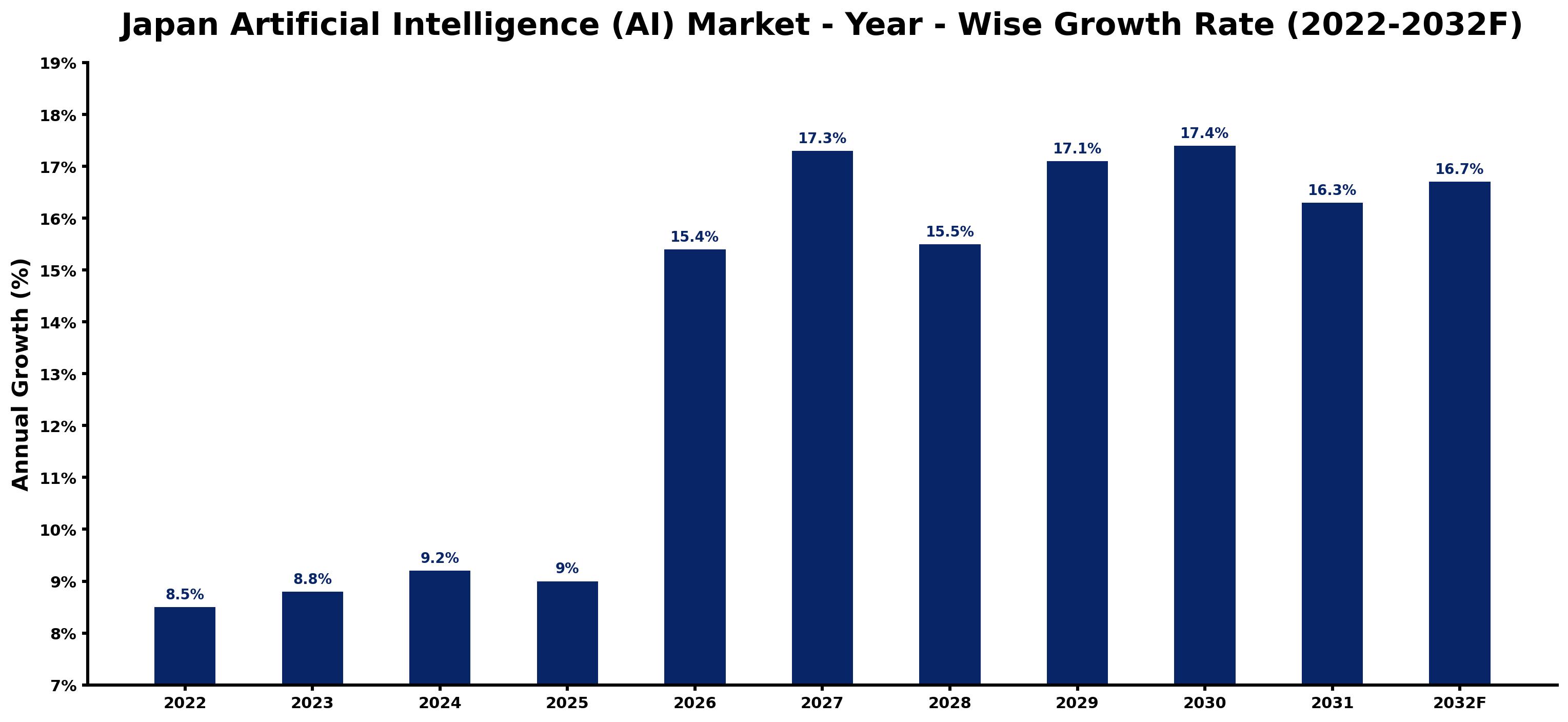
For each year, the table pairs the estimated growth rate with the leading influence on demand, showing how the drivers changed across the period.
| Year | Estimated Annual Growth (%) | Market Rationale |
| 2022 | 8.5 | The market saw steady growth as companies began adopting AI technologies for efficiency. |
| 2023 | 8.8 | Investment in AI technologies increased as over 70% of companies engaged in AI initiatives. |
| 2024 | 9.2 | Growth accelerated due to rising demand for AI in sectors like finance and healthcare. |
| 2025 | 9.0 | The market experienced a slight slowdown as firms adjusted their AI strategies and investments. |
| 2026 | 15.4 | Demand surged as the AI Promotion Act established a framework for accelerated AI adoption. |
| 2027 | 17.3 | Growth continued as companies expanded AI applications in security and human resources. |
| 2028 | 15.5 | A slight slowdown occurred as market maturation began to stabilise growth rates. |
| 2029 | 17.1 | Demand rose again as new AI applications emerged in elder care solutions. |
| 2030 | 17.4 | The market peaked with substantial investments in AI technologies across various sectors. |
| 2031 | 16.3 | Growth slowed as companies focused on optimising existing AI systems and applications. |
| 2032 | 16.7 | Demand increased as the healthcare sector targeted a 30% rise in AI adoption. |
Note: Market size estimations and growth projections presented in this report are based on 6Wresearch's proprietary forecasting methodology, utilizing the latest available industry data, government publications, and primary research inputs.
Japan Artificial Intelligence (AI) Market Synopsis
Artificial Intelligence (AI) encompasses advanced algorithms that enable machines to perform tasks requiring human intelligence. The Japan Artificial Intelligence (AI) Market is growing, driven by investments from over 70% of companies in AI technologies. The AI Strategy launched by the Ministry of Economy, Trade and Industry in 2019 promotes development, while the aging population increases demand for AI applications in healthcare. This growth reflects strong adoption across various sectors, particularly in technology and healthcare.
Market Dynamics Impact Analysis (2026–2032)
| Factor | Type | Impact | Primary Segment Affected |
| Growing investment in AI technologies | Driver | High | Software |
| Rising demand for AI in healthcare | Driver | High | Services |
| Increased need for automation in industries | Opportunity | High | Machine Learning |
| Expansion of AI applications in elder care | Opportunity | High | Natural Language Processing |
| High costs of AI implementation | Restraint | Medium | Hardware |
| Limited understanding of AI capabilities among SMEs | Restraint | Medium | Software |
| Challenges in compliance with AI regulations | Challenge | High | Services |
| Capacity constraints in AI talent acquisition | Challenge | High | Machine Learning |
Evaluation of Drivers in Japan Artificial Intelligence (AI) Market (2026–2032)
These are the developments adding the most demand over the forecast period.
| Drivers | Primary Segment Affected | Why It Matters (Evidence) |
| Increased corporate investment in AI technologies | Software | Over 70% of Japanese companies are investing in AI technologies, driving demand for software solutions. |
| Growing applications of AI in healthcare | Services | The government aims for a 30% increase in AI adoption in healthcare by 2025, boosting service demand. |
| Need for automation in various industries | Machine Learning | Automation is critical for efficiency, leading to higher demand for machine learning solutions across sectors. |
| Rising focus on data analysis | Natural Language Processing | AI technologies improve data analysis capabilities, attracting investments from finance and marketing sectors. |
| Demand for improved customer experiences | Computer Vision | AI improves customer engagement strategies, particularly in marketing and sales applications. |
The healthcare sector is set to see a 30% rise in AI adoption by 2025, driving demand for consulting services. In addition, the need for automation across industries is pushing the market for machine learning solutions. AI's role in improving data analysis is attracting investments from finance and marketing sectors, resulting in more purchases of natural language processing technologies. Consequently, AI applications are becoming essential for improving customer experiences in various business functions.
Evaluation of Restraints in Japan Artificial Intelligence (AI) Market
The main factors holding the market back are set out below.
| Market Restraint | Primary Segment Affected | Why It Matters (Evidence) |
| High costs associated with AI implementation | Hardware | The initial investment for AI hardware can be prohibitive, limiting adoption among smaller firms. |
| Limited understanding of AI capabilities | Software | Many SMEs lack knowledge about AI, hindering their ability to implement effective solutions. |
| Compliance challenges with AI regulations | Services | Navigating regulatory requirements can complicate AI service implementation for businesses, affecting project timelines. |
| Shortage of skilled AI professionals | Machine Learning | The demand for AI talent exceeds supply, creating barriers for companies looking to scale their operations. |
| Concerns over data privacy and security | Natural Language Processing | Regulatory scrutiny around data usage can slow down the adoption of AI technologies, limiting market growth. |
Japan Artificial Intelligence (AI) Market Challenges
Intense competition among buyers for AI solutions drives up costs, resulting in a 20% increase in project budgets for healthcare providers. Suppliers struggle with a lack of skilled professionals, causing delays of up to six months in project delivery for companies seeking to implement AI technologies. Regulatory requirements, such as compliance with ISO/IEC 20546:2019, can extend the approval process by a year, delaying market entry for new AI applications. Traditional industries face significant hurdles in adopting AI, leading to a 30% integration gap compared to technology sectors, which hampers operational efficiency for manufacturers.
Trends in the Japan Artificial Intelligence (AI) Market
Four trends stand out in the Japan Artificial Intelligence (AI) Market.
- Shift in AI Applications in Healthcare: The healthcare sector is increasingly adopting AI technologies, with a projected 30% rise in applications by 2025, as the aging population seeks elder care solutions.
- Transition from On-premises to Cloud Deployment: Cloud deployment is gaining traction, with a projected CAGR of 19.1% for AI services, as businesses seek flexibility and scalability in their AI solutions.
- Emergence of AI in Marketing Strategies: AI is becoming integral to marketing strategies, improving customer targeting and engagement, as evidenced by the growing use of AI-driven analytics tools in various sectors.
- Prioritisation of AI in Financial Services: Financial institutions are increasingly utilising AI for risk assessment and fraud detection, reflecting a notable shift in operational strategies.
Investment Opportunities in the Japan Artificial Intelligence (AI) Market
Below are the investment opportunities with the strongest case in the Japan Artificial Intelligence (AI) Market.
- Growing demand for AI in elder care: The aging population in Japan presents an opportunity for AI applications, with a projected 30% increase in adoption by 2025, making it an attractive market for investment.
- Investment in AI-driven automation solutions: With over 70% of companies investing in AI, there is a strong opportunity to supply automation tools, particularly in manufacturing and logistics sectors.
- Expansion of AI services in healthcare: The healthcare sector's increasing need for AI solutions offers a chance to partner with local firms to provide consulting and integration services.
- Focus on AI-driven customer engagement: As businesses seek to improve customer experiences, supplying AI-driven marketing tools can meet the rising demand, particularly in retail and finance.
Government Initiatives in the Japan Artificial Intelligence (AI) Market
The AI Promotion Act, established in 2025, creates a national framework for AI research and development, ensuring that producers comply with standards and guidelines. This act is vital for promoting innovation and streamlining AI adoption across various sectors, particularly healthcare, where the government aims for a 30% increase in AI applications by 2025.
The Digital Agency oversees the implementation of digital transformation initiatives, including the approval of AI projects. This agency funds various AI research initiatives and promotes the development of common system standards, which are essential for ensuring compliance and improving the capabilities of AI technologies in Japan.
Future Insight of the Japan Artificial Intelligence (AI) Market
By 2032, Japan's AI landscape will transform due to strategic initiatives like the AI Strategy, which aims for a 30% increase in AI adoption in healthcare. Buyers will benefit from improved elder care solutions driven by the aging population, encouraging innovation in this sector. Suppliers will engage with over 200 universities and institutions to boost research and development capabilities. Events like the AI Expo Tokyo will continue to attract global talent and partnerships, facilitating advancements in AI technologies.
Market Segmentation Analysis
Japan Artificial Intelligence (AI) Market report covers a detailed analysis of the following market segments:
By Offering – Hardware Leads, Software Expected to Grow Fastest
According to Ravi Bhandari, Research Head at 6Wresearch, in 2025, Hardware led the offering split with a 57% share. Hardware commands the largest share as it is essential for supporting various applications across multiple sectors. The substantial investment in AI technologies by over 70% of Japanese companies underscores the critical need for robust hardware infrastructure. Over 2026–2032, Software is expected to post the fastest growth, at a CAGR of 23.3%. Software is witnessing rapid growth due to its vital role in enabling functionalities within AI systems. The government's AI Strategy launched in 2019 is significantly driving the demand for software solutions across industries. This means suppliers should prioritise software development to address the rising needs of businesses.
By Technology – Machine Learning Leads, Natural Language Processing Expected to Grow Fastest
Machine Learning accounted for 49% of the market by technology in 2025. Machine Learning leads the market as it is a fundamental technology that drives AI capabilities across diverse applications. Its extensive utilisation in sectors such as finance for risk assessment illustrates its pivotal role in the market. Natural Language Processing is set to record the highest CAGR in this split, 22.8% over 2026–2032. Natural Language Processing is expanding quickly because it allows machines to understand and process human language effectively. The growing demand for enhanced customer engagement solutions is propelling this segment's rapid growth. Suppliers must focus on Natural Language Processing technologies to leverage the increasing demand for improved communication tools.
By Business Function – Finance Leads, Security Expected to Grow Fastest
The largest business function category in 2025 was Finance, at 34% of revenue. Finance is the leading business function for AI adoption, primarily due to its critical applications in risk assessment and fraud detection. The financial sector's reliance on advanced technologies underscores its importance in operational efficiency. Security is projected to grow fastest, at a CAGR of 22.0% during 2026–2032. Security is experiencing the fastest growth as AI technologies significantly improve security measures and threat detection. The escalating concerns regarding cybersecurity threats are prompting organisations to adopt these solutions more swiftly. This trend indicates that suppliers should concentrate on security-focused solutions to meet the rising demand across various sectors.
By Deployment Mode – On-premises Lead, Cloud Expected to Grow Fastest
On-premises held 56% of the Japan Artificial Intelligence (AI) Market by deployment mode in 2025. On-premises deployment holds the largest share as many businesses prefer this model for enhanced data security and control. This preference is particularly pronounced in industries that handle sensitive information and require strict compliance. The quickest growth will come from Cloud, forecast to expand at a CAGR of 19.1% between 2026 and 2032. Cloud deployment is the fastest-growing mode due to its scalability and flexibility for delivering AI services. The ongoing digital transformation trend among businesses is accelerating the shift towards cloud-based solutions. Suppliers should enhance their cloud offerings to align with the increasing preference for scalable solutions.
By Organization Size – Large Enterprises Lead, SMEs Expected to Grow Fastest
With 58% of organization size revenue in 2025, Large Enterprises was the largest category. Large Enterprises dominate the market as they are the primary adopters of AI technologies, utilising them to improve operational efficiency. Their significant resources enable substantial investments in advanced capabilities, setting benchmarks in the industry. Over 2026–2032, SMEs are expected to post the fastest growth, at a CAGR of 20.4%. SMEs are experiencing the fastest growth in AI adoption, driven by rising awareness and interest in these technologies. The gradual decrease in costs associated with AI solutions is making them more accessible to smaller businesses. This suggests that suppliers should tailor their offerings to meet the specific requirements of SMEs to capture this emerging market.
Key Attractiveness of the Report
- 10 Years of Market Numbers
- Historical Data Starting from 2022 to 2025
- Base Year 2025
- Forecast Data until 2032
- Key Performance Indicators Impacting the Market
- Major Upcoming Developments and Projects
Key Highlights of the Report:
- Japan Artificial Intelligence (AI) Market Outlook
- Market Size of Japan Artificial Intelligence (AI) Market, 2025
- Forecast of Japan Artificial Intelligence (AI) Market, 2032
- Historical Data and Forecast of Japan Artificial Intelligence (AI) Revenues & Volume for the Period 2022-2032
- Japan Artificial Intelligence (AI) Market Trend Evolution
- Japan Artificial Intelligence (AI) Market Drivers and Challenges
- Japan Artificial Intelligence (AI) Price Trends
- Japan Artificial Intelligence (AI) Porter's Five Forces
- Japan Artificial Intelligence (AI) Industry Life Cycle
- Historical Data and Forecast of Japan Artificial Intelligence (AI) Market Revenues & Volume By Offering for the Period 2022-2032
- Historical Data and Forecast of Japan Artificial Intelligence (AI) Market Revenues & Volume By Hardware for the Period 2022-2032
- Historical Data and Forecast of Japan Artificial Intelligence (AI) Market Revenues & Volume By Software for the Period 2022-2032
- Historical Data and Forecast of Japan Artificial Intelligence (AI) Market Revenues & Volume By Services for the Period 2022-2032
- Historical Data and Forecast of Japan Artificial Intelligence (AI) Market Revenues & Volume By Technology for the Period 2022-2032
- Historical Data and Forecast of Japan Artificial Intelligence (AI) Market Revenues & Volume By Machine Learning for the Period 2022-2032
- Historical Data and Forecast of Japan Artificial Intelligence (AI) Market Revenues & Volume By Natural Language Processing for the Period 2022-2032
- Historical Data and Forecast of Japan Artificial Intelligence (AI) Market Revenues & Volume By Context-Aware Computing for the Period 2022-2032
- Historical Data and Forecast of Japan Artificial Intelligence (AI) Market Revenues & Volume By Computer Vision for the Period 2022-2032
- Historical Data and Forecast of Japan Artificial Intelligence (AI) Market Revenues & Volume By Business Function for the Period 2022-2032
- Historical Data and Forecast of Japan Artificial Intelligence (AI) Market Revenues & Volume By Finance for the Period 2022-2032
- Historical Data and Forecast of Japan Artificial Intelligence (AI) Market Revenues & Volume By Security for the Period 2022-2032
- Historical Data and Forecast of Japan Artificial Intelligence (AI) Market Revenues & Volume By Human Resources for the Period 2022-2032
- Historical Data and Forecast of Japan Artificial Intelligence (AI) Market Revenues & Volume By Law for the Period 2022-2032
- Historical Data and Forecast of Japan Artificial Intelligence (AI) Market Revenues & Volume By Marketing and Sales for the Period 2022-2032
- Historical Data and Forecast of Japan Artificial Intelligence (AI) Market Revenues & Volume By Other Business Function (IT operations) for the Period 2022-2032
- Historical Data and Forecast of Japan Artificial Intelligence (AI) Market Revenues & Volume By Deployment Mode for the Period 2022-2032
- Historical Data and Forecast of Japan Artificial Intelligence (AI) Market Revenues & Volume By On-premises for the Period 2022-2032
- Historical Data and Forecast of Japan Artificial Intelligence (AI) Market Revenues & Volume By Cloud for the Period 2022-2032
- Historical Data and Forecast of Japan Artificial Intelligence (AI) Market Revenues & Volume By Organization Size for the Period 2022-2032
- Historical Data and Forecast of Japan Artificial Intelligence (AI) Market Revenues & Volume By Large Enterprises for the Period 2022-2032
- Historical Data and Forecast of Japan Artificial Intelligence (AI) Market Revenues & Volume By SMEs for the Period 2022-2032
- Historical Data and Forecast of Japan Artificial Intelligence (AI) Market Revenues & Volume By Verticals for the Period 2022-2032
- Historical Data and Forecast of Japan Artificial Intelligence (AI) Market Revenues & Volume By BFSI for the Period 2022-2032
- Historical Data and Forecast of Japan Artificial Intelligence (AI) Market Revenues & Volume By IT/ ITES for the Period 2022-2032
- Historical Data and Forecast of Japan Artificial Intelligence (AI) Market Revenues & Volume By Telecommunication for the Period 2022-2032
- Historical Data and Forecast of Japan Artificial Intelligence (AI) Market Revenues & Volume By Government and Defense for the Period 2022-2032
- Historical Data and Forecast of Japan Artificial Intelligence (AI) Market Revenues & Volume By Manufacturing for the Period 2022-2032
- Historical Data and Forecast of Japan Artificial Intelligence (AI) Market Revenues & Volume By Healthcare and Lifesciences for the Period 2022-2032
- Historical Data and Forecast of Japan Artificial Intelligence (AI) Market Revenues & Volume By Retail and Ecommerce for the Period 2022-2032
- Historical Data and Forecast of Japan Artificial Intelligence (AI) Market Revenues & Volume By Automotive, Transportation & Logistics for the Period 2022-2032
- Japan Artificial Intelligence (AI) Import Export Trade Statistics
- Market Opportunity Assessment By Offering
- Market Opportunity Assessment By Technology
- Market Opportunity Assessment By Business Function
- Market Opportunity Assessment By Deployment Mode
- Market Opportunity Assessment By Organization Size
- Market Opportunity Assessment By Verticals
- Japan Artificial Intelligence (AI) Top Companies Market Share
- Japan Artificial Intelligence (AI) Competitive Benchmarking By Technical and Operational Parameters
- Japan Artificial Intelligence (AI) Company Profiles
- Japan Artificial Intelligence (AI) Key Strategic Recommendations
Market Covered
Coverage by segment is as follows.
By Offering
- Hardware
- Software
- Services
By Technology
- Machine Learning
- Natural Language Processing
- Context-Aware Computing
- Computer Vision
By Business Function
- Finance
- Security
- Human Resources
- Law
- Marketing and Sales
- Other Business Function (IT operations)
By Deployment Mode
- On-premises
- Cloud
By Organization Size
- Large Enterprises
- SMEs































