Japan Assembly Line Solutions Market Size & Growth Rate
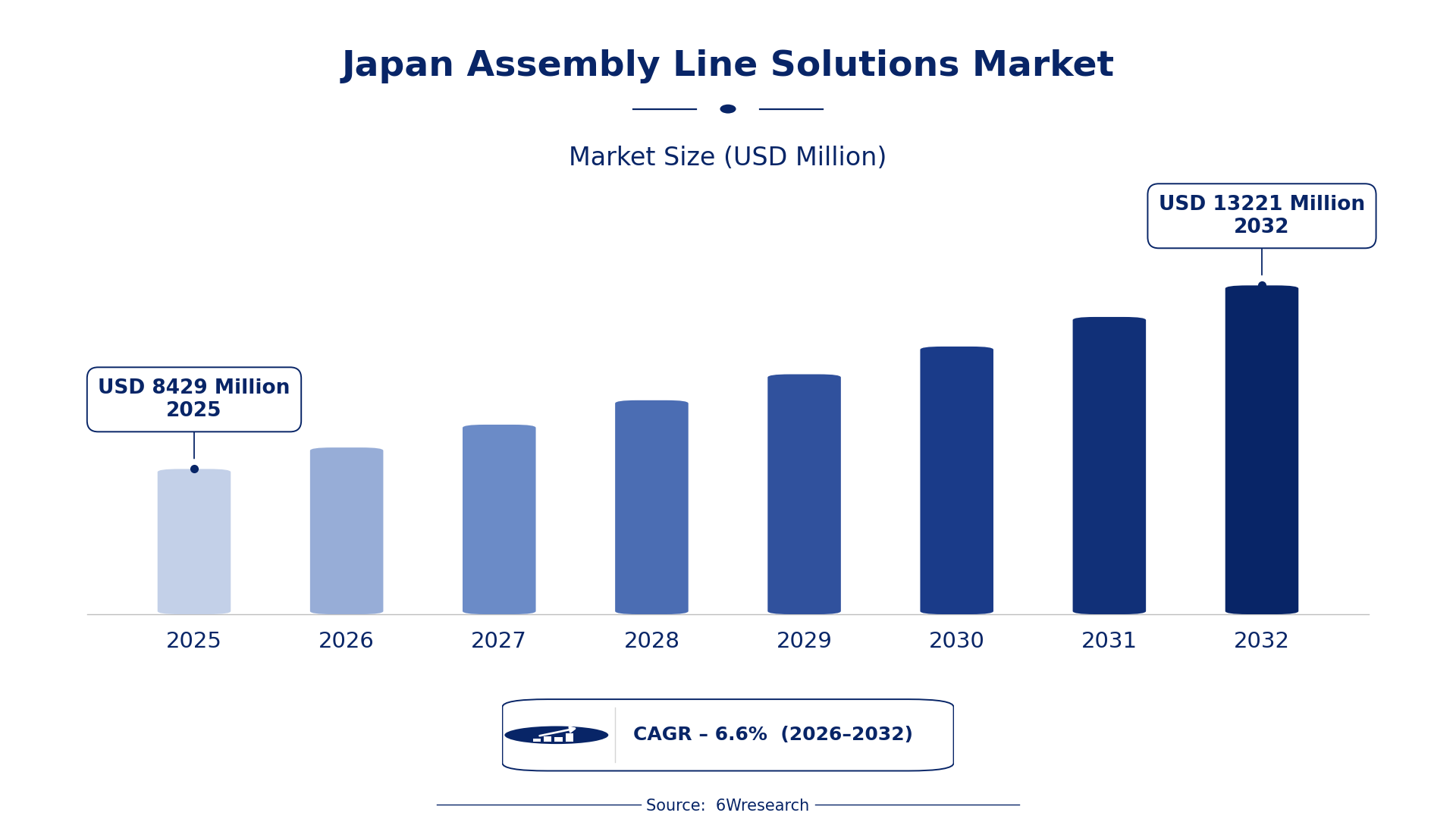
According to 6Wresearch internal database and industry insights, the Japan Assembly Line Solutions Market was valued at USD 8,429 Million in 2025 and is projected to reach USD 13,221 Million by 2032, growing at a CAGR of approximately 6.6% during 2026–2032.
Japan Assembly Line Solutions Market Highlights
| Report Metric | Details |
| Report Name | Japan Assembly Line Solutions Market (2026-2032) |
| Market Size 2025 | USD 8,429 Million |
| Market Size 2032 | USD 13,221 Million |
| Absolute Growth 2025–2032 | USD 4,792 Million |
| CAGR 2026–2032 | 6.6% |
| Peak Annual Growth | 7.7% in 2029 |
| Forecast Period | 2026–2032 |
| Historical Data | 2022–2025 |
| Base Year | 2025 |
| Leading Product Type, 2025 | Conveyor Systems (54% share) |
| Leading End User, 2025 | Automotive (49% share) |
| Leading Application, 2025 | Product Assembly (42% share) |
| Leading Technology, 2025 | Automated Lines (46% share) |
| Fastest-Growing Product Type | Assembly Machines (9.6% CAGR) |
| Fastest-Growing End User | Electronics (8.5% CAGR) |
| Fastest-Growing Application | Packaging (8.8% CAGR) |
| Fastest-Growing Technology | Modular Systems (9.8% CAGR) |
| Growing Sector | Automotive |
| Key End Users | Automotive, Electronics, Pharmaceuticals |
Japan Assembly Line Solutions Market Year-wise Growth Rate and Key Drivers (2022–2032)
This graph illustrates the annual growth rates of the market from 2022 to 2032, highlighting a steady upward trajectory and projected market expansion over the forecast period.
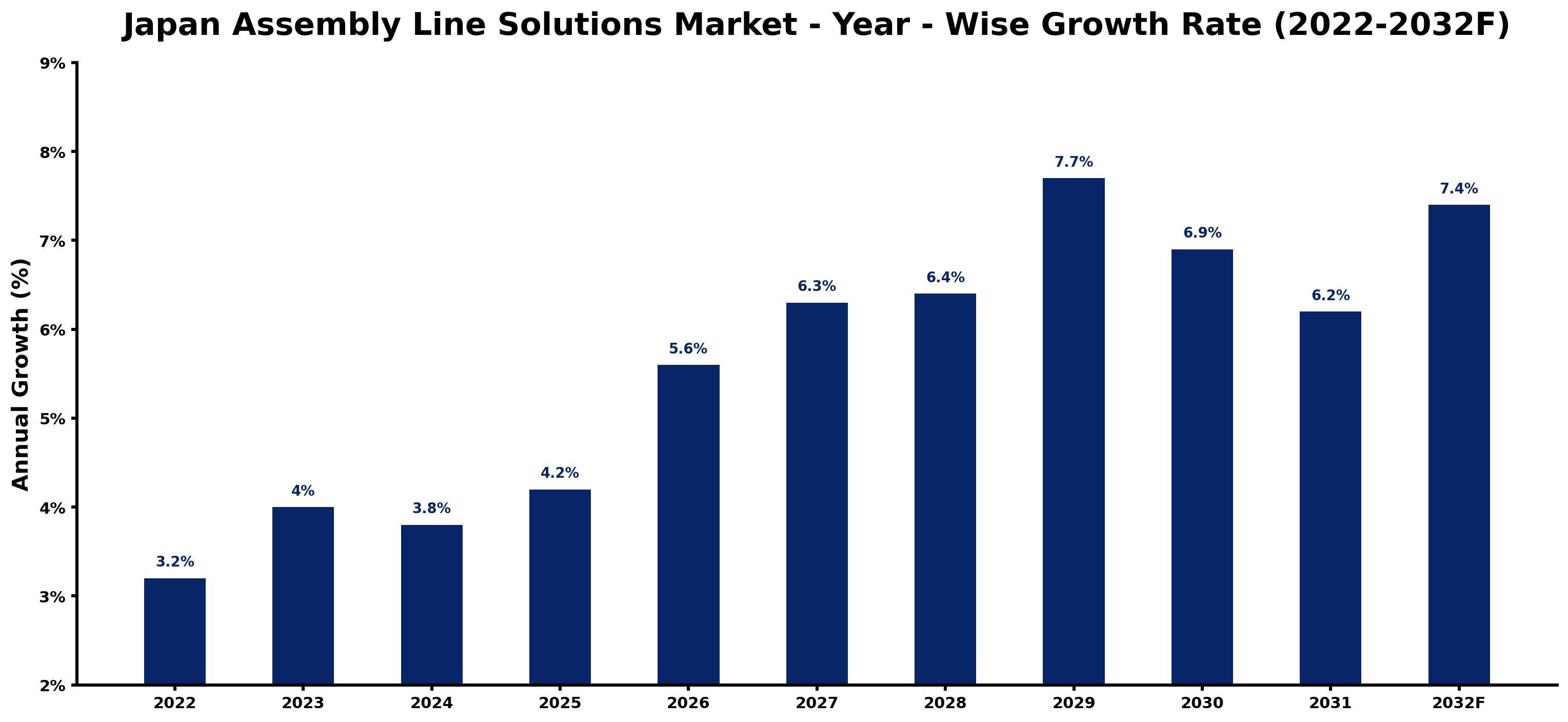
For each year, the table pairs the estimated growth rate with the leading influence on demand, showing how the drivers changed across the period.
| Year | Estimated Annual Growth (%) | Market Rationale |
| 2022 | 3.2 | The market experienced steady activity, driven by existing manufacturing needs. |
| 2023 | 4.0 | Demand increased due to heightened automotive production and technology adoption. |
| 2024 | 3.8 | Growth slowed as manufacturers adjusted to market conditions and demand patterns. |
| 2025 | 4.2 | A surge in automotive output and assembly efficiency drove faster growth. |
| 2026 | 5.6 | The introduction of new assembly technologies is expected to enhance production capabilities. |
| 2027 | 6.3 | Increased investment in automation is projected to support higher demand. |
| 2028 | 6.4 | The market is anticipated to continue expanding with ongoing technological advancements. |
| 2029 | 7.7 | Peak growth is forecasted as manufacturers adopt advanced assembly solutions. |
| 2030 | 6.9 | A slight slowdown occurs as the market stabilises after peak demand. |
| 2031 | 6.2 | Growth moderates as the market adjusts to new technology integration. |
| 2032 | 7.4 | Demand is expected to rise again with the introduction of new assembly systems. |
Note: Market size estimations and growth projections presented in this report are based on 6Wresearch's proprietary forecasting methodology, utilizing the latest available industry data, government publications, and primary research inputs.
Japan Assembly Line Solutions Market Synopsis
Assembly Line Solutions encompass various technologies aimed at improving manufacturing efficiency, including conveyor systems, assembly machines, and robotic systems. The Japan Assembly Line Solutions Market is expanding due to strong demand from the automotive sector, which produced 8.3 million vehicles in 2022, and the electronics industry, valued at approximately $100 billion. Initiatives such as a ¥10 billion programme to promote robotics in manufacturing stimulate investment and innovation in assembly technologies, driving growth across sectors.
Market Dynamics Impact Analysis (2026–2032)
| Factor | Type | Impact | Primary Segment Affected |
| Increased automotive production drives demand for efficient assembly solutions. | Driver | High | Automotive |
| Growing electronics industry necessitates advanced assembly technologies. | Driver | High | Electronics |
| Rising demand for automation presents opportunities for new suppliers. | Opportunity | High | Robotic Systems |
| Expansion of pharmaceutical manufacturing creates a need for precise assembly solutions. | Opportunity | Medium | Pharmaceuticals |
| High costs of advanced assembly technologies may limit market entry. | Restraint | High | Assembly Machines |
| Adoption of stringent quality standards can slow down production rates. | Restraint | Medium | Conveyor Systems |
| Supply chain disruptions can hinder timely delivery of assembly components. | Challenge | High | Robotic Systems |
| Competition from low-cost international suppliers affects local manufacturers. | Challenge | Medium | Automated Lines |
Evaluation of Drivers in Japan Assembly Line Solutions Market (2026–2032)
Below are the drivers that matter most for revenue growth, with supporting evidence.
| Drivers | Primary Segment Affected | Why It Matters (Evidence) |
| Increased vehicle production necessitates efficient assembly lines. | Automotive | Japan's automotive sector produced 8.3 million vehicles in 2022, driving demand for assembly line solutions. |
| Technological advancements improve assembly efficiency. | Electronics | The electronics industry in Japan is valued at approximately $100 billion, heavily relying on assembly technologies. |
| Government support for automation encourages investment in assembly solutions. | Robotic Systems | The Ministry of Economy, Trade and Industry supports initiatives for automation in manufacturing. |
| Growing pharmaceutical sector demands precise assembly processes. | Pharmaceuticals | The pharmaceutical industry in Japan is projected to grow, increasing the need for automated assembly solutions. |
| Rising demand for flexible manufacturing drives modular systems adoption. | Modular Systems | The adoption of modular systems is increasing, with many manufacturers seeking flexibility in production lines. |
Volumes grow on the back of Japan's strong automotive production, which reached 8.3 million vehicles in 2022, creating substantial demand for assembly line solutions. The electronics sector, valued at approximately $100 billion, relies on advanced assembly technologies to maintain operational efficiency. Increased investments in automation are expected to drive further demand for assembly solutions across various industries. The pharmaceutical sector's growth will necessitate more automated processes, while the rising trend towards modular systems reflects manufacturers' need for adaptable production lines.
Evaluation of Restraints in Japan Assembly Line Solutions Market
The following restraints limit how fast demand can grow.
| Market Restraint | Primary Segment Affected | Why It Matters (Evidence) |
| High initial costs of assembly technologies limit market entry. | Assembly Machines | The investment required for advanced assembly machines can deter smaller manufacturers. |
| Stringent quality standards may slow down production rates. | Conveyor Systems | Compliance with ISO 9001 standards necessitates rigorous testing and certification processes. |
| Supply chain disruptions affect timely delivery of components. | Robotic Systems | Recent global supply chain issues have delayed the availability of essential robotic parts. |
| Competition from low-cost international suppliers impacts pricing. | Automated Lines | Local manufacturers face challenges in competing with cheaper imports from abroad. |
| Limited skilled workforce hampers technology adoption. | Robotic Systems | The shortage of trained personnel in robotics affects operational efficiency in manufacturing. |
Japan Assembly Line Solutions Market Challenges
High competition in the assembly line solutions market pressures producers to lower prices, squeezing profit margins by up to 15%. Rapid technological advancements create a knowledge gap for buyers, resulting in potential production delays of 10% as they struggle to keep pace. Supply chain disruptions, especially in sourcing key components, can extend lead times by 20% for producers, hindering their order fulfilment capabilities. Strict regulatory standards, such as ISO 9001, impose annual compliance costs of up to ¥5 million on manufacturers, diverting resources from essential innovation efforts.
Trends in the Japan Assembly Line Solutions Market
These developments are changing demand patterns in the Japan Assembly Line Solutions Market.
- Shift towards Automation in Manufacturing: In 2023, Japan launched a ¥10 billion programme to promote robotics in manufacturing, reflecting a strong push towards automation. This trend is reshaping production processes, increasing efficiency and reducing labour costs.
- Growing Adoption of Modular Systems: Since 2022, manufacturers have increasingly embraced modular systems for flexible production setups. This shift allows companies to adapt quickly to changing market demands and optimise their assembly processes.
- Rise of Collaborative Robots: The Japan Robot Association has reported a growing use of collaborative robots in assembly tasks, improving productivity. This trend is evident in various sectors, including automotive and electronics, where efficiency is paramount.
- Focus on Quality Management Standards: The adoption of JIS Z 8401 standards has intensified since 2021, ensuring high-quality assembly processes. This emphasis on quality management is vital for maintaining competitiveness in the global market.
Investment Opportunities in the Japan Assembly Line Solutions Market
Investors looking at the Japan Assembly Line Solutions Market should consider the following areas.
- Investment in Robotics Facilities: Tokyo and Aichi Prefecture are major hubs for assembly line technology deployment, presenting opportunities for investment in robotics facilities. The projected growth of the pharmaceutical industry further necessitates advanced automation solutions.
- Supply of Automated Assembly Solutions: With the electronics industry valued at approximately $100 billion, there is an opportunity to supply automated assembly solutions. Collaborating with local manufacturers can facilitate market entry and growth.
- Demand for Flexible Manufacturing: The increasing adoption of modular systems creates a need for suppliers of flexible manufacturing solutions. Engaging with automotive manufacturers can lead to fruitful partnerships and investments.
- Collaborative Robots for Enhanced Efficiency: The growing use of collaborative robots in assembly tasks presents a lucrative opportunity. Establishing joint ventures with technology providers can improve product offerings and market reach.
Government Initiatives in the Japan Assembly Line Solutions Market
The Semiconductor and Digital Industry Strategy, introduced in June 2021, improves domestic semiconductor manufacturing capabilities. This measure complements the Battery Industry Strategy, launched in August 2022, which aims to boost domestic battery manufacturing capacity, ensuring a reliable supply chain for assembly line solutions.
In 2023, the government allocated ¥10 billion to promote robotics in manufacturing through the Ministry of Economy, Trade and Industry. This funding supports initiatives aimed at improving automation and efficiency in assembly processes, benefiting various industries.
Future Insight of the Japan Assembly Line Solutions Market
Government initiatives promoting automation will drive substantial changes in assembly line operations by 2032, prompting suppliers to invest in new technologies. The automotive sector's growth will create a surge in demand for efficient assembly solutions, pushing producers to enhance their offerings. Adoption of the JIS Z 8401 standard will improve quality across production processes, benefiting both suppliers and buyers. The International Robot Exhibition will continue to highlight advancements, shaping future trends in assembly technologies.
Market Segmentation Analysis
Japan Assembly Line Solutions Market report covers a detailed analysis of the following market segments:
By Product Type – Conveyor Systems Lead, Assembly Machines Expected to Grow Fastest
According to Sachin Kumar Rai, Senior Research Analyst at 6Wresearch, Conveyor Systems held 54% of the Japan Assembly Line Solutions Market by product type in 2025. Conveyor systems are essential for material handling in production lines, making them indispensable in the automotive sector. The production of 8.3 million vehicles in 2022 underscores the reliance on these systems for operational efficiency. Assembly Machines are set to record the highest CAGR in this split, 9.6% over 2026–2032. Assembly machines are experiencing rapid growth as manufacturers increasingly recognise their critical role in efficient assembly processes. The automotive and electronics sectors are particularly influential, driving demand for advanced assembly technologies. Suppliers should focus on developing assembly machines to meet the increasing demand for operational efficiency.
By End User – Automotive Leads, Electronics Expected to Grow Fastest
Automotive took 49% of end user revenue in 2025, more than any other category. The automotive sector is the largest end user of assembly line solutions, accounting for 20% of Japan's manufacturing output. This prominence is due to the high volume of vehicle production, necessitating sophisticated assembly technologies to maintain efficiency. Electronics is projected to grow fastest, at a CAGR of 8.5% during 2026–2032. The electronics industry is witnessing the fastest growth, propelled by its significant demand for assembly efficiency, with a market value of approximately $100 billion. Rapid technological advancements in this sector are further accelerating the need for enhanced assembly solutions. Buyers in the electronics sector should invest in advanced assembly technologies to maintain their competitive advantage.
By Application – Product Assembly Leads, Packaging Expected to Grow Fastest
The largest application category in 2025 was Product Assembly, at 42% of revenue. Product assembly is the core application of assembly line solutions, reflecting its vital role in production processes. Its widespread use across various industries ensures a steady demand for these technologies. The quickest growth will come from Packaging, forecast to expand at a CAGR of 8.8% between 2026 and 2032. Packaging is emerging as the fastest-growing application, crucial for production as companies aim to improve efficiency and reduce costs. The increasing focus on streamlined operations across industries is driving this trend. Suppliers should expand their offerings to include advanced packaging solutions to capitalise on this growing market.
By Technology – Automated Lines Lead, Modular Systems Expected to Grow Fastest
With 46% of technology revenue in 2025, Automated Lines was the largest category. Automated lines are the leading technology in this market, essential for achieving efficiency in modern manufacturing. Their widespread adoption across key sectors, particularly automotive and electronics, solidifies their dominant position in the industry. Over 2026–2032, Modular Systems are expected to post the fastest growth, at a CAGR of 9.8%. Modular systems are rapidly gaining traction as manufacturers seek greater flexibility in their production setups. This trend highlights the industry's need to adapt to changing market demands and enhance production efficiency. Investing in modular technology can provide suppliers with a competitive edge in addressing the diverse needs of manufacturers.
Key Attractiveness of the Report
- 10 Years of Market Numbers
- Historical Data Starting from 2022 to 2025
- Base Year 2025
- Forecast Data until 2032
- Key Performance Indicators Impacting the Market
- Major Upcoming Developments and Projects
Key Highlights of the Report:
- Japan Assembly Line Solutions Market Outlook
- Market Size of Japan Assembly Line Solutions Market, 2025
- Forecast of Japan Assembly Line Solutions Market, 2032
- Historical Data and Forecast of Japan Assembly Line Solutions Revenues & Volume for the Period 2022-2032
- Japan Assembly Line Solutions Market Trend Evolution
- Japan Assembly Line Solutions Market Drivers and Challenges
- Japan Assembly Line Solutions Price Trends
- Japan Assembly Line Solutions Porter's Five Forces
- Japan Assembly Line Solutions Industry Life Cycle
- Historical Data and Forecast of Japan Assembly Line Solutions Market Revenues & Volume By Product Type for the Period 2022-2032
- Historical Data and Forecast of Japan Assembly Line Solutions Market Revenues & Volume By Conveyor Systems for the Period 2022-2032
- Historical Data and Forecast of Japan Assembly Line Solutions Market Revenues & Volume By Assembly Machines for the Period 2022-2032
- Historical Data and Forecast of Japan Assembly Line Solutions Market Revenues & Volume By Robotic Systems for the Period 2022-2032
- Historical Data and Forecast of Japan Assembly Line Solutions Market Revenues & Volume By End User for the Period 2022-2032
- Historical Data and Forecast of Japan Assembly Line Solutions Market Revenues & Volume By Automotive for the Period 2022-2032
- Historical Data and Forecast of Japan Assembly Line Solutions Market Revenues & Volume By Electronics for the Period 2022-2032
- Historical Data and Forecast of Japan Assembly Line Solutions Market Revenues & Volume By Pharmaceuticals for the Period 2022-2032
- Historical Data and Forecast of Japan Assembly Line Solutions Market Revenues & Volume By Application for the Period 2022-2032
- Historical Data and Forecast of Japan Assembly Line Solutions Market Revenues & Volume By Product Assembly for the Period 2022-2032
- Historical Data and Forecast of Japan Assembly Line Solutions Market Revenues & Volume By Packaging for the Period 2022-2032
- Historical Data and Forecast of Japan Assembly Line Solutions Market Revenues & Volume By Manufacturing for the Period 2022-2032
- Historical Data and Forecast of Japan Assembly Line Solutions Market Revenues & Volume By Technology for the Period 2022-2032
- Historical Data and Forecast of Japan Assembly Line Solutions Market Revenues & Volume By Automated Lines for the Period 2022-2032
- Historical Data and Forecast of Japan Assembly Line Solutions Market Revenues & Volume By Modular Systems for the Period 2022-2032
- Historical Data and Forecast of Japan Assembly Line Solutions Market Revenues & Volume By Collaborative Robots for the Period 2022-2032
- Japan Assembly Line Solutions Import Export Trade Statistics
- Market Opportunity Assessment By Product Type
- Market Opportunity Assessment By End User
- Market Opportunity Assessment By Application
- Market Opportunity Assessment By Technology
- Japan Assembly Line Solutions Top Companies Market Share
- Japan Assembly Line Solutions Competitive Benchmarking By Technical and Operational Parameters
- Japan Assembly Line Solutions Company Profiles
- Japan Assembly Line Solutions Key Strategic Recommendations
Market Covered
The report covers the following segments.
By Product Type
- Conveyor Systems
- Assembly Machines
- Robotic Systems
By End User
- Automotive
- Electronics
- Pharmaceuticals
By Application
- Product Assembly
- Packaging
- Manufacturing
By Technology
- Automated Lines
- Modular Systems
- Collaborative Robots































