Japan Assisted Living Facility Market Size & Growth Rate
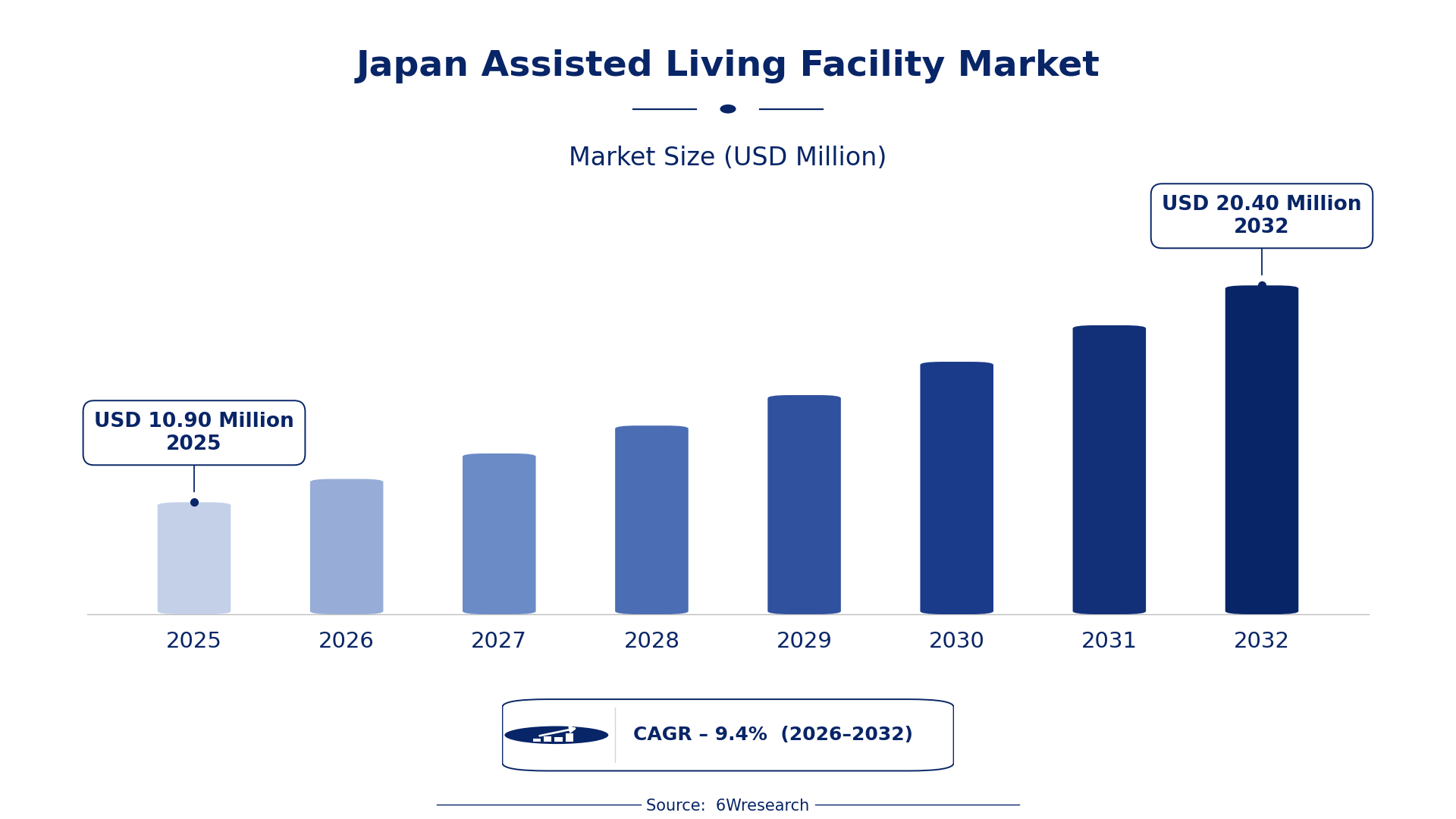
According to 6Wresearch internal database and industry insights, the Japan Assisted Living Facility Market was valued at USD 10.90 Million in 2025 and is projected to reach USD 20.40 Million by 2032, growing at a CAGR of approximately 9.4% during 2026–2032.
Japan Assisted Living Facility Market Highlights
| Report Metric | Details |
| Report Name | Japan Assisted Living Facility Market (2026-2032) |
| Market Size 2025 | USD 10.90 Million |
| Market Size 2032 | USD 20.40 Million |
| Absolute Growth 2025–2032 | USD 9.50 Million |
| CAGR 2026–2032 | 9.4% |
| Peak Annual Growth | 10.3% in 2029 |
| Forecast Period | 2026–2032 |
| Historical Data | 2022–2025 |
| Base Year | 2025 |
| Leading Age, 2025 | More Than 85 (42% share) |
| Fastest-Growing Age | 75-84 (12.3% CAGR) |
| Growing Sector | Elderly care services |
| Key End Users | Elderly individuals, families seeking care, healthcare providers, government agencies |
Japan Assisted Living Facility Market Year-wise Growth Rate and Key Drivers (2022–2032)
This graph illustrates the annual growth rates of the market from 2022 to 2032, highlighting a steady upward trajectory and projected market expansion over the forecast period.
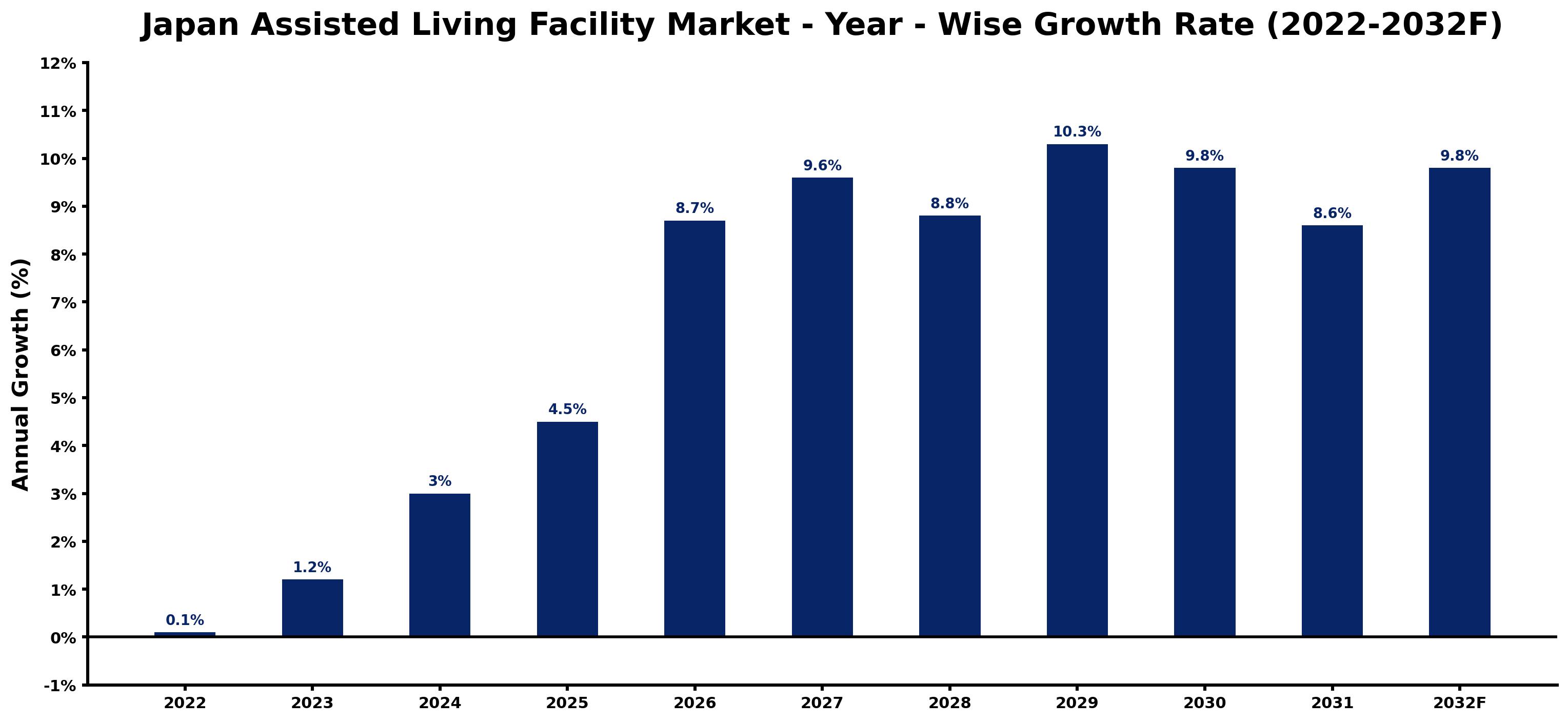
Below, each year's estimated growth is shown next to the factor that most influenced it.
| Year | Estimated Annual Growth (%) | Market Rationale |
| 2022 | 0.1 | The market experienced minimal growth due to initial adjustments in care service demand. |
| 2023 | 1.2 | Demand for assisted living facilities grew faster as families sought more care options for elderly relatives. |
| 2024 | 3.0 | Increased awareness of assisted living solutions led to higher inquiries and admissions in facilities. |
| 2025 | 4.5 | The market peaked historically as occupancy rates reached approximately 90%, driving further investments. |
| 2026 | 8.7 | Demand surged as urban areas expanded assisted living capacity to accommodate the growing elderly population. |
| 2027 | 9.6 | The market continued to grow as families increasingly recognised the benefits of assisted living services. |
| 2028 | 8.8 | Growth slowed slightly as facilities faced challenges in meeting high demand and maintaining quality care. |
| 2029 | 10.3 | The market saw a peak in growth as new developments and caregiver initiatives met rising demand. |
| 2030 | 9.8 | Growth decelerated as facilities adjusted to new standards and technological advancements in care. |
| 2031 | 8.6 | Demand remained strong, but growth slowed as the market stabilised after rapid expansions. |
| 2032 | 9.8 | The market is expected to grow faster as advancements in care technology improve operational efficiency. |
Note: Market size estimations and growth projections presented in this report are based on 6Wresearch's proprietary forecasting methodology, utilizing the latest available industry data, government publications, and primary research inputs.
Japan Assisted Living Facility Market Synopsis
Assisted living facilities in Japan provide personal care and support services for elderly individuals, particularly those unable to live independently. With over 5 million individuals aged 65 and older, the market is experiencing robust growth, driven by an increasing elderly population and a rising demand for quality care. Government initiatives, including a programme to increase certified caregivers, further expand market potential, while the average occupancy rate of around 90% highlights the strong demand for these facilities.
Market Dynamics Impact Analysis (2026–2032)
| Factor | Type | Impact | Primary Segment Affected |
| Aging population driving demand for personal care services | Driver | High | More Than 85 |
| Government initiatives to increase caregiver numbers | Driver | High | 75-84 |
| Growing demand for certified facilities in urban areas | Opportunity | High | More Than 85 |
| Expansion of subsidy programmes for new facilities | Opportunity | High | 75-84 |
| High operational costs limiting facility expansion | Restraint | Medium | More Than 85 |
| Regulatory compliance requirements increasing operational burdens | Restraint | Medium | 75-84 |
| Shortage of trained caregivers affecting service quality | Challenge | High | More Than 85 |
| Competition among facilities leading to pricing pressures | Challenge | Medium | 75-84 |
Evaluation of Drivers in Japan Assisted Living Facility Market (2026–2032)
The factors lifting demand, and the evidence behind each, are summarised below.
| Drivers | Primary Segment Affected | Why It Matters (Evidence) |
| Increasing elderly population requiring assisted living services | More Than 85 | As of 2023, over 5 million individuals aged 65 and older are in Japan, leading to higher demand for assisted living facilities. |
| Government funding for caregiver training programmes | 75-84 | The government aims to increase certified caregivers by 10,000 by 2025, improving service availability. |
| High occupancy rates indicating strong demand | More Than 85 | The average occupancy rate of around 90% reflects the growing need for assisted living facilities. |
| Urbanisation driving facility development in metropolitan areas | 75-84 | Tokyo accounts for 20% of all assisted living facilities, indicating concentrated demand in urban regions. |
| Rising awareness of elderly care options among families | More Than 85 | With 1.2 million individuals receiving long-term care services, families are increasingly seeking assisted living solutions. |
Buyers are adding capacity as the elderly population in Japan continues to grow, with over 5 million individuals aged 65 and older in 2023. This demographic shift is prompting families to seek assisted living solutions, reflected in the average occupancy rate of around 90% in facilities. Urban areas, particularly Tokyo, which hosts 20% of all facilities, are experiencing particularly strong demand, driving further investments in new developments. The rising awareness of care options among families is leading to increased inquiries and admissions into assisted living facilities, contributing to overall market growth.
Evaluation of Restraints in Japan Assisted Living Facility Market
Several factors work against faster growth; the main ones are summarised below.
| Market Restraint | Primary Segment Affected | Why It Matters (Evidence) |
| High operational costs impacting profitability | More Than 85 | Facilities face rising operational costs, restricting their ability to expand services effectively. |
| Regulatory compliance increasing operational burdens | 75-84 | Strict regulations enforced by the Ministry of Health, Labour and Welfare require substantial resources for compliance. |
| Shortage of trained caregivers affecting service quality | More Than 85 | The current caregiver shortage limits the quality of care that facilities can provide, impacting occupancy. |
| Competition leading to pricing pressures | 75-84 | Intense competition among facilities forces prices down, impacting overall revenue. |
| Limited funding for facility improvements | More Than 85 | Many facilities struggle to secure funding for necessary upgrades, impacting service quality. |
Japan Assisted Living Facility Market Challenges
The average monthly cost of assisted living in Japan is about 200,000 yen, which strains families seeking care for elderly relatives. Buyers face long waiting times for placement, as occupancy rates remain high at approximately 90%, delaying access to necessary support. A shortage of certified caregivers exists, with the government planning to increase their numbers by only 10,000 by 2025, limiting timely service delivery for facilities. Limited technological adoption hampers operational efficiency, resulting in increased costs for providers who must rely on outdated processes for care management.
Trends in the Japan Assisted Living Facility Market
The shifts below are changing how Japan Assisted Living Facility Market products are bought and supplied.
- Shift Towards Urban Assisted Living Facilities: In 2023, the trend of establishing assisted living facilities in urban areas intensified, with Tokyo housing 20% of all facilities. This shift reflects the need for accessible care options in densely populated regions, improving service availability for families.
- Transition to Enhanced Safety Standards: Since the 2022 update of the JIS standard for assisted living facilities, safety measures have improved. This change has led to increased confidence among families, resulting in higher occupancy rates as facilities comply with new regulations.
- Emergence of Subsidy Programs for New Facilities: In 2023, the Tokyo Metropolitan Government initiated a subsidy program to support new assisted living facilities. This initiative is expected to encourage investment in the sector, addressing the increasing need for elderly care services.
- Growing Demand for Certified Caregivers: The government launched a programme in 2023 to increase the number of certified caregivers by 10,000 by 2025. This initiative aims to improve service quality in assisted living facilities, responding to the rising need for elderly care.
Investment Opportunities in the Japan Assisted Living Facility Market
The openings below show where demand in the Japan Assisted Living Facility Market is visible and how suppliers can enter.
- Gap in Urban Assisted Living Facilities: With Tokyo accounting for 20% of all facilities, there is a notable gap in urban assisted living options. Investing in new facilities can meet the demand from families seeking care for elderly relatives.
- Expansion of Caregiver Training Services: The initiative to increase certified caregivers presents an opportunity to supply training services. Collaborating with educational institutions can help meet the rising need for skilled caregivers.
- Investment in Facility Upgrades: The average monthly cost of assisted living is about 200,000 yen, indicating potential for facility upgrades. Partnering with local governments can facilitate funding for enhancements.
- Development of Safety Compliance Solutions: The updated JIS standard for assisted living facilities highlights the need for compliance solutions. Providing consulting services to facilities can help them meet safety regulations effectively.
Government Initiatives in the Japan Assisted Living Facility Market
The Long-Term Care Insurance Act, in force since 2000, provides funding for nursing care and support services for older adults. This legislation ensures that assisted living facilities receive financial support, enabling them to offer essential services to residents. The Industrial Standardization Act governs safety and operational standards, which facilities must adhere to, ensuring quality care for the elderly population.
The Ministry of Health, Labour and Welfare oversees the implementation of the Long-Term Care Insurance Act, facilitating funding for facilities. In practice, assisted living facilities benefit from this funding to improve care services and expand their capacity to accommodate more residents.
Future Insight of the Japan Assisted Living Facility Market
The Tokyo Metropolitan Government's subsidy program for new assisted living facilities will boost capacity, allowing more seniors to receive care by 2025. The updated JIS standard for safety measures will enhance trust among families and attract more residents. By 2032, advancements in care technology will optimise operations, enabling facilities to better meet resident needs. With 1.2 million individuals receiving long-term care services, the demand for quality options will drive innovation and service improvements across the sector.
Market Segmentation Analysis
Japan Assisted Living Facility Market report covers a detailed analysis of the following market segments:
By Age – More Than 85 Leads, 75-84 Expected to Grow Fastest
According to Summon Dutta, Assistant Manager at 6Wresearch, More Than 85 held 42% of the Japan Assisted Living Facility Market by age in 2025. The age group above 85 commands the largest share as this demographic often requires extensive personal care and supervision, reflecting the needs of a significant portion of Japan's elderly population. For instance, with over 5 million individuals aged 65 and older, this segment represents a critical demand for assisted living services. 75-84 is set to record the highest CAGR in this split, 12.3% over 2026–2032. The 75-84 age group is experiencing rapid growth as more individuals in this range increasingly need assistance with daily activities, driven by the demographic shift in Japan. The government's programme to increase certified caregivers by 10,000 by 2025 will further support the expansion of this segment. Suppliers must focus on developing services that cater specifically to the growing needs of the 75-84 age group to seize market opportunities.
Key Attractiveness of the Report
- 10 Years of Market Numbers
- Historical Data Starting from 2022 to 2025
- Base Year 2025
- Forecast Data until 2032
- Key Performance Indicators Impacting the Market
- Major Upcoming Developments and Projects
Key Highlights of the Report:
- Japan Assisted Living Facility Market Outlook
- Market Size of Japan Assisted Living Facility Market, 2025
- Forecast of Japan Assisted Living Facility Market, 2032
- Historical Data and Forecast of Japan Assisted Living Facility Revenues & Volume for the Period 2022-2032
- Japan Assisted Living Facility Market Trend Evolution
- Japan Assisted Living Facility Market Drivers and Challenges
- Japan Assisted Living Facility Price Trends
- Japan Assisted Living Facility Porter's Five Forces
- Japan Assisted Living Facility Industry Life Cycle
- Historical Data and Forecast of Japan Assisted Living Facility Market Revenues & Volume By Age for the Period 2022-2032
- Historical Data and Forecast of Japan Assisted Living Facility Market Revenues & Volume By More Than 85 for the Period 2022-2032
- Historical Data and Forecast of Japan Assisted Living Facility Market Revenues & Volume By 75-84 for the Period 2022-2032
- Historical Data and Forecast of Japan Assisted Living Facility Market Revenues & Volume By 65-74 for the Period 2022-2032
- Historical Data and Forecast of Japan Assisted Living Facility Market Revenues & Volume By Less Than 65 for the Period 2022-2032
- Japan Assisted Living Facility Import Export Trade Statistics
- Market Opportunity Assessment By Age
- Japan Assisted Living Facility Top Companies Market Share
- Japan Assisted Living Facility Competitive Benchmarking By Technical and Operational Parameters
- Japan Assisted Living Facility Company Profiles
- Japan Assisted Living Facility Key Strategic Recommendations
Market Covered
Segments analysed in this report are listed below.
By Age
- More Than 85
- 75-84
- 65-74
- Less Than 65






































