Japan Augmented Reality Software Market Size & Growth Rate
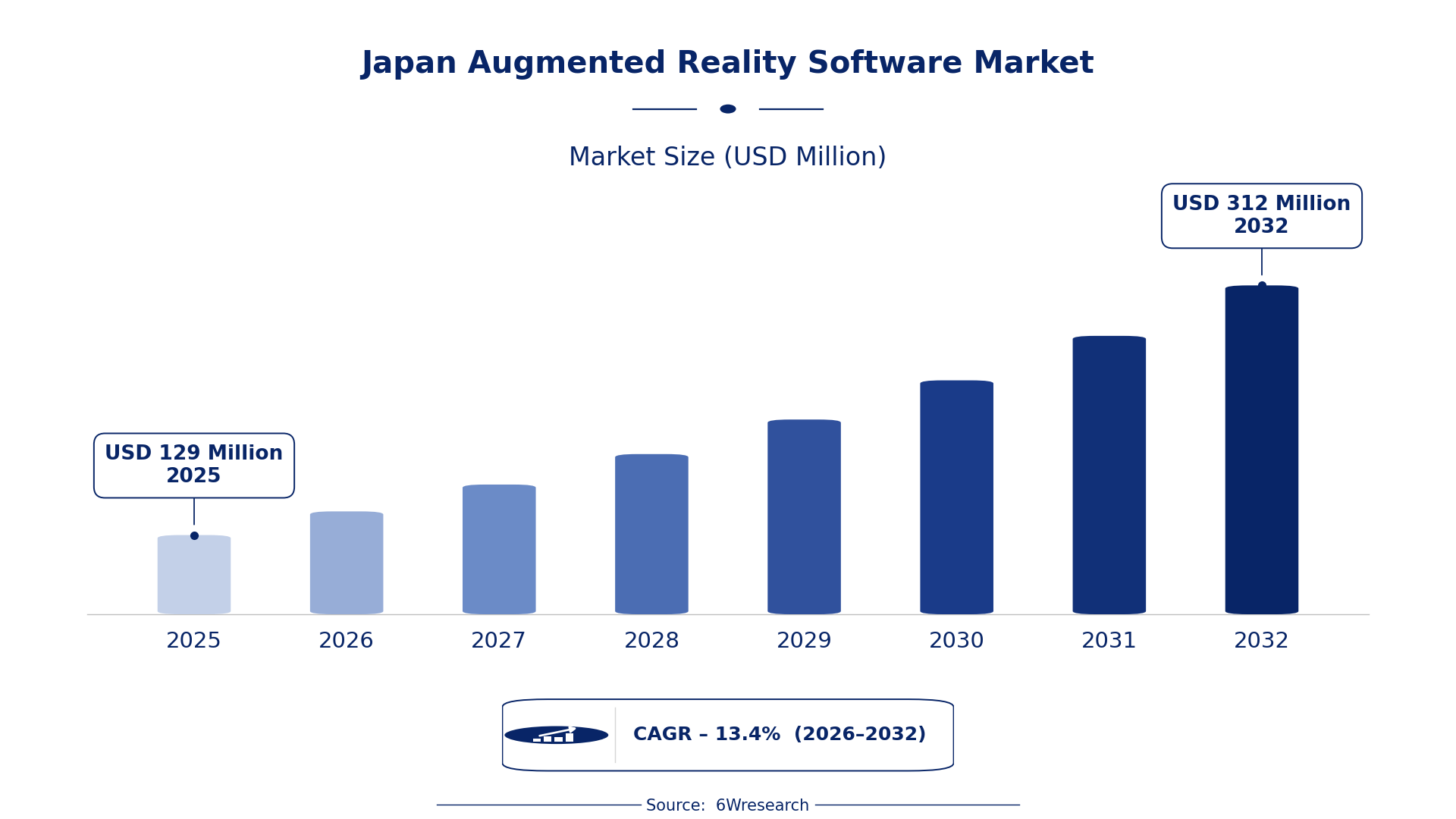
According to 6Wresearch internal database and industry insights, the Japan Augmented Reality Software Market was valued at USD 129 Million in 2025 and is projected to reach USD 312 Million by 2032, growing at a CAGR of approximately 13.4% during 2026–2032.
Japan Augmented Reality Software Market Highlights
| Report Metric | Details |
| Report Name | Japan Augmented Reality Software Market (2026-2032) |
| Market Size 2025 | USD 129 Million |
| Market Size 2032 | USD 312 Million |
| Absolute Growth 2025–2032 | USD 183 Million |
| CAGR 2026–2032 | 13.4% |
| Peak Annual Growth | 15.5% in 2032 |
| Forecast Period | 2026–2032 |
| Historical Data | 2022–2025 |
| Base Year | 2025 |
| Leading Software Function, 2025 | Remote Collaboration (39% share) |
| Leading Vertical, 2025 | Medical (29% share) |
| Fastest-Growing Software Function | 3D Modelling (19.0% CAGR) |
| Growing Sector | Healthcare |
| Key End Users | Healthcare providers, educational institutions, commercial enterprises |
Japan Augmented Reality Software Market Year-wise Growth Rate and Key Drivers (2022–2032)
This graph illustrates the annual growth rates of the market from 2022 to 2032, highlighting a steady upward trajectory and projected market expansion over the forecast period.
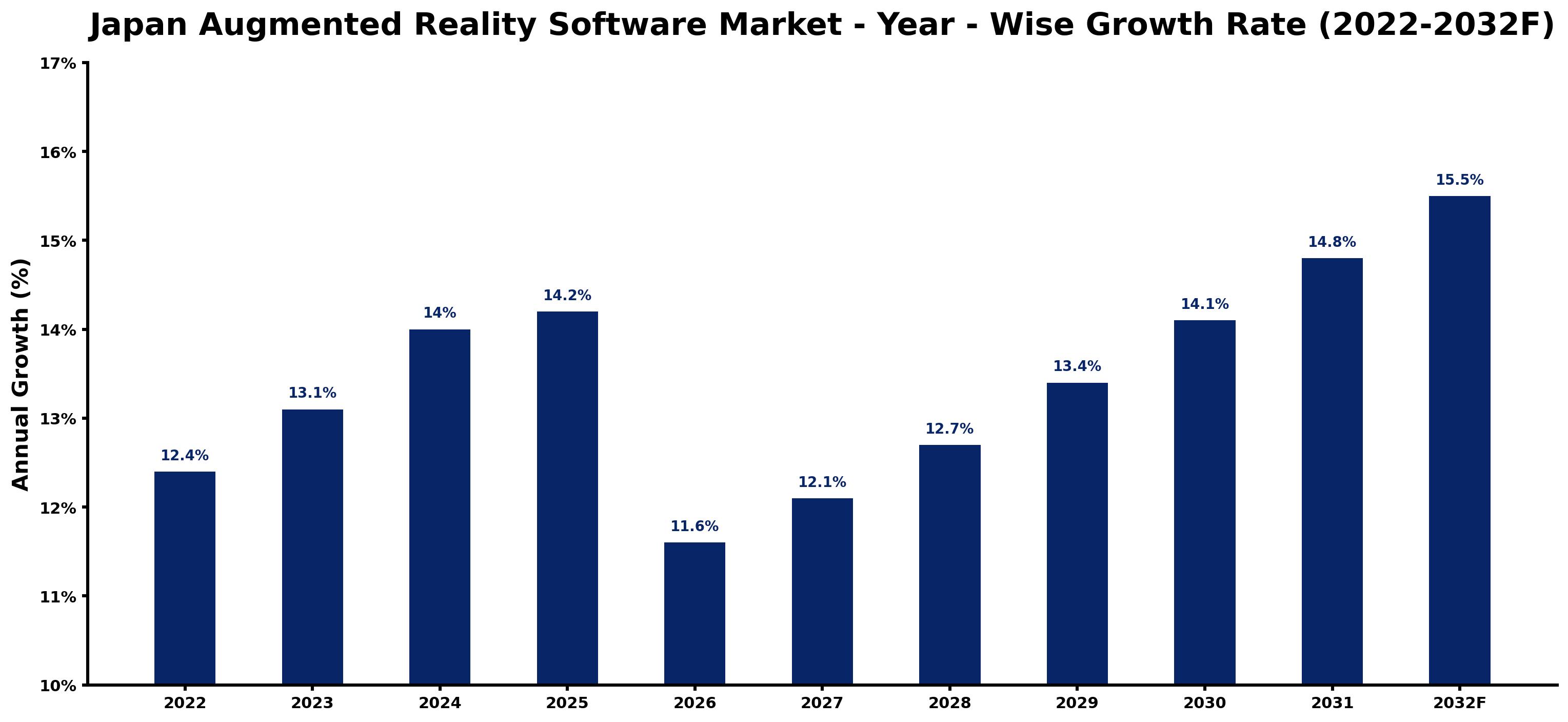
The following figures match every annual growth estimate with the main market development of that year, giving the reasoning behind each rise or slowdown.
| Year | Estimated Annual Growth (%) | Market Rationale |
| 2022 | 12.4 | The market experienced steady growth as AR applications gained traction across various sectors. |
| 2023 | 13.1 | Demand increased due to heightened interest in AR for training and marketing purposes. |
| 2024 | 14.0 | The healthcare sector expanded AR use, particularly for surgical training and patient education. |
| 2025 | 14.2 | Growth accelerated as more hospitals adopted AR technology for training simulations. |
| 2026 | 11.6 | The growth rate is expected to slow as market saturation begins to affect new investments. |
| 2027 | 12.1 | Interest in AR technology will rise again as companies seek to enhance operational processes. |
| 2028 | 12.7 | Continued advancements in AR software are projected to spur demand across multiple industries. |
| 2029 | 13.4 | Growth is expected to pick up as consumer engagement with AR applications becomes more prevalent. |
| 2030 | 14.1 | The market will see further expansion as new AR-enabled devices enter the market. |
| 2031 | 14.8 | Increased familiarity with AR among the population will drive further adoption and usage. |
| 2032 | 15.5 | The peak growth year is projected to be marked by substantial investments in AR technology across sectors. |
Note: Market size estimations and growth projections presented in this report are based on 6Wresearch's proprietary forecasting methodology, utilizing the latest available industry data, government publications, and primary research inputs.
Japan Augmented Reality Software Market Synopsis
Augmented Reality software overlays digital information onto the real world, primarily developed through computer vision and depth tracking technologies. This technology finds extensive applications in training simulations, remote assistance, and interactive marketing. The Japan Augmented Reality Software Market is expanding due to rising demand from sectors like healthcare, where over 30 hospitals are utilising AR for surgical training, and commercial sectors, which are projected to grow at 15% annually through 2025.
Market Dynamics Impact Analysis (2026–2032)
| Factor | Type | Impact | Primary Segment Affected |
| Increased adoption of AR in healthcare training | Driver | High | Medical |
| Growing demand for interactive marketing solutions | Driver | High | Commercial |
| Expansion of AR applications in educational institutions | Opportunity | High | Enterprise |
| Technological advancements in AR software development | Opportunity | High | Visualization |
| Limited awareness of AR benefits in traditional sectors | Restraint | Medium | Oil & Gas |
| High initial investment costs for AR implementation | Restraint | High | Aerospace & Defense |
| Shortage of skilled professionals in AR development | Challenge | High | 3D Modelling |
| Competition from alternative technologies like VR | Challenge | Medium | Remote Collaboration |
Evaluation of Drivers in Japan Augmented Reality Software Market (2026–2032)
The factors lifting demand, and the evidence behind each, are summarised below.
| Drivers | Primary Segment Affected | Why It Matters (Evidence) |
| Increased healthcare spending on training technologies | Medical | The healthcare sector's investment in AR for surgical training has surpassed JPY 5 billion, boosting demand for AR software. |
| Rising consumer engagement with AR marketing | Commercial | With over 60% of smartphone users interacting with AR content, businesses are investing in AR solutions to improve customer experiences. |
| Growing number of AR-enabled devices | Enterprise | An estimated 5 million AR-enabled devices in Japan are driving demand for software that improves operational efficiency. |
| Support from government funding programs for AR innovation | Visualization | The Ministry of Economy, Trade and Industry allocated JPY 2 billion for AR technology development, encouraging market growth. |
| Expansion of AR applications in educational tools | 3D Modelling | Over 100 universities are integrating AR into their curricula, increasing demand for AR software solutions. |
Much of the new demand traces back to increased healthcare spending, with the sector investing over JPY 5 billion in AR for surgical training. The number of AR-enabled devices in Japan is estimated at 5 million, driving demand for software that improves operational efficiency. The healthcare sector's investment in AR for surgical training is prompting hospitals to adopt these solutions, while the educational sector's integration of AR technology is reshaping learning methodologies.
Evaluation of Restraints in Japan Augmented Reality Software Market
The key brakes on demand, and where they bite hardest, are shown below.
| Market Restraint | Primary Segment Affected | Why It Matters (Evidence) |
| Limited awareness of AR benefits among traditional sectors | Oil & Gas | Many companies in the oil and gas sector remain unaware of AR's potential, limiting adoption rates and hindering market growth. |
| High initial investment costs for AR implementation | Aerospace & Defense | The aerospace sector faces high costs associated with AR technology integration, which can deter potential buyers. |
| Shortage of skilled professionals in AR development | 3D Modelling | The lack of qualified personnel in AR development slows down project implementation and affects software quality. |
| Concerns over data privacy and security in AR applications | Remote Collaboration | Potential users hesitate to adopt AR due to fears about data breaches and privacy violations. |
| Competition from alternative technologies like VR | Visualization | The growing popularity of virtual reality solutions poses a challenge to AR adoption in various sectors. |
Japan Augmented Reality Software Market Challenges
Sourcing AR software presents challenges for hospitals in Japan, as many rely on a limited pool of local developers, causing delays in technology integration for training programmes. A skills gap exists because educational institutions have not aligned their curricula with industry needs, costing hospitals time and resources in recruitment. Implementation costs have surged by 20% over the past year, straining clinics' budgets for new technologies. Competition among tech startups in the Tokyo region escalates, forcing smaller suppliers to navigate rapid innovation cycles that can hinder their ability to meet market demands.
Trends in the Japan Augmented Reality Software Market
The shifts below are changing how Japan Augmented Reality Software Market products are bought and supplied.
- Shift from Traditional Training to AR-Based Simulations: In 2023, over 30 hospitals in Japan adopted AR for surgical training, improving learning outcomes. This shift reflects a growing trend towards immersive training solutions.
- Growing Use of AR in Marketing Strategies: The commercial sector is increasingly integrating AR into marketing campaigns, with a projected 15% annual growth through 2025. This trend is seen in interactive advertising efforts across various platforms.
- Emergence of AR in Educational Tools: Since 2022, over 100 universities in Japan have incorporated AR into their educational tools, improving student engagement and learning experiences. This trend is reshaping educational methodologies.
- Expansion of AR Technology in Tech Startups: The Tokyo region has become a hub for AR development, hosting numerous tech startups focusing on AR solutions. This growth supports the overall expansion of the AR market.
Investment Opportunities in the Japan Augmented Reality Software Market
The openings below show where demand in the Japan Augmented Reality Software Market is visible and how suppliers can enter.
- Timing for Investment in AR for Healthcare: With over 30 hospitals using AR for training, now is the time to invest in AR solutions tailored for healthcare, capitalising on a growing market worth over JPY 5 billion.
- Entry into the Educational AR Market: Partnering with educational institutions to supply AR tools presents a strong opportunity, especially as over 100 universities are adopting AR technology.
- Supply of AR Solutions for Commercial Marketing: The commercial sector's projected growth in AR applications highlights a prime opportunity for suppliers to develop marketing-focused AR solutions.
- Gap in AR for Aerospace Training: With high initial investment costs in aerospace, a gap exists for affordable AR training solutions, presenting an opportunity for developers.
Government Initiatives in the Japan Augmented Reality Software Market
The Industrial Standardization Act governs AR standards, ensuring compliance and safety for producers. This law mandates that AR applications meet specific criteria, which helps buyers trust the technology's reliability and effectiveness. The Digital Transformation Strategy, launched in 2022, promotes the integration of AR across various industries, encouraging innovation and investment in this technology.
The Digital Agency oversees the implementation of the Digital Transformation Strategy, funding projects that support AR adoption. This agency assists buyers in accessing AR tools, ensuring they meet established standards and promoting wider usage across sectors.
Future Insight of the Japan Augmented Reality Software Market
New training facilities focused on AR technology will emerge by 2032, spurred by the government's Digital Transformation Strategy. The adoption of ISO/IEC 30170:2020 will standardise AR applications, promoting quality and reliability across various sectors. By 2025, AR-enabled devices are expected to reach 10 million units, improving accessibility for buyers. Collaboration between universities and tech startups will create a supportive environment for talent development and innovation, benefiting both suppliers and end users.
Market Segmentation Analysis
Japan Augmented Reality Software Market report covers a detailed analysis of the following market segments:
By Software Function – Remote Collaboration Leads, 3D Modelling Expected to Grow Fastest
According to Sumit Sagar, AM at 6Wresearch, in 2025, Remote Collaboration led the software function split with a 39% share. Remote collaboration holds the largest share as it is crucial for industries needing effective communication and problem-solving across distances. For instance, hospitals utilise AR for remote surgical assistance, underscoring its significance in the medical sector. Over 2026–2032, 3D Modelling is expected to post the fastest growth, at a CAGR of 19.0%. The 3D modelling segment is experiencing rapid growth as organisations increasingly recognise the importance of visualising complex data in real-time. This trend is evident in the rising adoption of AR in design processes, which enhances product development efficiency. Suppliers must focus on developing features that improve real-time collaboration to meet market needs.
By Vertical – Medical Leads and Records the Fastest Growth
Medical held 29% of the Japan Augmented Reality Software Market by vertical in 2025. The medical sector leads the market by effectively using AR for surgical training and patient education, with over 30 hospitals currently employing this technology. This established application provides a solid foundation for ongoing growth in AR within healthcare. Medical is also forecast to expand faster than any other category, at a CAGR of 16.1% over 2026–2032. The medical vertical is also the fastest-growing due to ongoing advancements in AR technology that enhance training and educational methods. The increasing integration of AR into healthcare facilities suggests a strong upward trajectory for this segment. Buyers in the medical sector should prioritise AR solutions that improve training effectiveness and patient engagement.
Key Attractiveness of the Report
- 10 Years of Market Numbers
- Historical Data Starting from 2022 to 2025
- Base Year 2025
- Forecast Data until 2032
- Key Performance Indicators Impacting the Market
- Major Upcoming Developments and Projects
Key Highlights of the Report:
- Japan Augmented Reality Software Market Outlook
- Market Size of Japan Augmented Reality Software Market, 2025
- Forecast of Japan Augmented Reality Software Market, 2032
- Historical Data and Forecast of Japan Augmented Reality Software Revenues & Volume for the Period 2022-2032
- Japan Augmented Reality Software Market Trend Evolution
- Japan Augmented Reality Software Market Drivers and Challenges
- Japan Augmented Reality Software Price Trends
- Japan Augmented Reality Software Porter's Five Forces
- Japan Augmented Reality Software Industry Life Cycle
- Historical Data and Forecast of Japan Augmented Reality Software Market Revenues & Volume By Software Function for the Period 2022-2032
- Historical Data and Forecast of Japan Augmented Reality Software Market Revenues & Volume By Remote Collaboration for the Period 2022-2032
- Historical Data and Forecast of Japan Augmented Reality Software Market Revenues & Volume By Workflow Optimization for the Period 2022-2032
- Historical Data and Forecast of Japan Augmented Reality Software Market Revenues & Volume By Visualization for the Period 2022-2032
- Historical Data and Forecast of Japan Augmented Reality Software Market Revenues & Volume By Documentation for the Period 2022-2032
- Historical Data and Forecast of Japan Augmented Reality Software Market Revenues & Volume By 3D Modelling for the Period 2022-2032
- Historical Data and Forecast of Japan Augmented Reality Software Market Revenues & Volume By Navigation for the Period 2022-2032
- Historical Data and Forecast of Japan Augmented Reality Software Market Revenues & Volume By Others for the Period 2022-2032
- Historical Data and Forecast of Japan Augmented Reality Software Market Revenues & Volume By Vertical for the Period 2022-2032
- Historical Data and Forecast of Japan Augmented Reality Software Market Revenues & Volume By Aerospace & Defense for the Period 2022-2032
- Historical Data and Forecast of Japan Augmented Reality Software Market Revenues & Volume By Medical for the Period 2022-2032
- Historical Data and Forecast of Japan Augmented Reality Software Market Revenues & Volume By Commercial for the Period 2022-2032
- Historical Data and Forecast of Japan Augmented Reality Software Market Revenues & Volume By Oil & Gas for the Period 2022-2032
- Historical Data and Forecast of Japan Augmented Reality Software Market Revenues & Volume By Mining for the Period 2022-2032
- Historical Data and Forecast of Japan Augmented Reality Software Market Revenues & Volume By Telecom for the Period 2022-2032
- Historical Data and Forecast of Japan Augmented Reality Software Market Revenues & Volume By IT/Data Centers for the Period 2022-2032
- Historical Data and Forecast of Japan Augmented Reality Software Market Revenues & Volume By Enterprise for the Period 2022-2032
- Japan Augmented Reality Software Import Export Trade Statistics
- Market Opportunity Assessment By Software Function
- Market Opportunity Assessment By Vertical
- Japan Augmented Reality Software Top Companies Market Share
- Japan Augmented Reality Software Competitive Benchmarking By Technical and Operational Parameters
- Japan Augmented Reality Software Company Profiles
- Japan Augmented Reality Software Key Strategic Recommendations
Market Covered
Coverage by segment is as follows.
By Software Function
- Remote Collaboration
- Workflow Optimization
- Visualization
- Documentation
- 3D Modelling
- Navigation
- Others
By Vertical
- Aerospace & Defense
- Medical
- Commercial
- Oil & Gas
- Mining
- Telecom
- IT/Data Centers
- Enterprise































