Japan Automated Material Handling and Storage Systems Market Size & Growth Rate
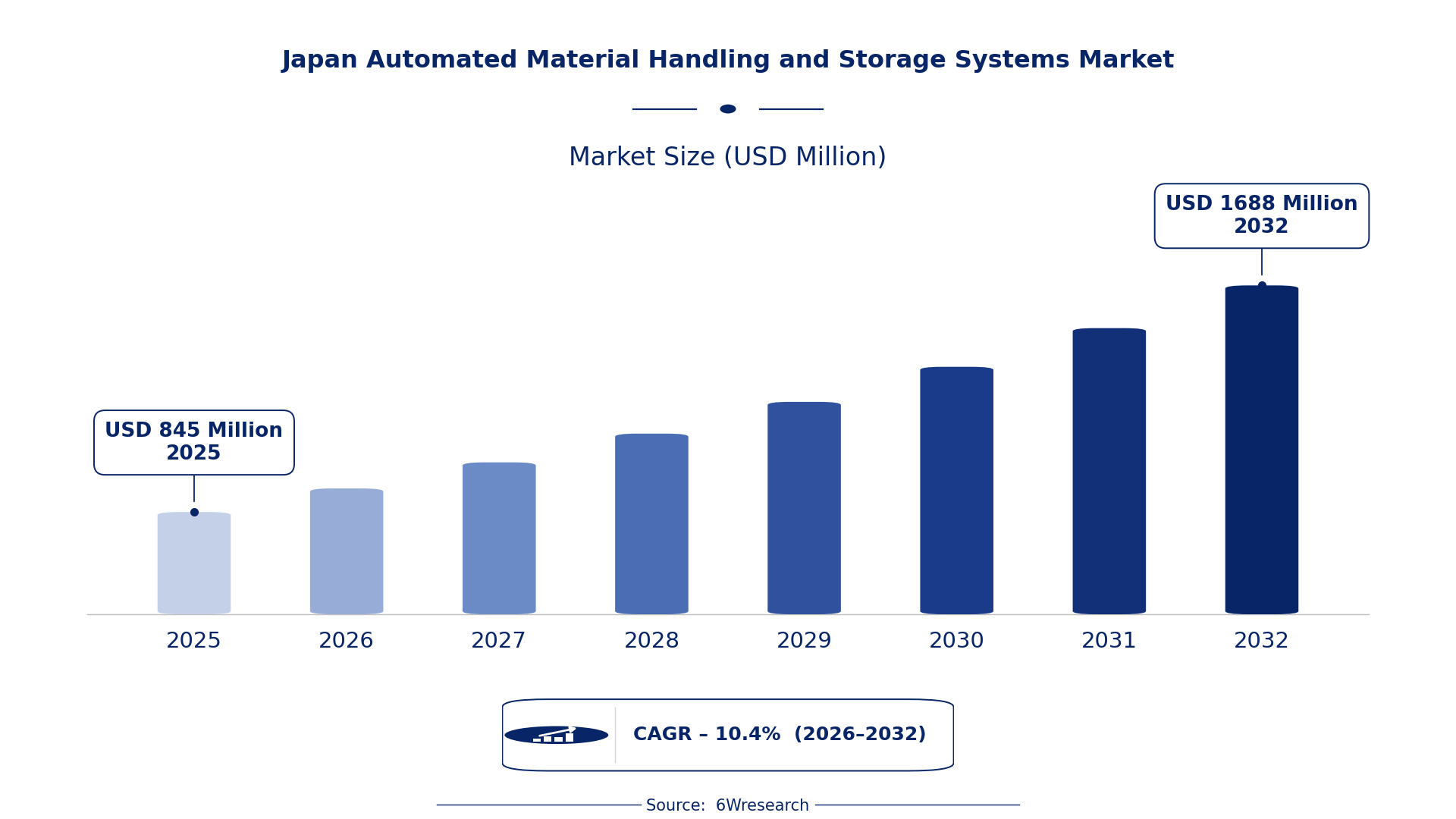
According to 6Wresearch internal database and industry insights, the Japan Automated Material Handling and Storage Systems Market was valued at USD 845 Million in 2025 and is projected to reach USD 1,688 Million by 2032, growing at a CAGR of approximately 10.4% during 2026–2032.
Japan Automated Material Handling and Storage Systems Market Highlights
| Report Metric | Details |
| Report Name | Japan Automated Material Handling and Storage Systems Market (2026-2032) |
| Market Size 2025 | USD 845 Million |
| Market Size 2032 | USD 1,688 Million |
| Absolute Growth 2025–2032 | USD 843 Million |
| CAGR 2026–2032 | 10.4% |
| Peak Annual Growth | 16.2% in 2032 |
| Forecast Period | 2026–2032 |
| Historical Data | 2022–2025 |
| Base Year | 2025 |
| Leading Product Type, 2025 | Hardware (48% share) |
| Leading End-User Industry, 2025 | Airport (28% share) |
| Fastest-Growing Product Type | Software (15.0% CAGR) |
| Fastest-Growing End-User Industry | Automotive (14.4% CAGR) |
| Growing Sector | Automotive |
| Key End Users | Logistics companies, manufacturing plants, distribution centres, retail sectors |
Japan Automated Material Handling and Storage Systems Market Year-wise Growth Rate and Key Drivers (2022–2032)
This graph illustrates the annual growth rates of the market from 2022 to 2032, highlighting a steady upward trajectory and projected market expansion over the forecast period.
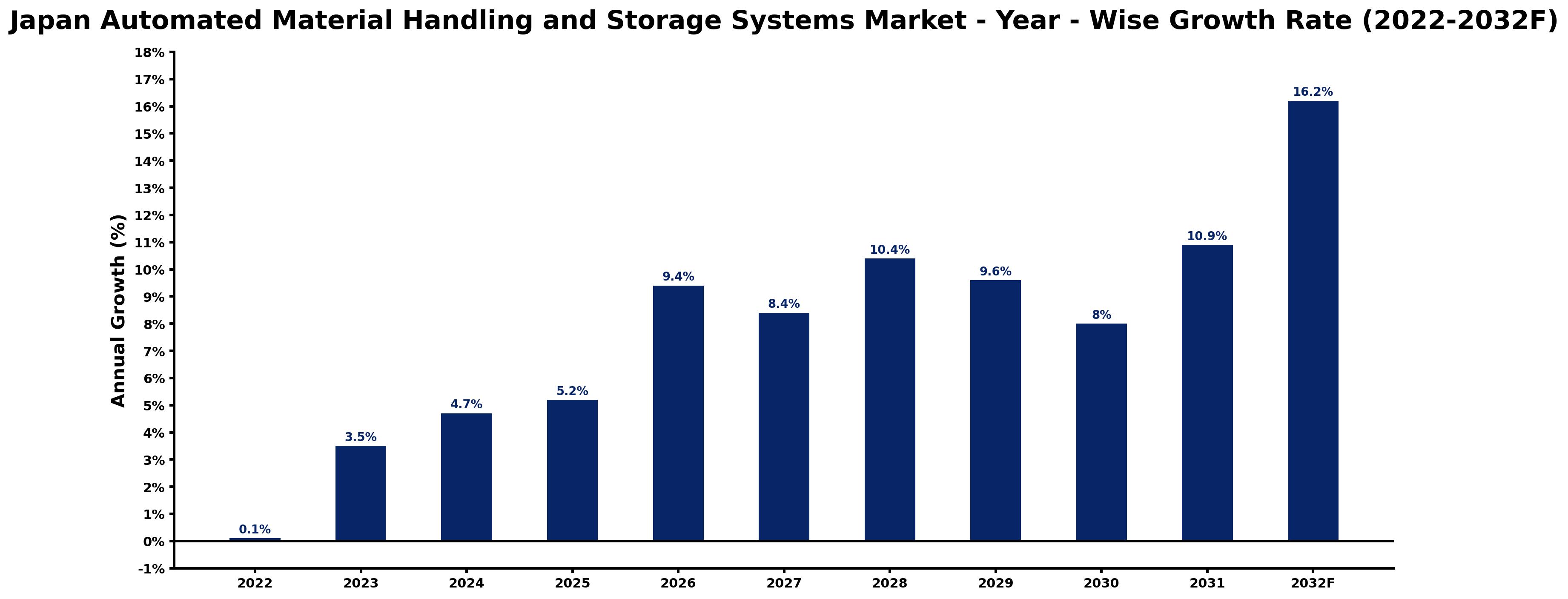
For each year, the table pairs the estimated growth rate with the leading influence on demand, showing how the drivers changed across the period.
| Year | Estimated Annual Growth (%) | Market Rationale |
| 2022 | 0.1 | The market experienced minimal growth due to cautious investment in automation technologies. |
| 2023 | 3.5 | Demand increased as logistics companies began adopting more automated solutions for efficiency. |
| 2024 | 4.7 | Production volumes in manufacturing spurred further investment in automation technologies. |
| 2025 | 5.2 | Growth accelerated as the automotive sector improved assembly line efficiency with automation. |
| 2026 | 9.4 | The market will expand as companies invest heavily in robotics technology. |
| 2027 | 8.4 | Growth is projected to slow slightly due to market saturation in some sectors, yet demand remains strong. |
| 2028 | 10.4 | Investment in automation technologies is expected to surge, driven by the need for operational efficiency. |
| 2029 | 9.6 | A slight slowdown is anticipated as firms adjust to new technologies and processes. |
| 2030 | 8.0 | Growth will continue as companies focus on sustainability and reducing emissions. |
| 2031 | 10.9 | Demand is expected to surge as more sectors recognise the benefits of automated systems. |
| 2032 | 16.2 | The market is projected to peak as advanced robotics and AI integration transform operations. |
Note: Market size estimations and growth projections presented in this report are based on 6Wresearch's proprietary forecasting methodology, utilizing the latest available industry data, government publications, and primary research inputs.
Japan Automated Material Handling and Storage Systems Market Synopsis
Automated Material Handling and Storage Systems utilise technology to streamline the movement and storage of materials within facilities. These systems improve efficiency in warehouses, manufacturing plants, and distribution centres. The Japan Automated Material Handling and Storage Systems Market is expanding due to rising demand from sectors like Food and Beverage, which accounts for 25% of market demand, alongside investments in robotics technology projected to reach ¥200 billion by 2025. The automotive industry, producing over 5 million vehicles annually, also drives this growth through enhanced operational capabilities.
Market Dynamics Impact Analysis (2026–2032)
| Factor | Type | Impact | Primary Segment Affected |
| Increased investment in robotics technology | Driver | High | Hardware |
| Growing demand for efficiency in logistics | Driver | High | Hardware |
| Rising need for automation in manufacturing | Opportunity | High | Automotive |
| Expansion of logistics hubs in urban areas | Opportunity | Medium | Airport |
| High initial investment costs for automation systems | Restraint | High | General Manufacturing |
| Limited availability of skilled workforce for system maintenance | Restraint | Medium | Services |
| Competition from low-cost manual handling solutions | Challenge | High | Food and Beverage |
| Technological integration challenges in existing facilities | Challenge | Medium | Retail/Warehousing/Distribution Centers/Logistic Centers |
Evaluation of Drivers in Japan Automated Material Handling and Storage Systems Market (2026–2032)
The following drivers explain most of the expected growth.
| Drivers | Primary Segment Affected | Why It Matters (Evidence) |
| Investment in robotics technology | Hardware | Japan's logistics industry is projected to invest ¥200 billion in automation technologies by 2025, driving demand for hardware. |
| Efficiency improvements in logistics operations | Hardware | The logistics sector's growth is supported by the need for operational efficiency, increasing demand for automated systems. |
| Growth in automotive production | Automotive | With over 5 million vehicles produced annually, the automotive sector demands advanced handling systems for assembly line efficiency. |
| Adoption of ISO 9001 standards | Software | The widespread adoption of ISO 9001 in the automated handling industry ensures quality control and boosts software demand. |
| Rising employment in logistics | Services | In 2023, the logistics sector employed over 1.5 million people, increasing the need for support and maintenance services. |
Volumes grow on the back of investments in robotics technology, with the logistics sector projected to invest ¥200 billion in automation technologies by 2025. The automotive sector, producing over 5 million vehicles annually, requires advanced handling systems to maintain assembly line efficiency. The widespread adoption of ISO 9001 standards ensures quality control, further boosting software demand. Increased production volumes in manufacturing also drive demand for automated solutions, as companies seek to optimise operations. The logistics sector's employment of over 1.5 million people highlights the need for support and maintenance services, contributing to market growth.
Evaluation of Restraints in Japan Automated Material Handling and Storage Systems Market
The main factors holding the market back are set out below.
| Market Restraint | Primary Segment Affected | Why It Matters (Evidence) |
| High initial investment costs for automation systems | General Manufacturing | The high capital required for automation systems limits adoption, particularly among smaller manufacturers. |
| Limited availability of skilled workforce for system maintenance | Services | A shortage of qualified personnel to maintain automated systems hinders operational efficiency in various sectors. |
| Competition from low-cost manual handling solutions | Food and Beverage | Manual handling solutions remain cheaper, making it difficult for automated systems to compete in price-sensitive markets. |
| Technological integration challenges in existing facilities | Retail/Warehousing/Distribution Centers/Logistic Centers | Integrating new automation technologies into existing infrastructure can be complex and costly, deterring investment. |
| Slow adoption rates among traditional industries | Pharmaceuticals | Conservative approaches in the pharmaceutical sector delay the transition to automated systems, impacting overall market growth. |
Japan Automated Material Handling and Storage Systems Market Challenges
Producers contend with intense competition from advanced automated systems that outperform traditional methods, leading to diminished profit margins and limited reinvestment capacity. Buyers face escalating operational costs as Japan's national minimum wage reached JPY 1,055 per hour in October 2024, straining their financial resources. Importers endure delays due to strict adherence to standards like JIS B 8400, which lengthens lead times for critical technologies. Skills shortages hinder the adoption of automation, particularly in logistics, where over 1.5 million workers struggle to meet rising demands, resulting in operational inefficiencies.
Trends in the Japan Automated Material Handling and Storage Systems Market
The following changes are redrawing the Japan Automated Material Handling and Storage Systems Market.
- Increased Automation in Logistics: Logistics companies are adopting automated material handling systems to improve efficiency. The Tokyo metropolitan area is leading this trend, with a projected investment of ¥200 billion in automation technologies by 2025.
- Transition from Manual to Automated Systems: The Food and Beverage sector is moving from manual handling to automated solutions for storage and distribution efficiency. This shift began in 2023, driven by a need for improved operational efficiency.
- Emergence of AI in Material Handling: AI technologies are being integrated into automated systems, improving control and efficiency. This trend started in 2025, particularly in the automotive sector, which produced over 5 million vehicles annually.
- Increased Focus on Sustainability: The logistics industry is prioritising sustainable practices, leading to investments in energy-efficient automated systems. This shift aligns with Japan's goal of a 46% reduction in greenhouse-gas emissions by 2030.
Investment Opportunities in the Japan Automated Material Handling and Storage Systems Market
Several openings in the Japan Automated Material Handling and Storage Systems Market merit attention from investors.
- Local Partnerships for Technology Development: Local partnerships are essential for developing advanced automation technologies. The automotive sector in Japan is seeking solutions to improve production efficiency, creating opportunities for collaboration.
- Investment in Robotics for Food and Beverage: The Food and Beverage sector needs advanced automated solutions to improve distribution efficiency. With 25% of market demand, suppliers can enter through local partnerships or technology transfers.
- Expansion of Logistics Hubs in Urban Areas: Urban logistics hubs are increasingly adopting automation technologies. The Tokyo metropolitan area is a prime location for investment, driven by the need for efficient material handling.
- Growing Demand for Automated Solutions in Pharmaceuticals: The pharmaceutical sector is projected to grow due to increased automation in drug storage and handling. Suppliers can enter the market by obtaining necessary certifications and partnerships.
Government Initiatives in the Japan Automated Material Handling and Storage Systems Market
The AI Promotion Act, enacted in 2025, provides a framework for AI research and development, enhancing the capabilities of automated material handling systems. This law builds on previous regulations by offering clearer guidelines for AI integration in various industries, encouraging innovation and investment in automation technologies. The initiative aims to improve operational efficiency and safety in automated systems, benefiting both producers and users.
The Ministry of Economy, Trade and Industry (METI) approves funding for projects promoting automation in manufacturing. With a budget of ¥100 billion, this initiative supports companies in adopting advanced technologies, ensuring compliance with safety and operational standards. This funding is vital for improving the competitiveness of the automated material handling sector.
Future Insight of the Japan Automated Material Handling and Storage Systems Market
New automation initiatives in manufacturing facilities will emerge by 2032, driven by substantial investments in robotics technology. The logistics sector is set to allocate ¥100 billion towards automation, facilitating streamlined operations and improved productivity. Enhanced integration of automated systems will optimise material handling processes, resulting in faster service delivery. As the pharmaceutical sector embraces automation, drug storage and handling will become more efficient, benefiting both suppliers and end-users.
Market Segmentation Analysis
Japan Automated Material Handling and Storage Systems Market report covers a detailed analysis of the following market segments:
By Product Type – Hardware Leads, Software Expected to Grow Fastest
According to Sumit Sagar, AM at 6Wresearch, in 2025, Hardware led the product type split with a 48% share. Hardware holds the largest share as it is essential for the physical movement and storage of materials within facilities. The extensive implementation of automated systems in logistics hubs necessitates robust hardware solutions to ensure operational efficiency. Over 2026–2032, Software is expected to post the fastest growth, at a CAGR of 15.0%. Software is witnessing rapid growth due to its critical role in controlling and optimising automated systems. The increasing complexity of operations in logistics and manufacturing sectors drives the demand for advanced software solutions. Suppliers must focus on developing integrated software solutions to meet the growing demand for automation.
By End-User Industry – Airport Leads, Automotive Expected to Grow Fastest
The largest end-user industry category in 2025 was Airport, at 28% of revenue. The airport sector leads the market as it heavily relies on automated systems for efficient baggage handling and logistics management. Substantial investments in technology within this sector ensure streamlined operations in high-traffic environments. Automotive is projected to grow fastest, at a CAGR of 14.4% during 2026–2032. The automotive industry is growing at the fastest rate due to its essential need for efficiency in assembly lines and parts handling. With over 5 million vehicles produced annually, the demand for automation in this sector is set to rise significantly. Buyers in the automotive sector should prioritise the adoption of automation technologies to enhance production efficiency and remain competitive.
Key Attractiveness of the Report
- 10 Years of Market Numbers
- Historical Data Starting from 2022 to 2025
- Base Year 2025
- Forecast Data until 2032
- Key Performance Indicators Impacting the Market
- Major Upcoming Developments and Projects
Key Highlights of the Report:
- Japan Automated Material Handling and Storage Systems Market Outlook
- Market Size of Japan Automated Material Handling and Storage Systems Market, 2025
- Forecast of Japan Automated Material Handling and Storage Systems Market, 2032
- Historical Data and Forecast of Japan Automated Material Handling and Storage Systems Revenues & Volume for the Period 2022-2032
- Japan Automated Material Handling and Storage Systems Market Trend Evolution
- Japan Automated Material Handling and Storage Systems Market Drivers and Challenges
- Japan Automated Material Handling and Storage Systems Price Trends
- Japan Automated Material Handling and Storage Systems Porter's Five Forces
- Japan Automated Material Handling and Storage Systems Industry Life Cycle
- Historical Data and Forecast of Japan Automated Material Handling and Storage Systems Market Revenues & Volume By Product Type for the Period 2022-2032
- Historical Data and Forecast of Japan Automated Material Handling and Storage Systems Market Revenues & Volume By Hardware for the Period 2022-2032
- Historical Data and Forecast of Japan Automated Material Handling and Storage Systems Market Revenues & Volume By Software for the Period 2022-2032
- Historical Data and Forecast of Japan Automated Material Handling and Storage Systems Market Revenues & Volume By Services for the Period 2022-2032
- Historical Data and Forecast of Japan Automated Material Handling and Storage Systems Market Revenues & Volume By End-User Industry for the Period 2022-2032
- Historical Data and Forecast of Japan Automated Material Handling and Storage Systems Market Revenues & Volume By Airport for the Period 2022-2032
- Historical Data and Forecast of Japan Automated Material Handling and Storage Systems Market Revenues & Volume By Automotive for the Period 2022-2032
- Historical Data and Forecast of Japan Automated Material Handling and Storage Systems Market Revenues & Volume By Food and Beverage for the Period 2022-2032
- Historical Data and Forecast of Japan Automated Material Handling and Storage Systems Market Revenues & Volume By Retail/Warehousing/Distribution Centers/Logistic Centers for the Period 2022-2032
- Historical Data and Forecast of Japan Automated Material Handling and Storage Systems Market Revenues & Volume By General Manufacturing for the Period 2022-2032
- Historical Data and Forecast of Japan Automated Material Handling and Storage Systems Market Revenues & Volume By Pharmaceuticals for the Period 2022-2032
- Historical Data and Forecast of Japan Automated Material Handling and Storage Systems Market Revenues & Volume By Post and Parcel for the Period 2022-2032
- Historical Data and Forecast of Japan Automated Material Handling and Storage Systems Market Revenues & Volume By Others for the Period 2022-2032
- Japan Automated Material Handling and Storage Systems Import Export Trade Statistics
- Market Opportunity Assessment By Product Type
- Market Opportunity Assessment By End-User Industry
- Japan Automated Material Handling and Storage Systems Top Companies Market Share
- Japan Automated Material Handling and Storage Systems Competitive Benchmarking By Technical and Operational Parameters
- Japan Automated Material Handling and Storage Systems Company Profiles
- Japan Automated Material Handling and Storage Systems Key Strategic Recommendations
Market Covered
This report examines the market across the segments below.
By Product Type
- Hardware
- Software
- Services
By End-User Industry
- Airport
- Automotive
- Food and Beverage
- Retail/Warehousing/Distribution Centers/Logistic Centers
- General Manufacturing
- Pharmaceuticals
- Post and Parcel
- Others































