Japan Automated Material Handling Market Size & Growth Rate
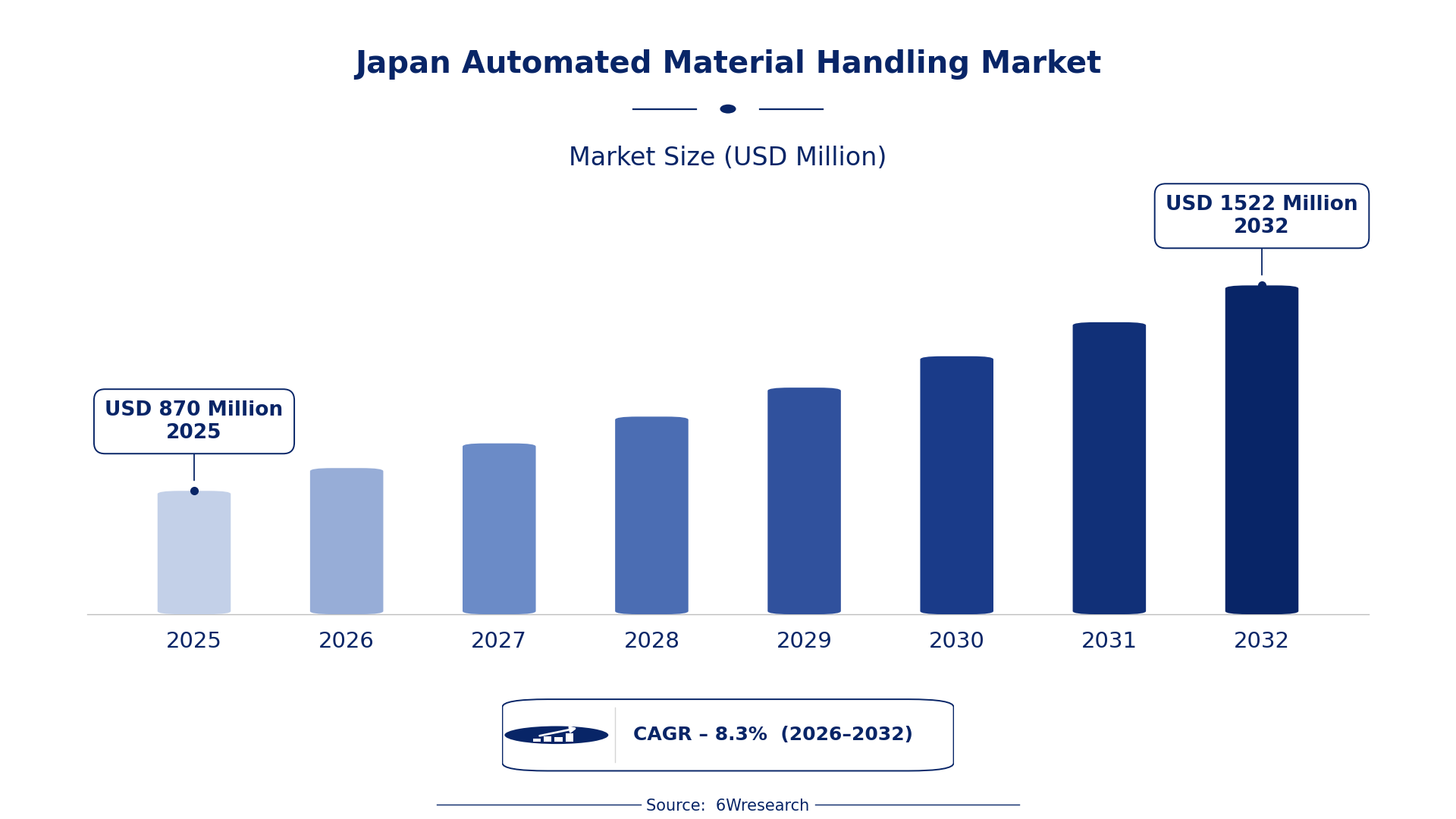
According to 6Wresearch internal database and industry insights, the Japan Automated Material Handling Market was valued at USD 870 Million in 2025 and is projected to reach USD 1,522 Million by 2032, growing at a CAGR of approximately 8.3% during 2026–2032.
Japan Automated Material Handling Market Highlights
| Report Metric | Details |
| Report Name | Japan Automated Material Handling Market (2026-2032) |
| Market Size 2025 | USD 870 Million |
| Market Size 2032 | USD 1,522 Million |
| Absolute Growth 2025–2032 | USD 652 Million |
| CAGR 2026–2032 | 8.3% |
| Peak Annual Growth | 9.4% in 2028 |
| Forecast Period | 2026–2032 |
| Historical Data | 2022–2025 |
| Base Year | 2025 |
| Leading Type, 2025 | Automated Storage & Retrieval System (55% share) |
| Leading System Load, 2025 | Unit Load (60% share) |
| Leading Application, 2025 | Distribution (38% share) |
| Leading Industry, 2025 | E-Commerce (40% share) |
| Fastest-Growing Type | Automated Guided Vehicle (12.1% CAGR) |
| Fastest-Growing Application | Transportation (10.9% CAGR) |
| Fastest-Growing Industry | Automotive (11.5% CAGR) |
| Growing Sector | E-Commerce |
| Key End Users | Logistics providers, automotive manufacturers, e-commerce retailers, food and beverage producers |
Japan Automated Material Handling Market Year-wise Growth Rate and Key Drivers (2022–2032)
This graph illustrates the annual growth rates of the market from 2022 to 2032, highlighting a steady upward trajectory and projected market expansion over the forecast period.
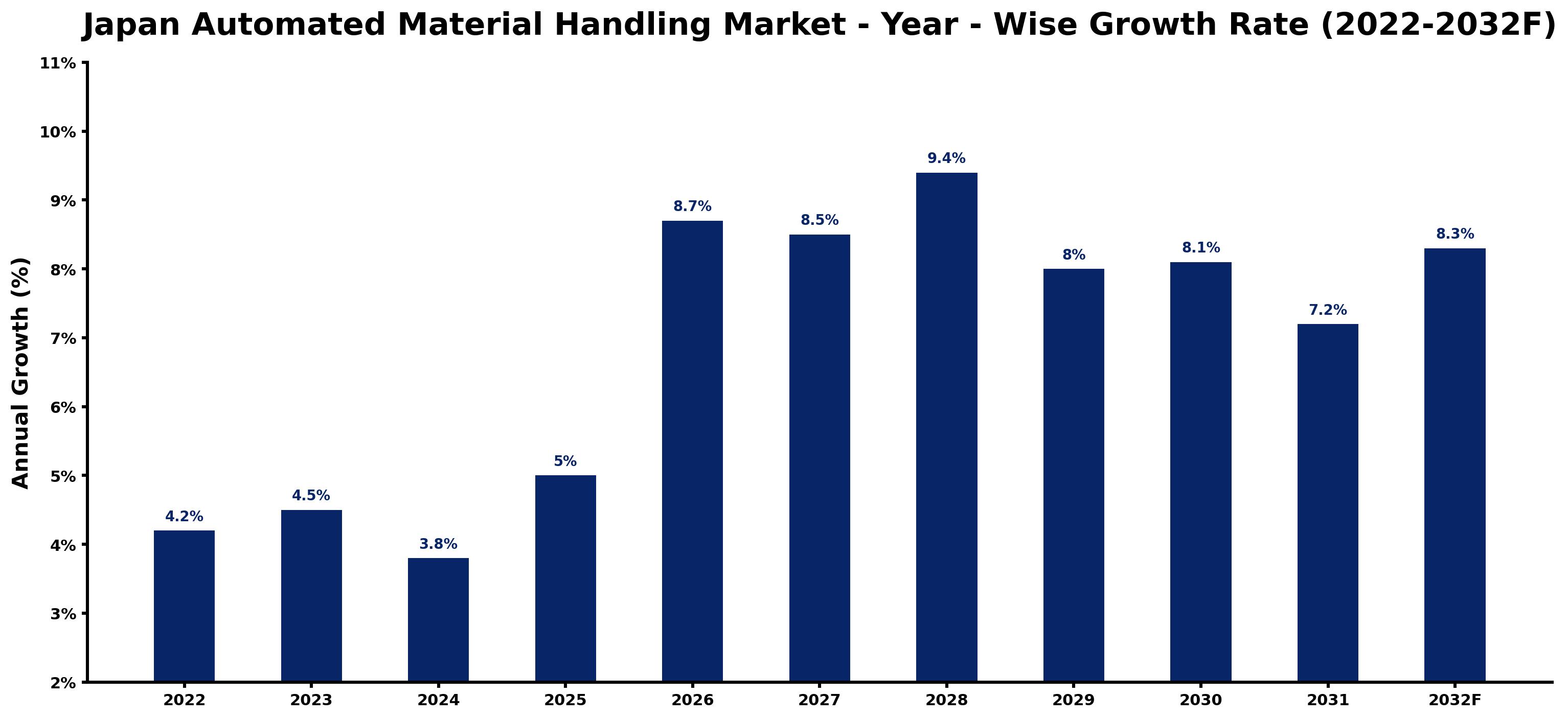
Each row of the following table gives one year's estimated growth and the event or demand shift that explains it.
| Year | Estimated Annual Growth (%) | Market Rationale |
| 2022 | 4.2 | The market showed steady growth due to increasing automation in logistics. |
| 2023 | 4.5 | Demand rose as e-commerce expanded, boosting the need for efficient systems. |
| 2024 | 3.8 | Growth slowed as firms adjusted to previous investments and market saturation. |
| 2025 | 5.0 | The automotive sector's expansion led to heightened demand for automated solutions. |
| 2026 | 8.7 | Investment in robotics is expected to surge, driving demand for advanced material handling systems. |
| 2027 | 8.5 | Growth is projected to slow slightly as companies consolidate their automated processes. |
| 2028 | 9.4 | The peak growth year will see accelerated investments in automation technologies. |
| 2029 | 8.0 | Demand will moderate as the market begins to stabilise after rapid expansion. |
| 2030 | 8.1 | Continued investment in logistics infrastructure is expected to support steady growth. |
| 2031 | 7.2 | Growth will slow as the market matures and competition intensifies. |
| 2032 | 8.3 | Demand will remain strong due to ongoing technological advancements and investments. |
Note: Market size estimations and growth projections presented in this report are based on 6Wresearch's proprietary forecasting methodology, utilizing the latest available industry data, government publications, and primary research inputs.
Japan Automated Material Handling Market Synopsis
Automated Material Handling encompasses technologies that streamline the movement, storage, and management of materials in manufacturing and distribution. Japan's e-commerce market is set to hit 20 trillion yen by 2025, which will drive the demand for these systems. Key growth drivers include the automotive sector's dependence on automation, increased investments in logistics efficiency, and the continuous growth of e-commerce operations that necessitate advanced material handling solutions to boost productivity.
Market Dynamics Impact Analysis (2026–2032)
| Factor | Type | Impact | Primary Segment Affected |
| Increased investment in logistics infrastructure | Driver | High | Automated Conveyor & Sorting System |
| Growing e-commerce market driving demand for efficiency | Driver | High | Automated Guided Vehicle |
| Expansion of the automotive sector requiring advanced handling solutions | Opportunity | High | Automated Storage & Retrieval System |
| Rising demand for automated solutions in food production | Opportunity | Medium | Automated Guided Vehicle |
| High initial investment costs for automated systems | Restraint | High | Automated Storage & Retrieval System |
| Limited awareness among SMEs about automation benefits | Restraint | Medium | Automated Conveyor & Sorting System |
| Shortage of skilled workforce for operating automated systems | Challenge | High | Automated Guided Vehicle |
| Supply chain disruptions affecting availability of components | Challenge | Medium | Automated Storage & Retrieval System |
Evaluation of Drivers in Japan Automated Material Handling Market (2026–2032)
The main growth drivers and the segments they affect most are set out below.
| Drivers | Primary Segment Affected | Why It Matters (Evidence) |
| Rising e-commerce sales | Automated Guided Vehicle | Japan's e-commerce market is projected to reach 20 trillion yen by 2025, prompting retailers to invest in automated solutions. |
| Investment in logistics efficiency | Automated Conveyor & Sorting System | The logistics sector employs over 1.5 million people, pushing companies to adopt automation for better productivity. |
| Automotive production growth | Automated Storage & Retrieval System | Japan produces over 9 million vehicles annually, increasing the need for efficient material handling systems. |
| Technological advancements in robotics | Automated Guided Vehicle | With over 1,000 automated guided vehicles deployed, firms are improving their operational capabilities. |
| Focus on sustainability and efficiency | Automated Conveyor & Sorting System | Japan targets a 46% cut in greenhouse-gas emissions by 2030, driving automation adoption in logistics. |
The strongest pull on demand comes from the e-commerce sector, projected to reach 20 trillion yen by 2025, prompting retailers to invest in automated solutions. The logistics sector employs over 1.5 million people, pushing companies to adopt automation for better productivity. Japan's automotive industry, producing over 9 million vehicles annually, increases the need for efficient material handling systems. Advances in robotics have led to over 1,000 automated guided vehicles deployed, improving operational capabilities. A focus on sustainability drives further automation adoption, as Japan aims for a 46% reduction in greenhouse-gas emissions by 2030.
Evaluation of Restraints in Japan Automated Material Handling Market
The following restraints limit how fast demand can grow.
| Market Restraint | Primary Segment Affected | Why It Matters (Evidence) |
| High initial investment costs for automation | Automated Storage & Retrieval System | The automotive industry requires substantial capital for upgrading to automated systems, limiting adoption. |
| Limited awareness among SMEs about automation benefits | Automated Conveyor & Sorting System | Many small and medium enterprises lack knowledge about the efficiency gains from automation. |
| Shortage of skilled workforce for operating automated systems | Automated Guided Vehicle | The logistics sector struggles to find qualified personnel to manage advanced automated technologies. |
| Supply chain disruptions affecting availability of components | Automated Storage & Retrieval System | Global supply chain issues have delayed the delivery of critical components for automation. |
| Regulatory compliance costs for automated systems | Automated Conveyor & Sorting System | Compliance with safety standards increases operational costs for automated solutions. |
Japan Automated Material Handling Market Challenges
Producers incur higher shipping costs, which have risen by 15% this year due to persistent supply chain disruptions, forcing them to rethink logistics strategies. A technology gap emerges as rapid advancements in automation outpace workforce skills, delaying operational efficiency for manufacturers. Rising operational expenses, driven by a 5% increase in the national minimum wage, strain budgets for small and medium enterprises, limiting their investment in automation. Compliance with the JIS B 8401 standard for safety introduces additional expenses, complicating implementation for suppliers in the market.
Trends in the Japan Automated Material Handling Market
Buyers and suppliers in the Japan Automated Material Handling Market are adjusting to the following trends.
- Shift to Advanced Robotics in Logistics: Tokyo is experiencing a shift towards advanced robotics in logistics, with over 1,000 automated guided vehicles now deployed. This change improves operational efficiency and reduces labour costs.
- Transition from Manual to Automated Systems: Japan's logistics sector is transitioning from manual processes to automated systems, driven by the need for efficiency. The sector employs over 1.5 million people, highlighting the scale of this shift.
- E-Commerce Prioritised over Traditional Retail: The expansion of e-commerce is prioritising automated material handling systems, with the market projected to reach 20 trillion yen by 2025. This trend is reshaping logistics operations across the country.
- Automotive Industry Embracing Automation: The automotive industry is increasingly embracing automation, with production volumes exceeding 9 million vehicles annually. This trend is driving demand for advanced material handling solutions.
Investment Opportunities in the Japan Automated Material Handling Market
The following areas offer the clearest openings for investors and suppliers in the Japan Automated Material Handling Market.
- E-Commerce Retailers Seeking Efficiency: E-commerce retailers are increasingly seeking automated solutions to improve logistics efficiency, with the market projected to reach 20 trillion yen by 2025. Collaborating with logistics firms can facilitate entry.
- Automated Guided Vehicles for Automotive Sector: The automotive sector is investing heavily in automated guided vehicles, with production volumes over 9 million annually. Suppliers can enter this market through local partnerships and certifications.
- Growing Demand in Food & Beverages: The food and beverages sector, valued at 30 trillion yen, is increasingly adopting automation for efficiency. Suppliers can target this sector by offering tailored solutions.
- Pharmaceutical Logistics Automation: With Japan's pharmaceutical market being the third largest globally, there is a growing need for automation in logistics. Suppliers can capitalize by providing compliant automated solutions.
Government Initiatives in the Japan Automated Material Handling Market
The AI Promotion Act, enacted in 2025, influences buyers by establishing a national framework for AI research and development. This legislation encourages investment in automated systems, ensuring that producers keep pace with technological advancements. Additionally, the Industrial Safety and Health Act requires employers to adhere to safety standards, impacting the design and implementation of automated material handling systems.
The Ministry of Economy, Trade and Industry (METI) is instrumental in approving and funding automation initiatives. In 2023, METI introduced a programme to promote automation in small and medium enterprises, allocating significant resources to support their transition. This initiative aims to boost productivity and competitiveness within the market.
Future Insight of the Japan Automated Material Handling Market
By 2032, Japan's JPY 150 trillion decarbonisation investment will drive widespread adoption of advanced automated systems across various sectors, including logistics, which employs over 1.5 million people. The logistics sector will see an increase in automated solutions, improving efficiency and reducing reliance on manual labour. As the e-commerce market expands to 20 trillion yen by 2025, suppliers will respond by integrating more sophisticated technologies to meet rising demand. The METI's 2023 program will further accelerate automation in small and medium enterprises, ensuring they remain competitive in a rapidly evolving market.
Market Segmentation Analysis
Japan Automated Material Handling Market report covers a detailed analysis of the following market segments:
By Type – Automated Storage & Retrieval System Leads, Automated Guided Vehicle Expected to Grow Fastest
According to Dhaval Chaurasia, Assistant Manager at 6Wresearch, the largest type category in 2025 was Automated Storage & Retrieval System, at 55% of revenue. The Automated Storage & Retrieval System commands the largest share as it is widely used in warehouses for efficient storage and retrieval of goods. Its established presence is evidenced by the deployment of over 1,000 automated guided vehicles in Japanese warehouses, indicating strong market reliance. The quickest growth will come from Automated Guided Vehicle, forecast to expand at a CAGR of 12.1% between 2026 and 2032. The Automated Guided Vehicle segment is witnessing rapid growth, fuelled by the increasing demand for automation in logistics and manufacturing sectors. The anticipated growth in Japan's e-commerce market to 20 trillion yen by 2025 is expected to further enhance the demand for these systems. Suppliers should focus on developing automated guided vehicles to capitalise on the rising market demand.
By System Load – Unit Load Leads and Records the Fastest Growth
Unit Load held 60% of the Japan Automated Material Handling Market by system load in 2025. Unit Load leads this segment as it is the standard choice for transporting standardized loads in warehouses, ensuring efficiency and compatibility across various systems. This widespread adoption is essential for meeting the operational needs of Japanese logistics. Its lead should widen, with a projected CAGR of 9.8% during 2026–2032, the highest in this split. Unit Load is also the fastest-growing segment, as its versatility and efficiency continue to meet the increasing demands of the logistics sector. With over 1.5 million people employed in logistics, the push for automation further accelerates this growth. Buyers will benefit from investing in unit load solutions to streamline their operations and improve overall efficiency.
By Application – Distribution Leads, Transportation Expected to Grow Fastest
Distribution accounted for 38% of the market by application in 2025. Distribution leads the application segment due to its essential role in logistics and distribution, where automation significantly improves operational efficiency. The push for decarbonisation and substantial investments in automation align well with the needs of this application. Over 2026–2032, Transportation is expected to post the fastest growth, at a CAGR of 10.9%. Transportation is growing swiftly as logistics operations adopt automated solutions to optimise material handling processes. The increasing focus on enhancing transportation efficiency in logistics supports this rapid growth. Suppliers should tailor their offerings to meet the specific demands of the transportation application to capture emerging opportunities.
By Industry – E-Commerce Leads, Automotive Expected to Grow Fastest
In 2025, E-Commerce led the industry split with a 40% share. E-Commerce is the dominant industry segment, driven by the growth of online retail that elevates the need for automated material handling solutions. This trend is reinforced by projections of Japan's e-commerce market reaching 20 trillion yen by 2025, showcasing the segment's strong growth potential. Automotive is projected to grow fastest, at a CAGR of 11.5% during 2026–2032. The Automotive industry is rapidly expanding as it plays a crucial role in manufacturing and logistics, which increasingly rely on automation. The production of over 9 million vehicles annually highlights the demand for advanced material handling systems in this sector. Suppliers must align their strategies with the shifting demands of the automotive sector to maintain competitiveness.
Key Attractiveness of the Report
- 10 Years of Market Numbers
- Historical Data Starting from 2022 to 2025
- Base Year 2025
- Forecast Data until 2032
- Key Performance Indicators Impacting the Market
- Major Upcoming Developments and Projects
Key Highlights of the Report:
- Japan Automated Material Handling Market Outlook
- Market Size of Japan Automated Material Handling Market, 2025
- Forecast of Japan Automated Material Handling Market, 2032
- Historical Data and Forecast of Japan Automated Material Handling Revenues & Volume for the Period 2022-2032
- Japan Automated Material Handling Market Trend Evolution
- Japan Automated Material Handling Market Drivers and Challenges
- Japan Automated Material Handling Price Trends
- Japan Automated Material Handling Porter's Five Forces
- Japan Automated Material Handling Industry Life Cycle
- Historical Data and Forecast of Japan Automated Material Handling Market Revenues & Volume By Type for the Period 2022-2032
- Historical Data and Forecast of Japan Automated Material Handling Market Revenues & Volume By Automated Storage & Retrieval System for the Period 2022-2032
- Historical Data and Forecast of Japan Automated Material Handling Market Revenues & Volume By Automated Conveyor & Sorting System for the Period 2022-2032
- Historical Data and Forecast of Japan Automated Material Handling Market Revenues & Volume By Automated Guided Vehicle for the Period 2022-2032
- Historical Data and Forecast of Japan Automated Material Handling Market Revenues & Volume By System Load for the Period 2022-2032
- Historical Data and Forecast of Japan Automated Material Handling Market Revenues & Volume By Unit Load for the Period 2022-2032
- Historical Data and Forecast of Japan Automated Material Handling Market Revenues & Volume By Bulk Load for the Period 2022-2032
- Historical Data and Forecast of Japan Automated Material Handling Market Revenues & Volume By Application for the Period 2022-2032
- Historical Data and Forecast of Japan Automated Material Handling Market Revenues & Volume By Assembly for the Period 2022-2032
- Historical Data and Forecast of Japan Automated Material Handling Market Revenues & Volume By Distribution for the Period 2022-2032
- Historical Data and Forecast of Japan Automated Material Handling Market Revenues & Volume By Transportation for the Period 2022-2032
- Historical Data and Forecast of Japan Automated Material Handling Market Revenues & Volume By Packaging for the Period 2022-2032
- Historical Data and Forecast of Japan Automated Material Handling Market Revenues & Volume By Others for the Period 2022-2032
- Historical Data and Forecast of Japan Automated Material Handling Market Revenues & Volume By Industry for the Period 2022-2032
- Historical Data and Forecast of Japan Automated Material Handling Market Revenues & Volume By E-Commerce for the Period 2022-2032
- Historical Data and Forecast of Japan Automated Material Handling Market Revenues & Volume By Automotive for the Period 2022-2032
- Historical Data and Forecast of Japan Automated Material Handling Market Revenues & Volume By Food & Beverages for the Period 2022-2032
- Historical Data and Forecast of Japan Automated Material Handling Market Revenues & Volume By Pharmaceutical for the Period 2022-2032
- Historical Data and Forecast of Japan Automated Material Handling Market Revenues & Volume By Aviation for the Period 2022-2032
- Historical Data and Forecast of Japan Automated Material Handling Market Revenues & Volume By Semiconductors & Electronics for the Period 2022-2032
- Historical Data and Forecast of Japan Automated Material Handling Market Revenues & Volume By Others for the Period 2022-2032
- Japan Automated Material Handling Import Export Trade Statistics
- Market Opportunity Assessment By Type
- Market Opportunity Assessment By System Load
- Market Opportunity Assessment By Application
- Market Opportunity Assessment By Industry
- Japan Automated Material Handling Top Companies Market Share
- Japan Automated Material Handling Competitive Benchmarking By Technical and Operational Parameters
- Japan Automated Material Handling Company Profiles
- Japan Automated Material Handling Key Strategic Recommendations
Market Covered
Segments analysed in this report are listed below.
By Type
- Automated Storage & Retrieval System
- Automated Conveyor & Sorting System
- Automated Guided Vehicle
By System Load
- Unit Load
- Bulk Load
By Application
- Assembly
- Distribution
- Transportation
- Packaging
- Others
By Industry
- E-Commerce
- Automotive
- Food & Beverages
- Pharmaceutical
- Aviation
- Semiconductors & Electronics
- Others































