Japan Automatic Boom Sprayers Market Size & Growth Rate
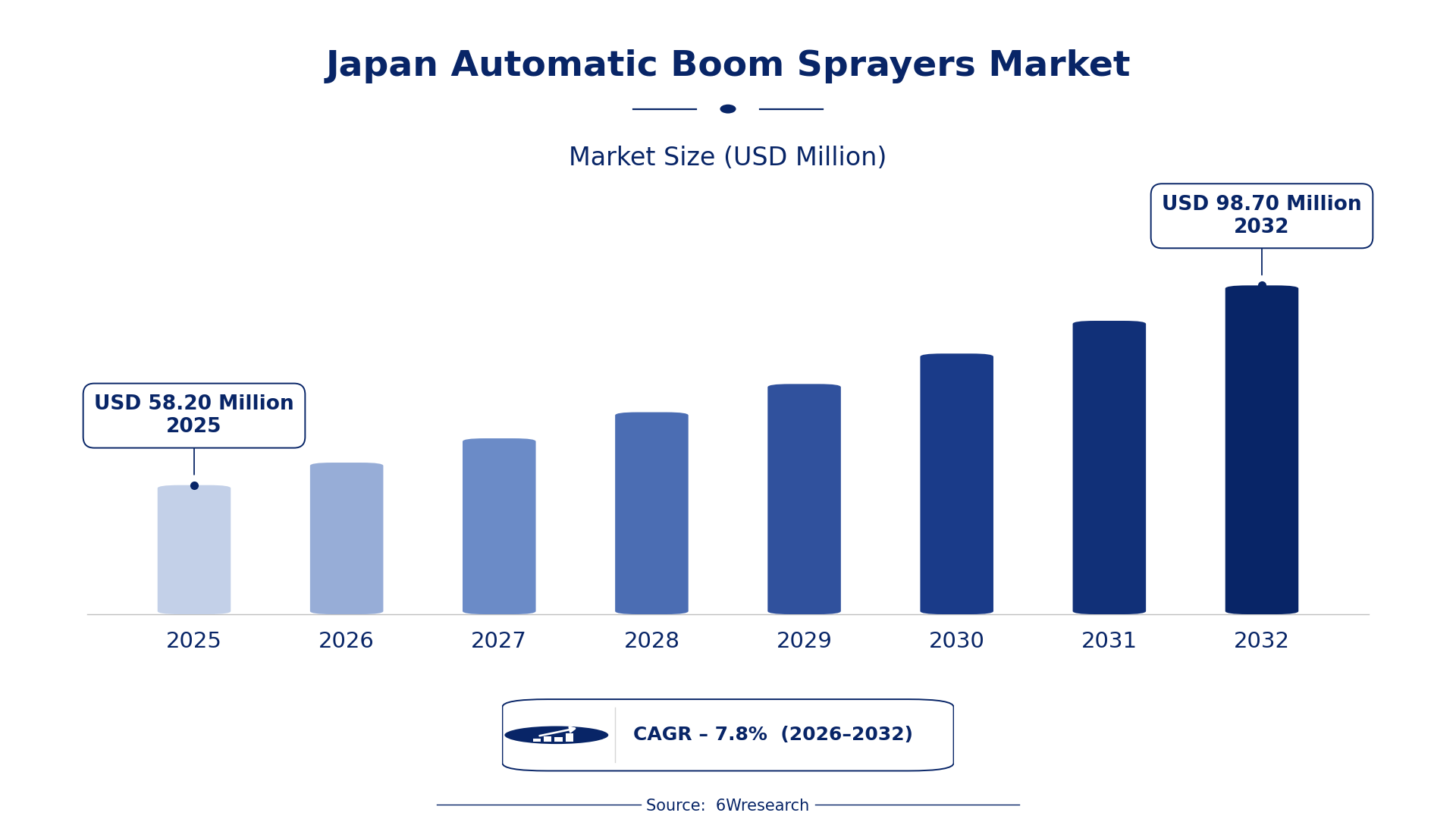
According to 6Wresearch internal database and industry insights, the Japan Automatic Boom Sprayers Market was valued at USD 58.20 Million in 2025 and is projected to reach USD 98.70 Million by 2032, growing at a CAGR of approximately 7.8% during 2026–2032.
Japan Automatic Boom Sprayers Market Highlights
| Report Metric | Details |
| Report Name | Japan Automatic Boom Sprayers Market (2026-2032) |
| Market Size 2025 | USD 58.20 Million |
| Market Size 2032 | USD 98.70 Million |
| Absolute Growth 2025–2032 | USD 40.50 Million |
| CAGR 2026–2032 | 7.8% |
| Peak Annual Growth | 9.0% in 2032 |
| Forecast Period | 2026–2032 |
| Historical Data | 2022–2025 |
| Base Year | 2025 |
| Leading Sprayer Type, 2025 | Self-Propelled Units (43% share) |
| Leading Operation Mode, 2025 | GPS Guided (35% share) |
| Leading Mounting Type, 2025 | Integrated Chassis (49% share) |
| Leading Distribution Channel, 2025 | Direct Sales (40% share) |
| Leading End User, 2025 | Large-Scale Farmers (41% share) |
| Fastest-Growing Operation Mode | Hydraulic Assisted (10.8% CAGR) |
| Fastest-Growing Mounting Type | Rear Mount (11.4% CAGR) |
| Fastest-Growing Distribution Channel | Online Platforms (10.5% CAGR) |
| Fastest-Growing End User | Agricultural Contractors (10.2% CAGR) |
| Growing Sector | Agricultural Contractors |
| Key End Users | Large-Scale Farmers, Agricultural Contractors, Medium Farms, Horticulture Farms |
Japan Automatic Boom Sprayers Market Year-wise Growth Rate and Key Drivers (2022–2032)
This graph illustrates the annual growth rates of the market from 2022 to 2032, highlighting a steady upward trajectory and projected market expansion over the forecast period.
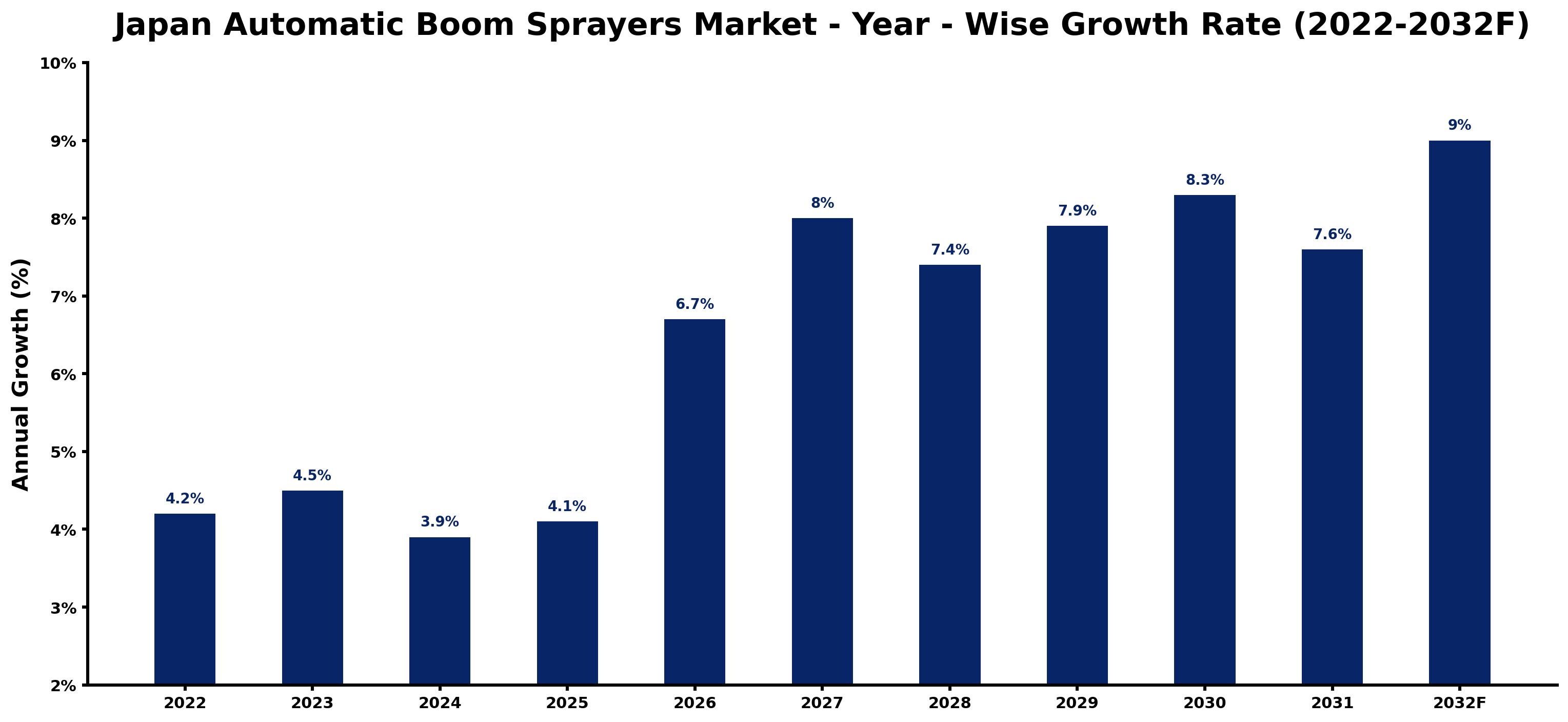
Annual growth estimates for each year appear below with the principal reason behind them, explaining the shifts that set the pace of the market.
| Year | Estimated Annual Growth (%) | Market Rationale |
| 2022 | 4.2 | The agricultural sector showed steady demand for efficient spraying solutions. |
| 2023 | 4.5 | Increased adoption of advanced technologies boosted market growth. |
| 2024 | 3.9 | A slight slowdown occurred as some farmers delayed equipment upgrades. |
| 2025 | 4.1 | Demand accelerated as farmers sought to improve productivity and reduce waste. |
| 2026 | 6.7 | Investment in precision agriculture is projected to drive higher purchases of sprayers. |
| 2027 | 8.0 | Technological advancements in sprayer efficiency will attract more buyers. |
| 2028 | 7.4 | The market is projected to slow as growth stabilises after rapid gains. |
| 2029 | 7.9 | Renewed interest in sustainable practices will spur additional purchases. |
| 2030 | 8.3 | Technological improvements will continue to drive demand for modern sprayers. |
| 2031 | 7.6 | A slight slowdown is anticipated as the market adjusts to previous growth. |
| 2032 | 9.0 | Demand is expected to surge as large-scale farmers upgrade to advanced sprayer systems. |
Note: Market size estimations and growth projections presented in this report are based on 6Wresearch's proprietary forecasting methodology, utilizing the latest available industry data, government publications, and primary research inputs.
Japan Automatic Boom Sprayers Market Synopsis
Automatic boom sprayers are advanced agricultural tools designed for the efficient application of pesticides and fertilizers. These sprayers improve productivity in large-scale farming operations while minimising chemical waste. The Japan Automatic Boom Sprayers Market is expanding due to increased investment in precision agriculture, with a total agricultural production value of around 8 trillion yen in 2022. The focus on reducing chemical use by 20% and support from the Ministry of Agriculture, Forestry and Fisheries are driving demand from domestic users and agricultural contractors.
Market Dynamics Impact Analysis (2026–2032)
| Factor | Type | Impact | Primary Segment Affected |
| Growing adoption of precision agriculture techniques | Driver | High | GPS Guided |
| Increased investment in agricultural modernization | Driver | High | Self-Propelled Units |
| Demand for efficient spraying solutions | Opportunity | High | Large-Scale Farmers |
| Rising interest in sustainable farming practices | Opportunity | High | Agricultural Contractors |
| High average age of farmers limits technology adoption | Restraint | Medium | Medium Farms |
| Limited availability of skilled operators for advanced sprayers | Restraint | Medium | Horticulture Farms |
| High initial investment costs for advanced sprayers | Challenge | High | Tractor-Mounted Boom |
| Potential delays in technology adoption due to regulatory changes | Challenge | High | Air-Assisted Boom |
Evaluation of Drivers in Japan Automatic Boom Sprayers Market (2026–2032)
Demand rests on the following drivers, each shown with the segment it touches most.
| Drivers | Primary Segment Affected | Why It Matters (Evidence) |
| Investment in precision agriculture | GPS Guided | This investment leads to increased accuracy in spraying, encouraging farmers to purchase advanced equipment focused on reducing chemical use. |
| Technological advancements in sprayer design | Self-Propelled Units | Innovations improve mobility and efficiency, prompting agricultural contractors to upgrade their equipment to improve operational effectiveness. |
| Government support for agricultural modernization | Large-Scale Farmers | Funding initiatives encourage farmers to adopt advanced spraying solutions, boosting overall demand for efficient technologies. |
| Focus on reducing chemical usage | Hydraulic Assisted | Farmers are motivated to invest in technologies that improve efficiency and sustainability, aligning with national environmental goals. |
| Increased awareness of environmental impacts | Precision Spray | Growing environmental concerns drive demand for sprayers that minimise chemical waste, supporting sustainable farming practices. |
Volumes grow on the back of investments in precision agriculture, which is projected to improve the accuracy of spraying operations. For instance, the Tohoku region, known for its large-scale rice production, is adopting GPS-guided sprayers to reduce chemical use by 20%. In 2022, the agricultural production value in Japan reached around 8 trillion yen, indicating a strong market for advanced spraying technologies. Agricultural contractors are increasingly purchasing self-propelled units to boost efficiency and meet rising demand for sustainable practices. As farmers seek to modernise their operations, the adoption of hydraulic-assisted sprayers is expected to rise, further driving market growth.
Evaluation of Restraints in Japan Automatic Boom Sprayers Market
These are the pressures that could keep growth below its potential.
| Market Restraint | Primary Segment Affected | Why It Matters (Evidence) |
| High initial investment costs | Self-Propelled Units | The price of advanced sprayers can deter smaller farmers from upgrading their equipment, limiting market reach. |
| Limited availability of skilled operators | GPS Guided | As the average age of farmers exceeds 67 years, there is a shortage of skilled operators for advanced sprayers. |
| Supply chain disruptions | Hydraulic Assisted | Ongoing disruptions affect the timely delivery of components, delaying production and sales. |
| Competition from alternative spraying methods | Precision Spray | Farmers may opt for manual or less advanced methods due to perceived cost benefits. |
| Regulatory compliance costs | Air-Assisted Boom | Meeting JIS standards increases operational costs for producers, impacting pricing strategies. |
Japan Automatic Boom Sprayers Market Challenges
In 2023, agricultural contractors in Japan face rising costs due to increased wages, with the national minimum wage reaching JPY 1,055 per hour. This wage hike strains budgets, forcing contractors to pass on higher expenses to farmers. Supply chain disruptions arise as the average age of farmers exceeds 67 years, leading to a shortage of skilled operators for advanced sprayers. Competition grows as new technologies emerge, compelling producers to invest heavily in innovation to maintain market presence. Buyers encounter delays in accessing efficient spraying solutions, as the government's JPY 1 billion allocation for modernization initiatives requires time to materialise.
Trends in the Japan Automatic Boom Sprayers Market
The following changes are redrawing the Japan Automatic Boom Sprayers Market.
- Shift from Manual to Automated Spraying: Since 2022, there has been a noticeable shift towards automated spraying solutions in Japan's agricultural sector. The adoption of GPS-guided systems is increasing, with over 30% of large-scale farmers now using these technologies to improve efficiency.
- Transition to Sustainable Practices: In 2023, the focus on sustainability has led to a rise in demand for sprayers that minimise chemical waste. Agricultural contractors are increasingly investing in precision spray technologies to comply with environmental regulations.
- Emergence of Online Sales Channels: The trend towards online platforms for purchasing agricultural equipment has accelerated since 2022. Online sales channels are projected to grow by 10.5% as more farmers seek convenience in procurement.
- Prioritisation of Efficiency Over Cost: In 2023, large-scale farmers began prioritising efficiency in their operations, leading to increased investments in advanced sprayers. The push for higher productivity is reshaping purchasing decisions across the sector.
Investment Opportunities in the Japan Automatic Boom Sprayers Market
Investors looking at the Japan Automatic Boom Sprayers Market should consider the following areas.
- Growing Demand for Precision Agriculture: With Japan targeting a 46% cut in greenhouse gas emissions by 2030, there is an opportunity for suppliers of precision sprayers. Agricultural contractors in the Tohoku region are particularly well-positioned to adopt these technologies.
- Investment in Agricultural Modernisation: The Japanese government allocated 1 billion yen for agricultural modernisation initiatives in 2023, creating opportunities for suppliers of advanced sprayers. Collaborating with local agricultural contractors can facilitate market entry.
- Expansion of Online Sales Platforms: The increasing shift towards online purchasing channels presents an opportunity for suppliers to reach a broader customer base. Focusing on digital marketing strategies can help penetrate the market effectively.
- Rising Interest in Sustainable Solutions: As farmers aim to reduce chemical use by 20%, there is a growing market for sprayers that support sustainable practices. Suppliers can target large-scale farmers seeking eco-friendly solutions.
Government Initiatives in the Japan Automatic Boom Sprayers Market
The Automatic Boom Sprayers Market is influenced by the Green Growth Strategy Through Achieving Carbon Neutrality in 2050, which aims to reduce greenhouse gas emissions significantly. This policy encourages the adoption of advanced agricultural technologies, including automatic boom sprayers, to improve efficiency and sustainability in farming practices. The Ministry of Agriculture, Forestry and Fisheries promotes these technologies, ensuring compliance with JIS standards to maintain quality and effectiveness in agricultural machinery.
In 2023, the Japanese government allocated 1 billion yen for agricultural modernisation initiatives, administered by the Ministry of Agriculture, Forestry and Fisheries. This funding supports the development and adoption of advanced agricultural equipment, including automatic boom sprayers, facilitating upgrades in farming operations across the country. The initiative aims to improve productivity and reduce environmental impact, benefiting both producers and users of agricultural technologies.
Future Insight of the Japan Automatic Boom Sprayers Market
By 2032, buyers will see a transformation in farming practices as precision agriculture becomes standard, driven by government initiatives and substantial investments. The introduction of new technological standards will improve equipment quality and reliability, benefiting suppliers by creating a more competitive market. Enhanced training programmes will equip the younger generation of farmers with necessary skills, increasing their participation in the sector. As a result, agricultural contractors will gain access to more efficient boom sprayers, leading to improved productivity and reduced costs.
Market Segmentation Analysis
Japan Automatic Boom Sprayers Market report covers a detailed analysis of the following market segments:
By Sprayer Type – Self-Propelled Units Lead and Record the Fastest Growth
According to Saurav Kr Singh, Senior Research Analyst at 6Wresearch, Self-Propelled Units held 43% of the Japan Automatic Boom Sprayers Market by sprayer type in 2025. Self-Propelled Units hold the largest share due to their mobility and efficiency, which are critical for large-scale crop spraying. Farmers in regions like Tohoku, known for extensive rice production, particularly benefit from these advanced sprayers. The same category are also set to grow fastest, at a CAGR of 11.0% during 2026–2032. The growth of Self-Propelled Units is propelled by the increasing adoption of precision agriculture, which aims to reduce chemical use by 20%. This trend aligns with governmental initiatives for agricultural modernization, ensuring sustained demand for these sprayers. Suppliers should focus on enhancing the features of Self-Propelled Units to meet the increasing demand for efficiency in agricultural operations.
By Operation Mode – GPS Guided Leads, Hydraulic Assisted Expected to Grow Fastest
The largest operation mode category in 2025 was GPS Guided, at 35% of revenue. GPS Guided systems dominate the market as they significantly enhance spraying accuracy, which is crucial for minimising chemical waste. Their implementation aligns with national standards aimed at promoting efficient agricultural practices, making them a preferred choice. Hydraulic Assisted is set to record the highest CAGR in this split, 10.8% over 2026–2032. Hydraulic Assisted systems are gaining traction due to their ability to provide improved control and precision in spraying tasks, which is increasingly necessary as farmers seek to optimise their operations for better results. Buyers may benefit from investing in advanced operation modes to improve efficiency and sustainability in their agricultural practices.
By Mounting Type – Integrated Chassis Leads, Rear Mount Expected to Grow Fastest
With 49% of mounting type revenue in 2025, Integrated Chassis was the largest category. Integrated Chassis is the leading mounting type because it provides stability and ease of operation, essential for effective spraying across varied terrains. This design is particularly favoured by large-scale farmers who require reliable and efficient equipment for their operations. The quickest growth will come from Rear Mount, forecast to expand at a CAGR of 11.4% between 2026 and 2032. The Rear Mount type is experiencing rapid growth as it is commonly used in tractor-mounted systems, providing ease of use for farmers looking to enhance their spraying capabilities. This mounting type is becoming increasingly popular among users seeking efficiency in their operations. Suppliers should consider developing more versatile mounting options to cater to the diverse needs of modern agricultural practices.
By Distribution Channel – Direct Sales Leads, Online Platforms Expected to Grow Fastest
Direct Sales accounted for 40% of the market by distribution channel in 2025. Direct Sales is the primary channel for purchasing sprayers, as it allows buyers to engage directly with manufacturers, ensuring they receive tailored solutions. This method is particularly effective in the agricultural sector, where personal relationships and direct communication are vital. Over 2026–2032, Online Platforms are expected to post the fastest growth, at a CAGR of 10.5%. Online Platforms are rapidly gaining traction as a distribution channel, driven by the increasing digitisation of the agricultural sector. This shift allows farmers to conveniently access a wider range of products, reflecting changing purchasing behaviours. Suppliers should enhance their online presence to capture the growing segment of buyers who prefer digital purchasing options.
By End User – Large-Scale Farmers Lead, Agricultural Contractors Expected to Grow Fastest
In 2025, Large-Scale Farmers led the end user split with a 41% share. Large-Scale Farmers represent the largest user group of advanced sprayers, as they require efficient solutions for extensive agricultural operations. Their significant contribution to the agricultural production value reinforces their importance in the market and drives demand for advanced equipment. Agricultural Contractors are projected to grow fastest, at a CAGR of 10.2% during 2026–2032. Agricultural Contractors are experiencing the fastest growth as they provide essential spraying services, leveraging advanced equipment to meet the diverse demands of various farming operations. Their role is crucial in the agricultural supply chain, further driving the market. Suppliers should target Agricultural Contractors with tailored solutions to tap into this expanding segment of the market.
Key Attractiveness of the Report
- 10 Years of Market Numbers
- Historical Data Starting from 2022 to 2025
- Base Year 2025
- Forecast Data until 2032
- Key Performance Indicators Impacting the Market
- Major Upcoming Developments and Projects
Key Highlights of the Report:
- Japan Automatic Boom Sprayers Market Outlook
- Market Size of Japan Automatic Boom Sprayers Market, 2025
- Forecast of Japan Automatic Boom Sprayers Market, 2032
- Historical Data and Forecast of Japan Automatic Boom Sprayers Revenues & Volume for the Period 2022-2032F
- Japan Automatic Boom Sprayers Market Trend Evolution
- Japan Automatic Boom Sprayers Market Drivers and Challenges
- Japan Automatic Boom Sprayers Price Trends
- Japan Automatic Boom Sprayers Porter's Five Forces
- Japan Automatic Boom Sprayers Industry Life Cycle
- Historical Data and Forecast of Japan Automatic Boom Sprayers Market Revenues & Volume By Sprayer Type for the Period 2022-2032F
- Historical Data and Forecast of Japan Automatic Boom Sprayers Market Revenues & Volume By Tractor-Mounted Boom for the Period 2022-2032F
- Historical Data and Forecast of Japan Automatic Boom Sprayers Market Revenues & Volume By Self-Propelled Units for the Period 2022-2032F
- Historical Data and Forecast of Japan Automatic Boom Sprayers Market Revenues & Volume By Manual Boom Extension for the Period 2022-2032F
- Historical Data and Forecast of Japan Automatic Boom Sprayers Market Revenues & Volume By Air-Assisted Boom for the Period 2022-2032F
- Historical Data and Forecast of Japan Automatic Boom Sprayers Market Revenues & Volume By Operation Mode for the Period 2022-2032F
- Historical Data and Forecast of Japan Automatic Boom Sprayers Market Revenues & Volume By Hydraulic Assisted for the Period 2022-2032F
- Historical Data and Forecast of Japan Automatic Boom Sprayers Market Revenues & Volume By GPS Guided for the Period 2022-2032F
- Historical Data and Forecast of Japan Automatic Boom Sprayers Market Revenues & Volume By Semi-Automatic for the Period 2022-2032F
- Historical Data and Forecast of Japan Automatic Boom Sprayers Market Revenues & Volume By Precision Spray for the Period 2022-2032F
- Historical Data and Forecast of Japan Automatic Boom Sprayers Market Revenues & Volume By Mounting Type for the Period 2022-2032F
- Historical Data and Forecast of Japan Automatic Boom Sprayers Market Revenues & Volume By Rear Mount for the Period 2022-2032F
- Historical Data and Forecast of Japan Automatic Boom Sprayers Market Revenues & Volume By Integrated Chassis for the Period 2022-2032F
- Historical Data and Forecast of Japan Automatic Boom Sprayers Market Revenues & Volume By 3-Point Linkage for the Period 2022-2032F
- Historical Data and Forecast of Japan Automatic Boom Sprayers Market Revenues & Volume By Towed for the Period 2022-2032F
- Historical Data and Forecast of Japan Automatic Boom Sprayers Market Revenues & Volume By Distribution Channel for the Period 2022-2032F
- Historical Data and Forecast of Japan Automatic Boom Sprayers Market Revenues & Volume By Direct Sales for the Period 2022-2032F
- Historical Data and Forecast of Japan Automatic Boom Sprayers Market Revenues & Volume By Industrial Suppliers for the Period 2022-2032F
- Historical Data and Forecast of Japan Automatic Boom Sprayers Market Revenues & Volume By Online Platforms for the Period 2022-2032F
- Historical Data and Forecast of Japan Automatic Boom Sprayers Market Revenues & Volume By Specialty Stores for the Period 2022-2032F
- Historical Data and Forecast of Japan Automatic Boom Sprayers Market Revenues & Volume By End User for the Period 2022-2032F
- Historical Data and Forecast of Japan Automatic Boom Sprayers Market Revenues & Volume By Large-Scale Farmers for the Period 2022-2032F
- Historical Data and Forecast of Japan Automatic Boom Sprayers Market Revenues & Volume By Agricultural Contractors for the Period 2022-2032F
- Historical Data and Forecast of Japan Automatic Boom Sprayers Market Revenues & Volume By Medium Farms for the Period 2022-2032F
- Historical Data and Forecast of Japan Automatic Boom Sprayers Market Revenues & Volume By Horticulture Farms for the Period 2022-2032F
- Japan Automatic Boom Sprayers Import Export Trade Statistics
- Market Opportunity Assessment By Sprayer Type
- Market Opportunity Assessment By Operation Mode
- Market Opportunity Assessment By Mounting Type
- Market Opportunity Assessment By Distribution Channel
- Market Opportunity Assessment By End User
- Japan Automatic Boom Sprayers Top Companies Market Share
- Japan Automatic Boom Sprayers Competitive Benchmarking By Technical and Operational Parameters
- Japan Automatic Boom Sprayers Company Profiles
- Japan Automatic Boom Sprayers Key Strategic Recommendations
Market Covered
This report examines the market across the segments below.
By Sprayer Type
- Tractor-Mounted Boom
- Self-Propelled Units
- Manual Boom Extension
- Air-Assisted Boom
By Operation Mode
- Hydraulic Assisted
- GPS Guided
- Semi-Automatic
- Precision Spray
By Mounting Type
- Rear Mount
- Integrated Chassis
- 3-Point Linkage
- Towed
By Distribution Channel
- Direct Sales
- Industrial Suppliers
- Online Platforms
- Specialty Stores
By End User
- Large-Scale Farmers
- Agricultural Contractors
- Medium Farms
- Horticulture Farms






































