Japan Automation and Industrial Control Market Size & Growth Rate
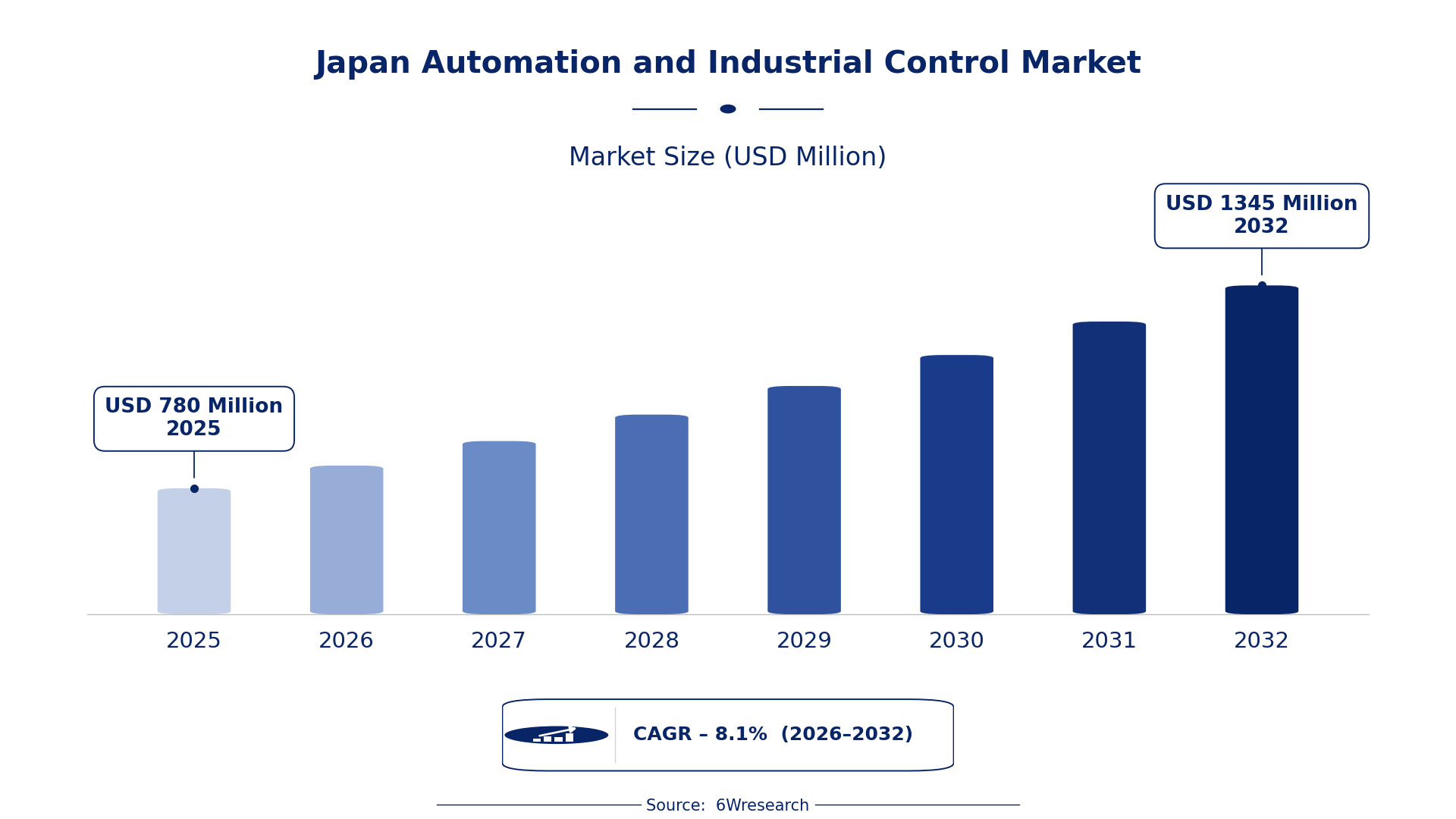
According to 6Wresearch internal database and industry insights, the Japan Automation and Industrial Control Market was valued at USD 780 Million in 2025 and is projected to reach USD 1,345 Million by 2032, growing at a CAGR of approximately 8.1% during 2026–2032.
Japan Automation and Industrial Control Market Highlights
| Report Metric | Details |
| Report Name | Japan Automation and Industrial Control Market (2026-2032) |
| Market Size 2025 | USD 780 Million |
| Market Size 2032 | USD 1,345 Million |
| Absolute Growth 2025–2032 | USD 565 Million |
| CAGR 2026–2032 | 8.1% |
| Peak Annual Growth | 8.9% in 2030 |
| Forecast Period | 2026–2032 |
| Historical Data | 2022–2025 |
| Base Year | 2025 |
| Leading Product, 2025 | Programmable Logic Controller (PLC) (31% share) |
| Leading End-user Industry, 2025 | Automotive (36% share) |
| Fastest-Growing Product | Distributed Control System (DCS) (12.0% CAGR) |
| Fastest-Growing End-user Industry | Chemical and Petrochemical (11.5% CAGR) |
| Growing Sector | Automotive |
| Key End Users | Automotive manufacturers, chemical producers, semiconductor manufacturers, power generation companies |
Japan Automation and Industrial Control Market Year-wise Growth Rate and Key Drivers (2022–2032)
This graph illustrates the annual growth rates of the market from 2022 to 2032, highlighting a steady upward trajectory and projected market expansion over the forecast period.
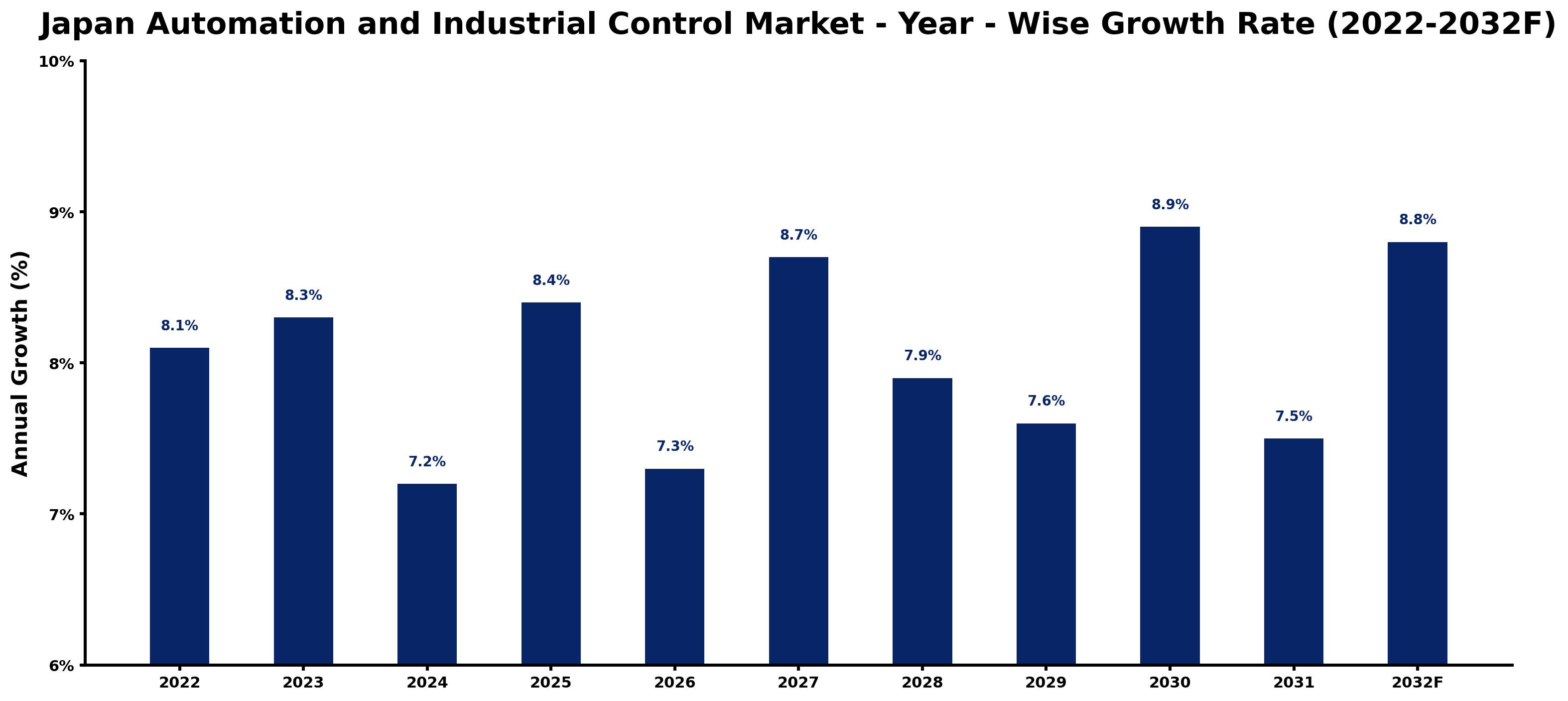
Each row of the following table gives one year's estimated growth and the event or demand shift that explains it.
| Year | Estimated Annual Growth (%) | Market Rationale |
| 2022 | 8.1 | The market exhibited strong growth due to increasing automation investments. |
| 2023 | 8.3 | Demand accelerated as industries adopted advanced automation technologies. |
| 2024 | 7.2 | Growth slowed as some sectors faced temporary project delays. |
| 2025 | 8.4 | The market rebounded with heightened investments in smart manufacturing. |
| 2026 | 7.3 | A slight slowdown occurred as companies adjusted to new technologies. |
| 2027 | 8.7 | Demand surged as industries embraced digital transformation initiatives. |
| 2028 | 7.9 | Growth decelerated as market saturation began in certain segments. |
| 2029 | 7.6 | A further slowdown was noted as competition intensified among providers. |
| 2030 | 8.9 | The market peaked with substantial investments in automation solutions. |
| 2031 | 7.5 | Growth slowed as economic uncertainties affected capital expenditures. |
| 2032 | 8.8 | Demand increased again as industries focused on sustainability initiatives. |
Note: Market size estimations and growth projections presented in this report are based on 6Wresearch's proprietary forecasting methodology, utilizing the latest available industry data, government publications, and primary research inputs.
Japan Automation and Industrial Control Market Synopsis
Automation and Industrial Control technologies in Japan are vital for improving efficiency and reliability in manufacturing processes. The market is valued at approximately 1 trillion JPY, driven by the automotive sector, which accounts for 30% of technology usage. Key factors supporting growth include substantial investments in smart factory initiatives, with the government allocating 200 billion JPY for such projects, and the ongoing push towards decarbonisation, targeting 150 trillion JPY in investments over the next decade.
Market Dynamics Impact Analysis (2026–2032)
| Factor | Type | Impact | Primary Segment Affected |
| Increasing automation in the automotive sector is driving demand for control systems. | Driver | High | Automotive |
| Growing investments in smart manufacturing technologies are boosting market growth. | Driver | High | Programmable Logic Controller (PLC) |
| The chemical industry is expanding its automation adoption, creating new opportunities. | Opportunity | High | Chemical and Petrochemical |
| The semiconductor sector's demand for precision automation is rising significantly. | Opportunity | High | Semiconductor and Electronics |
| High initial investment costs can deter smaller companies from adopting automation. | Restraint | Medium | Programmable Logic Controller (PLC) |
| The complexity of integrating new technologies into existing systems poses challenges. | Restraint | Medium | Programmable Logic Controller (PLC) |
| Talent shortages in automation expertise are affecting project timelines. | Challenge | High | Programmable Logic Controller (PLC) |
| Market competition is intensifying, leading to price pressures on suppliers. | Challenge | High | Programmable Logic Controller (PLC) |
Evaluation of Drivers in Japan Automation and Industrial Control Market (2026–2032)
These are the developments adding the most demand over the forecast period.
| Drivers | Primary Segment Affected | Why It Matters (Evidence) |
| Rising automotive production levels drive demand for PLCs to automate processes. | Programmable Logic Controller (PLC) | The automotive industry accounts for 30% of automation technology usage in Japan. |
| Increased focus on energy efficiency leads to more DCS installations. | Distributed Control System (DCS) | Japan's power generation sector is increasingly using automation to improve efficiency. |
| Growing semiconductor investments boost demand for SCADA systems in precision processes. | Supervisory Control and Data Acquisition System (SCADA) | In 2023, Japan's semiconductor industry invested 500 billion JPY in automation technologies. |
| The expansion of the water and wastewater sector drives HMI adoption for management. | Human Machine Interface (HMI) | The Water and Wastewater sector has seen a 20% increase in automation technology adoption since 2021. |
| Increased safety regulations in the oil and gas sector drive demand for safety systems. | Process Safety Systems | The oil and gas sector has invested heavily in automation for safety compliance. |
Buyers are adding capacity as the automotive sector continues to expand production, driving demand for Programmable Logic Controllers that automate critical processes. In 2023, Japan's semiconductor industry invested 500 billion JPY in automation technologies, boosting the need for systems that ensure precision. The Water and Wastewater sector has seen a 20% increase in automation adoption since 2021, leading to higher demand for Human Machine Interfaces.
Evaluation of Restraints in Japan Automation and Industrial Control Market
These restraints slow adoption and weigh on supplier margins.
| Market Restraint | Primary Segment Affected | Why It Matters (Evidence) |
| High initial costs of automation technologies can limit adoption among smaller firms. | Programmable Logic Controller (PLC) | Smaller companies often struggle to allocate budgets for advanced automation solutions. |
| Integration challenges with legacy systems can hinder automation efforts. | Programmable Logic Controller (PLC) | Many firms face difficulties in merging new technologies with existing infrastructure. |
| Talent shortages in automation expertise can delay project implementations. | Programmable Logic Controller (PLC) | A lack of skilled workers affects the timely deployment of automation solutions. |
| Market saturation in certain segments leads to increased competition and pricing pressures. | Programmable Logic Controller (PLC) | Intense competition forces suppliers to lower prices, impacting profit margins. |
| Economic uncertainties may lead to cautious spending on automation investments. | Programmable Logic Controller (PLC) | Companies may delay capital expenditures in response to fluctuating market conditions. |
Japan Automation and Industrial Control Market Challenges
Japan's automation market, valued at approximately 1 trillion JPY, faces stringent regulations that require compliance with standards like ISO 9001, potentially delaying project timelines for producers by up to six months. Continuous technological advancements compel suppliers to implement frequent upgrades, resulting in cost increases that buyers must manage, estimated at 10% of project budgets. Supply chain disruptions, particularly in semiconductor availability, can lead to project delays for producers, which in turn hampers buyers' operational efficiency. Rising minimum wages, currently at JPY 1,055 per hour, elevate labour costs for producers, forcing them to pass these expenses onto buyers, inflating overall project costs.
Trends in the Japan Automation and Industrial Control Market
The shifts below are changing how Japan Automation and Industrial Control Market products are bought and supplied.
- Shift towards Smart Factories in Tokyo: Tokyo is experiencing a shift towards smart factories as companies invest in automation technologies. In 2023, the government allocated 200 billion JPY for smart factory initiatives, improving operational efficiency and attracting new investments.
- Transition from Traditional to Advanced Automation: A notable transition from traditional automation systems to advanced technologies like AI and IoT is underway. The Society 5.0 initiative, launched in 2020, promotes the integration of these technologies across various industries.
- Emerging Demand for Process Safety Systems: The oil and gas sector is increasingly prioritising process safety systems to comply with new regulations. This trend is reflected in substantial investments aimed at improving safety measures in operations.
- Increasing Adoption of Automation in Healthcare: Healthcare facilities are increasingly integrating automation for improved patient management. The sector's focus on efficiency is driving investments in automation technologies to streamline operations.
Investment Opportunities in the Japan Automation and Industrial Control Market
Where to invest in the Japan Automation and Industrial Control Market: the main openings are set out below.
- Automotive Manufacturers Seeking Advanced Solutions: Automotive manufacturers are actively seeking advanced automation solutions to improve production efficiency. With 30% of automation technology usage, there is a strong opportunity for suppliers to meet this demand.
- Chemical Industry Expanding Automation Adoption: The chemical industry is projected to grow its automation adoption by 15% by 2025, creating opportunities for suppliers to provide tailored solutions to meet evolving needs.
- Water and Wastewater Management Facilities Needing Upgrades: Water and wastewater management facilities are looking to upgrade their automation systems. With a 20% increase in adoption since 2021, suppliers can enter this market with innovative solutions.
- Investment in Smart Manufacturing Technologies: The ongoing push for smart manufacturing presents a timely opportunity for investment. The government's allocation of 200 billion JPY for smart factory initiatives signals a growing market for automation technologies.
Government Initiatives in the Japan Automation and Industrial Control Market
The New Robot Strategy, introduced in 2015, aims to expand robot use across various sectors, improving productivity and innovation in Automation and Industrial Control. This initiative builds on the Industrial Safety and Health Act of 1972, which established safety standards for machinery, ensuring a safer working environment in automated settings.
In 2023, the government allocated 200 billion JPY for smart factory initiatives, administered by the Ministry of Economy, Trade and Industry. This funding supports the integration of advanced automation technologies, enabling industries to modernise and improve operational efficiency.
Future Insight of the Japan Automation and Industrial Control Market
The policy-driven shift towards a 46% reduction in greenhouse-gas emissions by 2030 will stimulate substantial investments in automation technologies, particularly in smart factory initiatives. By 2032, the government plans to allocate around JPY 150 trillion for decarbonisation efforts, prompting suppliers to incorporate advanced systems. The 'Society 5.0' initiative will enhance the integration of automation across various sectors, significantly increasing productivity. With the chemical industry projected to grow its automation adoption by 15% by 2025, suppliers will need to rapidly innovate to address specific industry requirements.
Market Segmentation Analysis
Japan Automation and Industrial Control Market report covers a detailed analysis of the following market segments:
By Product – Programmable Logic Controller (PLC) Leads, Distributed Control System (DCS) Expected to Grow Fastest
According to Sumit Sagar, AM at 6Wresearch, Programmable Logic Controller (PLC) held 31% of the Japan Automation and Industrial Control Market by product in 2025. The Programmable Logic Controller (PLC) holds the largest share due to its essential role in automating machinery and processes across various industries. Its extensive use, reflected in an installed base of approximately 1.5 million units in Japan, illustrates its critical importance in enhancing operational effectiveness. The quickest growth will come from Distributed Control System (DCS), forecast to expand at a CAGR of 12.0% between 2026 and 2032. The Distributed Control System (DCS) is experiencing rapid growth as it plays a crucial role in managing complex industrial processes, particularly within the chemical sector. With expectations for the market to reach 300 billion JPY by 2025, the DCS segment is positioned for substantial expansion, reinforcing its significance in automation. Suppliers must focus on strengthening their PLC offerings while also developing DCS capabilities to meet the rising demand.
By End-user Industry – Automotive Leads, Chemical and Petrochemical Expected to Grow Fastest
Automotive took 36% of end-user industry revenue in 2025, more than any other category. The automotive industry is the leading segment, representing 30% of automation technology usage in Japan, driven by the need for efficiency and precision in manufacturing processes. This sector's considerable investments in automation technologies solidify its dominant position in the market. Chemical and Petrochemical is projected to grow fastest, at a CAGR of 11.5% during 2026–2032. The chemical and petrochemical industry is the fastest-growing end-user, with a projected 15% increase in automation adoption by 2025, indicating a robust demand for enhanced process control. This trend reflects a shift towards more automated operations in response to market pressures. Buyers in the chemical sector should prioritise automation solutions to boost operational efficiency and prepare for future demands.
Key Attractiveness of the Report
- 10 Years of Market Numbers
- Historical Data Starting from 2022 to 2025
- Base Year 2025
- Forecast Data until 2032
- Key Performance Indicators Impacting the Market
- Major Upcoming Developments and Projects
Key Highlights of the Report:
- Japan Automation and Industrial Control Market Outlook
- Market Size of Japan Automation and Industrial Control Market, 2025
- Forecast of Japan Automation and Industrial Control Market, 2032
- Historical Data and Forecast of Japan Automation and Industrial Control Revenues & Volume for the Period 2022-2032
- Japan Automation and Industrial Control Market Trend Evolution
- Japan Automation and Industrial Control Market Drivers and Challenges
- Japan Automation and Industrial Control Price Trends
- Japan Automation and Industrial Control Porter's Five Forces
- Japan Automation and Industrial Control Industry Life Cycle
- Historical Data and Forecast of Japan Automation and Industrial Control Market Revenues & Volume By Product for the Period 2022-2032
- Historical Data and Forecast of Japan Automation and Industrial Control Market Revenues & Volume By Programmable Logic Controller (PLC) for the Period 2022-2032
- Historical Data and Forecast of Japan Automation and Industrial Control Market Revenues & Volume By Distributed Control System (DCS) for the Period 2022-2032
- Historical Data and Forecast of Japan Automation and Industrial Control Market Revenues & Volume By Supervisory Control and Data Acquisition System (SCADA) for the Period 2022-2032
- Historical Data and Forecast of Japan Automation and Industrial Control Market Revenues & Volume By Human Machine Interface (HMI) for the Period 2022-2032
- Historical Data and Forecast of Japan Automation and Industrial Control Market Revenues & Volume By Process Safety Systems for the Period 2022-2032
- Historical Data and Forecast of Japan Automation and Industrial Control Market Revenues & Volume By Sensors and Transmitters for the Period 2022-2032
- Historical Data and Forecast of Japan Automation and Industrial Control Market Revenues & Volume By Electric Motors for the Period 2022-2032
- Historical Data and Forecast of Japan Programmable Logic Controller (PLC) Automation and Industrial Control Market Revenues & Volume By Others for the Period 2022-2032
- Historical Data and Forecast of Japan Automation and Industrial Control Market Revenues & Volume By End-user Industry for the Period 2022-2032
- Historical Data and Forecast of Japan Automation and Industrial Control Market Revenues & Volume By Automotive for the Period 2022-2032
- Historical Data and Forecast of Japan Automation and Industrial Control Market Revenues & Volume By Chemical and Petrochemical for the Period 2022-2032
- Historical Data and Forecast of Japan Automation and Industrial Control Market Revenues & Volume By Semiconductor and Electronics for the Period 2022-2032
- Historical Data and Forecast of Japan Automation and Industrial Control Market Revenues & Volume By Oil and Gas for the Period 2022-2032
- Historical Data and Forecast of Japan Automation and Industrial Control Market Revenues & Volume By Power Generation for the Period 2022-2032
- Historical Data and Forecast of Japan Automation and Industrial Control Market Revenues & Volume By Water and Wastewater for the Period 2022-2032
- Historical Data and Forecast of Japan Automation and Industrial Control Market Revenues & Volume By Other End-user Industries for the Period 2022-2032
- Japan Automation and Industrial Control Import Export Trade Statistics
- Market Opportunity Assessment By Product
- Market Opportunity Assessment By End-user Industry
- Japan Automation and Industrial Control Top Companies Market Share
- Japan Automation and Industrial Control Competitive Benchmarking By Technical and Operational Parameters
- Japan Automation and Industrial Control Company Profiles
- Japan Automation and Industrial Control Key Strategic Recommendations
Market Covered
This report examines the market across the segments below.
By Product
- Programmable Logic Controller (PLC)
- Distributed Control System (DCS)
- Supervisory Control and Data Acquisition System (SCADA)
- Human Machine Interface (HMI)
- Process Safety Systems
- Sensors and Transmitters
- Electric Motors
- Others
By End-user Industry
- Automotive
- Chemical and Petrochemical
- Semiconductor and Electronics
- Oil and Gas
- Power Generation
- Water and Wastewater
- Other End-user Industries































