Japan Autonomous Agricultural Equipment Market Size & Growth Rate
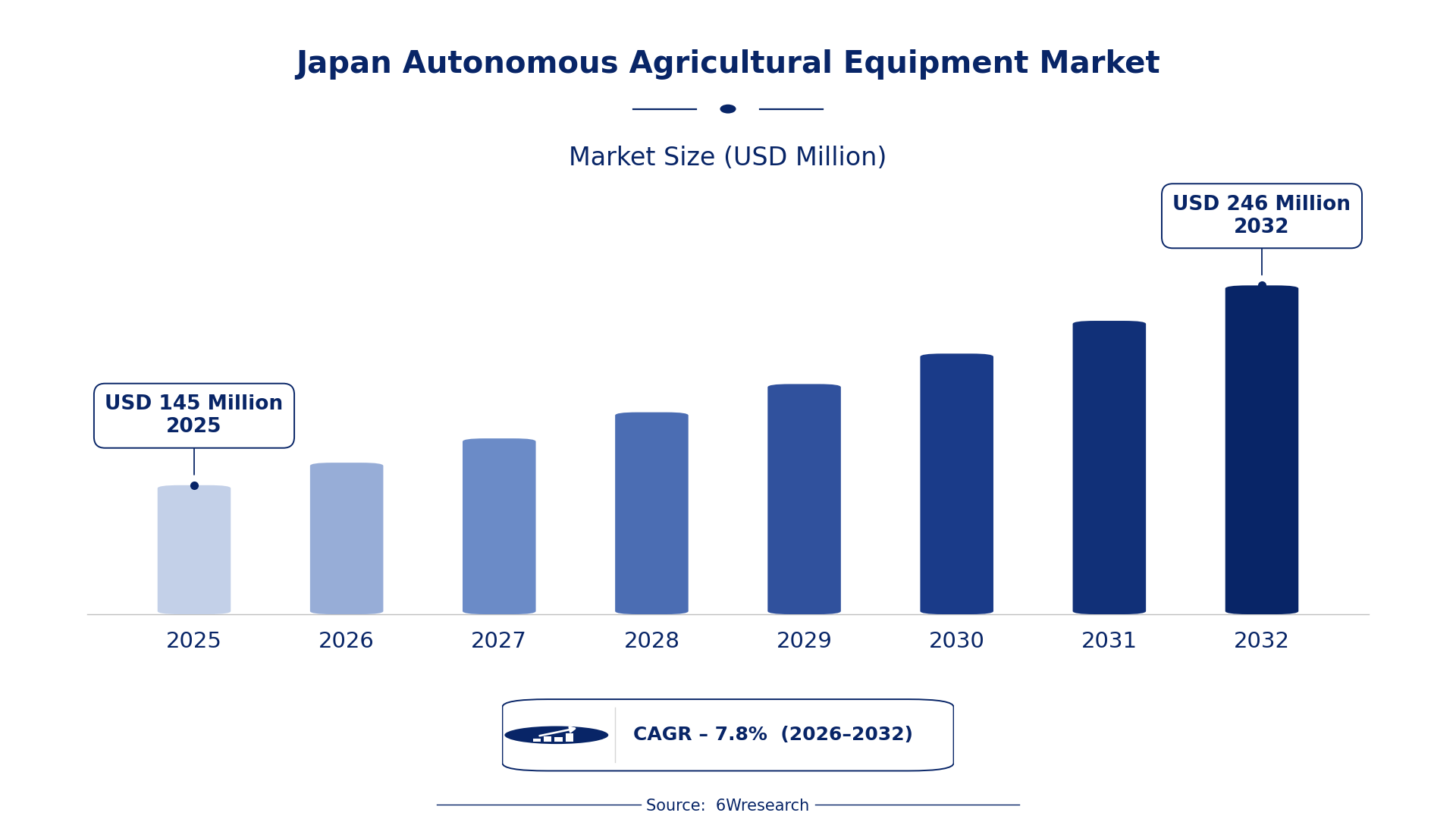
According to 6Wresearch internal database and industry insights, the Japan Autonomous Agricultural Equipment Market was valued at USD 145 Million in 2025 and is projected to reach USD 246 Million by 2032, growing at a CAGR of approximately 7.8% during 2026–2032.
Japan Autonomous Agricultural Equipment Market Highlights
| Report Metric | Details |
| Report Name | Japan Autonomous Agricultural Equipment Market (2026-2032) |
| Market Size 2025 | USD 145 Million |
| Market Size 2032 | USD 246 Million |
| Absolute Growth 2025–2032 | USD 101 Million |
| CAGR 2026–2032 | 7.8% |
| Peak Annual Growth | 9.2% in 2026 |
| Forecast Period | 2026–2032 |
| Historical Data | 2022–2025 |
| Base Year | 2025 |
| Leading Equipment Type, 2025 | Intelligent Harvesters (38% share) |
| Leading Power Source, 2025 | Electric (42% share) |
| Leading Crop Type, 2025 | Grain & Pulses (35% share) |
| Leading Automation Level, 2025 | Fully Autonomous (34% share) |
| Leading Distribution Channel, 2025 | Agri Tech Suppliers (44% share) |
| Fastest-Growing Equipment Type | Robotic Seeders (10.9% CAGR) |
| Fastest-Growing Crop Type | Vegetables (10.7% CAGR) |
| Fastest-Growing Automation Level | AI-Controlled (10.3% CAGR) |
| Fastest-Growing Distribution Channel | OEMs (10.0% CAGR) |
| Growing Sector | Agriculture |
| Key End Users | Farmers, agricultural cooperatives, urban farmers, equipment dealers |
Japan Autonomous Agricultural Equipment Market Year-wise Growth Rate and Key Drivers (2022–2032)
This graph illustrates the annual growth rates of the market from 2022 to 2032, highlighting a steady upward trajectory and projected market expansion over the forecast period.
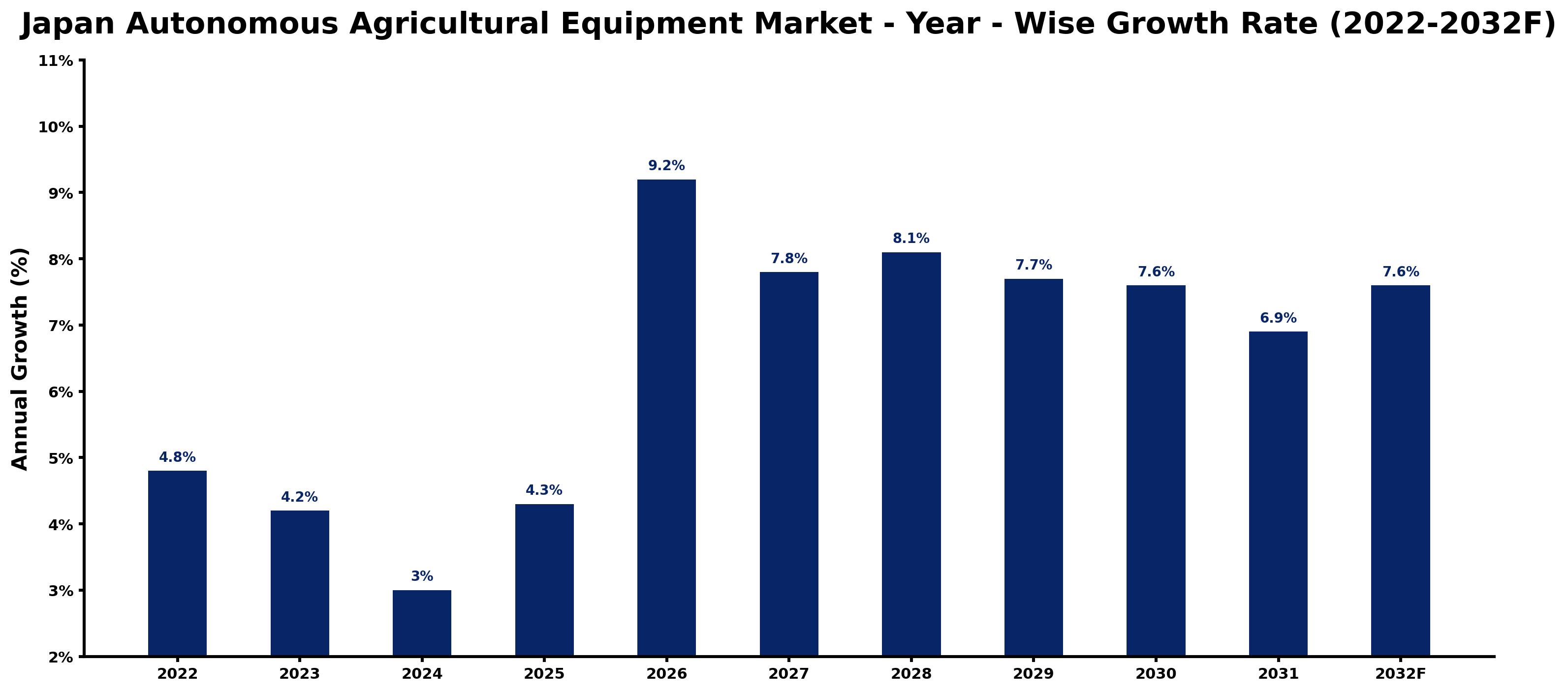
For each year, the table pairs the estimated growth rate with the leading influence on demand, showing how the drivers changed across the period.
| Year | Estimated Annual Growth (%) | Market Rationale |
| 2022 | 4.8 | The market exhibited solid growth, reflecting increasing adoption of automation in agriculture. |
| 2023 | 4.2 | Growth slowed due to a temporary dip in investment from agricultural cooperatives. |
| 2024 | 3.0 | Market expansion continued to decelerate as farmers adjusted to new technologies. |
| 2025 | 4.3 | A resurgence in demand occurred as subsidy programs incentivised equipment purchases. |
| 2026 | 9.2 | A notable uptick is anticipated as technological advancements drive higher adoption rates. |
| 2027 | 7.8 | Growth is projected to slow as the market begins to stabilise after rapid expansion in 2026. |
| 2028 | 8.1 | Demand is expected to increase again as urban farming initiatives gain traction in metropolitan areas. |
| 2029 | 7.7 | A slight slowdown is projected as competition intensifies among suppliers. |
| 2030 | 7.6 | Growth is anticipated to continue moderating as market saturation begins to set in. |
| 2031 | 6.9 | A further slowdown is expected as the market adjusts to evolving consumer preferences. |
| 2032 | 7.6 | Demand is projected to surge again as new AI-controlled equipment becomes widely available. |
Note: Market size estimations and growth projections presented in this report are based on 6Wresearch's proprietary forecasting methodology, utilizing the latest available industry data, government publications, and primary research inputs.
Japan Autonomous Agricultural Equipment Market Synopsis
Autonomous agricultural equipment offers a new approach to farming, employing advanced robotics, AI, and GPS technologies to function with minimal human involvement. This technology boosts productivity and lowers labour costs, making it crucial for contemporary agriculture. The Japan Autonomous Agricultural Equipment Market is growing due to rising demand from local users, the necessity for efficient farming methods, and government initiatives encouraging technological adoption, such as the subsidy program introduced in 2023.
Market Dynamics Impact Analysis (2026–2032)
| Factor | Type | Impact | Primary Segment Affected |
| Growing demand for precision farming techniques | Driver | High | Smart Sprayers |
| Increased investment in technology-driven farming solutions | Driver | High | Robotic Seeders |
| Rising interest in sustainable farming practices | Opportunity | Medium | Electric |
| Expansion of urban farming initiatives | Opportunity | Medium | Intelligent Harvesters |
| High initial investment costs for advanced equipment | Restraint | High | Self-Guided Plows |
| Aging farmer population leading to labor shortages | Restraint | Medium | Intelligent Harvesters |
| Challenges in integrating new technologies with traditional practices | Challenge | High | Robotic Seeders |
| Competition from traditional farming methods | Challenge | Medium | Smart Sprayers |
Evaluation of Drivers in Japan Autonomous Agricultural Equipment Market (2026–2032)
Below are the drivers that matter most for revenue growth, with supporting evidence.
| Drivers | Primary Segment Affected | Why It Matters (Evidence) |
| Increased adoption of precision farming | Smart Sprayers | This approach reduces chemical use, appealing to environmentally conscious farmers, particularly in the Kanto region where adoption is rising. |
| Government subsidies for autonomous equipment | Robotic Seeders | The subsidy program launched in 2023 encourages farmers to invest in robotic seeders, improving planting efficiency. |
| Focus on sustainability in agriculture | Electric | Urban farming initiatives in Tokyo favour electric-powered equipment, driving demand for eco-friendly solutions. |
| Technological advancements in AI and robotics | Intelligent Harvesters | These innovations improve harvesting efficiency, addressing labor shortages in the Tohoku region. |
| Rising awareness of labor cost reduction | Self-Guided Plows | Farmers seek to minimise manual labor costs, leading to increased purchases of self-guided technology. |
What keeps demand rising is the growing adoption of precision farming techniques, especially in areas where smart sprayers are becoming popular. The emphasis on sustainability increases demand for electric-powered equipment, particularly in urban farming projects. Advances in AI and robotics are improving the efficiency of harvesting systems, addressing labour shortages. Increased awareness of labour cost savings prompts farmers to invest in self-guided plows, further driving market growth.
Evaluation of Restraints in Japan Autonomous Agricultural Equipment Market
Several factors work against faster growth; the main ones are summarised below.
| Market Restraint | Primary Segment Affected | Why It Matters (Evidence) |
| High initial investment costs for advanced equipment | Self-Guided Plows | The substantial upfront costs deter small-scale farmers from adopting new technologies, limiting market penetration. |
| Aging farmer population leading to labor shortages | Intelligent Harvesters | The average age of farmers in Japan exceeds 67, complicating the transition to automated solutions. |
| Challenges in integrating new technologies with traditional practices | Robotic Seeders | Farmers struggle to adapt to automated systems, which hampers adoption rates. |
| Competition from traditional farming methods | Smart Sprayers | Many farmers remain loyal to established practices, hindering the shift to modern equipment. |
| Limited awareness of benefits among potential buyers | Electric | Some farmers lack knowledge about the advantages of electric-powered equipment, affecting overall demand. |
Japan Autonomous Agricultural Equipment Market Challenges
Producers face rising costs due to Japan's national minimum wage increase to JPY 1,055 per hour, which reduces their profit margins and limits investment in autonomous technology. Importers encounter regulatory hurdles from ISO 9001 compliance, leading to certification delays that can postpone equipment availability for distributors. Buyers struggle with a skills gap, as the average age of farmers exceeds 67, resulting in fewer individuals capable of operating advanced machinery, which hampers productivity. Technology adoption is slow in rural areas, restricting access to autonomous solutions and delaying operational improvements for farmers.
Trends in the Japan Autonomous Agricultural Equipment Market
The trends below show where the Japan Autonomous Agricultural Equipment Market is heading.
- Shift from Traditional to Automated Farming: Farmers are increasingly adopting autonomous agricultural equipment, particularly in Kanto, where smart sprayers are now widely used for rice cultivation, reflecting a 20% increase in adoption rates.
- Transition to Eco-Friendly Power Sources: The trend towards electric-powered equipment is visible in urban farming initiatives in Tokyo, where over 30% of new machinery is now electric, promoting sustainable practices.
- Emergence of AI-Controlled Systems: The integration of AI-controlled equipment is becoming prevalent, particularly in Hokkaido, where robotic seeders are gaining traction, with a projected 15% increase in usage by 2025.
- Growing Demand for Intelligent Harvesters: The Tohoku region is focusing on intelligent harvesters to combat labour shortages, with a 25% increase in adoption expected by 2025.
Investment Opportunities in the Japan Autonomous Agricultural Equipment Market
Where to invest in the Japan Autonomous Agricultural Equipment Market: the main openings are set out below.
- Urban Farming Initiatives: Tokyo's urban farming initiatives present an opportunity for suppliers of electric-powered equipment, with a projected increase in demand over the next five years.
- Investment in Autonomous Equipment: The 2023 subsidy program encourages investment in autonomous agricultural equipment, particularly among agricultural cooperatives, facilitating entry through local partnerships.
- Focus on Sustainable Practices: With Japan targeting a 46% cut in greenhouse-gas emissions by 2030, there is a growing market for eco-friendly agricultural solutions, particularly among urban farmers.
- Expansion of Agricultural Cooperatives: The over 300 agricultural cooperatives in Japan are promoting technology adoption, creating opportunities for suppliers to enter through collaborations.
Government Initiatives in the Japan Autonomous Agricultural Equipment Market
The Industrial Safety and Health Act of 1972 mandates that employers ensure safety in machinery, impacting producers of autonomous agricultural equipment by requiring compliance with safety standards. This law ensures that manufacturers invest in safer technologies, ultimately benefiting buyers through improved equipment reliability.
The Ministry of Agriculture, Forestry and Fisheries oversees the subsidy program for autonomous equipment launched in 2023, which funds farmers adopting advanced technologies. This initiative aims to increase efficiency in the agricultural sector, directly benefiting producers and buyers by reducing the cost of new equipment.
Future Insight of the Japan Autonomous Agricultural Equipment Market
The rollout of robotic seeders in Hokkaido will drive automation in large-scale agriculture, boosting productivity. By 2032, Japan's agricultural sector is expected to see a 20% increase in AI-controlled equipment adoption, supported by government subsidies. Urban farming projects in Tokyo will expand the use of electric-powered machinery, aligning with the country's decarbonisation targets. Smart sprayers will gain traction in rice cultivation, promoting precision farming and contributing to sustainable agricultural practices.
Market Segmentation Analysis
Japan Autonomous Agricultural Equipment Market report covers a detailed analysis of the following market segments:
By Equipment Type – Intelligent Harvesters Lead, Robotic Seeders Expected to Grow Fastest
According to Saurav Kr Singh, Senior Research Analyst at 6Wresearch, Intelligent Harvesters held 38% of the Japan Autonomous Agricultural Equipment Market by equipment type in 2025. Intelligent harvesters dominate the market due to their essential function in improving efficiency during large-scale harvesting, particularly in regions like Tohoku. Their capability to significantly minimise crop loss during harvest seasons makes them vital for farmers. Over 2026–2032, Robotic Seeders are expected to post the fastest growth, at a CAGR of 10.9%. Robotic seeders are witnessing rapid growth as they streamline the planting process, which is crucial given the current shortage of agricultural labour. The recent subsidy programme initiated by the Ministry of Agriculture is further propelling their adoption. Suppliers should focus on developing robotic seeders to cater to the rising demand in the market.
By Power Source – Electric Leads and Records the Fastest Growth
Electric accounted for 42% of the market by power source in 2025. Electric-powered equipment leads the market as it aligns with Japan's sustainability goals, offering eco-friendly solutions for agricultural practices. The government's push for decarbonisation investment supports the shift towards electric machinery. Its lead should widen, with a projected CAGR of 11.1% during 2026–2032, the highest in this split. Electric power sources are experiencing rapid growth due to their efficiency and alignment with urban farming initiatives in cities like Tokyo. This trend is expected to continue as the agricultural sector seeks sustainable energy solutions. Buyers will increasingly prefer electric solutions, prompting suppliers to innovate in this area.
By Crop Type – Grain & Pulses Lead, Vegetables Expected to Grow Fastest
In 2025, Grain & Pulses led the crop type split with a 35% share. Grain and pulses lead the market as autonomous equipment significantly boosts productivity in large-scale grain farming, essential for Japan's food security. The extensive availability of arable land supports the continued reliance on these crops. Vegetables are set to record the highest CAGR in this split, 10.7% over 2026–2032. Vegetables are the fastest-growing segment due to the efficiency improvements from autonomous equipment, which enhances yield while lowering labour costs. The increasing demand for fresh produce, especially in urban areas, drives this growth. Suppliers should tailor their products to meet the specific needs of vegetable farming to capitalise on this growth opportunity.
By Automation Level – Fully Autonomous Leads, AI-Controlled Expected to Grow Fastest
With 34% of automation level revenue in 2025, Fully Autonomous was the largest category. Fully autonomous systems are the leading segment as they deliver comprehensive solutions for various farming tasks, which are crucial for modern agricultural practices. Their proven effectiveness in enhancing productivity makes them a preferred choice among large-scale farmers. The quickest growth will come from AI-Controlled, forecast to expand at a CAGR of 10.3% between 2026 and 2032. AI-controlled systems are rapidly gaining popularity as they optimise farming processes, appealing to farmers who adopt technological advancements. The growing integration of AI in agriculture is expected to sustain this growth trend. Suppliers must invest in advanced automation technologies to maintain competitiveness in this market.
By Distribution Channel – Agri Tech Suppliers Lead, OEMs Expected to Grow Fastest
Agri Tech Suppliers took 44% of distribution channel revenue in 2025, more than any other category. Agri tech suppliers are the leading distribution channel as they effectively connect advanced farming technologies with end-users, facilitating widespread adoption. Their established networks throughout Japan ensure farmers have easy access to the latest equipment. Over 2026–2032, OEMs are expected to post the fastest growth, at a CAGR of 10.0%. OEMs are the fastest-growing distribution channel as they are the primary manufacturers of autonomous agricultural equipment, enabling them to swiftly adapt to market demands. Their direct involvement in technology development accelerates their growth in the sector. Suppliers should strengthen collaborations with OEMs to enhance distribution efficiency and market reach.
Key Attractiveness of the Report
- 10 Years of Market Numbers
- Historical Data Starting from 2022 to 2025
- Base Year 2025
- Forecast Data until 2032
- Key Performance Indicators Impacting the Market
- Major Upcoming Developments and Projects
Key Highlights of the Report:
- Japan Autonomous Agricultural Equipment Market Outlook
- Market Size of Japan Autonomous Agricultural Equipment Market, 2025
- Forecast of Japan Autonomous Agricultural Equipment Market, 2032
- Historical Data and Forecast of Japan Autonomous Agricultural Equipment Revenues & Volume for the Period 2022-2032F
- Japan Autonomous Agricultural Equipment Market Trend Evolution
- Japan Autonomous Agricultural Equipment Market Drivers and Challenges
- Japan Autonomous Agricultural Equipment Price Trends
- Japan Autonomous Agricultural Equipment Porter's Five Forces
- Japan Autonomous Agricultural Equipment Industry Life Cycle
- Historical Data and Forecast of Japan Autonomous Agricultural Equipment Market Revenues & Volume By Equipment Type for the Period 2022-2032F
- Historical Data and Forecast of Japan Autonomous Agricultural Equipment Market Revenues & Volume By Smart Sprayers for the Period 2022-2032F
- Historical Data and Forecast of Japan Autonomous Agricultural Equipment Market Revenues & Volume By Robotic Seeders for the Period 2022-2032F
- Historical Data and Forecast of Japan Autonomous Agricultural Equipment Market Revenues & Volume By Self-Guided Plows for the Period 2022-2032F
- Historical Data and Forecast of Japan Autonomous Agricultural Equipment Market Revenues & Volume By Intelligent Harvesters for the Period 2022-2032F
- Historical Data and Forecast of Japan Autonomous Agricultural Equipment Market Revenues & Volume By Power Source for the Period 2022-2032F
- Historical Data and Forecast of Japan Autonomous Agricultural Equipment Market Revenues & Volume By Battery Operated for the Period 2022-2032F
- Historical Data and Forecast of Japan Autonomous Agricultural Equipment Market Revenues & Volume By Electric for the Period 2022-2032F
- Historical Data and Forecast of Japan Autonomous Agricultural Equipment Market Revenues & Volume By Diesel for the Period 2022-2032F
- Historical Data and Forecast of Japan Autonomous Agricultural Equipment Market Revenues & Volume By Electric + GPS for the Period 2022-2032F
- Historical Data and Forecast of Japan Autonomous Agricultural Equipment Market Revenues & Volume By Crop Type for the Period 2022-2032F
- Historical Data and Forecast of Japan Autonomous Agricultural Equipment Market Revenues & Volume By Row Crops for the Period 2022-2032F
- Historical Data and Forecast of Japan Autonomous Agricultural Equipment Market Revenues & Volume By Grain & Pulses for the Period 2022-2032F
- Historical Data and Forecast of Japan Autonomous Agricultural Equipment Market Revenues & Volume By Vegetables for the Period 2022-2032F
- Historical Data and Forecast of Japan Autonomous Agricultural Equipment Market Revenues & Volume By Orchards for the Period 2022-2032F
- Historical Data and Forecast of Japan Autonomous Agricultural Equipment Market Revenues & Volume By Automation Level for the Period 2022-2032F
- Historical Data and Forecast of Japan Autonomous Agricultural Equipment Market Revenues & Volume By Semi-Autonomous for the Period 2022-2032F
- Historical Data and Forecast of Japan Autonomous Agricultural Equipment Market Revenues & Volume By Fully Autonomous for the Period 2022-2032F
- Historical Data and Forecast of Japan Autonomous Agricultural Equipment Market Revenues & Volume By Auto-Steered for the Period 2022-2032F
- Historical Data and Forecast of Japan Autonomous Agricultural Equipment Market Revenues & Volume By AI-Controlled for the Period 2022-2032F
- Historical Data and Forecast of Japan Autonomous Agricultural Equipment Market Revenues & Volume By Distribution Channel for the Period 2022-2032F
- Historical Data and Forecast of Japan Autonomous Agricultural Equipment Market Revenues & Volume By OEMs for the Period 2022-2032F
- Historical Data and Forecast of Japan Autonomous Agricultural Equipment Market Revenues & Volume By Agri Tech Suppliers for the Period 2022-2032F
- Historical Data and Forecast of Japan Autonomous Agricultural Equipment Market Revenues & Volume By Equipment Dealers for the Period 2022-2032F
- Historical Data and Forecast of Japan Autonomous Agricultural Equipment Market Revenues & Volume By Online Platforms for the Period 2022-2032F
- Japan Autonomous Agricultural Equipment Import Export Trade Statistics
- Market Opportunity Assessment By Equipment Type
- Market Opportunity Assessment By Power Source
- Market Opportunity Assessment By Crop Type
- Market Opportunity Assessment By Automation Level
- Market Opportunity Assessment By Distribution Channel
- Japan Autonomous Agricultural Equipment Top Companies Market Share
- Japan Autonomous Agricultural Equipment Competitive Benchmarking By Technical and Operational Parameters
- Japan Autonomous Agricultural Equipment Company Profiles
- Japan Autonomous Agricultural Equipment Key Strategic Recommendations
Market Covered
The following segment groups are covered in the report.
By Equipment Type
- Smart Sprayers
- Robotic Seeders
- Self-Guided Plows
- Intelligent Harvesters
By Power Source
- Battery Operated
- Electric
- Diesel
- Electric + GPS
By Crop Type
- Row Crops
- Grain & Pulses
- Vegetables
- Orchards
By Automation Level
- Semi-Autonomous
- Fully Autonomous
- Auto-Steered
- AI-Controlled
By Distribution Channel
- OEMs
- Agri Tech Suppliers
- Equipment Dealers
- Online Platforms






































