Japan Autonomous Farming Equipment Market Size & Growth Rate
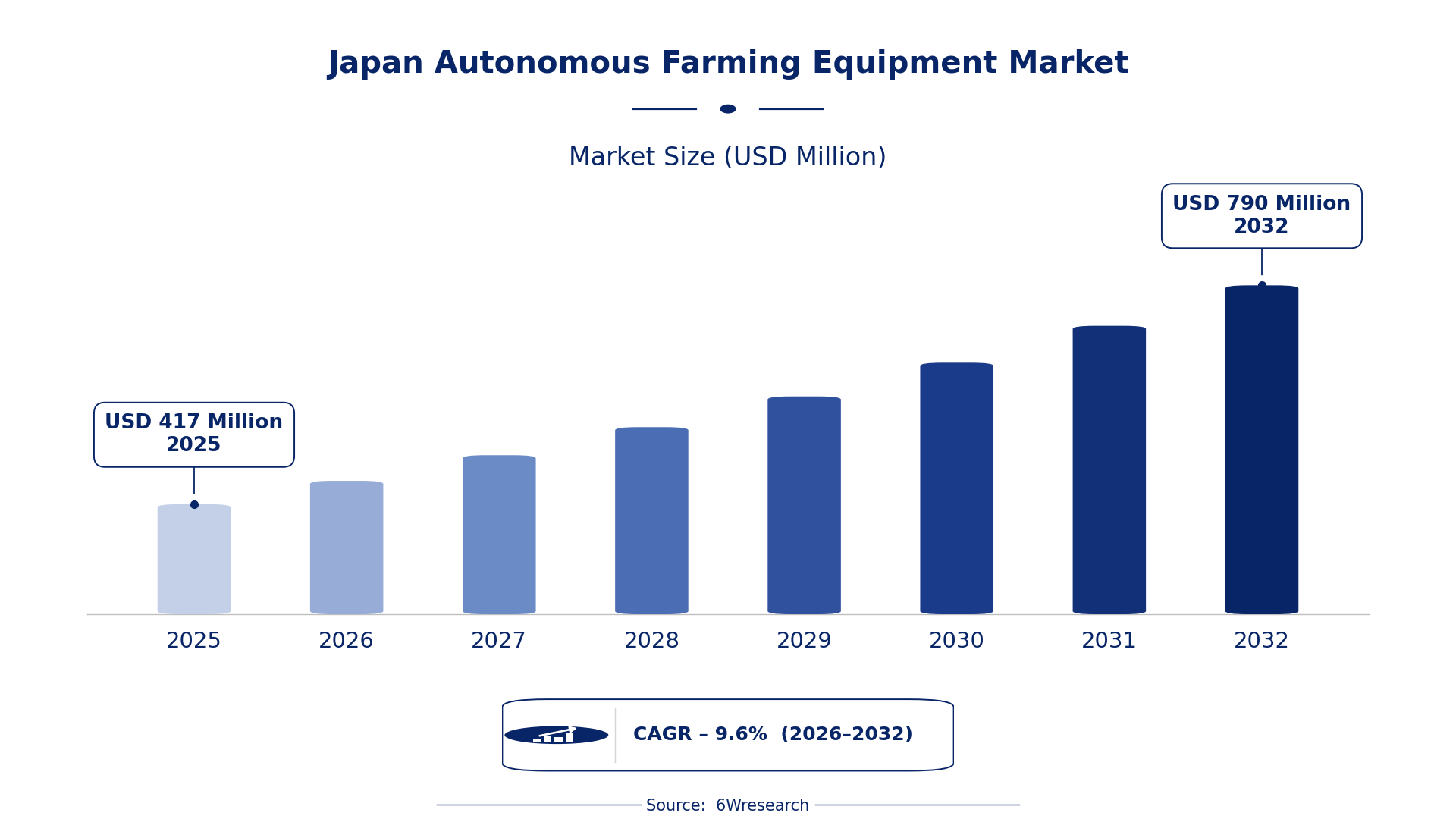
According to 6Wresearch internal database and industry insights, the Japan Autonomous Farming Equipment Market was valued at USD 417 Million in 2025 and is projected to reach USD 790 Million by 2032, growing at a CAGR of approximately 9.6% during 2026–2032.
Japan Autonomous Farming Equipment Market Highlights
| Report Metric | Details |
| Report Name | Japan Autonomous Farming Equipment Market (2026-2032) |
| Market Size 2025 | USD 417 Million |
| Market Size 2032 | USD 790 Million |
| Absolute Growth 2025–2032 | USD 373 Million |
| CAGR 2026–2032 | 9.6% |
| Peak Annual Growth | 10.3% in 2028 |
| Forecast Period | 2026–2032 |
| Historical Data | 2022–2025 |
| Base Year | 2025 |
| Leading Equipment Type, 2025 | Smart Tractors (43% share) |
| Leading Power Source, 2025 | Diesel/Electric (55% share) |
| Leading Application Area, 2025 | Plowing & Seeding (48% share) |
| Leading Navigation System, 2025 | RTK-GPS (34% share) |
| Leading Distribution Channel, 2025 | OEMs (47% share) |
| Fastest-Growing Equipment Type | Autonomous Sprayers (13.7% CAGR) |
| Fastest-Growing Power Source | Battery (13.9% CAGR) |
| Fastest-Growing Application Area | Pest Control (12.0% CAGR) |
| Fastest-Growing Navigation System | Computer Vision (14.1% CAGR) |
| Fastest-Growing Distribution Channel | Agri Dealers (12.4% CAGR) |
| Growing Sector | Agriculture |
| Key End Users | Farmers, Agricultural cooperatives, Agricultural technology providers |
Japan Autonomous Farming Equipment Market Year-wise Growth Rate and Key Drivers (2022–2032)
This graph illustrates the annual growth rates of the market from 2022 to 2032, highlighting a steady upward trajectory and projected market expansion over the forecast period.
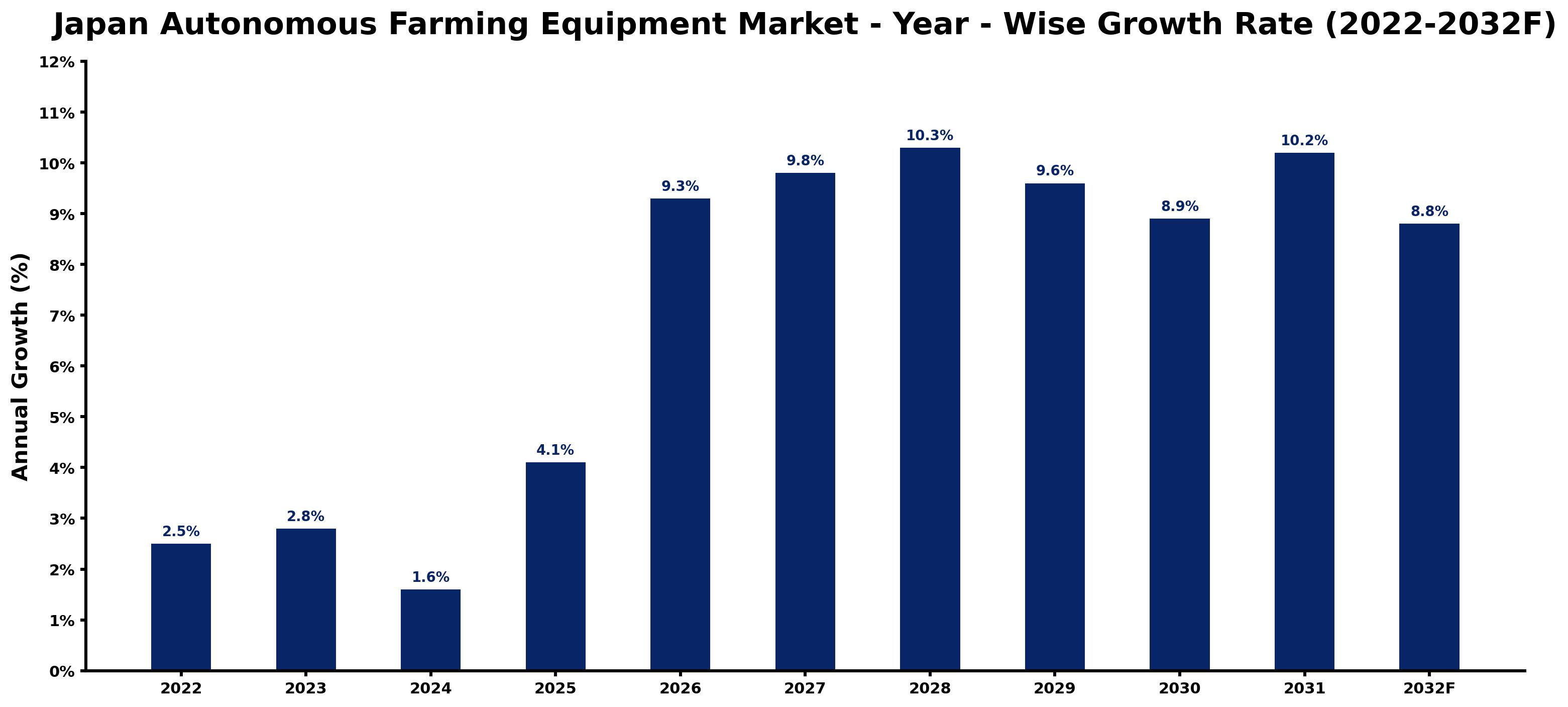
For each year, the table pairs the estimated growth rate with the leading influence on demand, showing how the drivers changed across the period.
| Year | Estimated Annual Growth (%) | Market Rationale |
| 2022 | 2.5 | The market showed steady growth as farmers began adopting new technologies. |
| 2023 | 2.8 | Demand increased as more farmers recognised the benefits of automation. |
| 2024 | 1.6 | Growth slowed due to market saturation in some regions. |
| 2025 | 4.1 | The introduction of new models spurred faster adoption among farmers. |
| 2026 | 9.3 | Investment in smart agriculture technologies is expected to boost demand. |
| 2027 | 9.8 | The trend towards precision farming will continue to drive growth. |
| 2028 | 10.3 | Peak growth will occur as advanced technologies gain widespread acceptance. |
| 2029 | 9.6 | Demand growth is projected to slow as the market matures and competition intensifies. |
| 2030 | 8.9 | The market will continue to grow as environmental regulations push for automation. |
| 2031 | 10.2 | Increased investment in agricultural innovation will lead to a surge in demand. |
| 2032 | 8.8 | Growth is expected to slow as the market stabilises with established technologies. |
Note: Market size estimations and growth projections presented in this report are based on 6Wresearch's proprietary forecasting methodology, utilizing the latest available industry data, government publications, and primary research inputs.
Japan Autonomous Farming Equipment Market Synopsis
Autonomous farming equipment refers to advanced machinery that operates with minimal human intervention, utilising AI, GPS, and robotics. The Japan Autonomous Farming Equipment Market is projected to grow, supported by over 1.5 million farms and increasing adoption of precision agriculture technologies. The ageing farmer population and government backing for smart agriculture initiatives are driving demand.
Market Dynamics Impact Analysis (2026–2032)
| Factor | Type | Impact | Primary Segment Affected |
| Increasing adoption of precision agriculture technologies | Driver | High | Smart Tractors |
| Government subsidies for smart agriculture initiatives | Driver | High | Autonomous Sprayers |
| Growing interest in sustainable farming practices | Opportunity | Medium | Driverless Harvesters |
| Expansion of online sales channels for agricultural equipment | Opportunity | Medium | Seeding Robots |
| High initial investment costs for autonomous equipment | Restraint | High | Smart Tractors |
| Limited awareness among farmers regarding technology benefits | Restraint | Medium | Autonomous Sprayers |
| Ageing farmer population leading to labour shortages | Challenge | High | Driverless Harvesters |
| Competition from traditional farming methods | Challenge | Medium | Seeding Robots |
Evaluation of Drivers in Japan Autonomous Farming Equipment Market (2026–2032)
These are the developments adding the most demand over the forecast period.
| Drivers | Primary Segment Affected | Why It Matters (Evidence) |
| Growing adoption of precision farming technologies | Smart Tractors | This trend is driven by the need for efficient field operations, with smart tractors increasingly used in rice cultivation, covering 1.5 million hectares. |
| Government subsidies for smart agriculture initiatives | Autonomous Sprayers | These financial incentives encourage farmers to invest in autonomous sprayers, enhancing pest control and crop protection. |
| Aging farmer population necessitating automation | Driverless Harvesters | With the average age of farmers at 67, there is a pressing need for driverless harvesters to reduce labor dependency and increase efficiency. |
| Increased online sales channels | Seeding Robots | The rise of online platforms, with a 25% increase in sales, supports the adoption of seeding robots for improved planting accuracy. |
| Environmental regulations promoting battery-powered equipment | Battery | As battery-powered equipment gains traction due to stricter environmental regulations, it is expected to play a significant role in the market. |
A wider customer base explains much of the growth, as the Tohoku region experiences a surge in demand for autonomous farming equipment. Over 100,000 hectares are now utilising autonomous equipment, reflecting a shift towards modern farming practices. With the average age of farmers at 67, automation is essential to address labour challenges. Substantial financial incentives for smart agriculture stimulate demand. The adoption of RTK-GPS technology, which exceeds 30% among farmers, improves precision farming capabilities, leading to increased crop yields.
Evaluation of Restraints in Japan Autonomous Farming Equipment Market
Several factors work against faster growth; the main ones are summarised below.
| Market Restraint | Primary Segment Affected | Why It Matters (Evidence) |
| High initial investment costs for autonomous equipment | Smart Tractors | Initial costs deter many farmers from adopting advanced technologies, limiting market growth. |
| Limited awareness among farmers regarding technology benefits | Autonomous Sprayers | Many farmers remain unaware of the advantages of automation, hindering adoption rates. |
| Regulatory challenges in equipment certification | Driverless Harvesters | Complex certification processes can delay the introduction of new technologies to the market. |
| Competition from traditional farming methods | Seeding Robots | Some farmers prefer conventional methods, which can slow the transition to automation. |
| Supply chain disruptions affecting equipment availability | Battery | Disruptions have led to delays in the delivery of essential components for autonomous equipment. |
Japan Autonomous Farming Equipment Market Challenges
Japan's agricultural buyers face rising operational costs, as the national minimum wage increased to JPY 1,055 per hour, squeezing profit margins. Competition intensifies from international manufacturers offering lower prices, which pressures local suppliers and contributes to a 25% rise in online sales of agricultural equipment. High costs for adopting new technologies hinder farmers from upgrading their equipment, delaying compliance with government decarbonisation targets. The average age of farmers is 67, creating a pressing need for automation that suppliers struggle to meet due to a shrinking workforce.
Trends in the Japan Autonomous Farming Equipment Market
These developments are changing demand patterns in the Japan Autonomous Farming Equipment Market.
- Shift towards Precision Agriculture: Japan's agricultural sector is increasingly adopting precision farming techniques, with over 30% of farmers using RTK-GPS technology. This shift is improving farming efficiency and crop yields.
- Rise of Online Sales Channels: Online platforms for agricultural equipment sales have surged by 25% in the last year, reflecting changing buyer preferences and expanding market reach for suppliers.
- Growing Demand for Battery-Powered Equipment: Battery-powered farming equipment is gaining traction, driven by environmental regulations targeting emissions reduction. This trend is reshaping the market for sustainable farming solutions.
- Increased Adoption of Smart Agriculture Initiatives: The Japanese government is actively promoting smart agriculture through various subsidies and programs, targeting a JPY 150 trillion investment in decarbonisation over the next decade.
Investment Opportunities in the Japan Autonomous Farming Equipment Market
The openings below show where demand in the Japan Autonomous Farming Equipment Market is visible and how suppliers can enter.
- Tohoku Region as a Hub for Innovation: The Tohoku region is focused on advancing agricultural technology, with over 100,000 hectares utilising autonomous equipment. Suppliers can enter this market through local partnerships.
- Investment in Smart Agriculture Technologies: With the average age of farmers at 67, there is a pressing need for automation. Investing in smart tractors and sprayers can effectively meet this demand.
- Expansion of Online Sales Platforms: The rise in online sales channels presents an opportunity for suppliers to reach a broader customer base and increase market penetration.
- Focus on Sustainable Farming Practices: As Japan targets a 46% cut in greenhouse gas emissions by 2030, there is a growing opportunity for suppliers of eco-friendly farming equipment.
Government Initiatives in the Japan Autonomous Farming Equipment Market
The Industrial Safety and Health Act of 1972 mandates safety standards for machinery used in agriculture, ensuring that producers adhere to safety regulations. This Act has shaped operational practices for autonomous farming equipment, requiring regular safety assessments and compliance checks. The GX Promotion Act of 2023 supports the transition to green technologies, with a focus on sustainable practices in agriculture. This law encourages investment in smart farming solutions, aligning with national decarbonisation goals.
The Ministry of Agriculture, Forestry and Fisheries oversees an annual budget of approximately $500 million for agricultural innovation. This funding supports various initiatives aimed at promoting smart agriculture, including subsidies for autonomous equipment adoption. The ministry's efforts are designed to facilitate the integration of advanced technologies in farming, benefiting both producers and buyers.
Future Insight of the Japan Autonomous Farming Equipment Market
RTK-GPS technology will become commonplace in precision farming, with adoption rates expected to exceed 30% by 2032. The Japanese government's JPY 150 trillion investment in decarbonisation will stimulate advancements in autonomous farming equipment. Battery-powered machinery will capture a larger share of the market as environmental regulations become stricter. Increased government support for smart agriculture initiatives will motivate more farmers to embrace automation, providing opportunities for both buyers and suppliers.
Market Segmentation Analysis
Japan Autonomous Farming Equipment Market report covers a detailed analysis of the following market segments:
By Equipment Type – Smart Tractors Lead, Autonomous Sprayers Expected to Grow Fastest
According to Saurav Kr Singh, Senior Research Analyst at 6Wresearch, Smart Tractors took 43% of equipment type revenue in 2025, more than any other category. Smart tractors hold the largest share due to their widespread utilisation in rice cultivation across 1.5 million hectares, making them essential for farmers. Their role in efficient field operations and precision agriculture reinforces their dominance in the market. Autonomous Sprayers are set to record the highest CAGR in this split, 13.7% over 2026–2032. The growth of autonomous sprayers is propelled by their significant role in pest control, which is vital for crop health. As sustainable farming practices gain traction, the demand for these sprayers is expected to increase substantially. Suppliers should focus on enhancing the capabilities of autonomous sprayers to meet the rising demand for effective pest management solutions.
By Power Source – Diesel/Electric Leads, Battery Expected to Grow Fastest
Diesel/Electric accounted for 55% of the market by power source in 2025. The diesel/electric power source is predominant as it is commonly employed in heavy machinery, crucial for demanding agricultural operations. This power source provides the necessary performance and reliability for large-scale farming in Japan. The quickest growth will come from Battery, forecast to expand at a CAGR of 13.9% between 2026 and 2032. Battery-powered equipment is witnessing rapid growth, largely due to increasing environmental regulations that favour sustainable practices. This shift indicates a broader trend towards eco-friendly solutions in the agricultural sector. Buyers may need to consider battery-powered options to comply with environmental standards and improve operational efficiency.
By Application Area – Plowing & Seeding Leads, Pest Control Expected to Grow Fastest
With 48% of application area revenue in 2025, Plowing & Seeding was the largest category. Plowing and seeding is the leading application area, essential for establishing crops, which is a fundamental aspect of farming. This segment's importance is underscored by Japan's large agricultural sector, which includes over 1.5 million farms. Pest Control is projected to grow fastest, at a CAGR of 12.0% during 2026–2032. Pest control is the fastest-growing application area, critical for ensuring crop health as farmers strive to optimise yields. The adoption of smart agriculture techniques is driving the rapid expansion of this segment. Suppliers should prioritise developing advanced solutions for pest control to address the evolving needs of farmers.
By Navigation System – RTK-GPS Leads, Computer Vision Expected to Grow Fastest
The largest navigation system category in 2025 was RTK-GPS, at 34% of revenue. RTK-GPS technology is the leader in navigation systems due to its ability to provide high-accuracy positioning, which is essential for the effective operation of autonomous farming equipment. Its adoption rate of over 30% among farmers highlights its importance in precision agriculture. Over 2026–2032, Computer Vision is expected to post the fastest growth, at a CAGR of 14.1%. Computer vision is experiencing rapid growth as it is increasingly used for monitoring and analysis, offering farmers valuable insights into crop conditions. This trend reflects a broader move towards data-driven farming practices. Suppliers should invest in developing advanced computer vision technologies to cater to the increasing demand for precision monitoring solutions.
By Distribution Channel – OEMs Lead, Agri Dealers Expected to Grow Fastest
In 2025, OEMs led the distribution channel split with a 47% share. OEMs are the primary distribution channel, serving as the main manufacturers of equipment and ensuring a direct supply to the market. Their established relationships with farmers make them trusted sources for high-quality autonomous farming machinery. Agri Dealers are set to record the highest CAGR in this split, 12.4% over 2026–2032. Agri dealers are the fastest-growing distribution channel, providing local access to agricultural machinery, which simplifies the purchasing process for farmers. Their increasing role in facilitating sales is becoming essential in the current market. Suppliers should strengthen collaborations with agri dealers to expand market reach and improve accessibility for farmers.
Key Attractiveness of the Report
- 10 Years of Market Numbers
- Historical Data Starting from 2022 to 2025
- Base Year 2025
- Forecast Data until 2032
- Key Performance Indicators Impacting the Market
- Major Upcoming Developments and Projects
Key Highlights of the Report:
- Japan Autonomous Farming Equipment Market Outlook
- Market Size of Japan Autonomous Farming Equipment Market, 2025
- Forecast of Japan Autonomous Farming Equipment Market, 2032
- Historical Data and Forecast of Japan Autonomous Farming Equipment Revenues & Volume for the Period 2022-2032F
- Japan Autonomous Farming Equipment Market Trend Evolution
- Japan Autonomous Farming Equipment Market Drivers and Challenges
- Japan Autonomous Farming Equipment Price Trends
- Japan Autonomous Farming Equipment Porter's Five Forces
- Japan Autonomous Farming Equipment Industry Life Cycle
- Historical Data and Forecast of Japan Autonomous Farming Equipment Market Revenues & Volume By Equipment Type for the Period 2022-2032F
- Historical Data and Forecast of Japan Autonomous Farming Equipment Market Revenues & Volume By Smart Tractors for the Period 2022-2032F
- Historical Data and Forecast of Japan Autonomous Farming Equipment Market Revenues & Volume By Autonomous Sprayers for the Period 2022-2032F
- Historical Data and Forecast of Japan Autonomous Farming Equipment Market Revenues & Volume By Driverless Harvesters for the Period 2022-2032F
- Historical Data and Forecast of Japan Autonomous Farming Equipment Market Revenues & Volume By Seeding Robots for the Period 2022-2032F
- Historical Data and Forecast of Japan Autonomous Farming Equipment Market Revenues & Volume By Power Source for the Period 2022-2032F
- Historical Data and Forecast of Japan Autonomous Farming Equipment Market Revenues & Volume By Diesel/Electric for the Period 2022-2032F
- Historical Data and Forecast of Japan Autonomous Farming Equipment Market Revenues & Volume By Battery for the Period 2022-2032F
- Historical Data and Forecast of Japan Autonomous Farming Equipment Market Revenues & Volume By Hybrid for the Period 2022-2032F
- Historical Data and Forecast of Japan Autonomous Farming Equipment Market Revenues & Volume By Electric for the Period 2022-2032F
- Historical Data and Forecast of Japan Autonomous Farming Equipment Market Revenues & Volume By Application Area for the Period 2022-2032F
- Historical Data and Forecast of Japan Autonomous Farming Equipment Market Revenues & Volume By Plowing & Seeding for the Period 2022-2032F
- Historical Data and Forecast of Japan Autonomous Farming Equipment Market Revenues & Volume By Pest Control for the Period 2022-2032F
- Historical Data and Forecast of Japan Autonomous Farming Equipment Market Revenues & Volume By Crop Collection for the Period 2022-2032F
- Historical Data and Forecast of Japan Autonomous Farming Equipment Market Revenues & Volume By Precision Planting for the Period 2022-2032F
- Historical Data and Forecast of Japan Autonomous Farming Equipment Market Revenues & Volume By Navigation System for the Period 2022-2032F
- Historical Data and Forecast of Japan Autonomous Farming Equipment Market Revenues & Volume By RTK-GPS for the Period 2022-2032F
- Historical Data and Forecast of Japan Autonomous Farming Equipment Market Revenues & Volume By Computer Vision for the Period 2022-2032F
- Historical Data and Forecast of Japan Autonomous Farming Equipment Market Revenues & Volume By Sensor Fusion for the Period 2022-2032F
- Historical Data and Forecast of Japan Autonomous Farming Equipment Market Revenues & Volume By AI Mapping for the Period 2022-2032F
- Historical Data and Forecast of Japan Autonomous Farming Equipment Market Revenues & Volume By Distribution Channel for the Period 2022-2032F
- Historical Data and Forecast of Japan Autonomous Farming Equipment Market Revenues & Volume By OEMs for the Period 2022-2032F
- Historical Data and Forecast of Japan Autonomous Farming Equipment Market Revenues & Volume By Agri Dealers for the Period 2022-2032F
- Historical Data and Forecast of Japan Autonomous Farming Equipment Market Revenues & Volume By Online Platforms for the Period 2022-2032F
- Historical Data and Forecast of Japan Autonomous Farming Equipment Market Revenues & Volume By Specialty Retailers for the Period 2022-2032F
- Japan Autonomous Farming Equipment Import Export Trade Statistics
- Market Opportunity Assessment By Equipment Type
- Market Opportunity Assessment By Power Source
- Market Opportunity Assessment By Application Area
- Market Opportunity Assessment By Navigation System
- Market Opportunity Assessment By Distribution Channel
- Japan Autonomous Farming Equipment Top Companies Market Share
- Japan Autonomous Farming Equipment Competitive Benchmarking By Technical and Operational Parameters
- Japan Autonomous Farming Equipment Company Profiles
- Japan Autonomous Farming Equipment Key Strategic Recommendations
Market Covered
The following segment groups are covered in the report.
By Equipment Type
- Smart Tractors
- Autonomous Sprayers
- Driverless Harvesters
- Seeding Robots
By Power Source
- Diesel/Electric
- Battery
- Hybrid
- Electric
By Application Area
- Plowing & Seeding
- Pest Control
- Crop Collection
- Precision Planting
By Navigation System
- RTK-GPS
- Computer Vision
- Sensor Fusion
- AI Mapping
By Distribution Channel
- OEMs
- Agri Dealers
- Online Platforms
- Specialty Retailers






































