Japan Autonomous Farming Robot Market Size & Growth Rate
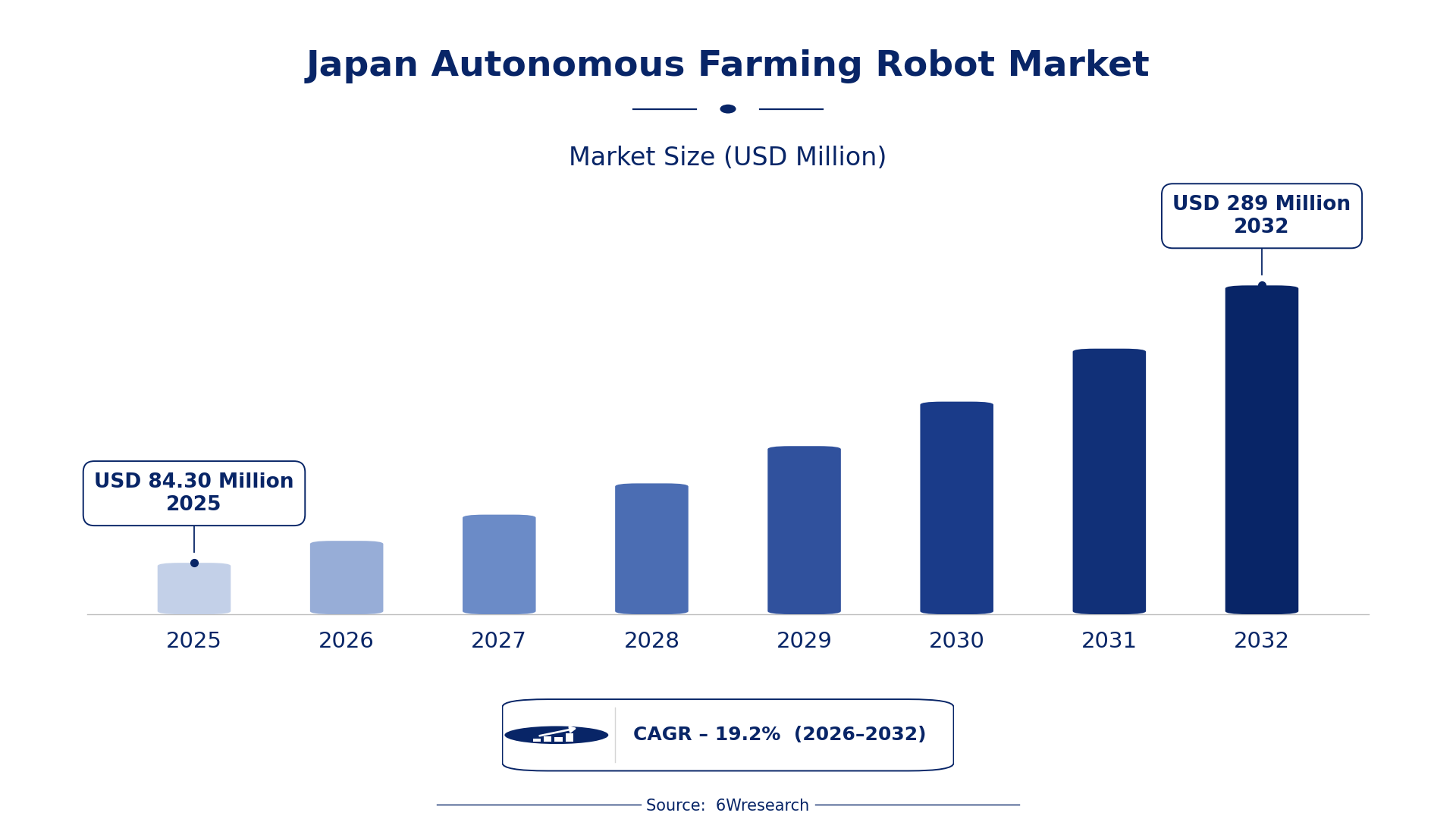
According to 6Wresearch internal database and industry insights, the Japan Autonomous Farming Robot Market was valued at USD 84.30 Million in 2025 and is projected to reach USD 289 Million by 2032, growing at a CAGR of approximately 19.2% during 2026–2032.
Japan Autonomous Farming Robot Market Highlights
| Report Metric | Details |
| Report Name | Japan Autonomous Farming Robot Market (2026-2032) |
| Market Size 2025 | USD 84.30 Million |
| Market Size 2032 | USD 289 Million |
| Absolute Growth 2025–2032 | USD 204.70 Million |
| CAGR 2026–2032 | 19.2% |
| Peak Annual Growth | 21.2% in 2032 |
| Forecast Period | 2026–2032 |
| Historical Data | 2022–2025 |
| Base Year | 2025 |
| Leading Robot Type, 2025 | Weeding Robots (48% share) |
| Leading Task Function, 2025 | Weed Removal (40% share) |
| Leading Power Mode, 2025 | Solar Powered (40% share) |
| Leading Crop Type, 2025 | Row Crops (45% share) |
| Leading Distribution Channel, 2025 | Direct Sales (48% share) |
| Fastest-Growing Robot Type | Fruit-Picking Robots (20.6% CAGR) |
| Fastest-Growing Task Function | Harvest Automation (21.8% CAGR) |
| Fastest-Growing Power Mode | Battery Operated (20.7% CAGR) |
| Fastest-Growing Crop Type | Orchards (20.9% CAGR) |
| Fastest-Growing Distribution Channel | Agri Equipment Firms (25.0% CAGR) |
| Growing Sector | Agriculture |
| Key End Users | Farmers, Agricultural businesses, Equipment manufacturers, Technology developers |
Japan Autonomous Farming Robot Market Year-wise Growth Rate and Key Drivers (2022–2032)
This graph illustrates the annual growth rates of the market from 2022 to 2032, highlighting a steady upward trajectory and projected market expansion over the forecast period.
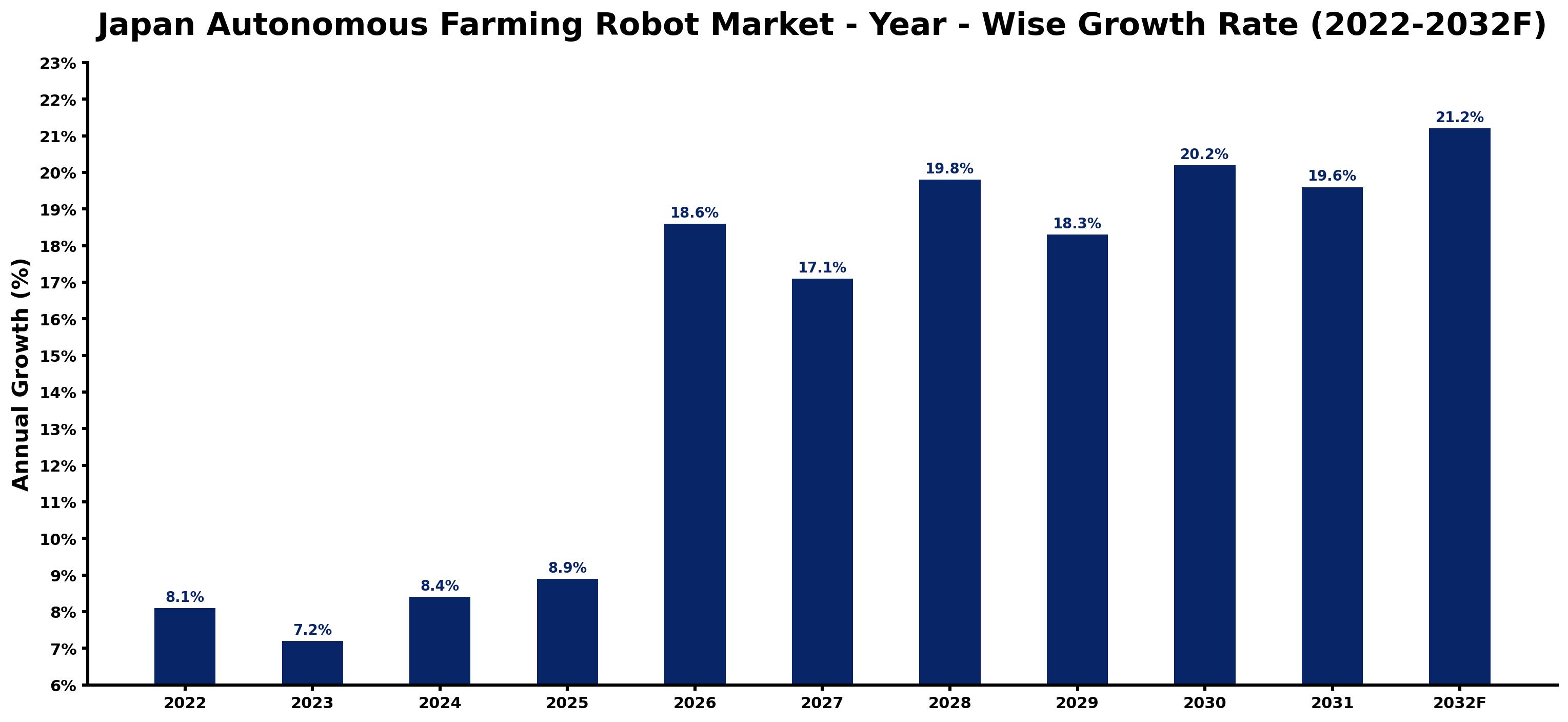
Year by year, the estimates below pair each growth rate with the development that shaped it.
| Year | Estimated Annual Growth (%) | Market Rationale |
| 2022 | 8.1 | The market experienced steady growth due to increasing automation in agriculture. |
| 2023 | 7.2 | Growth slowed as farmers adjusted to new technologies and market conditions. |
| 2024 | 8.4 | The adoption of autonomous robots increased as efficiency became a priority for farmers. |
| 2025 | 8.9 | Demand surged as farmers recognised the benefits of automation in reducing labor costs. |
| 2026 | 18.6 | Investment in smart agriculture technologies is projected to drive growth in robot orders. |
| 2027 | 17.1 | Growth is anticipated to slow as the market begins to stabilise after rapid expansion. |
| 2028 | 19.8 | Technological advancements will lead to renewed interest and higher orders for robots. |
| 2029 | 18.3 | The market is expected to continue growing as more farmers adopt precision farming techniques. |
| 2030 | 20.2 | Increased investment in agricultural innovation will boost demand for autonomous robots. |
| 2031 | 19.6 | Growth is expected to slow as the market matures and competition intensifies. |
| 2032 | 21.2 | The peak growth rate will be driven by a surge in demand for advanced automation solutions. |
Note: Market size estimations and growth projections presented in this report are based on 6Wresearch's proprietary forecasting methodology, utilizing the latest available industry data, government publications, and primary research inputs.
Japan Autonomous Farming Robot Market Synopsis
Autonomous farming robots are advanced agricultural machines that utilise AI and robotics technology to perform tasks such as planting, monitoring, and harvesting crops. The Japan Autonomous Farming Robot Market is growing due to the need for efficiency in farming operations and the increasing adoption of smart agriculture technologies. With a target of 30% adoption by 2025, domestic users are investing in these technologies to improve crop yields and reduce labour costs. This trend reflects strong demand for automation in agriculture, highlighting the market's potential for future expansion.
Market Dynamics Impact Analysis (2026–2032)
| Factor | Type | Impact | Primary Segment Affected |
| Increasing demand for efficiency in farming operations | Driver | High | Weed Removal |
| Technological advancements in precision farming | Driver | High | Harvest Automation |
| Growing interest in sustainable farming practices | Opportunity | High | Crop Monitoring Robots |
| Rising investment in agricultural innovation | Opportunity | High | Fruit-Picking Robots |
| High initial investment costs for autonomous robots | Restraint | Medium | Soil Analysis Robots |
| Limited awareness among farmers about technology benefits | Restraint | Medium | Weeding Robots |
| Competition from traditional farming methods | Challenge | High | Harvest Automation |
| Shortage of skilled workforce to operate advanced technologies | Challenge | Medium | Crop Monitoring Robots |
Evaluation of Drivers in Japan Autonomous Farming Robot Market (2026–2032)
Demand rests on the following drivers, each shown with the segment it touches most.
| Drivers | Primary Segment Affected | Why It Matters (Evidence) |
| Increased automation in agriculture | Weed Removal | The total cultivated area in Japan is approximately 4.5 million hectares, driving demand for efficient weed management. |
| Technological advancements in AI and robotics | Harvest Automation | The number of agricultural robots in Japan is expected to reach 50,000 units by 2025, enhancing harvesting efficiency. |
| Government initiatives promoting smart agriculture | Crop Monitoring Robots | The government allocated ¥10 billion for agricultural innovation in the 2023 budget, boosting technology adoption. |
| Aging farmer population necessitating automation | Fruit-Picking Robots | The average age of farmers in Japan is 67, increasing the need for labor-saving technologies. |
| Rising demand for precision farming solutions | Soil Analysis Robots | The adoption rate of precision farming technologies in Japan is around 15%, creating opportunities for related robots. |
Behind the steady rise in orders sits the increasing automation in agriculture. Japan's agricultural sector, with approximately 4.5 million hectares cultivated, drives demand for efficient solutions like weed removal robots. The expected growth in agricultural robots highlights the need for effective harvesting automation. The ageing farmer population necessitates the use of labor-saving technologies, increasing demand for fruit-picking robots. The adoption rate of precision farming technologies at around 15% indicates a growing market for soil analysis robots.
Evaluation of Restraints in Japan Autonomous Farming Robot Market
These restraints slow adoption and weigh on supplier margins.
| Market Restraint | Primary Segment Affected | Why It Matters (Evidence) |
| High initial investment costs for autonomous robots | Soil Analysis Robots | The average cost of advanced agricultural robots can deter smaller farms from investing in automation. |
| Limited awareness among farmers about technology benefits | Weeding Robots | Many farmers remain unaware of the efficiency gains that autonomous robots can offer. |
| Competition from traditional farming methods | Harvest Automation | Conventional farming practices are deeply ingrained, making it difficult for new technologies to gain traction. |
| Shortage of skilled workforce to operate advanced technologies | Crop Monitoring Robots | The lack of trained personnel to manage sophisticated robotic systems hampers adoption. |
| Regulatory hurdles for new technology approval | Fruit-Picking Robots | Stringent safety and performance standards can delay the introduction of new robotic solutions. |
Japan Autonomous Farming Robot Market Challenges
A major obstacle in Japan's agricultural sector is the limited supply of autonomous farming robots, causing producers to face inflated costs. With robots priced at JPY 5 million, many farmers struggle to invest in these technologies, leading to a slower transition to automation. Technological barriers exist as many current robots lack the necessary AI capabilities, which delays productivity improvements for buyers. Regulatory hurdles related to the JIS B 8390 standard can extend product development timelines by up to six months for suppliers, further complicating market entry.
Trends in the Japan Autonomous Farming Robot Market
Buyers and suppliers in the Japan Autonomous Farming Robot Market are adjusting to the following trends.
- Shift from Manual to Automated Harvesting: Farmers are increasingly adopting automated harvesting solutions, as seen in the Tohoku region, where the number of robotic fruit-picking units has risen by 25% in the last year.
- Transition from Traditional to Precision Farming: The adoption of precision farming technologies is growing, with a 15% rate in Japan, driven by the need for improved crop yields and efficiency.
- Row Crops Prioritised over Other Crop Types: Row crops are receiving more attention, holding a 45% share in the market, as farmers seek efficient solutions for large-scale cultivation.
- Increase in Government Support for Smart Agriculture: The launch of the smart agriculture programme in 2023 aims for 30% technology adoption by 2025, reflecting a policy shift towards automation.
Investment Opportunities in the Japan Autonomous Farming Robot Market
The following opportunities in the Japan Autonomous Farming Robot Market pair current demand with a clear way in.
- Investment in Soil Analysis Robotics: With the government allocating ¥10 billion for agricultural innovation, there is a strong opportunity to supply soil analysis robots to improve crop yields.
- Partnerships with Agri Equipment Firms: Now is an opportune time to enter the market through partnerships with agri equipment firms, which are growing rapidly at a CAGR of 25%.
- Focus on Sustainable Farming Solutions: The increasing need for sustainable farming practices presents an opportunity to supply solar-powered robots, especially as Japan targets a 46% reduction in greenhouse gas emissions by 2030.
- Expansion into the Tohoku Region: The Tohoku region is a key area for agricultural innovation, making it an ideal location for introducing new autonomous farming technologies.
Government Initiatives in the Japan Autonomous Farming Robot Market
The regulatory framework for autonomous farming robots is shaped by several key laws, starting with the New Robot Strategy (2015), which aims to expand robot use across various sectors, including agriculture. This is complemented by the Green Growth Strategy, updated in 2021, which identifies growth sectors and promotes sustainable practices. The AI Promotion Act (2025) further establishes a national framework for AI development, ensuring that agricultural robots meet safety and performance standards.
The Ministry of Agriculture, Forestry and Fisheries (MAFF) implements agricultural innovation initiatives. Through the Smart Agriculture Expo, the government promotes the adoption of autonomous technologies, aiming for a 30% adoption rate by 2025. The Japan Agricultural Machinery Manufacturers Association (JAMMA) supports farmers in integrating robotics into their operations, improving productivity and efficiency.
Future Insight of the Japan Autonomous Farming Robot Market
Japan's public and private decarbonisation investment pipeline of JPY 150 trillion over the next decade will drive demand for autonomous farming solutions. By 2032, the adoption rate of precision farming technologies is expected to rise significantly, influenced by government support and innovation initiatives. The ageing farmer demographic will create a pressing need for automation to maintain agricultural productivity. The Tohoku region is anticipated to emerge as a hub for agricultural technology advancements, fostering collaboration among stakeholders.
Market Segmentation Analysis
Japan Autonomous Farming Robot Market report covers a detailed analysis of the following market segments:
By Robot Type – Weeding Robots Lead, Fruit-Picking Robots Expected to Grow Fastest
According to Saurav Kr Singh, Senior Research Analyst at 6Wresearch, with 48% of robot type revenue in 2025, Weeding Robots was the largest category. Weeding robots hold the largest share as they are essential for efficient weed management in Japan's extensive agricultural fields. With around 1.2 million farms, their adoption is crucial for maintaining crop health and maximising yields. The quickest growth will come from Fruit-Picking Robots, forecast to expand at a CAGR of 20.6% between 2026 and 2032. Fruit-picking robots are rapidly growing due to increasing labour shortages faced by farmers, particularly given the average age of farmers at 67. The government's initiative to promote smart agriculture technologies further accelerates this segment's adoption. Suppliers should focus on developing features that specifically address the needs of weeding and fruit-picking applications.
By Task Function – Weed Removal Leads, Harvest Automation Expected to Grow Fastest
In 2025, Weed Removal led the task function split with a 40% share. Weed removal is the leading task function as it directly impacts crop health and yields, making it a priority for farmers looking to maximise efficiency. The adoption of these robots aligns with Japan's agricultural policies aimed at increasing productivity. Harvest Automation is set to record the highest CAGR in this split, 21.8% over 2026–2032. Harvest automation is growing quickly, driven by the urgent need to reduce labour costs and the increasing automation of Japan's agricultural sector. The government's investment in agricultural innovation supports this rapid adoption. Buyers will benefit from investing in automation solutions that streamline weed removal and harvesting processes.
By Power Mode – Solar Powered Leads, Battery Operated Expected to Grow Fastest
Solar Powered took 40% of power mode revenue in 2025, more than any other category. Solar powered robots are leading in share as they align with Japan's sustainability goals and the government's commitment to reducing greenhouse gas emissions. Their use contributes to a more eco-friendly agricultural practice, appealing to environmentally conscious farmers. Over 2026–2032, Battery Operated is expected to post the fastest growth, at a CAGR of 20.7%. Battery operated robots are growing rapidly due to their versatility and suitability for smaller farms, where solar options may not be feasible. This trend is expected to continue as more farmers seek efficient, low-maintenance solutions. Suppliers should consider developing more efficient battery-operated models to meet the rising demand.
By Crop Type – Row Crops Lead, Orchards Expected to Grow Fastest
Row Crops accounted for 45% of the market by crop type in 2025. Row crops lead the market as they represent a substantial portion of Japan's cultivated area, making robots for this crop type essential for farmers. This focus aligns with the country's agricultural practices that prioritise efficient cultivation methods. Orchards are projected to grow fastest, at a CAGR of 20.9% during 2026–2032. Orchards are witnessing the fastest growth as demand for automated fruit harvesting solutions rises, especially with an ageing labour force. The government's backing for smart agriculture technologies will likely spur further expansion in this segment. Buyers in the orchard segment should consider investing in advanced harvesting solutions to improve productivity.
By Distribution Channel – Direct Sales Leads, Agri Equipment Firms Expected to Grow Fastest
Direct Sales held 48% of the Japan Autonomous Farming Robot Market by distribution channel in 2025. Direct sales dominate the distribution landscape, enabling suppliers to build strong relationships with farmers and offer tailored solutions. This method is essential in a market where personal interaction and trust are paramount. The quickest growth will come from Agri Equipment Firms, forecast to expand at a CAGR of 25.0% between 2026 and 2032. Agri equipment firms are emerging as the fastest distribution channel, providing targeted solutions and support that facilitate the adoption of advanced technologies. Their role is becoming increasingly vital as the autonomous farming robot market continues to grow. Suppliers should enhance collaborations with agri equipment firms to improve market reach and customer engagement.
Key Attractiveness of the Report
- 10 Years of Market Numbers
- Historical Data Starting from 2022 to 2025
- Base Year 2025
- Forecast Data until 2032
- Key Performance Indicators Impacting the Market
- Major Upcoming Developments and Projects
Key Highlights of the Report:
- Japan Autonomous Farming Robot Market Outlook
- Market Size of Japan Autonomous Farming Robot Market, 2025
- Forecast of Japan Autonomous Farming Robot Market, 2032
- Historical Data and Forecast of Japan Autonomous Farming Robot Revenues & Volume for the Period 2022-2032F
- Japan Autonomous Farming Robot Market Trend Evolution
- Japan Autonomous Farming Robot Market Drivers and Challenges
- Japan Autonomous Farming Robot Price Trends
- Japan Autonomous Farming Robot Porter's Five Forces
- Japan Autonomous Farming Robot Industry Life Cycle
- Historical Data and Forecast of Japan Autonomous Farming Robot Market Revenues & Volume By Robot Type for the Period 2022-2032F
- Historical Data and Forecast of Japan Autonomous Farming Robot Market Revenues & Volume By Weeding Robots for the Period 2022-2032F
- Historical Data and Forecast of Japan Autonomous Farming Robot Market Revenues & Volume By Fruit-Picking Robots for the Period 2022-2032F
- Historical Data and Forecast of Japan Autonomous Farming Robot Market Revenues & Volume By Crop Monitoring Robots for the Period 2022-2032F
- Historical Data and Forecast of Japan Autonomous Farming Robot Market Revenues & Volume By Soil Analysis Robots for the Period 2022-2032F
- Historical Data and Forecast of Japan Autonomous Farming Robot Market Revenues & Volume By Task Function for the Period 2022-2032F
- Historical Data and Forecast of Japan Autonomous Farming Robot Market Revenues & Volume By Weed Removal for the Period 2022-2032F
- Historical Data and Forecast of Japan Autonomous Farming Robot Market Revenues & Volume By Harvest Automation for the Period 2022-2032F
- Historical Data and Forecast of Japan Autonomous Farming Robot Market Revenues & Volume By Imaging & Sensing for the Period 2022-2032F
- Historical Data and Forecast of Japan Autonomous Farming Robot Market Revenues & Volume By Sampling & Testing for the Period 2022-2032F
- Historical Data and Forecast of Japan Autonomous Farming Robot Market Revenues & Volume By Power Mode for the Period 2022-2032F
- Historical Data and Forecast of Japan Autonomous Farming Robot Market Revenues & Volume By Solar Powered for the Period 2022-2032F
- Historical Data and Forecast of Japan Autonomous Farming Robot Market Revenues & Volume By Battery Operated for the Period 2022-2032F
- Historical Data and Forecast of Japan Autonomous Farming Robot Market Revenues & Volume By Electric for the Period 2022-2032F
- Historical Data and Forecast of Japan Autonomous Farming Robot Market Revenues & Volume By Manual/Electric for the Period 2022-2032F
- Historical Data and Forecast of Japan Autonomous Farming Robot Market Revenues & Volume By Crop Type for the Period 2022-2032F
- Historical Data and Forecast of Japan Autonomous Farming Robot Market Revenues & Volume By Row Crops for the Period 2022-2032F
- Historical Data and Forecast of Japan Autonomous Farming Robot Market Revenues & Volume By Orchards for the Period 2022-2032F
- Historical Data and Forecast of Japan Autonomous Farming Robot Market Revenues & Volume By Cereals & Pulses for the Period 2022-2032F
- Historical Data and Forecast of Japan Autonomous Farming Robot Market Revenues & Volume By Various for the Period 2022-2032F
- Historical Data and Forecast of Japan Autonomous Farming Robot Market Revenues & Volume By Distribution Channel for the Period 2022-2032F
- Historical Data and Forecast of Japan Autonomous Farming Robot Market Revenues & Volume By Direct Sales for the Period 2022-2032F
- Historical Data and Forecast of Japan Autonomous Farming Robot Market Revenues & Volume By Agri Equipment Firms for the Period 2022-2032F
- Historical Data and Forecast of Japan Autonomous Farming Robot Market Revenues & Volume By Online Platforms for the Period 2022-2032F
- Historical Data and Forecast of Japan Autonomous Farming Robot Market Revenues & Volume By OEMs for the Period 2022-2032F
- Japan Autonomous Farming Robot Import Export Trade Statistics
- Market Opportunity Assessment By Robot Type
- Market Opportunity Assessment By Task Function
- Market Opportunity Assessment By Power Mode
- Market Opportunity Assessment By Crop Type
- Market Opportunity Assessment By Distribution Channel
- Japan Autonomous Farming Robot Top Companies Market Share
- Japan Autonomous Farming Robot Competitive Benchmarking By Technical and Operational Parameters
- Japan Autonomous Farming Robot Company Profiles
- Japan Autonomous Farming Robot Key Strategic Recommendations
Market Covered
Coverage by segment is as follows.
By Robot Type
- Weeding Robots
- Fruit-Picking Robots
- Crop Monitoring Robots
- Soil Analysis Robots
By Task Function
- Weed Removal
- Harvest Automation
- Imaging & Sensing
- Sampling & Testing
By Power Mode
- Solar Powered
- Battery Operated
- Electric
- Manual/Electric
By Crop Type
- Row Crops
- Orchards
- Cereals & Pulses
- Various
By Distribution Channel
- Direct Sales
- Agri Equipment Firms
- Online Platforms
- OEMs






































