Japan Autonomous Planting Systems Market Size & Growth Rate
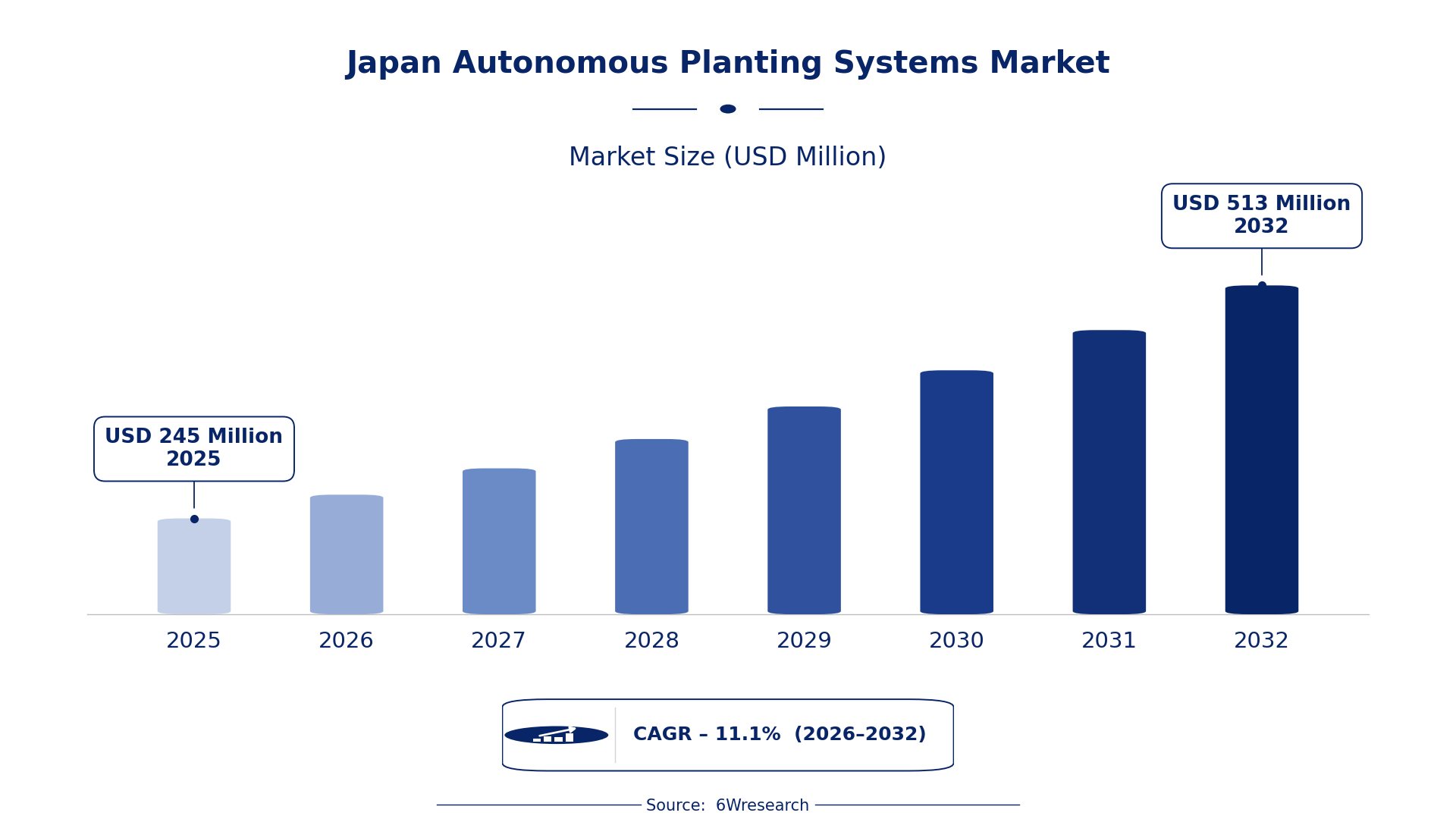
According to 6Wresearch internal database and industry insights, the Japan Autonomous Planting Systems Market was valued at USD 245 Million in 2025 and is projected to reach USD 513 Million by 2032, growing at a CAGR of approximately 11.1% during 2026–2032.
Japan Autonomous Planting Systems Market Highlights
| Report Metric | Details |
| Report Name | Japan Autonomous Planting Systems Market (2026-2032) |
| Market Size 2025 | USD 245 Million |
| Market Size 2032 | USD 513 Million |
| Absolute Growth 2025–2032 | USD 268 Million |
| CAGR 2026–2032 | 11.1% |
| Peak Annual Growth | 12.6% in 2032 |
| Forecast Period | 2026–2032 |
| Historical Data | 2022–2025 |
| Base Year | 2025 |
| Leading System Type, 2025 | Precision Seeders (38% share) |
| Leading Power Source, 2025 | Electric/Battery (40% share) |
| Leading Crop Type, 2025 | Cereals (48% share) |
| Leading Technology Used, 2025 | GPS + AI Mapping (38% share) |
| Leading Operational Mode, 2025 | Fully Autonomous (49% share) |
| Fastest-Growing System Type | AI-Driven Seeder Robots (17.0% CAGR) |
| Fastest-Growing Power Source | Solar Hybrid (17.5% CAGR) |
| Fastest-Growing Crop Type | Pulses (15.4% CAGR) |
| Fastest-Growing Technology Used | AI + Cloud (12.6% CAGR) |
| Growing Sector | Fully Autonomous |
| Key End Users | Fully Autonomous, Semi-Automated, Remote Operated, Swarm Mode |
Japan Autonomous Planting Systems Market Year-wise Growth Rate and Key Drivers (2022–2032)
This graph illustrates the annual growth rates of the market from 2022 to 2032, highlighting a steady upward trajectory and projected market expansion over the forecast period.
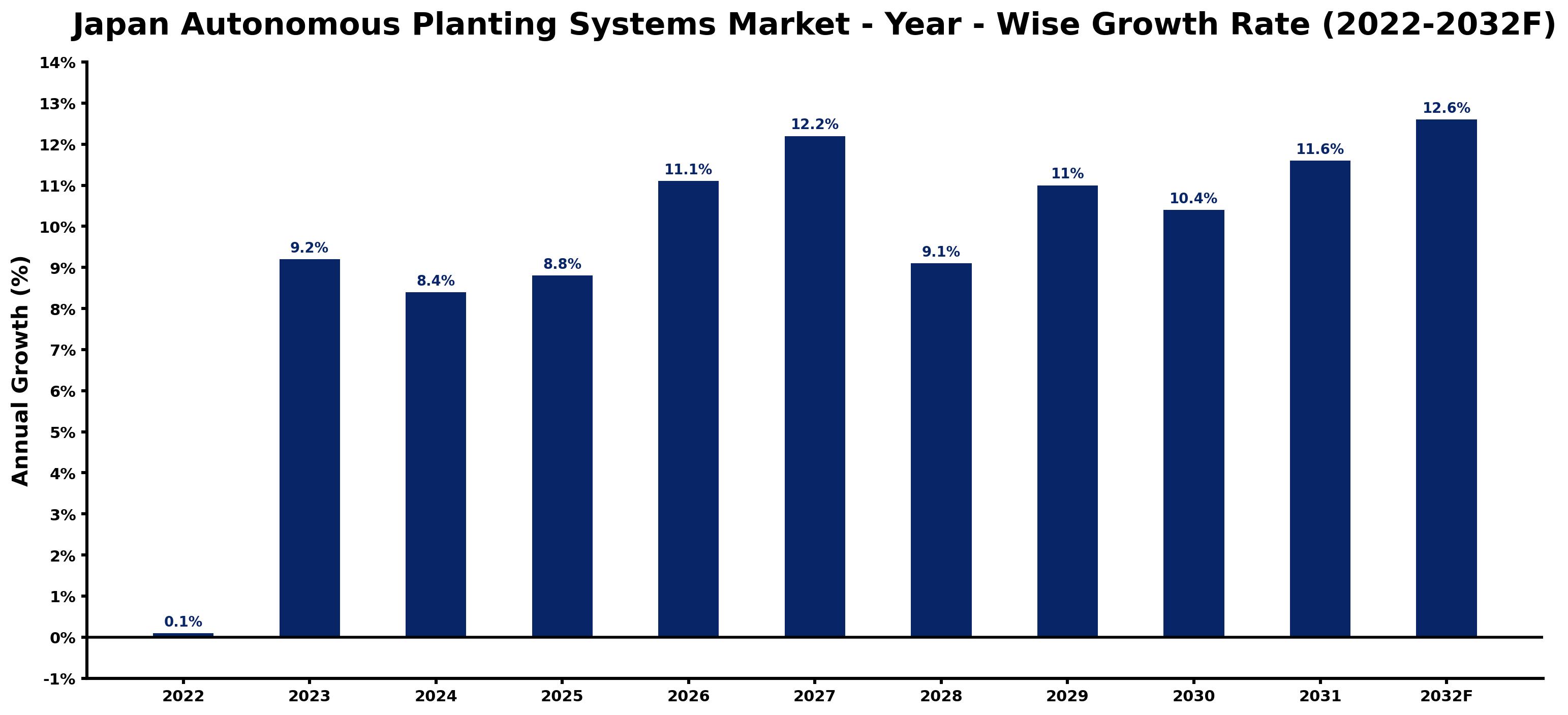
Annual growth estimates for each year appear below with the principal reason behind them, explaining the shifts that set the pace of the market.
| Year | Estimated Annual Growth (%) | Market Rationale |
| 2022 | 0.1 | The agricultural sector was adapting to new technologies and practices. |
| 2023 | 9.2 | Demand surged as farmers sought efficiency in planting operations. |
| 2024 | 8.4 | Adoption slowed slightly as farmers adjusted to new systems. |
| 2025 | 8.8 | Interest grew again as more farmers embraced automation. |
| 2026 | 11.1 | Investment in technology is expected to increase, driving higher demand for systems. |
| 2027 | 12.2 | Rising awareness of sustainability will boost system adoption further. |
| 2028 | 9.1 | Growth is projected to moderate as market saturation begins to set in. |
| 2029 | 11.0 | Demand is expected to accelerate again due to advancements in technology. |
| 2030 | 10.4 | Growth will slow as the market stabilises with established players. |
| 2031 | 11.6 | Innovations in AI technology will spur renewed interest in systems. |
| 2032 | 12.6 | The market is projected to peak as autonomous systems become mainstream. |
Note: Market size estimations and growth projections presented in this report are based on 6Wresearch's proprietary forecasting methodology, utilizing the latest available industry data, government publications, and primary research inputs.
Japan Autonomous Planting Systems Market Synopsis
Autonomous Planting Systems are advanced agricultural technologies that utilise robotics and AI for planting crops, improving efficiency and crop yields. The Japan Autonomous Planting Systems Market is projected to grow, driven by increasing demand from domestic farmers seeking innovative solutions, with the agricultural technology market valued at approximately 2 billion USD in 2023. Factors such as precision seeders being used in over 30% of rice cultivation and a subsidy program for farmers adopting these systems further propel this growth.
Market Dynamics Impact Analysis (2026–2032)
| Factor | Type | Impact | Primary Segment Affected |
| Rising demand for efficient agricultural practices among domestic farmers | Driver | High | Precision Seeders |
| Technological advancements in AI and robotics enhancing planting accuracy | Driver | High | AI-Driven Seeder Robots |
| Growing interest in sustainable farming practices among farmers | Opportunity | Medium | Electric/Battery |
| Increased investment in agricultural technology by public and private sectors | Opportunity | High | Multi-Row Planting Units |
| High initial costs of autonomous planting systems for farmers | Restraint | High | AI-Driven Seeder Robots |
| Limited awareness of autonomous systems' benefits among traditional farmers | Restraint | Medium | Precision Seeders |
| Challenges in integrating new technologies into existing farming practices | Challenge | High | Multi-Row Planting Units |
| Competition from traditional planting methods still prevalent in rural areas | Challenge | Medium | Compact Planting Drones |
Evaluation of Drivers in Japan Autonomous Planting Systems Market (2026–2032)
These are the developments adding the most demand over the forecast period.
| Drivers | Primary Segment Affected | Why It Matters (Evidence) |
| Rising adoption of precision seeders | Precision Seeders | These systems enhance planting accuracy, with over 30% usage in rice cultivation, encouraging more farmers to invest. |
| Increased investment in sustainable practices | Electric/Battery | Electric-powered systems are favoured for their environmental benefits, aligning with Japan's goal for a 46% reduction in greenhouse gas emissions by 2030. |
| Growing demand for AI-driven solutions | AI-Driven Seeder Robots | AI-driven robots automate planting, accounting for 25% of the market, which boosts operational efficiency for farmers. |
| Expansion of smart agriculture initiatives | GPS + AI Mapping | The government promotes smart agriculture, leading to a 15% increase in smart sensor adoption, enhancing planting efficiency. |
| Support from agricultural innovation programs | Multi-Row Planting Units | The Ministry of Agriculture promotes advanced technologies, increasing the efficiency of multi-row planting systems among diversified farmers. |
Spending rises because the Tohoku region is increasingly adopting autonomous planting technologies, with precision seeders used in over 30% of rice cultivation. The agricultural sector employs 1.5 million people as of 2023, driving demand for efficient planting solutions. The average farm size of about 1.5 hectares influences technology adoption, as farmers seek to maximise productivity. Investment in sustainable practices is also rising, aligning with Japan's target for a 46% cut in greenhouse-gas emissions by 2030. The integration of RTK positioning technology improves precision in farming, ensuring higher crop yields for buyers.
Evaluation of Restraints in Japan Autonomous Planting Systems Market
The main factors holding the market back are set out below.
| Market Restraint | Primary Segment Affected | Why It Matters (Evidence) |
| High initial investment costs for advanced systems | Precision Seeders | Costs can exceed JPY 10 million, delaying adoption for small-scale farmers. |
| Limited access to advanced technologies in rural areas | AI-Driven Seeder Robots | Many farmers lack the resources to invest in autonomous solutions. |
| Skills shortages in operating advanced systems | Multi-Row Planting Units | Only 25% of farmers currently use AI-driven seeder robots, limiting efficiency. |
| Competition from traditional farming methods | Electric/Battery | Some farmers prefer established methods due to familiarity and lower costs. |
| Market saturation affecting new investments | GPS + AI Mapping | As adoption increases, fewer new buyers enter the market. |
Japan Autonomous Planting Systems Market Challenges
In 2023, precision seeders are used in over 30% of rice cultivation, yet many farms still lack access to autonomous planting technologies. High initial investment costs, exceeding JPY 10 million for advanced systems, hinder adoption for small-scale farmers. As Japan's agricultural workforce declines to 1.5 million, buyers face escalating labour costs, prompting them to seek automation solutions. Skills shortages arise as only 25% of farmers utilise AI-driven seeder robots, limiting operational efficiency and crop yield improvements for producers.
Trends in the Japan Autonomous Planting Systems Market
Below are the shifts with the largest effect on the Japan Autonomous Planting Systems Market.
- Shift in Adoption from Traditional to Autonomous Systems: Farmers in the Tohoku region are increasingly adopting autonomous planting technologies, with a 15% rise in smart sensor usage from 2022 to 2023. This shift reflects a growing acceptance of technology in agriculture.
- Transition from Diesel to Electric Power Sources: Electric-powered planting systems are gaining traction, with a 40% market share expected by 2025. This trend illustrates a broader commitment to sustainability in Japan's agricultural practices.
- Emergence of AI-Driven Solutions in Vegetable Farming: AI-driven seeder robots are becoming more prevalent, accounting for 25% of the market in 2023. This trend shows the increasing reliance on technology to improve efficiency in vegetable production.
- Growing Interest in Multi-Crop Planting Systems: Multi-crop planting systems are gaining popularity among diversified farmers, with a notable increase in adoption rates. This trend underscores the demand for versatility in planting solutions.
Investment Opportunities in the Japan Autonomous Planting Systems Market
The following areas offer the clearest openings for investors and suppliers in the Japan Autonomous Planting Systems Market.
- Current Demand for Sustainable Solutions: With Japan targeting a 46% reduction in greenhouse-gas emissions by 2030, there is an opportunity to invest in electric-powered planting systems. Farmers in the Tohoku region are actively pursuing these solutions.
- Investment in Precision Agriculture Technologies: The agricultural technology market, valued at approximately 2 billion USD in 2023, offers opportunities for suppliers of advanced planting systems. Collaborating with local agricultural associations can facilitate market entry.
- Growing Need for Automation in Small Farms: As small-scale farmers confront labour shortages, the demand for autonomous planting systems is increasing. Engaging with farmer cooperatives can open new avenues for suppliers.
- Expansion of Smart Sensor Applications: The rising adoption of smart sensors in agriculture, with a 15% increase in usage from 2022 to 2023, indicates a market gap. Suppliers can explore partnerships with technology developers to address this demand.
Government Initiatives in the Japan Autonomous Planting Systems Market
The Green Growth Strategy Through Achieving Carbon Neutrality in 2050, updated in 2021, identifies growth sectors including agriculture. This policy encourages the adoption of advanced technologies such as autonomous planting systems, supporting innovation in the sector.
The Ministry of Agriculture, Forestry and Fisheries oversees agricultural innovation programs, approving funding for projects that improve efficiency in farming. In 2023, the updated GX Basic Policy aims to support sustainable agricultural practices through various initiatives.
Future Insight of the Japan Autonomous Planting Systems Market
Technological advancements will reshape the agricultural sector by 2032, with electric-powered planting systems becoming more prevalent due to their low environmental impact. The updated 'National Strategy for Agricultural Robotics' will drive innovation, enabling suppliers to deliver improved solutions. With JPY 150 trillion allocated for decarbonisation investments, buyers will benefit from enhanced planting efficiency. Adoption of smart sensors will increase, allowing farmers to optimise crop yields and streamline operations.
Market Segmentation Analysis
Japan Autonomous Planting Systems Market report covers a detailed analysis of the following market segments:
By System Type – Precision Seeders Lead, AI-Driven Seeder Robots Expected to Grow Fastest
According to Saurav Kr Singh, Senior Research Analyst at 6Wresearch, Precision Seeders accounted for 38% of the market by system type in 2025. Precision seeders dominate the market due to their tailored design for accurate seed placement, which is crucial for maximising crop yields. Their extensive application in over 30% of rice cultivation in Japan underscores their importance in the agricultural landscape. AI-Driven Seeder Robots are set to record the highest CAGR in this split, 17.0% over 2026–2032. AI-driven seeder robots are gaining momentum as they automate the planting process, which significantly improves operational efficiency. Their adoption in vegetable farming, where they account for 25% of the market, suggests a robust growth trajectory that will likely expand further. Suppliers must invest in advanced features for seeder robots to meet the rising demand in the market.
By Power Source – Electric/Battery Leads, Solar Hybrid Expected to Grow Fastest
With 40% of power source revenue in 2025, Electric/Battery was the largest category. Electric-powered systems lead the market as they align with Japan's sustainability goals, making them the preferred choice for many autonomous planting technologies. Their contribution to environmentally friendly practices has been crucial for widespread acceptance and use. Over 2026–2032, Solar Hybrid is expected to post the fastest growth, at a CAGR of 17.5%. Solar hybrid systems are emerging as a rapidly growing segment, propelled by the increasing focus on renewable energy solutions in agriculture. Despite challenges posed by variable solar conditions, their potential for enhancing sustainability is becoming more recognised. Buyers should consider solar hybrid options to support their sustainability initiatives in agricultural practices.
By Crop Type – Cereals Lead, Pulses Expected to Grow Fastest
In 2025, Cereals led the crop type split with a 48% share. Cereals represent 45% of Japan's total crop area, establishing them as the primary crop type for autonomous planting systems. This significant area illustrates the demand for efficient planting technologies specifically designed for cereal cultivation. The quickest growth will come from Pulses, forecast to expand at a CAGR of 15.4% between 2026 and 2032. Pulses are increasingly being planted with autonomous systems as farmers pursue more efficient planting methods. This trend reflects a growing interest in diversifying crop production and enhancing agricultural efficiency in Japan. Suppliers should develop tailored solutions for pulse cultivation to address the evolving needs of farmers.
By Technology Used – GPS + AI Mapping Leads, AI + Cloud Expected to Grow Fastest
The largest technology used category in 2025 was GPS + AI Mapping, at 38% of revenue. GPS and mapping technologies are vital for precise location tracking and planting, making them the leading technology in autonomous planting systems. Their integration ensures high accuracy, which is essential for optimising agricultural productivity. AI + Cloud is projected to grow fastest, at a CAGR of 12.6% during 2026–2032. AI and cloud technologies are gaining traction as they facilitate effective data analysis and enhance operational efficiency in planting. This trend indicates a shift towards more data-centric practices in agriculture, which will continue to grow. Investing in AI and cloud capabilities will be crucial for suppliers aiming to maintain competitiveness in the market.
By Operational Mode – Fully Autonomous Leads and Records the Fastest Growth
Fully Autonomous held 49% of the Japan Autonomous Planting Systems Market by operational mode in 2025. Fully autonomous systems lead the market as they represent the forefront of planting technology, offering farmers high efficiency and reduced labour costs. Their advanced features are driving widespread adoption among progressive agricultural operations. Its lead should widen, with a projected CAGR of 12.3% during 2026–2032, the highest in this split. As fully autonomous systems continue to dominate, their lead will only widen due to ongoing technological advancements and increasing acceptance among farmers. This trend ensures they remain central to agricultural innovation. Suppliers should prioritise the development of fully autonomous solutions to address the growing market demand.
Key Attractiveness of the Report
- 10 Years of Market Numbers
- Historical Data Starting from 2022 to 2025
- Base Year 2025
- Forecast Data until 2032
- Key Performance Indicators Impacting the Market
- Major Upcoming Developments and Projects
Key Highlights of the Report:
- Japan Autonomous Planting Systems Market Outlook
- Market Size of Japan Autonomous Planting Systems Market, 2025
- Forecast of Japan Autonomous Planting Systems Market, 2032
- Historical Data and Forecast of Japan Autonomous Planting Systems Revenues & Volume for the Period 2022-2032F
- Japan Autonomous Planting Systems Market Trend Evolution
- Japan Autonomous Planting Systems Market Drivers and Challenges
- Japan Autonomous Planting Systems Price Trends
- Japan Autonomous Planting Systems Porter's Five Forces
- Japan Autonomous Planting Systems Industry Life Cycle
- Historical Data and Forecast of Japan Autonomous Planting Systems Market Revenues & Volume By System Type for the Period 2022-2032F
- Historical Data and Forecast of Japan Autonomous Planting Systems Market Revenues & Volume By Precision Seeders for the Period 2022-2032F
- Historical Data and Forecast of Japan Autonomous Planting Systems Market Revenues & Volume By Multi-Row Planting Units for the Period 2022-2032F
- Historical Data and Forecast of Japan Autonomous Planting Systems Market Revenues & Volume By Compact Planting Drones for the Period 2022-2032F
- Historical Data and Forecast of Japan Autonomous Planting Systems Market Revenues & Volume By AI-Driven Seeder Robots for the Period 2022-2032F
- Historical Data and Forecast of Japan Autonomous Planting Systems Market Revenues & Volume By Power Source for the Period 2022-2032F
- Historical Data and Forecast of Japan Autonomous Planting Systems Market Revenues & Volume By Electric/Battery for the Period 2022-2032F
- Historical Data and Forecast of Japan Autonomous Planting Systems Market Revenues & Volume By Diesel/Electric for the Period 2022-2032F
- Historical Data and Forecast of Japan Autonomous Planting Systems Market Revenues & Volume By Battery for the Period 2022-2032F
- Historical Data and Forecast of Japan Autonomous Planting Systems Market Revenues & Volume By Solar Hybrid for the Period 2022-2032F
- Historical Data and Forecast of Japan Autonomous Planting Systems Market Revenues & Volume By Crop Type for the Period 2022-2032F
- Historical Data and Forecast of Japan Autonomous Planting Systems Market Revenues & Volume By Cereals for the Period 2022-2032F
- Historical Data and Forecast of Japan Autonomous Planting Systems Market Revenues & Volume By Pulses for the Period 2022-2032F
- Historical Data and Forecast of Japan Autonomous Planting Systems Market Revenues & Volume By Vegetables for the Period 2022-2032F
- Historical Data and Forecast of Japan Autonomous Planting Systems Market Revenues & Volume By Multi-Crop for the Period 2022-2032F
- Historical Data and Forecast of Japan Autonomous Planting Systems Market Revenues & Volume By Technology Used for the Period 2022-2032F
- Historical Data and Forecast of Japan Autonomous Planting Systems Market Revenues & Volume By GPS + AI Mapping for the Period 2022-2032F
- Historical Data and Forecast of Japan Autonomous Planting Systems Market Revenues & Volume By RTK Positioning for the Period 2022-2032F
- Historical Data and Forecast of Japan Autonomous Planting Systems Market Revenues & Volume By AI + Cloud for the Period 2022-2032F
- Historical Data and Forecast of Japan Autonomous Planting Systems Market Revenues & Volume By Smart Sensors for the Period 2022-2032F
- Historical Data and Forecast of Japan Autonomous Planting Systems Market Revenues & Volume By Operational Mode for the Period 2022-2032F
- Historical Data and Forecast of Japan Autonomous Planting Systems Market Revenues & Volume By Fully Autonomous for the Period 2022-2032F
- Historical Data and Forecast of Japan Autonomous Planting Systems Market Revenues & Volume By Semi-Automated for the Period 2022-2032F
- Historical Data and Forecast of Japan Autonomous Planting Systems Market Revenues & Volume By Swarm Mode for the Period 2022-2032F
- Historical Data and Forecast of Japan Autonomous Planting Systems Market Revenues & Volume By Remote Operated for the Period 2022-2032F
- Japan Autonomous Planting Systems Import Export Trade Statistics
- Market Opportunity Assessment By System Type
- Market Opportunity Assessment By Power Source
- Market Opportunity Assessment By Crop Type
- Market Opportunity Assessment By Technology Used
- Market Opportunity Assessment By Operational Mode
- Japan Autonomous Planting Systems Top Companies Market Share
- Japan Autonomous Planting Systems Competitive Benchmarking By Technical and Operational Parameters
- Japan Autonomous Planting Systems Company Profiles
- Japan Autonomous Planting Systems Key Strategic Recommendations
Market Covered
Coverage by segment is as follows.
By System Type
- Precision Seeders
- Multi-Row Planting Units
- Compact Planting Drones
- AI-Driven Seeder Robots
By Power Source
- Electric/Battery
- Diesel/Electric
- Battery
- Solar Hybrid
By Crop Type
- Cereals
- Pulses
- Vegetables
- Multi-Crop
By Technology Used
- GPS + AI Mapping
- RTK Positioning
- AI + Cloud
- Smart Sensors
By Operational Mode
- Fully Autonomous
- Semi-Automated
- Swarm Mode
- Remote Operated






































