Japan Aviation Headsets Market Size & Growth Rate
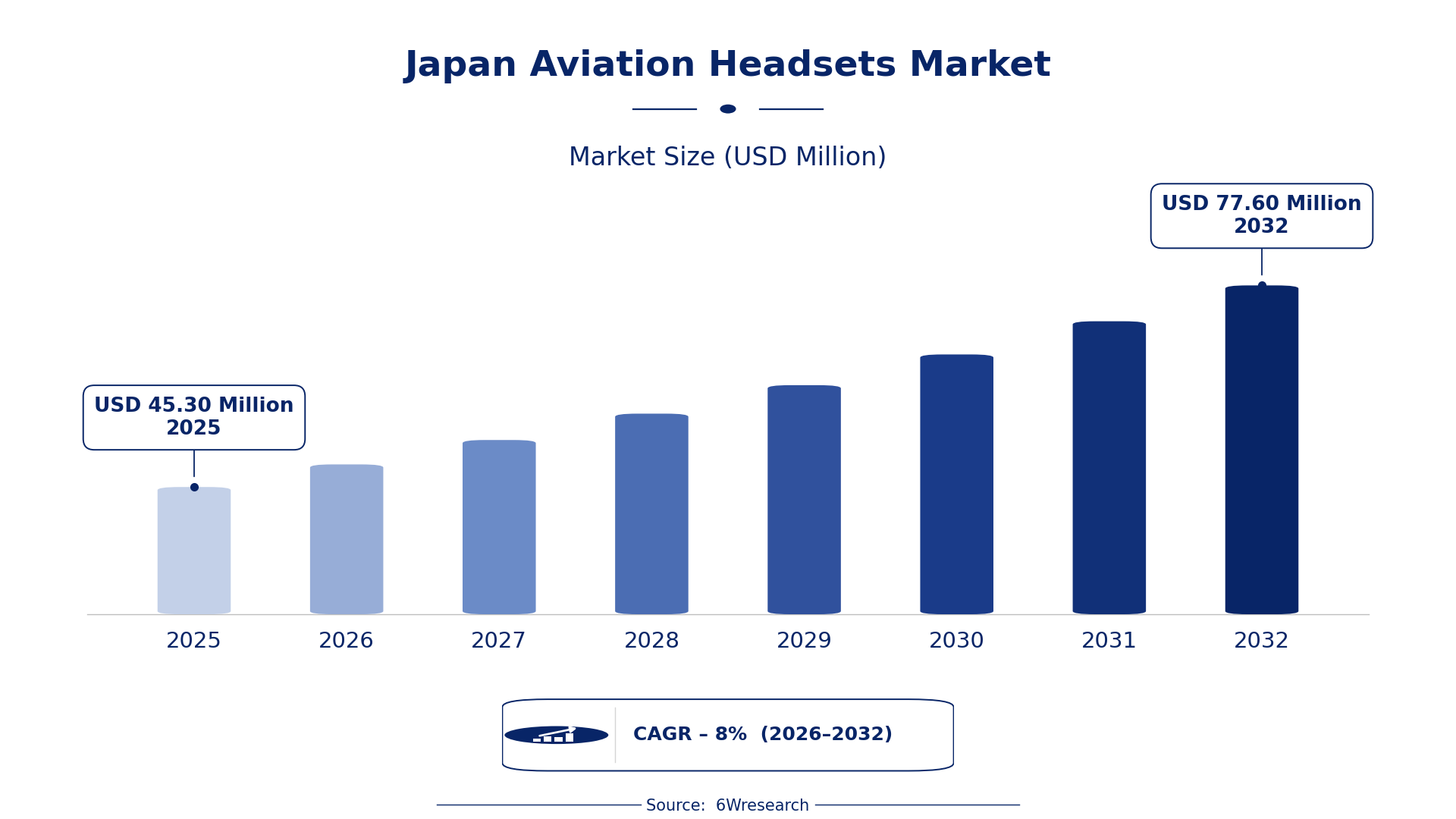
According to 6Wresearch internal database and industry insights, the Japan Aviation Headsets Market was valued at USD 45.30 Million in 2025 and is projected to reach USD 77.60 Million by 2032, growing at a CAGR of approximately 8% during 2026–2032.
Japan Aviation Headsets Market Highlights
| Report Metric | Details |
| Report Name | Japan Aviation Headsets Market (2026-2032) |
| Market Size 2025 | USD 45.30 Million |
| Market Size 2032 | USD 77.60 Million |
| Absolute Growth 2025–2032 | USD 32.30 Million |
| CAGR 2026–2032 | 8% |
| Peak Annual Growth | 8.6% in 2026 |
| Forecast Period | 2026–2032 |
| Historical Data | 2022–2025 |
| Base Year | 2025 |
| Leading Noise Cancellation Mode, 2025 | Active Noise Reduction (ANR)Aviation Headsets (67% share) |
| Leading Design Type, 2025 | On-Ear (54% share) |
| Leading Application, 2025 | Commercial Aviation (45% share) |
| Fastest-Growing Noise Cancellation Mode | Passive Noise Reduction (PNR) Aviation Headsets (9.9% CAGR) |
| Fastest-Growing Design Type | In-Ear (10.7% CAGR) |
| Fastest-Growing Application | Military Aviation (10.8% CAGR) |
| Growing Sector | Commercial Aviation |
| Key End Users | Flight Schools, Military Aviation, Commercial Airlines |
Japan Aviation Headsets Market Year-wise Growth Rate and Key Drivers (2022–2032)
This graph illustrates the annual growth rates of the market from 2022 to 2032, highlighting a steady upward trajectory and projected market expansion over the forecast period.
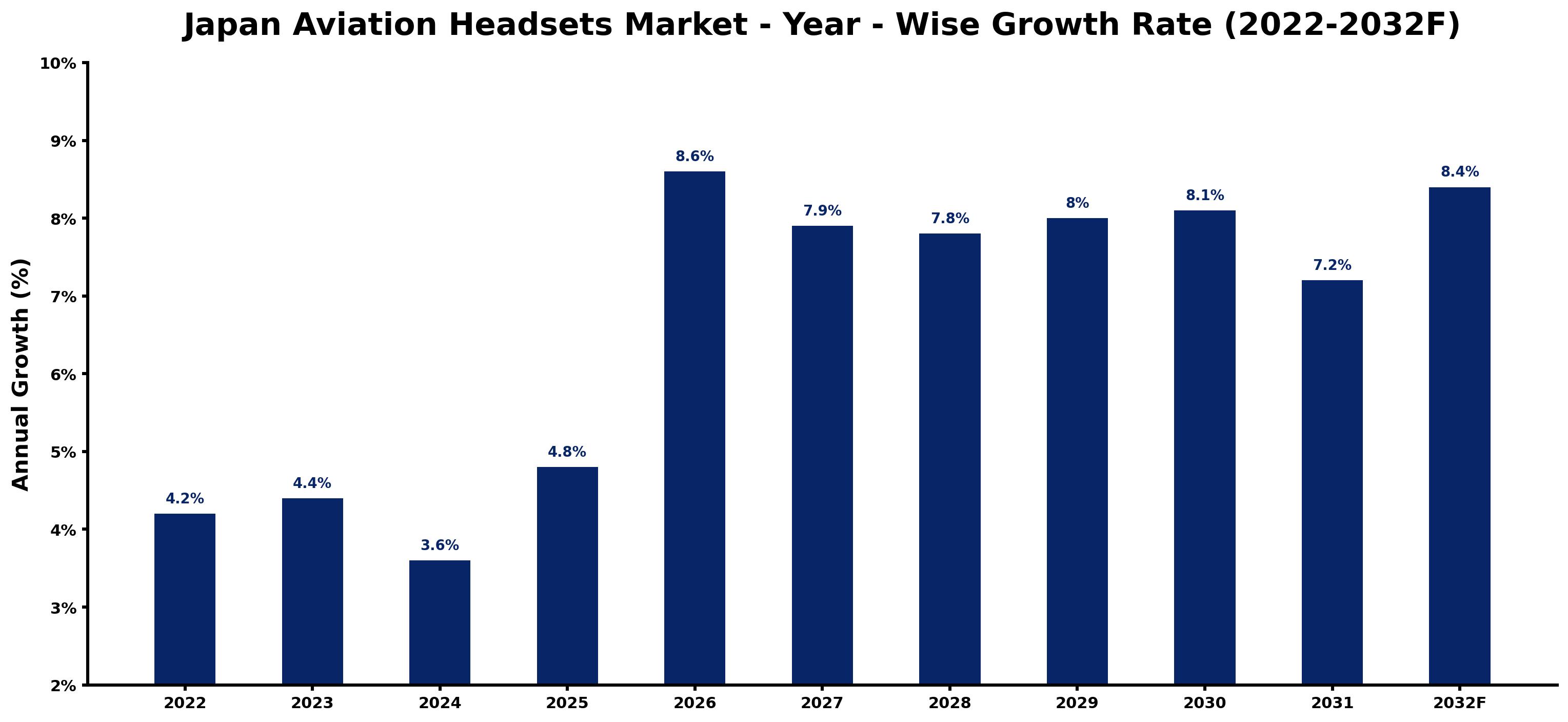
The yearly estimates that follow link every growth rate to its principal driver, so readers can see why the pace changed in each period.
| Year | Estimated Annual Growth (%) | Market Rationale |
| 2022 | 4.2 | The aviation industry employed over 300,000 people, supporting headset demand. |
| 2023 | 4.4 | Growth was driven by increased pilot training programs at approximately 100 flight schools. |
| 2024 | 3.6 | Demand growth slowed as the market adjusted to new safety standards. |
| 2025 | 4.8 | The market saw faster growth due to heightened safety measures in aviation. |
| 2026 | 8.6 | Active Noise Reduction headsets gained traction, improving communication clarity in flight. |
| 2027 | 7.9 | Demand growth is expected to slow as the market stabilises after rapid adoption of new technologies. |
| 2028 | 7.8 | The market is projected to continue growing as training efficiency programmes are implemented. |
| 2029 | 8.0 | Increased military spending is expected to boost demand for military aviation headsets. |
| 2030 | 8.1 | Continued investment in aviation safety is projected to keep demand strong for headsets. |
| 2031 | 7.2 | Growth is expected to slow as the market matures and competition intensifies. |
| 2032 | 8.4 | Demand is expected to rise as new aviation technologies are adopted. |
Note: Market size estimations and growth projections presented in this report are based on 6Wresearch's proprietary forecasting methodology, utilizing the latest available industry data, government publications, and primary research inputs.
Japan Aviation Headsets Market Synopsis
Aviation headsets are specialised communication devices designed for pilots, utilising advanced materials and noise cancellation technology to ensure clear communication in noisy environments. Factors behind this growth include heightened safety measures, substantial investment in pilot training, and the adoption of advanced headset technologies, particularly Active Noise Reduction systems.
Market Dynamics Impact Analysis (2026–2032)
| Factor | Type | Impact | Primary Segment Affected |
| Increased pilot training programmes | Driver | High | Flight Schools |
| Growing military spending | Driver | High | Military Aviation |
| Investment in aviation safety technologies | Opportunity | High | Commercial Aviation |
| Rising demand for Active Noise Reduction headsets | Opportunity | High | Active Noise Reduction (ANR)Aviation Headsets |
| Competition from alternative communication devices | Restraint | Medium | Active Noise Reduction (ANR)Aviation Headsets |
| High production costs for advanced headsets | Restraint | Medium | Active Noise Reduction (ANR)Aviation Headsets |
| Shortage of skilled workforce in aviation | Challenge | High | Flight Schools |
| Regulatory compliance costs for manufacturers | Challenge | High | Active Noise Reduction (ANR)Aviation Headsets |
Evaluation of Drivers in Japan Aviation Headsets Market (2026–2032)
The factors lifting demand, and the evidence behind each, are summarised below.
| Drivers | Primary Segment Affected | Why It Matters (Evidence) |
| Increased pilot training | Flight Schools | With approximately 100 flight schools, demand for headsets rises as more pilots are trained. |
| Military expenditure | Military Aviation | Japan's Self-Defense Forces drive demand for military headsets, increasing purchases for operations. |
| Safety regulations | Commercial Aviation | Heightened safety protocols require reliable communication, boosting headset demand among airlines. |
| Technological advancements | Active Noise Reduction (ANR)Aviation Headsets | Adoption of ANR technology improves communication clarity, leading to higher purchases by pilots. |
| Market expansion | Active Noise Reduction (ANR)Aviation Headsets | The aviation industry's growth, employing over 300,000 people, supports rising headset demand. |
What keeps demand rising is the increase in pilot training, with around 100 flight schools enhancing the need for reliable communication devices. Military spending is driving demand for headsets, particularly in operations where effective communication is critical. The growth of the aviation industry, employing over 300,000 people, supports increasing purchases of headsets, particularly those featuring Active Noise Reduction technology.
Evaluation of Restraints in Japan Aviation Headsets Market
The following restraints limit how fast demand can grow.
| Market Restraint | Primary Segment Affected | Why It Matters (Evidence) |
| Competition from alternative communication devices | Active Noise Reduction (ANR)Aviation Headsets | The emergence of alternative devices may divert purchases away from aviation headsets, impacting sales. |
| High production costs for advanced headsets | Active Noise Reduction (ANR)Aviation Headsets | Manufacturers face increased costs in producing advanced headsets, which can limit pricing flexibility. |
| Limited market awareness of benefits | Active Noise Reduction (ANR)Aviation Headsets | Some potential buyers remain unaware of the advantages of ANR technology, hindering sales. |
| Regulatory compliance challenges | Active Noise Reduction (ANR)Aviation Headsets | Manufacturers must navigate complex regulations, adding costs and delays to product launches. |
| Shortage of skilled workforce | Flight Schools | A lack of qualified trainers can slow the growth of pilot training programs, affecting headset demand. |
Japan Aviation Headsets Market Challenges
In Japan, outdated technology affects communication clarity for pilots, which can lead to safety risks in aviation operations. Buyers at flight schools face delays in training due to a shortage of reliable headsets, potentially extending program durations by three months. Rising costs of advanced materials for production pressure suppliers, forcing price increases of 15%, which impacts buyers' budgets. Supply chain disruptions can delay headset deliveries, causing operational inefficiencies for aviation personnel who depend on timely access to communication devices.
Trends in the Japan Aviation Headsets Market
The shifts below are changing how Japan Aviation Headsets Market products are bought and supplied.
- Shift towards Active Noise Reduction Technology: The adoption of Active Noise Reduction technology is increasing among commercial pilots. In 2022, this segment saw a rise in demand, reflecting a growing preference for advanced headsets.
- Growing Focus on Aviation Safety Standards: In 2023, Japan's aviation industry emphasised safety improvements, leading to increased headset purchases. The government allocated ¥5 billion for aviation safety, boosting demand for compliant headsets.
- Expansion of Pilot Training Programs: The number of flight schools in Japan is increasing, with around 100 institutions offering training. This growth is driving demand for aviation headsets, as more pilots require reliable communication tools.
- Military Aviation Demand Surge: Military aviation is experiencing heightened demand for headsets, with a projected CAGR of 10.8% from 2026-2032. This trend is driven by increased military spending and operational needs.
Investment Opportunities in the Japan Aviation Headsets Market
Several openings in the Japan Aviation Headsets Market merit attention from investors.
- Active Noise Reduction Aviation Headsets: The demand for Active Noise Reduction headsets is rising, with a projected market size of USD 77.60 million by 2032. Suppliers can target flight schools to meet this growing need.
- Investment in Pilot Training: With the government allocating ¥5 billion for aviation safety, there is an opportunity to supply headsets to training programmes. Partnering with flight schools can facilitate market entry.
- Military Aviation Headsets: The military segment is expanding, presenting a chance to invest in headsets tailored for military operations. Collaborating with defence contractors can enhance market access.
- Commercial Aviation Growth: The commercial aviation sector is projected to grow, creating opportunities for headset suppliers. Focusing on the Tokyo Metropolitan Area can provide strategic advantages.
Government Initiatives in the Japan Aviation Headsets Market
Japan's aviation regulations are shaped by the Industrial Standardization Act of 1949, which governs product standards. This law ensures that aviation headsets meet safety and performance criteria, impacting manufacturers and buyers alike. The Act on Japanese Industrial Standards, amended in 2019, further refines these requirements, promoting quality in aviation equipment.
The Consumer Affairs Agency oversees compliance with regulations regarding product representations. This agency ensures that aviation headsets meet established safety standards, protecting buyers and enhancing market trust. By enforcing these regulations, the agency helps maintain quality in the aviation headset market.
Future Insight of the Japan Aviation Headsets Market
By 2032, the government will allocate ¥5 billion for aviation safety improvements, creating demand for advanced headsets. Enhanced pilot training efficiency programs will require more reliable communication devices across training facilities. Research initiatives by the Japan Aerospace Exploration Agency will drive technological advancements in headset design. The Tokyo International Air Show will continue to showcase innovations, influencing buyer preferences towards higher-quality aviation headsets.
Market Segmentation Analysis
Japan Aviation Headsets Market report covers a detailed analysis of the following market segments:
By Noise Cancellation Mode – Active Noise Reduction (ANR)Aviation Headsets Lead, Passive Noise Reduction (PNR) Aviation Headsets Expected to Grow Fastest
According to Sumit Sagar, AM at 6Wresearch, Active Noise Reduction (ANR)Aviation Headsets accounted for 67% of the market by noise cancellation mode in 2025. Active Noise Reduction headsets dominate the market as they provide essential noise cancellation, crucial for maintaining clear communication in the demanding environments of commercial aviation. Their usage is particularly prevalent in the Tokyo Metropolitan Area, where stringent safety regulations necessitate high-quality communication devices. Passive Noise Reduction (PNR) Aviation Headsets are set to record the highest CAGR in this split, 9.9% over 2026–2032. The growth of Passive Noise Reduction headsets is fuelled by their affordability and effectiveness in less noisy settings, making them appealing to a wider range of users. As the aviation industry expands, the demand for these cost-effective alternatives is projected to rise. Suppliers should focus on diversifying their product features to cater to the distinct needs of different user segments.
By Design Type – On-Ear Leads, In-Ear Expected to Grow Fastest
The largest design type category in 2025 was On-Ear, at 54% of revenue. On-Ear headsets command the largest share due to their comfort during prolonged use, which is essential for pilots on lengthy flights. Their widespread use in commercial aviation highlights their role in ensuring pilot comfort and focus during operations. Over 2026–2032, In-Ear is expected to post the fastest growth, at a CAGR of 10.7%. In-Ear headsets are seeing rapid growth owing to their compact design and potential for better noise isolation. As users increasingly prefer lightweight alternatives, demand for these headsets is projected to rise. Manufacturers should consider developing more comfortable In-Ear options to capture a larger segment of the market.
By Application – Commercial Aviation Leads, Military Aviation Expected to Grow Fastest
Commercial Aviation held 45% of the Japan Aviation Headsets Market by application in 2025. Commercial Aviation is the leading application segment, encompassing a broad spectrum of operations that require reliable communication for both passenger and cargo flights. The substantial workforce of over 300,000 individuals in Japan's aviation sector underscores the critical need for effective communication tools in this area. Military Aviation is projected to grow fastest, at a CAGR of 10.8% during 2026–2032. Military Aviation is witnessing the fastest growth due to a heightened focus on communication efficiency within Japan's Self-Defense Forces. The government's ongoing initiatives to improve aviation safety further stimulate the demand for advanced headsets in military operations. Suppliers should customise their offerings to address the unique demands of military applications to capitalise on this growth opportunity.
Key Attractiveness of the Report
- 10 Years of Market Numbers
- Historical Data Starting from 2022 to 2025
- Base Year 2025
- Forecast Data until 2032
- Key Performance Indicators Impacting the Market
- Major Upcoming Developments and Projects
Key Highlights of the Report:
- Japan Aviation Headsets Market Outlook
- Market Size of Japan Aviation Headsets Market, 2025
- Forecast of Japan Aviation Headsets Market, 2032
- Historical Data and Forecast of Japan Aviation Headsets Revenues & Volume for the Period 2022-2032
- Japan Aviation Headsets Market Trend Evolution
- Japan Aviation Headsets Market Drivers and Challenges
- Japan Aviation Headsets Price Trends
- Japan Aviation Headsets Porter's Five Forces
- Japan Aviation Headsets Industry Life Cycle
- Historical Data and Forecast of Japan Aviation Headsets Market Revenues & Volume By Noise Cancellation Mode for the Period 2022-2032
- Historical Data and Forecast of Japan Aviation Headsets Market Revenues & Volume By Active Noise Reduction (ANR)Aviation Headsets for the Period 2022-2032
- Historical Data and Forecast of Japan Aviation Headsets Market Revenues & Volume By Passive Noise Reduction (PNR) Aviation Headsets) for the Period 2022-2032
- Historical Data and Forecast of Japan Aviation Headsets Market Revenues & Volume By Design Type for the Period 2022-2032
- Historical Data and Forecast of Japan Aviation Headsets Market Revenues & Volume By On-Ear for the Period 2022-2032
- Historical Data and Forecast of Japan Aviation Headsets Market Revenues & Volume By In-Ear for the Period 2022-2032
- Historical Data and Forecast of Japan Aviation Headsets Market Revenues & Volume By Application for the Period 2022-2032
- Historical Data and Forecast of Japan Aviation Headsets Market Revenues & Volume By Commercial Aviation for the Period 2022-2032
- Historical Data and Forecast of Japan Aviation Headsets Market Revenues & Volume By Military Aviation for the Period 2022-2032
- Historical Data and Forecast of Japan Aviation Headsets Market Revenues & Volume By Flight Schools for the Period 2022-2032
- Historical Data and Forecast of Japan Aviation Headsets Market Revenues & Volume By Helicopters for the Period 2022-2032
- Historical Data and Forecast of Japan Aviation Headsets Market Revenues & Volume By Recreational Activities for the Period 2022-2032
- Japan Aviation Headsets Import Export Trade Statistics
- Market Opportunity Assessment By Noise Cancellation Mode
- Market Opportunity Assessment By Design Type
- Market Opportunity Assessment By Application
- Japan Aviation Headsets Top Companies Market Share
- Japan Aviation Headsets Competitive Benchmarking By Technical and Operational Parameters
- Japan Aviation Headsets Company Profiles
- Japan Aviation Headsets Key Strategic Recommendations
Market Covered
This report examines the market across the segments below.
By Noise Cancellation Mode
- Active Noise Reduction (ANR)Aviation Headsets
- Passive Noise Reduction (PNR) Aviation Headsets
By Design Type
- On-Ear
- In-Ear
By Application
- Commercial Aviation
- Military Aviation
- Flight Schools
- Helicopters
- Recreational Activities






































