Japan Barcode Printer Market Size & Growth Rate
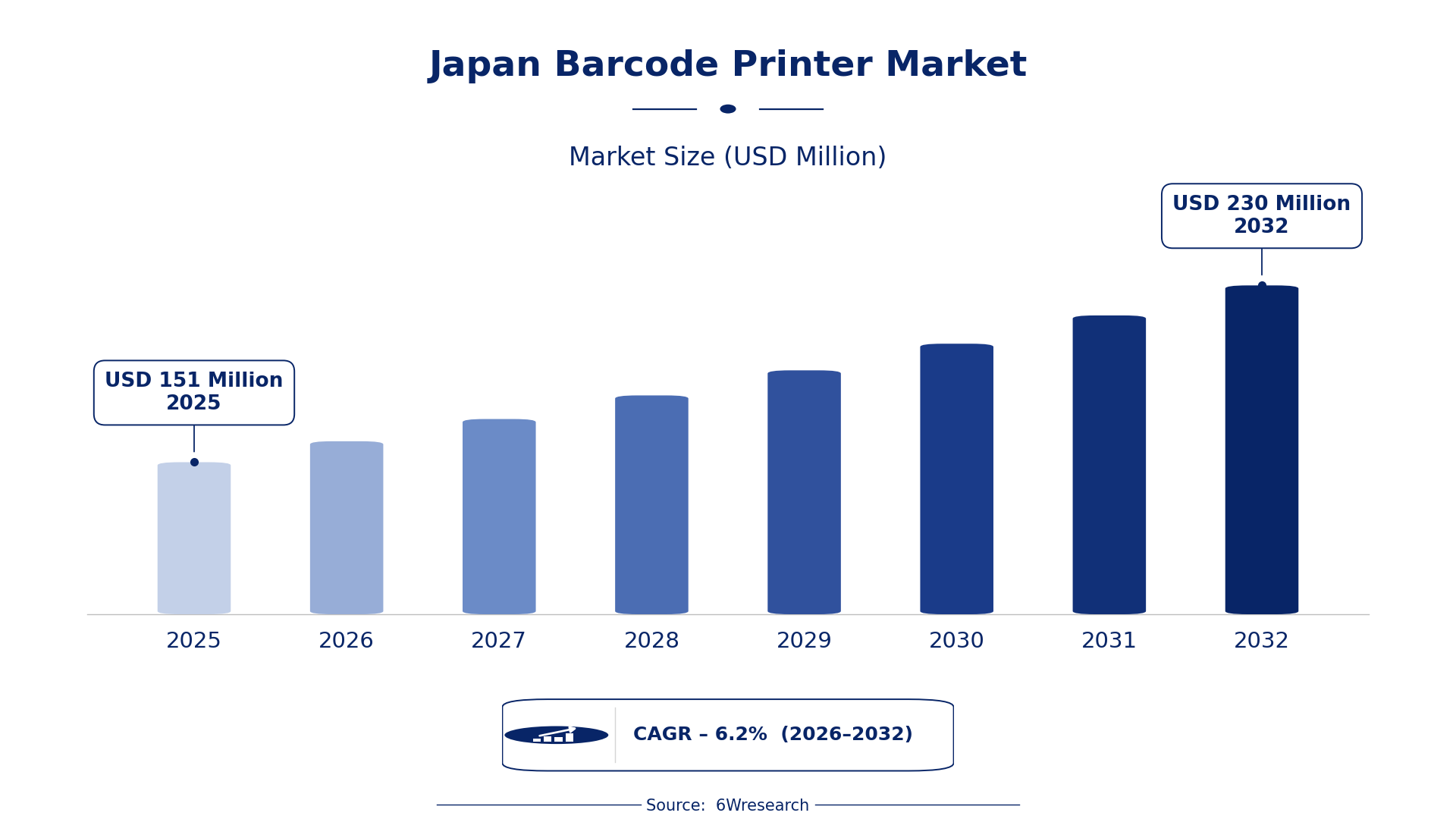
According to 6Wresearch internal database and industry insights, the Japan Barcode Printer Market was valued at USD 151 Million in 2025 and is projected to reach USD 230 Million by 2032, growing at a CAGR of approximately 6.2% during 2026–2032.
Japan Barcode Printer Market Highlights
| Report Metric | Details |
| Report Name | Japan Barcode Printer Market (2026-2032) |
| Market Size 2025 | USD 151 Million |
| Market Size 2032 | USD 230 Million |
| Absolute Growth 2025–2032 | USD 79 Million |
| CAGR 2026–2032 | 6.2% |
| Peak Annual Growth | 7.0% in 2028 |
| Forecast Period | 2026–2032 |
| Historical Data | 2022–2025 |
| Base Year | 2025 |
| Leading Product Type, 2025 | Desktop Printer (55% share) |
| Leading Printing Type, 2025 | Thermal Transfer (45% share) |
| Leading End-user Industry, 2025 | Manufacturing (41% share) |
| Fastest-Growing Product Type | Mobile Printer (8.9% CAGR) |
| Fastest-Growing Printing Type | Direct Thermal (8.5% CAGR) |
| Fastest-Growing End-user Industry | Retail (8.2% CAGR) |
| Growing Sector | Retail |
| Key End Users | Manufacturing, Retail, Healthcare, Transportation and Logistics |
Japan Barcode Printer Market Year-wise Growth Rate and Key Drivers (2022–2032)
This graph illustrates the annual growth rates of the market from 2022 to 2032, highlighting a steady upward trajectory and projected market expansion over the forecast period.
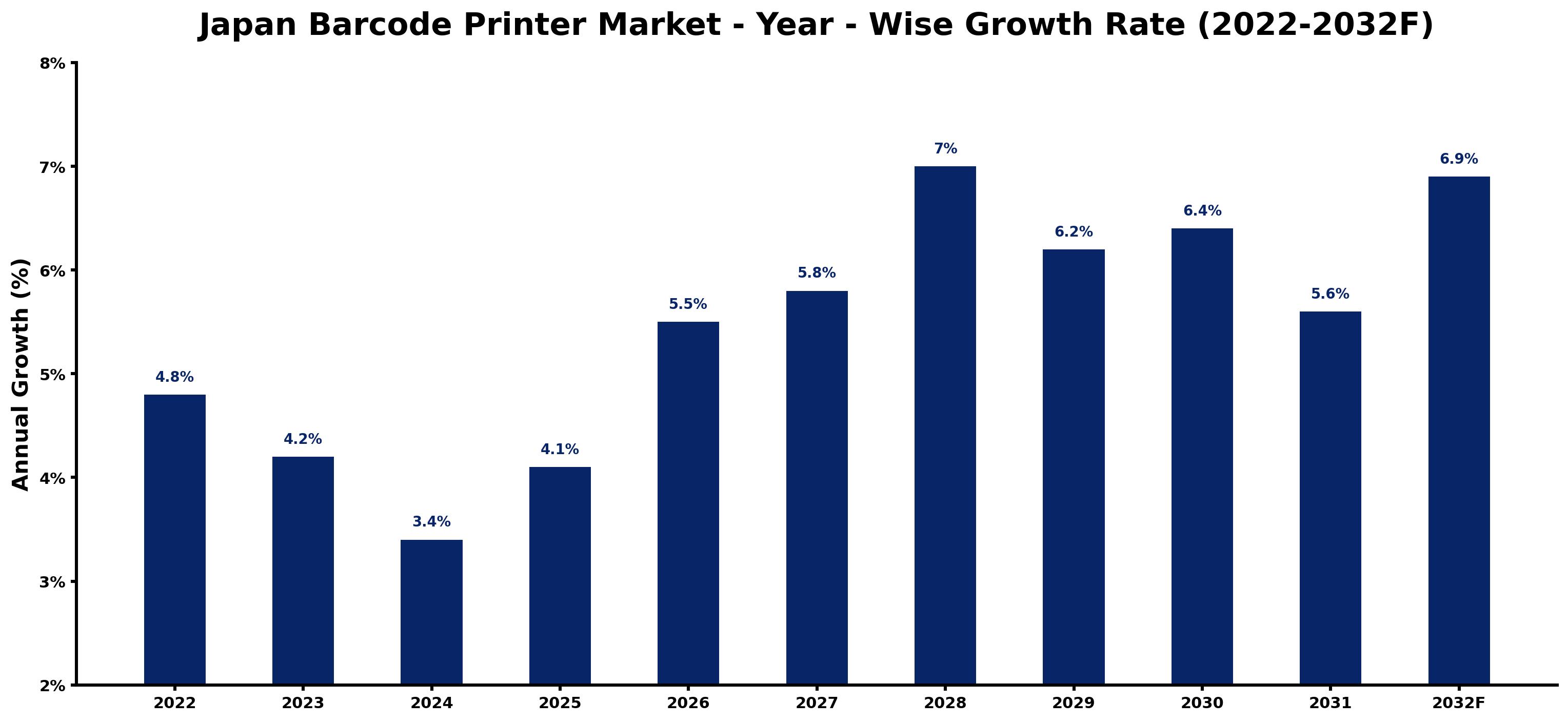
Annual growth estimates for each year appear below with the principal reason behind them, explaining the shifts that set the pace of the market.
| Year | Estimated Annual Growth (%) | Market Rationale |
| 2022 | 4.8 | Demand was strong due to recovery in the manufacturing and retail sectors. |
| 2023 | 4.2 | Growth slowed as market adjustments followed the previous year's peak performance. |
| 2024 | 3.4 | Demand continued to decelerate as businesses reassessed their inventory needs. |
| 2025 | 4.1 | A resurgence in retail sales boosted demand for barcode printers and labeling solutions. |
| 2026 | 5.5 | Increased logistics activity is projected to drive higher demand for mobile printing solutions. |
| 2027 | 5.8 | The manufacturing sector's growth will further support barcode printer adoption. |
| 2028 | 7.0 | Peak growth is anticipated as technology adoption accelerates across industries. |
| 2029 | 6.2 | Demand growth is expected to slow as the market stabilises after rapid expansion. |
| 2030 | 6.4 | A renewed focus on efficiency in logistics will sustain demand for printing solutions. |
| 2031 | 5.6 | Growth will moderate as market saturation begins to affect purchasing decisions. |
| 2032 | 6.9 | An increase in healthcare labeling needs will support growth in the barcode printer market. |
Note: Market size estimations and growth projections presented in this report are based on 6Wresearch's proprietary forecasting methodology, utilizing the latest available industry data, government publications, and primary research inputs.
Japan Barcode Printer Market Synopsis
Barcode printers are essential devices that print barcodes on labels for various applications, primarily using thermal printing technology. These devices are widely used in inventory management, shipping labels, and product labeling across industries. The Japan Barcode Printer Market is experiencing growth driven by strong demand from the manufacturing sector, which employs over 30 million people, and retail sales reaching 15 trillion yen in 2023. The logistics industry's expansion and the healthcare sector's labeling needs are also contributing to increased purchases, with the market valued at approximately 50 billion yen as of 2023.
Market Dynamics Impact Analysis (2026–2032)
| Factor | Type | Impact | Primary Segment Affected |
| Increased retail sales drive demand for barcode printers. | Driver | High | Retail |
| The logistics industry's growth enhances the need for mobile printing solutions. | Driver | High | Mobile Printer |
| The healthcare sector's expansion creates opportunities for labeling solutions. | Opportunity | High | Healthcare |
| The push for digital transformation in logistics opens new avenues for investment. | Opportunity | Medium | Transportation and Logistics |
| High costs of advanced printing technology may limit adoption in smaller businesses. | Restraint | High | Desktop Printer |
| Market saturation in certain segments could restrain growth potential. | Restraint | Medium | Industrial Printer |
| Compliance with evolving standards may increase operational costs for producers. | Challenge | High | Thermal Transfer |
| Capacity constraints in production may delay supply to meet rising demand. | Challenge | Medium | Direct Thermal |
Evaluation of Drivers in Japan Barcode Printer Market (2026–2032)
Demand rests on the following drivers, each shown with the segment it touches most.
| Drivers | Primary Segment Affected | Why It Matters (Evidence) |
| Strong retail sales boost barcode printer usage. | Retail | Retail sales in Japan reached 15 trillion yen in 2023, driving demand for efficient labeling solutions. |
| Logistics growth increases mobile printing demand. | Mobile Printer | Japan's logistics industry is projected to grow by 5% annually, increasing the need for mobile printing solutions. |
| Manufacturing sector expansion drives printer demand. | Manufacturing | The manufacturing sector employs over 30 million people, contributing to barcode printer demand for inventory management. |
| Healthcare sector requires efficient labeling solutions. | Healthcare | With over 8 million hospital beds, the healthcare sector increases demand for patient identification labels. |
| Digital transformation in logistics boosts technology adoption. | Transportation and Logistics | The government initiated a digital transformation strategy to improve logistics efficiency by 2025. |
Buyers are adding capacity as retail sales reached 15 trillion yen in 2023, driving demand for efficient labeling solutions. The logistics industry is expanding, creating a greater need for mobile printing solutions, particularly in urban centres like Tokyo and Osaka. The manufacturing sector employs over 30 million people, which boosts barcode printer demand for inventory management. The healthcare sector, with over 8 million hospital beds, requires efficient labeling for patient identification.
Evaluation of Restraints in Japan Barcode Printer Market
The table below lists the restraints and the evidence behind each.
| Market Restraint | Primary Segment Affected | Why It Matters (Evidence) |
| High costs of advanced printing technology limit adoption. | Desktop Printer | Many small businesses find it challenging to invest in high-end barcode printing technology due to costs. |
| Market saturation in certain segments may restrain growth. | Industrial Printer | As the market matures, growth potential in industrial printing may become limited. |
| Compliance with evolving standards increases operational costs. | Thermal Transfer | Producers must invest in meeting ISO 15416 standards, raising operational costs. |
| Capacity constraints in production delay supply. | Direct Thermal | Manufacturers may struggle to meet rising demand due to limited production capacity. |
| Dependence on imports for specialized applications can limit local growth. | Mobile Printer | Certain advanced mobile printing technologies are primarily imported, affecting local market conditions. |
Japan Barcode Printer Market Challenges
In Tokyo, retailers encounter frequent supply disruptions of barcode printers, resulting in delays in inventory management. This situation stems from limited domestic production, potentially causing retailers to lose billions of yen in sales due to stockouts. A shortage of skilled workers in the manufacturing sector hinders efficient operations, affecting over 30 million employees and raising operational costs. Compliance with ISO 15416 standards incurs substantial costs for suppliers, forcing them to increase prices by up to 15%, which burdens buyers seeking affordable solutions. Regulatory changes can complicate operations, delaying product launches and diminishing market competitiveness for suppliers.
Trends in the Japan Barcode Printer Market
These developments are changing demand patterns in the Japan Barcode Printer Market.
- Tokyo Leading in Barcode Printer Adoption: Tokyo has become a prominent region for barcode printer adoption, particularly within retail and logistics. The vibrant market environment has resulted in a marked increase in barcode usage, contributing to overall market growth.
- Shift from Direct Thermal to Thermal Transfer: The transition from direct thermal to thermal transfer printing technology commenced in 2023 as manufacturers sought more durable labeling solutions. This shift is motivated by the demand for long-lasting labels across various industries, especially manufacturing.
- Increase in Healthcare Labeling Solutions: The healthcare sector is progressively adopting advanced labeling solutions, with over 8 million hospital beds necessitating efficient patient identification systems. This trend is anticipated to drive further demand for barcode printers in the years to come.
- Digital Transformation in Logistics: The government's digital transformation strategy launched in 2023 aims to enhance logistics efficiency by 2025. This initiative is expected to stimulate substantial investments in mobile printing solutions throughout the logistics sector.
Investment Opportunities in the Japan Barcode Printer Market
Several openings in the Japan Barcode Printer Market merit attention from investors.
- Market Gap in Mobile Printing Solutions: With the logistics industry projected to grow by 5% annually, there exists a gap for mobile printing solutions. Investing in mobile printers can address the needs of logistics companies requiring efficient on-the-go printing.
- Partnerships for Advanced Printing Technology: Local manufacturers should establish partnerships with technology providers to enhance their product offerings. Collaborating with logistics firms can yield tailored solutions that address market demands.
- Healthcare Sector's Need for Efficient Labeling: The expansion of the healthcare sector presents a notable opportunity for suppliers of labeling solutions. Investing in durable and efficient labeling technologies can satisfy the increasing demands of hospitals and clinics.
- Investment in Digital Transformation Initiatives: The government's digital transformation strategy opens avenues for investment in advanced printing technologies. Companies can enter the market by aligning with logistics firms to deliver customised solutions.
Government Initiatives in the Japan Barcode Printer Market
The regulatory framework for barcode printers in Japan is influenced by laws such as the PMD Act of 2014, which governs the quality and approval of medical devices. Additionally, the Clinical Trials Act of 2017 establishes guidelines for the conduct of clinical research, impacting the healthcare sector's labeling requirements. These laws ensure that products adhere to stringent quality standards and support the growth of the barcode printer market.
Funding from the Next-Generation Medical Infrastructure Act aids in the anonymisation of medical data for research. The Pharmaceuticals and Medical Devices Agency (PMDA) oversees the regulation of medical devices and pharmaceuticals, ensuring compliance with safety standards and facilitating market entry for new technologies.
Future Insight of the Japan Barcode Printer Market
Retailers will increasingly adopt mobile printing solutions by 2032, driven by the logistics industry's projected growth. The government's digital transformation strategy will facilitate this shift, ensuring suppliers can meet rising demand. Barcode printers that comply with updated standards will be essential for maintaining quality, impacting buyers who need reliable products. Improved logistics capabilities will create opportunities for suppliers to innovate, ultimately benefiting buyers through enhanced service delivery.
Market Segmentation Analysis
Japan Barcode Printer Market report covers a detailed analysis of the following market segments:
By Product Type – Desktop Printer Leads, Mobile Printer Expected to Grow Fastest
According to Summon Dutta, Assistant Manager at 6Wresearch, the largest product type category in 2025 was Desktop Printer, at 55% of revenue. Desktop printers dominate the market as they are widely used in office and retail applications, where their reliability is crucial. Their extensive use for printing shipping labels in retail environments solidifies their leading position. The quickest growth will come from Mobile Printer, forecast to expand at a CAGR of 8.9% between 2026 and 2032. Mobile printers are experiencing rapid growth due to the increasing demand for portable printing solutions in logistics and retail. The projected growth of Japan's logistics industry will likely accelerate the adoption of mobile printing technologies. Suppliers should focus on enhancing mobile printing capabilities to meet the growing needs of logistics and retail.
By Printing Type – Thermal Transfer Leads, Direct Thermal Expected to Grow Fastest
Thermal Transfer took 45% of printing type revenue in 2025, more than any other category. Thermal transfer printing technology holds the largest share as it is preferred for producing durable labels across various industries, including manufacturing. This method's reliability in producing long-lasting labels is essential for tracking and inventory management. Direct Thermal is projected to grow fastest, at a CAGR of 8.5% during 2026–2032. Direct thermal printing is growing quickly due to its efficiency in producing short-term labels, particularly for shipping applications. The increasing retail sales in Japan highlight the rising need for efficient labeling solutions, propelling this segment's growth. Buyers may benefit from investing in direct thermal printers to meet the rising demand for efficient and cost-effective labeling solutions.
By End-user Industry – Manufacturing Leads, Retail Expected to Grow Fastest
Manufacturing accounted for 41% of the market by end-user industry in 2025. The manufacturing sector leads as the largest end-user, relying heavily on barcode printers for essential product labeling and tracking. With over 30 million people employed in this sector, the demand for these devices remains substantial. Over 2026–2032, Retail is expected to post the fastest growth, at a CAGR of 8.2%. Retail is the fastest-growing end-user industry, as barcode printers are critical for efficient pricing and inventory management. The retail sector's sales reaching 15 trillion yen in 2023 indicate a strong need for effective labeling solutions. Suppliers must tailor their offerings to address the specific needs of the expanding retail sector.
Key Attractiveness of the Report
- 10 Years of Market Numbers
- Historical Data Starting from 2022 to 2025
- Base Year 2025
- Forecast Data until 2032
- Key Performance Indicators Impacting the Market
- Major Upcoming Developments and Projects
Key Highlights of the Report:
- Japan Barcode Printer Market Outlook
- Market Size of Japan Barcode Printer Market, 2025
- Forecast of Japan Barcode Printer Market, 2032
- Historical Data and Forecast of Japan Barcode Printer Revenues & Volume for the Period 2022-2032
- Japan Barcode Printer Market Trend Evolution
- Japan Barcode Printer Market Drivers and Challenges
- Japan Barcode Printer Price Trends
- Japan Barcode Printer Porter's Five Forces
- Japan Barcode Printer Industry Life Cycle
- Historical Data and Forecast of Japan Barcode Printer Market Revenues & Volume By Product Type for the Period 2022-2032
- Historical Data and Forecast of Japan Barcode Printer Market Revenues & Volume By Desktop Printer for the Period 2022-2032
- Historical Data and Forecast of Japan Barcode Printer Market Revenues & Volume By Mobile Printer for the Period 2022-2032
- Historical Data and Forecast of Japan Barcode Printer Market Revenues & Volume By Industrial Printer for the Period 2022-2032
- Historical Data and Forecast of Japan Barcode Printer Market Revenues & Volume By Printing Type for the Period 2022-2032
- Historical Data and Forecast of Japan Barcode Printer Market Revenues & Volume By Thermal Transfer for the Period 2022-2032
- Historical Data and Forecast of Japan Barcode Printer Market Revenues & Volume By Direct Thermal for the Period 2022-2032
- Historical Data and Forecast of Japan Barcode Printer Market Revenues & Volume By Other Printing Types for the Period 2022-2032
- Historical Data and Forecast of Japan Barcode Printer Market Revenues & Volume By End-user Industry for the Period 2022-2032
- Historical Data and Forecast of Japan Barcode Printer Market Revenues & Volume By Manufacturing for the Period 2022-2032
- Historical Data and Forecast of Japan Barcode Printer Market Revenues & Volume By Retail for the Period 2022-2032
- Historical Data and Forecast of Japan Barcode Printer Market Revenues & Volume By Transportation and Logistics for the Period 2022-2032
- Historical Data and Forecast of Japan Barcode Printer Market Revenues & Volume By Healthcare for the Period 2022-2032
- Historical Data and Forecast of Japan Barcode Printer Market Revenues & Volume By Other End-Users for the Period 2022-2032
- Japan Barcode Printer Import Export Trade Statistics
- Market Opportunity Assessment By Product Type
- Market Opportunity Assessment By Printing Type
- Market Opportunity Assessment By End-user Industry
- Japan Barcode Printer Top Companies Market Share
- Japan Barcode Printer Competitive Benchmarking By Technical and Operational Parameters
- Japan Barcode Printer Company Profiles
- Japan Barcode Printer Key Strategic Recommendations
Market Covered
The study includes the following segmentation.
By Product Type
- Desktop Printer
- Mobile Printer
- Industrial Printer
By Printing Type
- Thermal Transfer
- Direct Thermal
- Other Printing Types
By End-user Industry
- Manufacturing
- Retail
- Transportation and Logistics
- Healthcare
- Other End-Users






































