Japan Beauveria Bassiana Market Size & Growth Rate
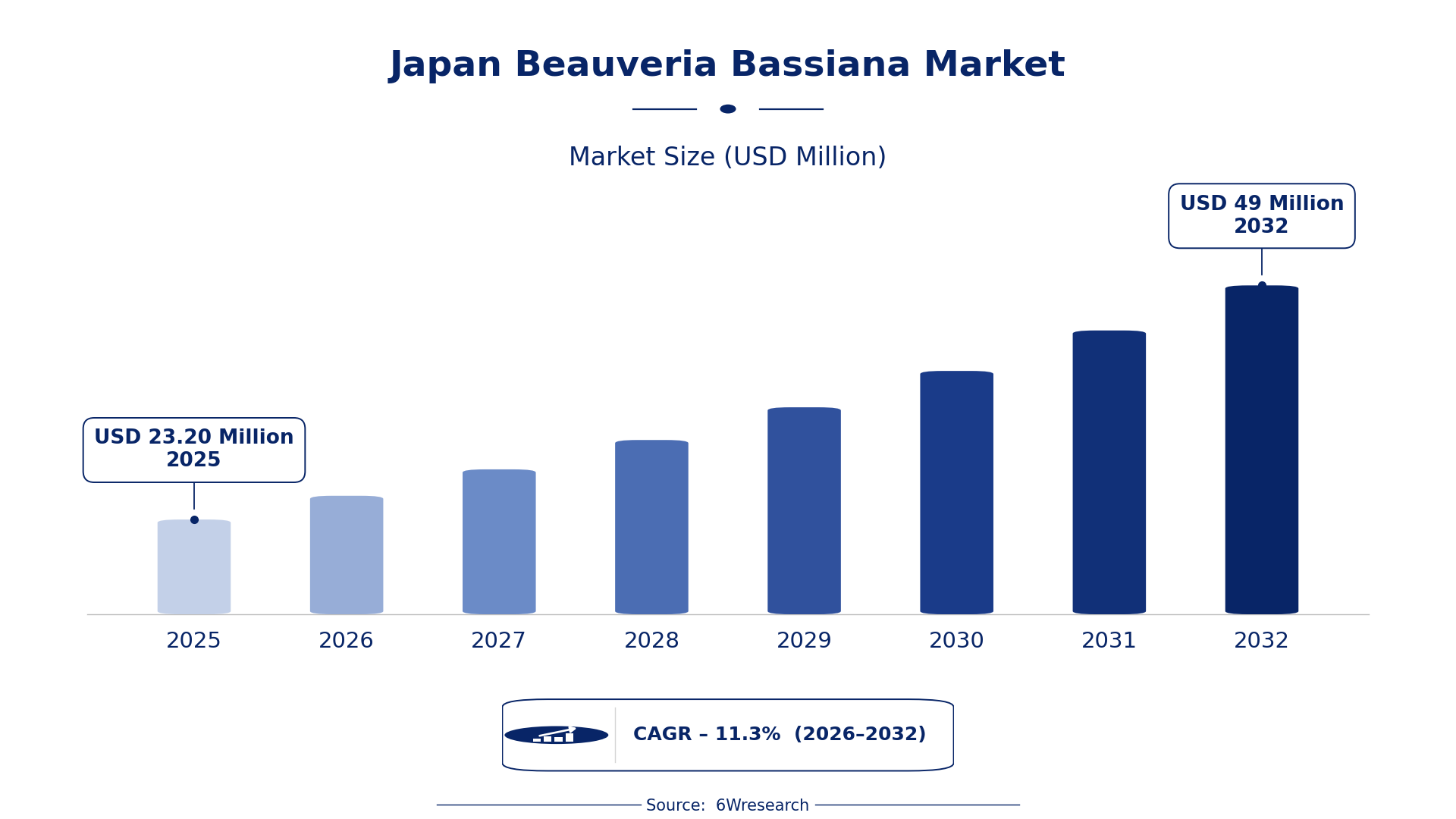
According to 6Wresearch internal database and industry insights, the Japan Beauveria Bassiana Market was valued at USD 23.20 Million in 2025 and is projected to reach USD 49 Million by 2032, growing at a CAGR of approximately 11.3% during 2026–2032.
Japan Beauveria Bassiana Market Highlights
| Report Metric | Details |
| Report Name | Japan Beauveria Bassiana Market (2026-2032) |
| Market Size 2025 | USD 23.20 Million |
| Market Size 2032 | USD 49 Million |
| Absolute Growth 2025–2032 | USD 25.80 Million |
| CAGR 2026–2032 | 11.3% |
| Peak Annual Growth | 13.0% in 2032 |
| Forecast Period | 2026–2032 |
| Historical Data | 2022–2025 |
| Base Year | 2025 |
| Leading Product Type, 2025 | Powder Form (43% share) |
| Leading Formulation, 2025 | Conidia Powder (40% share) |
| Leading Application Area, 2025 | Pest Control (38% share) |
| Leading Distribution Channel, 2025 | Direct Sales (36% share) |
| Leading End User, 2025 | Agriculture Farms (41% share) |
| Fastest-Growing Product Type | Liquid Form (16.0% CAGR) |
| Fastest-Growing Formulation | Suspension (16.8% CAGR) |
| Fastest-Growing Application Area | Insect Management (14.5% CAGR) |
| Fastest-Growing Distribution Channel | Online Platforms (15.0% CAGR) |
| Fastest-Growing End User | Horticulture Companies (14.7% CAGR) |
| Growing Sector | Agriculture |
| Key End Users | Agriculture Farms, Horticulture Companies, Crop Protection Firms, Agricultural Service Providers |
Japan Beauveria Bassiana Market Year-wise Growth Rate and Key Drivers (2022–2032)
This graph illustrates the annual growth rates of the market from 2022 to 2032, highlighting a steady upward trajectory and projected market expansion over the forecast period.
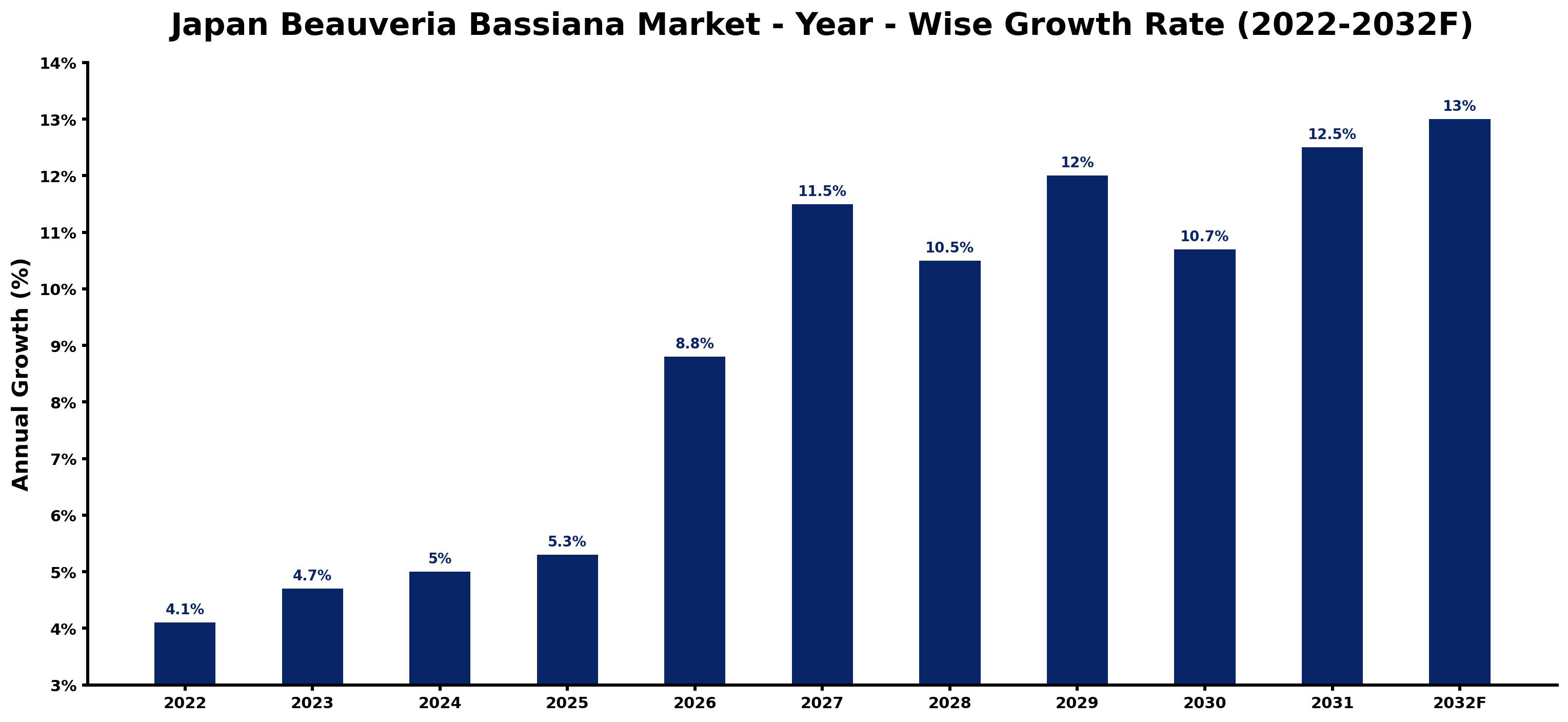
Below, each year's estimated growth is shown next to the factor that most influenced it.
| Year | Estimated Annual Growth (%) | Market Rationale |
| 2022 | 4.1 | The agricultural sector showed stable interest in biopesticides, reflecting ongoing sustainability efforts. |
| 2023 | 4.7 | Increased awareness of biopesticides led to a rise in adoption among farmers. |
| 2024 | 5.0 | Growing concerns over chemical pesticides drove further interest in biopesticide solutions. |
| 2025 | 5.3 | The implementation of sustainable practices by farmers encouraged higher usage of biopesticides. |
| 2026 | 8.8 | New biopesticide formulations are projected to attract more buyers. |
| 2027 | 11.5 | Rising demand for sustainable farming practices is anticipated to boost biopesticide orders. |
| 2028 | 10.5 | The market is projected to experience a slowdown as saturation begins in some areas. |
| 2029 | 12.0 | Increased focus on integrated pest management strategies is likely to drive demand. |
| 2030 | 10.7 | The ongoing shift towards eco-friendly agriculture is expected to sustain growth. |
| 2031 | 12.5 | The expansion of biopesticide research initiatives is anticipated to stimulate market activity. |
| 2032 | 13.0 | The growing commitment to sustainable agriculture practices will drive demand. |
Note: Market size estimations and growth projections presented in this report are based on 6Wresearch's proprietary forecasting methodology, utilizing the latest available industry data, government publications, and primary research inputs.
Japan Beauveria Bassiana Market Synopsis
Beauveria bassiana is a naturally occurring fungus used in agriculture, cultivated through controlled fermentation of spores. Its primary applications include pest control in crops and soil treatment, making it essential for sustainable farming practices. The Japan Beauveria Bassiana Market is expanding due to rising awareness of sustainable agriculture, with 30% of Japanese farms reporting biopesticide use in 2022. The Kanto region leads in application, supported by a government programme allocating 1 billion JPY for biopesticide research in 2023.
Market Dynamics Impact Analysis (2026–2032)
| Factor | Type | Impact | Primary Segment Affected |
| Rising adoption of biopesticides among farmers | Driver | High | Pest Control |
| Increased government support for sustainable agriculture | Driver | High | Biopesticide Mix |
| Growing demand for organic farming solutions | Opportunity | High | Insect Management |
| Expansion of online sales channels for biopesticides | Opportunity | Medium | Online Platforms |
| Limited awareness among farmers about biopesticides | Restraint | Medium | Granular Form |
| High initial costs associated with biopesticide adoption | Restraint | High | Liquid Form |
| Challenges in product registration and approval processes | Challenge | High | Custom Formulations |
| Competition from traditional chemical pesticides | Challenge | Medium | Powder Form |
Evaluation of Drivers in Japan Beauveria Bassiana Market (2026–2032)
Demand rests on the following drivers, each shown with the segment it touches most.
| Drivers | Primary Segment Affected | Why It Matters (Evidence) |
| Increased focus on sustainable farming practices | Pest Control | Approximately 30% of Japanese farms reported using biopesticides in 2022, driving demand for effective pest management solutions. |
| Government funding for biopesticide research | Biopesticide Mix | In 2023, the government allocated 1 billion JPY for biopesticide research, promoting innovation in the sector. |
| Growing interest in organic farming | Insect Management | The Japanese population's interest in sustainable farming practices is pushing demand for organic pest control solutions, with 25% of biopesticide usage in greenhouses. |
| Expansion of distribution channels | Online Platforms | The rise of e-commerce has increased accessibility, with online platforms accounting for 15% of biopesticide sales in 2023. |
| Technological advancements in biopesticide formulations | Liquid Form | Innovations in formulation technology are improving the effectiveness of biopesticides, attracting more users and increasing sales by 10%. |
Behind the steady rise in orders sits the increasing focus on sustainable farming practices, with approximately 30% of Japanese farms reporting biopesticide use in 2022. Funding for biopesticide research, amounting to 1 billion JPY in 2023, is promoting innovation and attracting new buyers. Interest in organic farming is driving demand for effective pest control solutions, particularly in the Kanto region, where 25% of biopesticide usage occurs in greenhouses. The expansion of distribution channels, especially online platforms, is improving accessibility for farmers, while advancements in formulation technology are making these products more effective, further increasing demand among agricultural service providers.
Evaluation of Restraints in Japan Beauveria Bassiana Market
The table below lists the restraints and the evidence behind each.
| Market Restraint | Primary Segment Affected | Why It Matters (Evidence) |
| Limited farmer awareness about biopesticides | Granular Form | Many farmers remain unaware of biopesticide benefits, with only 30% reporting usage in 2022, hindering adoption rates in specific applications. |
| High initial costs of biopesticide adoption | Liquid Form | The initial investment in biopesticides can deter farmers, especially smaller operations with budgets under 4 million JPY. |
| Regulatory hurdles in product registration | Custom Formulations | Complex registration processes can delay market entry for new biopesticide products, extending timelines by up to six months. |
| Competition from traditional chemical pesticides | Powder Form | Chemical pesticides often have lower upfront costs, making them more attractive to some farmers, especially those with limited budgets. |
| Limited availability of tailored biopesticide solutions | Custom Formulations | The niche nature of custom formulations can restrict access for farmers seeking specific pest management solutions. |
Japan Beauveria Bassiana Market Challenges
Producers encounter delays in biopesticide application due to outdated fermentation technology, which increases production time by 20%. Compliance with JIS Z 2801 creates regulatory hurdles, forcing producers to wait up to six months for product approvals. Supply chain disruptions occur as raw material availability fluctuates, resulting in a 15% reduction in product availability for producers. Rising operational expenses lead to cost pressures, causing prices to increase by 10% per hectare for buyers who rely on these products.
Trends in the Japan Beauveria Bassiana Market
Below are the shifts with the largest effect on the Japan Beauveria Bassiana Market.
- Shift towards Sustainable Pest Management Practices: The Kanto region is increasingly adopting sustainable pest management practices, with 25% of biopesticide usage in greenhouse applications. This trend reflects a growing commitment to eco-friendly farming methods.
- Rise in Online Sales Channels for Biopesticides: In 2023, online platforms accounted for a growing share of biopesticide sales, reflecting a shift in purchasing behaviour. This change is likely to improve accessibility for farmers across Japan.
- Increased Adoption of Integrated Pest Management: The introduction of integrated pest management strategies in 2022 has led to a rise in biopesticide usage among agriculture farms. This approach promotes sustainable practices and reduces reliance on chemical pesticides.
- Expansion of Biopesticide Research Initiatives: In 2023, the government allocated 1 billion JPY for biopesticide research, aiming to improve product effectiveness. This funding is expected to drive innovation and enhance market competitiveness.
Investment Opportunities in the Japan Beauveria Bassiana Market
Investors looking at the Japan Beauveria Bassiana Market should consider the following areas.
- Partnerships with Agricultural Service Providers: The Japanese agricultural sector is valued at approximately 4 trillion JPY, presenting an opportunity for partnerships. Collaborating with agricultural service providers can improve distribution and application of biopesticides.
- Investment in Online Sales Platforms: With online platforms growing as a distribution channel, investing in e-commerce solutions can capture a larger market share. This trend is particularly relevant for reaching farmers in remote areas.
- Development of Custom Formulations for Niche Markets: The increasing demand for tailored biopesticide solutions creates an opportunity to invest in custom formulations. Horticulture companies are particularly interested in these niche products.
- Expansion into Greenhouse Applications: Greenhouse applications account for 25% of biopesticide usage, indicating a gap for suppliers. Focusing on this segment can lead to increased sales and market penetration.
Government Initiatives in the Japan Beauveria Bassiana Market
The Waste Management and Public Cleansing Act of 1970 establishes guidelines for waste treatment and disposal, impacting biopesticide producers by ensuring compliance with environmental standards. The Water Supply Act of 1957 sets drinking-water quality standards, indirectly influencing biopesticide application in agriculture by promoting safe practices.
Agricultural service providers benefit from the Ministry of Agriculture, Forestry and Fisheries' initiatives, which support sustainable agriculture practices. The agency has approved various projects aimed at increasing biopesticide usage, contributing to a more sustainable agricultural sector.
Future Insight of the Japan Beauveria Bassiana Market
Emerging fermentation technology will revolutionise biopesticide production, enabling suppliers to meet demand swiftly. By 2032, government funding for biopesticide research will rise to 1 billion JPY, fostering advancements in sustainable agricultural practices. Updated standards will enhance product quality and safety, instilling greater confidence in biopesticide use among buyers. As agricultural service providers expand their offerings, the integration of biopesticides into farming practices will become increasingly prevalent.
Market Segmentation Analysis
Japan Beauveria Bassiana Market report covers a detailed analysis of the following market segments:
By Product Type – Powder Form Leads, Liquid Form Expected to Grow Fastest
According to Vasu Joshi, Associate Consultant at 6Wresearch, Powder Form accounted for 43% of the market by product type in 2025. Powder Form holds the largest share in Japan due to its effectiveness in various agricultural settings, making it a preferred choice for many farmers. For instance, the Kanto region, known for its agricultural output, extensively utilises this formulation for pest control. Over 2026–2032, Liquid Form is expected to post the fastest growth, at a CAGR of 16.0%. Liquid Form is experiencing rapid growth as it is easily dispersible, making it suitable for large-scale applications. The increasing demand for efficient pest control solutions in Japan's agricultural sector is propelling this growth. Suppliers should focus on enhancing liquid formulations to meet the rising demand from farmers.
By Formulation – Conidia Powder Leads, Suspension Expected to Grow Fastest
With 40% of formulation revenue in 2025, Conidia Powder was the largest category. Conidia Powder is the leading formulation as it serves as the primary form for pest control in agricultural practices across Japan. This formulation is widely adopted by agriculture farms, ensuring its dominance in the market. The quickest growth will come from Suspension, forecast to expand at a CAGR of 16.8% between 2026 and 2032. Suspension is growing quickly due to its ease of application, appealing to farmers seeking efficient pest management solutions. The trend towards more user-friendly products is driving this segment's rapid expansion. Buyers may benefit from the increasing availability of convenient formulations, enhancing their pest management strategies.
By Application Area – Pest Control Leads, Insect Management Expected to Grow Fastest
Pest Control took 38% of application area revenue in 2025, more than any other category. Pest Control is the leading application area, representing the main use of Beauveria bassiana in agriculture. The Japanese agricultural sector's focus on pest management solidifies its position as the largest segment. Insect Management is set to record the highest CAGR in this split, 14.5% over 2026–2032. Insect Management is witnessing the fastest growth as it plays a critical role in sustainable agricultural practices. The rising awareness of environmentally friendly pest control methods is fuelling this segment's expansion. Suppliers should prioritise products that support sustainable insect management to align with market trends.
By Distribution Channel – Direct Sales Leads, Online Platforms Expected to Grow Fastest
In 2025, Direct Sales led the distribution channel split with a 36% share. Direct Sales is the primary distribution channel, as it allows for direct engagement with agriculture farms, which are the largest end users. This method ensures that farmers receive tailored solutions that meet their specific needs. Online Platforms are projected to grow fastest, at a CAGR of 15.0% during 2026–2032. Online Platforms are rapidly gaining traction due to their ability to provide greater accessibility for farmers seeking biopesticides. The increasing digitalisation of the agricultural sector is driving this channel's growth. Suppliers need to enhance their online presence to capture the growing segment of digital buyers.
By End User – Agriculture Farms Lead, Horticulture Companies Expected to Grow Fastest
The largest end user category in 2025 was Agriculture Farms, at 41% of revenue. Agriculture Farms represent the largest end user group for Beauveria bassiana, as they are the primary consumers of biopesticides in Japan. The substantial number of farms utilising these products underscores their importance in pest control. Over 2026–2032, Horticulture Companies are expected to post the fastest growth, at a CAGR of 14.7%. Horticulture Companies are experiencing the fastest growth as they increasingly adopt biopesticides for specialised crop management. The notable rise in sustainable practices among horticulturists is propelling this segment forward, indicating a shift towards eco-friendly solutions. Suppliers should tailor their offerings to meet the specific needs of horticulture companies to capitalise on this growth.
Key Attractiveness of the Report
- 10 Years of Market Numbers
- Historical Data Starting from 2022 to 2025
- Base Year 2025
- Forecast Data until 2032
- Key Performance Indicators Impacting the Market
- Major Upcoming Developments and Projects
Key Highlights of the Report:
- Japan Beauveria Bassiana Market Outlook
- Market Size of Japan Beauveria Bassiana Market, 2025
- Forecast of Japan Beauveria Bassiana Market, 2032
- Historical Data and Forecast of Japan Beauveria Bassiana Market Revenues & Volume for the Period 2022-2032F
- Japan Beauveria Bassiana Market Trend Evolution
- Japan Beauveria Bassiana Market Drivers and Challenges
- Japan Beauveria Bassiana Market Price Trends
- Japan Beauveria Bassiana Market Porter's Five Forces
- Japan Beauveria Bassiana Market Industry Life Cycle
- Historical Data and Forecast of Japan Beauveria Bassiana Market Revenues & Volume By Product Type for the Period 2022-2032F
- Historical Data and Forecast of Japan Beauveria Bassiana Market Revenues & Volume By Powder Form for the Period 2022-2032F
- Historical Data and Forecast of Japan Beauveria Bassiana Market Revenues & Volume By Liquid Form for the Period 2022-2032F
- Historical Data and Forecast of Japan Beauveria Bassiana Market Revenues & Volume By Granular Form for the Period 2022-2032F
- Historical Data and Forecast of Japan Beauveria Bassiana Market Revenues & Volume By Custom Formulations for the Period 2022-2032F
- Historical Data and Forecast of Japan Beauveria Bassiana Market Revenues & Volume By Formulation for the Period 2022-2032F
- Historical Data and Forecast of Japan Beauveria Bassiana Market Revenues & Volume By Conidia Powder for the Period 2022-2032F
- Historical Data and Forecast of Japan Beauveria Bassiana Market Revenues & Volume By Suspension for the Period 2022-2032F
- Historical Data and Forecast of Japan Beauveria Bassiana Market Revenues & Volume By Encapsulated for the Period 2022-2032F
- Historical Data and Forecast of Japan Beauveria Bassiana Market Revenues & Volume By Biopesticide Mix for the Period 2022-2032F
- Historical Data and Forecast of Japan Beauveria Bassiana Market Revenues & Volume By Application Area for the Period 2022-2032F
- Historical Data and Forecast of Japan Beauveria Bassiana Market Revenues & Volume By Pest Control for the Period 2022-2032F
- Historical Data and Forecast of Japan Beauveria Bassiana Market Revenues & Volume By Insect Management for the Period 2022-2032F
- Historical Data and Forecast of Japan Beauveria Bassiana Market Revenues & Volume By Soil Treatment for the Period 2022-2032F
- Historical Data and Forecast of Japan Beauveria Bassiana Market Revenues & Volume By Greenhouse Applications for the Period 2022-2032F
- Historical Data and Forecast of Japan Beauveria Bassiana Market Revenues & Volume By Distribution Channel for the Period 2022-2032F
- Historical Data and Forecast of Japan Beauveria Bassiana Market Revenues & Volume By Direct Sales for the Period 2022-2032F
- Historical Data and Forecast of Japan Beauveria Bassiana Market Revenues & Volume By Online Platforms for the Period 2022-2032F
- Historical Data and Forecast of Japan Beauveria Bassiana Market Revenues & Volume By Specialty Distributors for the Period 2022-2032F
- Historical Data and Forecast of Japan Beauveria Bassiana Market Revenues & Volume By OEM Channels for the Period 2022-2032F
- Historical Data and Forecast of Japan Beauveria Bassiana Market Revenues & Volume By End User for the Period 2022-2032F
- Historical Data and Forecast of Japan Beauveria Bassiana Market Revenues & Volume By Agriculture Farms for the Period 2022-2032F
- Historical Data and Forecast of Japan Beauveria Bassiana Market Revenues & Volume By Horticulture Companies for the Period 2022-2032F
- Historical Data and Forecast of Japan Beauveria Bassiana Market Revenues & Volume By Crop Protection Firms for the Period 2022-2032F
- Historical Data and Forecast of Japan Beauveria Bassiana Market Revenues & Volume By Agricultural Service Providers for the Period 2022-2032F
- Japan Beauveria Bassiana Market Import Export Trade Statistics
- Market Opportunity Assessment By Product Type
- Market Opportunity Assessment By Formulation
- Market Opportunity Assessment By Application Area
- Market Opportunity Assessment By Distribution Channel
- Market Opportunity Assessment By End User
- Japan Beauveria Bassiana Market Top Companies Market Share
- Japan Beauveria Bassiana Market Competitive Benchmarking By Technical and Operational Parameters
- Japan Beauveria Bassiana Market Company Profiles
- Japan Beauveria Bassiana Market Key Strategic Recommendations
Market Covered
The report covers the following segments.
By Product Type
- Powder Form
- Liquid Form
- Granular Form
- Custom Formulations
By Formulation
- Conidia Powder
- Suspension
- Encapsulated
- Biopesticide Mix
By Application Area
- Pest Control
- Insect Management
- Soil Treatment
- Greenhouse Applications
By Distribution Channel
- Direct Sales
- Online Platforms
- Specialty Distributors
- OEM Channels
By End User
- Agriculture Farms
- Horticulture Companies
- Crop Protection Firms
- Agricultural Service Providers






































