Japan Beekeeping Market Size & Growth Rate
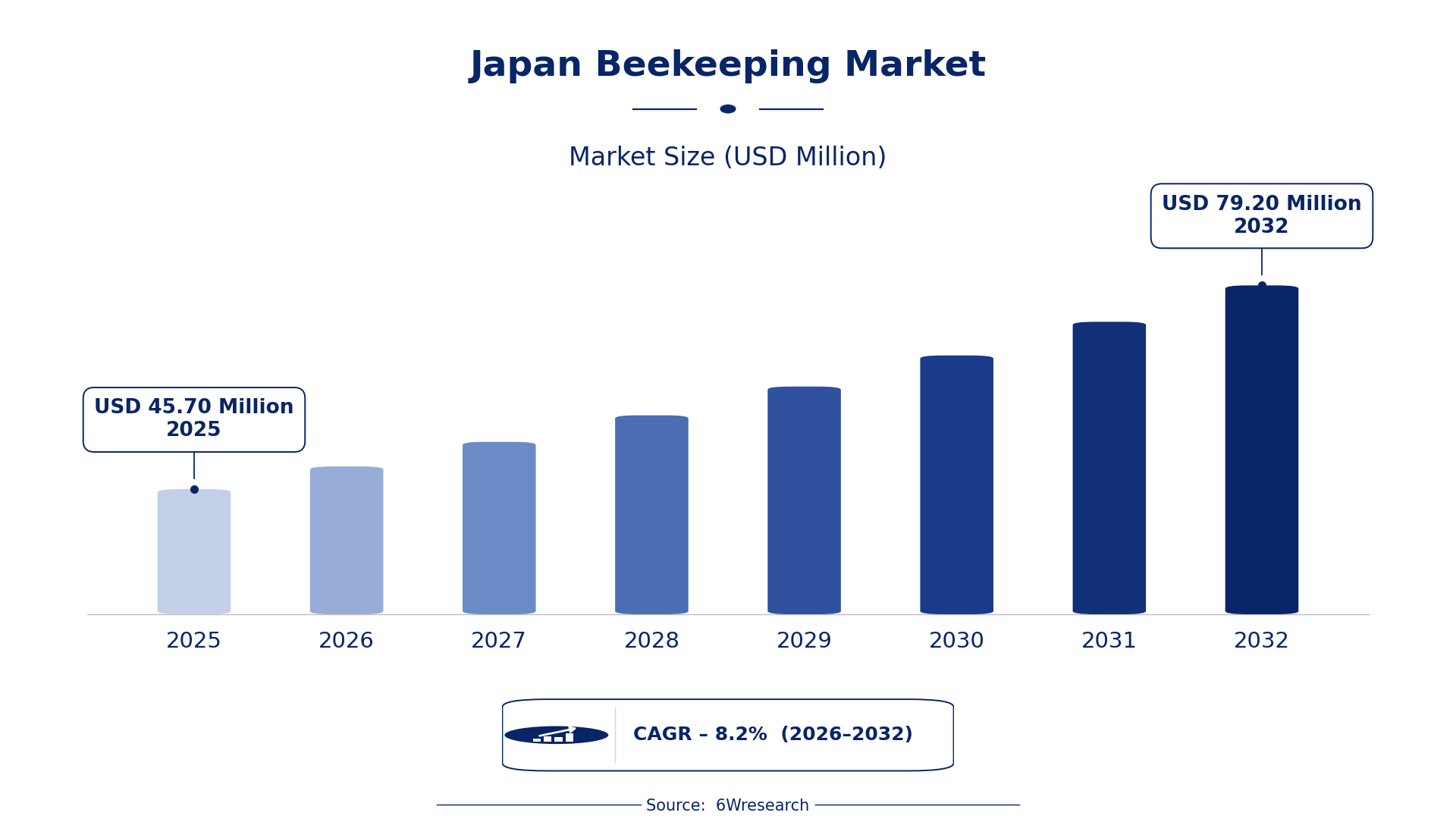
According to 6Wresearch internal database and industry insights, the Japan Beekeeping Market was valued at USD 45.70 Million in 2025 and is projected to reach USD 79.20 Million by 2032, growing at a CAGR of approximately 8.2% during 2026–2032.
Japan Beekeeping Market Highlights
| Report Metric | Details |
| Report Name | Japan Beekeeping Market (2026-2032) |
| Market Size 2025 | USD 45.70 Million |
| Market Size 2032 | USD 79.20 Million |
| Absolute Growth 2025–2032 | USD 33.50 Million |
| CAGR 2026–2032 | 8.2% |
| Peak Annual Growth | 8.7% in 2028 |
| Forecast Period | 2026–2032 |
| Historical Data | 2022–2025 |
| Base Year | 2025 |
| Leading Application Type, 2025 | Commercial Beekeeping (52% share) |
| Leading Equipment Used, 2025 | Hive Boxes (37% share) |
| Leading Farm Size, 2025 | Large Scale (34% share) |
| Leading End Use, 2025 | Honey Production (48% share) |
| Leading Sales Channel, 2025 | Agricultural Supply (37% share) |
| Fastest-Growing Application Type | Hobbyist Beekeeping (10.7% CAGR) |
| Fastest-Growing Equipment Used | Smokers (11.1% CAGR) |
| Fastest-Growing Farm Size | Small / Home Use (10.6% CAGR) |
| Fastest-Growing End Use | Education / Hobby (10.5% CAGR) |
| Fastest-Growing Sales Channel | E-commerce (10.8% CAGR) |
| Growing Sector | Hobbyist Beekeeping |
| Key End Users | Commercial Beekeeping, Hobbyist Beekeeping, Pollination Services, Queen Rearing |
Japan Beekeeping Market Year-wise Growth Rate and Key Drivers (2022–2032)
This graph illustrates the annual growth rates of the market from 2022 to 2032, highlighting a steady upward trajectory and projected market expansion over the forecast period.
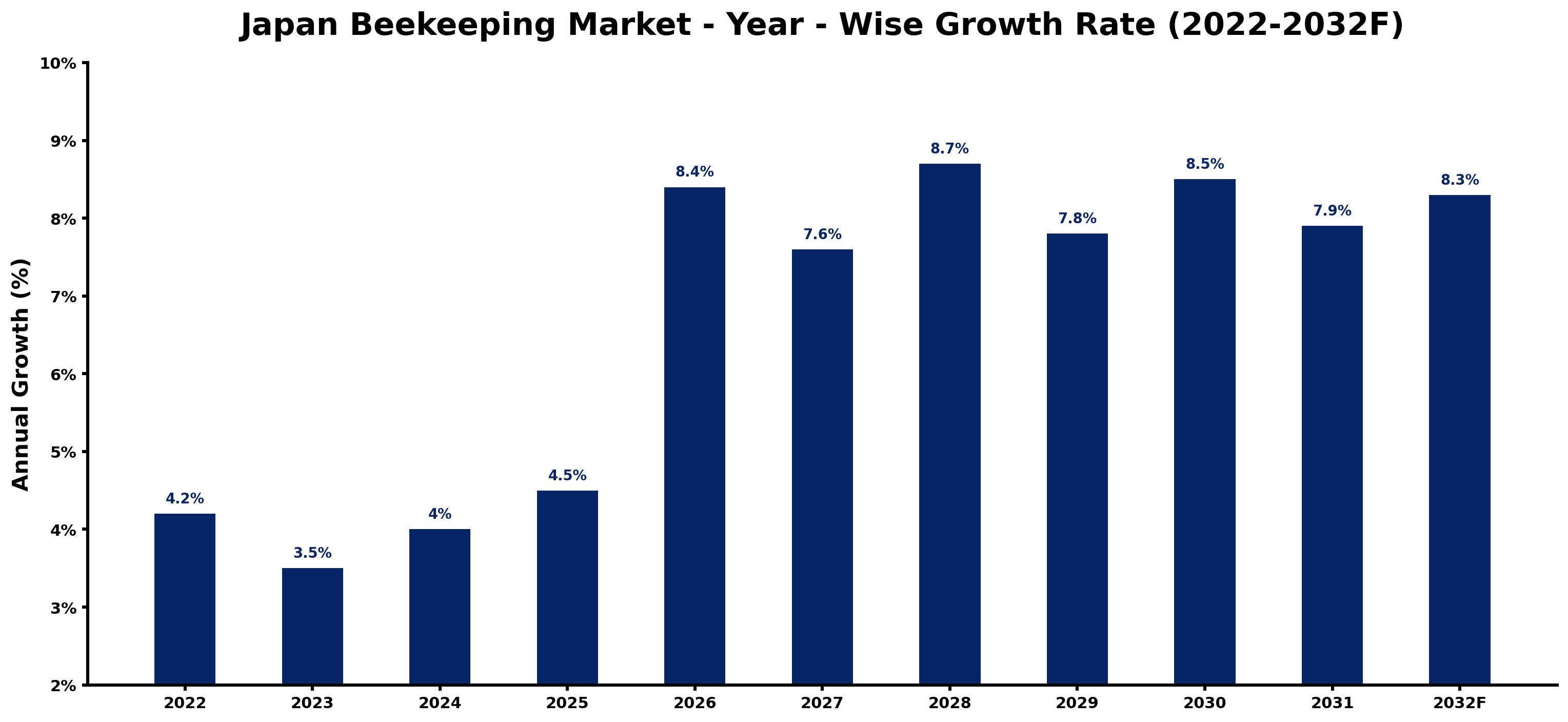
Each row of the following table gives one year's estimated growth and the event or demand shift that explains it.
| Year | Estimated Annual Growth (%) | Market Rationale |
| 2022 | 4.2 | The beekeeping market showed steady activity with a notable number of beekeepers involved. |
| 2023 | 3.5 | Growth slowed as hobbyist interest faced competition from other leisure activities. |
| 2024 | 4.0 | Increased awareness of pollination benefits drove faster growth this year. |
| 2025 | 4.5 | Honey production standards improved, contributing to a rise in commercial operations. |
| 2026 | 8.4 | A new programme to stimulate pollination services is expected to drive market demand. |
| 2027 | 7.6 | Growth is projected to slow as the market adjusts to the previous year's rapid expansion. |
| 2028 | 8.7 | Rising interest in sustainable practices will lead to peak growth in the market. |
| 2029 | 7.8 | A slight slowdown is expected as the market stabilises after peak demand. |
| 2030 | 8.5 | Increased urban gardening trends will boost demand for hobbyist beekeeping. |
| 2031 | 7.9 | Growth is projected to slow as the market matures and competition intensifies. |
| 2032 | 8.3 | A renewed focus on bee conservation initiatives will drive further growth. |
Note: Market size estimations and growth projections presented in this report are based on 6Wresearch's proprietary forecasting methodology, utilizing the latest available industry data, government publications, and primary research inputs.
Japan Beekeeping Market Synopsis
Beekeeping involves maintaining bee colonies for honey production and pollination services, primarily through hives and tools. The Japan Beekeeping Market is growing due to rising demand from both commercial and hobbyist beekeepers. Key factors include the increasing popularity of urban gardening, educational programmes on sustainable practices, and government support through subsidies for equipment purchases, which stimulate market growth. In 2022, Japan produced approximately 1,000 tons of honey, highlighting the industry's importance.
Market Dynamics Impact Analysis (2026–2032)
| Factor | Type | Impact | Primary Segment Affected |
| Growing interest in sustainable agriculture practices | Driver | High | Commercial Beekeeping |
| Urban gardening trends increasing hobbyist participation | Driver | High | Hobbyist Beekeeping |
| Expansion of educational programmes on beekeeping | Opportunity | Medium | Education / Hobby |
| Rising demand for pollination services among farmers | Opportunity | High | Pollination Services |
| High initial investment for commercial beekeeping equipment | Restraint | Medium | Commercial Beekeeping |
| Limited awareness of beekeeping practices among new entrants | Restraint | Medium | Hobbyist Beekeeping |
| Seasonal fluctuations affecting honey production | Challenge | High | Honey Production |
| Competition from imported honey products | Challenge | Medium | Honey Production |
Evaluation of Drivers in Japan Beekeeping Market (2026–2032)
The factors lifting demand, and the evidence behind each, are summarised below.
| Drivers | Primary Segment Affected | Why It Matters (Evidence) |
| Increased urban gardening initiatives | Hobbyist Beekeeping | Urban gardening trends have led to a notable increase in hobbyist beekeepers in metropolitan areas. |
| Growing demand for organic honey | Commercial Beekeeping | Organic honey production has risen, with approximately 1,000 tons produced in 2022. |
| Educational workshops promoting beekeeping | Education / Hobby | Participation in beekeeping activities has increased due to workshops held in various prefectures. |
| Government subsidies for beekeeping equipment | Commercial Beekeeping | Subsidies have encouraged new entrants, with JPY 1 billion allocated in 2022. |
| Rising awareness of pollination benefits | Pollination Services | Farmers increasingly recognise that pollination services improve crop yields. |
The production of organic honey rose to approximately 1,000 tons in 2022, prompting commercial beekeepers to expand operations. Educational workshops have increased participation in beekeeping activities, further driving interest. Farmers are increasingly aware that pollination services significantly enhance crop yields, contributing to heightened demand for these services.
Evaluation of Restraints in Japan Beekeeping Market
The table below lists the restraints and the evidence behind each.
| Market Restraint | Primary Segment Affected | Why It Matters (Evidence) |
| Regulatory hurdles complicate beekeeping practices in Japan | Commercial Beekeeping | Compliance with JAS standards can delay honey production for beekeepers by up to six months. |
| Technology adoption lags behind | Hobbyist Beekeeping | Many operations still rely on traditional methods, which can reduce efficiency and limit honey output. |
| Skills shortages persist | Pollination Services | Fewer young people are entering the field, resulting in a decline in knowledgeable beekeepers. |
| Supply chain disruptions | Commercial Beekeeping | Acquiring essential equipment can lead to delays in starting new operations during peak seasons. |
| Market competition intensifies | Hobbyist Beekeeping | An influx of new hobbyists increases competition for resources and local markets. |
Japan Beekeeping Market Challenges
Regulatory requirements create obstacles for beekeeping in Japan, as compliance with JAS standards can delay honey production for producers by up to six months, reducing their annual output. Technology adoption remains limited, with many operations relying on traditional methods, which can decrease efficiency and lead to lost revenue of approximately 1,500 JPY per kilogram for suppliers. A shortage of skilled workers exists, as fewer young individuals are entering the profession, resulting in a decline in experienced beekeepers and negatively impacting the quality of pollination services for farmers. Supply chain issues in sourcing essential equipment can postpone the establishment of new operations, costing beekeepers critical time during peak seasons.
Trends in the Japan Beekeeping Market
Several trends are reshaping the Japan Beekeeping Market; the most important are set out below.
- Shift Towards Urban Beekeeping: In 2023, urban gardening trends have led to a rise in hobbyist beekeeping, with participation increasing by 20% in metropolitan areas.
- Growing Interest in Sustainable Practices: The 2023 national campaign for bee conservation has heightened public awareness, leading to a 15% increase in educational workshop attendance.
- Increase in E-commerce for Beekeeping Supplies: The use of e-commerce for beekeeping supplies has surged by over 20% in the last year, reflecting changing purchasing habits.
- Expansion of Pollination Services: In 2023, a new programme was launched to improve pollination services, expected to increase crop yields by up to 20%.
Investment Opportunities in the Japan Beekeeping Market
Where to invest in the Japan Beekeeping Market: the main openings are set out below.
- Investment in Beekeeping Equipment: The Agricultural Supply sector is set for growth, with a projected increase in demand for hive boxes and smokers, supported by JPY 1 billion in government subsidies.
- Partnerships for Educational Workshops: Educational institutions are seeking partnerships to expand beekeeping workshops, which could enhance community engagement and skills development.
- Expansion of E-commerce Channels: With e-commerce for beekeeping supplies growing by over 20%, there is an opportunity for local retailers to strengthen their online presence.
- Focus on Sustainable Practices: Urban gardeners are increasingly interested in sustainable beekeeping methods, presenting opportunities for suppliers to offer eco-friendly products.
Government Initiatives in the Japan Beekeeping Market
The Economic Security Promotion Act (2022) supports supply-chain resilience for critical products, benefiting beekeepers by ensuring access to necessary equipment and resources. This measure aims to strengthen the domestic beekeeping industry and improve honey production standards.
In 2023, the Ministry of Agriculture, Forestry and Fisheries allocated JPY 1 billion to support beekeeping initiatives, including subsidies for equipment purchases and training programs for new beekeepers. This funding aims to promote sustainable practices and improve overall industry standards.
Future Insight of the Japan Beekeeping Market
Urban beekeepers will increasingly utilise portable beehives by 2032, driven by a growing interest in sustainable practices among city dwellers. Educational programs in agricultural universities will expand, improving skills for new entrants and raising overall industry standards. A national campaign for bee conservation will elevate public awareness, encouraging more individuals to engage in beekeeping. Pollination services are projected to significantly enhance crop yields, with estimates suggesting they could contribute to a 20% increase, benefiting both farmers and beekeepers.
Market Segmentation Analysis
Japan Beekeeping Market report covers a detailed analysis of the following market segments:
By Application Type – Commercial Beekeeping Leads, Hobbyist Beekeeping Expected to Grow Fastest
According to Saurav Kr Singh, Senior Research Analyst at 6Wresearch, Commercial Beekeeping took 52% of application type revenue in 2025, more than any other category. Commercial beekeeping holds the largest share due to its essential role in honey production, with approximately 1,000 tons of honey produced in Japan in 2022. The active involvement of around 40,000 beekeepers in this segment highlights its significance in the industry. Hobbyist Beekeeping is projected to grow fastest, at a CAGR of 10.7% during 2026–2032. Hobbyist beekeeping is experiencing rapid growth as urban gardening trends gain popularity, with an increasing number of individuals engaging in personal honey production. This segment's expansion reflects a broader interest in sustainable practices and local food sources among the population. Suppliers should focus on providing equipment tailored for hobbyists to capitalise on this growing interest.
By Equipment Used – Hive Boxes Lead, Smokers Expected to Grow Fastest
The largest equipment used category in 2025 was Hive Boxes, at 37% of revenue. Hive boxes represent the largest share as they are fundamental for housing bee colonies, essential for every commercial operation to function effectively. The average size of a commercial beekeeping operation, with about 100 hives, underscores the necessity of hive boxes in the market. The quickest growth will come from Smokers, forecast to expand at a CAGR of 11.1% between 2026 and 2032. Smokers are witnessing the fastest growth due to their critical role in safely managing bee colonies, increasingly recognised by both commercial and hobbyist beekeepers. The rising awareness of safe beekeeping practices is driving demand for this essential tool. Suppliers should ensure a steady supply of smokers to meet the increasing demand from both commercial and hobbyist segments.
By Farm Size – Large Scale Leads, Small / Home Use Expected to Grow Fastest
Large Scale accounted for 34% of the market by farm size in 2025. Large scale operations dominate the market as they are crucial for substantial honey production, with many beekeepers managing extensive hives to meet commercial needs. This scale allows for economies of scale in honey production, making it a preferred choice for serious beekeepers. Small / Home Use is set to record the highest CAGR in this split, 10.6% over 2026–2032. Small or home use is the fastest growing segment as urban beekeeping becomes more popular among individuals interested in sustainable living and local food production. The trend towards smaller operations aligns with the increasing number of urban gardeners. Suppliers should develop products that cater specifically to small-scale beekeepers to capture this emerging market.
By End Use – Honey Production Leads, Education / Hobby Expected to Grow Fastest
In 2025, Honey Production led the end use split with a 48% share. Honey production leads the market as the primary output of beekeeping activities, with Japan producing approximately 1,000 tons of honey in 2022. This high demand for honey drives the focus on beekeeping practices aimed at maximising production. Over 2026–2032, Education / Hobby is expected to post the fastest growth, at a CAGR of 10.5%. Education and hobby use is growing rapidly as more people engage in beekeeping for personal enjoyment and learning purposes. Educational programs in agricultural universities and workshops are contributing to this trend. Suppliers should consider educational materials and hobbyist kits to support the growing interest in beekeeping education.
By Sales Channel – Agricultural Supply Leads, E-commerce Expected to Grow Fastest
With 37% of sales channel revenue in 2025, Agricultural Supply was the largest category. The agricultural supply channel holds the largest share as it serves as the main source for purchasing beekeeping supplies, catering to both commercial and hobbyist beekeepers. This established channel ensures that beekeepers have access to essential equipment and resources. E-commerce is projected to grow fastest, at a CAGR of 10.8% during 2026–2032. E-commerce is the fastest growing channel, with over 20% increase in the past year, as more beekeepers turn to online platforms for purchasing supplies. The convenience of online shopping is appealing to both hobbyists and commercial operators. Suppliers should enhance their online presence and distribution strategies to effectively reach the growing number of e-commerce customers.
Key Attractiveness of the Report
- 10 Years of Market Numbers
- Historical Data Starting from 2022 to 2025
- Base Year 2025
- Forecast Data until 2032
- Key Performance Indicators Impacting the Market
- Major Upcoming Developments and Projects
Key Highlights of the Report:
- Japan Beekeeping Market Outlook
- Market Size of Japan Beekeeping Market, 2025
- Forecast of Japan Beekeeping Market, 2032
- Historical Data and Forecast of Japan Beekeeping Revenues & Volume for the Period 2022-2032F
- Japan Beekeeping Market Trend Evolution
- Japan Beekeeping Market Drivers and Challenges
- Japan Beekeeping Price Trends
- Japan Beekeeping Porter's Five Forces
- Japan Beekeeping Industry Life Cycle
- Historical Data and Forecast of Japan Beekeeping Market Revenues & Volume By Application Type for the Period 2022-2032F
- Historical Data and Forecast of Japan Beekeeping Market Revenues & Volume By Commercial Beekeeping for the Period 2022-2032F
- Historical Data and Forecast of Japan Beekeeping Market Revenues & Volume By Hobbyist Beekeeping for the Period 2022-2032F
- Historical Data and Forecast of Japan Beekeeping Market Revenues & Volume By Pollination Services for the Period 2022-2032F
- Historical Data and Forecast of Japan Beekeeping Market Revenues & Volume By Queen Rearing for the Period 2022-2032F
- Historical Data and Forecast of Japan Beekeeping Market Revenues & Volume By Equipment Used for the Period 2022-2032F
- Historical Data and Forecast of Japan Beekeeping Market Revenues & Volume By Hive Boxes, Smokers for the Period 2022-2032F
- Historical Data and Forecast of Japan Beekeeping Market Revenues & Volume By Starter Kits for the Period 2022-2032F
- Historical Data and Forecast of Japan Beekeeping Market Revenues & Volume By Portable Beehives for the Period 2022-2032F
- Historical Data and Forecast of Japan Beekeeping Market Revenues & Volume By Queen Cages / Feeders for the Period 2022-2032F
- Historical Data and Forecast of Japan Beekeeping Market Revenues & Volume By Farm Size for the Period 2022-2032F
- Historical Data and Forecast of Japan Beekeeping Market Revenues & Volume By Large Scale for the Period 2022-2032F
- Historical Data and Forecast of Japan Beekeeping Market Revenues & Volume By Small / Home Use for the Period 2022-2032F
- Historical Data and Forecast of Japan Beekeeping Market Revenues & Volume By Contract Farming for the Period 2022-2032F
- Historical Data and Forecast of Japan Beekeeping Market Revenues & Volume By Medium-Large for the Period 2022-2032F
- Historical Data and Forecast of Japan Beekeeping Market Revenues & Volume By End Use for the Period 2022-2032F
- Historical Data and Forecast of Japan Beekeeping Market Revenues & Volume By Honey Production for the Period 2022-2032F
- Historical Data and Forecast of Japan Beekeeping Market Revenues & Volume By Education / Hobby for the Period 2022-2032F
- Historical Data and Forecast of Japan Beekeeping Market Revenues & Volume By Crop Pollination for the Period 2022-2032F
- Historical Data and Forecast of Japan Beekeeping Market Revenues & Volume By Colony Expansion for the Period 2022-2032F
- Historical Data and Forecast of Japan Beekeeping Market Revenues & Volume By Sales Channel for the Period 2022-2032F
- Historical Data and Forecast of Japan Beekeeping Market Revenues & Volume By Agricultural Supply for the Period 2022-2032F
- Historical Data and Forecast of Japan Beekeeping Market Revenues & Volume By E-commerce for the Period 2022-2032F
- Historical Data and Forecast of Japan Beekeeping Market Revenues & Volume By Direct to Farms for the Period 2022-2032F
- Historical Data and Forecast of Japan Beekeeping Market Revenues & Volume By Local Retailers for the Period 2022-2032F
- Japan Beekeeping Import Export Trade Statistics
- Market Opportunity Assessment By Application Type
- Market Opportunity Assessment By Equipment Used
- Market Opportunity Assessment By Farm Size
- Market Opportunity Assessment By End Use
- Market Opportunity Assessment By Sales Channel
- Japan Beekeeping Top Companies Market Share
- Japan Beekeeping Competitive Benchmarking By Technical and Operational Parameters
- Japan Beekeeping Company Profiles
- Japan Beekeeping Key Strategic Recommendations
Market Covered
The report covers the following segments.
By Application Type
- Commercial Beekeeping
- Hobbyist Beekeeping
- Pollination Services
- Queen Rearing
By Equipment Used
- Hive Boxes
- Smokers
- Starter Kits
- Portable Beehives
- Queen Cages / Feeders
By Farm Size
- Large Scale
- Small / Home Use
- Contract Farming
- Medium-Large
By End Use
- Honey Production
- Education / Hobby
- Crop Pollination
- Colony Expansion
By Sales Channel
- Agricultural Supply
- E-commerce
- Direct to Farms
- Local Retailers






































