Japan Belt and Chain Drives Market Size & Growth Rate
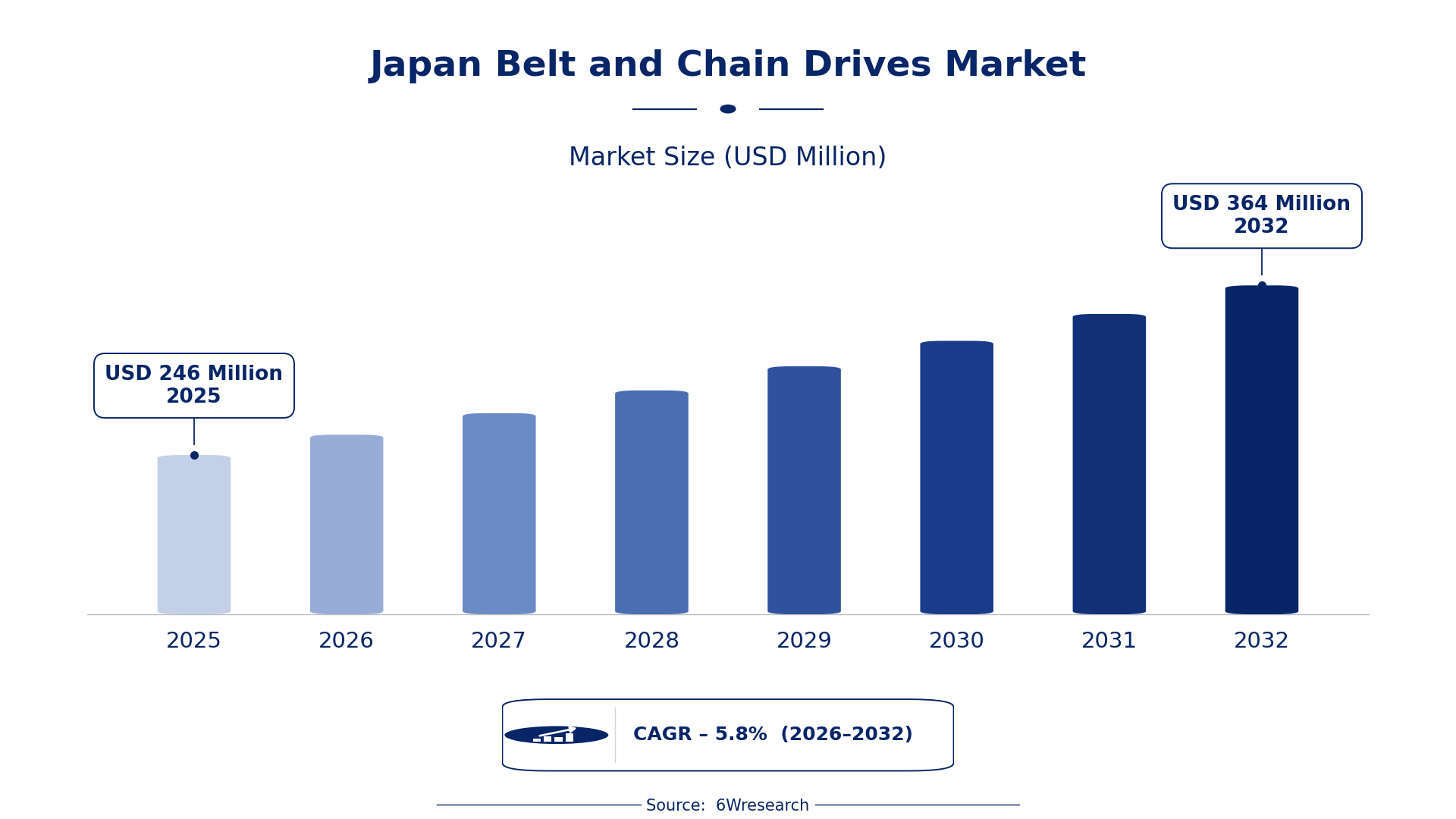
According to 6Wresearch internal database and industry insights, the Japan Belt and Chain Drives Market was valued at USD 246 Million in 2025 and is projected to reach USD 364 Million by 2032, growing at a CAGR of approximately 5.8% during 2026–2032.
Japan Belt and Chain Drives Market Highlights
| Report Metric | Details |
| Report Name | Japan Belt and Chain Drives Market (2026-2032) |
| Market Size 2025 | USD 246 Million |
| Market Size 2032 | USD 364 Million |
| Absolute Growth 2025–2032 | USD 118 Million |
| CAGR 2026–2032 | 5.8% |
| Peak Annual Growth | 6.7% in 2032 |
| Forecast Period | 2026–2032 |
| Historical Data | 2022–2025 |
| Base Year | 2025 |
| Leading Type, 2025 | Transmission Chain (37% share) |
| Leading End users, 2025 | Automotive (50% share) |
| Fastest-Growing Type | Silent Chain (8.2% CAGR) |
| Fastest-Growing End users | Industrial Machinery (7.4% CAGR) |
| Growing Sector | Automotive |
| Key End Users | Automotive, Industrial Machinery, Agriculture |
Japan Belt and Chain Drives Market Year-wise Growth Rate and Key Drivers (2022–2032)
This graph illustrates the annual growth rates of the market from 2022 to 2032, highlighting a steady upward trajectory and projected market expansion over the forecast period.
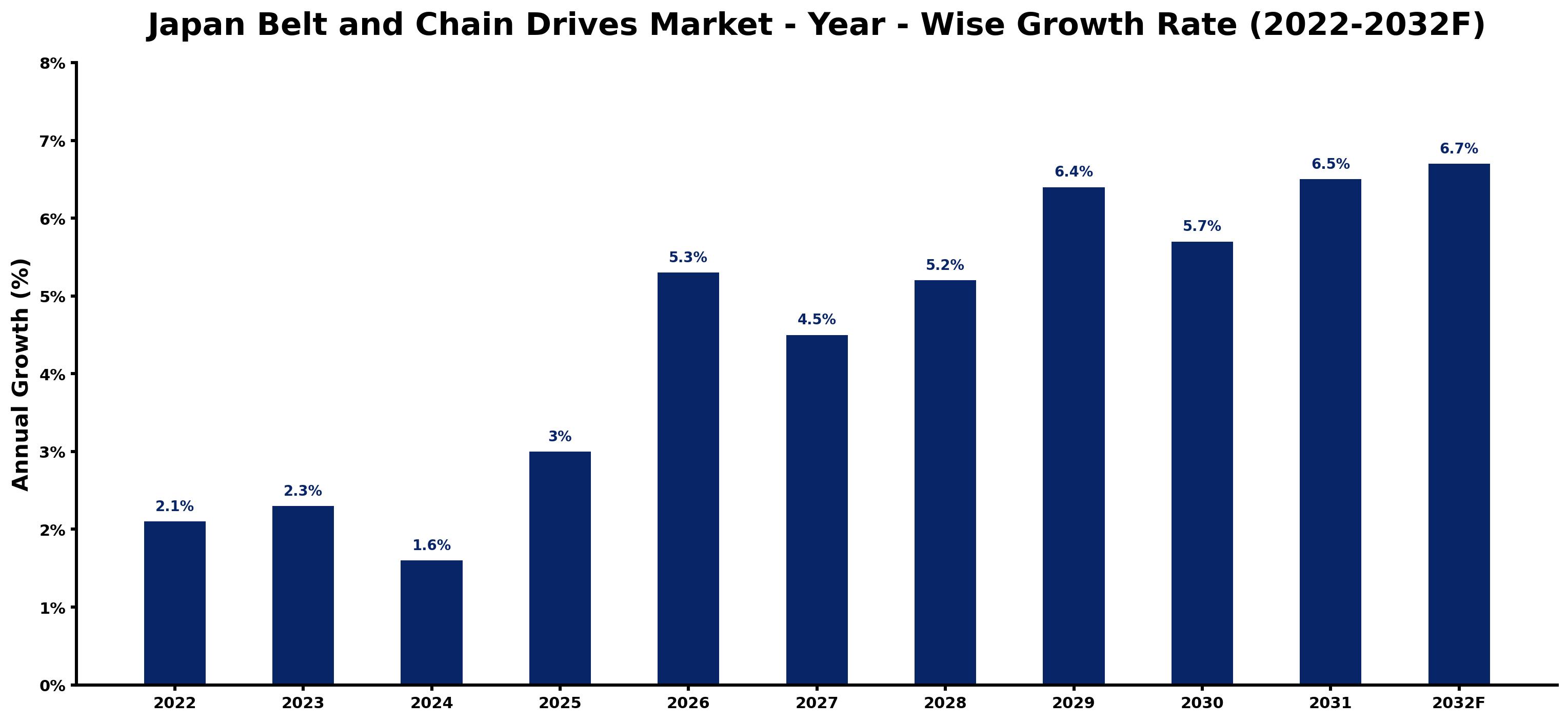
Year by year, the estimates below pair each growth rate with the development that shaped it.
| Year | Estimated Annual Growth (%) | Market Rationale |
| 2022 | 2.1 | The market showed steady activity with existing demand from automotive and industrial sectors. |
| 2023 | 2.3 | Growth accelerated due to increased production in the automotive sector and machinery upgrades. |
| 2024 | 1.6 | Growth slowed as manufacturers adjusted to market saturation and demand stabilised. |
| 2025 | 3.0 | Demand surged as automotive production ramped up, reaching a historical peak in growth. |
| 2026 | 5.3 | The market is expected to continue expanding due to rising automation in manufacturing processes. |
| 2027 | 4.5 | Growth will decelerate slightly as supply chain challenges begin to impact production schedules. |
| 2028 | 5.2 | Demand is projected to increase again as investments in advanced manufacturing technologies take effect. |
| 2029 | 6.4 | The market will experience a strong uptick driven by new automotive models requiring updated drives. |
| 2030 | 5.7 | Growth is expected to moderate as manufacturers face challenges in sourcing raw materials. |
| 2031 | 6.5 | Demand will rise again as companies adapt to new technologies and production methods. |
| 2032 | 6.7 | The market is projected to peak with substantial investments in automation and robotics. |
Note: Market size estimations and growth projections presented in this report are based on 6Wresearch's proprietary forecasting methodology, utilizing the latest available industry data, government publications, and primary research inputs.
Japan Belt and Chain Drives Market Synopsis
Belt and chain drives are mechanical devices that transmit power between shafts in machinery, made from materials like steel and rubber. Key applications include automotive powertrains and industrial machinery. The Japan Belt and Chain Drives Market is growing due to strong demand from the automotive sector, which accounts for approximately 30% of the market, alongside advancements in manufacturing technologies. The industrial machinery sector, particularly in regions like Aichi and Osaka, is also contributing to growth, supported by government initiatives promoting automation and efficiency.
Market Dynamics Impact Analysis (2026–2032)
| Factor | Type | Impact | Primary Segment Affected |
| Rising automotive production | Driver | High | Automotive |
| Increased investment in industrial automation | Driver | High | Industrial Machinery |
| Growing demand for silent chains due to noise regulations | Opportunity | Medium | Silent Chain |
| Expansion of manufacturing facilities in key regions | Opportunity | Medium | Industrial Machinery |
| Supply chain disruptions affecting raw material availability | Restraint | High | Transmission Chain |
| High competition leading to price pressures | Restraint | Medium | Transmission Chain |
| Technological advancements requiring constant adaptation | Challenge | High | Transmission Chain |
| Fluctuations in global demand impacting exports | Challenge | Medium | Transmission Chain |
Evaluation of Drivers in Japan Belt and Chain Drives Market (2026–2032)
Below are the drivers that matter most for revenue growth, with supporting evidence.
| Drivers | Primary Segment Affected | Why It Matters (Evidence) |
| Increased automotive production | Automotive | The automotive sector's output accounts for approximately 30% of the market, driving demand for belt and chain drives. |
| Investment in industrial automation | Industrial Machinery | The industrial machinery sector in Japan is valued at 15 trillion yen, spurring demand for efficient power transmission. |
| Demand for high-speed applications | Silent Chain | Silent chains are increasingly used in automotive applications, aligning with noise reduction regulations that are becoming stricter. |
| Growth in agricultural machinery | Agriculture | The agricultural machinery market is valued at approximately 1 trillion yen, contributing to chain drive demand. |
| Expansion of manufacturing capabilities | Transmission Chain | The Tokyo metropolitan area is a key industrial hub, increasing production capacity for various chain types. |
Several shifts outside the market lift sales. The automotive sector, accounting for about 30% of the market, drives demand as production ramps up. In 2023, Japan's industrial machinery production reached an estimated 15 trillion yen, leading to increased investments in automation technologies. The agricultural machinery market, valued at approximately 1 trillion yen, is also contributing to demand, particularly for transmission chains. The growth in these sectors is prompting manufacturers to improve their production capabilities to meet rising needs.
Evaluation of Restraints in Japan Belt and Chain Drives Market
The following restraints limit how fast demand can grow.
| Market Restraint | Primary Segment Affected | Why It Matters (Evidence) |
| Supply chain disruptions | Automotive | Supply chain disruptions have affected raw material availability, delaying production schedules in the automotive sector, which relies heavily on timely deliveries. |
| High competition | Transmission Chain | Intense competition among manufacturers leads to price pressures, impacting profitability across the market and forcing some to reduce prices. |
| Technological adaptation challenges | Transmission Chain | Rapid technological advancements require constant adaptation, straining resources for manufacturers who must invest continually. |
| Export fluctuations | Transmission Chain | Fluctuations in global demand impact exports, affecting overall market stability and creating uncertainty for producers. |
| Regulatory compliance costs | Transmission Chain | Compliance with standards such as JIS B 1801 increases operational costs for manufacturers, impacting their pricing strategies. |
Japan Belt and Chain Drives Market Challenges
Producers encounter fierce competition from lower-cost manufacturers in Southeast Asia, which erodes profit margins and compels price reductions, threatening their viability. Skills shortages in advanced manufacturing technologies hinder production efficiency, delaying output for manufacturers and raising operational costs by up to 15%. Supply chain disruptions, particularly for raw materials like steel, can extend lead times by several weeks, affecting distributors who depend on timely deliveries. Technology adoption lags behind global standards, resulting in inefficiencies that can cost producers up to 20% in market share.
Trends in the Japan Belt and Chain Drives Market
Several trends are reshaping the Japan Belt and Chain Drives Market; the most important are set out below.
- Shift in Automotive Applications: Automotive manufacturers are increasingly adopting silent chains for high-speed applications, driven by noise reduction regulations. In 2023, the demand for silent chains rose by approximately 15%, reflecting a growing trend towards quieter operations.
- Expansion of Manufacturing Facilities: The Tokyo metropolitan area is seeing new manufacturing facilities being established, with investments reaching approximately 15 trillion yen in industrial machinery production. This expansion is enhancing local supply capabilities.
- Transition to Advanced Manufacturing Technologies: In 2023, the Japanese government launched a program to promote advanced manufacturing technologies, targeting a 20% increase in automation by 2025. This initiative is reshaping production processes across sectors.
- Growing Demand for Automation: The push for automation in manufacturing is gaining momentum, with a target set to increase automation by 20% by 2025. This trend is particularly evident in regions like Aichi, driving demand for belt and chain drives.
Investment Opportunities in the Japan Belt and Chain Drives Market
Several openings in the Japan Belt and Chain Drives Market merit attention from investors.
- Aichi Region Manufacturing Growth: Aichi is experiencing growth in manufacturing, with investments projected to reach 15 trillion yen. Suppliers can enter this market by partnering with local manufacturers to meet rising demand.
- Investment in Silent Chains: The demand for silent chains is expected to grow due to noise regulations, with a projected increase of 8.2%. Suppliers should focus on developing products that meet these standards.
- Automotive Sector Expansion: The automotive sector, accounting for 30% of the market, is set for growth. Suppliers can benefit by aligning with automotive manufacturers to provide innovative chain solutions.
- Focus on Agricultural Machinery: With the agricultural machinery market valued at approximately 1 trillion yen, there is a need for reliable chain drives. Suppliers can target agricultural equipment manufacturers to fulfil this demand.
Government Initiatives in the Japan Belt and Chain Drives Market
The Industrial Safety and Health Act of 1972 mandates employer responsibilities regarding hazardous substances and machinery, ensuring safety standards are upheld in manufacturing. The Act on the Rational Use of Energy, established in 1979, requires large energy users to improve energy efficiency, which impacts machinery operations and energy consumption.
The New Robot Strategy launched in 2015 promotes robot use in manufacturing and agriculture. This strategy supports businesses in adopting automation technologies, improving productivity and efficiency in the machinery sector.
Future Insight of the Japan Belt and Chain Drives Market
The launch of advanced manufacturing technology programmes will reshape production capabilities by 2025, enabling suppliers to better meet market demands. By 2032, automation in manufacturing is expected to increase by 20%, improving efficiency and lowering costs for producers. Compliance with JIS B 1801 will enhance product quality, instilling greater confidence among buyers. The industrial machinery sector, valued at approximately 15 trillion yen, will drive innovations in belt and chain drives, creating new opportunities for suppliers.
Market Segmentation Analysis
Japan Belt and Chain Drives Market report covers a detailed analysis of the following market segments:
By Type – Transmission Chain Leads, Silent Chain Expected to Grow Fastest
According to Ravi Bhandari, Research Head at 6Wresearch, the largest type category in 2025 was Transmission Chain, at 37% of revenue. Transmission chains hold the largest market share due to their essential role in power transmission within machinery, particularly in the automotive sector. This is highlighted by the automotive industry's substantial contribution, which represents around 30% of the overall belt and chain drives market. The quickest growth will come from Silent Chain, forecast to expand at a CAGR of 8.2% between 2026 and 2032. The silent chain segment is experiencing rapid growth as a result of stricter noise reduction regulations, particularly in high-speed automotive applications. This trend is further reinforced by government support for advanced manufacturing technologies that prioritise quieter machinery solutions. Suppliers should focus on developing quieter chain solutions to meet the growing demand for silent chains in various applications.
By End users – Automotive Leads, Industrial Machinery Expected to Grow Fastest
With 50% of end users revenue in 2025, Automotive was the largest category. The automotive sector is the leading end-user group because it is vital for vehicle powertrains, with a significant portion of the belt and chain drives market linked to this industry. This strong demand is supported by Japan's robust automotive manufacturing capabilities and consumer preferences for reliable vehicles. Industrial Machinery is projected to grow fastest, at a CAGR of 7.4% during 2026–2032. Industrial machinery is the fastest-growing end-user segment, fuelled by increased automation initiatives and a government target to boost manufacturing automation by 20% by 2025. This growth reflects ongoing investments aimed at modernising manufacturing processes to enhance efficiency. Buyers in the industrial machinery sector should anticipate a rise in advanced solutions as suppliers respond to the increasing demand for automation.
Key Attractiveness of the Report
- 10 Years of Market Numbers
- Historical Data Starting from 2022 to 2025
- Base Year 2025
- Forecast Data until 2032
- Key Performance Indicators Impacting the Market
- Major Upcoming Developments and Projects
Key Highlights of the Report:
- Japan Belt and Chain Drives Market Outlook
- Market Size of Japan Belt and Chain Drives Market, 2025
- Forecast of Japan Belt and Chain Drives Market, 2032
- Historical Data and Forecast of Japan Belt and Chain Drives Revenues & Volume for the Period 2022-2032
- Japan Belt and Chain Drives Market Trend Evolution
- Japan Belt and Chain Drives Market Drivers and Challenges
- Japan Belt and Chain Drives Price Trends
- Japan Belt and Chain Drives Porter's Five Forces
- Japan Belt and Chain Drives Industry Life Cycle
- Historical Data and Forecast of Japan Belt and Chain Drives Market Revenues & Volume By Type for the Period 2022-2032
- Historical Data and Forecast of Japan Belt and Chain Drives Market Revenues & Volume By Transmission Chain for the Period 2022-2032
- Historical Data and Forecast of Japan Belt and Chain Drives Market Revenues & Volume By Silent Chain for the Period 2022-2032
- Historical Data and Forecast of Japan Belt and Chain Drives Market Revenues & Volume By Leaf Chain for the Period 2022-2032
- Historical Data and Forecast of Japan Belt and Chain Drives Market Revenues & Volume By Roller Chain for the Period 2022-2032
- Historical Data and Forecast of Japan Belt and Chain Drives Market Revenues & Volume By Others for the Period 2022-2032
- Historical Data and Forecast of Japan Belt and Chain Drives Market Revenues & Volume By End users for the Period 2022-2032
- Historical Data and Forecast of Japan Belt and Chain Drives Market Revenues & Volume By Automotive for the Period 2022-2032
- Historical Data and Forecast of Japan Belt and Chain Drives Market Revenues & Volume By Industrial Machinery for the Period 2022-2032
- Historical Data and Forecast of Japan Belt and Chain Drives Market Revenues & Volume By Agriculture for the Period 2022-2032
- Historical Data and Forecast of Japan Belt and Chain Drives Market Revenues & Volume By Others for the Period 2022-2032
- Japan Belt and Chain Drives Import Export Trade Statistics
- Market Opportunity Assessment By Type
- Market Opportunity Assessment By End users
- Japan Belt and Chain Drives Top Companies Market Share
- Japan Belt and Chain Drives Competitive Benchmarking By Technical and Operational Parameters
- Japan Belt and Chain Drives Company Profiles
- Japan Belt and Chain Drives Key Strategic Recommendations
Market Covered
The study includes the following segmentation.
By Type
- Transmission Chain
- Silent Chain
- Leaf Chain
- Roller Chain
- Others
By End users
- Automotive
- Industrial Machinery
- Agriculture
- Others






































