Japan Beta Agonist Feed Additives Market Size & Growth Rate
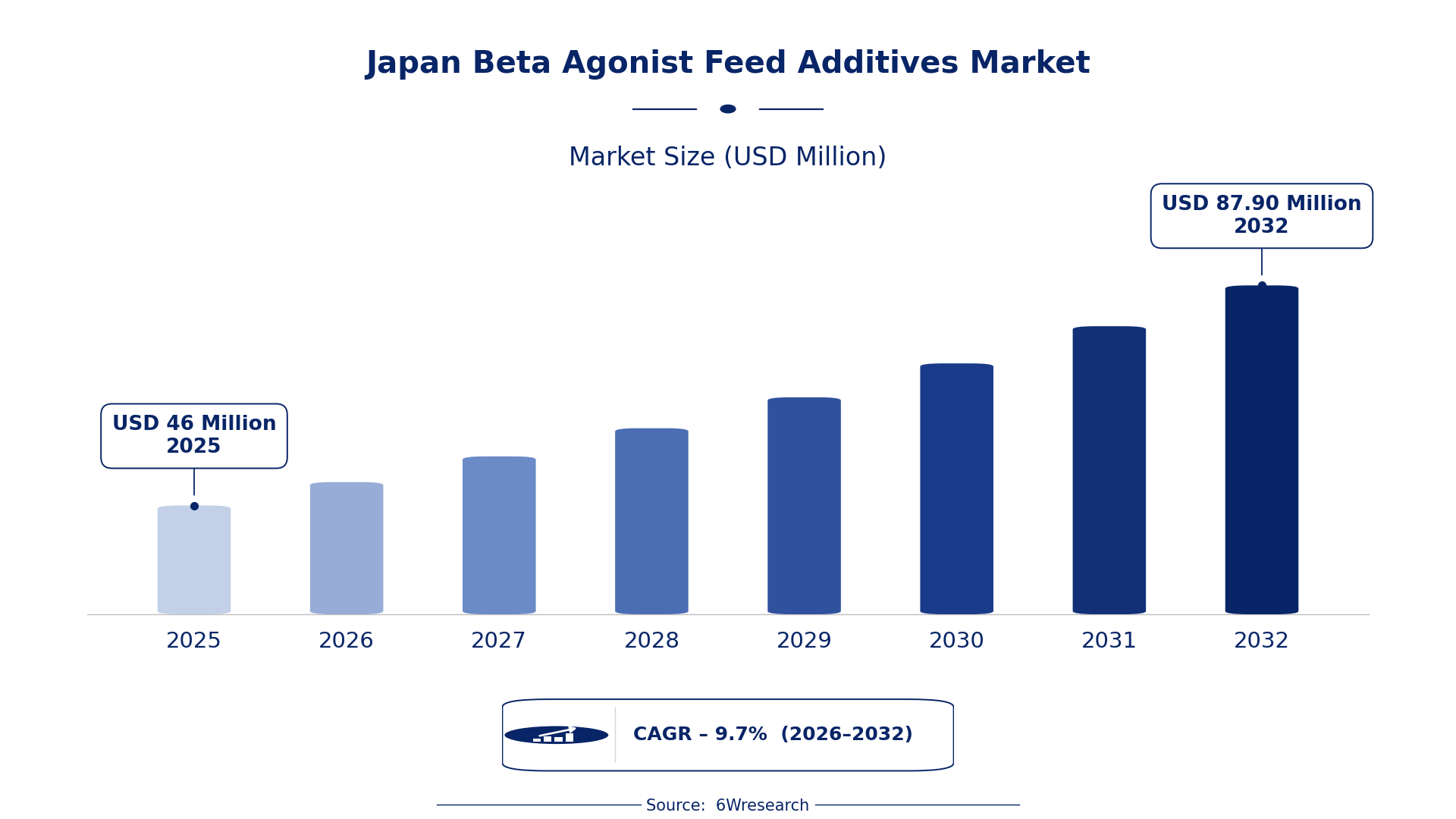
According to 6Wresearch internal database and industry insights, the Japan Beta Agonist Feed Additives Market was valued at USD 46 Million in 2025 and is projected to reach USD 87.90 Million by 2032, growing at a CAGR of approximately 9.7% during 2026–2032.
Japan Beta Agonist Feed Additives Market Highlights
| Report Metric | Details |
| Report Name | Japan Beta Agonist Feed Additives Market (2026-2032) |
| Market Size 2025 | USD 46 Million |
| Market Size 2032 | USD 87.90 Million |
| Absolute Growth 2025–2032 | USD 41.90 Million |
| CAGR 2026–2032 | 9.7% |
| Peak Annual Growth | 11.8% in 2032 |
| Forecast Period | 2026–2032 |
| Historical Data | 2022–2025 |
| Base Year | 2025 |
| Leading Product Type, 2025 | Ractopamine (48% share) |
| Leading Functionality, 2025 | Growth Promotion (49% share) |
| Leading Application Area, 2025 | Swine & Poultry (48% share) |
| Leading Distribution Channel, 2025 | Direct Sales (50% share) |
| Leading End User, 2025 | Livestock Farmers (45% share) |
| Fastest-Growing Product Type | Combination Additives (13.7% CAGR) |
| Fastest-Growing Functionality | Efficiency (12.7% CAGR) |
| Fastest-Growing Application Area | Cattle (12.2% CAGR) |
| Fastest-Growing Distribution Channel | Feed Distributors (13.0% CAGR) |
| Fastest-Growing End User | Animal Feed Companies (12.6% CAGR) |
| Growing Sector | Livestock Farming |
| Key End Users | Livestock Farmers, Animal Feed Companies, Feed Distributors |
Japan Beta Agonist Feed Additives Market Year-wise Growth Rate and Key Drivers (2022–2032)
This graph illustrates the annual growth rates of the market from 2022 to 2032, highlighting a steady upward trajectory and projected market expansion over the forecast period.
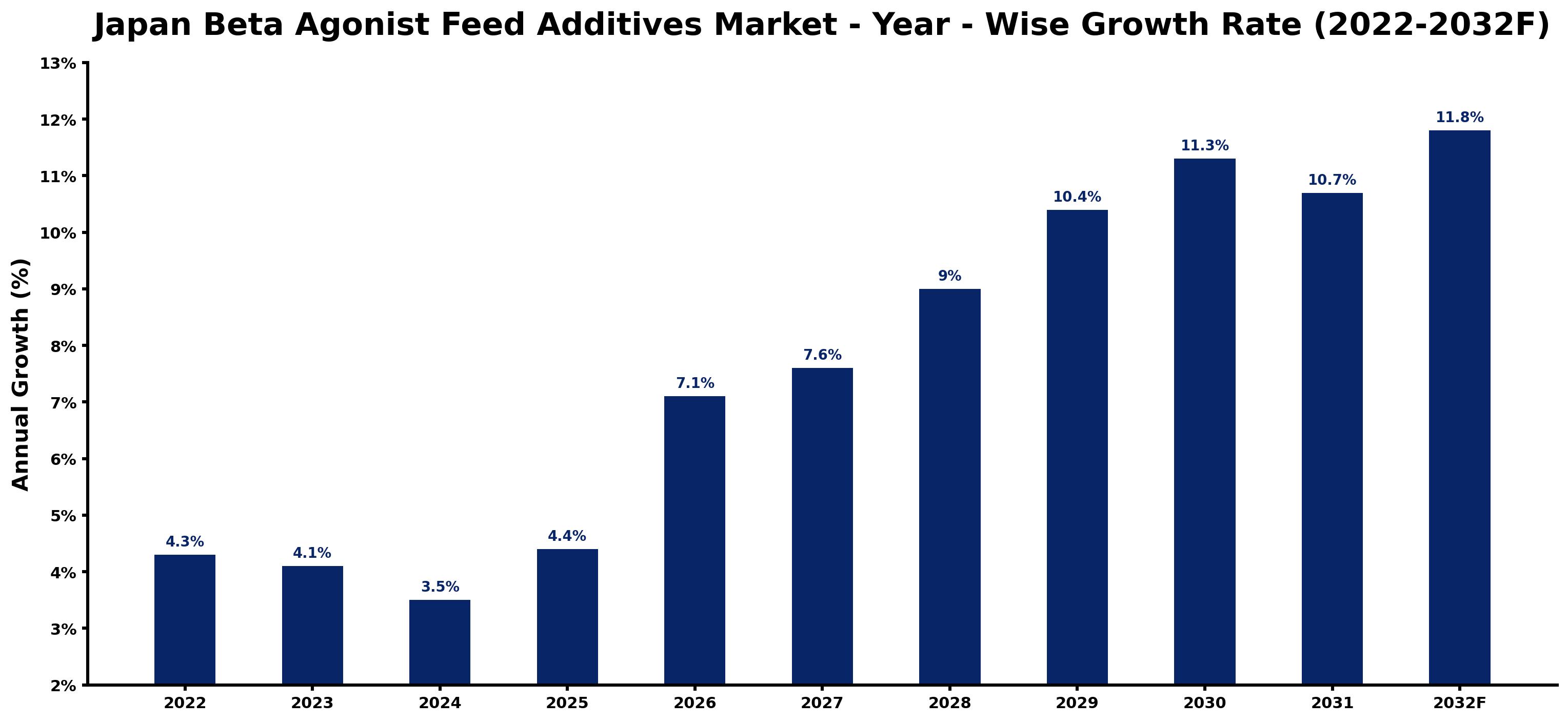
The table below sets out the estimated growth rate for each year and the main factor behind it.
| Year | Estimated Annual Growth (%) | Market Rationale |
| 2022 | 4.3 | The market experienced steady growth due to consistent demand from livestock farmers. |
| 2023 | 4.1 | Growth slowed as livestock feed regulations tightened, impacting purchasing decisions. |
| 2024 | 3.5 | A further slowdown occurred as farmers adjusted to new compliance standards. |
| 2025 | 4.4 | Growth accelerated as livestock farmers increased feed efficiency initiatives. |
| 2026 | 7.1 | Demand rose significantly with the introduction of new growth-promoting additives. |
| 2027 | 7.6 | An increase in livestock production drove higher consumption of feed additives. |
| 2028 | 9.0 | Rising meat consumption led to a further uptick in feed additive purchases. |
| 2029 | 10.4 | The market expanded as livestock farmers sought to improve productivity. |
| 2030 | 11.3 | Increased investment in livestock technology spurred demand for feed additives. |
| 2031 | 10.7 | Growth slowed slightly as the market began to stabilise after rapid expansion. |
| 2032 | 11.8 | The market peaked as new regulations supported the use of innovative additives. |
Note: Market size estimations and growth projections presented in this report are based on 6Wresearch's proprietary forecasting methodology, utilizing the latest available industry data, government publications, and primary research inputs.
Japan Beta Agonist Feed Additives Market Synopsis
Beta Agonist Feed Additives are synthetic compounds that promote growth and feed efficiency in livestock. In Japan, these additives find primary application in swine and cattle farming, with Ractopamine as a notable example. The market is expanding due to increasing meat consumption, an ageing workforce in agriculture, and government initiatives aimed at sustainable farming practices. With a livestock population surpassing 9 million pigs, the demand for effective feed additives is projected to rise significantly, prompting substantial investments in the sector.
Market Dynamics Impact Analysis (2026–2032)
| Factor | Type | Impact | Primary Segment Affected |
| Increasing meat consumption drives demand for efficient feed additives. | Driver | High | Growth Promotion |
| Rising livestock production necessitates improved feed efficiency. | Driver | High | Swine & Poultry |
| Growing demand for sustainable livestock practices presents new opportunities. | Opportunity | High | Animal Feed Companies |
| The need for compliance with strict regulations opens avenues for innovation. | Opportunity | Medium | Feed Mills |
| Regulatory restrictions limit the use of certain additives, impacting supply. | Restraint | High | Ractopamine |
| An aging farmer population poses challenges for workforce sustainability. | Restraint | Medium | Livestock Farmers |
| Cost pressures from regulatory compliance can strain producers' margins. | Challenge | High | Animal Feed Companies |
| Capacity constraints in production facilities may hinder market growth. | Challenge | Medium | Feed Distributors |
Evaluation of Drivers in Japan Beta Agonist Feed Additives Market (2026–2032)
Demand rests on the following drivers, each shown with the segment it touches most.
| Drivers | Primary Segment Affected | Why It Matters (Evidence) |
| Rising meat consumption in Japan increases demand for feed additives. | Growth Promotion | The average annual meat consumption is around 40 kg per person, prompting livestock farmers to improve growth rates. |
| The livestock population exceeding 9 million pigs necessitates efficient feed solutions. | Swine & Poultry | This large population drives the need for effective growth-promoting additives to improve production. |
| Technological advancements in feed production improve efficiency. | Efficiency | Modernisation in the agricultural sector allows for better feed formulations, increasing demand for new additives. |
| Government initiatives promote sustainable farming practices, boosting market growth. | Animal Feed Companies | Support for sustainability encourages farmers to invest in quality feed additives. |
| The livestock sector's contribution to Japan's GDP highlights its importance. | Cattle | As the livestock industry contributes about 1% to GDP, demand for efficient feed additives is essential. |
Buyers are adding capacity as the livestock population in Japan, particularly over 9 million pigs, drives demand for Beta Agonist Feed Additives. The average annual meat consumption of around 40 kg per person is prompting livestock farmers to improve growth rates. Recent advancements in feed production are increasing efficiency, which boosts demand for new additives. The livestock sector's contribution of about 1% to Japan's GDP underscores the importance of effective feed solutions in meeting rising consumption needs.
Evaluation of Restraints in Japan Beta Agonist Feed Additives Market
Several factors work against faster growth; the main ones are summarised below.
| Market Restraint | Primary Segment Affected | Why It Matters (Evidence) |
| Strict regulations limit the use of certain beta agonists in livestock feed. | Ractopamine | Japan's regulatory framework restricts the use of some additives, impacting supply availability. |
| An aging workforce in agriculture complicates production and innovation efforts. | Livestock Farmers | With the average age of farmers over 60, the sector faces challenges in maintaining productivity. |
| Rising costs associated with compliance can strain profit margins for producers. | Animal Feed Companies | Compliance with stringent regulations increases operational costs, affecting profitability. |
| Limited production capacity may hinder market expansion. | Feed Distributors | Capacity constraints restrict the availability of feed additives in the market. |
| Market competition may drive prices down, affecting profitability. | Growth Promotion | Intense competition among suppliers can lead to price wars, reducing margins for producers. |
Japan Beta Agonist Feed Additives Market Challenges
Livestock farmers face a 10-15% increase in costs due to inefficient feed use, compelling them to allocate additional budgets for nutrition. Suppliers deal with stringent regulations on beta agonists, complicating sourcing and compliance, which may delay product availability by several weeks. Regulatory hurdles from the Ministry of Agriculture, Forestry and Fisheries slow the approval of new additives, affecting producers' ability to innovate and respond to market demands. An ageing workforce, with farmers averaging over 60 years, creates a skills gap that hampers productivity and growth across the livestock sector.
Trends in the Japan Beta Agonist Feed Additives Market
Several trends are reshaping the Japan Beta Agonist Feed Additives Market; the most important are set out below.
- Rising Focus on Sustainable Practices: In 2023, a programme was launched to promote sustainable practices in livestock farming. This initiative aligns with the aim to reduce greenhouse gas emissions from livestock by 30% by 2030, encouraging farmers to adopt more efficient feed solutions.
- Shift from Traditional to Advanced Feed Additives: The livestock sector is moving towards advanced feed additives, driven by the need for efficiency. The introduction of new growth-promoting formulations is reshaping the market, with a projected 10-15% reduction in feed costs.
- Emergence of Digital Solutions in Feed Production: The Digital Agency, established in September 2021, is leading the digital transformation in agriculture. This shift towards digital solutions is set to improve operational efficiency in feed production, supporting the industry's growth.
- Increasing Demand for Combination Additives: Combination Additives are gaining traction in the market, with a CAGR of 13.7% projected from 2026 to 2032. This growth reflects the increasing need for efficient formulations that optimise feed conversion rates.
Investment Opportunities in the Japan Beta Agonist Feed Additives Market
Where to invest in the Japan Beta Agonist Feed Additives Market: the main openings are set out below.
- Investment in Sustainable Feed Solutions: With the government's goal to reduce greenhouse gas emissions by 30% by 2030, there is an opportunity to invest in sustainable feed solutions. Livestock farmers are increasingly seeking environmentally friendly options.
- Supply of Advanced Feed Additives: The market gap for advanced feed additives presents an opportunity for suppliers. With animal feed production at approximately 16 million tons in 2021, there is strong demand for new products.
- Expansion of Feed Distribution Channels: Feed distributors are looking to broaden their offerings to meet rising demand. The projected growth in the livestock sector creates a need for diverse distribution channels to effectively reach farmers.
- Collaboration with Agricultural Firms: Partnering with agricultural firms can provide access to new markets. The ageing farmer population indicates a need for new entrants, making collaboration a strategic approach to capture this opportunity.
Government Initiatives in the Japan Beta Agonist Feed Additives Market
The GX Basic Policy, adopted in 2023, aims for approximately JPY 150 trillion in public-private decarbonisation investment over the next decade. This policy builds on existing regulations by promoting sustainable practices in livestock farming, encouraging producers to adopt effective feed solutions that align with environmental goals.
In 2023, a programme was initiated to enhance livestock productivity, overseen by the Ministry of Agriculture, Forestry and Fisheries. This initiative focuses on improving feed efficiency and safety standards, ensuring that livestock farmers can access high-quality feed additives.
Future Insight of the Japan Beta Agonist Feed Additives Market
Investment in technology integration will drive efficiency improvements, creating demand for beta agonist feed additives. By 2032, the government aims for a 30% reduction in greenhouse gas emissions, prompting livestock farmers to adopt more sustainable practices. The launch of a new programme to enhance livestock productivity will encourage innovation in formulations. With animal feed production reaching approximately 16 million tons in 2021, suppliers will need to adapt to changing consumer preferences and regulatory standards.
Market Segmentation Analysis
Japan Beta Agonist Feed Additives Market report covers a detailed analysis of the following market segments:
By Product Type – Ractopamine Leads, Combination Additives Expected to Grow Fastest
According to Prakhar Dixit, Senior Research Analyst at 6Wresearch, with 48% of product type revenue in 2025, Ractopamine was the largest category. Ractopamine holds the largest share due to its widespread acceptance among livestock farmers for promoting muscle growth in swine. Its regulatory approval aligns with the needs of the over 9 million pigs in Japan's livestock population, ensuring consistent demand. The quickest growth will come from Combination Additives, forecast to expand at a CAGR of 13.7% between 2026 and 2032. Combination Additives are experiencing rapid growth as they are increasingly utilised in specialised formulations that optimise feed efficiency. The government's 2023 initiative to enhance livestock productivity is likely to further accelerate this sub-segment's expansion. Suppliers should focus on developing combination additives to capitalise on this growing market opportunity.
By Functionality – Growth Promotion Leads, Efficiency Expected to Grow Fastest
Growth Promotion accounted for 49% of the market by functionality in 2025. Growth Promotion dominates functionality as it is essential for improving livestock growth rates, particularly in swine and poultry. The focus on maximising productivity makes this functionality critical for farmers in Japan's livestock sector. Efficiency is projected to grow fastest, at a CAGR of 12.7% during 2026–2032. Efficiency is rapidly gaining traction as farmers aim to optimise feed conversion rates, which can lead to a 10-15% reduction in feed costs. This aligns with the government's commitment to sustainable livestock practices, driving further demand. Buyers will increasingly seek additives that enhance efficiency to reduce operational costs.
By Application Area – Swine & Poultry Leads, Cattle Expected to Grow Fastest
Swine & Poultry took 48% of application area revenue in 2025, more than any other category. Swine & Poultry is the leading application area, accounting for a significant portion of growth promotion efforts in Japan's livestock industry. The large population of pigs and poultry ensures a steady demand for beta agonist feed additives. Cattle is set to record the highest CAGR in this split, 12.2% over 2026–2032. Cattle applications are expanding rapidly, driven by the growing importance of beef production in Japan. As consumer preferences shift, there is an increasing need for additives that support cattle growth. Suppliers should consider diversifying their product lines to cater to the expanding cattle segment.
By Distribution Channel – Direct Sales Leads, Feed Distributors Expected to Grow Fastest
In 2025, Direct Sales led the distribution channel split with a 50% share. Direct Sales is the primary distribution channel, effectively linking suppliers with livestock farmers who are the main users of these additives. This direct approach facilitates better communication and understanding of farmers' needs. Over 2026–2032, Feed Distributors are expected to post the fastest growth, at a CAGR of 13.0%. Feed Distributors are experiencing the fastest growth as they play a crucial role in the supply chain, ensuring that additives reach a wider range of livestock farmers. Their increasing influence is essential for scaling operations in the market. Suppliers may need to strengthen partnerships with feed distributors to enhance market penetration.
By End User – Livestock Farmers Lead, Animal Feed Companies Expected to Grow Fastest
The largest end user category in 2025 was Livestock Farmers, at 45% of revenue. Livestock Farmers are the leading end users of beta agonist feed additives, as they directly utilise these products to improve livestock growth and efficiency. With approximately 1.5 million people employed in the livestock farming sector, their demand drives the market. The quickest growth will come from Animal Feed Companies, forecast to expand at a CAGR of 12.6% between 2026 and 2032. Animal Feed Companies are rapidly growing as they formulate feed products that incorporate these additives. Their critical role in the supply chain ensures that they will continue to expand alongside the livestock sector. Suppliers should focus on building relationships with animal feed companies to secure steady demand.
Key Attractiveness of the Report
- 10 Years of Market Numbers
- Historical Data Starting from 2022 to 2025
- Base Year 2025
- Forecast Data until 2032
- Key Performance Indicators Impacting the Market
- Major Upcoming Developments and Projects
Key Highlights of the Report:
- Japan Beta Agonist Feed Additives Market Outlook
- Market Size of Japan Beta Agonist Feed Additives Market, 2025
- Forecast of Japan Beta Agonist Feed Additives Market, 2032
- Historical Data and Forecast of Japan Beta Agonist Feed Additives Market Revenues & Volume for the Period 2022-2032F
- Japan Beta Agonist Feed Additives Market Trend Evolution
- Japan Beta Agonist Feed Additives Market Drivers and Challenges
- Japan Beta Agonist Feed Additives Market Price Trends
- Japan Beta Agonist Feed Additives Market Porter's Five Forces
- Japan Beta Agonist Feed Additives Market Industry Life Cycle
- Historical Data and Forecast of Japan Beta Agonist Feed Additives Market Revenues & Volume By Product Type for the Period 2022-2032F
- Historical Data and Forecast of Japan Beta Agonist Feed Additives Market Revenues & Volume By Ractopamine for the Period 2022-2032F
- Historical Data and Forecast of Japan Beta Agonist Feed Additives Market Revenues & Volume By Salbutamol for the Period 2022-2032F
- Historical Data and Forecast of Japan Beta Agonist Feed Additives Market Revenues & Volume By Clenbuterol for the Period 2022-2032F
- Historical Data and Forecast of Japan Beta Agonist Feed Additives Market Revenues & Volume By Combination Additives for the Period 2022-2032F
- Historical Data and Forecast of Japan Beta Agonist Feed Additives Market Revenues & Volume By Functionality for the Period 2022-2032F
- Historical Data and Forecast of Japan Beta Agonist Feed Additives Market Revenues & Volume By Growth Promotion for the Period 2022-2032F
- Historical Data and Forecast of Japan Beta Agonist Feed Additives Market Revenues & Volume By Respiratory Support for the Period 2022-2032F
- Historical Data and Forecast of Japan Beta Agonist Feed Additives Market Revenues & Volume By Muscle Growth for the Period 2022-2032F
- Historical Data and Forecast of Japan Beta Agonist Feed Additives Market Revenues & Volume By Efficiency for the Period 2022-2032F
- Historical Data and Forecast of Japan Beta Agonist Feed Additives Market Revenues & Volume By Application Area for the Period 2022-2032F
- Historical Data and Forecast of Japan Beta Agonist Feed Additives Market Revenues & Volume By Swine & Poultry for the Period 2022-2032F
- Historical Data and Forecast of Japan Beta Agonist Feed Additives Market Revenues & Volume By Cattle for the Period 2022-2032F
- Historical Data and Forecast of Japan Beta Agonist Feed Additives Market Revenues & Volume By Sheep & Goats for the Period 2022-2032F
- Historical Data and Forecast of Japan Beta Agonist Feed Additives Market Revenues & Volume By Mixed Livestock for the Period 2022-2032F
- Historical Data and Forecast of Japan Beta Agonist Feed Additives Market Revenues & Volume By Distribution Channel for the Period 2022-2032F
- Historical Data and Forecast of Japan Beta Agonist Feed Additives Market Revenues & Volume By Direct Sales for the Period 2022-2032F
- Historical Data and Forecast of Japan Beta Agonist Feed Additives Market Revenues & Volume By Feed Distributors for the Period 2022-2032F
- Historical Data and Forecast of Japan Beta Agonist Feed Additives Market Revenues & Volume By Online Platforms for the Period 2022-2032F
- Historical Data and Forecast of Japan Beta Agonist Feed Additives Market Revenues & Volume By Specialty Vendors for the Period 2022-2032F
- Historical Data and Forecast of Japan Beta Agonist Feed Additives Market Revenues & Volume By End User for the Period 2022-2032F
- Historical Data and Forecast of Japan Beta Agonist Feed Additives Market Revenues & Volume By Livestock Farmers for the Period 2022-2032F
- Historical Data and Forecast of Japan Beta Agonist Feed Additives Market Revenues & Volume By Animal Feed Companies for the Period 2022-2032F
- Historical Data and Forecast of Japan Beta Agonist Feed Additives Market Revenues & Volume By Agricultural Firms for the Period 2022-2032F
- Historical Data and Forecast of Japan Beta Agonist Feed Additives Market Revenues & Volume By Feed Mills for the Period 2022-2032F
- Japan Beta Agonist Feed Additives Market Import Export Trade Statistics
- Market Opportunity Assessment By Product Type
- Market Opportunity Assessment By Functionality
- Market Opportunity Assessment By Application Area
- Market Opportunity Assessment By Distribution Channel
- Market Opportunity Assessment By End User
- Japan Beta Agonist Feed Additives Market Top Companies Market Share
- Japan Beta Agonist Feed Additives Market Competitive Benchmarking By Technical and Operational Parameters
- Japan Beta Agonist Feed Additives Market Company Profiles
- Japan Beta Agonist Feed Additives Market Key Strategic Recommendations
Market Covered
The report covers the following segments.
By Product Type
- Ractopamine
- Salbutamol
- Clenbuterol
- Combination Additives
By Functionality
- Growth Promotion
- Respiratory Support
- Muscle Growth
- Efficiency
By Application Area
- Swine & Poultry
- Cattle
- Sheep & Goats
- Mixed Livestock
By Distribution Channel
- Direct Sales
- Feed Distributors
- Online Platforms
- Specialty Vendors
By End User
- Livestock Farmers
- Animal Feed Companies
- Agricultural Firms
- Feed Mills






































