Japan Bio-Based Soil Stabilizers Market Size & Growth Rate
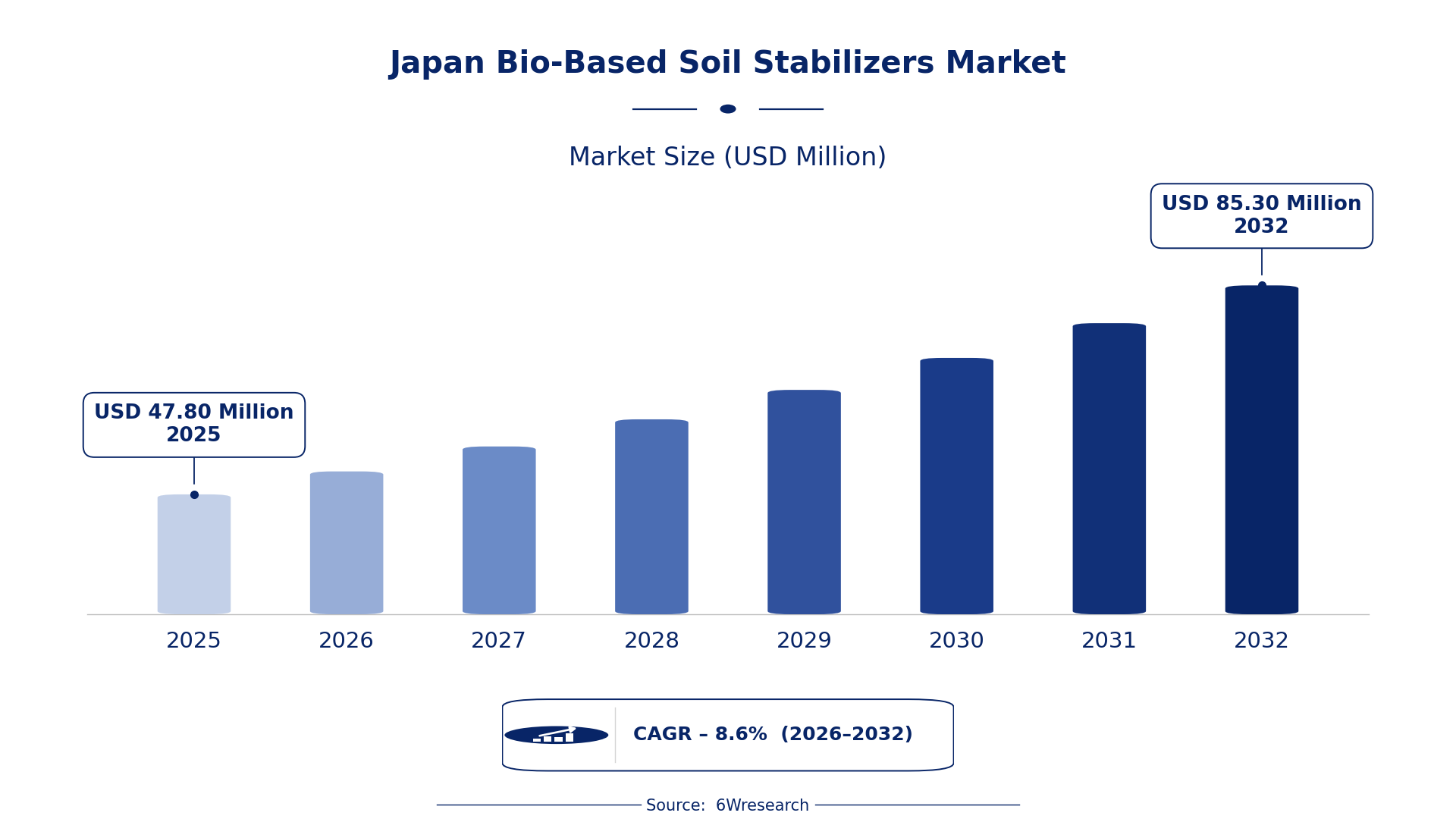
According to 6Wresearch internal database and industry insights, the Japan Bio-Based Soil Stabilizers Market was valued at USD 47.80 Million in 2025 and is projected to reach USD 85.30 Million by 2032, growing at a CAGR of approximately 8.6% during 2026–2032.
Japan Bio-Based Soil Stabilizers Market Highlights
| Report Metric | Details |
| Report Name | Japan Bio-Based Soil Stabilizers Market (2026-2032) |
| Market Size 2025 | USD 47.80 Million |
| Market Size 2032 | USD 85.30 Million |
| Absolute Growth 2025–2032 | USD 37.50 Million |
| CAGR 2026–2032 | 8.6% |
| Peak Annual Growth | 9.4% in 2032 |
| Forecast Period | 2026–2032 |
| Historical Data | 2022–2025 |
| Base Year | 2025 |
| Leading Product Type, 2025 | Polysaccharide-based (44% share) |
| Leading Base Material, 2025 | Corn Starch (42% share) |
| Leading Application Area, 2025 | Road Construction (37% share) |
| Leading Distribution Channel, 2025 | Direct Sales (52% share) |
| Leading End User Industry, 2025 | Infrastructure (38% share) |
| Fastest-Growing Product Type | Lignosulfonate-based (12.0% CAGR) |
| Fastest-Growing Base Material | Wood Pulp (12.4% CAGR) |
| Fastest-Growing Application Area | Dust Control (10.1% CAGR) |
| Fastest-Growing Distribution Channel | Online Retail (11.0% CAGR) |
| Fastest-Growing End User Industry | Mining & Construction (11.1% CAGR) |
| Growing Sector | Dust Control |
| Key End Users | Road Construction, Dust Control, Erosion Control, Slope Stabilization |
Japan Bio-Based Soil Stabilizers Market Year-wise Growth Rate and Key Drivers (2022–2032)
This graph illustrates the annual growth rates of the market from 2022 to 2032, highlighting a steady upward trajectory and projected market expansion over the forecast period.
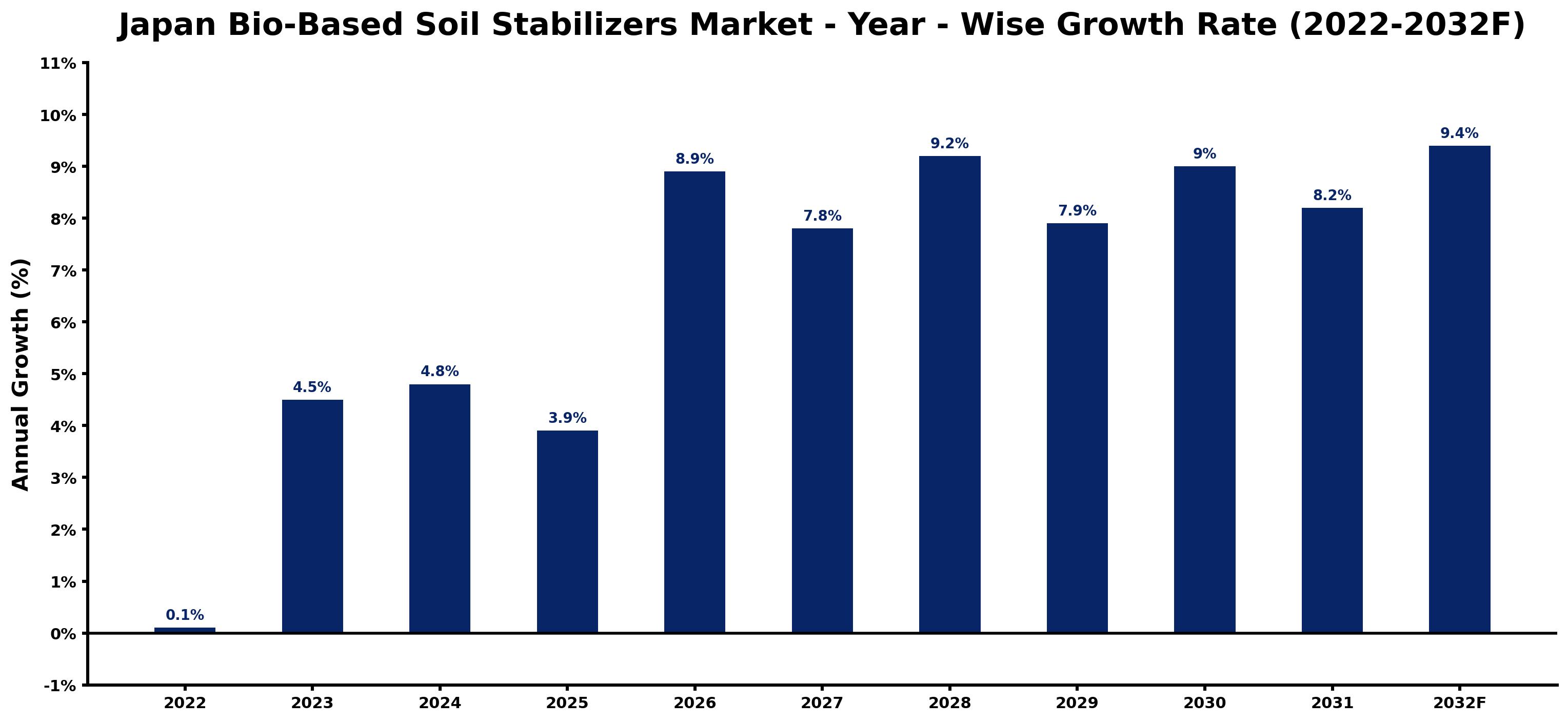
Annual growth estimates for each year appear below with the principal reason behind them, explaining the shifts that set the pace of the market.
| Year | Estimated Annual Growth (%) | Market Rationale |
| 2022 | 0.1 | The market experienced minimal growth due to limited adoption of bio-based materials. |
| 2023 | 4.5 | Demand increased as awareness of environmental benefits grew among construction firms. |
| 2024 | 4.8 | Continued interest in sustainable practices led to further growth in bio-based stabilizers. |
| 2025 | 3.9 | Growth slowed as some projects faced budget constraints and delays. |
| 2026 | 8.9 | A surge in infrastructure investment stimulated demand for eco-friendly solutions. |
| 2027 | 7.8 | Growth slowed slightly as the market adjusted to increased supply levels. |
| 2028 | 9.2 | Demand rose again as urban development projects ramped up in major cities. |
| 2029 | 7.9 | A slight slowdown occurred as market saturation began in certain regions. |
| 2030 | 9.0 | Growth accelerated as new standards promoted the use of bio-based materials. |
| 2031 | 8.2 | Demand growth slowed as the market matured and competition intensified. |
| 2032 | 9.4 | The market peaked due to strong infrastructure investments and environmental regulations. |
Note: Market size estimations and growth projections presented in this report are based on 6Wresearch's proprietary forecasting methodology, utilizing the latest available industry data, government publications, and primary research inputs.
Japan Bio-Based Soil Stabilizers Market Synopsis
Bio-Based Soil Stabilizers are eco-friendly materials derived from natural sources, primarily used to improve soil stability in construction projects and control dust on roads. The Japan Bio-Based Soil Stabilizers Market is expanding as the infrastructure sector is projected to invest ¥1 trillion in soil stabilization projects by 2025. Growth is driven by increased urban development, a rising emphasis on sustainable construction practices, and government support for eco-friendly materials, particularly in regions like Tokyo and Kansai.
Market Dynamics Impact Analysis (2026–2032)
| Factor | Type | Impact | Primary Segment Affected |
| Increased urban development projects drive demand for soil stabilizers in construction. | Driver | High | Polysaccharide-based |
| Growing emphasis on sustainable construction materials creates opportunities for bio-based solutions. | Driver | High | Corn Starch |
| Investment in eco-friendly construction materials is rising, particularly in urban areas. | Opportunity | High | Road Construction |
| The agricultural sector's interest in sustainable practices opens new markets for bio-based stabilizers. | Opportunity | Medium | Agricultural Waste |
| Budget constraints in some infrastructure projects limit the adoption of bio-based stabilizers. | Restraint | Medium | Lignosulfonate-based |
| Market saturation in certain regions leads to increased competition among suppliers. | Restraint | Medium | Direct Sales |
| Supply chain disruptions can delay the availability of bio-based materials. | Challenge | High | Infrastructure |
| Technological limitations in production processes hinder scalability of bio-based stabilizers. | Challenge | Medium | Protein-based |
Evaluation of Drivers in Japan Bio-Based Soil Stabilizers Market (2026–2032)
The table below links each growth driver to the segment it affects and the evidence for it.
| Drivers | Primary Segment Affected | Why It Matters (Evidence) |
| Urban development projects are increasing demand for soil stabilizers. | Polysaccharide-based | In Tokyo, infrastructure investments are projected to reach ¥1 trillion by 2025. |
| Sustainable construction practices are gaining traction among builders. | Corn Starch | The Ministry of Land, Infrastructure, Transport and Tourism promotes eco-friendly materials. |
| Government initiatives support the use of bio-based materials in construction. | Lignosulfonate-based | The Japan Wood-Products Association encourages lignosulfonate adoption for dust control. |
| Growing awareness of environmental benefits boosts market interest. | Agricultural Waste | The agricultural sector is increasingly focusing on sustainable soil management practices. |
| Rising urbanisation leads to higher demand for effective soil stabilization. | Road Construction | The demand for bio-based stabilizers in civil engineering is expected to rise due to urban development projects. |
The strongest pull on demand comes from urban development projects, with infrastructure investments in Tokyo projected to reach ¥1 trillion by 2025. Awareness of environmental benefits drives interest in bio-based solutions, particularly in agriculture focusing on sustainable soil management. Rising urbanisation leads to higher demand for effective soil stabilization in civil engineering projects, stimulating market growth further. In addition, the agricultural sector is increasingly focusing on sustainable soil management practices, which further boosts demand for bio-based materials.
Evaluation of Restraints in Japan Bio-Based Soil Stabilizers Market
The table below lists the restraints and the evidence behind each.
| Market Restraint | Primary Segment Affected | Why It Matters (Evidence) |
| Budget constraints in infrastructure projects limit the adoption of bio-based stabilizers. | Lignosulfonate-based | In 2022, several projects faced funding issues, slowing material adoption. |
| Market saturation in certain regions leads to increased competition among suppliers. | Direct Sales | In Kansai, many suppliers are competing for a limited customer base. |
| Supply chain disruptions can delay the availability of bio-based materials. | Infrastructure | Recent global events have caused delays in sourcing raw materials. |
| Technological limitations in production processes hinder scalability of bio-based stabilizers. | Protein-based | Current production methods are not yet efficient for mass production. |
| Limited consumer awareness of bio-based products restricts market growth. | Agricultural Waste | Many potential users are still unaware of the benefits of bio-based solutions. |
Japan Bio-Based Soil Stabilizers Market Challenges
In 2023, Japan's infrastructure sector plans to invest ¥1 trillion in soil stabilization projects, but strong competition from traditional materials restricts market entry for bio-based options, delaying adoption for construction firms. Strict regulations under the JIS A 1450 standard create compliance challenges for suppliers, resulting in increased costs that can reach 15% of project budgets. Technological advancements are lagging, as suppliers struggle to innovate bio-based solutions, which can postpone product availability for buyers by up to six months. Supply chain disruptions due to natural disasters can lead to shortages, forcing producers to raise prices and affecting project timelines.
Trends in the Japan Bio-Based Soil Stabilizers Market
The following changes are redrawing the Japan Bio-Based Soil Stabilizers Market.
- Shift towards Eco-Friendly Construction Materials: The trend towards eco-friendly construction materials is gaining momentum in the Tokyo metropolitan area, where demand for bio-based soil stabilizers is rising. In 2023, the Ministry of Land, Infrastructure, Transport and Tourism launched a program promoting these materials.
- Increased Adoption of Agricultural Waste: The agricultural sector is increasingly adopting agricultural waste for sustainable soil management. In 2023, the Ministry of Agriculture, Forestry and Fisheries reported a growing interest in using waste materials for bio-based products.
- Transition from Traditional to Bio-Based Stabilizers: Since 2022, there has been a notable shift from traditional stabilizers to bio-based alternatives in construction. This change is particularly visible in the Kansai region, where bio-based stabilizers are increasingly used for erosion control.
- Emergence of Online Retail Channels: Online retail channels are becoming more prominent for bio-based soil stabilizers, particularly since 2023. The growing preference for online purchasing has led to an 11.0% CAGR in this distribution channel.
Investment Opportunities in the Japan Bio-Based Soil Stabilizers Market
The following areas offer the clearest openings for investors and suppliers in the Japan Bio-Based Soil Stabilizers Market.
- Tokyo Infrastructure Projects: Tokyo is investing ¥1 trillion in soil stabilization projects by 2025, presenting a valuable opportunity for suppliers of bio-based stabilizers. Collaborating with local contractors can facilitate market entry.
- Kansai Region Demand: The Kansai region demonstrates a growing interest in sustainable soil management practices, with demand for bio-based stabilizers on the rise. Suppliers can enter this market by partnering with local agricultural cooperatives.
- Rising Urban Development: With urban development projects increasing, there is a growing need for effective soil stabilization solutions. Infrastructure firms in Japan are seeking reliable suppliers of bio-based materials.
- Government Support for Research: The Japanese government allocated ¥500 million for research on bio-based materials in construction, creating opportunities for innovation. Collaborating with research institutions can improve product development.
Government Initiatives in the Japan Bio-Based Soil Stabilizers Market
The Waste Management and Public Cleansing Act (1970) has been revised to include regulations promoting eco-friendly materials in construction. This measure establishes compliance requirements for producers, ensuring that bio-based soil stabilizers meet environmental standards and encouraging their adoption. Additionally, the updated regulations require that producers demonstrate the environmental benefits of their products, enhancing market credibility.
The Ministry of Land, Infrastructure, Transport and Tourism plays a key role in approving eco-friendly materials. It funds various programmes aimed at promoting sustainable construction practices, thereby supporting the growth of the bio-based soil stabilizers market. In 2023, the ministry allocated ¥200 million for initiatives focused on eco-friendly construction materials, benefiting numerous projects across Japan.
Future Insight of the Japan Bio-Based Soil Stabilizers Market
The upcoming road construction projects will prioritise eco-friendly materials, driving demand for bio-based soil stabilizers. By 2032, urban development initiatives will increase the need for sustainable solutions, with the agricultural sector also embracing bio-based practices. Government funding for research on bio-based materials is set to rise, potentially reaching ¥1 billion by 2025. As awareness of environmental impacts grows, suppliers will invest in technologies that improve product performance, benefiting both buyers and the ecosystem.
Market Segmentation Analysis
Japan Bio-Based Soil Stabilizers Market report covers a detailed analysis of the following market segments:
By Product Type – Polysaccharide-based Leads, Lignosulfonate-based Expected to Grow Fastest
According to Saurav Kr Singh, Senior Research Analyst at 6Wresearch, in 2025, Polysaccharide-based led the product type split with a 44% share. Polysaccharide-based stabilizers dominate the market due to their extensive use in construction projects, particularly in urban infrastructure. Their reliability in enhancing soil stability makes them a preferred choice among contractors and builders. The quickest growth will come from Lignosulfonate-based, forecast to expand at a CAGR of 12.0% between 2026 and 2032. Lignosulfonate-based stabilizers are experiencing rapid growth as they are increasingly employed for dust control applications. The heightened emphasis on road safety and environmental sustainability is significantly driving their adoption in various projects. Suppliers should focus on improving polysaccharide-based offerings while also exploring lignosulfonate advancements to meet the rising market demand.
By Base Material – Corn Starch Leads, Wood Pulp Expected to Grow Fastest
With 42% of base material revenue in 2025, Corn Starch was the largest category. Corn Starch holds the largest share as it is a primary ingredient in many bio-based stabilizers, ensuring consistent quality and performance. Its availability and cost-effectiveness make it a go-to choice for manufacturers in Japan. Wood Pulp is set to record the highest CAGR in this split, 12.4% over 2026–2032. Wood Pulp is gaining traction rapidly as a base material due to its sustainable sourcing and compatibility with eco-friendly formulations. The increasing focus on utilising renewable resources in production is driving this segment's growth. Manufacturers should consider diversifying their base material sources to include more sustainable options like wood pulp to align with market trends.
By Application Area – Road Construction Leads, Dust Control Expected to Grow Fastest
Road Construction took 37% of application area revenue in 2025, more than any other category. Road Construction is the leading application area for bio-based soil stabilizers, fuelled by ongoing infrastructure initiatives in urban settings. The need for robust materials in this sector ensures consistent demand for these stabilizers. Dust Control is projected to grow fastest, at a CAGR of 10.1% during 2026–2032. Dust Control applications are growing swiftly as they are vital for maintaining safety on roads, particularly in construction areas. The increasing awareness of health implications related to dust exposure is accelerating this segment's growth. Companies should adjust their marketing strategies to highlight dust control solutions to capture the increasing interest in this area.
By Distribution Channel – Direct Sales Leads, Online Retail Expected to Grow Fastest
The largest distribution channel category in 2025 was Direct Sales, at 52% of revenue. Direct Sales is the primary distribution channel, allowing manufacturers to establish strong connections with clients and ensure product quality. This method is especially effective in the construction industry, where trust and reliability are crucial. Over 2026–2032, Online Retail is expected to post the fastest growth, at a CAGR of 11.0%. Online Retail is the fastest-growing distribution channel, catering to the demand for smaller quantities of bio-based stabilizers. The convenience of online shopping attracts a broader customer base, including smaller contractors and individual buyers. Suppliers should enhance their digital presence and logistics capabilities to capitalise on the growing trend towards online sales.
By End User Industry – Infrastructure Leads, Mining & Construction Expected to Grow Fastest
Infrastructure held 38% of the Japan Bio-Based Soil Stabilizers Market by end user industry in 2025. Infrastructure is the foremost end-user industry for bio-based soil stabilizers, bolstered by significant investments in construction and urban development projects. The alignment of these materials with national environmental objectives drives their demand. The quickest growth will come from Mining & Construction, forecast to expand at a CAGR of 11.1% between 2026 and 2032. Mining & Construction is experiencing the fastest growth as these industries increasingly incorporate bio-based solutions into their operations. The shift towards sustainable practices in resource extraction is notably influencing this trend. Businesses should focus on creating tailored solutions for the mining and construction sectors to leverage their rising interest in bio-based products.
Key Attractiveness of the Report
- 10 Years of Market Numbers
- Historical Data Starting from 2022 to 2025
- Base Year 2025
- Forecast Data until 2032
- Key Performance Indicators Impacting the Market
- Major Upcoming Developments and Projects
Key Highlights of the Report:
- Japan Bio-Based Soil Stabilizers Market Outlook
- Market Size of Japan Bio-Based Soil Stabilizers Market, 2025
- Forecast of Japan Bio-Based Soil Stabilizers Market, 2032
- Historical Data and Forecast of Japan Bio-Based Soil Stabilizers Revenues & Volume for the Period 2022-2032F
- Japan Bio-Based Soil Stabilizers Market Trend Evolution
- Japan Bio-Based Soil Stabilizers Market Drivers and Challenges
- Japan Bio-Based Soil Stabilizers Price Trends
- Japan Bio-Based Soil Stabilizers Porter's Five Forces
- Japan Bio-Based Soil Stabilizers Industry Life Cycle
- Historical Data and Forecast of Japan Bio-Based Soil Stabilizers Market Revenues & Volume By Product Type for the Period 2022-2032F
- Historical Data and Forecast of Japan Bio-Based Soil Stabilizers Market Revenues & Volume By Polysaccharide-based for the Period 2022-2032F
- Historical Data and Forecast of Japan Bio-Based Soil Stabilizers Market Revenues & Volume By Lignosulfonate-based for the Period 2022-2032F
- Historical Data and Forecast of Japan Bio-Based Soil Stabilizers Market Revenues & Volume By Protein-based for the Period 2022-2032F
- Historical Data and Forecast of Japan Bio-Based Soil Stabilizers Market Revenues & Volume By Gums & Resins for the Period 2022-2032F
- Historical Data and Forecast of Japan Bio-Based Soil Stabilizers Market Revenues & Volume By Base Material for the Period 2022-2032F
- Historical Data and Forecast of Japan Bio-Based Soil Stabilizers Market Revenues & Volume By Corn Starch for the Period 2022-2032F
- Historical Data and Forecast of Japan Bio-Based Soil Stabilizers Market Revenues & Volume By Wood Pulp for the Period 2022-2032F
- Historical Data and Forecast of Japan Bio-Based Soil Stabilizers Market Revenues & Volume By Agricultural Waste for the Period 2022-2032F
- Historical Data and Forecast of Japan Bio-Based Soil Stabilizers Market Revenues & Volume By Plant-based for the Period 2022-2032F
- Historical Data and Forecast of Japan Bio-Based Soil Stabilizers Market Revenues & Volume By Application Area for the Period 2022-2032F
- Historical Data and Forecast of Japan Bio-Based Soil Stabilizers Market Revenues & Volume By Road Construction for the Period 2022-2032F
- Historical Data and Forecast of Japan Bio-Based Soil Stabilizers Market Revenues & Volume By Dust Control for the Period 2022-2032F
- Historical Data and Forecast of Japan Bio-Based Soil Stabilizers Market Revenues & Volume By Erosion Control for the Period 2022-2032F
- Historical Data and Forecast of Japan Bio-Based Soil Stabilizers Market Revenues & Volume By Slope Stabilization for the Period 2022-2032F
- Historical Data and Forecast of Japan Bio-Based Soil Stabilizers Market Revenues & Volume By Distribution Channel for the Period 2022-2032F
- Historical Data and Forecast of Japan Bio-Based Soil Stabilizers Market Revenues & Volume By Direct Sales for the Period 2022-2032F
- Historical Data and Forecast of Japan Bio-Based Soil Stabilizers Market Revenues & Volume By Online Retail for the Period 2022-2032F
- Historical Data and Forecast of Japan Bio-Based Soil Stabilizers Market Revenues & Volume By Distributors for the Period 2022-2032F
- Historical Data and Forecast of Japan Bio-Based Soil Stabilizers Market Revenues & Volume By Industrial Suppliers for the Period 2022-2032F
- Historical Data and Forecast of Japan Bio-Based Soil Stabilizers Market Revenues & Volume By End User Industry for the Period 2022-2032F
- Historical Data and Forecast of Japan Bio-Based Soil Stabilizers Market Revenues & Volume By Infrastructure for the Period 2022-2032F
- Historical Data and Forecast of Japan Bio-Based Soil Stabilizers Market Revenues & Volume By Mining & Construction for the Period 2022-2032F
- Historical Data and Forecast of Japan Bio-Based Soil Stabilizers Market Revenues & Volume By Agriculture for the Period 2022-2032F
- Historical Data and Forecast of Japan Bio-Based Soil Stabilizers Market Revenues & Volume By Civil Engineering for the Period 2022-2032F
- Japan Bio-Based Soil Stabilizers Import Export Trade Statistics
- Market Opportunity Assessment By Product Type
- Market Opportunity Assessment By Base Material
- Market Opportunity Assessment By Application Area
- Market Opportunity Assessment By Distribution Channel
- Market Opportunity Assessment By End User Industry
- Japan Bio-Based Soil Stabilizers Top Companies Market Share
- Japan Bio-Based Soil Stabilizers Competitive Benchmarking By Technical and Operational Parameters
- Japan Bio-Based Soil Stabilizers Company Profiles
- Japan Bio-Based Soil Stabilizers Key Strategic Recommendations
Market Covered
Segments analysed in this report are listed below.
By Product Type
- Polysaccharide-based
- Lignosulfonate-based
- Protein-based
- Gums & Resins
By Base Material
- Corn Starch
- Wood Pulp
- Agricultural Waste
- Plant-based
By Application Area
- Road Construction
- Dust Control
- Erosion Control
- Slope Stabilization
By Distribution Channel
- Direct Sales
- Online Retail
- Distributors
- Industrial Suppliers
By End User Industry
- Infrastructure
- Mining & Construction
- Agriculture
- Civil Engineering






































