Japan Biodegradable Agricultural Films Market Size & Growth Rate
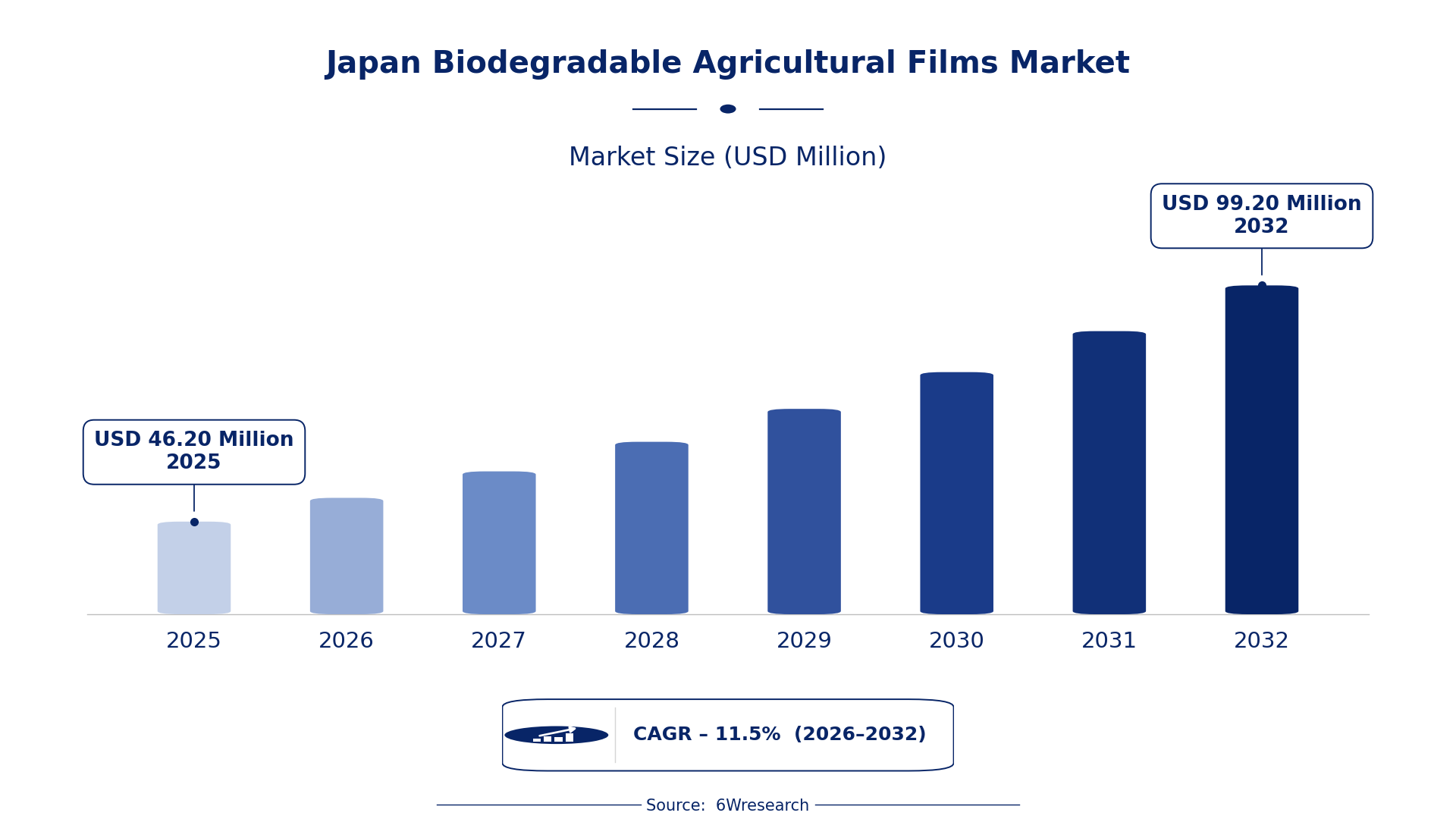
According to 6Wresearch internal database and industry insights, the Japan Biodegradable Agricultural Films Market was valued at USD 46.20 Million in 2025 and is projected to reach USD 99.20 Million by 2032, growing at a CAGR of approximately 11.5% during 2026–2032.
Japan Biodegradable Agricultural Films Market Highlights
| Report Metric | Details |
| Report Name | Japan Biodegradable Agricultural Films Market (2026-2032) |
| Market Size 2025 | USD 46.20 Million |
| Market Size 2032 | USD 99.20 Million |
| Absolute Growth 2025–2032 | USD 53 Million |
| CAGR 2026–2032 | 11.5% |
| Peak Annual Growth | 13.6% in 2032 |
| Forecast Period | 2026–2032 |
| Historical Data | 2022–2025 |
| Base Year | 2025 |
| Leading Film Type, 2025 | Mulch Films (36% share) |
| Leading Raw Material, 2025 | PLA-based (43% share) |
| Leading Application Area, 2025 | Crop Protection (34% share) |
| Leading Distribution Channel, 2025 | Direct Sales (37% share) |
| Leading End User Industry, 2025 | Farms (42% share) |
| Fastest-Growing Film Type | Compostable Films (16.9% CAGR) |
| Fastest-Growing Raw Material | Biopolymers (17.1% CAGR) |
| Fastest-Growing Application Area | Soil Conditioning (13.9% CAGR) |
| Fastest-Growing Distribution Channel | Online Retail (15.3% CAGR) |
| Fastest-Growing End User Industry | Sustainable Agriculture (15.8% CAGR) |
| Growing Sector | Horticulture |
| Key End Users | Farms, Horticulture, Livestock Sector, Sustainable Agriculture |
Japan Biodegradable Agricultural Films Market Year-wise Growth Rate and Key Drivers (2022–2032)
This graph illustrates the annual growth rates of the market from 2022 to 2032, highlighting a steady upward trajectory and projected market expansion over the forecast period.
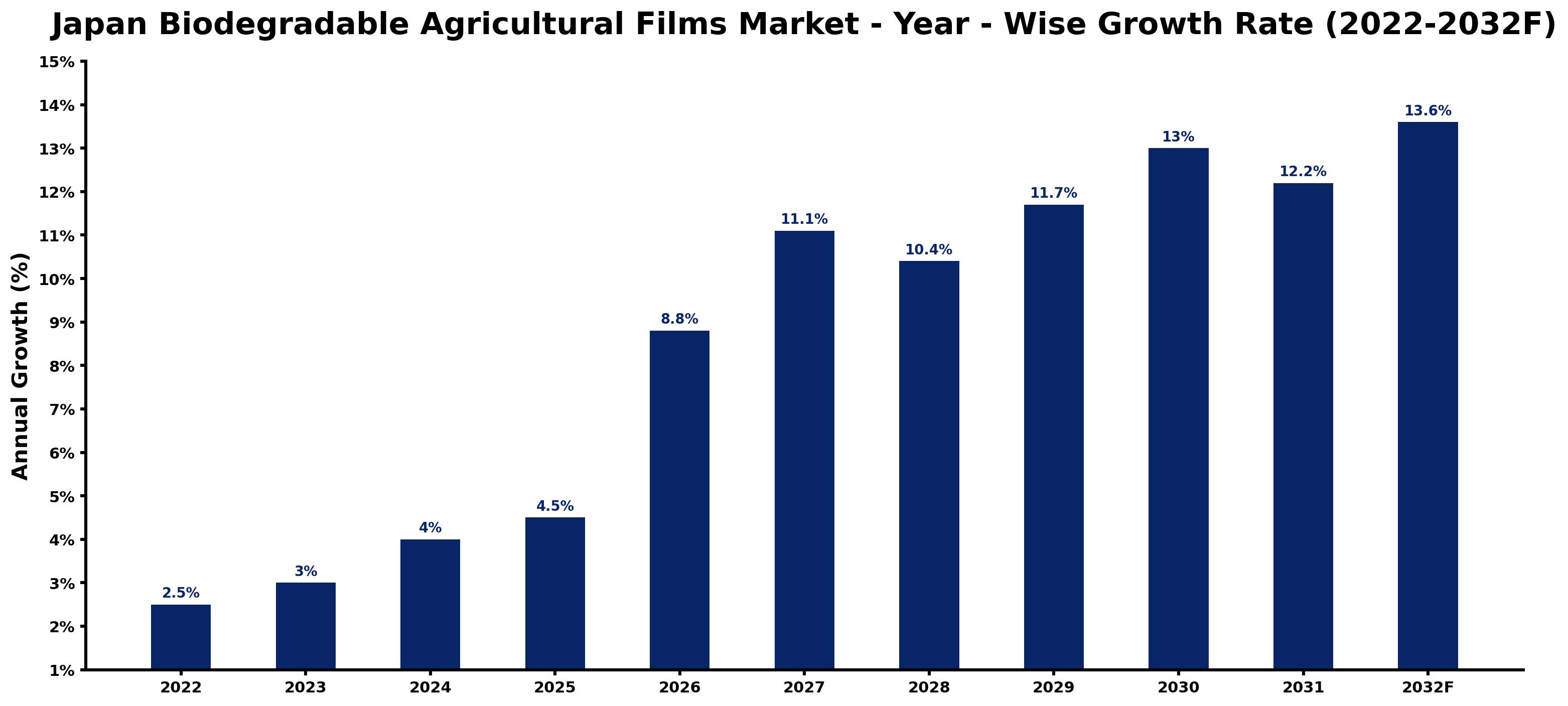
The yearly estimates that follow link every growth rate to its principal driver, so readers can see why the pace changed in each period.
| Year | Estimated Annual Growth (%) | Market Rationale |
| 2022 | 2.5 | The market exhibited steady growth as awareness of biodegradable solutions increased among farmers. |
| 2023 | 3.0 | Demand accelerated due to rising interest in sustainable agricultural practices across Japan. |
| 2024 | 4.0 | Growth continued as more farmers adopted biodegradable films for crop protection and soil conditioning. |
| 2025 | 4.5 | The market reached its historical peak as the agricultural sector valued sustainability highly. |
| 2026 | 8.8 | Demand is expected to rise with increasing investments in eco-friendly farming technologies. |
| 2027 | 11.1 | Growth will continue as the horticulture sector expands its use of biodegradable films. |
| 2028 | 10.4 | The growth rate is projected to slow slightly as the market matures and competition increases. |
| 2029 | 11.7 | Demand is anticipated to pick up again as new biodegradable products enter the market. |
| 2030 | 13.0 | The market is expected to grow rapidly, driven by government initiatives promoting sustainable agriculture. |
| 2031 | 12.2 | Growth will moderate as the market stabilises and adoption rates level off. |
| 2032 | 13.6 | The market will peak as biodegradable films become a standard in agricultural practices. |
Note: Market size estimations and growth projections presented in this report are based on 6Wresearch's proprietary forecasting methodology, utilizing the latest available industry data, government publications, and primary research inputs.
Japan Biodegradable Agricultural Films Market Synopsis
Biodegradable agricultural films are crafted from renewable resources such as starch and polylactic acid, designed to decompose naturally and thus reduce plastic waste in agriculture. The Japan Biodegradable Agricultural Films Market is growing due to rising demand from domestic farms and the horticulture sector, which prioritises sustainable practices. The agricultural sector, valued at approximately 8 trillion JPY, is a key driver of this growth, supported by initiatives that promote the adoption of eco-friendly technologies and practices.
Market Dynamics Impact Analysis (2026–2032)
| Factor | Type | Impact | Primary Segment Affected |
| Growing adoption of sustainable farming practices | Driver | High | Crop Protection |
| Increasing area under organic farming | Driver | High | Soil Conditioning |
| Rising demand for eco-friendly solutions | Opportunity | High | Horticulture |
| Expansion of urban farming initiatives | Opportunity | Medium | Forage Preservation |
| Limited awareness among traditional farmers | Restraint | Medium | Mulch Films |
| Higher initial costs compared to conventional films | Restraint | High | Silage Films |
| Competition from non-biodegradable alternatives | Challenge | High | Greenhouse Films |
| Supply chain disruptions affecting availability | Challenge | Medium | Compostable Films |
Evaluation of Drivers in Japan Biodegradable Agricultural Films Market (2026–2032)
The following drivers explain most of the expected growth.
| Drivers | Primary Segment Affected | Why It Matters (Evidence) |
| Increased investment in organic farming practices | Soil Conditioning | The area under organic farming reached 400,000 hectares in 2023, leading to higher demand for biodegradable films. |
| Government initiatives promoting sustainable agriculture | Crop Protection | The Plastic Resource Circulation Act encourages the use of biodegradable films, driving demand among farmers. |
| Growing consumer preference for eco-friendly products | Horticulture | As consumers demand sustainable options, the horticulture sector increasingly adopts biodegradable films. |
| Rising awareness of plastic waste issues | Mulch Films | The Ministry of the Environment's initiatives to reduce plastic waste boost the use of biodegradable films. |
| Technological advancements in film production | Compostable Films | Innovations in biopolymer technology attract more farmers to biodegradable options. |
The strongest pull on demand comes from increased investment in organic farming practices, with the area under organic farming reaching 400,000 hectares in 2023. Consumer preference for eco-friendly products drives the horticulture sector's adoption of these films. Awareness of plastic waste issues further boosts demand, while advancements in biopolymer technology improve product properties, attracting more farmers to these options.
Evaluation of Restraints in Japan Biodegradable Agricultural Films Market
Several factors work against faster growth; the main ones are summarised below.
| Market Restraint | Primary Segment Affected | Why It Matters (Evidence) |
| Limited awareness among traditional farmers about biodegradable options | Mulch Films | Many traditional farmers lack knowledge of biodegradable films, hindering their adoption and market growth. |
| Higher initial costs compared to conventional films | Silage Films | The cost barrier prevents some farmers from switching to biodegradable alternatives, affecting overall demand. |
| Competition from non-biodegradable alternatives | Greenhouse Films | Non-biodegradable films remain cheaper and more familiar to many farmers, limiting market penetration. |
| Supply chain disruptions affecting availability | Compostable Films | Logistical challenges can delay the distribution of biodegradable films, impacting farmer access and sales. |
| Regulatory hurdles in product approval | PLA-based | Strict regulations can slow down the introduction of new biodegradable film products, affecting market growth. |
Japan Biodegradable Agricultural Films Market Challenges
Farmers encounter higher costs due to stringent regulations on biodegradable materials, which necessitate compliance with JIS standards. This situation can lead to delays in planting, risking reduced crop yields for producers who depend on timely application. Buyers face price increases as the agricultural sector, valued at approximately 8 trillion JPY in 2022, shifts towards sustainable solutions. Technological limitations impede the development of more efficient biodegradable films, causing delays in innovation for suppliers. Supply chain disruptions complicate raw material availability, forcing producers to manage longer lead times and increased operational costs.
Trends in the Japan Biodegradable Agricultural Films Market
The trends below show where the Japan Biodegradable Agricultural Films Market is heading.
- Shift towards Eco-Friendly Agricultural Practices: The Sustainable Agriculture Summit in 2023 underscored the shift towards eco-friendly technologies, with 8 trillion JPY invested in the agricultural sector. This trend motivates farmers to adopt biodegradable films.
- Transition from Conventional to Biodegradable Films: In the Tokyo region, the adoption of biodegradable films is on the rise, with a 15% increase among horticulturists in 2023. This transition reflects a growing commitment to sustainability.
- Emergence of Urban Farming Initiatives: Urban farming initiatives are gaining momentum, with 400,000 hectares of organic farming in Japan as of 2023. This development drives demand for biodegradable films in urban settings.
- Growing Regulatory Support for Biodegradable Solutions: Since the introduction of the Plastic Resource Circulation Act in 2021, there has been a marked increase in the adoption of biodegradable films, focusing on reducing plastic waste.
Investment Opportunities in the Japan Biodegradable Agricultural Films Market
The following areas offer the clearest openings for investors and suppliers in the Japan Biodegradable Agricultural Films Market.
- Farmers seeking sustainable solutions: With 1.5 million farmers in Japan, there is an increasing demand for biodegradable films to comply with eco-friendly farming standards, particularly under the Plastic Resource Circulation Act.
- Biodegradable films for urban agriculture: Urban farmers require biodegradable films to support sustainable practices, with the Tokyo region emerging as a key market for such products, especially as urban farming grows.
- Investment in compostable film production: As the demand for compostable films escalates, suppliers have the opportunity to invest in production facilities to cater to the expanding horticulture sector, particularly in urban areas.
- Partnerships with agricultural cooperatives: Collaborating with agricultural cooperatives can ease market entry for suppliers, as these groups increasingly focus on sustainable farming practices.
Government Initiatives in the Japan Biodegradable Agricultural Films Market
The Plastic Resource Circulation Act, enacted in 2021, strengthens previous laws by promoting the reduction, reuse, and recycling of plastics, specifically supporting alternatives such as biodegradable films. This measure aims to decrease plastic waste in agriculture and encourages farmers to adopt eco-friendly practices. The act also establishes specific targets for plastic reduction, aiming for a 25% decrease by 2030.
Support from the Ministry of Agriculture, Forestry and Fisheries promotes sustainable agriculture through various initiatives. Programs funded by the ministry assist farmers in transitioning to biodegradable films, ensuring compliance with environmental standards. In 2023, the ministry allocated JPY 10 billion to support sustainable practices among farmers, improving their access to biodegradable solutions.
Future Insight of the Japan Biodegradable Agricultural Films Market
By 2032, urban horticulture facilities will increasingly adopt advanced film technologies, driven by government initiatives promoting sustainable agriculture. The area under organic farming is projected to expand, reaching 10% of total agricultural land, which will elevate demand for these films. Sustainable Agriculture Summits will continue to encourage eco-friendly practices and collaboration among stakeholders. As Japan's population of farmers, currently around 1.5 million, embraces these advancements, the market for biodegradable agricultural films will likely thrive.
Market Segmentation Analysis
Japan Biodegradable Agricultural Films Market report covers a detailed analysis of the following market segments:
By Film Type – Mulch Films Lead, Compostable Films Expected to Grow Fastest
According to Saurav Kr Singh, Senior Research Analyst at 6Wresearch, in 2025, Mulch Films led the film type split with a 36% share. Mulch films are widely used in Japan for effective weed control and moisture retention in crops, making them essential for farmers aiming to maximise yields. Their established presence in the agricultural sector, particularly in regions like Tokyo, contributes to their leading market share. Over 2026–2032, Compostable Films are expected to post the fastest growth, at a CAGR of 16.9%. The rapid adoption of compostable films is primarily driven by increasing awareness of environmental issues and government initiatives promoting sustainable practices. For instance, the Green Food System Strategy encourages the use of materials that decompose naturally, boosting demand for compostable options. Suppliers should focus on developing and marketing compostable films to capitalise on the growing trend towards sustainability.
By Raw Material – PLA-based Leads, Biopolymers Expected to Grow Fastest
PLA-based accounted for 43% of the market by raw material in 2025. PLA-based materials dominate the market due to their effectiveness in creating biodegradable films that meet quality standards set by JIS. Their widespread use in various agricultural applications ensures a strong demand from farmers across Japan. Biopolymers are projected to grow fastest, at a CAGR of 17.1% during 2026–2032. The biopolymers segment is experiencing rapid growth as they are increasingly recognised for their versatility in biodegradable applications, aligning with the shift towards sustainable farming. The government's push for eco-friendly solutions further accelerates this trend. Manufacturers should invest in biopolymer research to stay competitive in the evolving market.
By Application Area – Crop Protection Leads, Soil Conditioning Expected to Grow Fastest
Crop Protection held 34% of the Japan Biodegradable Agricultural Films Market by application area in 2025. Crop protection commands the largest share as it is vital for safeguarding crops from pests and diseases, directly impacting agricultural yields. This is particularly evident in regions like Tokyo, where farmers rely heavily on effective crop protection measures to maintain productivity. The quickest growth will come from Soil Conditioning, forecast to expand at a CAGR of 13.9% between 2026 and 2032. Soil conditioning is witnessing rapid growth due to its essential role in improving soil health and structure, which is crucial for sustainable farming practices. The increasing focus on soil quality among agricultural practitioners is driving this segment's swift rise. This trend indicates that suppliers must focus on developing innovative soil conditioning solutions to meet the rising demand for sustainable agriculture.
By Distribution Channel – Direct Sales Leads, Online Retail Expected to Grow Fastest
Direct Sales took 37% of distribution channel revenue in 2025, more than any other category. Direct sales serve as the primary channel for reaching farmers, allowing for direct engagement and tailored solutions to meet their specific needs. This established method of distribution ensures that farmers have immediate access to biodegradable films. Online Retail is set to record the highest CAGR in this split, 15.3% over 2026–2032. Online retail is rapidly gaining traction as a distribution channel, driven by the increasing digitalisation of purchasing processes among consumers and farmers alike. The convenience of online shopping is attracting a broader customer base, contributing to its fast growth. Suppliers should optimise their online presence to capture the growing segment of customers preferring digital purchasing options.
By End User Industry – Farms Lead, Sustainable Agriculture Expected to Grow Fastest
The largest end user industry category in 2025 was Farms, at 42% of revenue. Farms represent the primary end users of biodegradable agricultural films, as they directly utilise these products for various agricultural practices. The large population of approximately 1.5 million farmers in Japan ensures a consistent demand for these films. Over 2026–2032, Sustainable Agriculture is expected to post the fastest growth, at a CAGR of 15.8%. The sustainable agriculture sector is growing rapidly, reflecting a shift towards eco-friendly farming practices that utilise biodegradable films. This trend is supported by government initiatives aimed at increasing organic farming and reducing plastic waste. Suppliers should align their product offerings with the principles of sustainable agriculture to attract environmentally conscious buyers.
Key Attractiveness of the Report
- 10 Years of Market Numbers
- Historical Data Starting from 2022 to 2025
- Base Year 2025
- Forecast Data until 2032
- Key Performance Indicators Impacting the Market
- Major Upcoming Developments and Projects
Key Highlights of the Report:
- Japan Biodegradable Agricultural Films Market Outlook
- Market Size of Japan Biodegradable Agricultural Films Market, 2025
- Forecast of Japan Biodegradable Agricultural Films Market, 2032
- Historical Data and Forecast of Japan Biodegradable Agricultural Films Revenues & Volume for the Period 2022-2032F
- Japan Biodegradable Agricultural Films Market Trend Evolution
- Japan Biodegradable Agricultural Films Market Drivers and Challenges
- Japan Biodegradable Agricultural Films Price Trends
- Japan Biodegradable Agricultural Films Porter's Five Forces
- Japan Biodegradable Agricultural Films Industry Life Cycle
- Historical Data and Forecast of Japan Biodegradable Agricultural Films Market Revenues & Volume By Film Type for the Period 2022-2032F
- Historical Data and Forecast of Japan Biodegradable Agricultural Films Market Revenues & Volume By Mulch Films for the Period 2022-2032F
- Historical Data and Forecast of Japan Biodegradable Agricultural Films Market Revenues & Volume By Silage Films for the Period 2022-2032F
- Historical Data and Forecast of Japan Biodegradable Agricultural Films Market Revenues & Volume By Greenhouse Films for the Period 2022-2032F
- Historical Data and Forecast of Japan Biodegradable Agricultural Films Market Revenues & Volume By Compostable Films for the Period 2022-2032F
- Historical Data and Forecast of Japan Biodegradable Agricultural Films Market Revenues & Volume By Raw Material for the Period 2022-2032F
- Historical Data and Forecast of Japan Biodegradable Agricultural Films Market Revenues & Volume By Starch Blends for the Period 2022-2032F
- Historical Data and Forecast of Japan Biodegradable Agricultural Films Market Revenues & Volume By PLA-based for the Period 2022-2032F
- Historical Data and Forecast of Japan Biodegradable Agricultural Films Market Revenues & Volume By PBAT + PLA for the Period 2022-2032F
- Historical Data and Forecast of Japan Biodegradable Agricultural Films Market Revenues & Volume By Biopolymers for the Period 2022-2032F
- Historical Data and Forecast of Japan Biodegradable Agricultural Films Market Revenues & Volume By Application Area for the Period 2022-2032F
- Historical Data and Forecast of Japan Biodegradable Agricultural Films Market Revenues & Volume By Crop Protection for the Period 2022-2032F
- Historical Data and Forecast of Japan Biodegradable Agricultural Films Market Revenues & Volume By Forage Preservation for the Period 2022-2032F
- Historical Data and Forecast of Japan Biodegradable Agricultural Films Market Revenues & Volume By Environmental Covering for the Period 2022-2032F
- Historical Data and Forecast of Japan Biodegradable Agricultural Films Market Revenues & Volume By Soil Conditioning for the Period 2022-2032F
- Historical Data and Forecast of Japan Biodegradable Agricultural Films Market Revenues & Volume By Distribution Channel for the Period 2022-2032F
- Historical Data and Forecast of Japan Biodegradable Agricultural Films Market Revenues & Volume By Direct Sales for the Period 2022-2032F
- Historical Data and Forecast of Japan Biodegradable Agricultural Films Market Revenues & Volume By Distributors for the Period 2022-2032F
- Historical Data and Forecast of Japan Biodegradable Agricultural Films Market Revenues & Volume By Online Retail for the Period 2022-2032F
- Historical Data and Forecast of Japan Biodegradable Agricultural Films Market Revenues & Volume By Agro Dealers for the Period 2022-2032F
- Historical Data and Forecast of Japan Biodegradable Agricultural Films Market Revenues & Volume By End User Industry for the Period 2022-2032F
- Historical Data and Forecast of Japan Biodegradable Agricultural Films Market Revenues & Volume By Farms for the Period 2022-2032F
- Historical Data and Forecast of Japan Biodegradable Agricultural Films Market Revenues & Volume By Livestock Sector for the Period 2022-2032F
- Historical Data and Forecast of Japan Biodegradable Agricultural Films Market Revenues & Volume By Horticulture for the Period 2022-2032F
- Historical Data and Forecast of Japan Biodegradable Agricultural Films Market Revenues & Volume By Sustainable Agriculture for the Period 2022-2032F
- Japan Biodegradable Agricultural Films Import Export Trade Statistics
- Market Opportunity Assessment By Film Type
- Market Opportunity Assessment By Raw Material
- Market Opportunity Assessment By Application Area
- Market Opportunity Assessment By Distribution Channel
- Market Opportunity Assessment By End User Industry
- Japan Biodegradable Agricultural Films Top Companies Market Share
- Japan Biodegradable Agricultural Films Competitive Benchmarking By Technical and Operational Parameters
- Japan Biodegradable Agricultural Films Company Profiles
- Japan Biodegradable Agricultural Films Key Strategic Recommendations
Market Covered
The following segment groups are covered in the report.
By Film Type
- Mulch Films
- Silage Films
- Greenhouse Films
- Compostable Films
By Raw Material
- Starch Blends
- PLA-based
- PBAT + PLA
- Biopolymers
By Application Area
- Crop Protection
- Forage Preservation
- Environmental Covering
- Soil Conditioning
By Distribution Channel
- Direct Sales
- Distributors
- Online Retail
- Agro Dealers
By End User Industry
- Farms
- Livestock Sector
- Horticulture
- Sustainable Agriculture






































