Japan Biological Crop Protection Market Size & Growth Rate
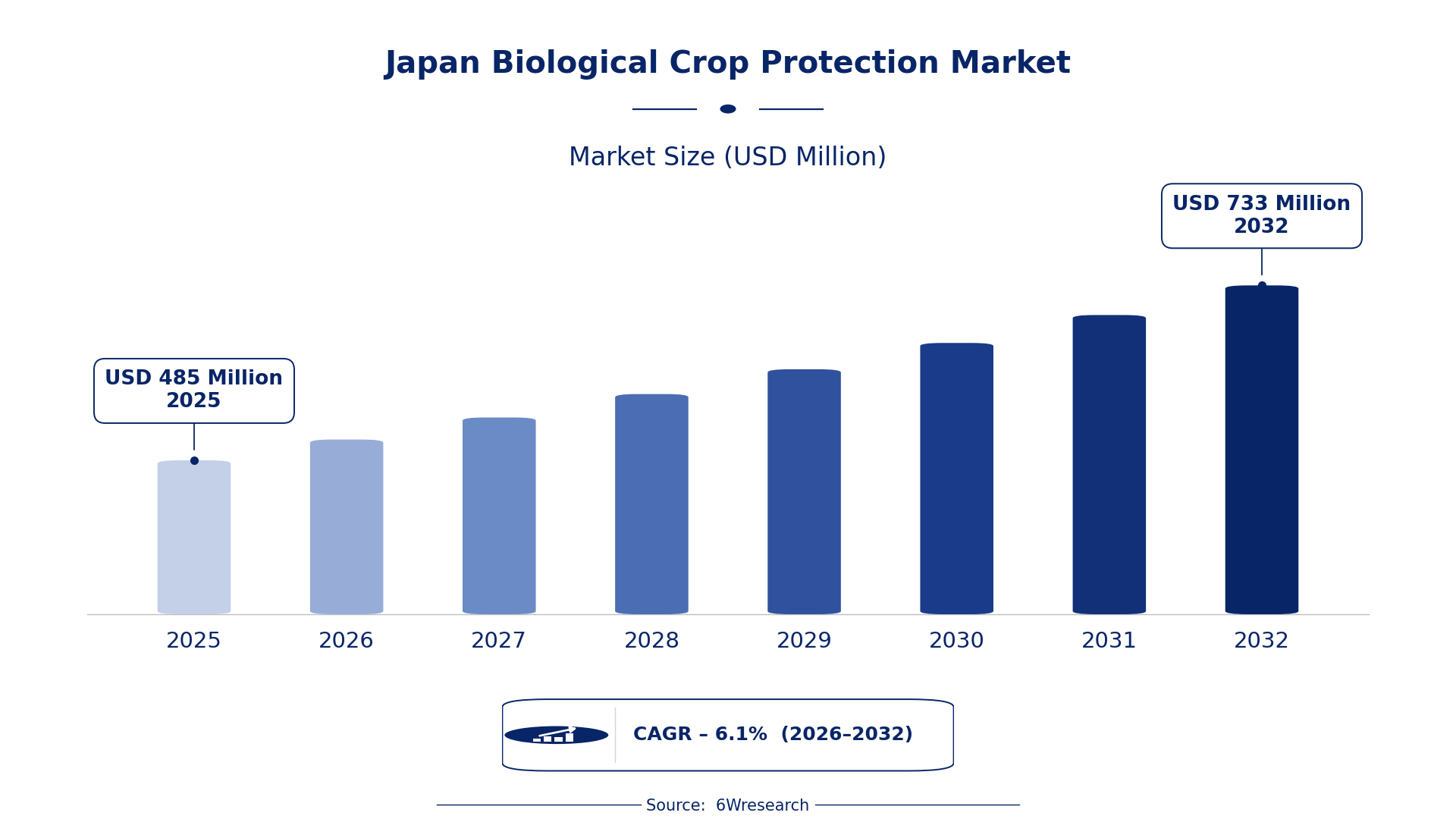
According to 6Wresearch internal database and industry insights, the Japan Biological Crop Protection Market was valued at USD 485 Million in 2025 and is projected to reach USD 733 Million by 2032, growing at a CAGR of approximately 6.1% during 2026–2032.
Japan Biological Crop Protection Market Highlights
| Report Metric | Details |
| Report Name | Japan Biological Crop Protection Market (2026-2032) |
| Market Size 2025 | USD 485 Million |
| Market Size 2032 | USD 733 Million |
| Absolute Growth 2025–2032 | USD 248 Million |
| CAGR 2026–2032 | 6.1% |
| Peak Annual Growth | 7.6% in 2027 |
| Forecast Period | 2026–2032 |
| Historical Data | 2022–2025 |
| Base Year | 2025 |
| Leading Segment, 2025 | Bioinsecticides (52% share) |
| Leading Product Type, 2025 | Bacillus subtilis (40% share) |
| Leading Crop Type, 2025 | Fruits & Vegetables (48% share) |
| Leading Mode of Application, 2025 | Foliar Spray (47% share) |
| Leading Distribution Channel, 2025 | Agri Retailers (44% share) |
| Fastest-Growing Segment | Biostimulants (8.3% CAGR) |
| Fastest-Growing Product Type | Seaweed Extracts (8.5% CAGR) |
| Fastest-Growing Mode of Application | Soil Treatment (7.6% CAGR) |
| Fastest-Growing Distribution Channel | Online Platforms (7.9% CAGR) |
| Growing Sector | Soil Treatment |
| Key End Users | Foliar Spray, Soil Treatment, Seed Coating, Drip Irrigation |
Japan Biological Crop Protection Market Year-wise Growth Rate and Key Drivers (2022–2032)
This graph illustrates the annual growth rates of the market from 2022 to 2032, highlighting a steady upward trajectory and projected market expansion over the forecast period.
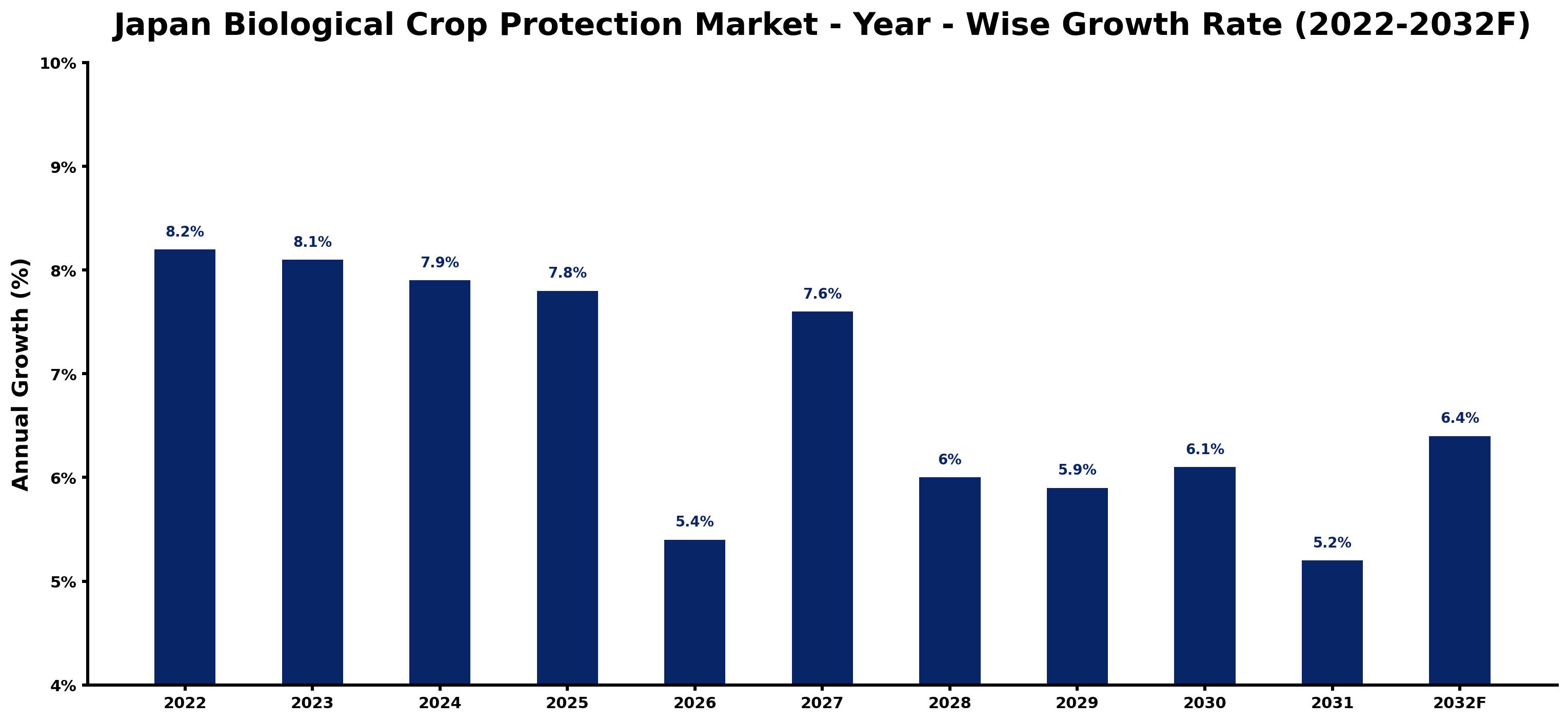
Annual growth estimates for each year appear below with the principal reason behind them, explaining the shifts that set the pace of the market.
| Year | Estimated Annual Growth (%) | Market Rationale |
| 2022 | 8.2 | The market experienced strong demand due to increased awareness of sustainable agriculture practices. |
| 2023 | 8.1 | Growth slowed slightly as farmers adjusted to new biological products and methods. |
| 2024 | 7.9 | Continued adoption of biological solutions was observed, though at a reduced growth rate. |
| 2025 | 7.8 | The market maintained steady growth as more agricultural users embraced biological crop protection. |
| 2026 | 5.4 | Growth is expected to slow further as market saturation begins to impact new product introductions. |
| 2027 | 7.6 | Demand is projected to surge again as technological advancements improve product efficacy and application methods. |
| 2028 | 6.0 | Growth is expected to moderate as the market stabilises following the previous surge in demand. |
| 2029 | 5.9 | The market will continue to grow, albeit at a slower pace as competition intensifies. |
| 2030 | 6.1 | Growth is projected to pick up again as new innovations in biological products enter the market. |
| 2031 | 5.2 | The market is expected to experience a slowdown as established products dominate purchasing decisions. |
| 2032 | 6.4 | Growth is projected to accelerate again due to increased government support for biological solutions. |
Note: Market size estimations and growth projections presented in this report are based on 6Wresearch's proprietary forecasting methodology, utilizing the latest available industry data, government publications, and primary research inputs.
Japan Biological Crop Protection Market Synopsis
Biological crop protection involves using natural organisms or substances to manage agricultural pests and diseases, produced through fermentation or extraction processes. The Japan Biological Crop Protection Market is growing as domestic agricultural users increasingly focus on sustainable farming practices. The Ministry of Agriculture, Forestry and Fisheries promotes bio-pesticides, contributing to a substantial rise in the total area of organic farmland, which reached 400,000 hectares in 2023, thereby increasing demand for biological solutions.
Market Dynamics Impact Analysis (2026–2032)
| Factor | Type | Impact | Primary Segment Affected |
| Rising adoption of sustainable farming practices | Driver | High | Bioinsecticides |
| Technological advancements in product formulations | Driver | High | Biofungicides |
| Growing demand for organic produce | Opportunity | High | Biostimulants |
| Expansion of online purchasing platforms | Opportunity | Medium | Agri Retailers |
| Limited awareness among traditional farmers | Restraint | High | Bionematicides |
| Regulatory hurdles for new product approvals | Restraint | Medium | Bioinsecticides |
| Supply chain disruptions affecting availability | Challenge | High | Biofungicides |
| Competition from synthetic pesticides | Challenge | Medium | Biostimulants |
Evaluation of Drivers in Japan Biological Crop Protection Market (2026–2032)
The factors lifting demand, and the evidence behind each, are summarised below.
| Drivers | Primary Segment Affected | Why It Matters (Evidence) |
| Increased focus on environmental sustainability | Bioinsecticides | This shift encourages farmers to adopt biological solutions, with bioinsecticides accounting for 25% of the market in 2023. |
| Technological improvements in product efficacy | Biofungicides | Advancements have led to a higher adoption rate, with over 300 registered biofungicide products in Japan. |
| Consumer preference for organic produce | Biostimulants | As 20% of farmers reported using biostimulants in 2023, demand for these products is rising. |
| Government initiatives promoting biological products | Bioinsecticides | The Sustainable Agriculture Program aims to increase the adoption of bio-pesticides by 30% by 2025. |
| Growing organic farmland area | Biofungicides | With 400,000 hectares of organic farmland in 2023, demand for biological solutions is expected to rise. |
What keeps demand rising is the increased focus on environmental sustainability in Japan, leading to a higher adoption of biological solutions among farmers. In 2023, bioinsecticides accounted for 25% of the biological crop protection market, as consumers increasingly prefer organic produce. Technological improvements have resulted in over 300 registered biofungicide products, boosting their appeal. The expansion of organic farmland to 400,000 hectares in 2023 supports the growth of biological crop protection solutions.
Evaluation of Restraints in Japan Biological Crop Protection Market
The following restraints limit how fast demand can grow.
| Market Restraint | Primary Segment Affected | Why It Matters (Evidence) |
| Limited awareness of biological products among some farmers | Bioinsecticides | This lack of knowledge restricts adoption, impacting overall market growth, with many farmers unaware of available solutions. |
| High initial costs for implementing biological solutions | Biofungicides | These costs can deter farmers from switching from traditional methods, leading to lower adoption rates of effective products. |
| Regulatory hurdles in product registration | Bioinsecticides | Complex approval processes delay market entry for new products, resulting in missed opportunities for suppliers. |
| Inconsistent supply of natural ingredients | Biofungicides | Supply chain disruptions can lead to product shortages and delays, affecting farmers' access to necessary solutions. |
| Limited research on efficacy for certain crops | Biostimulants | Insufficient data can hinder farmer confidence in these products, slowing their adoption in pest management strategies. |
Japan Biological Crop Protection Market Challenges
Japan struggles with outdated pest management technology, causing producers to lose up to 15% in yields annually. Rising demand for biological crop protection products leads to increased costs for buyers, with 1.5 million tons used in 2022, pushing prices higher. A shortage of skilled workers in agricultural innovation hampers the adoption of biological solutions, delaying implementation for farmers and impacting their profitability. Supply chain disruptions in sourcing natural ingredients for bio-pesticides create delays in product availability, forcing buyers to wait longer for essential inputs, which can postpone planting schedules by several weeks.
Trends in the Japan Biological Crop Protection Market
Below are the shifts with the largest effect on the Japan Biological Crop Protection Market.
- Shift from Chemical to Biological Solutions: Since 2022, Japan has seen a marked shift towards biological crop protection methods, as consumer demand for organic produce grows. In 2023, bioinsecticides made up 25% of the market, reflecting this change.
- Transition to Integrated Pest Management: Beginning in 2023, farmers are increasingly adopting integrated pest management strategies that incorporate biological solutions. This approach improves crop resilience and sustainability, with 20% of farmers using biostimulants.
- Emergence of Online Sales Channels: In 2023, online platforms for purchasing biological products gained traction, with a projected 7.9% CAGR through 2032. This trend supports accessibility for farmers seeking sustainable solutions.
- Growing Investment in R&D: Since 2023, there has been a surge in investment in research and development for biological crop protection technologies. This focus aims to improve product efficacy and expand the range of available solutions.
Investment Opportunities in the Japan Biological Crop Protection Market
The openings below show where demand in the Japan Biological Crop Protection Market is visible and how suppliers can enter.
- Supply of Bioinsecticides: With a 25% market share in 2023, bioinsecticides present a strong opportunity for suppliers. Farmers in the Tokyo region are increasingly seeking these products to meet organic standards.
- Distribution of Biofungicides: The growing demand for biofungicides, with over 300 products registered, offers a chance for distributors to expand their offerings. Agri retailers are key players in this supply chain.
- Market for Biostimulants: As 20% of farmers reported using biostimulants in 2023, there is a clear gap in the market for suppliers. Targeting farmers in rural areas can facilitate entry into this growing segment.
- Soil Treatment Solutions: Soil treatment methods are gaining traction, with a projected growth rate of 7.6% through 2032. Suppliers can focus on developing effective products for agricultural users in Japan.
Government Initiatives in the Japan Biological Crop Protection Market
The Agricultural Chemicals Regulation Law governs the registration of biological crop protection products, ensuring quality and safety standards. This law mandates rigorous testing and reporting for new products, which builds consumer confidence in biological solutions and encourages wider adoption among farmers.
The Japan Agency for Medical Research and Development (AMED) oversees funding for research and development projects aimed at improving biological pest control technologies. This agency supports initiatives that enhance product efficacy and safety for farmers, facilitating the growth of the biological crop protection market.
Future Insight of the Japan Biological Crop Protection Market
A policy-driven shift towards biological crop protection will reshape the market, with the government targeting a 30% increase in adoption by 2025. This change will spur the development of new bio-pesticide formulations, as the total area of organic farmland reached 400,000 hectares in 2023. Enhanced research and development initiatives will support the growth of effective biological pest control technologies. As a result, buyers will benefit from a wider range of sustainable solutions, while suppliers will see increased opportunities in the expanding market.
Market Segmentation Analysis
Japan Biological Crop Protection Market report covers a detailed analysis of the following market segments:
By Segment – Bioinsecticides Lead, Biostimulants Expected to Grow Fastest
According to Saurav Kr Singh, Senior Research Analyst at 6Wresearch, the largest segment category in 2025 was Bioinsecticides, at 52% of revenue. Bioinsecticides hold the largest share as they effectively target specific insect pests, which is essential for farmers focused on crop protection while maintaining beneficial insect populations. The Tokyo region's agricultural innovation has significantly contributed to the widespread use of bioinsecticides among local growers. The quickest growth will come from Biostimulants, forecast to expand at a CAGR of 8.3% between 2026 and 2032. Biostimulants are experiencing rapid growth, with 20% of farmers reporting their use to enhance crop resilience against pests, reflecting a broader trend towards sustainable agricultural practices. The ongoing popularity of bioinsecticides will likely support the continued expansion of biostimulants in the market. Suppliers should prioritise the development of biostimulants to align with the increasing demand for sustainable agricultural solutions.
By Product Type – Bacillus subtilis Leads, Seaweed Extracts Expected to Grow Fastest
Bacillus subtilis held 40% of the Japan Biological Crop Protection Market by product type in 2025. Bacillus subtilis is the leading product type due to its proven effectiveness against various plant pathogens, making it a preferred choice among farmers for managing crop health. Its widespread use is supported by established guidelines ensuring quality and safety under JIS standards. Seaweed Extracts are set to record the highest CAGR in this split, 8.5% over 2026–2032. Seaweed extracts are gaining traction as they promote plant health indirectly, aligning with the increasing demand for sustainable agricultural practices. This growth is likely to be supported by ongoing research into the benefits of natural extracts in crop management. Suppliers should consider expanding their product lines to include seaweed extracts to meet the evolving preferences of farmers.
By Crop Type – Fruits & Vegetables Lead and Record the Fastest Growth
Fruits & Vegetables took 48% of crop type revenue in 2025, more than any other category. Fruits and vegetables lead the crop type segment as they require effective pest control solutions to satisfy high market demand and ensure quality produce. This focus is reflected in the agricultural strategies implemented by farmers throughout Japan. Fruits & Vegetables are also forecast to expand faster than any other category, at a CAGR of 8.6% over 2026–2032. The fruits and vegetables segment is also the fastest-growing due to the persistent need for effective pest management in this high-value category, ensuring farmers maintain yield and quality. As the leader, this segment's growth will likely strengthen its market position. Suppliers should prioritise products specifically designed for fruits and vegetables to align with market needs.
By Mode of Application – Foliar Spray Leads, Soil Treatment Expected to Grow Fastest
Foliar Spray accounted for 47% of the market by mode of application in 2025. Foliar spray is the leading application method as it is widely used by farmers to apply biological products directly to crops, allowing for precise pest targeting. This method effectively minimises waste while ensuring optimal application. Soil Treatment is projected to grow fastest, at a CAGR of 7.6% during 2026–2032. Soil treatment is rapidly gaining traction as it is vital for maintaining root health and managing soil-borne pests, reflecting an increasing awareness of soil health in agriculture. This growing trend will complement the established use of foliar spray. Suppliers should invest in soil treatment solutions to cater to the rising demand from farmers.
By Distribution Channel – Agri Retailers Lead, Online Platforms Expected to Grow Fastest
With 44% of distribution channel revenue in 2025, Agri Retailers was the largest category. Agri retailers are the primary distribution channel for farmers, providing essential access to biological crop protection products and agricultural support services. Their established connections with local farmers facilitate a more efficient distribution process across the region. The quickest growth will come from Online Platforms, forecast to expand at a CAGR of 7.9% between 2026 and 2032. Online platforms are rapidly growing as a distribution channel, fuelled by farmers' increasing comfort with digital purchasing methods and the convenience they offer. This shift indicates changing preferences among farmers for acquiring agricultural products through online means. Suppliers should enhance their online strategies to effectively engage with the growing segment of digital buyers in the agricultural market.
Key Attractiveness of the Report
- 10 Years of Market Numbers
- Historical Data Starting from 2022 to 2025
- Base Year 2025
- Forecast Data until 2032
- Key Performance Indicators Impacting the Market
- Major Upcoming Developments and Projects
Key Highlights of the Report:
- Japan Biological Crop Protection Market Outlook
- Market Size of Japan Biological Crop Protection Market, 2025
- Forecast of Japan Biological Crop Protection Market, 2032
- Historical Data and Forecast of Japan Biological Crop Protection Revenues & Volume for the Period 2022-2032F
- Japan Biological Crop Protection Market Trend Evolution
- Japan Biological Crop Protection Market Drivers and Challenges
- Japan Biological Crop Protection Price Trends
- Japan Biological Crop Protection Porter's Five Forces
- Japan Biological Crop Protection Industry Life Cycle
- Historical Data and Forecast of Japan Biological Crop Protection Market Revenues & Volume By Segment for the Period 2022-2032F
- Historical Data and Forecast of Japan Biological Crop Protection Market Revenues & Volume By Biofungicides for the Period 2022-2032F
- Historical Data and Forecast of Japan Biological Crop Protection Market Revenues & Volume By Bioinsecticides for the Period 2022-2032F
- Historical Data and Forecast of Japan Biological Crop Protection Market Revenues & Volume By Bionematicides for the Period 2022-2032F
- Historical Data and Forecast of Japan Biological Crop Protection Market Revenues & Volume By Biostimulants for the Period 2022-2032F
- Historical Data and Forecast of Japan Biological Crop Protection Market Revenues & Volume By Product Type for the Period 2022-2032F
- Historical Data and Forecast of Japan Biological Crop Protection Market Revenues & Volume By Bacillus subtilis for the Period 2022-2032F
- Historical Data and Forecast of Japan Biological Crop Protection Market Revenues & Volume By Neem-based for the Period 2022-2032F
- Historical Data and Forecast of Japan Biological Crop Protection Market Revenues & Volume By Paecilomyces for the Period 2022-2032F
- Historical Data and Forecast of Japan Biological Crop Protection Market Revenues & Volume By Seaweed Extracts for the Period 2022-2032F
- Historical Data and Forecast of Japan Biological Crop Protection Market Revenues & Volume By Crop Type for the Period 2022-2032F
- Historical Data and Forecast of Japan Biological Crop Protection Market Revenues & Volume By Fruits & Vegetables for the Period 2022-2032F
- Historical Data and Forecast of Japan Biological Crop Protection Market Revenues & Volume By Cereals for the Period 2022-2032F
- Historical Data and Forecast of Japan Biological Crop Protection Market Revenues & Volume By Pulses for the Period 2022-2032F
- Historical Data and Forecast of Japan Biological Crop Protection Market Revenues & Volume By Cash Crops for the Period 2022-2032F
- Historical Data and Forecast of Japan Biological Crop Protection Market Revenues & Volume By Mode of Application for the Period 2022-2032F
- Historical Data and Forecast of Japan Biological Crop Protection Market Revenues & Volume By Foliar Spray for the Period 2022-2032F
- Historical Data and Forecast of Japan Biological Crop Protection Market Revenues & Volume By Soil Treatment for the Period 2022-2032F
- Historical Data and Forecast of Japan Biological Crop Protection Market Revenues & Volume By Seed Coating for the Period 2022-2032F
- Historical Data and Forecast of Japan Biological Crop Protection Market Revenues & Volume By Drip Irrigation for the Period 2022-2032F
- Historical Data and Forecast of Japan Biological Crop Protection Market Revenues & Volume By Distribution Channel for the Period 2022-2032F
- Historical Data and Forecast of Japan Biological Crop Protection Market Revenues & Volume By Agri Retailers for the Period 2022-2032F
- Historical Data and Forecast of Japan Biological Crop Protection Market Revenues & Volume By Online Platforms for the Period 2022-2032F
- Historical Data and Forecast of Japan Biological Crop Protection Market Revenues & Volume By Agro Dealers for the Period 2022-2032F
- Historical Data and Forecast of Japan Biological Crop Protection Market Revenues & Volume By Distributors for the Period 2022-2032F
- Japan Biological Crop Protection Import Export Trade Statistics
- Market Opportunity Assessment By Segment
- Market Opportunity Assessment By Product Type
- Market Opportunity Assessment By Crop Type
- Market Opportunity Assessment By Mode of Application
- Market Opportunity Assessment By Distribution Channel
- Japan Biological Crop Protection Top Companies Market Share
- Japan Biological Crop Protection Competitive Benchmarking By Technical and Operational Parameters
- Japan Biological Crop Protection Company Profiles
- Japan Biological Crop Protection Key Strategic Recommendations
Market Covered
Segments analysed in this report are listed below.
By Segment
- Biofungicides
- Bioinsecticides
- Bionematicides
- Biostimulants
By Product Type
- Bacillus subtilis
- Neem-based
- Paecilomyces
- Seaweed Extracts
By Crop Type
- Fruits & Vegetables
- Cereals
- Pulses
- Cash Crops
By Mode of Application
- Foliar Spray
- Soil Treatment
- Seed Coating
- Drip Irrigation
By Distribution Channel
- Agri Retailers
- Online Platforms
- Agro Dealers
- Distributors






































