Japan Biological Organic Fertilizer Market Size & Growth Rate
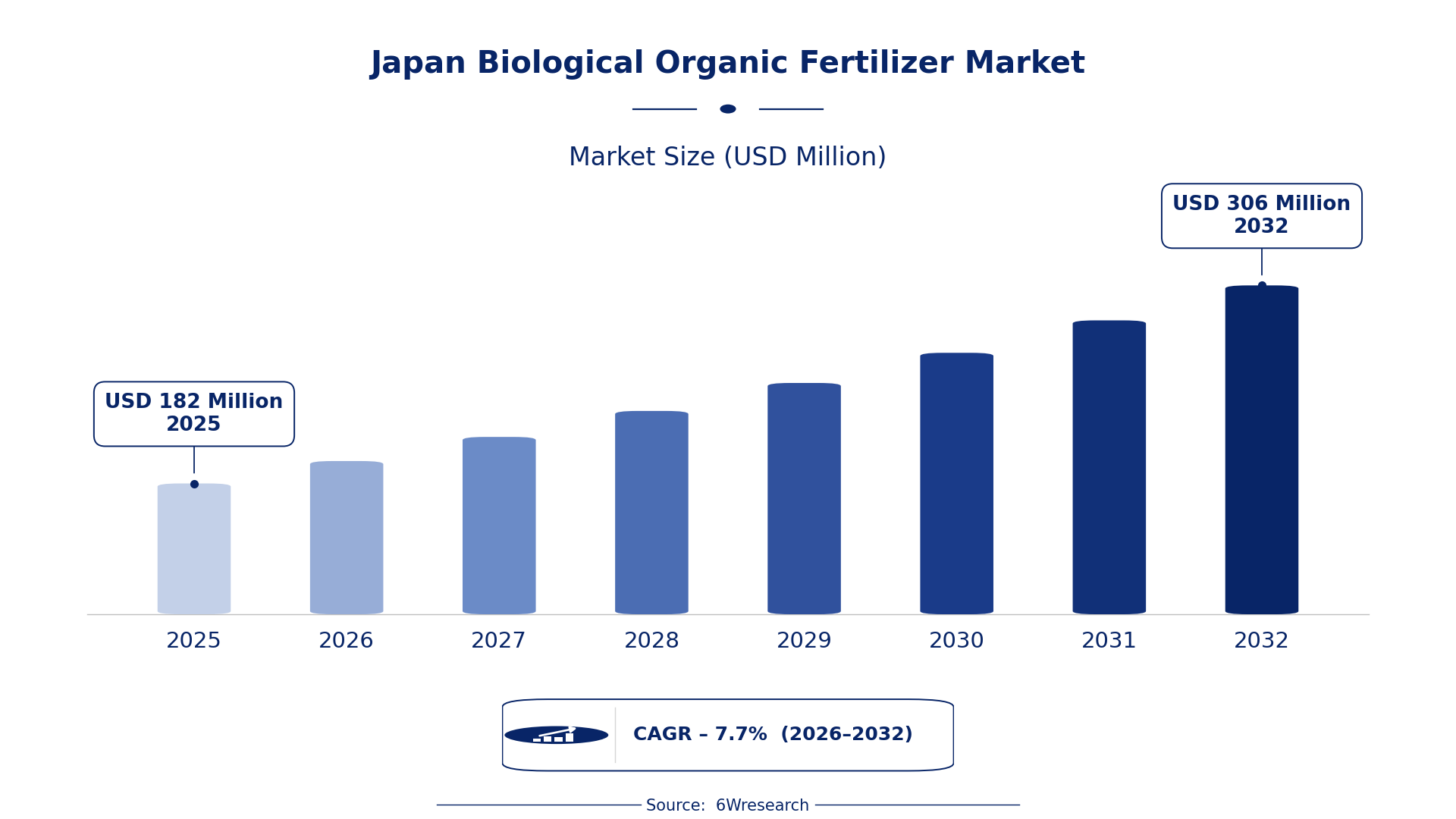
According to 6Wresearch internal database and industry insights, the Japan Biological Organic Fertilizer Market was valued at USD 182 Million in 2025 and is projected to reach USD 306 Million by 2032, growing at a CAGR of approximately 7.7% during 2026–2032.
Japan Biological Organic Fertilizer Market Highlights
| Report Metric | Details |
| Report Name | Japan Biological Organic Fertilizer Market (2026-2032) |
| Market Size 2025 | USD 182 Million |
| Market Size 2032 | USD 306 Million |
| Absolute Growth 2025–2032 | USD 124 Million |
| CAGR 2026–2032 | 7.7% |
| Peak Annual Growth | 8.6% in 2032 |
| Forecast Period | 2026–2032 |
| Historical Data | 2022–2025 |
| Base Year | 2025 |
| Leading Material Type, 2025 | Compost-based Fertilizer (39% share) |
| Leading Functionality, 2025 | Nutrient Supply (38% share) |
| Leading Application Area, 2025 | Crop Growth (46% share) |
| Leading Distribution Channel, 2025 | Direct Sales (50% share) |
| Leading End User, 2025 | Farms (49% share) |
| Fastest-Growing Material Type | Biofertilizers (11.2% CAGR) |
| Fastest-Growing Functionality | Microbial Activity (9.9% CAGR) |
| Fastest-Growing Application Area | Organic Farming (9.6% CAGR) |
| Fastest-Growing Distribution Channel | Online Platforms (10.1% CAGR) |
| Fastest-Growing End User | Horticulture (9.8% CAGR) |
| Growing Sector | Organic Farming |
| Key End Users | Farms, Agriculture Companies, Horticulture, Plant Nurseries |
Japan Biological Organic Fertilizer Market Year-wise Growth Rate and Key Drivers (2022–2032)
This graph illustrates the annual growth rates of the market from 2022 to 2032, highlighting a steady upward trajectory and projected market expansion over the forecast period.
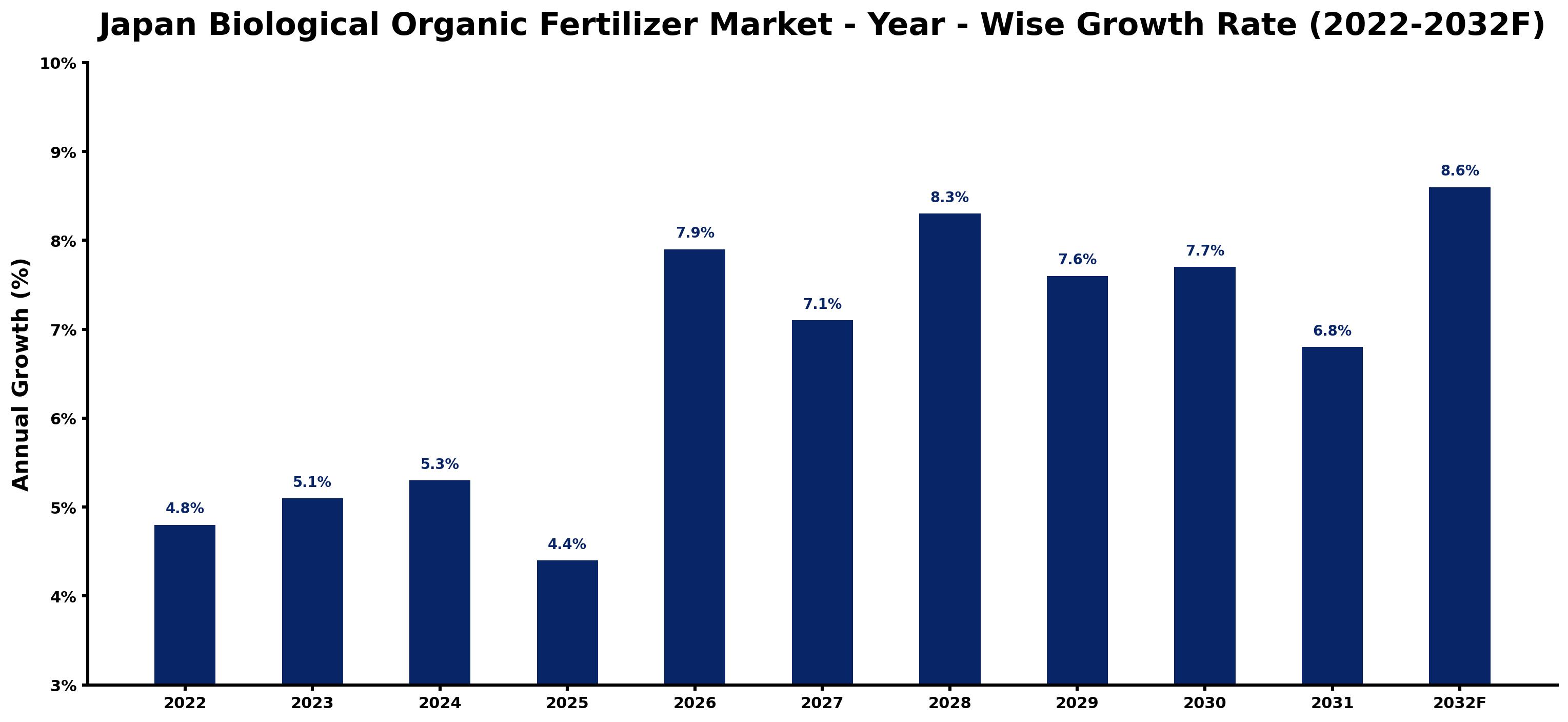
Year by year, the estimates below pair each growth rate with the development that shaped it.
| Year | Estimated Annual Growth (%) | Market Rationale |
| 2022 | 4.8 | The market experienced steady growth as organic farming gained traction among domestic farms. |
| 2023 | 5.1 | Increased interest in sustainable practices led to higher adoption rates of biological organic fertilizers. |
| 2024 | 5.3 | Demand continued to rise, supported by successful crop yield trials using compost-based fertilizers. |
| 2025 | 4.4 | Growth slowed as market saturation began to affect new customer acquisition. |
| 2026 | 7.9 | A surge in organic farming initiatives is expected to spur renewed interest in biological organic fertilizers. |
| 2027 | 7.1 | The market will see a slight slowdown as competition intensifies among suppliers. |
| 2028 | 8.3 | Demand is projected to accelerate again due to rising awareness of soil health benefits from organic fertilizers. |
| 2029 | 7.6 | Growth is expected to moderate as the market adjusts to increased production capacity and supply. |
| 2030 | 7.7 | Renewed investments in organic farming infrastructure will contribute to a boost in demand. |
| 2031 | 6.8 | A slowdown is projected as market conditions stabilise, with consistent demand from existing users. |
| 2032 | 8.6 | The market is expected to peak as organic farming initiatives reach their targets, driving higher purchases. |
Note: Market size estimations and growth projections presented in this report are based on 6Wresearch's proprietary forecasting methodology, utilizing the latest available industry data, government publications, and primary research inputs.
Japan Biological Organic Fertilizer Market Synopsis
Biological organic fertilizers are derived from natural materials like compost and manure, promoting soil fertility and plant growth. In Japan, the organic farming area reached 0.5 million hectares in 2022, with over 1,000 certified organic farms. The Japan Biological Organic Fertilizer Market is expanding due to increased domestic demand from farms, supported by government measures such as the Organic Agriculture Promotion Program launched in 2023, which aims to increase organic farmland to 1 million hectares by 2025, creating a favourable environment for biological organic fertilizers.
Market Dynamics Impact Analysis (2026–2032)
| Factor | Type | Impact | Primary Segment Affected |
| Rising interest in sustainable agriculture practices | Driver | High | Organic Farming |
| Government support for organic initiatives | Driver | High | Crop Growth |
| Increasing organic farmland targets | Opportunity | High | Farms |
| Growing consumer demand for organic products | Opportunity | Medium | Horticulture |
| Aging farmer population affecting workforce | Restraint | High | Farms |
| Market saturation limiting new customer acquisition | Restraint | Medium | Organic Farming |
| Competition among suppliers intensifying | Challenge | High | Crop Growth |
| Need for younger entrants in organic farming | Challenge | Medium | Farms |
Evaluation of Drivers in Japan Biological Organic Fertilizer Market (2026–2032)
The factors lifting demand, and the evidence behind each, are summarised below.
| Drivers | Primary Segment Affected | Why It Matters (Evidence) |
| Increased organic farming area | Organic Farming | Japan's organic farming area reached 0.5 million hectares in 2022, driving demand for biological organic fertilizers. |
| Government initiatives promoting organic agriculture | Crop Growth | The government aims to increase organic farmland to 1 million hectares by 2025, boosting fertilizer demand. |
| Higher crop yields linked to organic fertilizers | Nutrient Supply | Trials showed a 20% increase in crop yields using compost-based fertilizers, encouraging more farmers to adopt these products. |
| Growing awareness of soil health benefits | Soil Improvement | Promotional activities on vermicomposting are raising awareness, leading to increased purchases of biological organic fertilizers. |
| Rising consumer demand for organic produce | Horticulture | As the number of organic product retailers increased by 15% since 2020, farmers are responding with more organic farming practices. |
The strongest pull on demand comes from the agricultural sector's increasing focus on sustainable practices, with the organic farming area reaching 0.5 million hectares in 2022. Studies indicate that compost-based fertilizers can significantly enhance crop yields, prompting farmers to adopt these products. Awareness of soil health is rising, prompting higher purchases of organic fertilizers. The growing number of organic product retailers reflects the increasing consumer interest in organic produce, further boosting market growth.
Evaluation of Restraints in Japan Biological Organic Fertilizer Market
These restraints slow adoption and weigh on supplier margins.
| Market Restraint | Primary Segment Affected | Why It Matters (Evidence) |
| Market saturation limiting new customer acquisition | Organic Farming | As the market matures, new customer acquisition becomes challenging, slowing growth rates for suppliers. |
| Limited awareness among conventional farmers | Soil Improvement | Many conventional farmers remain unaware of the benefits of biological organic fertilizers, hindering market expansion. |
| Regulatory hurdles for new entrants | Crop Growth | New regulations complicate the entry of new suppliers, limiting competition and innovation. |
| High production costs for organic fertilizers | Nutrient Supply | The rising costs of organic inputs can deter farmers from switching to biological fertilizers. |
| Supply chain disruptions due to aging agricultural workforce | Organic Farming | An aging agricultural population, with an average age of 56 years for organic farmers, impacts production timelines. |
Japan Biological Organic Fertilizer Market Challenges
Farmers encounter rising costs associated with biological organic fertilizers, which can reduce profit margins by 15%. Regulatory hurdles complicate the certification process, with the Organic JAS certification requiring extensive documentation, delaying new suppliers' market entry by up to six months. Supply chain disruptions arise as the average age of organic farmers is 56, resulting in a shortage of skilled labour that can postpone production timelines by several weeks. Competition from conventional fertilizers remains fierce, compelling organic producers to lower prices, which threatens their profitability and long-term sustainability.
Trends in the Japan Biological Organic Fertilizer Market
Four trends stand out in the Japan Biological Organic Fertilizer Market.
- Shift from Conventional to Organic Farming: Farms across Japan are increasingly adopting organic farming practices, with the organic farming area reaching 0.5 million hectares in 2022. This shift reflects consumer demand for organic products and government support for sustainable agriculture.
- Growing Use of Liquid Organic Fertilizers in Greenhouses: Liquid organic fertilizers are becoming more popular in greenhouse cultivation, accounting for 30% of the market. This trend responds to the need for quick nutrient absorption to optimise plant growth conditions.
- Increased Promotion of Vermicomposting in Education: Vermicomposting is being promoted in schools as part of environmental education programs. This initiative aims to raise awareness of sustainable practices among younger generations and encourage organic farming.
- Expansion of Online Platforms for Fertilizer Sales: Online platforms are emerging as a growing distribution channel for biological organic fertilizers, with a projected CAGR of 10.1% from 2026 to 2032. This trend reflects the increasing digitalisation of agricultural sales.
Investment Opportunities in the Japan Biological Organic Fertilizer Market
Below are the investment opportunities with the strongest case in the Japan Biological Organic Fertilizer Market.
- Tokyo Region as a Hub for Organic Farming: The Tokyo region, with the highest concentration of organic farms, presents an opportunity for suppliers. The government aims to increase organic farmland to 1 million hectares by 2025, creating demand for fertilizers.
- Gap in Supply for Organic Fertilizers: With only 0.5 million hectares of organic farmland in 2022, there is a growing need for suppliers to meet the demand for biological organic fertilizers. This gap offers investment opportunities for new entrants.
- Support for Organic Farmers through Training: The Japanese Organic Agriculture Association provides training and resources to farmers. With over 1,000 certified organic farms, this support encourages more farmers to adopt biological organic fertilizers.
- Investment in Research for Sustainable Practices: Investment in research on sustainable agricultural practices is essential for the market. The government has set a target of 25% organic farming by 2030, driving demand for new fertilizers.
Government Initiatives in the Japan Biological Organic Fertilizer Market
The Organic Agriculture Promotion Program, launched in 2023, supports organic farming initiatives and complements the Organic Agriculture Promotion Law enacted in 2000. These measures encourage the use of biological organic fertilizers by providing guidelines and resources for farmers to adopt sustainable practices, thereby improving soil health and crop yields.
The Organic Agriculture Promotion Program, launched in 2023 with a budget of ¥2 billion, helps farmers transition to organic methods. This program provides financial assistance and resources to certified organic farms, enabling them to invest in biological organic fertilizers and improve their agricultural practices.
Future Insight of the Japan Biological Organic Fertilizer Market
The introduction of new composting facilities will enhance production efficiency and cut costs for suppliers by 20% by 2032. Japan's target to increase organic farmland to 1 million hectares will significantly boost supply for buyers, creating a more dynamic market. The government's initiative to achieve 25% organic farming by 2030 will drive advancements in agricultural practices. Rising consumer awareness will elevate demand for organic products, encouraging more farmers to transition to organic methods.
Market Segmentation Analysis
Japan Biological Organic Fertilizer Market report covers a detailed analysis of the following market segments:
By Material Type – Compost-based Fertilizer Leads, Biofertilizers Expected to Grow Fastest
According to Ayushi Shukla, Senior Research Analyst at 6Wresearch, Compost-based Fertilizer accounted for 39% of the market by material type in 2025. Compost-based fertilizers dominate the market due to their widespread use in enhancing soil fertility across various agricultural practices. Their importance is underscored by initiatives like the Sustainable Agriculture Strategy, which aims to significantly improve crop yields. Over 2026–2032, Biofertilizers are expected to post the fastest growth, at a CAGR of 11.2%. Biofertilizers are experiencing rapid growth as they align with the increasing demand for sustainable agricultural practices. The Japanese government's target of achieving 25% organic farming by 2030 is expected to further accelerate their adoption. Suppliers should prioritise the development of biofertilizer products to meet the rising demand for sustainable agricultural solutions.
By Functionality – Nutrient Supply Leads, Microbial Activity Expected to Grow Fastest
Nutrient Supply took 38% of functionality revenue in 2025, more than any other category. Nutrient supply is the leading functionality because it is crucial for ensuring crop health and maximising agricultural yields. This aspect is particularly important for farmers focused on improving productivity and overall output. The quickest growth will come from Microbial Activity, forecast to expand at a CAGR of 9.9% between 2026 and 2032. The microbial activity segment is growing swiftly due to its essential role in promoting beneficial soil microorganisms necessary for organic farming. Increased awareness of soil health and its impact on crop performance is driving this trend. Buyers may need to prioritise fertilizers that enhance microbial activity to improve soil health and boost crop performance.
By Application Area – Crop Growth Leads, Organic Farming Expected to Grow Fastest
The largest application area category in 2025 was Crop Growth, at 46% of revenue. Crop growth is the primary application area, fundamental for agricultural productivity and essential for ensuring food security in Japan. This focus is evident in the practices adopted by a majority of farms across the nation. Organic Farming is set to record the highest CAGR in this split, 9.6% over 2026–2032. Organic farming is expanding rapidly as it is crucial for maintaining organic standards and meeting consumer demand for organic products. Government initiatives are significantly propelling this growth trajectory. Suppliers should align their offerings with organic farming standards to capitalise on this expanding market.
By Distribution Channel – Direct Sales Leads, Online Platforms Expected to Grow Fastest
Direct Sales held 50% of the Japan Biological Organic Fertilizer Market by distribution channel in 2025. Direct sales remain the leading distribution channel as they provide farmers with immediate access to fertilizers, ensuring timely application for their crop needs. This method is preferred for its personal engagement and direct communication with farmers. Online Platforms are projected to grow fastest, at a CAGR of 10.1% during 2026–2032. Online platforms are witnessing the fastest growth due to their convenience and accessibility to a wider audience, particularly among younger farmers. The increasing digitalisation of the agricultural sector supports this trend. Suppliers should enhance their online presence to capture the growing segment of the market that prefers digital purchasing.
By End User – Farms Lead, Horticulture Expected to Grow Fastest
In 2025, Farms led the end user split with a 49% share. Farms represent the largest end-user segment for fertilizers, as they are the primary producers of crops and directly benefit from improved soil fertility. The agricultural population of approximately 2 million underscores this demand. Over 2026–2032, Horticulture is expected to post the fastest growth, at a CAGR of 9.8%. Horticulture is experiencing rapid growth due to its importance in flower and plant cultivation, which is increasingly popular among consumers. The rise in gardening trends is contributing to this expansion. Suppliers should tailor their products to meet the specific needs of horticulture to take advantage of this growing market.
Key Attractiveness of the Report
- 10 Years of Market Numbers
- Historical Data Starting from 2022 to 2025
- Base Year 2025
- Forecast Data until 2032
- Key Performance Indicators Impacting the Market
- Major Upcoming Developments and Projects
Key Highlights of the Report:
- Japan Biological Organic Fertilizer Market Outlook
- Market Size of Japan Biological Organic Fertilizer Market, 2025
- Forecast of Japan Biological Organic Fertilizer Market, 2032
- Historical Data and Forecast of Japan Biological Organic Fertilizer Market Revenues & Volume for the Period 2022-2032F
- Japan Biological Organic Fertilizer Market Trend Evolution
- Japan Biological Organic Fertilizer Market Drivers and Challenges
- Japan Biological Organic Fertilizer Market Price Trends
- Japan Biological Organic Fertilizer Market Porter's Five Forces
- Japan Biological Organic Fertilizer Market Industry Life Cycle
- Historical Data and Forecast of Japan Biological Organic Fertilizer Market Revenues & Volume By Material Type for the Period 2022-2032F
- Historical Data and Forecast of Japan Biological Organic Fertilizer Market Revenues & Volume By Compost-based Fertilizer for the Period 2022-2032F
- Historical Data and Forecast of Japan Biological Organic Fertilizer Market Revenues & Volume By Vermicompost for the Period 2022-2032F
- Historical Data and Forecast of Japan Biological Organic Fertilizer Market Revenues & Volume By Biofertilizers for the Period 2022-2032F
- Historical Data and Forecast of Japan Biological Organic Fertilizer Market Revenues & Volume By Liquid Organic Fertilizer for the Period 2022-2032F
- Historical Data and Forecast of Japan Biological Organic Fertilizer Market Revenues & Volume By Functionality for the Period 2022-2032F
- Historical Data and Forecast of Japan Biological Organic Fertilizer Market Revenues & Volume By Nutrient Supply for the Period 2022-2032F
- Historical Data and Forecast of Japan Biological Organic Fertilizer Market Revenues & Volume By Soil Improvement for the Period 2022-2032F
- Historical Data and Forecast of Japan Biological Organic Fertilizer Market Revenues & Volume By Microbial Activity for the Period 2022-2032F
- Historical Data and Forecast of Japan Biological Organic Fertilizer Market Revenues & Volume By Fast Absorption for the Period 2022-2032F
- Historical Data and Forecast of Japan Biological Organic Fertilizer Market Revenues & Volume By Application Area for the Period 2022-2032F
- Historical Data and Forecast of Japan Biological Organic Fertilizer Market Revenues & Volume By Crop Growth for the Period 2022-2032F
- Historical Data and Forecast of Japan Biological Organic Fertilizer Market Revenues & Volume By Organic Farming for the Period 2022-2032F
- Historical Data and Forecast of Japan Biological Organic Fertilizer Market Revenues & Volume By Soil Fertility for the Period 2022-2032F
- Historical Data and Forecast of Japan Biological Organic Fertilizer Market Revenues & Volume By Greenhouses for the Period 2022-2032F
- Historical Data and Forecast of Japan Biological Organic Fertilizer Market Revenues & Volume By Distribution Channel for the Period 2022-2032F
- Historical Data and Forecast of Japan Biological Organic Fertilizer Market Revenues & Volume By Direct Sales for the Period 2022-2032F
- Historical Data and Forecast of Japan Biological Organic Fertilizer Market Revenues & Volume By Online Platforms for the Period 2022-2032F
- Historical Data and Forecast of Japan Biological Organic Fertilizer Market Revenues & Volume By Industrial Suppliers for the Period 2022-2032F
- Historical Data and Forecast of Japan Biological Organic Fertilizer Market Revenues & Volume By Specialty Distributors for the Period 2022-2032F
- Historical Data and Forecast of Japan Biological Organic Fertilizer Market Revenues & Volume By End User for the Period 2022-2032F
- Historical Data and Forecast of Japan Biological Organic Fertilizer Market Revenues & Volume By Farms for the Period 2022-2032F
- Historical Data and Forecast of Japan Biological Organic Fertilizer Market Revenues & Volume By Agriculture Companies for the Period 2022-2032F
- Historical Data and Forecast of Japan Biological Organic Fertilizer Market Revenues & Volume By Horticulture for the Period 2022-2032F
- Historical Data and Forecast of Japan Biological Organic Fertilizer Market Revenues & Volume By Plant Nurseries for the Period 2022-2032F
- Japan Biological Organic Fertilizer Market Import Export Trade Statistics
- Market Opportunity Assessment By Material Type
- Market Opportunity Assessment By Functionality
- Market Opportunity Assessment By Application Area
- Market Opportunity Assessment By Distribution Channel
- Market Opportunity Assessment By End User
- Japan Biological Organic Fertilizer Market Top Companies Market Share
- Japan Biological Organic Fertilizer Market Competitive Benchmarking By Technical and Operational Parameters
- Japan Biological Organic Fertilizer Market Company Profiles
- Japan Biological Organic Fertilizer Market Key Strategic Recommendations
Market Covered
Coverage by segment is as follows.
By Material Type
- Compost-based Fertilizer
- Vermicompost
- Biofertilizers
- Liquid Organic Fertilizer
By Functionality
- Nutrient Supply
- Soil Improvement
- Microbial Activity
- Fast Absorption
By Application Area
- Crop Growth
- Organic Farming
- Soil Fertility
- Greenhouses
By Distribution Channel
- Direct Sales
- Online Platforms
- Industrial Suppliers
- Specialty Distributors
By End User
- Farms
- Agriculture Companies
- Horticulture
- Plant Nurseries






































