Japan Biological Soil Amendments Market Size & Growth Rate
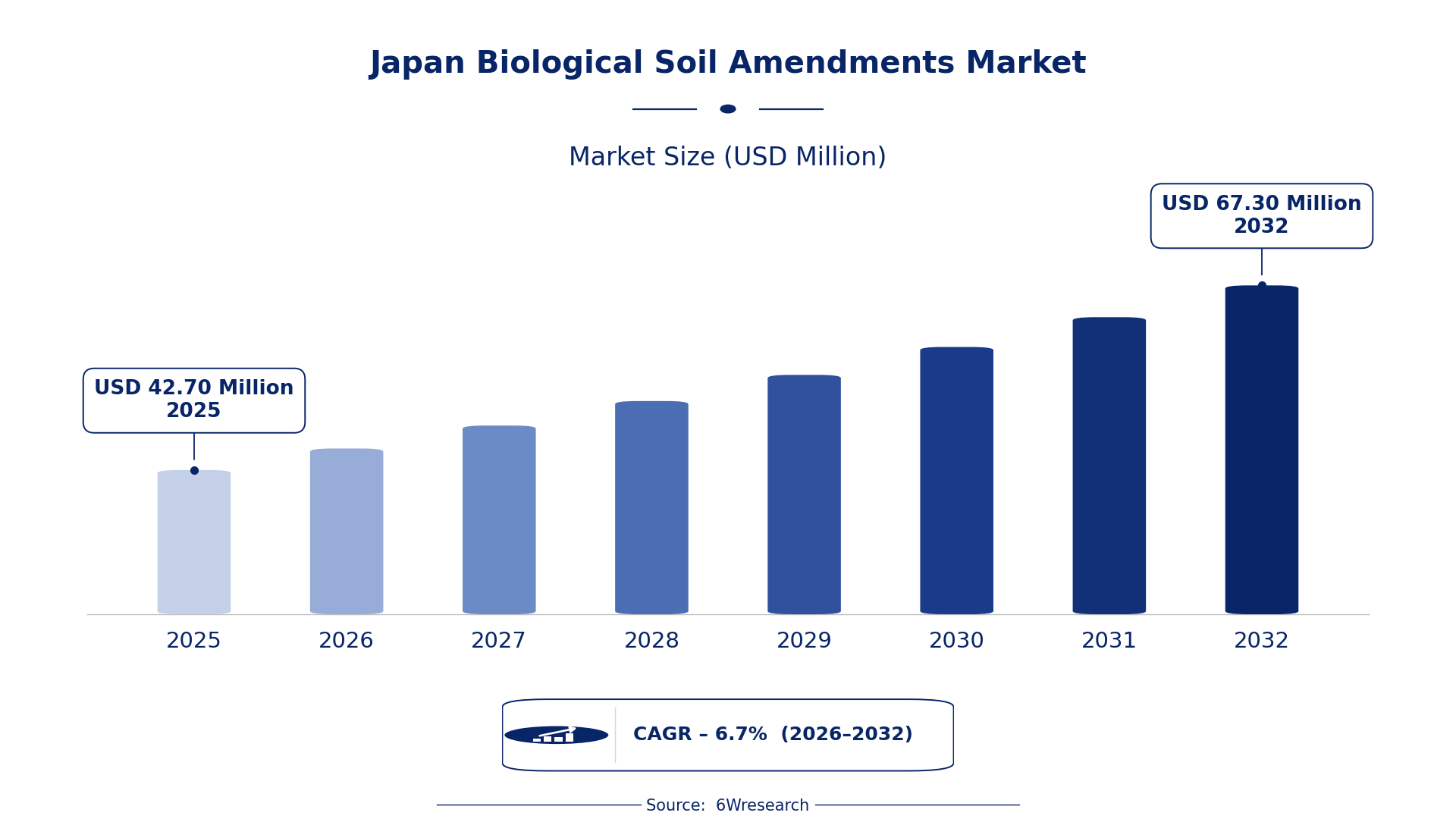
According to 6Wresearch internal database and industry insights, the Japan Biological Soil Amendments Market was valued at USD 42.70 Million in 2025 and is projected to reach USD 67.30 Million by 2032, growing at a CAGR of approximately 6.7% during 2026–2032.
Japan Biological Soil Amendments Market Highlights
| Report Metric | Details |
| Report Name | Japan Biological Soil Amendments Market (2026-2032) |
| Market Size 2025 | USD 42.70 Million |
| Market Size 2032 | USD 67.30 Million |
| Absolute Growth 2025–2032 | USD 24.60 Million |
| CAGR 2026–2032 | 6.7% |
| Peak Annual Growth | 7.7% in 2030 |
| Forecast Period | 2026–2032 |
| Historical Data | 2022–2025 |
| Base Year | 2025 |
| Leading Segment, 2025 | Compost (46% share) |
| Leading Type, 2025 | Organic (45% share) |
| Leading Composition, 2025 | Decomposed Plant Matter (40% share) |
| Leading Application, 2025 | Top Dressing (40% share) |
| Leading End User, 2025 | Organic Farmers (47% share) |
| Fastest-Growing Segment | Biofertilizers (9.2% CAGR) |
| Fastest-Growing Type | Microbial (9.6% CAGR) |
| Fastest-Growing Composition | Rhizobium (9.0% CAGR) |
| Fastest-Growing Application | Seed Coating (9.5% CAGR) |
| Fastest-Growing End User | Agricultural Coops (8.8% CAGR) |
| Growing Sector | Seed Coating |
| Key End Users | Top Dressing, Seed Coating, Soil Mix, Plow-in |
Japan Biological Soil Amendments Market Year-wise Growth Rate and Key Drivers (2022–2032)
This graph illustrates the annual growth rates of the market from 2022 to 2032, highlighting a steady upward trajectory and projected market expansion over the forecast period.
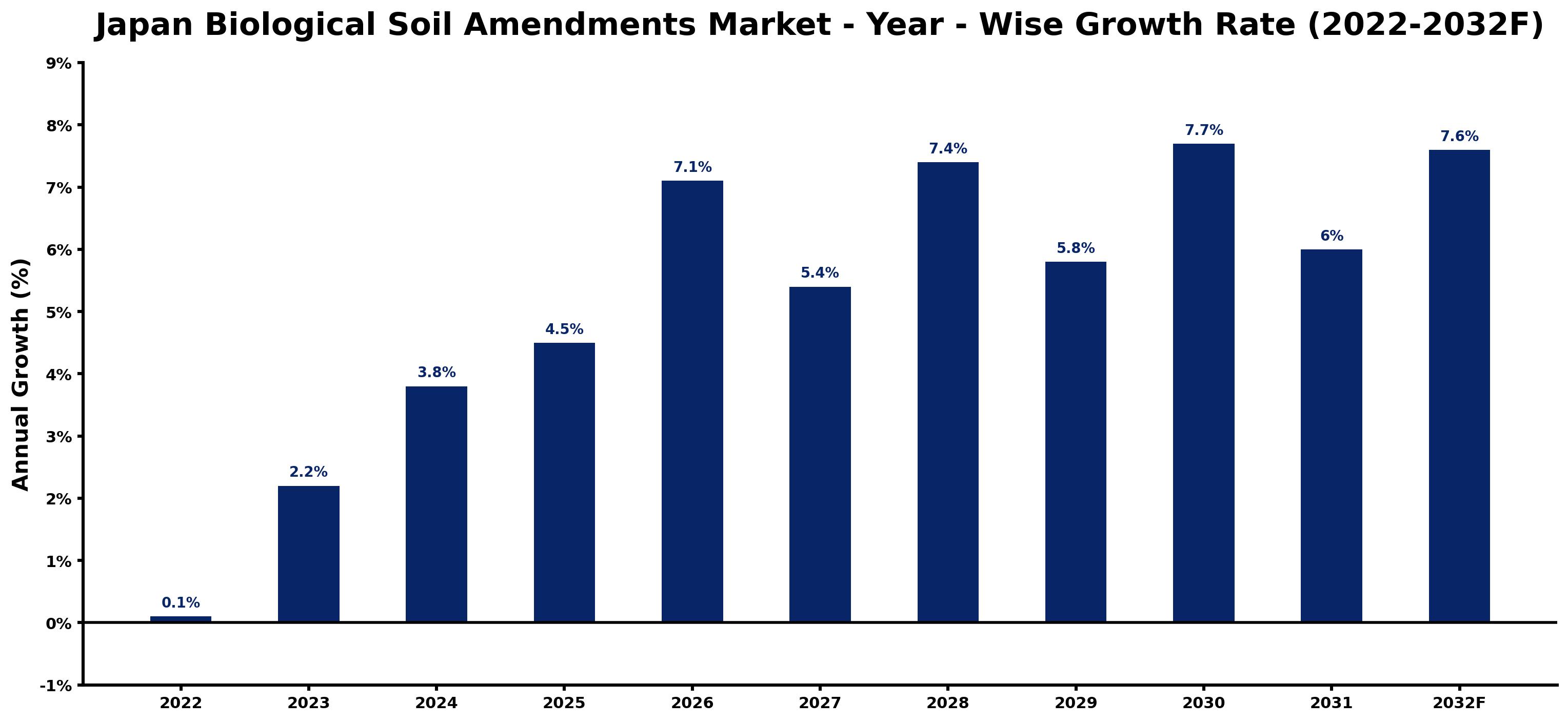
Below, each year's estimated growth is shown next to the factor that most influenced it.
| Year | Estimated Annual Growth (%) | Market Rationale |
| 2022 | 0.1 | The market showed minimal growth due to initial recovery from previous agricultural challenges. |
| 2023 | 2.2 | Growth accelerated as organic farming gained popularity among consumers and producers. |
| 2024 | 3.8 | Increased awareness of sustainable practices drove further growth in biological soil amendments. |
| 2025 | 4.5 | The market peaked historically as demand surged from organic farmers and cooperatives. |
| 2026 | 7.1 | Investment in agricultural technology is expected to boost the demand for biological soil amendments. |
| 2027 | 5.4 | Growth is projected to slow as market saturation begins to affect new purchases. |
| 2028 | 7.4 | Renewed interest in sustainable agriculture practices is expected to spur demand for soil amendments. |
| 2029 | 5.8 | Growth is projected to decelerate slightly as competition among suppliers intensifies. |
| 2030 | 7.7 | The market is expected to reach its peak growth rate as environmental concerns heighten demand. |
| 2031 | 6.0 | Growth is projected to moderate as the market adjusts to the peak levels of the previous year. |
| 2032 | 7.6 | Demand is expected to remain strong as organic farming initiatives continue to expand. |
Note: Market size estimations and growth projections presented in this report are based on 6Wresearch's proprietary forecasting methodology, utilizing the latest available industry data, government publications, and primary research inputs.
Japan Biological Soil Amendments Market Synopsis
Biological soil amendments are organic materials added to improve soil fertility and structure, primarily derived from decomposed organic matter. The Japan Biological Soil Amendments Market is expanding, driven by over 1 million organic farmers as of 2023 and a government goal to increase organic farmland to 3% by 2030. The Tokyo region serves as a hub for organic farming activities, stimulating demand as agricultural cooperatives actively distribute these products to promote sustainable practices.
Market Dynamics Impact Analysis (2026–2032)
| Factor | Type | Impact | Primary Segment Affected |
| Growing organic farming practices are driving demand for biological soil amendments. | Driver | High | Compost |
| Increased consumer demand for organic produce is boosting the use of biological soil amendments. | Driver | High | Biofertilizers |
| The Tokyo region's focus on organic farming creates opportunities for suppliers of biological soil amendments. | Opportunity | High | Organic |
| Government initiatives to support sustainable agriculture open new markets for biological soil amendments. | Opportunity | Medium | Green Manures |
| Limited awareness among traditional farmers may restrain the adoption of biological soil amendments. | Restraint | Medium | Manure |
| Regulatory challenges regarding the quality standards of compost may hinder market growth. | Restraint | High | Compost |
| Supply chain disruptions can limit the availability of key organic materials for amendments. | Challenge | High | Biofertilizers |
| Competition among suppliers may lead to price pressures, affecting profitability for producers. | Challenge | Medium | Organic |
Evaluation of Drivers in Japan Biological Soil Amendments Market (2026–2032)
The factors lifting demand, and the evidence behind each, are summarised below.
| Drivers | Primary Segment Affected | Why It Matters (Evidence) |
| Increased investment in organic farming technologies drives demand for compost. | Compost | Japan's organic farmers are adopting advanced practices, leading to a 5 billion yen budget for organic farming support. |
| Rising consumer preference for organic products boosts biofertilizer usage. | Biofertilizers | The government aims to increase organic farming to 3% by 2030, which will further increase biofertilizer demand. |
| The Tokyo region's organic farming hub supports the use of green manures. | Green Manures | This region's focus on sustainable practices promotes the adoption of green manures. |
| Awareness of environmental sustainability increases demand for microbial amendments. | Microbial | The growing trend of sustainable agriculture encourages the use of microbial amendments. |
| The rise in organic farmland supports the use of animal waste in agriculture. | Animal Waste | With organic farmland reaching 0.5% of total agricultural land, animal waste is increasingly utilized. |
Several shifts outside the market lift sales. The rise in organic farming, with over 1 million organic farmers in Japan, stimulates demand for compost and biofertilizers. The growing awareness of environmental sustainability drives the demand for animal waste as a nutrient source in agriculture, while the focus on sustainable practices in the Tokyo region promotes the use of green manures.
Evaluation of Restraints in Japan Biological Soil Amendments Market
Several factors work against faster growth; the main ones are summarised below.
| Market Restraint | Primary Segment Affected | Why It Matters (Evidence) |
| Limited awareness among traditional farmers about the benefits of biological soil amendments restricts market growth. | Manure | Many traditional farmers remain unaware of the advantages of using biological soil amendments, limiting their adoption. |
| Regulatory challenges related to compost quality standards may impede market expansion. | Compost | Strict regulations regarding compost quality can create barriers for producers, affecting availability. |
| Supply chain disruptions can impact the availability of organic materials for soil amendments. | Biofertilizers | Supply chain issues may delay the delivery of essential organic materials, hindering production. |
| High competition among suppliers can lead to price pressures, affecting profitability. | Organic | Intense competition may force suppliers to lower prices, impacting their profit margins. |
| Limited infrastructure for composting facilities can restrict the production capacity of biological soil amendments. | Green Manures | Inadequate composting facilities may limit the ability to produce sufficient quantities of green manures. |
Japan Biological Soil Amendments Market Challenges
High production costs restrict the use of biological soil amendments, as sourcing quality organic materials can raise expenses by 20%, putting pressure on producers' margins. Limited availability of quality compost leads to supply chain inefficiencies, causing delays of up to two weeks for agricultural cooperatives and increasing operational costs. Buyers face challenges accessing these amendments due to price volatility, which can rise by 20% during peak seasons, complicating budgeting for sustainable practices. Slow technology adoption hinders many producers, as inadequate access to modern composting facilities limits their ability to scale operations effectively.
Trends in the Japan Biological Soil Amendments Market
Buyers and suppliers in the Japan Biological Soil Amendments Market are adjusting to the following trends.
- Shift from Conventional to Organic Farming: Organic farmers in Japan are increasingly adopting biological soil amendments, with over 1 million practitioners as of 2023. This shift is notable in the Tokyo region, where organic farming activities are thriving, supported by a 5 billion yen budget for agricultural initiatives.
- Rising Adoption of Microbial Amendments: The use of microbial amendments is gaining traction, particularly in vegetable production. This trend aligns with the government's goal to increase organic farming, aiming for 3% of farmland by 2030.
- Increased Focus on Sustainable Practices: The government's initiatives promote sustainable agricultural practices across Japan, encouraging the use of biological soil amendments. The budget of 5 billion yen in 2023 highlights the commitment to sustainability.
- Expansion of Composting Facilities: Local municipalities are encouraging compost made from food waste, leading to an increase in composting facilities. This initiative aligns with Japan's environmental goals and supports the organic farming sector.
Investment Opportunities in the Japan Biological Soil Amendments Market
The following opportunities in the Japan Biological Soil Amendments Market pair current demand with a clear way in.
- Investing in Composting Facilities: The Tokyo region's emphasis on sustainable agriculture offers a chance to invest in composting facilities, meeting the growing demand for organic materials. With a budget of 5 billion yen for organic farming support, local partnerships can aid market entry.
- Supply of Biofertilizers for Organic Farmers: With the government aiming for a 3% increase in organic farmland by 2030, there is a notable opportunity to supply biofertilizers. Collaborating with agricultural cooperatives can streamline market entry and distribution.
- Enhancing Awareness Programs: Many traditional farmers remain unaware of biological soil amendments, creating a pressing need for awareness programs. Partnering with local agricultural extension services can effectively bridge this gap and promote adoption.
- Development of Microbial Products: The rising demand for microbial amendments presents an opportunity to develop specialised products. Targeting regions with high vegetable production can improve market penetration and address specific agricultural needs.
Government Initiatives in the Japan Biological Soil Amendments Market
The Waste Management and Public Cleansing Act, established in 1970, governs the treatment and disposal of waste, affecting producers of biological soil amendments by ensuring compliance with waste management standards. This law requires proper handling and processing of organic materials, which is crucial for maintaining quality in soil amendments.
The Ministry of Agriculture, Forestry and Fisheries oversees the implementation of agricultural support programs, including a budget of 5 billion yen in 2023 aimed at promoting organic farming. Agricultural cooperatives utilise this funding to distribute biological soil amendments, improving access for organic farmers across Japan.
Future Insight of the Japan Biological Soil Amendments Market
Agricultural cooperatives will experience substantial changes by 2032, as advancements in composting technology and increased government support for sustainable agriculture transform the sector. The budget for organic farming support is projected to reach 10 billion yen, providing additional resources for producers. New standards will emerge, enhancing the quality of biological amendments, which will be crucial for buyers seeking reliable products. Urban composting facilities will expand, creating local sources of organic materials and reducing transportation costs for producers.
Market Segmentation Analysis
Japan Biological Soil Amendments Market report covers a detailed analysis of the following market segments:
By Segment – Compost Leads, Biofertilizers Expected to Grow Fastest
According to Saurav Kr Singh, Senior Research Analyst at 6Wresearch, Compost accounted for 46% of the market by segment in 2025. Compost holds the largest share as it is widely used for enhancing soil structure and fertility, particularly among Japan's over 1 million organic farmers. The Tokyo region exemplifies this trend, with local municipalities actively supporting composting initiatives. Biofertilizers are projected to grow fastest, at a CAGR of 9.2% during 2026–2032. Biofertilizers are experiencing rapid growth, primarily due to heightened environmental awareness and their effectiveness in improving nutrient availability for crops. Government initiatives promoting organic farming further contribute to this upward trajectory, suggesting a promising future for biofertilizers. Suppliers should focus on developing biofertilizers to meet the rising demand from environmentally conscious farmers.
By Type – Organic Leads, Microbial Expected to Grow Fastest
The largest type category in 2025 was Organic, at 45% of revenue. Organic soil amendments dominate the market, essential for organic farming practices and supported by government initiatives that encourage organic agriculture. In 2023, the budget for organic farming support reached 5 billion yen, underscoring a strong commitment to this segment. Over 2026–2032, Microbial is expected to post the fastest growth, at a CAGR of 9.6%. Microbial amendments are gaining traction as they play a crucial role in enhancing soil microbial activity, vital for sustainable farming. As farmers increasingly seek to improve soil health and crop yields, the adoption of microbial amendments is anticipated to rise. Buyers should consider integrating microbial amendments to optimise soil health and support sustainable agricultural practices.
By Composition – Decomposed Plant Matter Leads, Rhizobium Expected to Grow Fastest
In 2025, Decomposed Plant Matter led the composition split with a 40% share. Decomposed plant matter is the leading component in soil amendments, serving as a key ingredient that enhances soil fertility. Its extensive use in composting aligns with the practices of Japan's organic farmers, ensuring its dominant position. The quickest growth will come from Rhizobium, forecast to expand at a CAGR of 9.0% between 2026 and 2032. Rhizobium is becoming increasingly popular in specific biofertilizer applications, particularly for legumes, as it effectively improves nitrogen availability in the soil. This trend is likely to expand as farmers become more aware of its benefits. Suppliers must ensure the availability of rhizobium-based products to meet the preferences of farmers seeking effective biofertilizers.
By Application – Top Dressing Leads, Seed Coating Expected to Grow Fastest
With 40% of application revenue in 2025, Top Dressing was the largest category. Top dressing is the most prevalent application method, allowing for direct nutrient provision to crops from the soil surface. This method is particularly favoured in rice cultivation areas, where maintaining soil health is critical. Seed Coating is set to record the highest CAGR in this split, 9.5% over 2026–2032. Seed coating is emerging as a rapidly growing application method due to its effectiveness in protecting seeds and enhancing germination rates. This approach is gaining traction among farmers seeking specialised solutions for improved crop establishment. Suppliers should focus on developing seed coating products to capitalise on this growing application trend.
By End User – Organic Farmers Lead, Agricultural Coops Expected to Grow Fastest
Organic Farmers held 47% of the Japan Biological Soil Amendments Market by end user in 2025. Organic farmers represent the largest user group of biological soil amendments, relying on these products to meet organic certification standards. Their commitment to sustainable practices significantly drives the demand for high-quality soil amendments. Agricultural Coops are projected to grow fastest, at a CAGR of 8.8% during 2026–2032. Agricultural cooperatives are quickly becoming the fastest-growing user group, as they distribute and utilise soil amendments to support their member farmers. Their pivotal role in promoting biological soil amendments is crucial for expanding market reach. Suppliers should strengthen partnerships with agricultural cooperatives to enhance distribution and market penetration.
Key Attractiveness of the Report
- 10 Years of Market Numbers
- Historical Data Starting from 2022 to 2025
- Base Year 2025
- Forecast Data until 2032
- Key Performance Indicators Impacting the Market
- Major Upcoming Developments and Projects
Key Highlights of the Report:
- Japan Biological Soil Amendments Market Outlook
- Market Size of Japan Biological Soil Amendments Market, 2025
- Forecast of Japan Biological Soil Amendments Market, 2032
- Historical Data and Forecast of Japan Biological Soil Amendments Revenues & Volume for the Period 2022-2032F
- Japan Biological Soil Amendments Market Trend Evolution
- Japan Biological Soil Amendments Market Drivers and Challenges
- Japan Biological Soil Amendments Price Trends
- Japan Biological Soil Amendments Porter's Five Forces
- Japan Biological Soil Amendments Industry Life Cycle
- Historical Data and Forecast of Japan Biological Soil Amendments Market Revenues & Volume By Segment for the Period 2022-2032F
- Historical Data and Forecast of Japan Biological Soil Amendments Market Revenues & Volume By Compost for the Period 2022-2032F
- Historical Data and Forecast of Japan Biological Soil Amendments Market Revenues & Volume By Biofertilizers for the Period 2022-2032F
- Historical Data and Forecast of Japan Biological Soil Amendments Market Revenues & Volume By Manure for the Period 2022-2032F
- Historical Data and Forecast of Japan Biological Soil Amendments Market Revenues & Volume By Green Manures for the Period 2022-2032F
- Historical Data and Forecast of Japan Biological Soil Amendments Market Revenues & Volume By Type for the Period 2022-2032F
- Historical Data and Forecast of Japan Biological Soil Amendments Market Revenues & Volume By Organic for the Period 2022-2032F
- Historical Data and Forecast of Japan Biological Soil Amendments Market Revenues & Volume By Microbial for the Period 2022-2032F
- Historical Data and Forecast of Japan Biological Soil Amendments Market Revenues & Volume By Animal Waste for the Period 2022-2032F
- Historical Data and Forecast of Japan Biological Soil Amendments Market Revenues & Volume By Leguminous Plants for the Period 2022-2032F
- Historical Data and Forecast of Japan Biological Soil Amendments Market Revenues & Volume By Composition for the Period 2022-2032F
- Historical Data and Forecast of Japan Biological Soil Amendments Market Revenues & Volume By Decomposed Plant Matter for the Period 2022-2032F
- Historical Data and Forecast of Japan Biological Soil Amendments Market Revenues & Volume By Rhizobium, Azospirillum for the Period 2022-2032F
- Historical Data and Forecast of Japan Biological Soil Amendments Market Revenues & Volume By Cow, Poultry for the Period 2022-2032F
- Historical Data and Forecast of Japan Biological Soil Amendments Market Revenues & Volume By Natural Nitrogen Fixers for the Period 2022-2032F
- Historical Data and Forecast of Japan Biological Soil Amendments Market Revenues & Volume By Application for the Period 2022-2032F
- Historical Data and Forecast of Japan Biological Soil Amendments Market Revenues & Volume By Top Dressing for the Period 2022-2032F
- Historical Data and Forecast of Japan Biological Soil Amendments Market Revenues & Volume By Seed Coating for the Period 2022-2032F
- Historical Data and Forecast of Japan Biological Soil Amendments Market Revenues & Volume By Soil Mix for the Period 2022-2032F
- Historical Data and Forecast of Japan Biological Soil Amendments Market Revenues & Volume By Plow-in for the Period 2022-2032F
- Historical Data and Forecast of Japan Biological Soil Amendments Market Revenues & Volume By End User for the Period 2022-2032F
- Historical Data and Forecast of Japan Biological Soil Amendments Market Revenues & Volume By Organic Farmers for the Period 2022-2032F
- Historical Data and Forecast of Japan Biological Soil Amendments Market Revenues & Volume By Agricultural Coops for the Period 2022-2032F
- Historical Data and Forecast of Japan Biological Soil Amendments Market Revenues & Volume By Agri Firms for the Period 2022-2032F
- Historical Data and Forecast of Japan Biological Soil Amendments Market Revenues & Volume By Eco-Farms for the Period 2022-2032F
- Japan Biological Soil Amendments Import Export Trade Statistics
- Market Opportunity Assessment By Segment
- Market Opportunity Assessment By Type
- Market Opportunity Assessment By Composition
- Market Opportunity Assessment By Application
- Market Opportunity Assessment By End User
- Japan Biological Soil Amendments Top Companies Market Share
- Japan Biological Soil Amendments Competitive Benchmarking By Technical and Operational Parameters
- Japan Biological Soil Amendments Company Profiles
- Japan Biological Soil Amendments Key Strategic Recommendations
Market Covered
Coverage by segment is as follows.
By Segment
- Compost
- Biofertilizers
- Manure
- Green Manures
By Type
- Organic
- Microbial
- Animal Waste
- Leguminous Plants
By Composition
- Decomposed Plant Matter
- Rhizobium
- Azospirillum
- Cow
- Poultry
- Natural Nitrogen Fixers
By Application
- Top Dressing
- Seed Coating
- Soil Mix
- Plow-in
By End User
- Organic Farmers
- Agricultural Coops
- Agri Firms
- Eco-Farms






































