Japan Biotech Crop Testing Market Size & Growth Rate
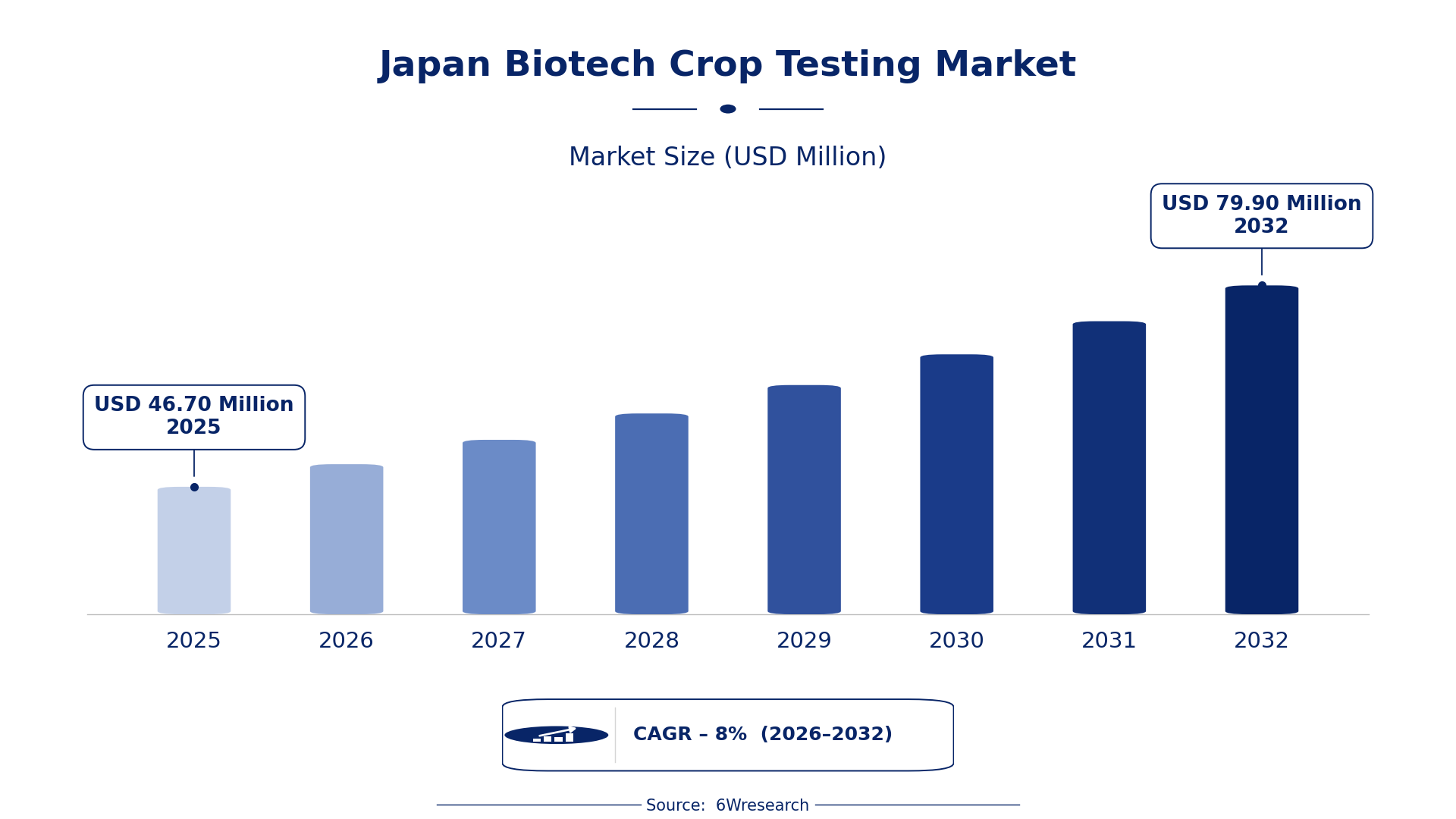
According to 6Wresearch internal database and industry insights, the Japan Biotech Crop Testing Market was valued at USD 46.70 Million in 2025 and is projected to reach USD 79.90 Million by 2032, growing at a CAGR of approximately 8% during 2026–2032.
Japan Biotech Crop Testing Market Highlights
| Report Metric | Details |
| Report Name | Japan Biotech Crop Testing Market (2026-2032) |
| Market Size 2025 | USD 46.70 Million |
| Market Size 2032 | USD 79.90 Million |
| Absolute Growth 2025–2032 | USD 33.20 Million |
| CAGR 2026–2032 | 8% |
| Peak Annual Growth | 9.1% in 2031 |
| Forecast Period | 2026–2032 |
| Historical Data | 2022–2025 |
| Base Year | 2025 |
| Leading Segment, 2025 | Genetic Purity Testing (49% share) |
| Leading Test Type, 2025 | Corn (49% share) |
| Leading Crop Type, 2025 | Seed Validation (41% share) |
| Leading Purpose, 2025 | Seed Companies (46% share) |
| Fastest-Growing Segment | Trait Verification (10.7% CAGR) |
| Fastest-Growing Test Type | Soybean (11.3% CAGR) |
| Fastest-Growing Crop Type | GMO Identification (11.7% CAGR) |
| Fastest-Growing Purpose | Farmers (10.8% CAGR) |
| Growing Sector | Farmers |
| Key End Users | Seed Companies, Farmers, Agri Labs, Agronomists |
Japan Biotech Crop Testing Market Year-wise Growth Rate and Key Drivers (2022–2032)
This graph illustrates the annual growth rates of the market from 2022 to 2032, highlighting a steady upward trajectory and projected market expansion over the forecast period.
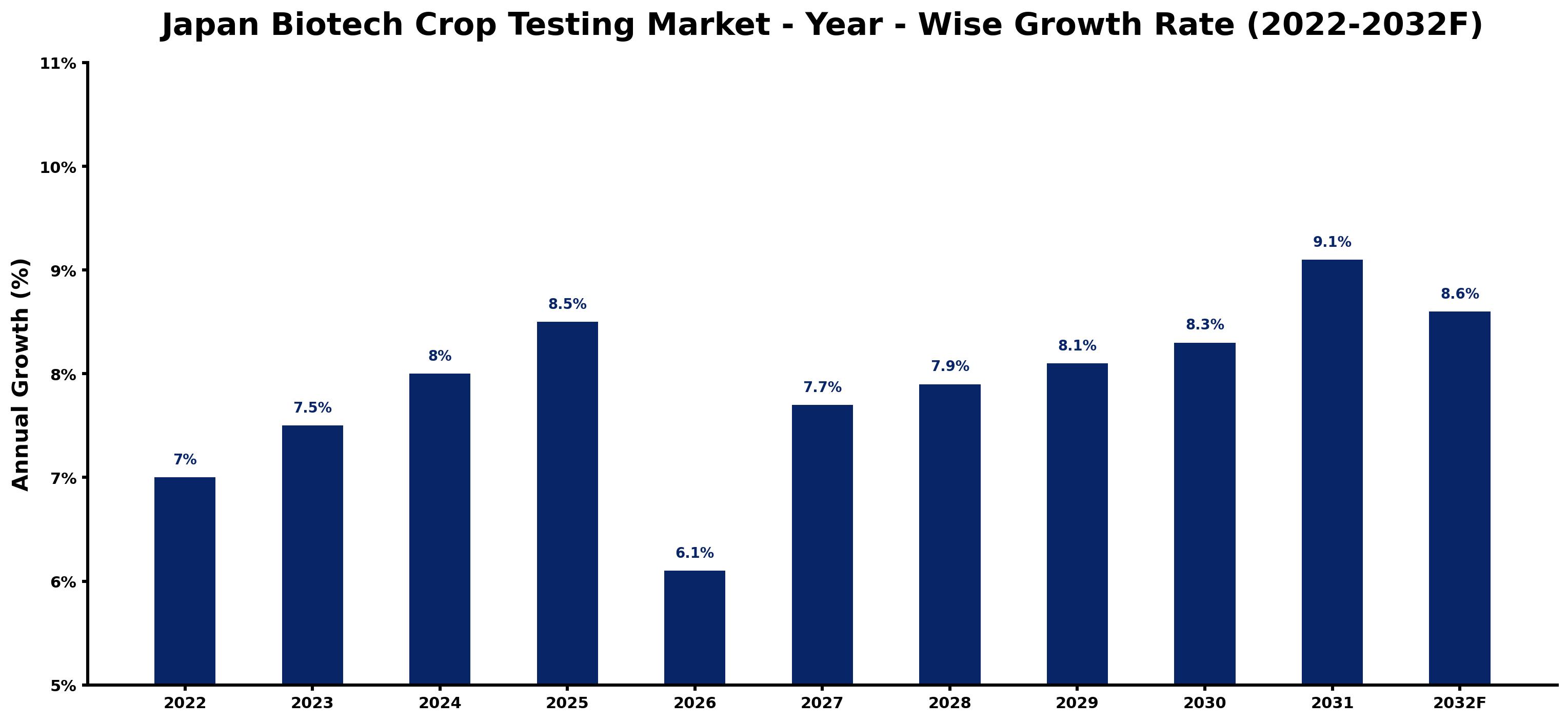
Each row of the following table gives one year's estimated growth and the event or demand shift that explains it.
| Year | Estimated Annual Growth (%) | Market Rationale |
| 2022 | 7.0 | The market showed steady growth due to increasing compliance requirements. |
| 2023 | 7.5 | Demand rose as seed companies expanded their testing capabilities. |
| 2024 | 8.0 | Growth accelerated with heightened awareness of GMO regulations. |
| 2025 | 8.5 | The market peaked as more farmers adopted biotech crops. |
| 2026 | 6.1 | Growth is expected to slow as regulatory frameworks become more stringent. |
| 2027 | 7.7 | Demand will increase as farmers seek to improve crop yields. |
| 2028 | 7.9 | The market is projected to continue growing with rising agricultural exports. |
| 2029 | 8.1 | Growth is anticipated to be driven by advancements in testing technologies. |
| 2030 | 8.3 | Demand will rise as seed validation becomes more critical. |
| 2031 | 9.1 | The market is expected to peak again with a surge in trait verification needs. |
| 2032 | 8.6 | Growth is projected to slow as the market matures and competition intensifies. |
Note: Market size estimations and growth projections presented in this report are based on 6Wresearch's proprietary forecasting methodology, utilizing the latest available industry data, government publications, and primary research inputs.
Japan Biotech Crop Testing Market Synopsis
Biotech crop testing ensures compliance with safety and regulatory standards for genetically modified organisms (GMOs) through various molecular techniques. The Japan Biotech Crop Testing Market is primarily driven by domestic seed companies and agricultural laboratories, with local farmers demanding validated seeds. The 'GMO Safety Assessment' program mandates testing for over 90% of biotech crops, increasing the need for these services and propelling market growth. In 2023, Japan reported over 1 million hectares of corn cultivation, further boosting this market.
Market Dynamics Impact Analysis (2026–2032)
| Factor | Type | Impact | Primary Segment Affected |
| Rising demand for genetically modified crops among farmers | Driver | High | Genetic Purity Testing |
| Increased focus on regulatory compliance by seed companies | Driver | High | Trait Verification |
| Growing agricultural exports creating a need for quality assurance | Opportunity | High | Seed Validation |
| Expansion of testing facilities to accommodate new technologies | Opportunity | High | GMO Identification |
| Stringent regulations affecting testing timelines | Restraint | High | Herbicide Tolerance Test |
| Limited awareness among farmers about testing benefits | Restraint | Medium | Resistance Testing |
| High costs associated with advanced testing technologies | Challenge | High | Genetic Purity Testing |
| Competition from alternative agricultural practices | Challenge | Medium | Trait Verification |
Evaluation of Drivers in Japan Biotech Crop Testing Market (2026–2032)
The following drivers explain most of the expected growth.
| Drivers | Primary Segment Affected | Why It Matters (Evidence) |
| Increased adoption of genetically modified crops | Genetic Purity Testing | Over 1 million hectares of corn cultivated in 2023 drives demand for purity testing. |
| Heightened regulatory scrutiny on GMOs | Trait Verification | The 'GMO Safety Assessment' program mandates verification for over 90% of biotech crops. |
| Rising agricultural exports necessitating compliance | Seed Validation | Japan's agricultural exports reached approximately $9 billion in 2023, boosting demand for quality assurance. |
| Technological advancements in testing methods | GMO Identification | ISO 17025 standards improve laboratory testing capabilities, increasing demand. |
| Growing consumer preference for verified products | Resistance Testing | Farmers seek pest-resistant crops to ensure sustainable agricultural practices. |
Much of the new demand traces back to the increasing adoption of genetically modified crops, with over 1 million hectares of corn cultivated in 2023, leading to a surge in genetic purity testing. Rising agricultural exports, reaching approximately $9 billion in 2023, necessitate compliance and quality assurance, further driving seed validation services. Technological advancements in testing methods aligned with ISO 17025 standards improve laboratory capabilities, resulting in increased demand for GMO identification. Farmers are prioritising pest-resistant crops to ensure sustainable agricultural practices, boosting resistance testing.
Evaluation of Restraints in Japan Biotech Crop Testing Market
Several factors work against faster growth; the main ones are summarised below.
| Market Restraint | Primary Segment Affected | Why It Matters (Evidence) |
| Stringent regulatory compliance requirements | Genetic Purity Testing | Compliance with the 'GMO Safety Assessment' program can delay testing by up to six months. |
| Limited access to advanced testing technology | Trait Verification | Producers may rely on outdated methods that lead to inaccuracies and further delays. |
| High costs associated with prolonged validation periods | Seed Validation | Seed companies may incur additional expenses of approximately $500,000 per product. |
| Market entry barriers for new testing methods | GMO Identification | Strict regulations can hinder the adoption of new testing technologies. |
| Inconsistent quality assurance practices | Resistance Testing | Variability in testing standards can lead to unreliable results for pest resistance. |
Japan Biotech Crop Testing Market Challenges
Japan's strict regulations create supply issues for producers, as compliance with the 'GMO Safety Assessment' program can delay testing by up to six months. This prolonged process raises costs for seed companies, who may incur additional expenses of around $500,000 per product due to extended validation periods. Limited access to modern testing technology hampers efficiency, forcing producers to rely on outdated methods that can lead to inaccuracies and further delays. Consequently, buyers face increased prices and uncertainty in crop availability, which can disrupt their planting schedules and impact overall yield.
Trends in the Japan Biotech Crop Testing Market
The shifts below are changing how Japan Biotech Crop Testing Market products are bought and supplied.
- Shift towards Enhanced Seed Validation: Seed companies are increasingly focusing on rigorous validation processes to ensure crop quality. The 'GMO Safety Assessment' program mandates testing for over 90% of biotech crops, intensifying this trend.
- Growing Demand for Trait Verification: In 2023, the emphasis on trait verification surged as over 90% of biotech crops required compliance checks. This shift is evident in the increasing investments by seed companies in testing services.
- Increased Focus on Sustainable Practices: Farmers are prioritising pest-resistant crops to ensure sustainable agricultural practices. With rising consumer demand for verified products, this trend is shaping the biotech crop testing market.
- Technological Advancements in Testing: The adoption of ISO 17025 standards has led to improved laboratory testing capabilities. This shift is essential for ensuring compliance and enhancing the overall quality of biotech crop testing services.
Investment Opportunities in the Japan Biotech Crop Testing Market
Below are the investment opportunities with the strongest case in the Japan Biotech Crop Testing Market.
- Seed Companies Seeking Compliance Solutions: With the market projected to grow, seed companies are looking for advanced testing solutions. Investing in new testing technologies will enable them to meet compliance requirements more efficiently.
- Expansion of Testing Services in Agricultural Labs: Agricultural laboratories are expanding their offerings to include comprehensive testing services. This trend is driven by the demand for quality assurance in biotech crops, creating investment opportunities.
- Investment in Advanced Testing Facilities: Now is the time to invest in state-of-the-art testing facilities, as demand for reliable testing services is on the rise. Regions with high agricultural activity, such as Hokkaido, present ideal opportunities.
- Growth in Biotech Crop Exports: As Japan's agricultural exports reached approximately $9 billion in 2023, there is a growing need for compliance testing. This scenario opens avenues for suppliers to provide essential testing services.
Government Initiatives in the Japan Biotech Crop Testing Market
The 'GMO Safety Assessment' program mandates rigorous testing for all biotech crops, ensuring compliance with safety standards. This measure complements existing regulations, such as the PMD Act, which regulates the approval and quality of pharmaceuticals and medical devices, ensuring that producers meet quality benchmarks.
Seed companies benefit from the 'GMO Safety Assessment' program as it provides a clear framework for compliance. This program facilitates access to the market while ensuring that products meet the necessary safety and quality standards.
Future Insight of the Japan Biotech Crop Testing Market
Investment in advanced molecular testing technologies will reshape compliance processes, creating a demand for faster testing solutions by 2032. The Japanese government's support for biotechnology will drive research capabilities, leading to innovations in crop development. With over 1 million hectares of corn cultivation, the need for reliable trait verification will escalate, prompting seed companies to adopt updated testing standards. Buyers will benefit from improved crop quality and availability, ultimately boosting agricultural productivity.
Market Segmentation Analysis
Japan Biotech Crop Testing Market report covers a detailed analysis of the following market segments:
By Segment – Genetic Purity Testing Leads, Trait Verification Expected to Grow Fastest
According to Saurav Kr Singh, Senior Research Analyst at 6Wresearch, Genetic Purity Testing took 49% of segment revenue in 2025, more than any other category. Genetic Purity Testing holds the largest share due to its essential role in maintaining crop quality, particularly for the extensive corn cultivation in Japan. This testing is crucial for domestic seed companies that must comply with the regulations set by the Ministry of Agriculture, Forestry and Fisheries. Over 2026–2032, Trait Verification is expected to post the fastest growth, at a CAGR of 10.7%. Trait Verification is rapidly growing as it is vital for confirming desired traits in over 90% of biotech crops in Japan. The increasing focus on specific traits among farmers will drive demand for effective verification processes, further solidifying the lead of Genetic Purity Testing. Suppliers must enhance their testing capabilities to meet the rising demand for trait verification.
By Test Type – Corn Leads, Soybean Expected to Grow Fastest
With 49% of test type revenue in 2025, Corn was the largest category. Corn testing leads the market as it is a widely cultivated crop in Japan, significantly contributing to agricultural output and creating high demand for quality assurance. The robust cultivation of corn establishes a strong installed base for testing services among seed companies. Soybean is projected to grow fastest, at a CAGR of 11.3% during 2026–2032. Soybean testing is experiencing rapid growth due to its importance as a key crop for domestic consumption, with local farmers increasingly prioritising quality assurance. The rise in soybean cultivation will likely drive further demand for testing services, supporting market growth. Buyers should invest in soybean testing to ensure quality for this essential crop.
By Crop Type – Seed Validation Leads, GMO Identification Expected to Grow Fastest
Seed Validation held 41% of the Japan Biotech Crop Testing Market by crop type in 2025. Seed Validation is the leading crop type as it is critical for ensuring seed quality, especially for the numerous registered seed companies in Japan. This process guarantees that seeds meet the necessary standards for successful cultivation and market acceptance. The quickest growth will come from GMO Identification, forecast to expand at a CAGR of 11.7% between 2026 and 2032. GMO Identification is the fastest-growing crop type due to its necessity for regulatory compliance in testing biotech crops. As regulations tighten, the demand for identification services will increase significantly, underscoring the importance of this segment. Suppliers must adapt their offerings to include comprehensive GMO identification services to meet regulatory requirements.
By Purpose – Seed Companies Lead, Farmers Expected to Grow Fastest
Seed Companies accounted for 46% of the market by purpose in 2025. Seed Companies are the primary users of testing services, reflecting their substantial share of the market. Their reliance on testing for seed quality assurance drives consistent demand for biotech crop testing. Farmers are set to record the highest CAGR in this split, 10.8% over 2026–2032. Farmers represent the fastest-growing segment as they increasingly seek tested seeds to ensure crop success and adhere to safety standards. This trend indicates a growing awareness among farmers of the importance of testing in their agricultural practices. Suppliers should enhance their outreach to farmers to cater to the increasing demand for tested seeds.
Key Attractiveness of the Report
- 10 Years of Market Numbers
- Historical Data Starting from 2022 to 2025
- Base Year 2025
- Forecast Data until 2032
- Key Performance Indicators Impacting the Market
- Major Upcoming Developments and Projects
Key Highlights of the Report:
- Japan Biotech Crop Testing Market Outlook
- Market Size of Japan Biotech Crop Testing Market, 2025
- Forecast of Japan Biotech Crop Testing Market, 2032
- Historical Data and Forecast of Japan Biotech Crop Testing Revenues & Volume for the Period 2022-2032F
- Japan Biotech Crop Testing Market Trend Evolution
- Japan Biotech Crop Testing Market Drivers and Challenges
- Japan Biotech Crop Testing Price Trends
- Japan Biotech Crop Testing Porter's Five Forces
- Japan Biotech Crop Testing Industry Life Cycle
- Historical Data and Forecast of Japan Biotech Crop Testing Market Revenues & Volume By Segment for the Period 2022-2032F
- Historical Data and Forecast of Japan Biotech Crop Testing Market Revenues & Volume By Genetic Purity Testing for the Period 2022-2032F
- Historical Data and Forecast of Japan Biotech Crop Testing Market Revenues & Volume By Trait Verification for the Period 2022-2032F
- Historical Data and Forecast of Japan Biotech Crop Testing Market Revenues & Volume By Herbicide Tolerance Test for the Period 2022-2032F
- Historical Data and Forecast of Japan Biotech Crop Testing Market Revenues & Volume By Resistance Testing for the Period 2022-2032F
- Historical Data and Forecast of Japan Biotech Crop Testing Market Revenues & Volume By Test Type for the Period 2022-2032F
- Historical Data and Forecast of Japan Biotech Crop Testing Market Revenues & Volume By Corn for the Period 2022-2032F
- Historical Data and Forecast of Japan Biotech Crop Testing Market Revenues & Volume By Soybean for the Period 2022-2032F
- Historical Data and Forecast of Japan Biotech Crop Testing Market Revenues & Volume By Cotton for the Period 2022-2032F
- Historical Data and Forecast of Japan Biotech Crop Testing Market Revenues & Volume By Rice for the Period 2022-2032F
- Historical Data and Forecast of Japan Biotech Crop Testing Market Revenues & Volume By Crop Type for the Period 2022-2032F
- Historical Data and Forecast of Japan Biotech Crop Testing Market Revenues & Volume By Seed Validation for the Period 2022-2032F
- Historical Data and Forecast of Japan Biotech Crop Testing Market Revenues & Volume By GMO Identification for the Period 2022-2032F
- Historical Data and Forecast of Japan Biotech Crop Testing Market Revenues & Volume By Compliance for the Period 2022-2032F
- Historical Data and Forecast of Japan Biotech Crop Testing Market Revenues & Volume By Pest Resistance for the Period 2022-2032F
- Historical Data and Forecast of Japan Biotech Crop Testing Market Revenues & Volume By Purpose for the Period 2022-2032F
- Historical Data and Forecast of Japan Biotech Crop Testing Market Revenues & Volume By Seed Companies for the Period 2022-2032F
- Historical Data and Forecast of Japan Biotech Crop Testing Market Revenues & Volume By Farmers for the Period 2022-2032F
- Historical Data and Forecast of Japan Biotech Crop Testing Market Revenues & Volume By Agri Labs for the Period 2022-2032F
- Historical Data and Forecast of Japan Biotech Crop Testing Market Revenues & Volume By Agronomists for the Period 2022-2032F
- Japan Biotech Crop Testing Import Export Trade Statistics
- Market Opportunity Assessment By Segment
- Market Opportunity Assessment By Test Type
- Market Opportunity Assessment By Crop Type
- Market Opportunity Assessment By Purpose
- Japan Biotech Crop Testing Top Companies Market Share
- Japan Biotech Crop Testing Competitive Benchmarking By Technical and Operational Parameters
- Japan Biotech Crop Testing Company Profiles
- Japan Biotech Crop Testing Key Strategic Recommendations
Market Covered
The following segment groups are covered in the report.
By Segment
- Genetic Purity Testing
- Trait Verification
- Herbicide Tolerance Test
- Resistance Testing
By Test Type
- Corn
- Soybean
- Cotton
- Rice
By Crop Type
- Seed Validation
- GMO Identification
- Compliance
- Pest Resistance
By Purpose
- Seed Companies
- Farmers
- Agri Labs
- Agronomists






































