Japan Bitcoin Mining Hardware Market Size & Growth Rate
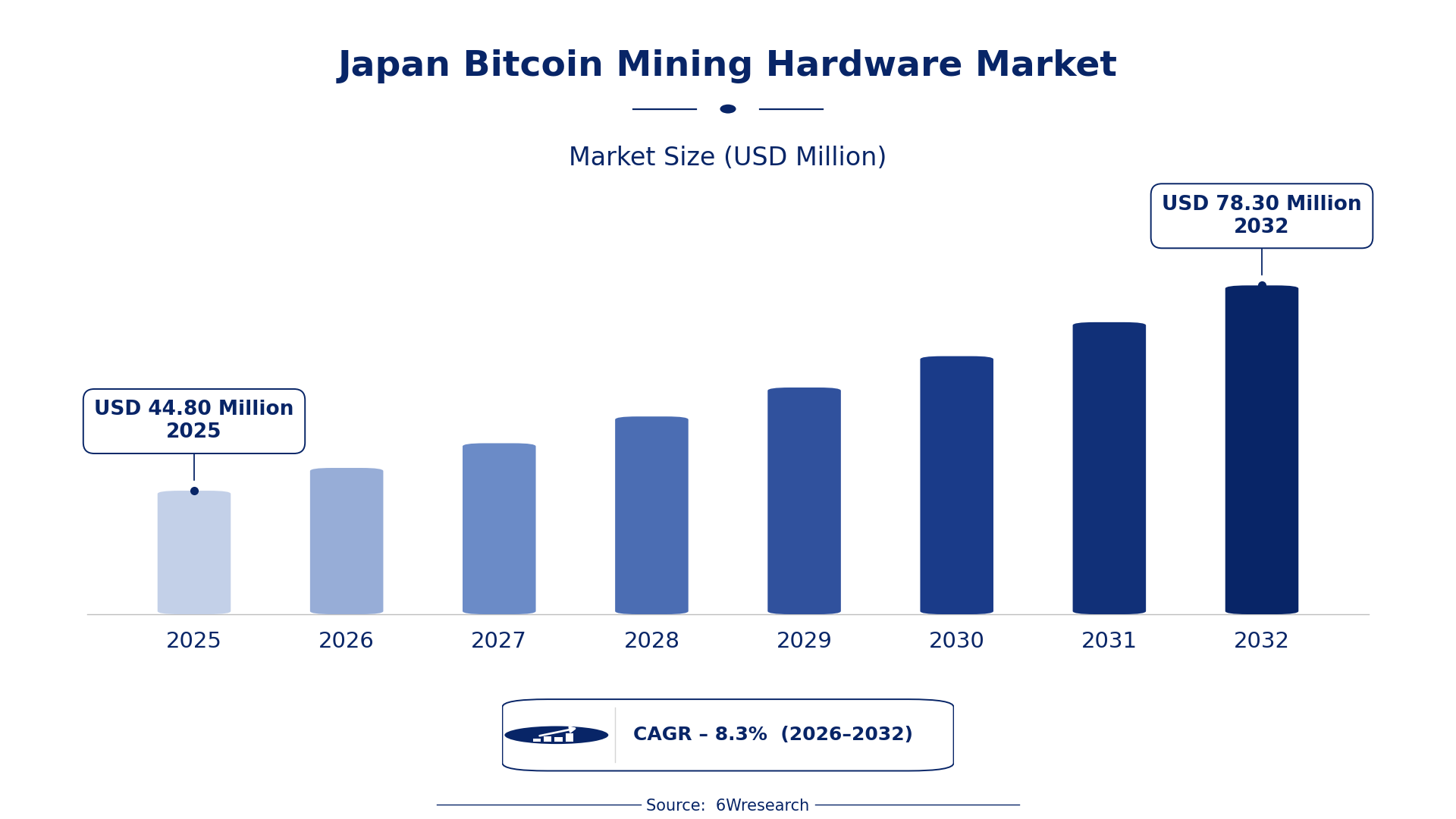
According to 6Wresearch internal database and industry insights, the Japan Bitcoin Mining Hardware Market was valued at USD 44.80 Million in 2025 and is projected to reach USD 78.30 Million by 2032, growing at a CAGR of approximately 8.3% during 2026–2032.
Japan Bitcoin Mining Hardware Market Highlights
| Report Metric | Details |
| Report Name | Japan Bitcoin Mining Hardware Market (2026-2032) |
| Market Size 2025 | USD 44.80 Million |
| Market Size 2032 | USD 78.30 Million |
| Absolute Growth 2025–2032 | USD 33.50 Million |
| CAGR 2026–2032 | 8.3% |
| Peak Annual Growth | 9.3% in 2027 |
| Forecast Period | 2026–2032 |
| Historical Data | 2022–2025 |
| Base Year | 2025 |
| Leading Hardware Type, 2025 | ASIC Miners (39% share) |
| Leading Processing Power, 2025 | High Hash Rate (50% share) |
| Leading Cooling Type, 2025 | Air Cooling (44% share) |
| Leading Distribution Channel, 2025 | Direct Sales (40% share) |
| Leading End User, 2025 | Mining Farms (39% share) |
| Fastest-Growing Hardware Type | Power Units (11.5% CAGR) |
| Fastest-Growing Processing Power | Energy Efficient (12.0% CAGR) |
| Fastest-Growing Cooling Type | Liquid Cooling (11.9% CAGR) |
| Fastest-Growing Distribution Channel | Online Platforms (10.6% CAGR) |
| Fastest-Growing End User | Data Centers (11.1% CAGR) |
| Growing Sector | cryptocurrency mining |
| Key End Users | mining farms, individual miners, data centers, enterprises |
Japan Bitcoin Mining Hardware Market Year-wise Growth Rate and Key Drivers (2022–2032)
This graph illustrates the annual growth rates of the market from 2022 to 2032, highlighting a steady upward trajectory and projected market expansion over the forecast period.
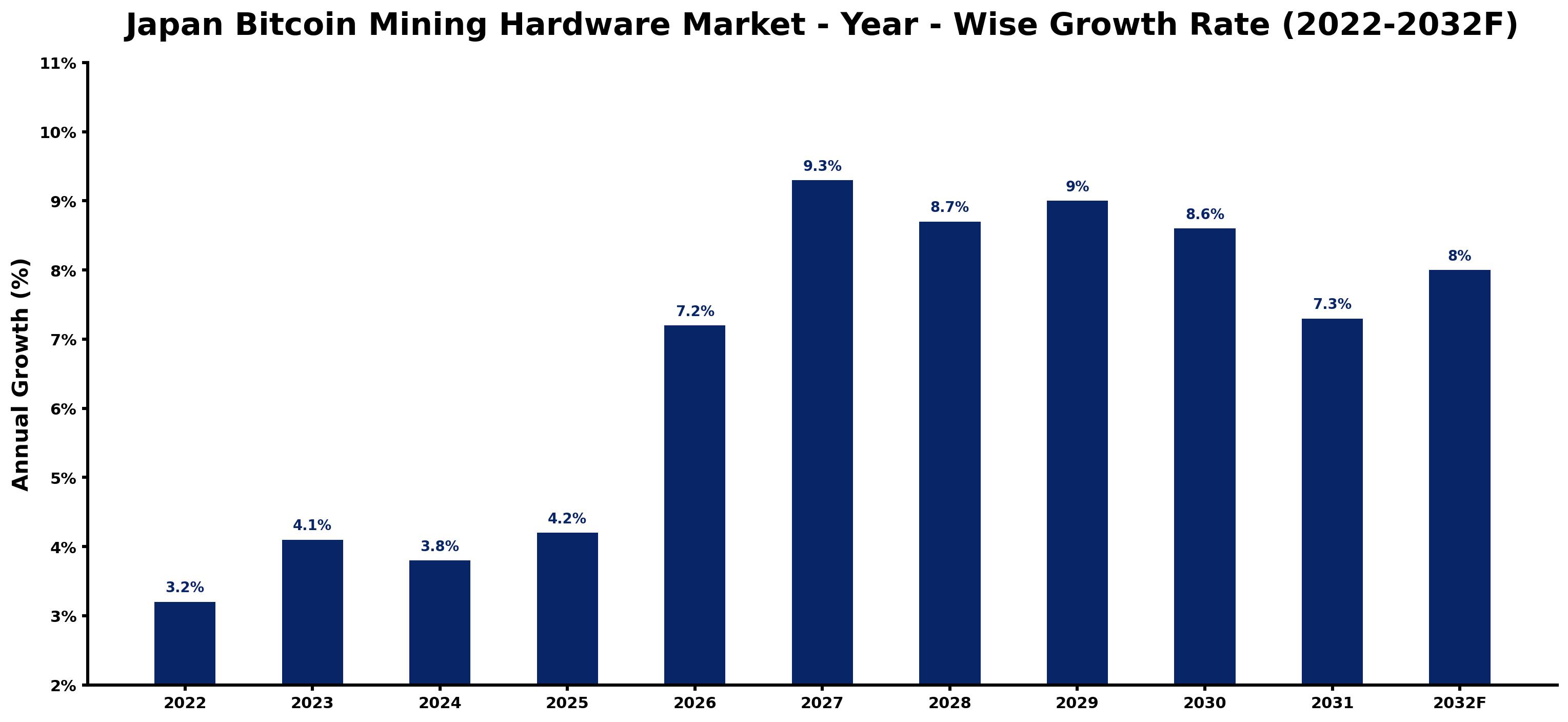
For each year, the table pairs the estimated growth rate with the leading influence on demand, showing how the drivers changed across the period.
| Year | Estimated Annual Growth (%) | Market Rationale |
| 2022 | 3.2 | The market showed steady growth due to increasing interest in cryptocurrency mining. |
| 2023 | 4.1 | Growth accelerated as more mining operations registered across the country. |
| 2024 | 3.8 | Growth slowed slightly as competition intensified among existing miners. |
| 2025 | 4.2 | The market experienced a resurgence as energy-efficient mining hardware gained traction. |
| 2026 | 7.2 | Demand is expected to surge with the introduction of new mining facilities in key regions. |
| 2027 | 9.3 | The peak growth year will see a rise in mining rewards and efficiency. |
| 2028 | 8.7 | Growth is projected to moderate as energy costs begin to impact operational decisions. |
| 2029 | 9.0 | Demand will increase again as mining farms expand their operations. |
| 2030 | 8.6 | Growth is anticipated to slow again due to market saturation and rising electricity prices. |
| 2031 | 7.3 | The market will continue to grow, albeit at a reduced pace, as new technologies emerge. |
| 2032 | 8.0 | Growth is expected to rise as energy-efficient solutions become standard. |
Note: Market size estimations and growth projections presented in this report are based on 6Wresearch's proprietary forecasting methodology, utilizing the latest available industry data, government publications, and primary research inputs.
Japan Bitcoin Mining Hardware Market Synopsis
Bitcoin mining hardware consists of specialized devices designed for mining cryptocurrencies, primarily Bitcoin. These devices validate transactions on the Bitcoin network and earn rewards. The Japan Bitcoin Mining Hardware Market is expanding, driven by over 1,000 registered mining operations and a growing interest in cryptocurrency among the population. Factors such as the dominance of ASIC miners, energy-efficient technologies, and the establishment of standards by the Japan Blockchain Association propel market growth. The increasing number of mining farms, particularly in urban areas, further supports this upward trend.
Market Dynamics Impact Analysis (2026–2032)
| Factor | Type | Impact | Primary Segment Affected |
| Growing demand for energy-efficient mining solutions | Driver | High | Energy Efficient |
| Increasing number of registered mining operations | Driver | High | ASIC Miners |
| Emerging interest in renewable energy solutions | Opportunity | Medium | Data Centers |
| Expansion of mining farms in urban areas | Opportunity | High | Mining Farms |
| High electricity costs impacting profitability | Restraint | High | ASIC Miners |
| Regulatory uncertainties affecting new operations | Restraint | Medium | ASIC Miners |
| High initial investment costs for advanced hardware | Challenge | High | ASIC Miners |
| Competition from international mining operations | Challenge | Medium | Mining Farms |
Evaluation of Drivers in Japan Bitcoin Mining Hardware Market (2026–2032)
The table below links each growth driver to the segment it affects and the evidence for it.
| Drivers | Primary Segment Affected | Why It Matters (Evidence) |
| Increased adoption of ASIC miners | ASIC Miners | Over 70% of mining hardware sales are attributed to ASIC miners, leading to higher efficiency and profitability for mining operations. |
| Rising interest in energy-efficient technologies | Energy Efficient | Energy-efficient mining hardware is increasingly adopted due to rising electricity costs, with average costs around 25 yen per kWh. |
| Expansion of mining farms in urban regions | Mining Farms | The Tokyo region, a major hub for Bitcoin mining, has over 300 active mining farms driving demand for hardware. |
| Support from industry associations | ASIC Miners | The Japan Blockchain Association promotes standards that improve the credibility and efficiency of mining operations. |
| Growing population interest in cryptocurrency | Individual Miners | Japan's population of approximately 126 million shows a growing interest in cryptocurrency, increasing demand for mining hardware. |
Most of the extra volume comes from the increasing adoption of ASIC miners, which dominate over 70% of sales, resulting in higher efficiency for mining operations. Energy-efficient solutions are gaining traction, with average electricity costs around 25 yen per kWh, prompting miners to invest in advanced hardware. The expansion of mining farms in urban regions, particularly in Tokyo, has resulted in over 300 active operations, driving demand for equipment. Support from the Japan Blockchain Association improves the credibility of mining operations, encouraging more investments in mining technologies. Japan's population of approximately 126 million is increasingly interested in cryptocurrency, further boosting hardware purchases.
Evaluation of Restraints in Japan Bitcoin Mining Hardware Market
The table below lists the restraints and the evidence behind each.
| Market Restraint | Primary Segment Affected | Why It Matters (Evidence) |
| High electricity costs impacting operational efficiency | ASIC Miners | The average electricity cost of approximately 25 yen per kWh affects profitability for miners. |
| Regulatory uncertainties affecting mining operations | ASIC Miners | The Japan Cryptocurrency Exchange Association oversees regulations, complicating operational compliance for miners. |
| Limited availability of advanced cooling solutions | ASIC Miners | The adoption of advanced cooling technologies is slow, impacting the efficiency of mining operations. |
| High initial investment costs for ASIC miners | ASIC Miners | The cost of acquiring ASIC miners can be prohibitive, limiting access for smaller operators. |
| Competition from international mining operations | Mining Farms | Local mining farms face increasing competition from international players, affecting market share and profitability. |
Japan Bitcoin Mining Hardware Market Challenges
Producers encounter high electricity costs, averaging 25 yen per kWh, which reduces their profit margins. Regulatory requirements from the Japan Cryptocurrency Exchange Association can prolong the approval process for new mining operations, delaying access to essential hardware for operators. The dominance of ASIC miners, which account for over 70% of sales, limits competition and forces buyers to pay inflated prices for necessary equipment. Despite the interest in cryptocurrency among Japan's 126 million population, the limited availability of energy-efficient mining hardware creates supply shortages, impacting operations for many miners.
Trends in the Japan Bitcoin Mining Hardware Market
The shifts below are changing how Japan Bitcoin Mining Hardware Market products are bought and supplied.
- Mining Farms Adopting Renewable Energy: Mining farms are increasingly adopting renewable energy solutions to reduce costs and improve sustainability. The Tokyo Metropolitan Government has launched a program promoting renewable energy for mining, supporting this shift. In 2023, over 300 active mining farms are now exploring renewable sources.
- Shift Towards Energy-Efficient Hardware: There is a noticeable shift towards energy-efficient mining hardware as miners seek to reduce operational costs. The average electricity cost of 25 yen per kWh has prompted this change, resulting in higher adoption rates of energy-efficient solutions.
- Expansion of Online Sales Channels: Online platforms for purchasing mining hardware are becoming more popular, reflecting a shift in buyer behaviour. The fastest-growing distribution channel is projected to grow at a CAGR of 10.6% from 2026 to 2032, indicating a trend towards digital transactions.
- Increased Standardisation in Mining Practices: There is a growing emphasis on standardisation in cryptocurrency mining practices. The establishment of ISO standards for mining practices in Japan is expected to improve operational efficiency and compliance among miners.
Investment Opportunities in the Japan Bitcoin Mining Hardware Market
Investors looking at the Japan Bitcoin Mining Hardware Market should consider the following areas.
- Rising Demand for Energy-Efficient Solutions: With electricity costs averaging 25 yen per kWh, there is a strong demand for energy-efficient mining solutions. Mining farms in urban areas are particularly interested in these technologies to reduce operational costs.
- Investment in Mining Infrastructure: The timing is ideal for investing in mining farms, especially in the Tokyo region, where over 300 operations exist. Collaborating with local partners can facilitate entry into this growing market.
- Growing Interest in Cryptocurrency Among Individuals: As Japan's population shows increasing interest in cryptocurrency, there is an opportunity for suppliers of mining hardware. Establishing partnerships with local distributors can improve market access.
- Investment in Renewable Energy Solutions: The Tokyo Metropolitan Government's program promoting renewable energy for mining presents an opportunity for investment. Suppliers can enter this market by collaborating with local energy providers.
Government Initiatives in the Japan Bitcoin Mining Hardware Market
The Act on the Rational Use of Energy, established in 1979 by the Ministry of Economy, Trade and Industry, mandates large energy users to improve energy efficiency and report energy consumption. This law impacts mining operations, requiring them to adopt energy-efficient practices to comply with regulations. The Industrial Safety and Health Act, enacted in 1972, sets employer duties for hazardous substances and machinery, ensuring safe working conditions in mining facilities. These regulations compel mining operations to implement safety measures and maintain compliance, affecting their operational costs and practices.
The Digital Agency, established in September 2021, leads government digital transformation efforts and approves standards for cryptocurrency mining operations. This agency's initiatives aim to improve the operational efficiency and regulatory compliance of mining activities, ensuring that mining operations align with national standards and practices. The Japan Cryptocurrency Exchange Association also plays a role in overseeing regulations for mining operations, which can impact the speed and efficiency of hardware procurement.
Future Insight of the Japan Bitcoin Mining Hardware Market
A programme to promote renewable energy sources for cryptocurrency mining will launch by 2032, driving sustainability in the sector. The shift towards energy-efficient mining hardware will accelerate as producers aim to reduce operational expenses. The establishment of ISO standards for mining practices will improve compliance and operational consistency across the industry. By 2032, Japan's registered cryptocurrency mining operations, currently exceeding 1,000, are expected to expand significantly, enhancing the infrastructure necessary to support evolving market needs.
Market Segmentation Analysis
Japan Bitcoin Mining Hardware Market report covers a detailed analysis of the following market segments:
By Hardware Type – ASIC Miners Lead, Power Units Expected to Grow Fastest
According to Prakhar Dixit, Senior Research Analyst at 6Wresearch, ASIC Miners held 39% of the Japan Bitcoin Mining Hardware Market by hardware type in 2025. ASIC miners dominate the Japan Bitcoin mining hardware market due to their efficiency in performing complex calculations, essential for mining operations. With over 70% of hardware sales attributed to ASIC miners, they are the preferred choice for most mining facilities. The quickest growth will come from Power Units, forecast to expand at a CAGR of 11.5% between 2026 and 2032. Power units are experiencing rapid growth as miners seek to optimise energy consumption amidst rising electricity costs, with average rates at approximately 25 yen per kWh. This trend towards energy efficiency will likely continue to drive demand for advanced power units. Suppliers should focus on energy-efficient solutions to meet the evolving demands of mining operations.
By Processing Power – High Hash Rate Leads, Energy Efficient Expected to Grow Fastest
In 2025, High Hash Rate led the processing power split with a 50% share. High hash rate processors are vital for competitive mining, enabling operations to validate transactions swiftly and earn rewards efficiently. Their importance is underscored by their substantial share of over 70% in mining hardware sales within Japan. Energy Efficient is projected to grow fastest, at a CAGR of 12.0% during 2026–2032. Energy-efficient processing power is gaining traction as miners adapt to rising electricity costs, leading to a shift in hardware investments. This trend will likely continue as operational expenses remain a key concern for miners. Buyers should focus on energy-efficient solutions to improve profitability in a challenging cost environment.
By Cooling Type – Air Cooling Leads, Liquid Cooling Expected to Grow Fastest
The largest cooling type category in 2025 was Air Cooling, at 44% of revenue. Air cooling is the most commonly used method in Japan for cooling mining rigs, providing a straightforward and effective solution for temperature management. Its widespread adoption among mining farms illustrates its reliability and cost-effectiveness. Over 2026–2032, Liquid Cooling is expected to post the fastest growth, at a CAGR of 11.9%. Liquid cooling is becoming increasingly popular, especially in high-performance setups, as it offers superior temperature control and efficiency. This growth reflects a broader trend towards optimising mining operations for better performance. Suppliers should consider expanding their cooling solutions to include liquid cooling options to cater to high-performance mining setups.
By Distribution Channel – Direct Sales Leads, Online Platforms Expected to Grow Fastest
Direct Sales took 40% of distribution channel revenue in 2025, more than any other category. Direct sales are the main channel for acquiring mining hardware, allowing buyers to connect directly with manufacturers for the latest products. This approach is particularly advantageous for mining farms that require bulk purchases to optimise their operations. Online Platforms are set to record the highest CAGR in this split, 10.6% over 2026–2032. Online platforms are quickly becoming a preferred distribution method, providing miners with convenient access to a wider selection of equipment. This trend is expected to continue as buyers increasingly favour the convenience of online shopping. Suppliers need to strengthen their online presence to effectively engage the growing base of digital buyers.
By End User – Mining Farms Lead, Data Centers Expected to Grow Fastest
Mining Farms accounted for 39% of the market by end user in 2025. Mining farms are the predominant users of Bitcoin mining hardware, operating on a large scale to maximise their mining potential. With approximately 300 active mining farms in Japan, they represent a substantial segment of the market. The quickest growth will come from Data Centers, forecast to expand at a CAGR of 11.1% between 2026 and 2032. Data centers are emerging as a rapidly growing user segment, often hosting mining operations to leverage their existing infrastructure for enhanced efficiency. This shift indicates a trend towards more centralised mining practices in the industry. Suppliers should adapt their products to cater to the unique requirements of data centers as they gain prominence in the mining landscape.
Key Attractiveness of the Report
- 10 Years of Market Numbers
- Historical Data Starting from 2022 to 2025
- Base Year 2025
- Forecast Data until 2032
- Key Performance Indicators Impacting the Market
- Major Upcoming Developments and Projects
Key Highlights of the Report:
- Japan Bitcoin Mining Hardware Market Outlook
- Market Size of Japan Bitcoin Mining Hardware Market, 2025
- Forecast of Japan Bitcoin Mining Hardware Market, 2032
- Historical Data and Forecast of Japan Bitcoin Mining Hardware Market Revenues & Volume for the Period 2022-2032F
- Japan Bitcoin Mining Hardware Market Trend Evolution
- Japan Bitcoin Mining Hardware Market Drivers and Challenges
- Japan Bitcoin Mining Hardware Market Price Trends
- Japan Bitcoin Mining Hardware Market Porter's Five Forces
- Japan Bitcoin Mining Hardware Market Industry Life Cycle
- Historical Data and Forecast of Japan Bitcoin Mining Hardware Market Revenues & Volume By Hardware Type for the Period 2022-2032F
- Historical Data and Forecast of Japan Bitcoin Mining Hardware Market Revenues & Volume By ASIC Miners for the Period 2022-2032F
- Historical Data and Forecast of Japan Bitcoin Mining Hardware Market Revenues & Volume By GPU Rigs for the Period 2022-2032F
- Historical Data and Forecast of Japan Bitcoin Mining Hardware Market Revenues & Volume By FPGA Miners for the Period 2022-2032F
- Historical Data and Forecast of Japan Bitcoin Mining Hardware Market Revenues & Volume By Power Units for the Period 2022-2032F
- Historical Data and Forecast of Japan Bitcoin Mining Hardware Market Revenues & Volume By Processing Power for the Period 2022-2032F
- Historical Data and Forecast of Japan Bitcoin Mining Hardware Market Revenues & Volume By High Hash Rate for the Period 2022-2032F
- Historical Data and Forecast of Japan Bitcoin Mining Hardware Market Revenues & Volume By Medium Hash Rate for the Period 2022-2032F
- Historical Data and Forecast of Japan Bitcoin Mining Hardware Market Revenues & Volume By Energy Efficient for the Period 2022-2032F
- Historical Data and Forecast of Japan Bitcoin Mining Hardware Market Revenues & Volume By Supporting Equipment for the Period 2022-2032F
- Historical Data and Forecast of Japan Bitcoin Mining Hardware Market Revenues & Volume By Cooling Type for the Period 2022-2032F
- Historical Data and Forecast of Japan Bitcoin Mining Hardware Market Revenues & Volume By Air Cooling for the Period 2022-2032F
- Historical Data and Forecast of Japan Bitcoin Mining Hardware Market Revenues & Volume By Liquid Cooling for the Period 2022-2032F
- Historical Data and Forecast of Japan Bitcoin Mining Hardware Market Revenues & Volume By Hybrid Cooling for the Period 2022-2032F
- Historical Data and Forecast of Japan Bitcoin Mining Hardware Market Revenues & Volume By Passive Cooling for the Period 2022-2032F
- Historical Data and Forecast of Japan Bitcoin Mining Hardware Market Revenues & Volume By Distribution Channel for the Period 2022-2032F
- Historical Data and Forecast of Japan Bitcoin Mining Hardware Market Revenues & Volume By Direct Sales for the Period 2022-2032F
- Historical Data and Forecast of Japan Bitcoin Mining Hardware Market Revenues & Volume By Online Platforms for the Period 2022-2032F
- Historical Data and Forecast of Japan Bitcoin Mining Hardware Market Revenues & Volume By Technology Distributors for the Period 2022-2032F
- Historical Data and Forecast of Japan Bitcoin Mining Hardware Market Revenues & Volume By Hardware Suppliers for the Period 2022-2032F
- Historical Data and Forecast of Japan Bitcoin Mining Hardware Market Revenues & Volume By End User for the Period 2022-2032F
- Historical Data and Forecast of Japan Bitcoin Mining Hardware Market Revenues & Volume By Mining Farms for the Period 2022-2032F
- Historical Data and Forecast of Japan Bitcoin Mining Hardware Market Revenues & Volume By Individual Miners for the Period 2022-2032F
- Historical Data and Forecast of Japan Bitcoin Mining Hardware Market Revenues & Volume By Enterprises for the Period 2022-2032F
- Historical Data and Forecast of Japan Bitcoin Mining Hardware Market Revenues & Volume By Data Centers for the Period 2022-2032F
- Japan Bitcoin Mining Hardware Market Import Export Trade Statistics
- Market Opportunity Assessment By Hardware Type
- Market Opportunity Assessment By Processing Power
- Market Opportunity Assessment By Cooling Type
- Market Opportunity Assessment By Distribution Channel
- Market Opportunity Assessment By End User
- Japan Bitcoin Mining Hardware Market Top Companies Market Share
- Japan Bitcoin Mining Hardware Market Competitive Benchmarking By Technical and Operational Parameters
- Japan Bitcoin Mining Hardware Market Company Profiles
- Japan Bitcoin Mining Hardware Market Key Strategic Recommendations
Market Covered
The following segment groups are covered in the report.
By Hardware Type
- ASIC Miners
- GPU Rigs
- FPGA Miners
- Power Units
By Processing Power
- High Hash Rate
- Medium Hash Rate
- Energy Efficient
- Supporting Equipment
By Cooling Type
- Air Cooling
- Liquid Cooling
- Hybrid Cooling
- Passive Cooling
By Distribution Channel
- Direct Sales
- Online Platforms
- Technology Distributors
- Hardware Suppliers
By End User
- Mining Farms
- Individual Miners
- Enterprises
- Data Centers






































