Japan Blockchain Crop Traceability Market Size & Growth Rate
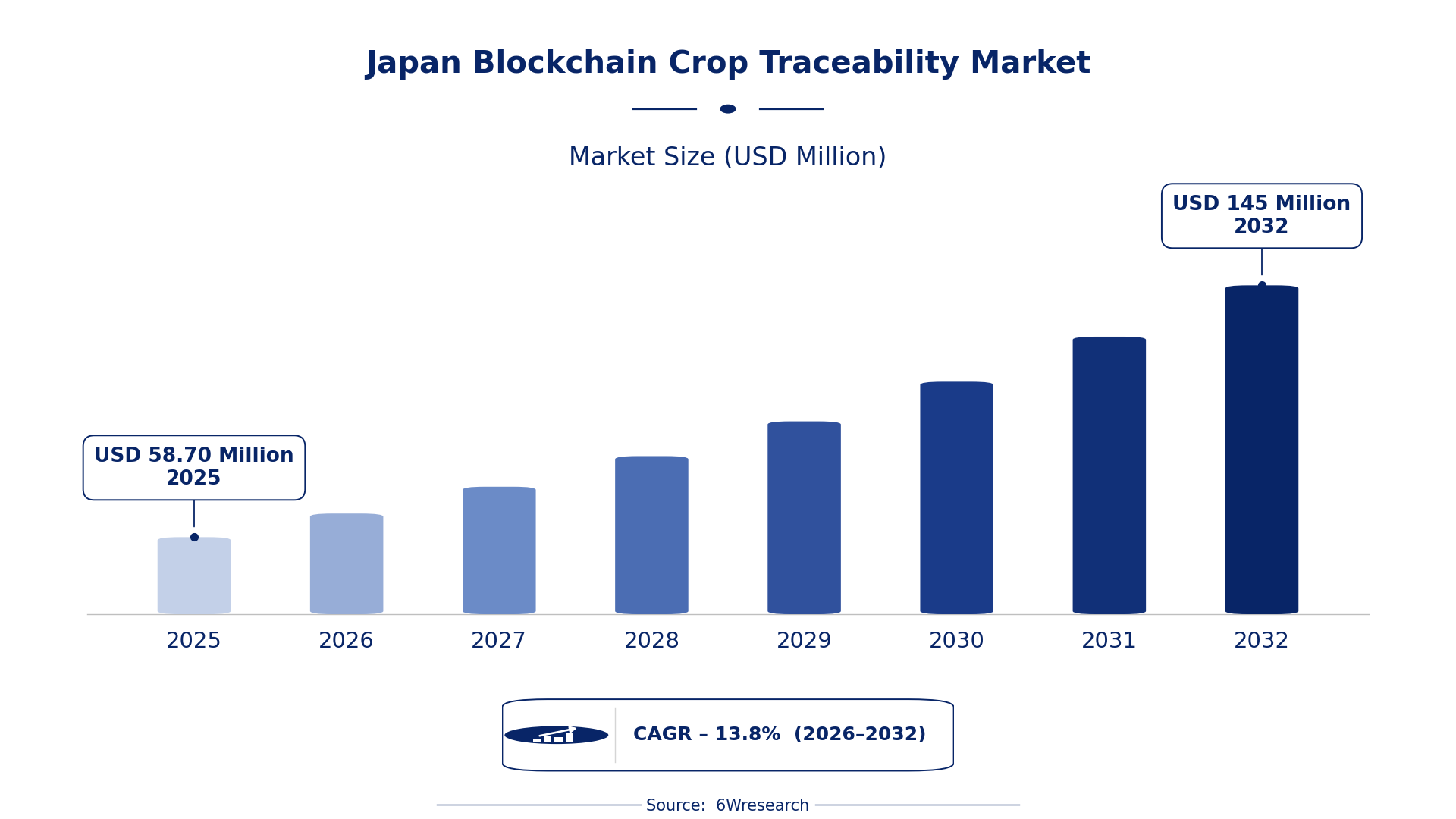
According to 6Wresearch internal database and industry insights, the Japan Blockchain Crop Traceability Market was valued at USD 58.70 Million in 2025 and is projected to reach USD 145 Million by 2032, growing at a CAGR of approximately 13.8% during 2026–2032.
Japan Blockchain Crop Traceability Market Highlights
| Report Metric | Details |
| Report Name | Japan Blockchain Crop Traceability Market (2026-2032) |
| Market Size 2025 | USD 58.70 Million |
| Market Size 2032 | USD 145 Million |
| Absolute Growth 2025–2032 | USD 86.30 Million |
| CAGR 2026–2032 | 13.8% |
| Peak Annual Growth | 15.8% in 2026 |
| Forecast Period | 2026–2032 |
| Historical Data | 2022–2025 |
| Base Year | 2025 |
| Leading Crop Type, 2025 | Fruits & Vegetables (36% share) |
| Leading Blockchain Layer, 2025 | Supply Chain Ledger (35% share) |
| Leading Platform Type, 2025 | Cloud-Based Platform (37% share) |
| Leading Application, 2025 | Farm-to-Fork Tracking (44% share) |
| Leading End User, 2025 | Agritech Startups (43% share) |
| Fastest-Growing Crop Type | Grains & Cereals (19.8% CAGR) |
| Fastest-Growing Blockchain Layer | Smart Contracts (17.6% CAGR) |
| Fastest-Growing Application | Product Authentication (18.1% CAGR) |
| Fastest-Growing End User | Co-operatives (17.7% CAGR) |
| Growing Sector | Agritech |
| Key End Users | Agritech Startups, Organic Certifiers, Co-operatives, Commodity Traders |
Japan Blockchain Crop Traceability Market Year-wise Growth Rate and Key Drivers (2022–2032)
This graph illustrates the annual growth rates of the market from 2022 to 2032, highlighting a steady upward trajectory and projected market expansion over the forecast period.
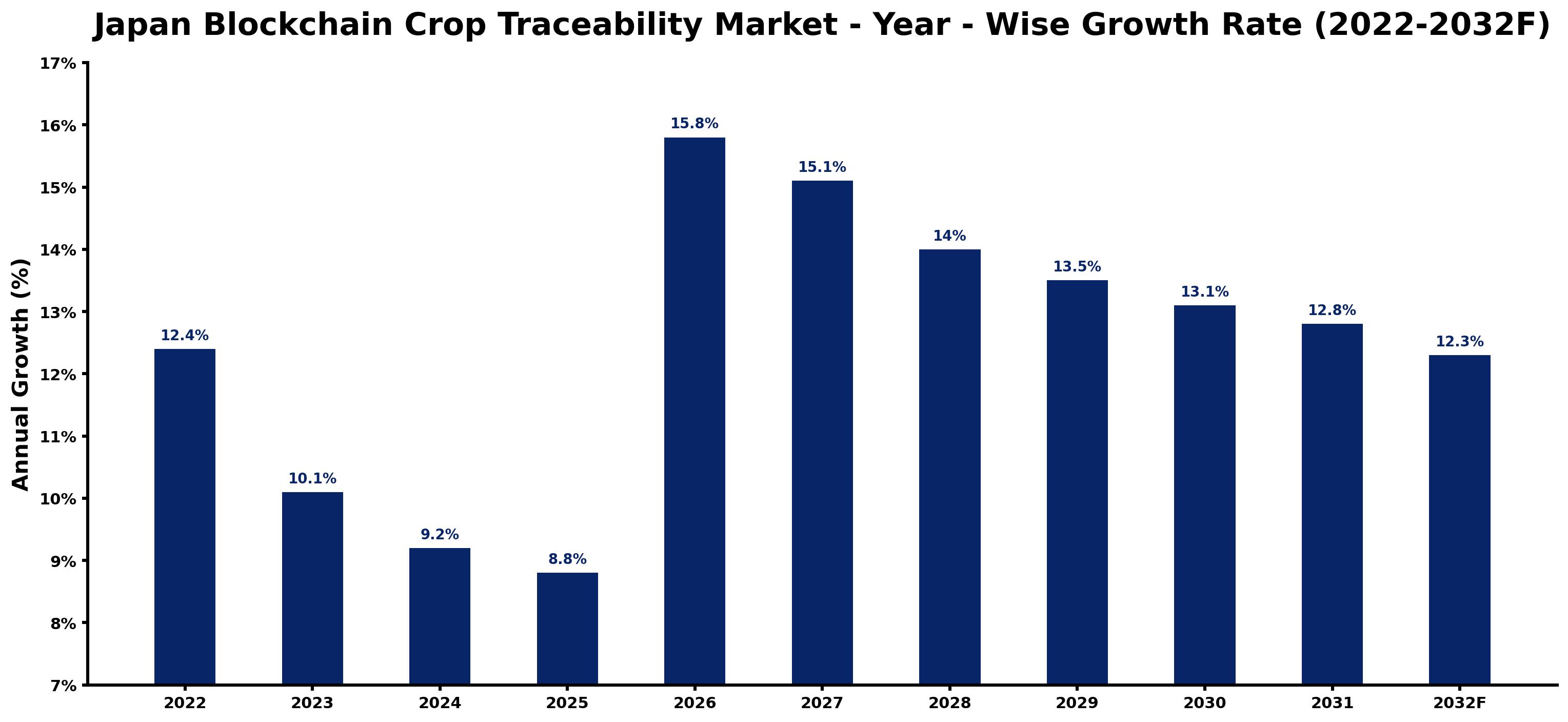
Below, each year's estimated growth is shown next to the factor that most influenced it.
| Year | Estimated Annual Growth (%) | Market Rationale |
| 2022 | 12.4 | The market showed strong growth due to rising awareness of food safety and traceability. |
| 2023 | 10.1 | Growth slowed as the market adjusted to previous peaks in demand for traceability solutions. |
| 2024 | 9.2 | The market continued to grow, albeit at a slower pace than before, reflecting ongoing interest in transparency. |
| 2025 | 8.8 | Demand remained steady, reflecting ongoing interest in traceability solutions and food safety measures. |
| 2026 | 15.8 | The market is expected to accelerate as technology adoption surges, particularly in agritech. |
| 2027 | 15.1 | Growth is projected to slow slightly as the market matures and competition increases among providers. |
| 2028 | 14.0 | The market will experience a further slowdown as saturation begins to set in, affecting new investments. |
| 2029 | 13.5 | Demand is expected to continue decreasing gradually as buyers adjust their strategies to market conditions. |
| 2030 | 13.1 | The market will maintain a steady growth rate amid evolving consumer preferences for traceable products. |
| 2031 | 12.8 | Growth is projected to slow as the market approaches maturity and faces new challenges in technology. |
| 2032 | 12.3 | The market is expected to grow at a slower rate as competition intensifies among traceability solutions. |
Note: Market size estimations and growth projections presented in this report are based on 6Wresearch's proprietary forecasting methodology, utilizing the latest available industry data, government publications, and primary research inputs.
Japan Blockchain Crop Traceability Market Synopsis
Blockchain Crop Traceability utilises distributed ledger technology to ensure transparency in agricultural supply chains. This system tracks crops from farm to consumer, ensuring food safety and verifying organic certifications. The Japan Blockchain Crop Traceability Market is growing due to rising demand from agritech startups and consumers prioritising food safety. The Tokyo region serves as an innovation hub, supported by government initiatives aiming for integration into 25% of supply chains by 2025, which drives further adoption of traceability solutions.
Market Dynamics Impact Analysis (2026–2032)
| Factor | Type | Impact | Primary Segment Affected |
| Increasing demand for food safety and quality assurance | Driver | High | Farm-to-Fork Tracking |
| Growing adoption of cloud-based platforms for data management | Driver | High | Cloud-Based Platform |
| Emergence of agritech cooperatives enhancing traceability efforts | Opportunity | Medium | Agritech Startups |
| Rising organic food sales driving demand for traceability | Opportunity | High | Organic Certifiers |
| Aging farmer population limiting technology adoption | Restraint | High | Agritech Startups |
| Limited awareness among traditional farmers about blockchain benefits | Restraint | Medium | Co-operatives |
| High initial investment costs for blockchain implementation | Challenge | High | Supply Chain Ledger |
| Complexity of integrating blockchain with existing systems | Challenge | Medium | Smart Contracts |
Evaluation of Drivers in Japan Blockchain Crop Traceability Market (2026–2032)
Demand rests on the following drivers, each shown with the segment it touches most.
| Drivers | Primary Segment Affected | Why It Matters (Evidence) |
| Increasing consumer demand for food safety | Fruits & Vegetables | This segment accounts for 60% of blockchain applications, prompting retailers to adopt traceability solutions. |
| Government support for digital agriculture | Agritech Startups | The government promotes blockchain integration, enhancing product verification and safety standards. |
| Adoption of ISO 22000 standards | Cloud-Based Platform | This drives retailers to implement cloud solutions for better data management and compliance. |
| Growth in organic food sales | Organic Certifiers | Reaching 1.2 billion USD in 2022, this trend increases demand for effective product authentication. |
| Integration of blockchain in supply chains | Supply Chain Ledger | Projected to reach 25% by 2025, this enhances transparency and efficiency in agricultural processes. |
Most of the extra volume comes from rising consumer demand for transparency in food sourcing, with fruits and vegetables accounting for 60% of blockchain applications. Compliance with ISO 22000 standards drives retailers to adopt cloud-based platforms for data management, improving safety and traceability. Agritech startups in the Tokyo region are integrating blockchain, reflecting Japan's growing digital agriculture sector. The surge in organic food sales, reaching 1.2 billion USD in 2022, fuels demand for effective product authentication, driving further investments in traceability solutions.
Evaluation of Restraints in Japan Blockchain Crop Traceability Market
The following restraints limit how fast demand can grow.
| Market Restraint | Primary Segment Affected | Why It Matters (Evidence) |
| High compliance costs for organic certifiers | Organic Certifiers | Over 70% use blockchain, raising costs and limiting market access for smaller producers. |
| Aging farmer population | Agritech Startups | With an average age of 67, this demographic faces challenges in adopting new technologies. |
| Increased competition among suppliers | Supply Chain Ledger | Blockchain integration in 25% of supply chains by 2025 intensifies competition for market share. |
| Funding limitations for digital agriculture programs | Agritech Startups | Government initiatives may face budget constraints, delaying technological advancements. |
| Slow adoption of digital solutions | Co-operatives | The technology gap among farmers hinders the integration of essential digital tools. |
Japan Blockchain Crop Traceability Market Challenges
Over 70% of organic certifiers in Japan use blockchain for product verification, which raises compliance costs for buyers and limits their market access. The average age of farmers in Japan is 67, creating a technology gap that delays the adoption of essential digital solutions for producers. Blockchain integration in 25% of agricultural supply chains by 2025 means suppliers face increased competition from those who can implement traceability faster, risking their market share. The Japanese government's program to promote digital agriculture may encounter funding limitations, resulting in slower technological advancements for suppliers and missed growth opportunities.
Trends in the Japan Blockchain Crop Traceability Market
Several trends are reshaping the Japan Blockchain Crop Traceability Market; the most important are set out below.
- Shift towards Digital Agriculture: The Tokyo region is increasingly focusing on digital agriculture, with agritech startups leading the charge. In 2023, the government launched a program to promote digital agriculture, aiming to improve productivity and traceability in the sector.
- Transition to Cloud-Based Platforms: Cloud-Based Platforms are becoming the preferred choice for data management in agriculture. The increasing adoption of these platforms reflects a shift towards more efficient data handling, with over 70% of organic certifiers using blockchain for verification.
- Emergence of Agritech Cooperatives: Agritech cooperatives are forming partnerships to improve traceability efforts. In 2023, these cooperatives are expected to enhance their blockchain initiatives, reflecting a growing trend towards collaboration in the sector.
- Rising Demand for Organic Certification: Organic Certifiers are prioritising blockchain for product verification, driven by the increasing sales of organic foods, which reached 1.2 billion USD in 2022. This trend underscores the importance of traceability in maintaining consumer trust.
Investment Opportunities in the Japan Blockchain Crop Traceability Market
Where to invest in the Japan Blockchain Crop Traceability Market: the main openings are set out below.
- Tokyo's Agritech Innovation: The Tokyo region is a hub for agritech startups focusing on blockchain, with over 2 million people employed in agriculture. This presents a strong opportunity for investment in traceability solutions.
- Growing Organic Market: With organic food sales reaching 1.2 billion USD in 2022, there is a pressing need for effective traceability solutions. Suppliers can enter this market by collaborating with organic certifiers.
- Digital Agriculture Initiatives: The Japanese government aims to increase digital technology adoption by 2025, allocating funding for agritech projects. This creates opportunities for suppliers to provide blockchain solutions.
- Cloud-Based Platforms Adoption: Cloud-based platforms are increasingly adopted for agricultural data management, with a projected growth rate of 14.9%. Suppliers can capitalise on this trend by offering tailored solutions.
Government Initiatives in the Japan Blockchain Crop Traceability Market
The regulatory framework for blockchain crop traceability is shaped by laws such as the Waste Management and Public Cleansing Act, which governs waste treatment in agriculture, and the Economic Security Promotion Act, which supports supply-chain resilience. These measures ensure that producers adhere to safety standards while implementing blockchain technology, promoting transparency and efficiency in the sector.
In 2023, the government allocated funding for digital agriculture initiatives, overseen by the Digital Agency. This agency promotes the integration of digital technologies in agriculture, facilitating the adoption of blockchain solutions and enhancing overall productivity.
Future Insight of the Japan Blockchain Crop Traceability Market
Blockchain protocols will transform demand for traceability as the Japanese government aims to increase digital technology adoption in agriculture by 2025. By 2026, smart contracts are expected to automate 30% of transactions in the agritech sector, streamlining processes for suppliers. By 2032, agritech cooperatives will form partnerships to strengthen traceability efforts, enhancing product verification for buyers. The Tokyo Agricultural Technology Center will continue to promote blockchain applications, ensuring that buyers receive verified products and suppliers can meet rising food safety demands.
Market Segmentation Analysis
Japan Blockchain Crop Traceability Market report covers a detailed analysis of the following market segments:
By Crop Type – Fruits & Vegetables Lead, Grains & Cereals Expected to Grow Fastest
According to Saurav Kr Singh, Senior Research Analyst at 6Wresearch, with 36% of crop type revenue in 2025, Fruits & Vegetables was the largest category. Fruits and vegetables dominate the market due to their critical role in tracking freshness and origin throughout the supply chain. The substantial adoption of blockchain technology by over 70% of organic certifiers in Japan highlights their significance in ensuring food safety and quality assurance. The quickest growth will come from Grains & Cereals, forecast to expand at a CAGR of 19.8% between 2026 and 2032. Grains and cereals are experiencing rapid growth, driven by their essential function in quality assurance and traceability. The increasing consumer focus on food safety, particularly for staple crops, is propelling this segment's expansion. Suppliers should enhance their offerings for grains and cereals to capitalise on the increasing demand for traceability solutions.
By Blockchain Layer – Supply Chain Ledger Leads, Smart Contracts Expected to Grow Fastest
Supply Chain Ledger accounted for 35% of the market by blockchain layer in 2025. The supply chain ledger holds the largest share as it is fundamental for recording transactions throughout the agricultural supply chain. Its established presence in various applications ensures widespread adoption among stakeholders. Smart Contracts are projected to grow fastest, at a CAGR of 17.6% during 2026–2032. Smart contracts are growing quickly due to their role in automating agreements, which streamlines processes in the agritech sector. As more stakeholders recognise the efficiency gains, this segment is set for rapid expansion. Buyers may benefit from investing in smart contract solutions to improve operational efficiency.
By Platform Type – Cloud-Based Platform Leads and Records the Fastest Growth
The largest platform type category in 2025 was Cloud-Based Platform, at 37% of revenue. Cloud-based platforms lead the market as they provide vital data storage and access capabilities for agricultural stakeholders. The government's initiatives to promote digital technologies in agriculture further solidify this segment's importance in the ecosystem. The same category is also set to grow fastest, at a CAGR of 14.9% during 2026–2032. Cloud-based platforms are also the fastest-growing segment, driven by the rising need for efficient data management solutions in agriculture. This convergence of demand reinforces its role as the backbone of blockchain applications in the sector. Suppliers must prioritise cloud-based solutions to address the escalating demand for effective data management in agriculture.
By Application – Farm-to-Fork Tracking Leads, Product Authentication Expected to Grow Fastest
Farm-to-Fork Tracking held 44% of the Japan Blockchain Crop Traceability Market by application in 2025. Farm-to-fork tracking is the leading application as it ensures complete traceability from production to consumer. This capability is increasingly crucial as consumers demand transparency regarding food sourcing and safety, making it a priority for stakeholders. Product Authentication is set to record the highest CAGR in this split, 18.1% over 2026–2032. Product authentication is rapidly gaining traction due to its importance in verifying product claims, especially within the organic market. The surge in organic food sales, reaching 1.2 billion USD in 2022, significantly contributes to this growth. Suppliers should focus on enhancing product authentication features to meet the growing market demand for verification and transparency.
By End User – Agritech Startups Lead, Co-operatives Expected to Grow Fastest
Agritech Startups took 43% of end user revenue in 2025, more than any other category. Agritech startups are the leading end user, as they drive innovation and the adoption of blockchain solutions in the agricultural sector. Their focus on integrating technology into farming practices positions them as key players in advancing traceability efforts. The quickest growth will come from Co-operatives, forecast to expand at a CAGR of 17.7% between 2026 and 2032. Co-operatives are emerging as the fastest-growing end user due to their collaborative approach to tracking and implementing blockchain solutions. This collective effort is accelerating the adoption of technology in agriculture. Suppliers should explore partnerships with co-operatives to leverage their collective tracking capabilities and enhance market reach.
Key Attractiveness of the Report
- 10 Years of Market Numbers
- Historical Data Starting from 2022 to 2025
- Base Year 2025
- Forecast Data until 2032
- Key Performance Indicators Impacting the Market
- Major Upcoming Developments and Projects
Key Highlights of the Report:
- Japan Blockchain Crop Traceability Market Outlook
- Market Size of Japan Blockchain Crop Traceability Market, 2025
- Forecast of Japan Blockchain Crop Traceability Market, 2032
- Historical Data and Forecast of Japan Blockchain Crop Traceability Revenues & Volume for the Period 2022-2032F
- Japan Blockchain Crop Traceability Market Trend Evolution
- Japan Blockchain Crop Traceability Market Drivers and Challenges
- Japan Blockchain Crop Traceability Price Trends
- Japan Blockchain Crop Traceability Porter's Five Forces
- Japan Blockchain Crop Traceability Industry Life Cycle
- Historical Data and Forecast of Japan Blockchain Crop Traceability Market Revenues & Volume By Crop Type for the Period 2022-2032F
- Historical Data and Forecast of Japan Blockchain Crop Traceability Market Revenues & Volume By Fruits & Vegetables for the Period 2022-2032F
- Historical Data and Forecast of Japan Blockchain Crop Traceability Market Revenues & Volume By Grains & Cereals for the Period 2022-2032F
- Historical Data and Forecast of Japan Blockchain Crop Traceability Market Revenues & Volume By Leafy Greens for the Period 2022-2032F
- Historical Data and Forecast of Japan Blockchain Crop Traceability Market Revenues & Volume By Oilseeds for the Period 2022-2032F
- Historical Data and Forecast of Japan Blockchain Crop Traceability Market Revenues & Volume By Blockchain Layer for the Period 2022-2032F
- Historical Data and Forecast of Japan Blockchain Crop Traceability Market Revenues & Volume By Supply Chain Ledger for the Period 2022-2032F
- Historical Data and Forecast of Japan Blockchain Crop Traceability Market Revenues & Volume By Smart Contracts for the Period 2022-2032F
- Historical Data and Forecast of Japan Blockchain Crop Traceability Market Revenues & Volume By Distributed Ledger for the Period 2022-2032F
- Historical Data and Forecast of Japan Blockchain Crop Traceability Market Revenues & Volume By Tokenized Identity for the Period 2022-2032F
- Historical Data and Forecast of Japan Blockchain Crop Traceability Market Revenues & Volume By Platform Type for the Period 2022-2032F
- Historical Data and Forecast of Japan Blockchain Crop Traceability Market Revenues & Volume By Web-Based Dashboard for the Period 2022-2032F
- Historical Data and Forecast of Japan Blockchain Crop Traceability Market Revenues & Volume By Mobile App for the Period 2022-2032F
- Historical Data and Forecast of Japan Blockchain Crop Traceability Market Revenues & Volume By Cloud-Based Platform for the Period 2022-2032F
- Historical Data and Forecast of Japan Blockchain Crop Traceability Market Revenues & Volume By IoT Integrated for the Period 2022-2032F
- Historical Data and Forecast of Japan Blockchain Crop Traceability Market Revenues & Volume By Application for the Period 2022-2032F
- Historical Data and Forecast of Japan Blockchain Crop Traceability Market Revenues & Volume By Farm-to-Fork Tracking for the Period 2022-2032F
- Historical Data and Forecast of Japan Blockchain Crop Traceability Market Revenues & Volume By Contamination Alerts for the Period 2022-2032F
- Historical Data and Forecast of Japan Blockchain Crop Traceability Market Revenues & Volume By Cold Chain Monitoring for the Period 2022-2032F
- Historical Data and Forecast of Japan Blockchain Crop Traceability Market Revenues & Volume By Product Authentication for the Period 2022-2032F
- Historical Data and Forecast of Japan Blockchain Crop Traceability Market Revenues & Volume By End User for the Period 2022-2032F
- Historical Data and Forecast of Japan Blockchain Crop Traceability Market Revenues & Volume By Agritech Startups for the Period 2022-2032F
- Historical Data and Forecast of Japan Blockchain Crop Traceability Market Revenues & Volume By Co-operatives for the Period 2022-2032F
- Historical Data and Forecast of Japan Blockchain Crop Traceability Market Revenues & Volume By Organic Certifiers for the Period 2022-2032F
- Historical Data and Forecast of Japan Blockchain Crop Traceability Market Revenues & Volume By Commodity Traders for the Period 2022-2032F
- Japan Blockchain Crop Traceability Import Export Trade Statistics
- Market Opportunity Assessment By Crop Type
- Market Opportunity Assessment By Blockchain Layer
- Market Opportunity Assessment By Platform Type
- Market Opportunity Assessment By Application
- Market Opportunity Assessment By End User
- Japan Blockchain Crop Traceability Top Companies Market Share
- Japan Blockchain Crop Traceability Competitive Benchmarking By Technical and Operational Parameters
- Japan Blockchain Crop Traceability Company Profiles
- Japan Blockchain Crop Traceability Key Strategic Recommendations
Market Covered
The report covers the following segments.
By Crop Type
- Fruits & Vegetables
- Grains & Cereals
- Leafy Greens
- Oilseeds
By Blockchain Layer
- Supply Chain Ledger
- Smart Contracts
- Distributed Ledger
- Tokenized Identity
By Platform Type
- Web-Based Dashboard
- Mobile App
- Cloud-Based Platform
- IoT Integrated
By Application
- Farm-to-Fork Tracking
- Contamination Alerts
- Cold Chain Monitoring
- Product Authentication
By End User
- Agritech Startups
- Co-operatives
- Organic Certifiers
- Commodity Traders






































