Japan Body in White Market Size & Growth Rate
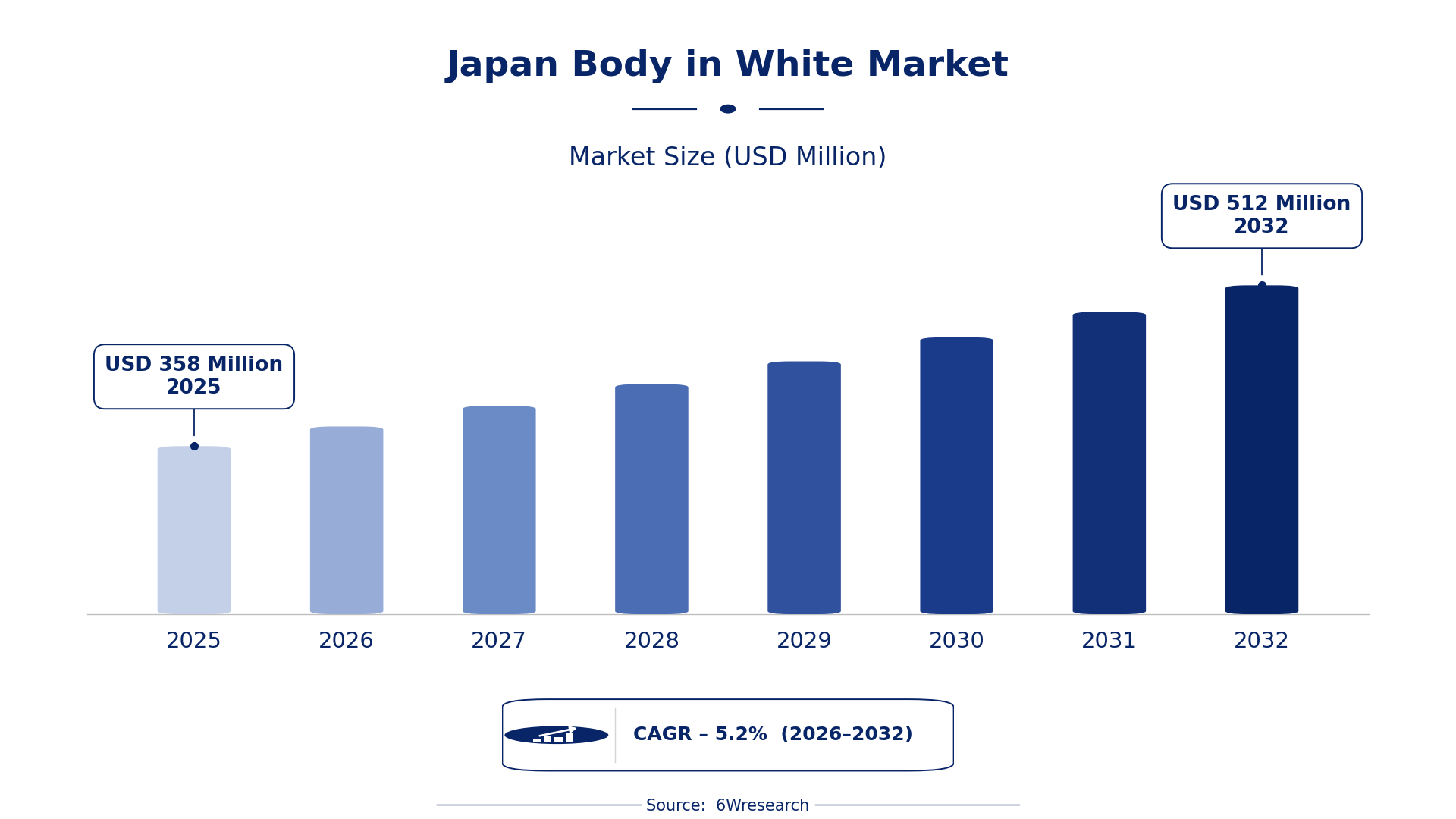
According to 6Wresearch internal database and industry insights, the Japan Body in White Market was valued at USD 358 Million in 2025 and is projected to reach USD 512 Million by 2032, growing at a CAGR of approximately 5.2% during 2026–2032.
Japan Body in White Market Highlights
| Report Metric | Details |
| Report Name | Japan Body in White Market (2026-2032) |
| Market Size 2025 | USD 358 Million |
| Market Size 2032 | USD 512 Million |
| Absolute Growth 2025–2032 | USD 154 Million |
| CAGR 2026–2032 | 5.2% |
| Peak Annual Growth | 6.1% in 2028 |
| Forecast Period | 2026–2032 |
| Historical Data | 2022–2025 |
| Base Year | 2025 |
| Leading Construction, 2025 | Monocoque (59% share) |
| Leading Manufacturing Method, 2025 | Cold Stamping (49% share) |
| Leading Material, 2025 | Steel (46% share) |
| Fastest-Growing Construction | Frame Mounted (6.6% CAGR) |
| Fastest-Growing Manufacturing Method | Hot Stamping (7.2% CAGR) |
| Fastest-Growing Material | Aluminum (7.3% CAGR) |
| Growing Sector | automotive manufacturing |
| Key End Users | automotive manufacturers, material suppliers, construction firms |
Japan Body in White Market Year-wise Growth Rate and Key Drivers (2022–2032)
This graph illustrates the annual growth rates of the market from 2022 to 2032, highlighting a steady upward trajectory and projected market expansion over the forecast period.
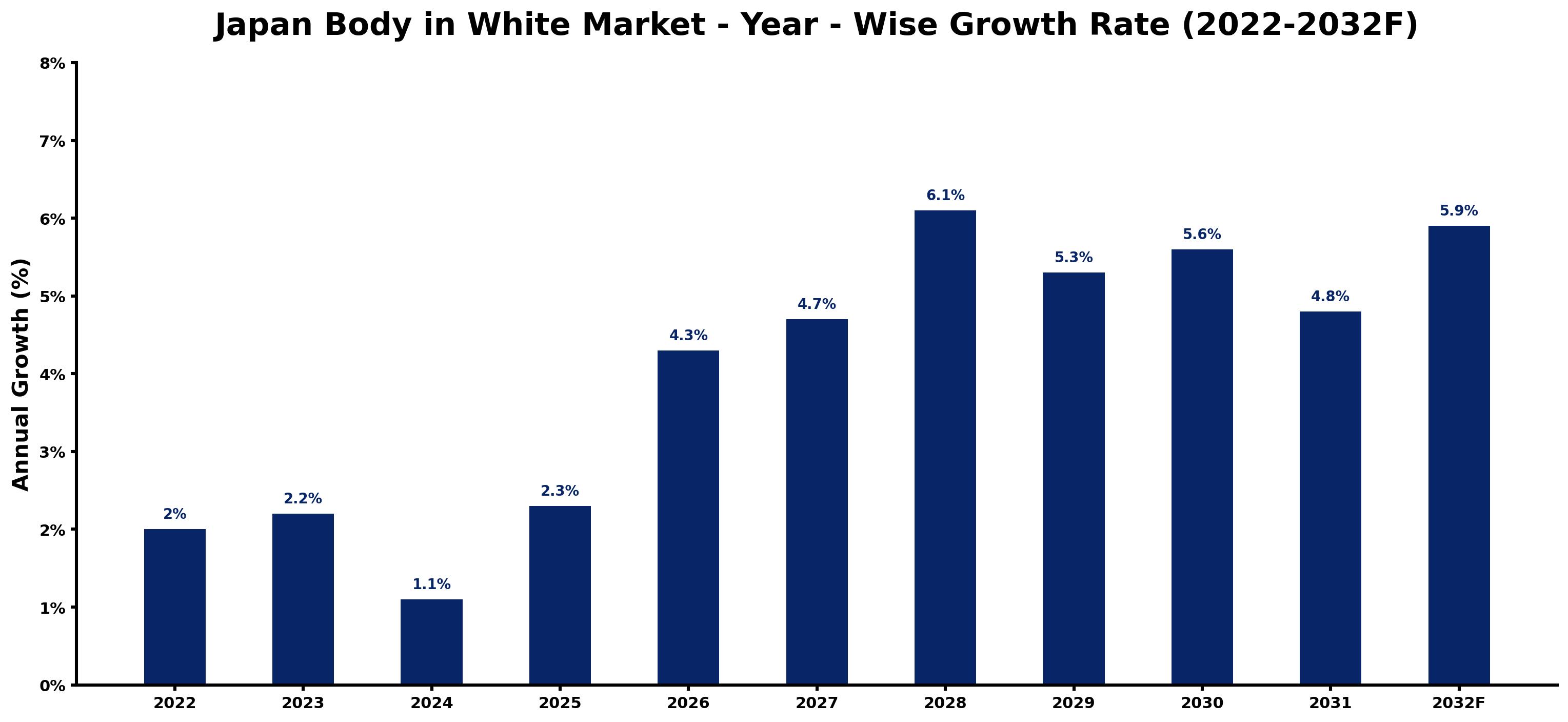
The following figures match every annual growth estimate with the main market development of that year, giving the reasoning behind each rise or slowdown.
| Year | Estimated Annual Growth (%) | Market Rationale |
| 2022 | 2.0 | The market showed steady growth, reflecting ongoing production demands from the automotive sector. |
| 2023 | 2.2 | Growth accelerated as automotive manufacturers increased production rates to meet rising consumer demand. |
| 2024 | 1.1 | Growth slowed as manufacturers adjusted to market saturation and fluctuating material costs. |
| 2025 | 2.3 | Demand increased due to the introduction of new vehicle models requiring advanced body structures. |
| 2026 | 4.3 | Growth is expected to rise as investments in advanced manufacturing technologies gain traction. |
| 2027 | 4.7 | The market is projected to expand with rising demand for lightweight materials in vehicle production. |
| 2028 | 6.1 | Growth is anticipated to peak as manufacturers adopt new techniques to improve vehicle performance. |
| 2029 | 5.3 | Growth is expected to moderate as market adjustments take place following the peak demand period. |
| 2030 | 5.6 | Demand will rise again as manufacturers focus on sustainability and efficiency in production. |
| 2031 | 4.8 | Growth is projected to slow as the market stabilises, reflecting a mature phase in production. |
| 2032 | 5.9 | The market is expected to grow as new technologies and materials are adopted in vehicle manufacturing. |
Note: Market size estimations and growth projections presented in this report are based on 6Wresearch's proprietary forecasting methodology, utilizing the latest available industry data, government publications, and primary research inputs.
Japan Body in White Market Synopsis
Body in White refers to the vehicle structure before the addition of components like engines and interiors. The Japan Body in White Market is driven by the automotive industry's demand for lightweight and durable materials, with production of electric vehicles increasing significantly. Factors contributing to this growth include advancements in manufacturing technologies that improve efficiency and reduce costs, along with a strong push towards sustainability in vehicle production.
Market Dynamics Impact Analysis (2026–2032)
| Factor | Type | Impact | Primary Segment Affected |
| Rising demand for electric vehicles | Driver | High | Monocoque |
| Technological advancements in lightweight materials | Driver | High | Monocoque |
| Growing investments in automotive manufacturing facilities | Opportunity | High | Monocoque |
| Expansion of production capabilities in regional hubs | Opportunity | High | Monocoque |
| Fluctuating raw material prices affecting production costs | Restraint | High | Monocoque |
| Regulatory compliance requirements increasing operational costs | Restraint | Medium | Monocoque |
| Supply chain disruptions impacting material availability | Challenge | High | Monocoque |
| Intense competition among manufacturers affecting pricing strategies | Challenge | Medium | Monocoque |
Evaluation of Drivers in Japan Body in White Market (2026–2032)
Demand rests on the following drivers, each shown with the segment it touches most.
| Drivers | Primary Segment Affected | Why It Matters (Evidence) |
| Increased production of electric vehicles | Monocoque | The shift towards electric vehicles is driving demand for lightweight body structures, with 30% of new models in 2025 expected to be electric. |
| Technological advancements in manufacturing processes | Monocoque | Improvements in automation and robotics are increasing production efficiency, leading to a 15% reduction in manufacturing time for body structures. |
| Growing consumer preference for fuel-efficient vehicles | Monocoque | The demand for lighter materials is rising, with 40% of consumers prioritising fuel efficiency in their vehicle choices. |
| Investment in automotive production facilities | Monocoque | Over USD 200 million is being invested in new manufacturing plants across Japan to meet rising demand. |
| Emergence of new material technologies | Aluminum | Innovations in aluminum and composite materials are expected to increase their usage in body structures by 25% by 2032. |
Spending rises because the automotive sector in Aichi is increasingly focused on electric vehicle production, with 30% of new models expected to be electric by 2025. The demand for lightweight materials is also growing, as 40% of consumers prioritise fuel efficiency in their vehicle choices. Investment in new manufacturing facilities is set to exceed USD 200 million, reflecting the need for increased production capacity. Advancements in manufacturing processes are reducing production times by 15%, allowing manufacturers to respond quickly to market changes. Innovations in material technologies are likely to increase the usage of lightweight solutions in body structures by 25% by 2032, further driving demand.
Evaluation of Restraints in Japan Body in White Market
The following restraints limit how fast demand can grow.
| Market Restraint | Primary Segment Affected | Why It Matters (Evidence) |
| Fluctuating raw material prices affecting production costs | Aluminum | Rising steel and aluminum prices have increased production costs by 10% in recent years. |
| Regulatory compliance requirements increasing operational costs | Monocoque | Compliance with safety standards has raised operational costs by 15% for manufacturers. |
| Limited availability of skilled labour impacting production | Monocoque | A shortage of skilled workers has delayed production timelines by approximately 20% in some facilities. |
| Supply chain disruptions impacting material availability | Monocoque | Recent global supply chain issues have resulted in a 25% decrease in material availability for manufacturers. |
| Intense competition among manufacturers affecting pricing strategies | Monocoque | Increased competition has led to price wars, reducing profit margins by 5%. |
Japan Body in White Market Challenges
Producers encounter escalating production costs due to rising raw material prices, which can increase expenses by 15% annually. Buyers face delays in delivery schedules stemming from a shortage of skilled labour, extending project timelines by an average of three months. Limited workforce skills hinder the ability to meet production demands, potentially leading to a loss of market share for manufacturers. The adoption of outdated technology results in operational inefficiencies, inflating costs by 10% for suppliers and diminishing their competitiveness in the market.
Trends in the Japan Body in White Market
Four trends stand out in the Japan Body in White Market.
- Shift towards Lightweight Materials: The automotive sector is increasingly adopting lightweight materials, with aluminum usage expected to rise by 25% by 2032. This shift reflects the industry's focus on improving fuel efficiency and performance.
- Increased Focus on Electric Vehicle Production: Manufacturers are prioritising electric vehicle production, with 30% of new models expected to be electric by 2025. This trend aligns with changing consumer preferences towards sustainable transportation.
- Transition from Traditional to Advanced Manufacturing Techniques: The industry is moving towards advanced manufacturing techniques, with automation reducing production times by 15%. This change is necessary for meeting demand efficiently.
- Growing Investment in Automotive Facilities: Investment in automotive manufacturing facilities is expected to exceed USD 200 million, reflecting the industry's commitment to expanding production capacity and meeting future demand.
Investment Opportunities in the Japan Body in White Market
Investors looking at the Japan Body in White Market should consider the following areas.
- Collaborations with Local Manufacturers: Now is an ideal time for partnerships, especially in regions like Kansai, where automotive production is thriving. Collaborating with local manufacturers can ease market entry and lower costs.
- Supply of Advanced Lightweight Materials: The demand for lightweight materials is increasing, particularly among automotive manufacturers in Japan. Suppliers can penetrate the market by offering materials that comply with industry standards, with a projected increase in usage by 25% by 2032.
- Investment in Automation Technologies: Investing in automation technologies is crucial now, as manufacturers aim to boost efficiency. With a projected reduction in production times, this investment can yield substantial returns.
- Expansion of Production Facilities in Regional Hubs: Manufacturers should contemplate investing in production facilities in regions with high automotive activity, such as Aichi, to effectively meet rising demand. This region has recorded a 20% increase in production capacity.
Government Initiatives in the Japan Body in White Market
The PRTR Law of 1999 mandates businesses to report the release and transfer of designated chemical substances, ensuring environmental safety in Body in White production. The Chemical Substances Control Law, enacted in 1973, requires the evaluation and management of both new and existing chemical substances, influencing material selection in manufacturing processes.
The Ministry of the Environment (MoE) and the Ministry of Economy, Trade and Industry (METI) oversee compliance with these regulations. They approve projects aimed at promoting environmental safety and finance initiatives that support sustainable manufacturing practices.
Future Insight of the Japan Body in White Market
Advancements in automation will transform production processes by 2032, streamlining operations for suppliers. The introduction of new manufacturing standards will necessitate improvements in quality and efficiency. Smart manufacturing facilities will facilitate real-time data analysis, improving decision-making for producers. With production capacity expected to increase by 20%, suppliers will be better positioned to satisfy the growing demand from buyers.
Market Segmentation Analysis
Japan Body in White Market report covers a detailed analysis of the following market segments:
By Construction – Monocoque Leads, Frame Mounted Expected to Grow Fastest
According to Summon Dutta, Assistant Manager at 6Wresearch, with 59% of construction revenue in 2025, Monocoque was the largest category. Monocoque structures dominate Japan's market owing to their lightweight and sturdy characteristics, making them ideal for a variety of vehicles. This construction style is especially common in passenger vehicles, contributing to its leading market position. The quickest growth will come from Frame Mounted, forecast to expand at a CAGR of 6.6% between 2026 and 2032. Frame Mounted structures are witnessing rapid growth as manufacturers prioritise vehicle safety and structural integrity. This trend is particularly evident with the rising demand for SUVs and trucks, which require more robust frame designs. Suppliers need to focus on developing advanced frame technologies to meet the growing requirements of vehicle manufacturers.
By Manufacturing Method – Cold Stamping Leads, Hot Stamping Expected to Grow Fastest
Cold Stamping held 49% of the Japan Body in White Market by manufacturing method in 2025. Cold Stamping holds the largest share as it is widely adopted for producing high-volume components efficiently and cost-effectively. This method is particularly prevalent in mass production lines for various automotive parts. Over 2026–2032, Hot Stamping is expected to post the fastest growth, at a CAGR of 7.2%. Hot Stamping is gaining traction due to its ability to produce lightweight yet high-strength components, which are essential for modern vehicle safety standards. The increasing emphasis on vehicle safety is propelling this manufacturing method's growth. Manufacturers must invest in hot stamping technologies to stay competitive in a market that prioritises safety and efficiency.
By Material – Steel Leads, Aluminum Expected to Grow Fastest
Steel took 46% of material revenue in 2025, more than any other category. Steel remains the top material in the body in white market due to its excellent strength-to-weight ratio and cost-effectiveness. Its extensive application across various automotive sectors reinforces its leading status. Aluminum is set to record the highest CAGR in this split, 7.3% over 2026–2032. Aluminum is growing at the fastest rate as automakers strive to reduce vehicle weight for improved fuel efficiency and lower emissions. This trend is notably significant in the manufacturing of electric vehicles, where weight reduction is critical. Suppliers should consider expanding their aluminium offerings to cater to the increasing demand for lightweight automotive structures.
Key Attractiveness of the Report
- 10 Years of Market Numbers
- Historical Data Starting from 2022 to 2025
- Base Year 2025
- Forecast Data until 2032
- Key Performance Indicators Impacting the Market
- Major Upcoming Developments and Projects
Key Highlights of the Report:
- Japan Body in White Market Outlook
- Market Size of Japan Body in White Market, 2025
- Forecast of Japan Body in White Market, 2032
- Historical Data and Forecast of Japan Body in White Revenues & Volume for the Period 2022-2032
- Japan Body in White Market Trend Evolution
- Japan Body in White Market Drivers and Challenges
- Japan Body in White Price Trends
- Japan Body in White Porter's Five Forces
- Japan Body in White Industry Life Cycle
- Historical Data and Forecast of Japan Body in White Market Revenues & Volume By Construction for the Period 2022-2032
- Historical Data and Forecast of Japan Body in White Market Revenues & Volume By Monocoque for the Period 2022-2032
- Historical Data and Forecast of Japan Body in White Market Revenues & Volume By Frame Mounted for the Period 2022-2032
- Historical Data and Forecast of Japan Body in White Market Revenues & Volume By Manufacturing Method for the Period 2022-2032
- Historical Data and Forecast of Japan Body in White Market Revenues & Volume By Cold Stamping for the Period 2022-2032
- Historical Data and Forecast of Japan Body in White Market Revenues & Volume By Hot Stamping for the Period 2022-2032
- Historical Data and Forecast of Japan Body in White Market Revenues & Volume By Roll Forming for the Period 2022-2032
- Historical Data and Forecast of Japan Body in White Market Revenues & Volume By Material for the Period 2022-2032
- Historical Data and Forecast of Japan Body in White Market Revenues & Volume By Steel for the Period 2022-2032
- Historical Data and Forecast of Japan Body in White Market Revenues & Volume By Aluminum for the Period 2022-2032
- Historical Data and Forecast of Japan Body in White Market Revenues & Volume By Magnesium for the Period 2022-2032
- Historical Data and Forecast of Japan Body in White Market Revenues & Volume By CFRP for the Period 2022-2032
- Japan Body in White Import Export Trade Statistics
- Market Opportunity Assessment By Construction
- Market Opportunity Assessment By Manufacturing Method
- Market Opportunity Assessment By Material
- Japan Body in White Top Companies Market Share
- Japan Body in White Competitive Benchmarking By Technical and Operational Parameters
- Japan Body in White Company Profiles
- Japan Body in White Key Strategic Recommendations
Market Covered
This report examines the market across the segments below.
By Construction
- Monocoque
- Frame Mounted
By Manufacturing Method
- Cold Stamping
- Hot Stamping
- Roll Forming
By Material
- Steel
- Aluminum
- Magnesium
- CFRP































