Japan Bonding Agents for Crop Covers Market Size & Growth Rate
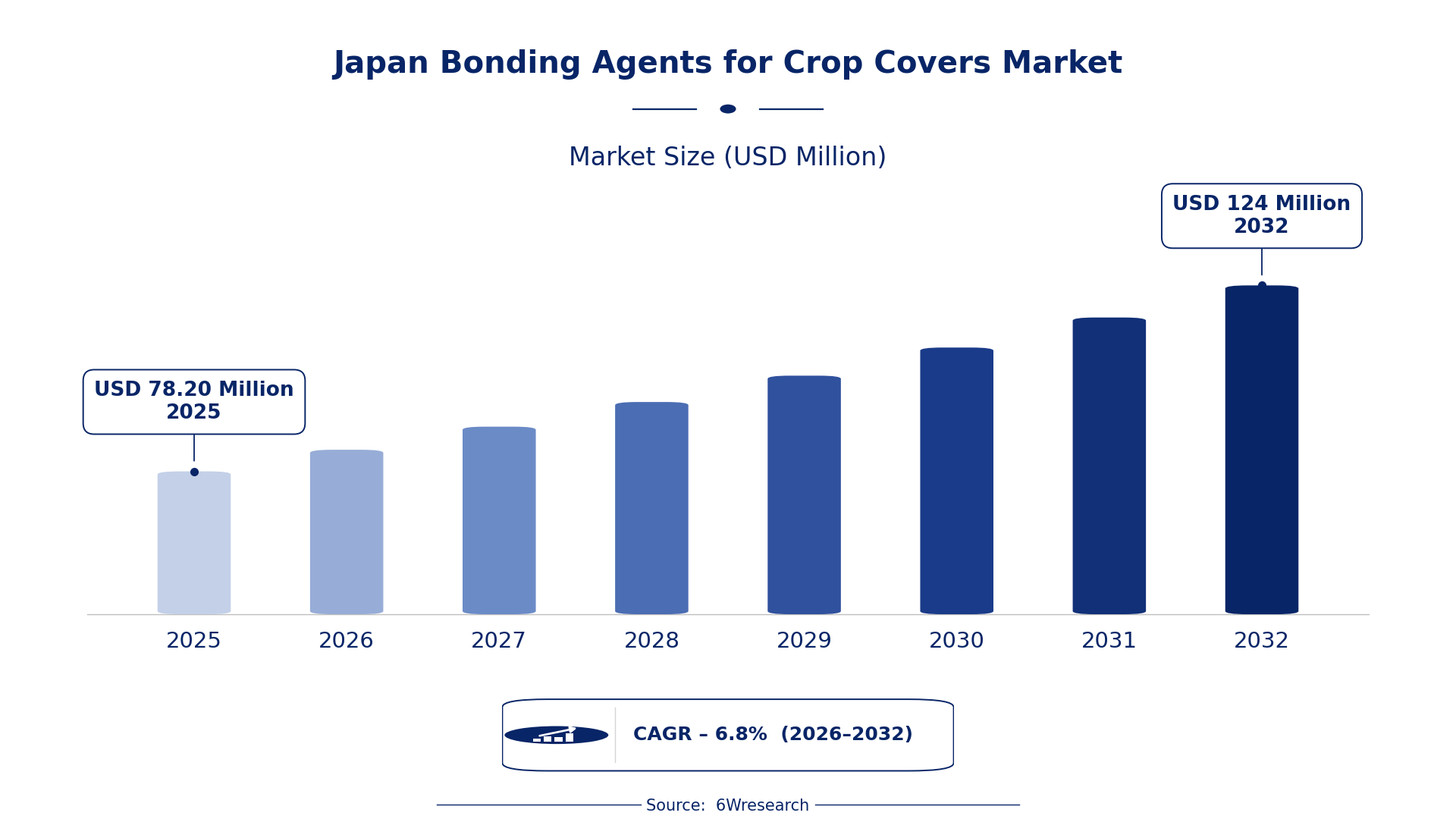
According to 6Wresearch internal database and industry insights, the Japan Bonding Agents for Crop Covers Market was valued at USD 78.20 Million in 2025 and is projected to reach USD 124 Million by 2032, growing at a CAGR of approximately 6.8% during 2026–2032.
Japan Bonding Agents for Crop Covers Market Highlights
| Report Metric | Details |
| Report Name | Japan Bonding Agents for Crop Covers Market (2026-2032) |
| Market Size 2025 | USD 78.20 Million |
| Market Size 2032 | USD 124 Million |
| Absolute Growth 2025–2032 | USD 45.80 Million |
| CAGR 2026–2032 | 6.8% |
| Peak Annual Growth | 8.5% in 2032 |
| Forecast Period | 2026–2032 |
| Historical Data | 2022–2025 |
| Base Year | 2025 |
| Leading Bonding Type, 2025 | Adhesive Spray (40% share) |
| Leading Polymer Base, 2025 | Polyethylene-Based (51% share) |
| Leading Application Method, 2025 | Spray Coating (37% share) |
| Leading Crop Type, 2025 | Vegetable Fields (44% share) |
| Fastest-Growing Bonding Type | Film Bond (9.6% CAGR) |
| Fastest-Growing Polymer Base | Polypropylene Blends (8.9% CAGR) |
| Fastest-Growing Application Method | Sheet Lamination (9.2% CAGR) |
| Fastest-Growing Crop Type | Greenhouse Crops (9.9% CAGR) |
| Growing Sector | Sheet Lamination |
| Key End Users | Spray Coating, Sheet Lamination, Tape Application, Heat Seal |
Japan Bonding Agents for Crop Covers Market Year-wise Growth Rate and Key Drivers (2022–2032)
This graph illustrates the annual growth rates of the market from 2022 to 2032, highlighting a steady upward trajectory and projected market expansion over the forecast period.
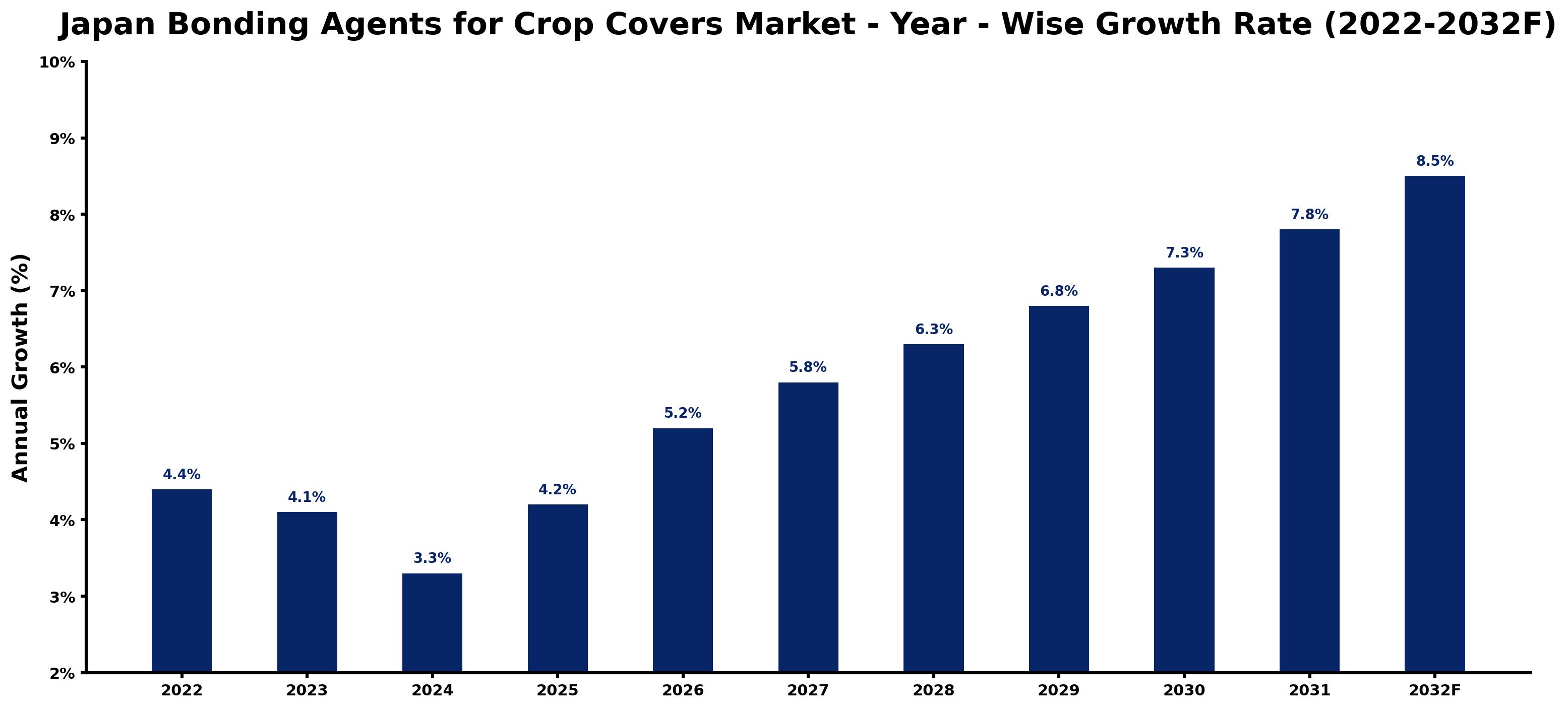
The table below sets out the estimated growth rate for each year and the main factor behind it.
| Year | Estimated Annual Growth (%) | Market Rationale |
| 2022 | 4.4 | The market showed solid growth due to increased awareness of crop protection needs. |
| 2023 | 4.1 | Growth slowed as farmers adjusted to pest management strategies and economic conditions. |
| 2024 | 3.3 | A further slowdown occurred as the market stabilised amid changing agricultural practices. |
| 2025 | 4.2 | Growth accelerated again as demand for effective crop protection solutions rose. |
| 2026 | 5.2 | The market is projected to grow faster due to rising adoption of advanced bonding agents. |
| 2027 | 5.8 | Increased investment in agricultural innovation is projected to further boost growth. |
| 2028 | 6.3 | Demand is anticipated to rise as farmers seek to improve crop resilience. |
| 2029 | 6.8 | The market is expected to grow as new technologies in bonding agents gain traction. |
| 2030 | 7.3 | Rising environmental concerns will drive demand for sustainable bonding solutions. |
| 2031 | 7.8 | Growth is projected to continue as the agricultural sector embraces new practices. |
| 2032 | 8.5 | The market will peak as bonding agents become essential for crop protection. |
Note: Market size estimations and growth projections presented in this report are based on 6Wresearch's proprietary forecasting methodology, utilizing the latest available industry data, government publications, and primary research inputs.
Japan Bonding Agents for Crop Covers Market Synopsis
Bonding agents for crop covers are chemical formulations that adhere protective materials to crops, providing growth and protection. The increasing number of farms, which exceeds 1.3 million, along with government support for sustainable agriculture initiatives, will further propel market growth.
Market Dynamics Impact Analysis (2026–2032)
| Factor | Type | Impact | Primary Segment Affected |
| Increasing adoption of bonding agents in vegetable fields driven by pest management needs. | Driver | High | Adhesive Spray |
| Growing greenhouse crop production requiring effective bonding solutions. | Driver | High | Film Bond |
| Rising demand for sustainable agricultural practices creating opportunities for innovative products. | Opportunity | High | Polyethylene-Based |
| Investment in agricultural innovation programs enhancing product development. | Opportunity | Medium | Polypropylene Blends |
| Regulatory compliance costs associated with chemical substances control affecting producers. | Restraint | High | Acrylic-Based |
| Limited awareness among farmers regarding advanced bonding technologies hindering adoption. | Restraint | Medium | EVA Copolymers |
| High costs of compliance with environmental regulations impacting profitability. | Challenge | High | Pressure-Sensitive |
| Aging farmer population leading to slower adoption of new technologies. | Challenge | Medium | Thermal Bonding Agent |
Evaluation of Drivers in Japan Bonding Agents for Crop Covers Market (2026–2032)
These are the developments adding the most demand over the forecast period.
| Drivers | Primary Segment Affected | Why It Matters (Evidence) |
| Rising number of farms requiring effective crop protection solutions. | Adhesive Spray | Japan has over 1.3 million farms, increasing the demand for bonding agents. |
| Growth in greenhouse crop production necessitating durable bonding solutions. | Film Bond | Greenhouse crop production reached 1.5 million tons in 2021, driving demand. |
| Government initiatives promoting sustainable agriculture boosting market interest. | Polyethylene-Based | The Ministry of Agriculture, Forestry and Fisheries supports sustainable practices, enhancing market growth. |
| Increased pest management needs among farmers driving bonding agent usage. | Polypropylene Blends | Adoption of bonding agents is rising due to pest management requirements, increasing sales. |
| Technological advancements in bonding agents improving performance and application. | Acrylic-Based | Innovations in bonding formulations are attracting attention from farmers seeking effective solutions. |
Spending rises because the number of farms in Japan exceeds 1.3 million, driving demand for effective crop protection solutions. In 2021, greenhouse crop production reached 1.5 million tons, necessitating durable bonding agents. Pest management needs among farmers are increasing, leading to a rise in bonding agent adoption. Technological advancements in formulations are improving performance, attracting attention from farmers seeking effective solutions.
Evaluation of Restraints in Japan Bonding Agents for Crop Covers Market
Several factors work against faster growth; the main ones are summarised below.
| Market Restraint | Primary Segment Affected | Why It Matters (Evidence) |
| High compliance costs associated with the Chemical Substances Control Law affecting producers. | Acrylic-Based | Producers must evaluate and control chemical substances, which increases operational costs by 15%. |
| Limited awareness of advanced bonding technologies among farmers hindering adoption. | EVA Copolymers | Farmers may be reluctant to invest in new products without clear benefits, limiting sales. |
| Regulatory compliance requirements increasing production costs. | Pressure-Sensitive | Producers face additional costs to meet stringent regulations on chemical use, affecting pricing. |
| Challenges in sourcing sustainable raw materials impacting production. | Thermal Bonding Agent | Availability of sustainable materials is limited, affecting product development and supply. |
| Market fragmentation creating competition and pricing pressures. | Film Bond | Numerous small producers create a competitive environment, impacting profitability and market stability. |
Japan Bonding Agents for Crop Covers Market Challenges
Supply shortages of bonding agents arise from limited domestic production capabilities, largely due to the ageing farmer population, with an average age of 67. This demographic trend results in fewer producers adopting modern agricultural practices, raising operational costs by up to 15% for those remaining. Buyers in greenhouse crop production experience delays in accessing essential products, risking yield losses of up to 20%. The slow integration of advanced technologies in bonding agents hampers effective pest management solutions, diminishing overall crop protection efforts for farmers, particularly in vegetable fields.
Trends in the Japan Bonding Agents for Crop Covers Market
Buyers and suppliers in the Japan Bonding Agents for Crop Covers Market are adjusting to the following trends.
- Vegetable Farmers Adopting Sustainable Practices: Farmers are increasingly adopting sustainable practices, with the Ministry of Agriculture, Forestry and Fisheries promoting eco-friendly solutions. In 2023, Japan invested ¥5 billion in agricultural innovation, encouraging the use of advanced bonding agents.
- Transition from Traditional to Advanced Bonding Technologies: The shift began in 2021 as farmers sought better crop protection methods. Adoption of advanced bonding agents is rising, with the market for polyethylene-based products projected to grow by 8.9%.
- Emergence of Film Bonding Techniques: Film bonding techniques are gaining traction among farmers, with a projected CAGR of 9.6% from 2026 to 2032. This shift reflects the need for durable solutions in crop protection.
- Prioritisation of Pest Management Solutions: Farmers are focusing on effective pest management, leading to increased bonding agent usage. In 2022, pest management needs prompted a rise in the adoption of bonding agents across various crop types.
Investment Opportunities in the Japan Bonding Agents for Crop Covers Market
The opportunities below stand out in the Japan Bonding Agents for Crop Covers Market for new entrants and existing suppliers.
- Vegetable Farmers Seeking Advanced Bonding Solutions: Vegetable farmers need bonding agents to improve crop protection. The market is expected to reach USD 124 million by 2032, allowing suppliers to enter through local partnerships.
- Entry into Greenhouse Crop Production: Greenhouse crop producers require durable bonding solutions to enhance crop resilience. Collaborating with local distributors can facilitate market entry for new bonding agents.
- Investment in Polypropylene Blends for Crop Covers: Investing in polypropylene blends offers opportunities for suppliers to meet rising demand. The Tokyo region, a hub for greenhouse crops, presents a viable market for these products.
- Expansion in Agricultural Innovation Programs: With the government's ¥5 billion investment in agricultural innovation, suppliers can develop new bonding agents. Engaging with local agricultural cooperatives can enhance market access.
Government Initiatives in the Japan Bonding Agents for Crop Covers Market
The Food Sanitation Act amendment (2018) introduced a system for evaluating synthetic resins, establishing safety standards for producers. This measure, effective from June 2020, requires compliance with strict regulations, ensuring that bonding agents meet safety criteria for agricultural use.
Buyers, particularly farmers, benefit from the Plastic Resource Circulation Act (2021), which promotes recycling and sustainable practices. This law encourages the use of biodegradable materials, allowing farmers to adopt more environmentally friendly bonding solutions.
Future Insight of the Japan Bonding Agents for Crop Covers Market
By 2032, policy-driven shifts will transform Japan's agricultural market, with government support for sustainable practices. The ¥5 billion investment in agricultural innovation will encourage suppliers to develop more effective bonding agents, which will improve crop resilience. Enhanced formulations will equip producers with superior crop protection methods, minimising yield losses. Adoption of ISO 9001 standards will raise product quality, building trust among buyers and stimulating a more competitive market.
Market Segmentation Analysis
Japan Bonding Agents for Crop Covers Market report covers a detailed analysis of the following market segments:
By Bonding Type – Adhesive Spray Leads, Film Bond Expected to Grow Fastest
According to Saurav Kr Singh, Senior Research Analyst at 6Wresearch, in 2025, Adhesive Spray led the bonding type split with a 40% share. Adhesive spray holds the largest share due to its versatility and ease of application across various crop covers. This method is particularly favoured in urban areas like Tokyo, where timely pest management is essential for crop health. Film Bond is set to record the highest CAGR in this split, 9.6% over 2026–2032. Film bond is experiencing rapid growth as it provides a strong protective layer that is increasingly vital for crop resilience. The recent programme launched in 2023 to enhance crop resilience against climate change has significantly accelerated its adoption. Suppliers should focus on promoting film bond solutions to meet the rising demand for durable crop protection.
By Polymer Base – Polyethylene-Based Leads, Polypropylene Blends Expected to Grow Fastest
The largest polymer base category in 2025 was Polyethylene-Based, at 51% of revenue. Polyethylene-based bonding agents lead the market owing to their strength and flexibility, making them suitable for a variety of agricultural applications. This type is especially common in vegetable fields, which span around 200,000 hectares in Japan. Polypropylene Blends are projected to grow fastest, at a CAGR of 8.9% during 2026–2032. Polypropylene blends are experiencing swift growth due to their superior resistance and durability, critical for safeguarding crops in adverse conditions. The increasing emphasis on sustainable agricultural practices is propelling this trend forward. Buyers should explore the integration of polypropylene blends to improve the resilience of their crop protection measures.
By Application Method – Spray Coating Leads, Sheet Lamination Expected to Grow Fastest
Spray Coating held 37% of the Japan Bonding Agents for Crop Covers Market by application method in 2025. Spray coating is the leading application method as it is extensively used for its efficiency in uniformly applying bonding agents. This technique is especially common in vegetable fields, where comprehensive coverage is crucial for effective pest management. Over 2026–2032, Sheet Lamination is expected to post the fastest growth, at a CAGR of 9.2%. Sheet lamination is the fastest-growing method as it creates robust protective layers that are increasingly necessary for greenhouse crop production. The notable increase in greenhouse crop output, reaching 1.5 million tons in 2021, is a key factor driving this trend. Suppliers must invest in technologies that enable sheet lamination to capitalise on the expanding market for protective applications.
By Crop Type – Vegetable Fields Lead, Greenhouse Crops Expected to Grow Fastest
With 44% of crop type revenue in 2025, Vegetable Fields was the largest category. Vegetable fields represent the largest segment due to their significant dependence on crop covers for safeguarding against pests and environmental challenges. With over 1.3 million farms in Japan, this area remains a crucial market for bonding agents. The quickest growth will come from Greenhouse Crops, forecast to expand at a CAGR of 9.9% between 2026 and 2032. Greenhouse crops are the fastest-growing segment as they require specific protective measures for sensitive plants. The increasing production of greenhouse crops, which reached 1.5 million tons in 2021, highlights the urgent need for effective bonding solutions. Buyers should prioritise solutions tailored for greenhouse crops to optimise protection and enhance yield.
Key Attractiveness of the Report
- 10 Years of Market Numbers
- Historical Data Starting from 2022 to 2025
- Base Year 2025
- Forecast Data until 2032
- Key Performance Indicators Impacting the Market
- Major Upcoming Developments and Projects
Key Highlights of the Report:
- Japan Bonding Agents for Crop Covers Market Outlook
- Market Size of Japan Bonding Agents for Crop Covers Market, 2025
- Forecast of Japan Bonding Agents for Crop Covers Market, 2032
- Historical Data and Forecast of Japan Bonding Agents for Crop Covers Revenues & Volume for the Period 2022-2032F
- Japan Bonding Agents for Crop Covers Market Trend Evolution
- Japan Bonding Agents for Crop Covers Market Drivers and Challenges
- Japan Bonding Agents for Crop Covers Price Trends
- Japan Bonding Agents for Crop Covers Porter's Five Forces
- Japan Bonding Agents for Crop Covers Industry Life Cycle
- Historical Data and Forecast of Japan Bonding Agents for Crop Covers Market Revenues & Volume By Bonding Type for the Period 2022-2032F
- Historical Data and Forecast of Japan Bonding Agents for Crop Covers Market Revenues & Volume By Adhesive Spray for the Period 2022-2032F
- Historical Data and Forecast of Japan Bonding Agents for Crop Covers Market Revenues & Volume By Film Bond for the Period 2022-2032F
- Historical Data and Forecast of Japan Bonding Agents for Crop Covers Market Revenues & Volume By Pressure-Sensitive for the Period 2022-2032F
- Historical Data and Forecast of Japan Bonding Agents for Crop Covers Market Revenues & Volume By Thermal Bonding Agent for the Period 2022-2032F
- Historical Data and Forecast of Japan Bonding Agents for Crop Covers Market Revenues & Volume By Polymer Base for the Period 2022-2032F
- Historical Data and Forecast of Japan Bonding Agents for Crop Covers Market Revenues & Volume By Polyethylene-Based for the Period 2022-2032F
- Historical Data and Forecast of Japan Bonding Agents for Crop Covers Market Revenues & Volume By Polypropylene Blends for the Period 2022-2032F
- Historical Data and Forecast of Japan Bonding Agents for Crop Covers Market Revenues & Volume By Acrylic-Based for the Period 2022-2032F
- Historical Data and Forecast of Japan Bonding Agents for Crop Covers Market Revenues & Volume By EVA Copolymers for the Period 2022-2032F
- Historical Data and Forecast of Japan Bonding Agents for Crop Covers Market Revenues & Volume By Application Method for the Period 2022-2032F
- Historical Data and Forecast of Japan Bonding Agents for Crop Covers Market Revenues & Volume By Spray Coating for the Period 2022-2032F
- Historical Data and Forecast of Japan Bonding Agents for Crop Covers Market Revenues & Volume By Sheet Lamination for the Period 2022-2032F
- Historical Data and Forecast of Japan Bonding Agents for Crop Covers Market Revenues & Volume By Tape Application for the Period 2022-2032F
- Historical Data and Forecast of Japan Bonding Agents for Crop Covers Market Revenues & Volume By Heat Seal for the Period 2022-2032F
- Historical Data and Forecast of Japan Bonding Agents for Crop Covers Market Revenues & Volume By Crop Type for the Period 2022-2032F
- Historical Data and Forecast of Japan Bonding Agents for Crop Covers Market Revenues & Volume By Vegetable Fields for the Period 2022-2032F
- Historical Data and Forecast of Japan Bonding Agents for Crop Covers Market Revenues & Volume By Greenhouse Crops for the Period 2022-2032F
- Historical Data and Forecast of Japan Bonding Agents for Crop Covers Market Revenues & Volume By Fruit Plantations for the Period 2022-2032F
- Historical Data and Forecast of Japan Bonding Agents for Crop Covers Market Revenues & Volume By Row Crops for the Period 2022-2032F
- Japan Bonding Agents for Crop Covers Import Export Trade Statistics
- Market Opportunity Assessment By Bonding Type
- Market Opportunity Assessment By Polymer Base
- Market Opportunity Assessment By Application Method
- Market Opportunity Assessment By Crop Type
- Japan Bonding Agents for Crop Covers Top Companies Market Share
- Japan Bonding Agents for Crop Covers Competitive Benchmarking By Technical and Operational Parameters
- Japan Bonding Agents for Crop Covers Company Profiles
- Japan Bonding Agents for Crop Covers Key Strategic Recommendations
Market Covered
Segments analysed in this report are listed below.
By Bonding Type
- Adhesive Spray
- Film Bond
- Pressure-Sensitive
- Thermal Bonding Agent
By Polymer Base
- Polyethylene-Based
- Polypropylene Blends
- Acrylic-Based
- EVA Copolymers
By Application Method
- Spray Coating
- Sheet Lamination
- Tape Application
- Heat Seal
By Crop Type
- Vegetable Fields
- Greenhouse Crops
- Fruit Plantations
- Row Crops






































