Japan Bone Meal Market Size & Growth Rate
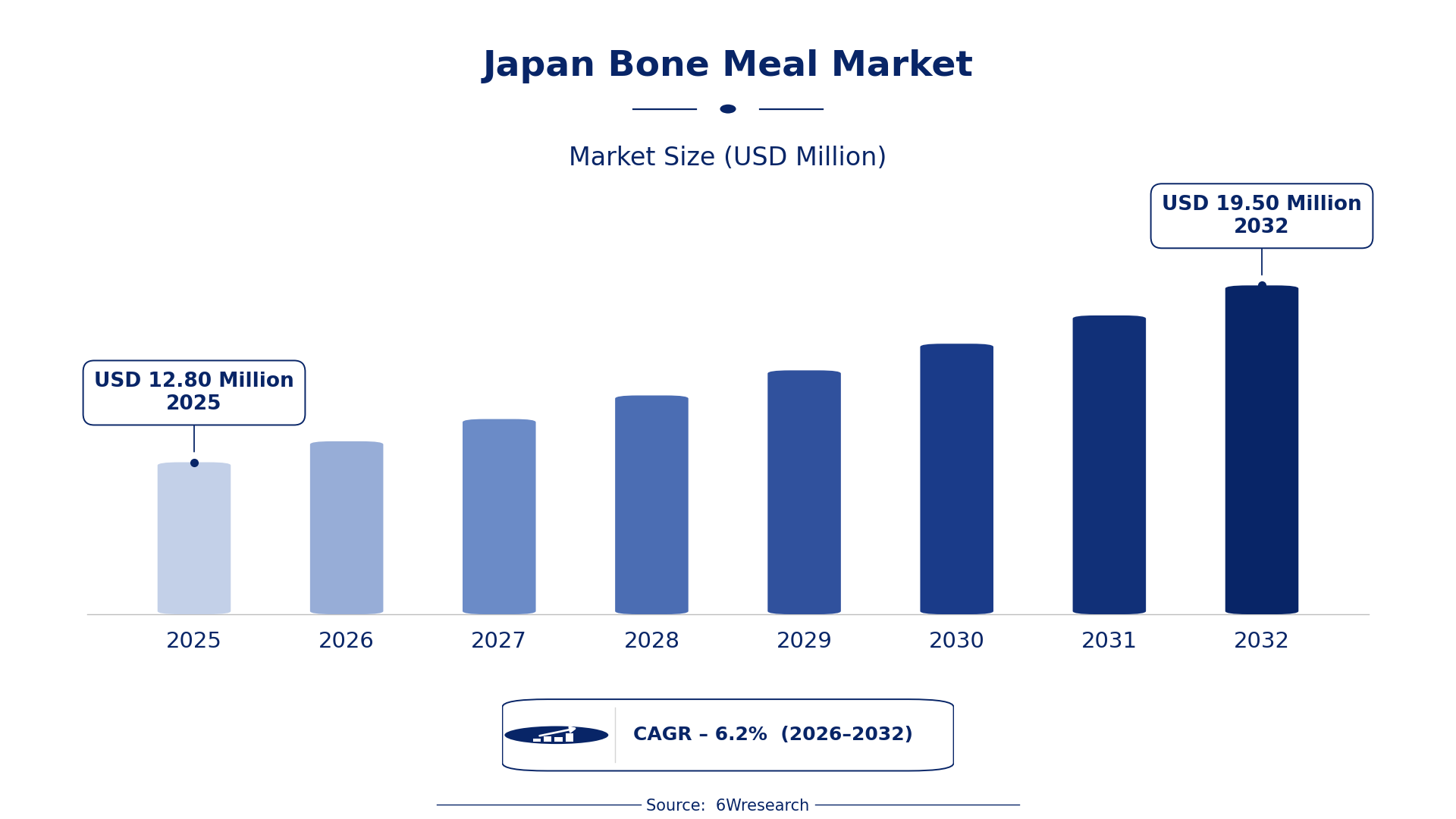
According to 6Wresearch internal database and industry insights, the Japan Bone Meal Market was valued at USD 12.80 Million in 2025 and is projected to reach USD 19.50 Million by 2032, growing at a CAGR of approximately 6.2% during 2026–2032.
Japan Bone Meal Market Highlights
| Report Metric | Details |
| Report Name | Japan Bone Meal Market (2026-2032) |
| Market Size 2025 | USD 12.80 Million |
| Market Size 2032 | USD 19.50 Million |
| Absolute Growth 2025–2032 | USD 6.70 Million |
| CAGR 2026–2032 | 6.2% |
| Peak Annual Growth | 6.9% in 2030 |
| Forecast Period | 2026–2032 |
| Historical Data | 2022–2025 |
| Base Year | 2025 |
| Leading Product Type, 2025 | Sterilized Bone Meal (40% share) |
| Leading Source Material, 2025 | Animal Bones (44% share) |
| Leading Application Area, 2025 | Animal Feed (46% share) |
| Leading End Use, 2025 | Agriculture (38% share) |
| Fastest-Growing Product Type | Organic Bone Meal (8.8% CAGR) |
| Fastest-Growing Source Material | Cattle Bone Waste (8.7% CAGR) |
| Fastest-Growing Application Area | Soil Amendment (7.4% CAGR) |
| Fastest-Growing End Use | Horticulture (8.0% CAGR) |
| Growing Sector | Agriculture |
| Key End Users | Farmers, Livestock Producers, Horticulturists, Pet Food Manufacturers |
Japan Bone Meal Market Year-wise Growth Rate and Key Drivers (2022–2032)
This graph illustrates the annual growth rates of the market from 2022 to 2032, highlighting a steady upward trajectory and projected market expansion over the forecast period.
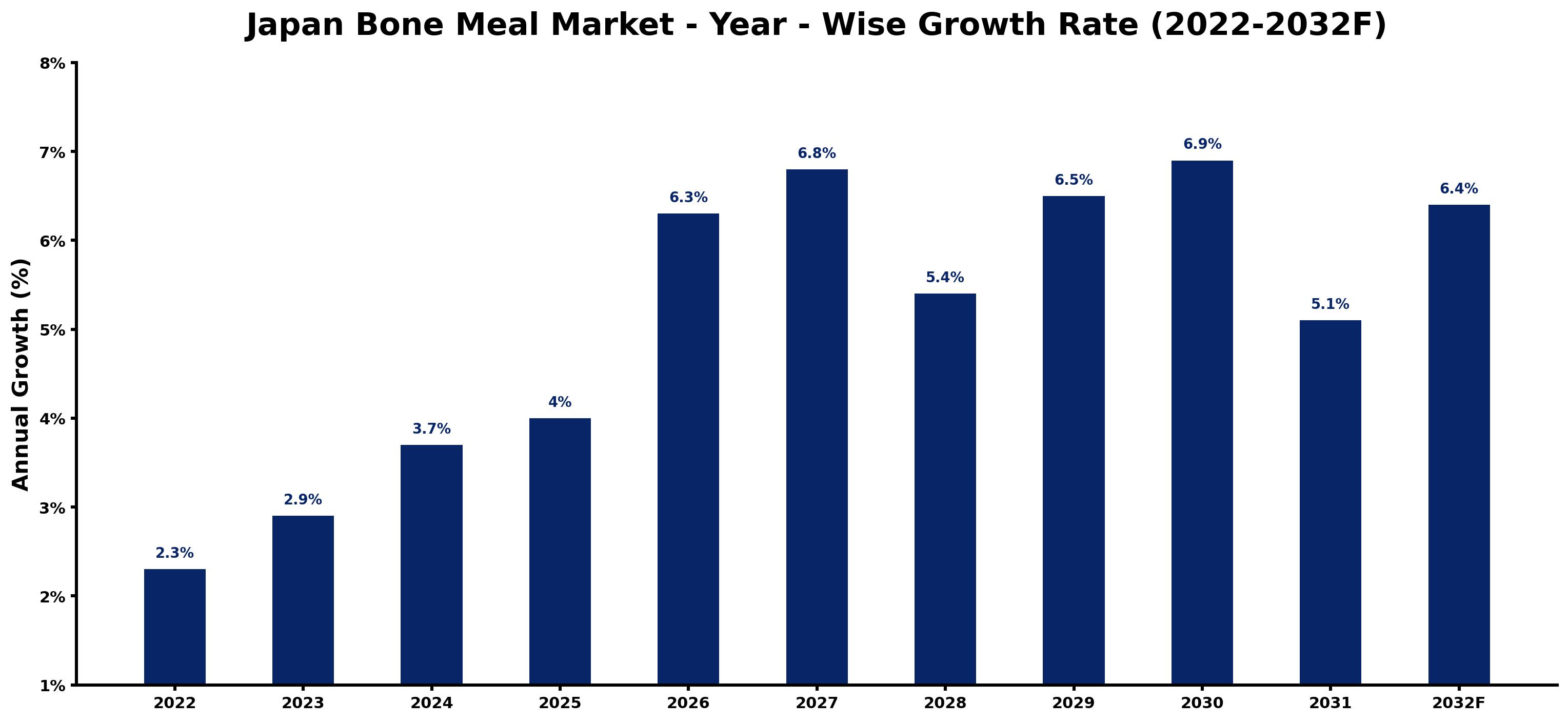
For each year, the table pairs the estimated growth rate with the leading influence on demand, showing how the drivers changed across the period.
| Year | Estimated Annual Growth (%) | Market Rationale |
| 2022 | 2.3 | The market saw steady growth with increasing interest in organic fertilizers. |
| 2023 | 2.9 | Growth accelerated due to rising awareness of sustainable agriculture practices. |
| 2024 | 3.7 | Demand continued to rise as more farmers adopted bone meal for soil improvement. |
| 2025 | 4.0 | The market reached a peak growth rate, driven by the livestock industry's expansion. |
| 2026 | 6.3 | Investment in organic farming initiatives is expected to spur higher consumption of bone meal. |
| 2027 | 6.8 | The market will maintain strong growth as agricultural practices evolve towards sustainability. |
| 2028 | 5.4 | Growth is projected to slow slightly as the market adjusts to new supply chain conditions. |
| 2029 | 6.5 | Demand is expected to increase again, supported by rising livestock populations and feed needs. |
| 2030 | 6.9 | The market is projected to peak with significant investments in organic fertilizer programs. |
| 2031 | 5.1 | Growth will decelerate as market saturation begins to set in with established buyers. |
| 2032 | 6.4 | Demand is expected to rise again as technology improves production efficiency. |
Note: Market size estimations and growth projections presented in this report are based on 6Wresearch's proprietary forecasting methodology, utilizing the latest available industry data, government publications, and primary research inputs.
Japan Bone Meal Market Synopsis
Bone meal is a nutrient-rich product made from ground animal bones, primarily used as a fertilizer and animal feed supplement. The Japan Bone Meal Market is expanding due to rising demand from the agricultural sector, particularly in organic farming, where bone meal serves as a key soil amendment in over 30% of organic farms. The livestock industry, valued at approximately ¥1.5 trillion, drives demand as it seeks nutrient-rich feed supplements. A government program launched in 2023 aims to increase organic fertilizer usage by 20%, further boosting market prospects.
Market Dynamics Impact Analysis (2026–2032)
| Factor | Type | Impact | Primary Segment Affected |
| Growing interest in organic farming practices | Driver | High | Organic Bone Meal |
| Increased livestock population and feed requirements | Driver | High | Animal Feed |
| Expansion of organic farms in regions like Tokyo | Opportunity | High | Soil Amendment |
| Rising demand for sustainable agricultural inputs | Opportunity | Medium | Fertilizer Additive |
| Competition from alternative fertilizers | Restraint | High | Organic Bone Meal |
| Regulatory challenges in processing animal by-products | Restraint | Medium | Sterilized Bone Meal |
| High production costs affecting profitability | Challenge | High | Animal Feed |
| Supply chain disruptions impacting availability | Challenge | Medium | Industrial Bone Meal |
Evaluation of Drivers in Japan Bone Meal Market (2026–2032)
Below are the drivers that matter most for revenue growth, with supporting evidence.
| Drivers | Primary Segment Affected | Why It Matters (Evidence) |
| Rising livestock population | Animal Feed | The average population of livestock in Japan is around 4 million cattle, increasing demand for nutrient-rich feed. |
| Growing organic farming initiatives | Organic Bone Meal | The promotion of organic fertilizers drives demand for bone meal in agricultural applications. |
| High demand for soil amendments in agriculture | Soil Amendment | Bone meal is used as a soil amendment in over 30% of organic farms in Japan. |
| Increased focus on sustainable agriculture | Fertilizer Additive | The livestock industry seeks sustainable feed options, valued at approximately ¥1.5 trillion. |
| Expansion of horticulture applications | Horticulture | The Tokyo region has a high demand for bone meal in horticulture applications. |
A wider customer base explains much of the growth, as the livestock population in Japan is around 4 million cattle, leading to increased demand for nutrient-rich feed supplements. The promotion of organic fertilizers drives demand for bone meal in agricultural applications. Over 30% of organic farms use bone meal as a soil amendment, reflecting a growing focus on sustainable agriculture. The livestock industry, valued at approximately ¥1.5 trillion, seeks sustainable feed options, further boosting market demand. The high horticulture demand in the Tokyo region also contributes to the growth of bone meal applications.
Evaluation of Restraints in Japan Bone Meal Market
The following restraints limit how fast demand can grow.
| Market Restraint | Primary Segment Affected | Why It Matters (Evidence) |
| Competition from alternative fertilizers | Organic Bone Meal | Alternative fertilizers are gaining popularity, making it challenging for bone meal to maintain market share. |
| Regulatory challenges in processing | Sterilized Bone Meal | Strict regulations on processing animal by-products can limit production capabilities. |
| High production costs affecting profitability | Animal Feed | Rising costs of raw materials impact pricing and profitability of bone meal. |
| Supply chain disruptions | Industrial Bone Meal | Supply chain issues can lead to delays in availability, affecting market stability. |
| Consumer awareness of animal by-products | Edible Bone Meal | Concerns about animal by-products in pet nutrition can limit market growth. |
Japan Bone Meal Market Challenges
High competition from cheaper fertilisers pressures producers, forcing them to reduce prices and diminishing their profit margins. Strict regulations regarding the processing of animal by-products increase production costs by approximately 15% for local manufacturers. Limited expertise in quality control hampers production efficiency, leading to delays that can extend lead times by several weeks for distributors. Inconsistent sourcing of raw materials from processing plants causes stock shortages for buyers, particularly in peak seasons when demand surges.
Trends in the Japan Bone Meal Market
Four trends stand out in the Japan Bone Meal Market.
- Shift towards Organic Fertilizers: Since 2023, Japan has seen a shift towards organic fertilizers, with a government program aiming to increase usage by 20%. This trend indicates a growing preference for sustainable agricultural practices among farmers.
- Increase in Livestock Feed Demand: The livestock industry is increasingly relying on bone meal as a key feed ingredient, particularly in regions with high cattle populations. The average livestock population in Japan is around 4 million, driving demand for nutrient-rich supplements.
- Expansion of Horticulture Applications: The Tokyo region has emerged as a hub for horticulture, where bone meal is increasingly used to improve plant growth. This trend is supported by the high demand for quality produce in urban markets.
- Rise in Organic Farming Practices: The adoption of organic farming practices has been on the rise, with over 30% of organic farms in Japan using bone meal as a soil amendment. This reflects a broader shift towards sustainable agriculture.
Investment Opportunities in the Japan Bone Meal Market
The following opportunities in the Japan Bone Meal Market pair current demand with a clear way in.
- Tokyo Region's Horticulture Demand: The Tokyo region presents an opportunity for bone meal suppliers, with high demand for horticultural applications. The average annual consumption of bone meal is around 50,000 tons, indicating a gap for suppliers.
- Investment in Organic Farming: With the government aiming for a 20% increase in organic fertilizer usage, suppliers can invest in organic bone meal production to meet rising demand. The agricultural sector is actively seeking sustainable inputs.
- Partnerships with Organic Farmers: Collaborating with organic farmers can open new markets for bone meal. The increasing number of organic farms provides a pathway for suppliers to establish partnerships and expand their reach.
- Certification for Organic Products: Obtaining organic certification can improve marketability for bone meal products. With the growing emphasis on organic farming, certified products are likely to see increased demand.
Government Initiatives in the Japan Bone Meal Market
The Waste Management and Public Cleansing Act impacts bone meal producers by enforcing guidelines on waste management. Compliance ensures that bone meal production meets safety and environmental standards, which is essential for market acceptance. The act mandates proper disposal and treatment of waste, influencing production processes and costs for manufacturers.
In 2023, a government program was launched to increase organic fertilizer usage by 20%, administered by the Ministry of Agriculture, Forestry and Fisheries. This initiative aims to promote sustainable agricultural practices, benefiting bone meal producers by expanding their market opportunities.
Future Insight of the Japan Bone Meal Market
Technological advancements in processing bone meal will transform demand by 2032, driven by Japan's programme to increase organic fertiliser usage by 20%. Enhanced processing techniques will improve the quality and efficiency of bone meal production, benefiting suppliers and buyers alike. Stricter JIS standards will guarantee higher quality products, building consumer trust in fertilisers. With the livestock population stabilising at around 4 million, steady demand for bone meal will persist as a key ingredient in pet food formulations.
Market Segmentation Analysis
Japan Bone Meal Market report covers a detailed analysis of the following market segments:
By Product Type – Sterilized Bone Meal Leads, Organic Bone Meal Expected to Grow Fastest
According to Saurav Kr Singh, Senior Research Analyst at 6Wresearch, the largest product type category in 2025 was Sterilized Bone Meal, at 40% of revenue. Sterilized bone meal holds the largest share due to its extensive use in animal feed, providing essential nutrients to livestock. For instance, the livestock industry in Japan, valued at approximately ¥1.5 trillion, relies heavily on this product for optimal animal health. The quickest growth will come from Organic Bone Meal, forecast to expand at a CAGR of 8.8% between 2026 and 2032. Organic bone meal is experiencing rapid growth as the demand for natural fertilizers in organic farming increases. The recent initiative to boost organic fertilizer usage by 20% in Japan further supports this trend. Suppliers should focus on expanding their organic product lines to meet rising consumer demand.
By Source Material – Animal Bones Lead, Cattle Bone Waste Expected to Grow Fastest
Animal Bones accounted for 44% of the market by source material in 2025. Animal bones are the primary raw material for bone meal production, ensuring a consistent supply for manufacturers. The sourcing from cattle and poultry processing plants solidifies this segment's strong presence in the market. Cattle Bone Waste is set to record the highest CAGR in this split, 8.7% over 2026–2032. Cattle bone waste is rapidly gaining traction as processors focus on maximising resource utilisation and reducing waste. This trend aligns with the agricultural sector's increasing commitment to sustainable practices, driving demand further. Buyers may enhance their procurement strategies by prioritising sustainable sourcing practices.
By Application Area – Animal Feed Leads, Soil Amendment Expected to Grow Fastest
Animal Feed took 46% of application area revenue in 2025, more than any other category. Animal feed is the leading application area for bone meal, supplying essential nutrients crucial for livestock health. The substantial population of approximately 4 million cattle in Japan significantly contributes to this demand. Soil Amendment is projected to grow fastest, at a CAGR of 7.4% during 2026–2032. Soil amendment is the fastest-growing application area, reflecting a growing emphasis on improving soil health in agricultural practices. The use of bone meal in over 30% of organic farms highlights its rising importance in this sector. Suppliers should focus on agricultural sectors that prioritise soil health to capture emerging market opportunities.
By End Use – Agriculture Leads, Horticulture Expected to Grow Fastest
Agriculture held 38% of the Japan Bone Meal Market by end use in 2025. Agriculture is the primary end-use sector for bone meal, mainly for enhancing soil fertility. The Ministry of Agriculture, Forestry and Fisheries promotes the use of organic fertilizers, including bone meal, reinforcing its role in this sector. Over 2026–2032, Horticulture is expected to post the fastest growth, at a CAGR of 8.0%. Horticulture is witnessing the fastest growth as growers increasingly aim to improve plant yield and health through natural amendments. The strong demand in regions like Tokyo indicates significant potential for further development in this area. Buyers in horticulture should pursue partnerships with suppliers that offer specialised bone meal products to optimise their crop performance.
Key Attractiveness of the Report
- 10 Years of Market Numbers
- Historical Data Starting from 2022 to 2025
- Base Year 2025
- Forecast Data until 2032
- Key Performance Indicators Impacting the Market
- Major Upcoming Developments and Projects
Key Highlights of the Report:
- Japan Bone Meal Market Outlook
- Market Size of Japan Bone Meal Market, 2025
- Forecast of Japan Bone Meal Market, 2032
- Historical Data and Forecast of Japan Bone Meal Revenues & Volume for the Period 2022-2032F
- Japan Bone Meal Market Trend Evolution
- Japan Bone Meal Market Drivers and Challenges
- Japan Bone Meal Price Trends
- Japan Bone Meal Porter's Five Forces
- Japan Bone Meal Industry Life Cycle
- Historical Data and Forecast of Japan Bone Meal Market Revenues & Volume By Product Type for the Period 2022-2032F
- Historical Data and Forecast of Japan Bone Meal Market Revenues & Volume By Organic Bone Meal for the Period 2022-2032F
- Historical Data and Forecast of Japan Bone Meal Market Revenues & Volume By Sterilized Bone Meal for the Period 2022-2032F
- Historical Data and Forecast of Japan Bone Meal Market Revenues & Volume By Edible Bone Meal for the Period 2022-2032F
- Historical Data and Forecast of Japan Bone Meal Market Revenues & Volume By Industrial Bone Meal for the Period 2022-2032F
- Historical Data and Forecast of Japan Bone Meal Market Revenues & Volume By Source Material for the Period 2022-2032F
- Historical Data and Forecast of Japan Bone Meal Market Revenues & Volume By Animal Bones for the Period 2022-2032F
- Historical Data and Forecast of Japan Bone Meal Market Revenues & Volume By Cattle Bone Waste for the Period 2022-2032F
- Historical Data and Forecast of Japan Bone Meal Market Revenues & Volume By Marine Sources for the Period 2022-2032F
- Historical Data and Forecast of Japan Bone Meal Market Revenues & Volume By Processed Bone Powder for the Period 2022-2032F
- Historical Data and Forecast of Japan Bone Meal Market Revenues & Volume By Application Area for the Period 2022-2032F
- Historical Data and Forecast of Japan Bone Meal Market Revenues & Volume By Soil Amendment for the Period 2022-2032F
- Historical Data and Forecast of Japan Bone Meal Market Revenues & Volume By Animal Feed for the Period 2022-2032F
- Historical Data and Forecast of Japan Bone Meal Market Revenues & Volume By Dietary Supplement for the Period 2022-2032F
- Historical Data and Forecast of Japan Bone Meal Market Revenues & Volume By Fertilizer Additive for the Period 2022-2032F
- Historical Data and Forecast of Japan Bone Meal Market Revenues & Volume By End Use for the Period 2022-2032F
- Historical Data and Forecast of Japan Bone Meal Market Revenues & Volume By Agriculture for the Period 2022-2032F
- Historical Data and Forecast of Japan Bone Meal Market Revenues & Volume By Livestock Industry for the Period 2022-2032F
- Historical Data and Forecast of Japan Bone Meal Market Revenues & Volume By Pet Nutrition for the Period 2022-2032F
- Historical Data and Forecast of Japan Bone Meal Market Revenues & Volume By Horticulture for the Period 2022-2032F
- Japan Bone Meal Import Export Trade Statistics
- Market Opportunity Assessment By Product Type
- Market Opportunity Assessment By Source Material
- Market Opportunity Assessment By Application Area
- Market Opportunity Assessment By End Use
- Japan Bone Meal Top Companies Market Share
- Japan Bone Meal Competitive Benchmarking By Technical and Operational Parameters
- Japan Bone Meal Company Profiles
- Japan Bone Meal Key Strategic Recommendations
Market Covered
Segments analysed in this report are listed below.
By Product Type
- Organic Bone Meal
- Sterilized Bone Meal
- Edible Bone Meal
- Industrial Bone Meal
By Source Material
- Animal Bones
- Cattle Bone Waste
- Marine Sources
- Processed Bone Powder
By Application Area
- Soil Amendment
- Animal Feed
- Dietary Supplement
- Fertilizer Additive
By End Use
- Agriculture
- Livestock Industry
- Pet Nutrition
- Horticulture






































