Japan Boom Sprayers Market Size & Growth Rate
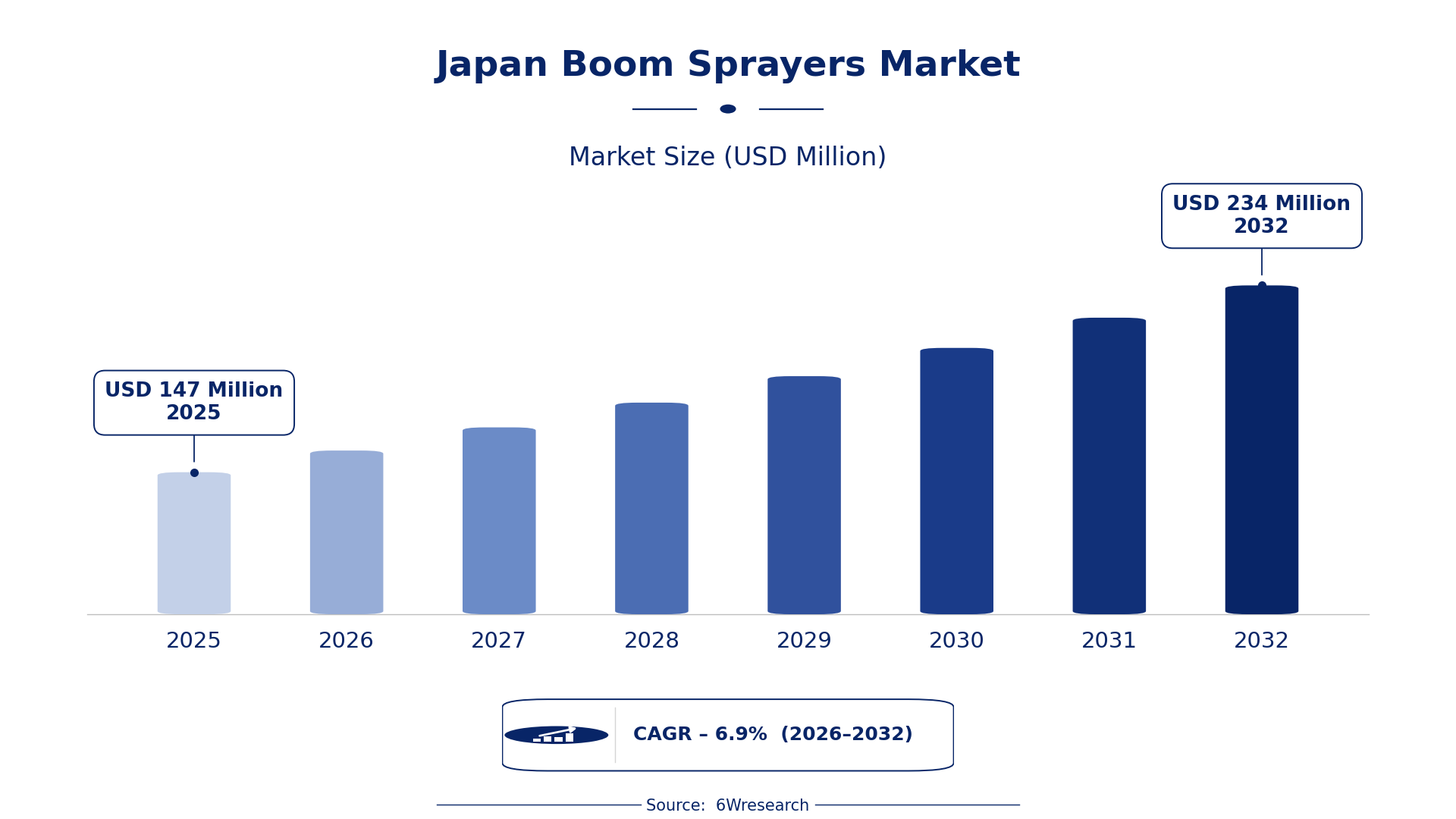
According to 6Wresearch internal database and industry insights, the Japan Boom Sprayers Market was valued at USD 147 Million in 2025 and is projected to reach USD 234 Million by 2032, growing at a CAGR of approximately 6.9% during 2026–2032.
Japan Boom Sprayers Market Highlights
| Report Metric | Details |
| Report Name | Japan Boom Sprayers Market (2026-2032) |
| Market Size 2025 | USD 147 Million |
| Market Size 2032 | USD 234 Million |
| Absolute Growth 2025–2032 | USD 87 Million |
| CAGR 2026–2032 | 6.9% |
| Peak Annual Growth | 7.2% in 2031 |
| Forecast Period | 2026–2032 |
| Historical Data | 2022–2025 |
| Base Year | 2025 |
| Leading Product Type, 2025 | Self-Propelled Boom Sprayers (35% share) |
| Leading Spray Type, 2025 | Liquid (52% share) |
| Leading Application Area, 2025 | Large-Scale Agriculture (42% share) |
| Leading Distribution Channel, 2025 | Direct Sales (47% share) |
| Leading End User, 2025 | Farms & Plantations (43% share) |
| Fastest-Growing Product Type | Hydraulic Boom Sprayers (9.4% CAGR) |
| Fastest-Growing Spray Type | Motorized (9.6% CAGR) |
| Fastest-Growing Application Area | Crop Protection (8.4% CAGR) |
| Fastest-Growing Distribution Channel | OEM Channels (8.9% CAGR) |
| Fastest-Growing End User | Agrochemical Companies (8.8% CAGR) |
| Growing Sector | Agriculture |
| Key End Users | Farms & Plantations, Agrochemical Companies, Agricultural Enterprises |
Japan Boom Sprayers Market Year-wise Growth Rate and Key Drivers (2022–2032)
This graph illustrates the annual growth rates of the market from 2022 to 2032, highlighting a steady upward trajectory and projected market expansion over the forecast period.
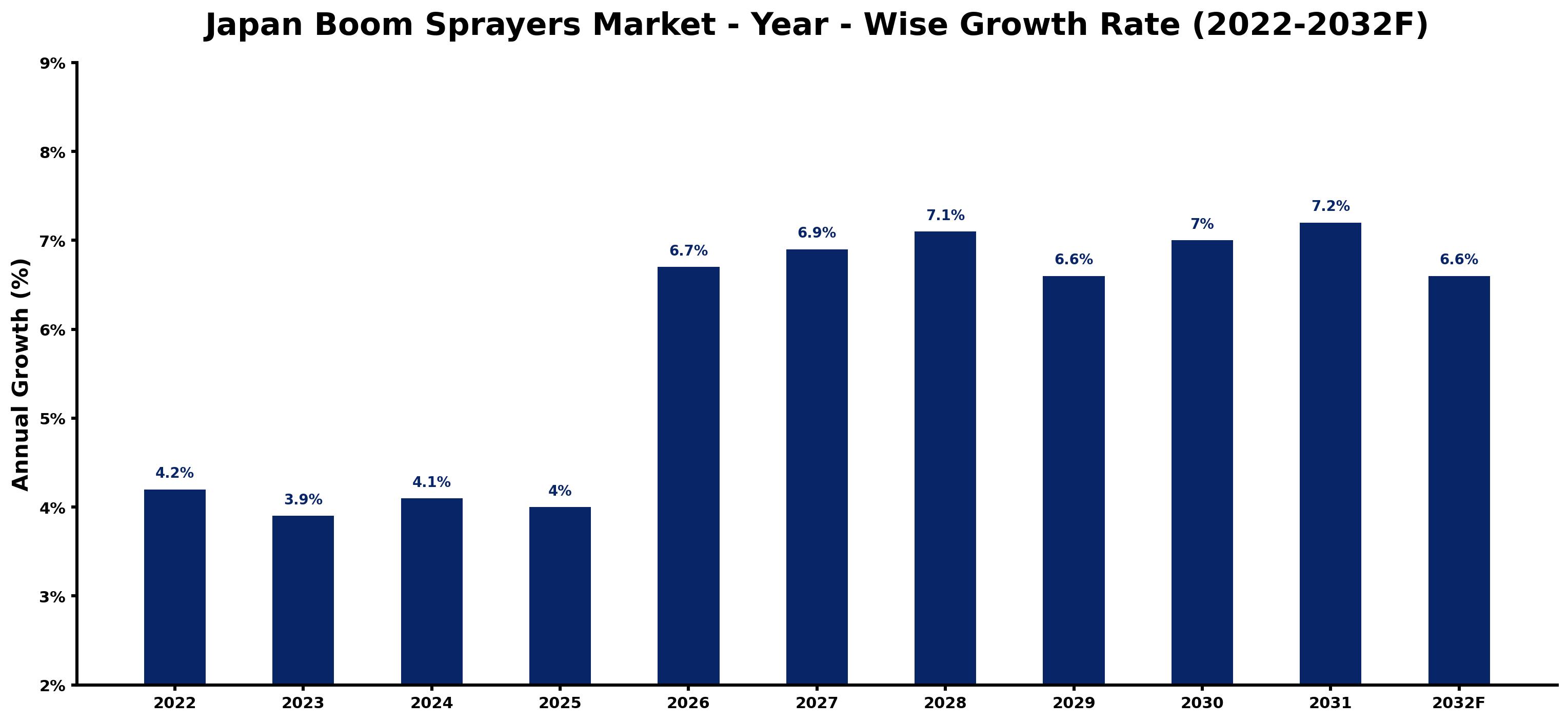
The table below sets out the estimated growth rate for each year and the main factor behind it.
| Year | Estimated Annual Growth (%) | Market Rationale |
| 2022 | 4.2 | The market experienced stable growth due to consistent agricultural practices across Japan. |
| 2023 | 3.9 | Growth slowed slightly as farmers adjusted to changing weather patterns impacting crop yields. |
| 2024 | 4.1 | Increased adoption of advanced spraying technologies boosted growth rates as farmers sought efficiency. |
| 2025 | 4.0 | Market growth slowed again as producers faced challenges in sourcing materials for equipment. |
| 2026 | 6.7 | Investment in modernizing agricultural practices is expected to lead to a resurgence in demand for boom sprayers. |
| 2027 | 6.9 | Rising interest in sustainable farming practices will drive demand for efficient spraying solutions. |
| 2028 | 7.1 | Technological advancements in sprayer design are projected to contribute to higher growth rates in the market. |
| 2029 | 6.6 | Growth is expected to slow as market saturation begins to impact new equipment purchases. |
| 2030 | 7.0 | Increased government support for modern agricultural equipment will spur renewed interest in boom sprayers. |
| 2031 | 7.2 | The market is projected to peak as farmers invest heavily in new technology to improve productivity. |
| 2032 | 6.6 | Growth will slow as the market stabilises following the peak investment phase. |
Note: Market size estimations and growth projections presented in this report are based on 6Wresearch's proprietary forecasting methodology, utilizing the latest available industry data, government publications, and primary research inputs.
Japan Boom Sprayers Market Synopsis
Boom sprayers are essential agricultural equipment used for applying pesticides and fertilizers efficiently over large fields. The Japan Boom Sprayers Market is driven by the need for high-quality produce, with the agriculture sector valued at approximately 8 trillion yen. The growing focus on sustainable farming practices and the adoption of advanced spraying technologies are key factors contributing to the market's expansion. The Tohoku region, known for its large-scale agriculture, highlights the rising demand for boom sprayers as producers seek to improve productivity and crop protection.
Market Dynamics Impact Analysis (2026–2032)
| Factor | Type | Impact | Primary Segment Affected |
| Growing adoption of self-propelled boom sprayers for large-scale applications. | Driver | High | Self-Propelled Boom Sprayers |
| Increased focus on crop protection to maintain agricultural productivity. | Driver | High | Crop Protection |
| Modernization of agricultural practices creates demand for advanced spraying equipment. | Opportunity | High | Hydraulic Boom Sprayers |
| Rising interest in sustainable farming practices drives investment in efficient technologies. | Opportunity | Medium | Liquid |
| High costs associated with advanced sprayer technologies limit access for small farmers. | Restraint | High | Hydraulic Boom Sprayers |
| Market saturation in certain regions leads to slower growth in equipment purchases. | Restraint | Medium | Self-Propelled Boom Sprayers |
| Rising material costs for manufacturing boom sprayers impact overall pricing. | Challenge | High | Pneumatic Boom Sprayers |
| Technological advancements require continuous investment, posing challenges for smaller producers. | Challenge | Medium | Motorized |
Evaluation of Drivers in Japan Boom Sprayers Market (2026–2032)
The table below links each growth driver to the segment it affects and the evidence for it.
| Drivers | Primary Segment Affected | Why It Matters (Evidence) |
| Investment in self-propelled boom sprayers improves operational efficiency. | Self-Propelled Boom Sprayers | In 2023, demand surged as farmers sought to reduce manual labour and increase productivity. |
| Focus on crop protection drives purchases of hydraulic boom sprayers. | Hydraulic Boom Sprayers | Approximately 60% of boom sprayers used in Japan are liquid types, essential for effective pesticide application. |
| Government initiatives promote modern agricultural practices, boosting sprayer sales. | Liquid | In 2023, the government allocated 1 billion yen to support sustainable farming, increasing equipment demand. |
| Technological advancements in sprayer design improve application precision. | Pneumatic Boom Sprayers | Farmers are increasingly investing in precise application technologies to improve crop yields. |
| Growing interest in sustainable agriculture boosts demand for efficient spraying solutions. | Crop Protection | The agricultural sector's value of 8 trillion yen reflects the need for effective crop management. |
What keeps demand rising is the growing investment in self-propelled boom sprayers, as farmers strive to boost productivity. In 2023, about 60% of boom sprayers in Japan were liquid types, crucial for effective pesticide application. Technological progress in sprayer design has refined application precision, resulting in higher adoption rates among producers. The agricultural sector, valued at 8 trillion yen, highlights the urgent need for effective crop protection solutions, propelling purchases of hydraulic boom sprayers.
Evaluation of Restraints in Japan Boom Sprayers Market
Several factors work against faster growth; the main ones are summarised below.
| Market Restraint | Primary Segment Affected | Why It Matters (Evidence) |
| High costs of advanced sprayer technologies limit accessibility for small farmers. | Hydraulic Boom Sprayers | In 2022, over 1.5 million farms faced challenges in upgrading equipment due to financial constraints. |
| Market saturation in certain regions leads to slower growth in equipment purchases. | Self-Propelled Boom Sprayers | The average size of a Japanese farm is around 1.5 hectares, limiting expansion opportunities. |
| Rising material costs for manufacturing impact overall pricing of boom sprayers. | Pneumatic Boom Sprayers | In 2023, material costs increased, affecting affordability for producers. |
| Limited availability of skilled labour affects operational efficiency in large-scale agriculture. | Motorized | The agricultural sector struggles to attract and retain skilled workers, impacting productivity. |
| Regulatory compliance costs for safety standards increase operational expenses. | Liquid | The JIS B 9920 standard requires rigorous testing, adding to the financial burden on producers. |
Japan Boom Sprayers Market Challenges
High costs associated with advanced technology deter buyers from upgrading boom sprayers, with new models exceeding 5 million yen, limiting productivity improvements for farmers. Suppliers encounter difficulties due to the JIS B 9920 standard, which can postpone product launches by six months, affecting their capacity to satisfy market demand. Rising raw material costs, especially for steel, have escalated production expenses for suppliers, leading to higher prices that discourage buyers from investing in new equipment. Supply chain disruptions in the Tohoku region can delay deliveries by weeks, complicating farmers' operational planning and crop management.
Trends in the Japan Boom Sprayers Market
The following changes are redrawing the Japan Boom Sprayers Market.
- Shift from Manual to Self-Propelled Boom Sprayers: In Japan, farmers are increasingly transitioning from manual to self-propelled boom sprayers to improve efficiency. In 2023, self-propelled models accounted for a notable share of new equipment sales, reflecting the demand for reduced manual labour.
- Growing Emphasis on Crop Protection Technologies: The focus on crop protection is intensifying, with hydraulic boom sprayers being adopted widely. In 2022, approximately 60% of boom sprayers used were liquid types, highlighting the trend towards effective pesticide application.
- Increased Adoption of Sustainable Practices: Farms and plantations are prioritising sustainable agricultural practices, driving demand for efficient spraying solutions. Initiatives from the Ministry of Agriculture have led to a notable increase in investment in modern equipment.
- Increased Funding for Agricultural Research: The Japanese government is increasing funding for agrochemical research, which is essential for improving crop protection methods. In 2023, 1 billion yen was allocated for modernizing agricultural equipment, supporting productivity.
Investment Opportunities in the Japan Boom Sprayers Market
Below are the investment opportunities with the strongest case in the Japan Boom Sprayers Market.
- 1 Billion Yen Investment for Modernization: The Japanese government allocated 1 billion yen in 2023 for modernizing agricultural equipment, creating an opportunity for suppliers to meet demand. This funding supports farms in the Tohoku region, encouraging partnerships with local manufacturers.
- Growing Demand for Efficient Spraying Solutions: With Japan's agricultural sector valued at 8 trillion yen, there is a pressing need for efficient spraying technologies. Suppliers can target large-scale agriculture operations in the Kanto region to meet this demand.
- Rising Interest in Sustainable Agriculture: The increasing focus on sustainable farming practices presents opportunities for suppliers of advanced boom sprayers. Agrochemical companies are actively seeking effective solutions to improve productivity and crop health.
- Expansion of Direct Sales Channels: The direct sales channel, accounting for 47% of distribution, offers a prime opportunity for suppliers. Establishing partnerships with local distributors can facilitate market entry and expand reach.
Government Initiatives in the Japan Boom Sprayers Market
Producers of boom sprayers must comply with the Chemical Substances Control Law, which requires evaluation and control of chemical substances. This ensures safety and compliance, impacting manufacturers' operational standards and increasing the need for rigorous testing and certification.
In 2023, the Ministry of Agriculture, Forestry and Fisheries allocated 1 billion yen for modernizing agricultural equipment, administered by the Agricultural Machinery Manufacturers Association. This funding supports producers in upgrading their technologies and improving operational efficiency.
Future Insight of the Japan Boom Sprayers Market
Investment in agricultural equipment modernisation will stimulate demand for advanced boom sprayers, prompting suppliers to innovate and refine product offerings. The rising popularity of self-propelled boom sprayers will drive advancements in design and efficiency. Increased government support for agrochemical research will produce more effective solutions for farmers, ultimately boosting crop yields. A heightened focus on sustainable farming practices will align with national initiatives, shaping future equipment development and usage.
Market Segmentation Analysis
Japan Boom Sprayers Market report covers a detailed analysis of the following market segments:
By Product Type – Self-Propelled Boom Sprayers Lead, Hydraulic Boom Sprayers Expected to Grow Fastest
According to Vasu Joshi, Associate Consultant at 6Wresearch, Self-Propelled Boom Sprayers held 35% of the Japan Boom Sprayers Market by product type in 2025. Self-propelled boom sprayers hold the largest share as they are essential for large-scale applications, enabling farmers to efficiently cover extensive fields. Their widespread use in the Tohoku region underscores their importance in modern agricultural practices. Hydraulic Boom Sprayers are projected to grow fastest, at a CAGR of 9.4% during 2026–2032. Hydraulic boom sprayers are experiencing rapid growth due to their efficiency in liquid application, which is crucial for maintaining productivity in vast fields. The increasing focus on sustainable farming practices is expected to further enhance their adoption among farmers. Suppliers must ensure a robust supply of hydraulic boom sprayers to meet the growing demand.
By Spray Type – Liquid Leads, Motorized Expected to Grow Fastest
Liquid accounted for 52% of the market by spray type in 2025. Liquid spray types dominate the market as they are the most common method for applying pesticides and fertilizers, which are vital for effective crop management. This trend is particularly evident across Japan's agricultural landscape, which encompasses over 1.5 million farms. The quickest growth will come from Motorized, forecast to expand at a CAGR of 9.6% between 2026 and 2032. Motorized spray types are rapidly gaining popularity due to their efficiency in large farms, allowing for quicker and more uniform application of agrochemicals. The ongoing push for modernisation in agricultural practices is likely to accelerate this trend. Buyers should consider motorized options to improve their application efficiency.
By Application Area – Large-Scale Agriculture Leads, Crop Protection Expected to Grow Fastest
The largest application area category in 2025 was Large-Scale Agriculture, at 42% of revenue. Large-scale agriculture is the primary application area for boom sprayers, representing a substantial user base that requires effective crop management solutions. The operational scale in regions like Tohoku necessitates the use of these sprayers to achieve optimal productivity. Over 2026–2032, Crop Protection is expected to post the fastest growth, at a CAGR of 8.4%. Crop protection is the fastest-growing application area, driven by the urgent need to maintain crop health in response to rising pest pressures. The government's commitment to sustainable farming practices further supports this growth trajectory. Suppliers should prioritise crop protection solutions to align with market demands.
By Distribution Channel – Direct Sales Leads, OEM Channels Expected to Grow Fastest
In 2025, Direct Sales led the distribution channel split with a 47% share. Direct sales are the leading distribution method for boom sprayers, allowing manufacturers to engage directly with farmers and ensure proper equipment usage. This approach is particularly effective in regions with a high concentration of agricultural operations. OEM Channels are set to record the highest CAGR in this split, 8.9% over 2026–2032. OEM channels are expanding rapidly as they meet the specialised equipment needs of large agricultural operations. This trend reflects the increasing demand for tailored solutions within the market. Suppliers should strengthen OEM partnerships to capitalise on emerging opportunities.
By End User – Farms & Plantations Lead, Agrochemical Companies Expected to Grow Fastest
Farms & Plantations took 43% of end user revenue in 2025, more than any other category. Farms and plantations represent the largest end user group for boom sprayers, extensively utilising these tools to enhance productivity and effectively manage crops. Their significant presence within Japan's agricultural sector highlights the importance of this segment. Agrochemical Companies are projected to grow fastest, at a CAGR of 8.8% during 2026–2032. Agrochemical companies are the fastest-growing end user segment, relying on boom sprayers for efficient product application across diverse agricultural settings. Ongoing support for agrochemical research is further driving this demand. Suppliers should focus on building relationships with agrochemical companies to leverage growth opportunities.
Key Attractiveness of the Report
- 10 Years of Market Numbers
- Historical Data Starting from 2022 to 2025
- Base Year 2025
- Forecast Data until 2032
- Key Performance Indicators Impacting the Market
- Major Upcoming Developments and Projects
Key Highlights of the Report:
- Japan Boom Sprayers Market Outlook
- Market Size of Japan Boom Sprayers Market, 2025
- Forecast of Japan Boom Sprayers Market, 2032
- Historical Data and Forecast of Japan Boom Sprayers Market Revenues & Volume for the Period 2022-2032F
- Japan Boom Sprayers Market Trend Evolution
- Japan Boom Sprayers Market Drivers and Challenges
- Japan Boom Sprayers Market Price Trends
- Japan Boom Sprayers Market Porter's Five Forces
- Japan Boom Sprayers Market Industry Life Cycle
- Historical Data and Forecast of Japan Boom Sprayers Market Revenues & Volume By Product Type for the Period 2022-2032F
- Historical Data and Forecast of Japan Boom Sprayers Market Revenues & Volume By Hydraulic Boom Sprayers for the Period 2022-2032F
- Historical Data and Forecast of Japan Boom Sprayers Market Revenues & Volume By Pneumatic Boom Sprayers for the Period 2022-2032F
- Historical Data and Forecast of Japan Boom Sprayers Market Revenues & Volume By Foldable Boom Sprayers for the Period 2022-2032F
- Historical Data and Forecast of Japan Boom Sprayers Market Revenues & Volume By Self-Propelled Boom Sprayers for the Period 2022-2032F
- Historical Data and Forecast of Japan Boom Sprayers Market Revenues & Volume By Spray Type for the Period 2022-2032F
- Historical Data and Forecast of Japan Boom Sprayers Market Revenues & Volume By Liquid for the Period 2022-2032F
- Historical Data and Forecast of Japan Boom Sprayers Market Revenues & Volume By Air-Assisted for the Period 2022-2032F
- Historical Data and Forecast of Japan Boom Sprayers Market Revenues & Volume By Manual for the Period 2022-2032F
- Historical Data and Forecast of Japan Boom Sprayers Market Revenues & Volume By Motorized for the Period 2022-2032F
- Historical Data and Forecast of Japan Boom Sprayers Market Revenues & Volume By Application Area for the Period 2022-2032F
- Historical Data and Forecast of Japan Boom Sprayers Market Revenues & Volume By Agriculture for the Period 2022-2032F
- Historical Data and Forecast of Japan Boom Sprayers Market Revenues & Volume By Crop Protection for the Period 2022-2032F
- Historical Data and Forecast of Japan Boom Sprayers Market Revenues & Volume By Greenhouses for the Period 2022-2032F
- Historical Data and Forecast of Japan Boom Sprayers Market Revenues & Volume By Large-Scale Agriculture for the Period 2022-2032F
- Historical Data and Forecast of Japan Boom Sprayers Market Revenues & Volume By Distribution Channel for the Period 2022-2032F
- Historical Data and Forecast of Japan Boom Sprayers Market Revenues & Volume By Direct Sales for the Period 2022-2032F
- Historical Data and Forecast of Japan Boom Sprayers Market Revenues & Volume By OEM Channels for the Period 2022-2032F
- Historical Data and Forecast of Japan Boom Sprayers Market Revenues & Volume By Industrial Suppliers for the Period 2022-2032F
- Historical Data and Forecast of Japan Boom Sprayers Market Revenues & Volume By Specialty Distributors for the Period 2022-2032F
- Historical Data and Forecast of Japan Boom Sprayers Market Revenues & Volume By End User for the Period 2022-2032F
- Historical Data and Forecast of Japan Boom Sprayers Market Revenues & Volume By Farms & Plantations for the Period 2022-2032F
- Historical Data and Forecast of Japan Boom Sprayers Market Revenues & Volume By Agrochemical Companies for the Period 2022-2032F
- Historical Data and Forecast of Japan Boom Sprayers Market Revenues & Volume By Horticulture Farms for the Period 2022-2032F
- Historical Data and Forecast of Japan Boom Sprayers Market Revenues & Volume By Agricultural Enterprises for the Period 2022-2032F
- Japan Boom Sprayers Market Import Export Trade Statistics
- Market Opportunity Assessment By Product Type
- Market Opportunity Assessment By Spray Type
- Market Opportunity Assessment By Application Area
- Market Opportunity Assessment By Distribution Channel
- Market Opportunity Assessment By End User
- Japan Boom Sprayers Market Top Companies Market Share
- Japan Boom Sprayers Market Competitive Benchmarking By Technical and Operational Parameters
- Japan Boom Sprayers Market Company Profiles
- Japan Boom Sprayers Market Key Strategic Recommendations
Market Covered
The study includes the following segmentation.
By Product Type
- Hydraulic Boom Sprayers
- Pneumatic Boom Sprayers
- Foldable Boom Sprayers
- Self-Propelled Boom Sprayers
By Spray Type
- Liquid
- Air-Assisted
- Manual
- Motorized
By Application Area
- Agriculture
- Crop Protection
- Greenhouses
- Large-Scale Agriculture
By Distribution Channel
- Direct Sales
- OEM Channels
- Industrial Suppliers
- Specialty Distributors
By End User
- Farms & Plantations
- Agrochemical Companies
- Horticulture Farms
- Agricultural Enterprises






































