Japan Building Integrated Photovoltaics (BIPV) Market Size & Growth Rate
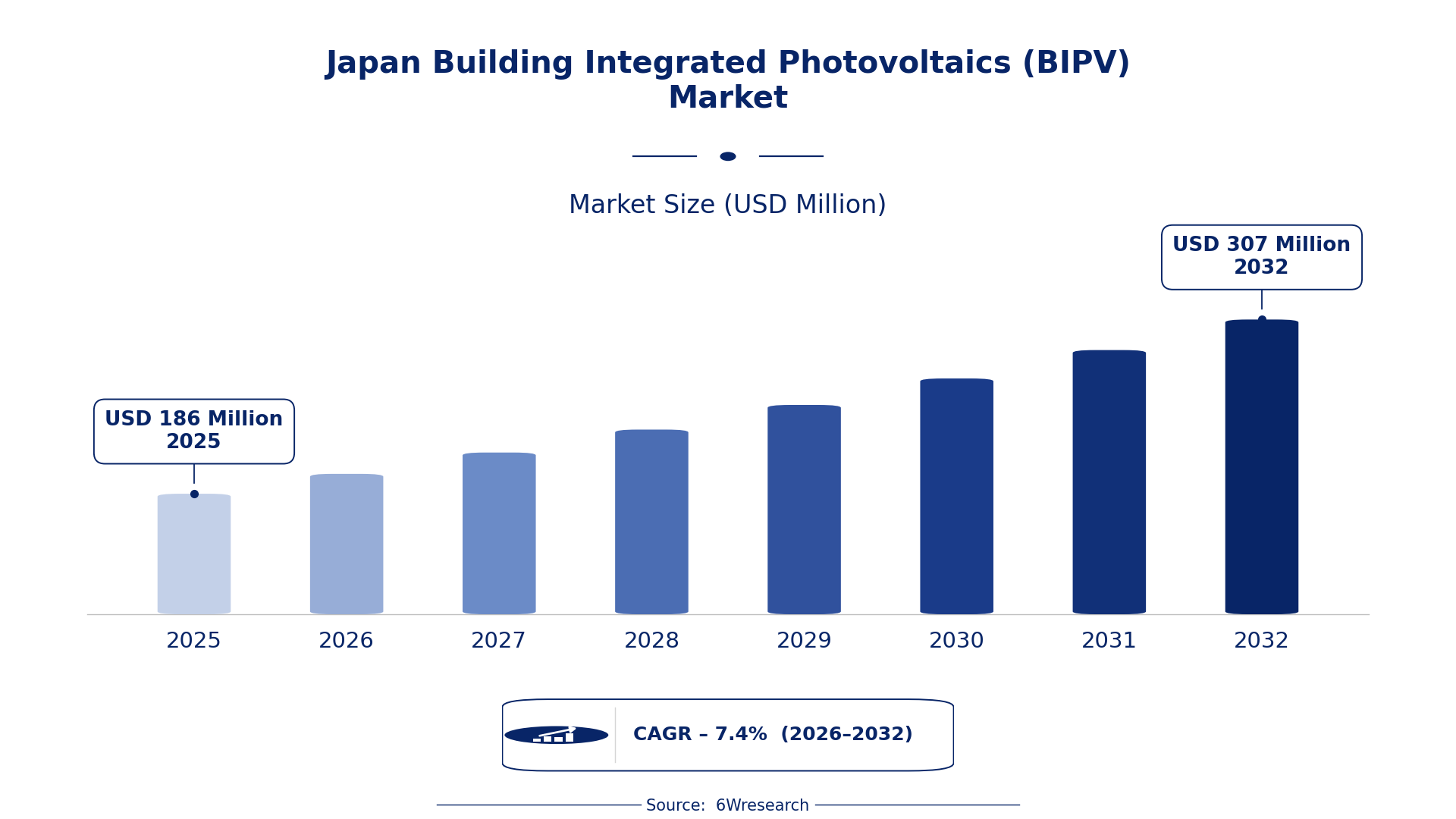
According to 6Wresearch internal database and industry insights, the Japan Building Integrated Photovoltaics (BIPV) Market was valued at USD 186 Million in 2025 and is projected to reach USD 307 Million by 2032, growing at a CAGR of approximately 7.4% during 2026–2032.
Japan Building Integrated Photovoltaics (BIPV) Market Highlights
| Report Metric | Details |
| Report Name | Japan Building Integrated Photovoltaics (BIPV) Market (2026-2032) |
| Market Size 2025 | USD 186 Million |
| Market Size 2032 | USD 307 Million |
| Absolute Growth 2025–2032 | USD 121 Million |
| CAGR 2026–2032 | 7.4% |
| Peak Annual Growth | 8.6% in 2028 |
| Forecast Period | 2026–2032 |
| Historical Data | 2022–2025 |
| Base Year | 2025 |
| Leading Technology, 2025 | Crystalline silicon (50% share) |
| Leading Application, 2025 | Roofs (36% share) |
| Leading End Use, 2025 | Residential (59% share) |
| Fastest-Growing Technology | Thin film (9.9% CAGR) |
| Fastest-Growing Application | Walls (9.8% CAGR) |
| Fastest-Growing End Use | Commercial (9.2% CAGR) |
| Growing Sector | Residential |
| Key End Users | homeowners, commercial builders, construction firms, urban developers |
Japan Building Integrated Photovoltaics (BIPV) Market Year-wise Growth Rate and Key Drivers (2022–2032)
This graph illustrates the annual growth rates of the market from 2022 to 2032, highlighting a steady upward trajectory and projected market expansion over the forecast period.
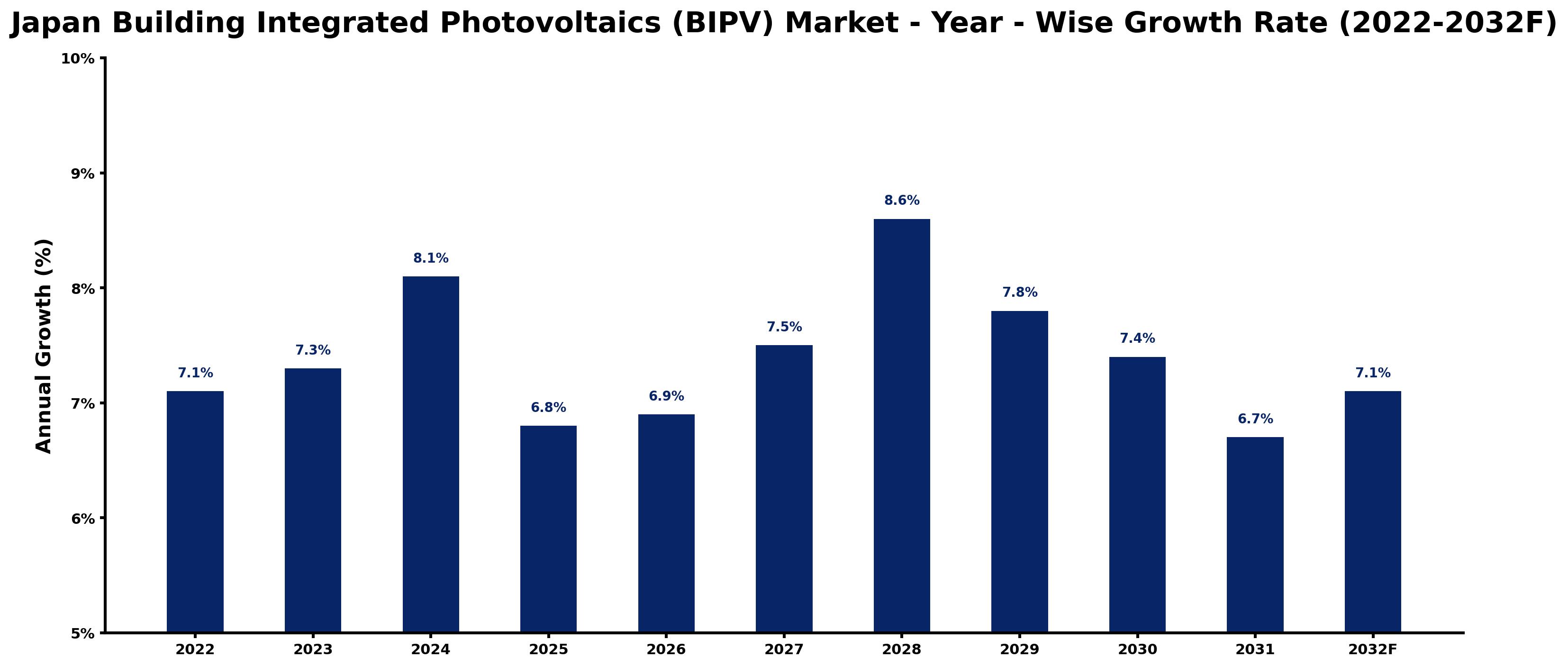
The following figures match every annual growth estimate with the main market development of that year, giving the reasoning behind each rise or slowdown.
| Year | Estimated Annual Growth (%) | Market Rationale |
| 2022 | 7.1 | The market showed steady growth with established demand from ongoing construction projects. |
| 2023 | 7.3 | Demand increased as more residential users adopted BIPV for energy savings. |
| 2024 | 8.1 | Growth accelerated due to heightened awareness of renewable energy benefits. |
| 2025 | 6.8 | The market experienced a slowdown as some projects faced delays. |
| 2026 | 6.9 | Demand is expected to rise again as new subsidies for BIPV installations are introduced. |
| 2027 | 7.5 | Increased energy costs will prompt more buyers to invest in BIPV solutions. |
| 2028 | 8.6 | The market is projected to peak as major urban projects boost installations. |
| 2029 | 7.8 | Growth is expected to slow slightly as the market begins to stabilise after rapid expansion. |
| 2030 | 7.4 | Demand will continue to rise, supported by urban development initiatives. |
| 2031 | 6.7 | The market is projected to experience a slowdown as competition intensifies among suppliers. |
| 2032 | 7.1 | Growth is expected to pick up again as technology advancements improve efficiency. |
Note: Market size estimations and growth projections presented in this report are based on 6Wresearch's proprietary forecasting methodology, utilizing the latest available industry data, government publications, and primary research inputs.
Japan Building Integrated Photovoltaics (BIPV) Market Synopsis
Building Integrated Photovoltaics (BIPV) are solar technologies embedded in building materials, enabling structures to generate electricity while maintaining aesthetic appeal. The Japan Building Integrated Photovoltaics (BIPV) Market is growing due to rising energy needs and sustainability initiatives. The residential sector accounts for 40% of demand, while government measures like the 'Green Building Program' are driving new installations. With a target to cut greenhouse-gas emissions by 46% by 2030, BIPV adoption is expected to increase as urban projects expand.
Market Dynamics Impact Analysis (2026–2032)
| Factor | Type | Impact | Primary Segment Affected |
| Growing urbanisation and energy needs drive demand for BIPV solutions. | Driver | High | Residential |
| Government incentives boost demand for sustainable building practices. | Driver | High | Commercial |
| High initial costs deter residential buyers from adopting BIPV systems. | Restraint | High | Residential |
| Limited awareness of BIPV technology hampers its adoption in commercial buildings. | Restraint | Medium | Commercial |
| Regulatory hurdles can complicate the installation process for BIPV. | Challenge | Medium | Commercial |
| Competition from traditional energy sources limits BIPV market growth. | Challenge | High | Residential |
| Supply chain disruptions affect the availability of BIPV materials. | Restraint | High | Residential |
| Technological advancements are needed to improve efficiency and reduce costs. | Challenge | Medium | Commercial |
Evaluation of Drivers in Japan Building Integrated Photovoltaics (BIPV) Market (2026–2032)
Below are the drivers that matter most for revenue growth, with supporting evidence.
| Drivers | Primary Segment Affected | Why It Matters (Evidence) |
| Rising energy costs encourage homeowners to invest in BIPV systems. | Residential | In 2023, BIPV systems can reduce energy costs by up to 50% for residential users. |
| Urban development projects create new opportunities for BIPV installations. | Residential | Tokyo has over 300 BIPV projects, reflecting urban energy needs. |
| Technological advancements improve the efficiency of BIPV systems. | Commercial | Updated JIS standards in 2023 improve safety and performance for BIPV materials. |
| Growing public awareness of climate change drives BIPV adoption. | Residential | Japan targets a 46% cut in greenhouse-gas emissions by 2030, increasing demand. |
| Government incentives boost demand for sustainable building practices. | Commercial | The 'Green Building Program' promotes BIPV, leading to increased installations. |
Buyers are adding capacity as Japan's installed BIPV capacity reached 1,200 MW in 2022, which spurred interest in energy-efficient solutions. The residential sector accounts for 40% of demand, as homeowners seek to reduce energy costs. Incentives for sustainable practices further encourage the adoption of these technologies. Updated safety standards in 2023 improve the performance of BIPV materials, prompting more commercial buyers to invest in these systems. Urban areas are leading the way in installations, reflecting a strong shift towards renewable energy solutions.
Evaluation of Restraints in Japan Building Integrated Photovoltaics (BIPV) Market
Several factors work against faster growth; the main ones are summarised below.
| Market Restraint | Primary Segment Affected | Why It Matters (Evidence) |
| High initial costs deter residential buyers from adopting BIPV systems. | Residential | Installation costs can be a barrier, limiting market penetration among homeowners. |
| Limited awareness of BIPV technology hampers its adoption in commercial buildings. | Commercial | Many potential buyers lack knowledge about the benefits and functionality of BIPV. |
| Regulatory hurdles can complicate the installation process for BIPV. | Commercial | Complex approval processes may deter some developers from pursuing BIPV projects. |
| Competition from traditional energy sources limits BIPV market growth. | Residential | Conventional energy solutions often present lower upfront costs compared to BIPV. |
| Supply chain disruptions affect the availability of BIPV materials. | Residential | Delays in material supply can postpone installation timelines for new projects. |
Japan Building Integrated Photovoltaics (BIPV) Market Challenges
Buyers face high upfront costs for BIPV installations, which can deter adoption despite potential energy savings of up to 50%. Producers must adhere to updated JIS standards for BIPV materials, requiring extensive testing that delays product launches and raises costs. Importers encounter lengthy approval processes due to strict regulations from the Ministry of the Environment, leading to stock shortages that hinder their ability to meet market demand. Competition intensifies as Tokyo aims for a 30% increase in BIPV installations by 2025, pressuring suppliers to innovate rapidly or risk losing market share.
Trends in the Japan Building Integrated Photovoltaics (BIPV) Market
The shifts below are changing how Japan Building Integrated Photovoltaics (BIPV) Market products are bought and supplied.
- Shift from Traditional Roofs to BIPV Solutions: In 2023, the trend towards BIPV solutions gained traction as residential users sought energy efficiency. Tokyo's projects reflect this shift, with a target to increase installations by 30% by 2025.
- Emergence of Urban Sustainability Initiatives: The 'Green Building Program' launched in 2023 promotes renewable energy technologies, including BIPV. This initiative aims to integrate BIPV into urban planning, improving energy sustainability.
- Transition from Conventional Materials to Integrated Technologies: As of 2023, the adoption of integrated technologies in building materials is on the rise. The updated JIS standards for BIPV materials reflect this shift towards improved safety and efficiency.
- Growing Demand for Aesthetic Energy Solutions: The integration of BIPV into building facades is becoming popular, driven by aesthetic considerations. This trend is apparent in urban developments across Japan, enhancing building designs.
Investment Opportunities in the Japan Building Integrated Photovoltaics (BIPV) Market
The opportunities below stand out in the Japan Building Integrated Photovoltaics (BIPV) Market for new entrants and existing suppliers.
- Gap in Energy Efficiency Solutions: With Japan's energy needs increasing, there is a gap for BIPV solutions. The residential sector, accounting for 40% of demand, presents an opportunity for investment in new technologies.
- Collaborations for Urban Development Projects: Now is the time to partner with local developers in urban areas to supply BIPV solutions. Tokyo's ongoing construction projects create a timely entry point for new suppliers.
- Investment in Research and Development: The demand for improved efficiency in BIPV systems creates an opportunity for R&D investments. Collaborating with academic institutions can facilitate technology adoption in commercial buildings.
- Expansion of Government Subsidy Programs: With a ¥10 billion budget for BIPV installations in 2023, there is an opportunity to supply materials and services. Engaging with local governments can facilitate access to these funds.
Government Initiatives in the Japan Building Integrated Photovoltaics (BIPV) Market
The Building Energy Efficiency Act, amended in 2022, mandates that all new buildings meet energy standards from April 2025. This requirement compels builders to incorporate energy-efficient technologies, including BIPV, into their designs, promoting wider adoption among producers and buyers alike. The GX Basic Policy, adopted in 2023, aims for approximately JPY 150 trillion in public-private decarbonisation investment over the next decade, enhancing the market for BIPV solutions.
The Ministry of the Environment oversees the implementation of the 'Green Building Program', which funds projects that integrate BIPV technologies. This program aims to promote sustainable building practices and has allocated significant resources to support BIPV installations across Japan. The Tokyo Metropolitan Government's initiative to increase BIPV installations by 30% by 2025 reflects the commitment to improving urban energy efficiency.
Future Insight of the Japan Building Integrated Photovoltaics (BIPV) Market
By 2032, advancements in solar technology will transform demand for BIPV, as the government prioritises renewable energy initiatives. The new subsidy program, with a budget of ¥10 billion, will support installations, making BIPV more accessible for users. Updated safety standards will enhance consumer trust, resulting in increased project approvals. As Tokyo accelerates its installation targets, suppliers must adapt swiftly to changing requirements and improve their offerings to remain competitive.
Market Segmentation Analysis
Japan Building Integrated Photovoltaics (BIPV) Market report covers a detailed analysis of the following market segments:
By Technology – Crystalline silicon Leads, Thin film Expected to Grow Fastest
According to Ravi Bhandari, Research Head at 6Wresearch, the largest technology category in 2025 was Crystalline silicon, at 50% of revenue. Crystalline silicon technology holds the largest share due to its efficiency and extensive use in diverse building types across Japan. This technology is particularly prevalent in urban areas, where energy generation demands are high, with numerous installations in Tokyo. Thin film is set to record the highest CAGR in this split, 9.9% over 2026–2032. Thin film technology is witnessing rapid growth as it is increasingly applied in situations where traditional methods may not be suitable. The recent subsidy programme introduced in 2023 is expected to notably boost its adoption in specific markets. Suppliers should focus on enhancing the efficiency and versatility of thin film technology to capitalise on emerging market opportunities.
By Application – Roofs Lead, Walls Expected to Grow Fastest
Roofs accounted for 36% of the market by application in 2025. Roofs account for the largest share as they serve as the primary application for energy generation in both residential and commercial structures. The ongoing construction projects in urban areas like Tokyo reinforce this trend, highlighting roofs as a key focus for BIPV installations. The quickest growth will come from Walls, forecast to expand at a CAGR of 9.8% between 2026 and 2032. Walls are the fastest-growing application, fulfilling both energy generation and aesthetic enhancement roles. The increasing preference for visually appealing buildings in urban developments is significantly driving this growth. Buyers should consider wall-integrated BIPV solutions to optimise energy efficiency while enhancing the aesthetic appeal of their buildings.
By End Use – Residential Leads, Commercial Expected to Grow Fastest
With 59% of end use revenue in 2025, Residential was the largest category. The residential sector leads in demand due to a strong interest among homeowners in achieving energy savings and promoting sustainability. With 40% of BIPV demand originating from this segment, it reflects a robust trend towards energy self-sufficiency. Commercial is projected to grow fastest, at a CAGR of 9.2% during 2026–2032. The commercial sector is expanding rapidly as office buildings increasingly adopt BIPV for sustainability initiatives. This trend aligns with Japan's ambitious target of reducing greenhouse-gas emissions by 46% by 2030, driving further growth. Suppliers must tailor their offerings to meet the sustainability goals of commercial clients to effectively capture this growing market.
Key Attractiveness of the Report
- 10 Years of Market Numbers
- Historical Data Starting from 2022 to 2025
- Base Year 2025
- Forecast Data until 2032
- Key Performance Indicators Impacting the Market
- Major Upcoming Developments and Projects
Key Highlights of the Report:
- Japan Building Integrated Photovoltaics (BIPV) Market Outlook
- Market Size of Japan Building Integrated Photovoltaics (BIPV) Market, 2025
- Forecast of Japan Building Integrated Photovoltaics (BIPV) Market, 2032
- Historical Data and Forecast of Japan Building Integrated Photovoltaics (BIPV) Revenues & Volume for the Period 2022-2032
- Japan Building Integrated Photovoltaics (BIPV) Market Trend Evolution
- Japan Building Integrated Photovoltaics (BIPV) Market Drivers and Challenges
- Japan Building Integrated Photovoltaics (BIPV) Price Trends
- Japan Building Integrated Photovoltaics (BIPV) Porter's Five Forces
- Japan Building Integrated Photovoltaics (BIPV) Industry Life Cycle
- Historical Data and Forecast of Japan Building Integrated Photovoltaics (BIPV) Market Revenues & Volume By Technology for the Period 2022-2032
- Historical Data and Forecast of Japan Building Integrated Photovoltaics (BIPV) Market Revenues & Volume By Crystalline silicon for the Period 2022-2032
- Historical Data and Forecast of Japan Building Integrated Photovoltaics (BIPV) Market Revenues & Volume By Thin film for the Period 2022-2032
- Historical Data and Forecast of Japan Building Integrated Photovoltaics (BIPV) Market Revenues & Volume By Others for the Period 2022-2032
- Historical Data and Forecast of Japan Building Integrated Photovoltaics (BIPV) Market Revenues & Volume By Application for the Period 2022-2032
- Historical Data and Forecast of Japan Building Integrated Photovoltaics (BIPV) Market Revenues & Volume By Roofs for the Period 2022-2032
- Historical Data and Forecast of Japan Building Integrated Photovoltaics (BIPV) Market Revenues & Volume By Walls for the Period 2022-2032
- Historical Data and Forecast of Japan Building Integrated Photovoltaics (BIPV) Market Revenues & Volume By Glass for the Period 2022-2032
- Historical Data and Forecast of Japan Building Integrated Photovoltaics (BIPV) Market Revenues & Volume By Facade for the Period 2022-2032
- Historical Data and Forecast of Japan Building Integrated Photovoltaics (BIPV) Market Revenues & Volume By Others for the Period 2022-2032
- Historical Data and Forecast of Japan Building Integrated Photovoltaics (BIPV) Market Revenues & Volume By End Use for the Period 2022-2032
- Historical Data and Forecast of Japan Building Integrated Photovoltaics (BIPV) Market Revenues & Volume By Residential for the Period 2022-2032
- Historical Data and Forecast of Japan Building Integrated Photovoltaics (BIPV) Market Revenues & Volume By Commercial for the Period 2022-2032
- Historical Data and Forecast of Japan Building Integrated Photovoltaics (BIPV) Market Revenues & Volume By Industrial for the Period 2022-2032
- Japan Building Integrated Photovoltaics (BIPV) Import Export Trade Statistics
- Market Opportunity Assessment By Technology
- Market Opportunity Assessment By Application
- Market Opportunity Assessment By End Use
- Japan Building Integrated Photovoltaics (BIPV) Top Companies Market Share
- Japan Building Integrated Photovoltaics (BIPV) Competitive Benchmarking By Technical and Operational Parameters
- Japan Building Integrated Photovoltaics (BIPV) Company Profiles
- Japan Building Integrated Photovoltaics (BIPV) Key Strategic Recommendations
Market Covered
Segments analysed in this report are listed below.
By Technology
- Crystalline silicon
- Thin film
- Others
By Application
- Roofs
- Walls
- Glass
- Facade
- Others
By End Use
- Residential
- Commercial
- Industrial































