Japan Butyric Acid Market Size & Growth Rate
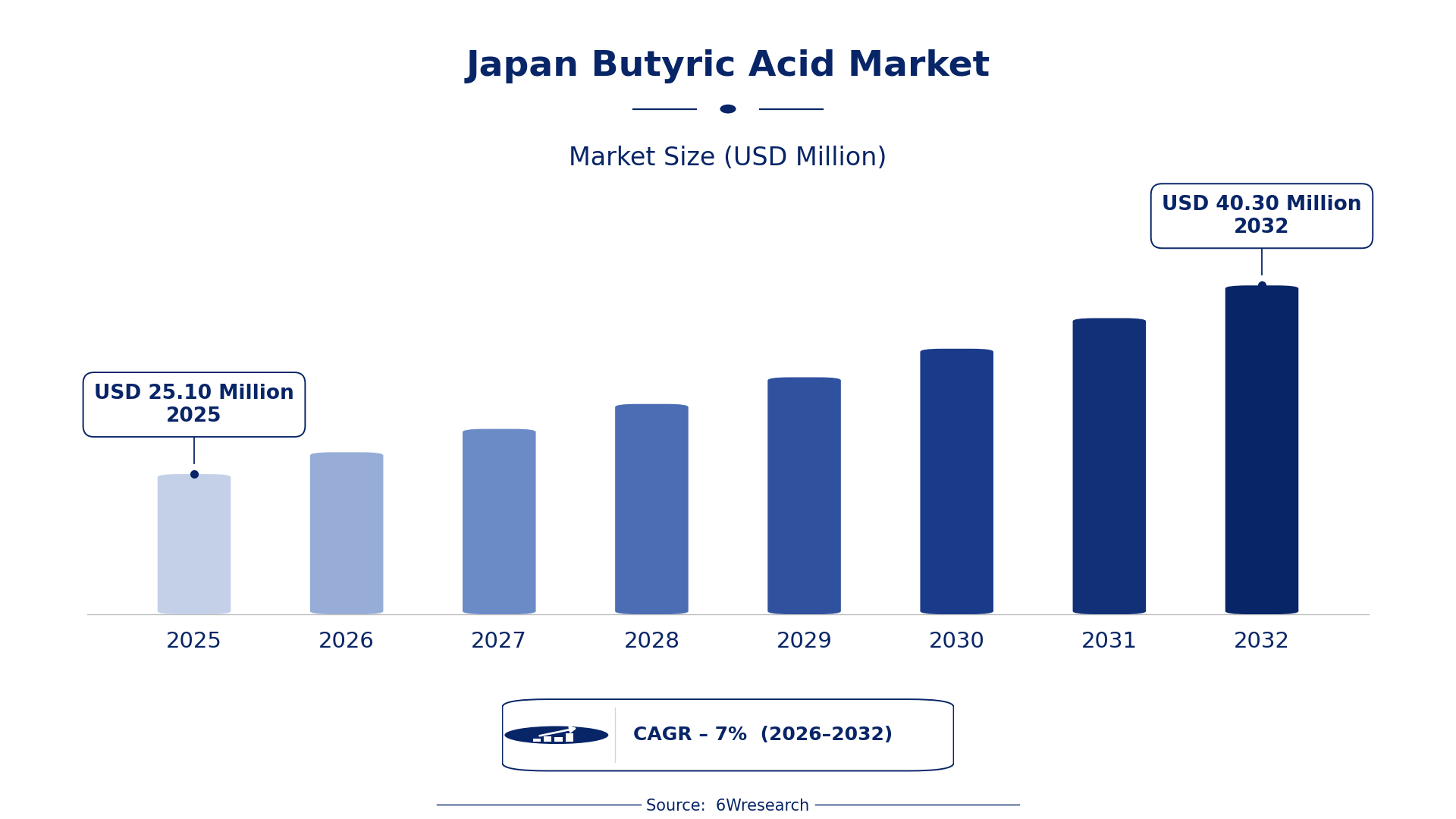
According to 6Wresearch internal database and industry insights, the Japan Butyric Acid Market was valued at USD 25.10 Million in 2025 and is projected to reach USD 40.30 Million by 2032, growing at a CAGR of approximately 7% during 2026–2032.
Japan Butyric Acid Market Highlights
| Report Metric | Details |
| Report Name | Japan Butyric Acid Market (2026-2032) |
| Market Size 2025 | USD 25.10 Million |
| Market Size 2032 | USD 40.30 Million |
| Absolute Growth 2025–2032 | USD 15.20 Million |
| CAGR 2026–2032 | 7% |
| Peak Annual Growth | 7.6% in 2032 |
| Forecast Period | 2026–2032 |
| Historical Data | 2022–2025 |
| Base Year | 2025 |
| Leading Type, 2025 | Natural Butyric Acid (64% share) |
| Leading Derivatives, 2025 | Sodium Butyrate (48% share) |
| Leading Application, 2025 | Animal Feed (39% share) |
| Fastest-Growing Type | Synthetic Butyric Acid (10.0% CAGR) |
| Fastest-Growing Derivatives | Calcium Butyrate (8.8% CAGR) |
| Fastest-Growing Application | Chemical Intermediate (9.9% CAGR) |
| Growing Sector | Animal Feed |
| Key End Users | Livestock producers, pharmaceutical companies, food manufacturers |
Japan Butyric Acid Market Year-wise Growth Rate and Key Drivers (2022–2032)
This graph illustrates the annual growth rates of the market from 2022 to 2032, highlighting a steady upward trajectory and projected market expansion over the forecast period.
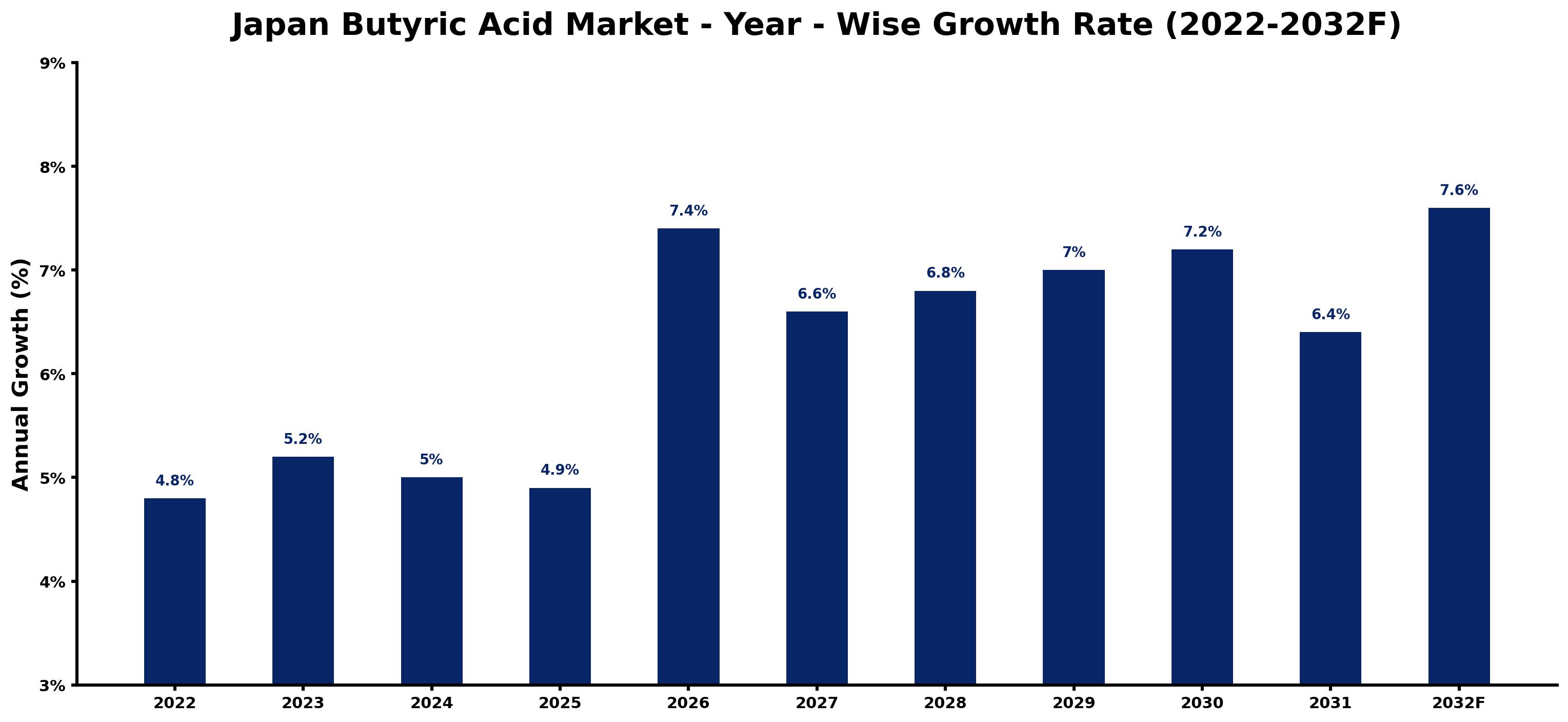
Below, each year's estimated growth is shown next to the factor that most influenced it.
| Year | Estimated Annual Growth (%) | Market Rationale |
| 2022 | 4.8 | The market experienced steady growth, supported by strong domestic livestock production. |
| 2023 | 5.2 | Growth accelerated as the animal feed sector expanded, driven by increasing livestock numbers. |
| 2024 | 5.0 | Growth slowed slightly as market conditions stabilised, maintaining a positive trend. |
| 2025 | 4.9 | Continued growth was observed, although at a reduced rate compared to previous years. |
| 2026 | 7.4 | A resurgence in demand is expected to emerge, fueled by rising interest in gut health supplements. |
| 2027 | 6.6 | Growth is projected to moderate as the market adjusts to new supply factors and consumer preferences. |
| 2028 | 6.8 | Demand is expected to pick up again, driven by innovations in pharmaceuticals and animal nutrition. |
| 2029 | 7.0 | Growth will continue as the food flavoring sector increasingly adopts butyric acid applications. |
| 2030 | 7.2 | The market is projected to maintain positive momentum, supported by ongoing livestock health initiatives. |
| 2031 | 6.4 | Growth is expected to slow as market conditions normalise, reflecting a more stable environment. |
| 2032 | 7.6 | Demand will surge as the market peaks, driven by advancements in production technologies. |
Note: Market size estimations and growth projections presented in this report are based on 6Wresearch's proprietary forecasting methodology, utilizing the latest available industry data, government publications, and primary research inputs.
Japan Butyric Acid Market Synopsis
Butyric acid is a short-chain fatty acid produced through fermentation or chemical synthesis, primarily used in animal feed, pharmaceuticals, and food flavouring. The Japan Butyric Acid Market is growing due to rising livestock production, increasing interest in gut health supplements, and advancements in food flavouring applications. The animal feed sector, valued at approximately 1 trillion JPY, remains a key driver of this trend, while the pharmaceutical industry continues to be a large consumer of butyric acid derivatives, reflecting a shift in market conditions.
Market Dynamics Impact Analysis (2026–2032)
| Factor | Type | Impact | Primary Segment Affected |
| Rising livestock production drives demand for butyric acid in animal feed. | Driver | High | Animal Feed |
| Growing interest in gut health supplements boosts the use of sodium butyrate. | Driver | High | Pharmaceuticals |
| Increased demand for food flavoring presents opportunities for butyric acid suppliers. | Opportunity | High | Food and Flavours |
| Expansion of the pharmaceutical sector offers new markets for butyric acid derivatives. | Opportunity | High | Pharmaceuticals |
| Regulatory compliance under the Food Sanitation Act can restrict market entry. | Restraint | Medium | Natural Butyric Acid |
| Production challenges related to fermentation processes may limit supply. | Restraint | Medium | Natural Butyric Acid |
| Cost pressures from raw materials can impact profitability for producers. | Challenge | High | Natural Butyric Acid |
| Capacity constraints in production facilities may hinder growth potential. | Challenge | Medium | Natural Butyric Acid |
Evaluation of Drivers in Japan Butyric Acid Market (2026–2032)
The factors lifting demand, and the evidence behind each, are summarised below.
| Drivers | Primary Segment Affected | Why It Matters (Evidence) |
| Increased livestock production leads to higher demand for butyric acid in animal feed. | Animal Feed | Japan's livestock population exceeds 4 million cattle, driving purchases of butyric acid. |
| Rising consumer awareness of gut health boosts sodium butyrate usage in supplements. | Pharmaceuticals | Over 60% of gut health supplements in Japan contain sodium butyrate, increasing demand. |
| Growing food flavoring applications create new markets for butyric acid. | Food and Flavours | The food flavoring industry in Japan has seen a rise in butyric acid usage for flavours. |
| Expansion of the pharmaceutical sector increases demand for butyric acid derivatives. | Pharmaceuticals | The pharmaceutical industry is one of the largest consumers of butyric acid derivatives in Japan. |
| Technological advancements in production processes improve supply capabilities. | Natural Butyric Acid | Optimising fermentation processes for butyric acid production enhances efficiency. |
Several shifts outside the market lift sales. The livestock population in Japan, exceeding 4 million cattle, drives demand for butyric acid in animal feed. Over 60% of gut health supplements in Japan now contain sodium butyrate, reflecting a growing consumer focus on gut health. The food flavoring sector has also seen increased adoption of butyric acid, improving product appeal. The pharmaceutical industry remains a major consumer, utilising butyric acid derivatives for various health applications. Recent improvements in fermentation processes are boosting production efficiency, further supporting market growth.
Evaluation of Restraints in Japan Butyric Acid Market
The key brakes on demand, and where they bite hardest, are shown below.
| Market Restraint | Primary Segment Affected | Why It Matters (Evidence) |
| Compliance with the Chemical Substances Control Law can limit market entry for new products. | Natural Butyric Acid | Producers must adhere to strict regulations, which can delay product launches. |
| Production challenges in fermentation processes may restrict supply availability. | Natural Butyric Acid | Inconsistent fermentation yields can affect the overall supply of natural butyric acid. |
| Cost pressures from raw materials can impact profitability for producers. | Natural Butyric Acid | Rising prices of feedstock materials can squeeze margins for butyric acid manufacturers. |
| Capacity constraints in production facilities may hinder growth potential. | Natural Butyric Acid | Limited production capacity can restrict the ability to meet rising demand. |
| Market competition from alternative feed additives can limit market share. | Animal Feed | The presence of various feed additives may divert demand away from butyric acid. |
Japan Butyric Acid Market Challenges
Limited fermentation facilities in Japan create supply constraints, causing delays in production for pharmaceutical buyers. High production costs arise from strict regulations, leading to increased prices for suppliers and limiting affordability for clinics. Intense competition from imports pressures local suppliers to lower prices, which can erode profit margins and threaten financial stability for domestic manufacturers. Slow adoption of new technologies in butyric acid applications restricts innovation, reducing options for buyers in the food flavouring sector.
Trends in the Japan Butyric Acid Market
The shifts below are changing how Japan Butyric Acid Market products are bought and supplied.
- Shift in Animal Feed Preferences: Livestock producers are increasingly favouring butyric acid for animal nutrition, improving gut health and feed efficiency. In 2023, the Japanese government launched a programme to improve livestock health using butyric acid, reflecting this trend.
- Emergence of Gut Health Products: The rise in consumer awareness around gut health has led to a surge in sodium butyrate usage in supplements. Research indicates that over 60% of gut health supplements in Japan now include this ingredient, driving demand.
- Increased Adoption in Food Flavoring: Food manufacturers are increasingly using butyric acid to improve flavours in various products. The food flavouring industry in Japan has seen a notable rise in butyric acid applications, contributing to market growth.
- Expansion of Pharmaceutical Applications: Pharmaceutical companies are exploring new applications for butyric acid derivatives, particularly in health supplements. The pharmaceutical sector in Japan is one of the largest consumers of these derivatives, driving innovation.
Investment Opportunities in the Japan Butyric Acid Market
Below are the investment opportunities with the strongest case in the Japan Butyric Acid Market.
- Animal Feed Sector Growth: Livestock producers are seeking high-quality additives, creating opportunities for butyric acid suppliers. With the animal feed sector valued at approximately 1 trillion JPY, entering this market through local partnerships can be beneficial.
- Pharmaceutical Innovations: Pharmaceutical companies are increasingly investing in gut health products, presenting opportunities for butyric acid derivatives. Collaborating with research institutions can facilitate entry into this growing sector.
- Food Flavoring Demand: Food manufacturers are looking for natural flavour enhancers, leading to increased demand for butyric acid. Establishing connections with food producers in the Tokyo metropolitan area can improve market access.
- Regulatory Approvals for New Products: The need for compliant additives opens opportunities for suppliers to innovate. Gaining approvals under the Chemical Substances Control Law can provide a competitive edge in the market.
Government Initiatives in the Japan Butyric Acid Market
The regulations affecting butyric acid production and use in Japan are shaped by several laws. The PRTR Law (1999) mandates businesses to report chemical releases, while the Chemical Substances Control Law (1973) requires evaluation of new substances. The Industrial Standardization Act (1949) governs product standards, ensuring quality and safety in butyric acid production. These regulations ensure that producers maintain high standards and comply with safety protocols, impacting production practices.
The Chemical Substances Control Law ensures that butyric acid derivatives meet safety standards, benefiting the pharmaceutical sector. The Ministry of Agriculture, Forestry and Fisheries oversees regulations affecting butyric acid in animal feed, ensuring compliance with relevant standards. These measures build consumer confidence in products containing butyric acid, as they must meet stringent safety and quality requirements.
Future Insight of the Japan Butyric Acid Market
Advancements in fermentation technology will transform butyric acid production efficiency, allowing suppliers to meet rising demand from the pharmaceutical sector, which is projected to consume over 1 trillion JPY worth of derivatives. The government's livestock health programme will integrate butyric acid into animal feed, reinforcing its role in livestock nutrition. Research on gut health will drive increased use of butyric acid in dietary supplements, benefiting producers and consumers alike. Stricter production standards will improve quality, building trust among buyers in the food industry.
Market Segmentation Analysis
Japan Butyric Acid Market report covers a detailed analysis of the following market segments:
By Type – Natural Butyric Acid Leads, Synthetic Butyric Acid Expected to Grow Fastest
According to Summon Dutta, Assistant Manager at 6Wresearch, in 2025, Natural Butyric Acid led the type split with a 64% share. Natural butyric acid holds the largest share in Japan due to its extensive use in animal feed and food applications. The strong livestock population, including over 4 million cattle, significantly contributes to this demand. Over 2026–2032, Synthetic Butyric Acid is expected to post the fastest growth, at a CAGR of 10.0%. Synthetic butyric acid is experiencing rapid growth, primarily driven by its increasing utilisation in pharmaceuticals and as a chemical intermediate. The rising consumer interest in gut health supplements further propels this segment's expansion. Suppliers should focus on increasing synthetic butyric acid production to align with the growing pharmaceutical and health supplement markets.
By Derivatives – Sodium Butyrate Leads, Calcium Butyrate Expected to Grow Fastest
Sodium Butyrate took 48% of derivatives revenue in 2025, more than any other category. Sodium butyrate leads the derivatives segment as it is widely utilised in pharmaceuticals, particularly for gut health supplements. Its application in over 60% of such products highlights its importance in the market. The quickest growth will come from Calcium Butyrate, forecast to expand at a CAGR of 8.8% between 2026 and 2032. Calcium butyrate is the fastest-growing derivative, primarily due to its use in animal feed, which is gaining traction among livestock producers. The increasing focus on livestock health is propelling this growth. Buyers in the animal feed sector should consider incorporating calcium butyrate to meet the rising health standards for livestock.
By Application – Animal Feed Leads, Chemical Intermediate Expected to Grow Fastest
The largest application category in 2025 was Animal Feed, at 39% of revenue. Animal feed is the dominant application for butyric acid, driven by the substantial livestock industry in Japan valued at approximately 1 trillion JPY. This sector's reliance on butyric acid for livestock nutrition solidifies its leading position. Chemical Intermediate is set to record the highest CAGR in this split, 9.9% over 2026–2032. The chemical intermediate application is growing rapidly as butyric acid is increasingly recognised for its role in various chemical syntheses. This trend is expected to continue as industries seek efficient production methods. Suppliers must adapt to the increasing demand for butyric acid in chemical applications to remain competitive.
Key Attractiveness of the Report
- 10 Years of Market Numbers
- Historical Data Starting from 2022 to 2025
- Base Year 2025
- Forecast Data until 2032
- Key Performance Indicators Impacting the Market
- Major Upcoming Developments and Projects
Key Highlights of the Report:
- Japan Butyric Acid Market Outlook
- Market Size of Japan Butyric Acid Market, 2025
- Forecast of Japan Butyric Acid Market, 2032
- Historical Data and Forecast of Japan Butyric Acid Revenues & Volume for the Period 2022-2032
- Japan Butyric Acid Market Trend Evolution
- Japan Butyric Acid Market Drivers and Challenges
- Japan Butyric Acid Price Trends
- Japan Butyric Acid Porter's Five Forces
- Japan Butyric Acid Industry Life Cycle
- Historical Data and Forecast of Japan Butyric Acid Market Revenues & Volume By Type for the Period 2022-2032
- Historical Data and Forecast of Japan Butyric Acid Market Revenues & Volume By Natural Butyric Acid for the Period 2022-2032
- Historical Data and Forecast of Japan Butyric Acid Market Revenues & Volume By Synthetic Butyric Acid for the Period 2022-2032
- Historical Data and Forecast of Japan Butyric Acid Market Revenues & Volume By Derivatives for the Period 2022-2032
- Historical Data and Forecast of Japan Butyric Acid Market Revenues & Volume By Sodium Butyrate for the Period 2022-2032
- Historical Data and Forecast of Japan Butyric Acid Market Revenues & Volume By Calcium Butyrate for the Period 2022-2032
- Historical Data and Forecast of Japan Butyric Acid Market Revenues & Volume By Others for the Period 2022-2032
- Historical Data and Forecast of Japan Butyric Acid Market Revenues & Volume By Application for the Period 2022-2032
- Historical Data and Forecast of Japan Butyric Acid Market Revenues & Volume By Animal Feed for the Period 2022-2032
- Historical Data and Forecast of Japan Butyric Acid Market Revenues & Volume By Chemical Intermediate for the Period 2022-2032
- Historical Data and Forecast of Japan Butyric Acid Market Revenues & Volume By Food and Flavours for the Period 2022-2032
- Historical Data and Forecast of Japan Butyric Acid Market Revenues & Volume By Pharmaceuticals for the Period 2022-2032
- Historical Data and Forecast of Japan Butyric Acid Market Revenues & Volume By Perfumes for the Period 2022-2032
- Historical Data and Forecast of Japan Butyric Acid Market Revenues & Volume By Inks for the Period 2022-2032
- Historical Data and Forecast of Japan Butyric Acid Market Revenues & Volume By Paints & Coatings for the Period 2022-2032
- Historical Data and Forecast of Japan Butyric Acid Market Revenues & Volume By Others for the Period 2022-2032
- Japan Butyric Acid Import Export Trade Statistics
- Market Opportunity Assessment By Type
- Market Opportunity Assessment By Derivatives
- Market Opportunity Assessment By Application
- Japan Butyric Acid Top Companies Market Share
- Japan Butyric Acid Competitive Benchmarking By Technical and Operational Parameters
- Japan Butyric Acid Company Profiles
- Japan Butyric Acid Key Strategic Recommendations
Market Covered
Coverage by segment is as follows.
By Type
- Natural Butyric Acid
- Synthetic Butyric Acid
By Derivatives
- Sodium Butyrate
- Calcium Butyrate
- Others
By Application
- Animal Feed
- Chemical Intermediate
- Food and Flavours
- Pharmaceuticals
- Perfumes
- Inks
- Paints & Coatings
- Others































