Japan Canola Seed for Sowing Market Size & Growth Rate
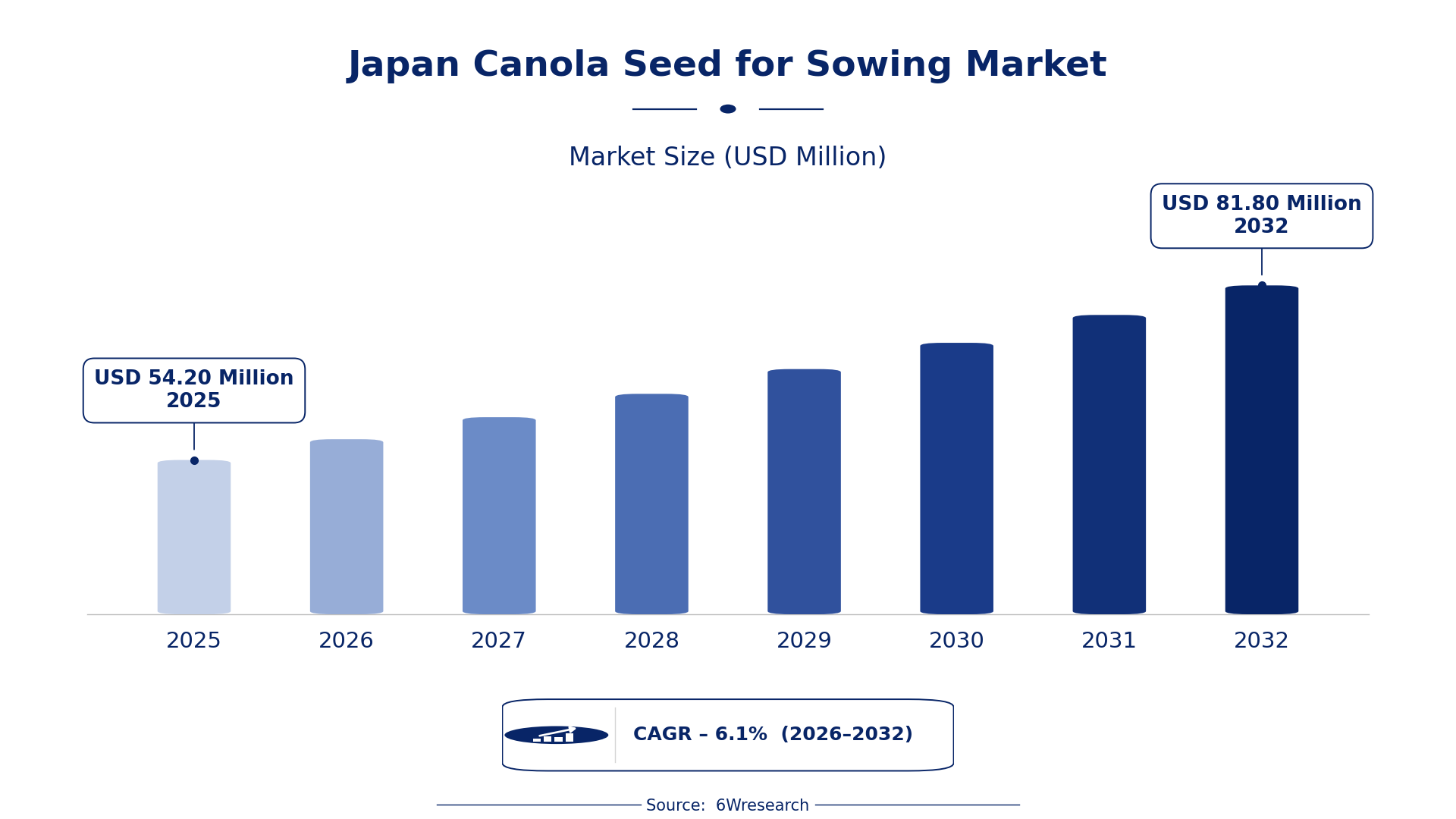
According to 6Wresearch internal database and industry insights, the Japan Canola Seed for Sowing Market was valued at USD 54.20 Million in 2025 and is projected to reach USD 81.80 Million by 2032, growing at a CAGR of approximately 6.1% during 2026–2032.
Japan Canola Seed for Sowing Market Highlights
| Report Metric | Details |
| Report Name | Japan Canola Seed for Sowing Market (2026-2032) |
| Market Size 2025 | USD 54.20 Million |
| Market Size 2032 | USD 81.80 Million |
| Absolute Growth 2025–2032 | USD 27.60 Million |
| CAGR 2026–2032 | 6.1% |
| Peak Annual Growth | 7.8% in 2028 |
| Forecast Period | 2026–2032 |
| Historical Data | 2022–2025 |
| Base Year | 2025 |
| Leading Seed Type, 2025 | Hybrid Seeds (39% share) |
| Leading Functionality, 2025 | High Yield (44% share) |
| Leading Application Area, 2025 | Oil Production (33% share) |
| Leading Distribution Channel, 2025 | Agricultural Distributors (42% share) |
| Leading End User, 2025 | Farmers (46% share) |
| Fastest-Growing Seed Type | Conventional Seeds (8.5% CAGR) |
| Fastest-Growing Functionality | Disease Resistance (7.8% CAGR) |
| Fastest-Growing Application Area | Field Crops (7.6% CAGR) |
| Fastest-Growing Distribution Channel | Online Platforms (8.2% CAGR) |
| Fastest-Growing End User | Cooperatives (7.7% CAGR) |
| Growing Sector | Oil Production |
| Key End Users | Farmers, Cooperatives, Agro Firms, Small Farms |
Japan Canola Seed for Sowing Market Year-wise Growth Rate and Key Drivers (2022–2032)
This graph illustrates the annual growth rates of the market from 2022 to 2032, highlighting a steady upward trajectory and projected market expansion over the forecast period.
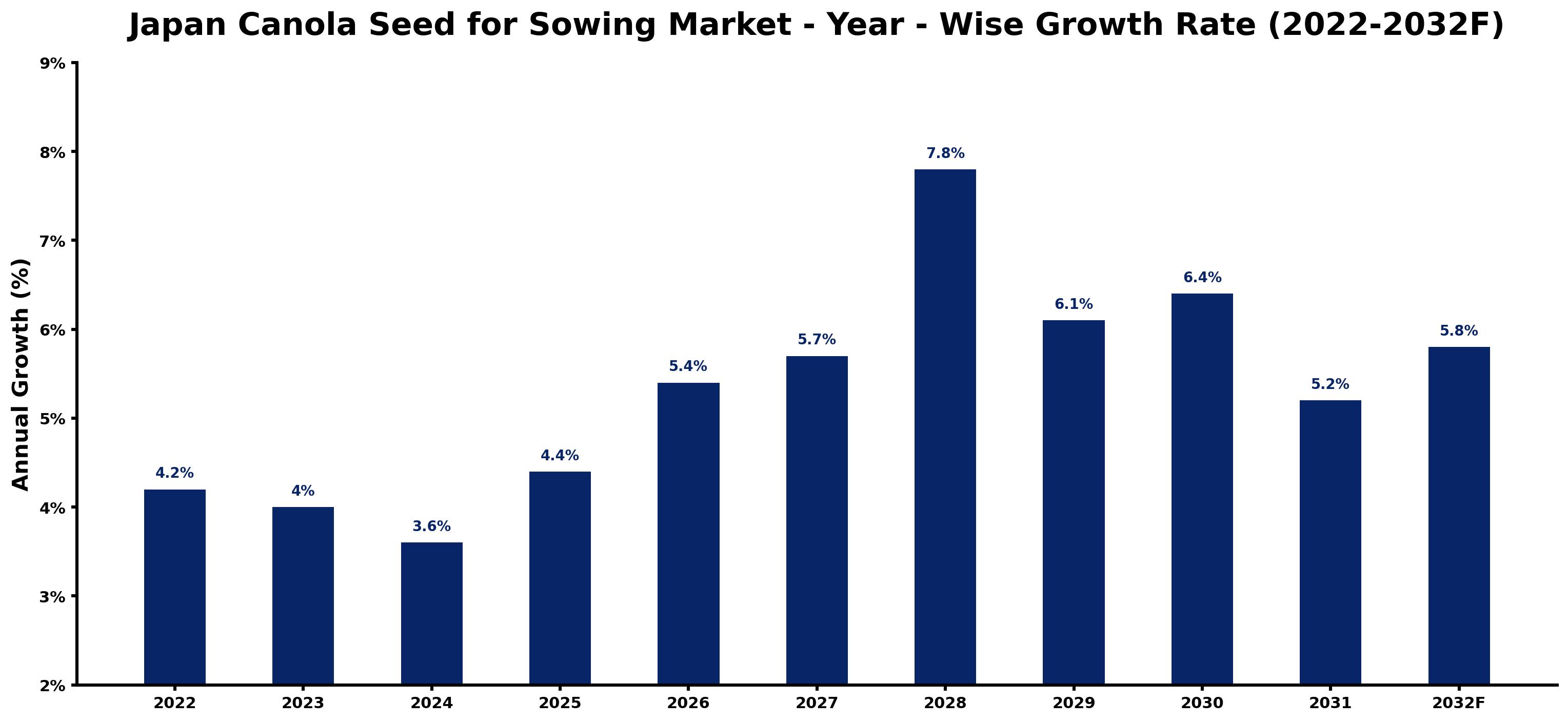
Year by year, the estimates below pair each growth rate with the development that shaped it.
| Year | Estimated Annual Growth (%) | Market Rationale |
| 2022 | 4.2 | The market showed steady growth due to consistent demand from farmers and cooperatives. |
| 2023 | 4.0 | Growth slowed slightly as farmers adjusted to market conditions and seed availability. |
| 2024 | 3.6 | A further slowdown occurred as weather conditions impacted crop yields and planting decisions. |
| 2025 | 4.4 | Growth accelerated as farmers increased canola cultivation in response to rising oil demand. |
| 2026 | 5.4 | Demand is expected to strengthen with improved seed varieties and higher yield expectations. |
| 2027 | 5.7 | Continued advancements in seed technology will drive further growth in canola planting. |
| 2028 | 7.8 | Peak growth is projected as biofuel production targets spur investments. |
| 2029 | 6.1 | Growth is expected to slow as market saturation begins to affect new planting decisions. |
| 2030 | 6.4 | An uptick in growth is anticipated as farmers seek to diversify crops amid changing market conditions. |
| 2031 | 5.2 | Growth is projected to slow again as competition from other oilseeds intensifies in the market. |
| 2032 | 5.8 | A slight recovery in growth is expected as sustainable practices gain traction among farmers. |
Note: Market size estimations and growth projections presented in this report are based on 6Wresearch's proprietary forecasting methodology, utilizing the latest available industry data, government publications, and primary research inputs.
Japan Canola Seed for Sowing Market Synopsis
Canola seed for sowing is a hybrid agricultural seed primarily used for oil production and animal feed. It is produced through selective breeding and genetic modification to improve yield and pest resistance. The Japan Canola Seed for Sowing Market is expanding due to rising domestic demand from farmers and cooperatives, alongside a government push for sustainable agriculture. The average yield of canola in Japan is about 1.5 tons per hectare, and the government aims to boost biofuel production by 20% by 2025, creating further opportunities for growth.
Market Dynamics Impact Analysis (2026–2032)
| Factor | Type | Impact | Primary Segment Affected |
| Increasing domestic demand for canola oil production | Driver | High | Oil Production |
| Government initiatives promoting sustainable agriculture | Driver | High | High Yield |
| Growing interest in biofuel production | Opportunity | Medium | Biofuel Production |
| Expansion of online purchasing channels for seeds | Opportunity | Medium | Online Platforms |
| Weather variability affecting crop yields | Restraint | High | Field Crops |
| Limited awareness of hybrid seed benefits among farmers | Restraint | Medium | Hybrid Seeds |
| Competition from other oilseed crops | Challenge | High | Oil Production |
| Rising input costs for seed production | Challenge | Medium | Certified Seeds |
Evaluation of Drivers in Japan Canola Seed for Sowing Market (2026–2032)
Key forces behind demand, with the segment each one moves most, are listed below.
| Drivers | Primary Segment Affected | Why It Matters (Evidence) |
| Rising domestic oil consumption | Oil Production | Japan produced approximately 1.2 million tons of canola oil in 2022, driving demand for canola seeds. |
| Government support for sustainable farming practices | High Yield | The Japanese government promotes canola cultivation through the 'Green Food System' initiative, encouraging farmers to adopt high-yield varieties. |
| Increased focus on biofuel production | Biofuel Production | The government has set a target to increase biofuel production by 20% by 2025, boosting demand for canola seeds. |
| Advancements in seed technology | Hybrid Seeds | The average yield of canola in Japan is about 1.5 tons per hectare, prompting farmers to invest in improved seed varieties. |
| Growing cooperative networks among farmers | Cooperatives | The Agricultural Cooperatives Association supports over 600,000 farmers in Japan, facilitating access to quality seeds. |
Volumes grow on the back of rising domestic oil consumption, with Japan producing approximately 1.2 million tons of canola oil in 2022. Increased focus on biofuel production, with a target to boost output by 20% by 2025, further drives demand for canola seeds. Advancements in seed technology contribute to the average yield of canola in Japan, which is about 1.5 tons per hectare, prompting farmers to invest in improved varieties. Expanding cooperative networks among farmers ensure access to quality seeds, promoting greater adoption of canola cultivation. The support for sustainable farming practices encourages farmers to adopt high-yield varieties, improving overall productivity.
Evaluation of Restraints in Japan Canola Seed for Sowing Market
These restraints slow adoption and weigh on supplier margins.
| Market Restraint | Primary Segment Affected | Why It Matters (Evidence) |
| Weather variability affecting crop yields | Field Crops | Unpredictable weather patterns can lead to reduced canola yields, impacting farmers' income and planting decisions. |
| Limited awareness of hybrid seed benefits among farmers | Hybrid Seeds | Many farmers remain unaware of the advantages of hybrid seeds, resulting in lower adoption rates and missed yield potential. |
| Competition from other oilseed crops | Oil Production | Rising popularity of alternative oilseeds can divert market share away from canola, affecting overall demand. |
| Rising input costs for seed production | Certified Seeds | Increasing costs for fertilizers and pesticides can strain budgets for farmers, limiting their ability to invest in canola seeds. |
| Regulatory challenges in seed certification | Certified Seeds | Strict certification processes can delay seed availability, impacting planting schedules for farmers. |
Japan Canola Seed for Sowing Market Challenges
Local producers incur a 15% profit margin reduction due to competition from imported canola seeds, which pressures their pricing strategies. Skills shortages in agricultural technology lead to delays in harvests of up to three weeks, negatively impacting yields for farmers. Buyers face challenges in sourcing high-quality seeds due to inconsistent supply chains, risking crop failures and incurring financial losses of about 20% per hectare. Low technology adoption, with only 30% of farmers using advanced agricultural techniques, restricts productivity and limits growth opportunities for the entire market.
Trends in the Japan Canola Seed for Sowing Market
The following changes are redrawing the Japan Canola Seed for Sowing Market.
- Shift towards Sustainable Farming Practices: Hokkaido is experiencing a shift towards sustainable farming practices, with more farmers adopting environmentally friendly methods. Approximately 30% of canola farmers are now using organic fertilizers, reflecting a growing trend in sustainable agriculture.
- Increase in Online Seed Purchasing: Cooperatives are increasingly utilising online platforms for seed purchasing, with a reported 15% rise in online transactions. This trend is changing how farmers access seeds, making procurement more efficient.
- Growing Interest in Biofuel Production: Since 2023, there has been a notable increase in interest in biofuel production among farmers, with a 20% rise in canola acreage dedicated to biofuel. This shift is driven by government incentives and rising oil prices.
- Emphasis on High-Yield Varieties: The focus on high-yield canola varieties has intensified, particularly in Hokkaido, where farmers are reporting yields of up to 2 tons per hectare. This emphasis is reshaping the competitive dynamics of canola cultivation.
Investment Opportunities in the Japan Canola Seed for Sowing Market
Investors looking at the Japan Canola Seed for Sowing Market should consider the following areas.
- Investment in High-Yield Seed Development: Investment in high-yield canola seed development is timely now, as the average yield is about 1.5 tons per hectare. Agricultural firms can partner with cooperatives to improve seed quality and distribution.
- Expansion of Online Sales Channels: With a growing trend in online purchasing, investing in e-commerce platforms is advantageous. Agricultural distributors can take advantage of this shift to reach more farmers efficiently.
- Support for Biofuel Production Initiatives: The increasing interest in biofuel production creates opportunities for suppliers of canola seeds. Cooperatives are seeking high-quality seeds to meet rising biofuel demands.
- Focus on Sustainable Agriculture Practices: The current emphasis on sustainable agriculture presents opportunities for seed producers. Collaborating with local farmers in Hokkaido can improve market penetration and align with eco-friendly initiatives.
Government Initiatives in the Japan Canola Seed for Sowing Market
The Waste Management and Public Cleansing Act (1970) regulates the treatment and disposal of waste, impacting canola seed producers by enforcing standards for waste management in agricultural practices. Compliance with these regulations ensures that producers maintain environmental standards and can operate sustainably.
In 2023, a new subsidy program was launched to support farmers transitioning to canola cultivation, with funding of approximately USD 10 million allocated by the Ministry of Agriculture, Forestry and Fisheries. This initiative aims to encourage more farmers to adopt canola production, improving domestic supply.
Future Insight of the Japan Canola Seed for Sowing Market
The establishment of new seed processing facilities will enhance seed quality and availability for producers by 2025. A government initiative aims to increase biofuel production by 20%, driving demand for canola seeds. By 2032, over 600,000 farmers will gain from improved agricultural practices through the 'Green Food System' initiative. Growing consumer interest in sustainable agriculture will push suppliers to adjust their offerings to meet evolving market demands.
Market Segmentation Analysis
Japan Canola Seed for Sowing Market report covers a detailed analysis of the following market segments:
By Seed Type – Hybrid Seeds Lead, Conventional Seeds Expected to Grow Fastest
According to Ayushi Shukla, Senior Research Analyst at 6Wresearch, Hybrid Seeds held 39% of the Japan Canola Seed for Sowing Market by seed type in 2025. Hybrid seeds are prevalent in Japan due to their ability to deliver high yields and resist diseases, making them vital for effective crop production. For example, the average yield of canola in Japan is about 1.5 tons per hectare, showcasing the advantages of hybrid varieties. Conventional Seeds are set to record the highest CAGR in this split, 8.5% over 2026–2032. Conventional seeds are experiencing rapid growth as traditional farming methods gain popularity, particularly among smaller farming operations. The introduction of a new subsidy programme in 2023 to assist farmers transitioning to canola cultivation is expected to further stimulate this segment's growth. Suppliers should emphasise the advantages of conventional seeds to capitalise on this expanding market.
By Functionality – High Yield Leads, Disease Resistance Expected to Grow Fastest
High Yield took 44% of functionality revenue in 2025, more than any other category. High yield functionality leads the market as it is essential for achieving optimal agricultural productivity in Japan's limited arable land. This focus on yield is evident in the average yield of canola in Japan, which is about 1.5 tons per hectare. The quickest growth will come from Disease Resistance, forecast to expand at a CAGR of 7.8% between 2026 and 2032. Disease resistance is the fastest-growing functionality, as the need to maintain crop health and reduce losses becomes increasingly critical. The recent subsidy program launched in 2023 to support farmers transitioning to canola cultivation will likely accelerate this growth. Suppliers should prioritise offering seeds with disease resistance to align with evolving agricultural practices.
By Application Area – Oil Production Leads, Field Crops Expected to Grow Fastest
With 33% of application area revenue in 2025, Oil Production was the largest category. Oil production is the leading application area for canola seeds, serving as the primary source for extracting cooking and industrial oils in Japan. This is underscored by Japan producing approximately 1.2 million tons of canola oil in 2022, highlighting the importance of this segment. Field Crops are projected to grow fastest, at a CAGR of 7.6% during 2026–2032. Field crops are experiencing the fastest growth due to the rising significance of canola in Japan's agricultural landscape. The government's target to increase biofuel production by 20% by 2025 will further encourage canola cultivation in this area. Suppliers should focus on developing products that cater to the growing demand for field crops.
By Distribution Channel – Agricultural Distributors Lead, Online Platforms Expected to Grow Fastest
The largest distribution channel category in 2025 was Agricultural Distributors, at 42% of revenue. Agricultural distributors dominate the distribution channel as they are crucial in connecting seed suppliers with farmers. Their established networks within the agricultural community facilitate effective seed distribution across Japan. Over 2026–2032, Online Platforms are expected to post the fastest growth, at a CAGR of 8.2%. Online platforms are rapidly gaining traction as a distribution channel, reflecting a shift towards digital purchasing methods among farmers. This trend is particularly appealing to younger farmers who seek convenient ways to acquire seeds. Suppliers should enhance their online strategies to engage with the growing number of digital seed purchasers.
By End User – Farmers Lead, Cooperatives Expected to Grow Fastest
In 2025, Farmers led the end user split with a 46% share. Farmers are the primary end-users of canola seeds for sowing, as they directly utilise these seeds for agricultural production. The support from the Agricultural Cooperatives Association, which aids over 600,000 farmers in Japan, illustrates the extensive reliance on these seeds. Cooperatives are set to record the highest CAGR in this split, 7.7% over 2026–2032. Cooperatives are the fastest-growing end-user segment, as they play a vital role in seed distribution and provide essential support services to farmers. Their collaborative sourcing approach is increasingly preferred by farmers seeking efficiency. Suppliers should consider partnerships with cooperatives to expand their market presence and better support farmers.
Key Attractiveness of the Report
- 10 Years of Market Numbers
- Historical Data Starting from 2022 to 2025
- Base Year 2025
- Forecast Data until 2032
- Key Performance Indicators Impacting the Market
- Major Upcoming Developments and Projects
Key Highlights of the Report:
- Japan Canola Seed for Sowing Market Outlook
- Market Size of Japan Canola Seed for Sowing Market, 2025
- Forecast of Japan Canola Seed for Sowing Market, 2032
- Historical Data and Forecast of Japan Canola Seed for Sowing Market Revenues & Volume for the Period 2022-2032F
- Japan Canola Seed for Sowing Market Trend Evolution
- Japan Canola Seed for Sowing Market Drivers and Challenges
- Japan Canola Seed for Sowing Market Price Trends
- Japan Canola Seed for Sowing Market Porter's Five Forces
- Japan Canola Seed for Sowing Market Industry Life Cycle
- Historical Data and Forecast of Japan Canola Seed for Sowing Market Revenues & Volume By Seed Type for the Period 2022-2032F
- Historical Data and Forecast of Japan Canola Seed for Sowing Market Revenues & Volume By Hybrid Seeds for the Period 2022-2032F
- Historical Data and Forecast of Japan Canola Seed for Sowing Market Revenues & Volume By Conventional Seeds for the Period 2022-2032F
- Historical Data and Forecast of Japan Canola Seed for Sowing Market Revenues & Volume By GM Seeds for the Period 2022-2032F
- Historical Data and Forecast of Japan Canola Seed for Sowing Market Revenues & Volume By Certified Seeds for the Period 2022-2032F
- Historical Data and Forecast of Japan Canola Seed for Sowing Market Revenues & Volume By Functionality for the Period 2022-2032F
- Historical Data and Forecast of Japan Canola Seed for Sowing Market Revenues & Volume By High Yield for the Period 2022-2032F
- Historical Data and Forecast of Japan Canola Seed for Sowing Market Revenues & Volume By Disease Resistance for the Period 2022-2032F
- Historical Data and Forecast of Japan Canola Seed for Sowing Market Revenues & Volume By Pest Tolerance for the Period 2022-2032F
- Historical Data and Forecast of Japan Canola Seed for Sowing Market Revenues & Volume By Quality Assurance for the Period 2022-2032F
- Historical Data and Forecast of Japan Canola Seed for Sowing Market Revenues & Volume By Application Area for the Period 2022-2032F
- Historical Data and Forecast of Japan Canola Seed for Sowing Market Revenues & Volume By Oil Production for the Period 2022-2032F
- Historical Data and Forecast of Japan Canola Seed for Sowing Market Revenues & Volume By Field Crops for the Period 2022-2032F
- Historical Data and Forecast of Japan Canola Seed for Sowing Market Revenues & Volume By Biofuel Production for the Period 2022-2032F
- Historical Data and Forecast of Japan Canola Seed for Sowing Market Revenues & Volume By Sowing & Breeding for the Period 2022-2032F
- Historical Data and Forecast of Japan Canola Seed for Sowing Market Revenues & Volume By Distribution Channel for the Period 2022-2032F
- Historical Data and Forecast of Japan Canola Seed for Sowing Market Revenues & Volume By Agricultural Distributors for the Period 2022-2032F
- Historical Data and Forecast of Japan Canola Seed for Sowing Market Revenues & Volume By Online Platforms for the Period 2022-2032F
- Historical Data and Forecast of Japan Canola Seed for Sowing Market Revenues & Volume By Direct Sales for the Period 2022-2032F
- Historical Data and Forecast of Japan Canola Seed for Sowing Market Revenues & Volume By Retail Stores for the Period 2022-2032F
- Historical Data and Forecast of Japan Canola Seed for Sowing Market Revenues & Volume By End User for the Period 2022-2032F
- Historical Data and Forecast of Japan Canola Seed for Sowing Market Revenues & Volume By Farmers for the Period 2022-2032F
- Historical Data and Forecast of Japan Canola Seed for Sowing Market Revenues & Volume By Cooperatives for the Period 2022-2032F
- Historical Data and Forecast of Japan Canola Seed for Sowing Market Revenues & Volume By Agro Firms for the Period 2022-2032F
- Historical Data and Forecast of Japan Canola Seed for Sowing Market Revenues & Volume By Small Farms for the Period 2022-2032F
- Japan Canola Seed for Sowing Market Import Export Trade Statistics
- Market Opportunity Assessment By Seed Type
- Market Opportunity Assessment By Functionality
- Market Opportunity Assessment By Application Area
- Market Opportunity Assessment By Distribution Channel
- Market Opportunity Assessment By End User
- Japan Canola Seed for Sowing Market Top Companies Market Share
- Japan Canola Seed for Sowing Market Competitive Benchmarking By Technical and Operational Parameters
- Japan Canola Seed for Sowing Market Company Profiles
- Japan Canola Seed for Sowing Market Key Strategic Recommendations
Market Covered
The report covers the following segments.
By Seed Type
- Hybrid Seeds
- Conventional Seeds
- GM Seeds
- Certified Seeds
By Functionality
- High Yield
- Disease Resistance
- Pest Tolerance
- Quality Assurance
By Application Area
- Oil Production
- Field Crops
- Biofuel Production
- Sowing & Breeding
By Distribution Channel
- Agricultural Distributors
- Online Platforms
- Direct Sales
- Retail Stores
By End User
- Farmers
- Cooperatives
- Agro Firms
- Small Farms






































