Japan Cappuccino Ingredients Market Size & Growth Rate
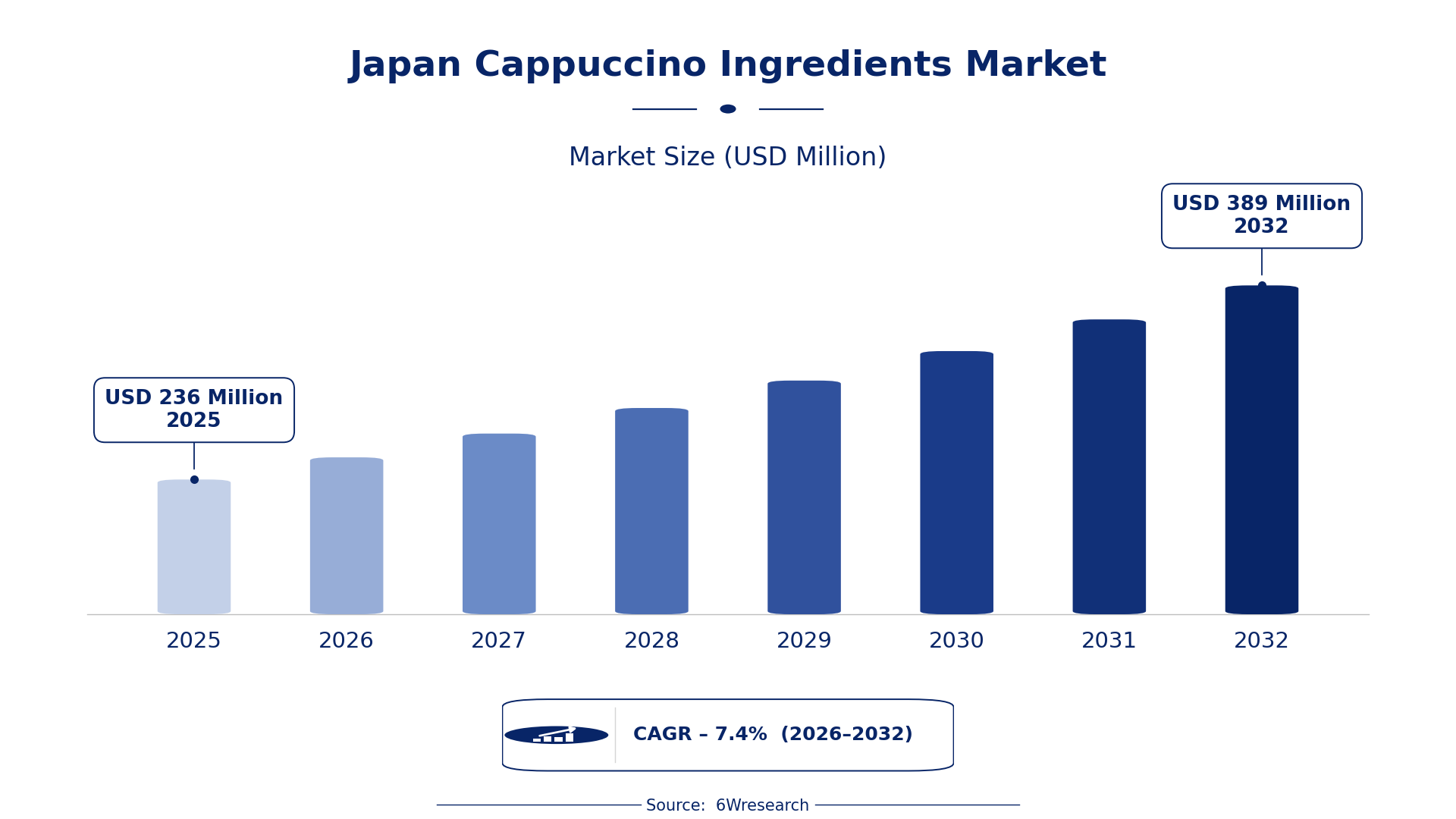
According to 6Wresearch internal database and industry insights, the Japan Cappuccino Ingredients Market was valued at USD 236 Million in 2025 and is projected to reach USD 389 Million by 2032, growing at a CAGR of approximately 7.4% during 2026–2032.
Japan Cappuccino Ingredients Market Highlights
| Report Metric | Details |
| Report Name | Japan Cappuccino Ingredients Market (2026-2032) |
| Market Size 2025 | USD 236 Million |
| Market Size 2032 | USD 389 Million |
| Absolute Growth 2025–2032 | USD 153 Million |
| CAGR 2026–2032 | 7.4% |
| Peak Annual Growth | 8.7% in 2028 |
| Forecast Period | 2026–2032 |
| Historical Data | 2022–2025 |
| Base Year | 2025 |
| Leading Coffee Bean, 2025 | Arabica (36% share) |
| Leading Traditional Style Cappuccino, 2025 | Wet Cappuccino (44% share) |
| Leading Application, 2025 | Coffeehouse Service (31% share) |
| Fastest-Growing Coffee Bean | Cappucino Type (9.4% CAGR) |
| Fastest-Growing Traditional Style Cappuccino | Flavored Cappuccino (9.3% CAGR) |
| Fastest-Growing Application | Drink To Go (10.2% CAGR) |
| Growing Sector | Coffeehouse Service |
| Key End Users | Cafes, Restaurants, Households, Convenience Stores |
Japan Cappuccino Ingredients Market Year-wise Growth Rate and Key Drivers (2022–2032)
This graph illustrates the annual growth rates of the market from 2022 to 2032, highlighting a steady upward trajectory and projected market expansion over the forecast period.
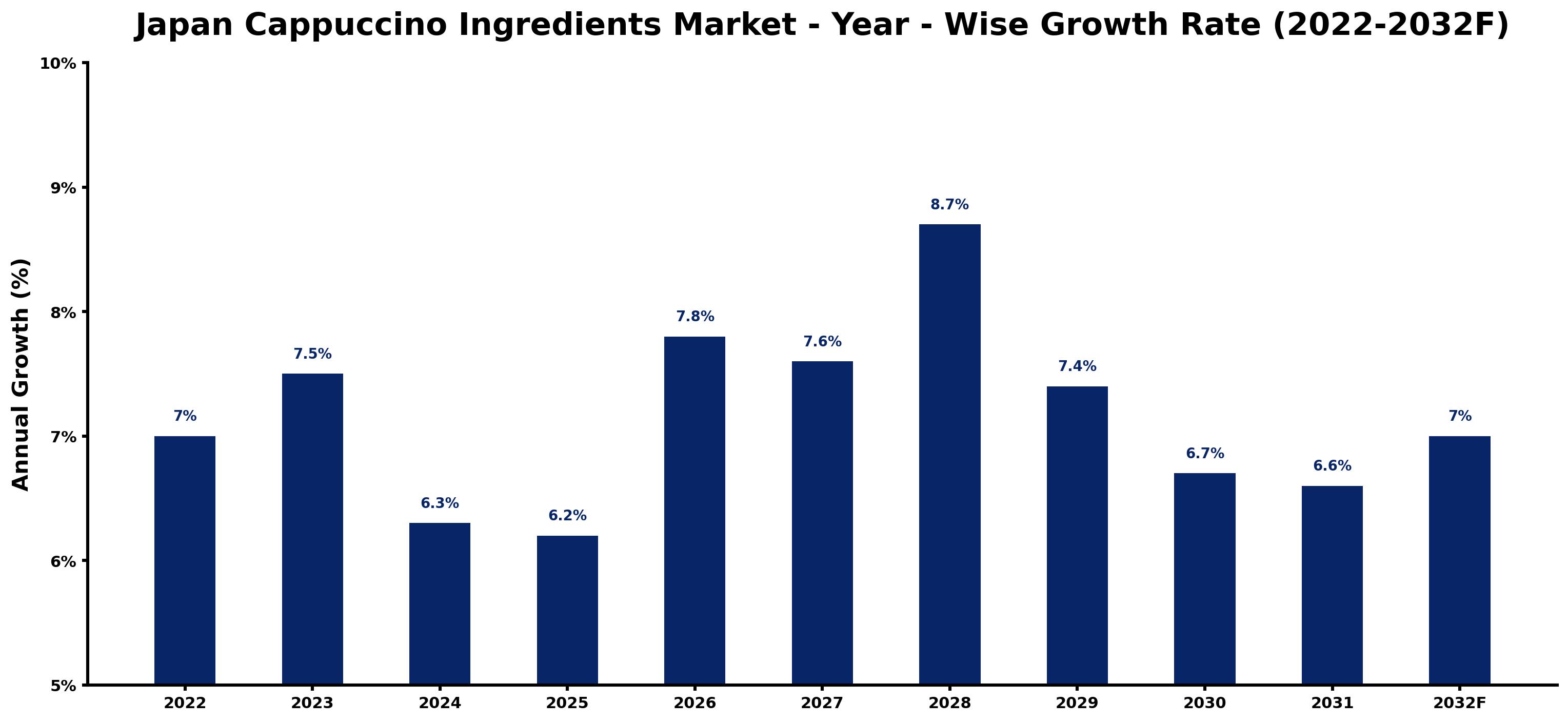
For each year, the table pairs the estimated growth rate with the leading influence on demand, showing how the drivers changed across the period.
| Year | Estimated Annual Growth (%) | Market Rationale |
| 2022 | 7.0 | The market showed steady growth, reflecting strong consumer interest in coffee culture. |
| 2023 | 7.5 | Increased café openings and a rise in specialty coffee consumption drove higher demand. |
| 2024 | 6.3 | The growth rate slowed as market saturation began to impact new café establishments. |
| 2025 | 6.2 | Consumer preferences shifted towards convenience, affecting traditional coffee sales. |
| 2026 | 7.8 | A resurgence in café culture and new product offerings is expected to spur renewed interest. |
| 2027 | 7.6 | Growth is projected to moderate as competition intensifies among coffeehouse services. |
| 2028 | 8.7 | The market is expected to peak due to heightened interest in unique cappuccino flavors and styles. |
| 2029 | 7.4 | Demand is projected to slow as consumer preferences stabilise after the peak growth period. |
| 2030 | 6.7 | Market growth is expected to slow as the novelty of new offerings begins to wear off. |
| 2031 | 6.6 | Consumer interest in sustainability is projected to influence purchasing decisions. |
| 2032 | 7.0 | A renewed focus on specialty and artisanal products is expected to boost sales. |
Note: Market size estimations and growth projections presented in this report are based on 6Wresearch's proprietary forecasting methodology, utilizing the latest available industry data, government publications, and primary research inputs.
Japan Cappuccino Ingredients Market Synopsis
Cappuccino ingredients, including coffee beans, milk, and flavourings, are essential for crafting cappuccinos in various settings. The Japan Cappuccino Ingredients Market is experiencing growth, valued at approximately 1.2 trillion yen, driven by the flourishing café culture and increasing coffee consumption. The number of specialty coffee shops rose by 15% in 2023, reflecting a growing preference for unique coffee experiences. The popularity of flavored cappuccinos among younger consumers is adding new demand, creating opportunities for diverse product offerings.
Market Dynamics Impact Analysis (2026–2032)
| Factor | Type | Impact | Primary Segment Affected |
| Growing café culture and specialty coffee shops | Driver | High | Coffeehouse Service |
| Rising consumer interest in home brewing | Driver | Medium | Personal Use |
| Increasing demand for unique flavours and styles | Opportunity | High | Flavored Cappuccino |
| Expansion of takeaway and convenience options | Opportunity | Medium | Drink To Go |
| Market saturation in urban areas | Restraint | High | Coffeehouse Service |
| High competition among coffee brands | Restraint | Medium | Arabica |
| Fluctuating coffee bean prices due to climate change | Challenge | High | Arabica |
| Consumer preference shifts towards sustainability | Challenge | Medium | Flavored Cappuccino |
Evaluation of Drivers in Japan Cappuccino Ingredients Market (2026–2032)
The factors lifting demand, and the evidence behind each, are summarised below.
| Drivers | Primary Segment Affected | Why It Matters (Evidence) |
| Increased café openings and specialty coffee consumption | Coffeehouse Service | Japan's coffee consumption reached 4.5 million tons in 2022, driving demand for cappuccino ingredients. |
| Growing interest in home brewing and convenience | Personal Use | The average Japanese household consumes 1.2 kg of coffee annually, leading to higher purchases of cappuccino ingredients. |
| Rising popularity of flavored cappuccinos | Flavored Cappuccino | Flavored cappuccinos have seen a 20% rise in popularity among young consumers, boosting sales. |
| Expansion of convenience store coffee offerings | Convenience Stores Service | Convenience stores in Japan sell over 1 million cups of coffee daily, increasing demand for cappuccino ingredients. |
| Café culture and events promoting coffee appreciation | Coffeehouse Service | The Tokyo Coffee Festival attracted over 50,000 visitors in 2023, highlighting consumer interest. |
The strongest pull on demand comes from the increasing café culture, with Japan's coffee consumption reaching 4.5 million tons in 2022, which drives purchases of cappuccino ingredients. The average Japanese household consumes 1.2 kg of coffee annually, boosting home brewing trends. Events like the Tokyo Coffee Festival, which attracted over 50,000 visitors, showcase the growing interest in coffee appreciation. The expanding number of specialty coffee shops further fuels demand, creating opportunities for diverse product offerings. The rise in café openings, with a 15% increase in specialty shops in 2023, reflects a shift towards premium coffee experiences.
Evaluation of Restraints in Japan Cappuccino Ingredients Market
Several factors work against faster growth; the main ones are summarised below.
| Market Restraint | Primary Segment Affected | Why It Matters (Evidence) |
| Market saturation in urban areas limiting new café openings | Coffeehouse Service | The number of specialty coffee shops in Japan increased by 15% in 2023, resulting in intense competition. |
| High competition among coffee brands impacting pricing | Arabica | The Japanese coffee market is valued at approximately 1.2 trillion yen, heightening price wars. |
| Fluctuating coffee bean prices due to climate change | Arabica | Arabica coffee accounts for 70% of imports, exposing the market to supply chain vulnerabilities. |
| Consumer preference shifts towards sustainability affecting traditional brands | Flavored Cappuccino | The Japan Specialty Coffee Association promotes sustainable practices, impacting buyer decisions. |
| Limited niche appeal of certain coffee types | Liberica | Liberica coffee has a minor market presence, limiting its growth opportunities. |
Japan Cappuccino Ingredients Market Challenges
Inefficient roasting technology results in inconsistent quality, leading to customer dissatisfaction and lost sales for cafés. Supply chain disruptions in sourcing specialty beans create delays, costing urban coffee shops potential revenue as they struggle to meet consumer demand. A shortage of trained baristas leads to longer service times, frustrating customers and reducing foot traffic in popular cafés. Stricter food safety regulations impose compliance costs on producers, which can inflate prices for buyers, diminishing their purchasing power and limiting options in the market.
Trends in the Japan Cappuccino Ingredients Market
The following changes are redrawing the Japan Cappuccino Ingredients Market.
- Shift towards Specialty Coffee: In 2023, the trend towards specialty coffee gained momentum as more consumers seek unique experiences. The number of specialty coffee shops increased by 15%, indicating a growing preference for artisanal offerings.
- Transition from Traditional to Flavored Cappuccinos: Flavoured cappuccinos gained traction in 2023, appealing to younger demographics. Their popularity rose by 20%, reflecting changing consumer tastes.
- Emergence of Home Brewing: Home brewing became a notable trend in 2023, driven by increased consumer interest in coffee quality. The average Japanese household's coffee consumption reached 1.2 kg annually, highlighting this shift.
- Growth of Convenience Coffee Options: Convenience stores have become key players in the coffee market since 2023, selling over 1 million cups daily. This trend indicates a shift towards on-the-go coffee consumption.
Investment Opportunities in the Japan Cappuccino Ingredients Market
Below are the investment opportunities with the strongest case in the Japan Cappuccino Ingredients Market.
- Rising Demand for Flavored Products: With a 20% rise in popularity among young consumers, there is a gap in the market for flavoured cappuccino ingredients. Targeting specialty coffee shops can facilitate entry.
- Expansion of Takeaway Services: As urban lifestyles evolve, the demand for convenient coffee options is increasing. Investing in takeaway cappuccino ingredients can cater to busy consumers in metropolitan areas.
- Growth in Home Brewing Market: The average household's coffee consumption of 1.2 kg annually indicates a need for high-quality cappuccino ingredients. Partnering with local retailers can help tap into this growing segment.
- Investment in Sustainable Practices: With increasing consumer preference for sustainability, there is an opportunity to supply eco-friendly cappuccino ingredients. Engaging with the Japan Specialty Coffee Association can improve market presence.
Government Initiatives in the Japan Cappuccino Ingredients Market
The Food Recycling Law, enacted in 2000, mandates food businesses to reduce waste and recycle it into feed, fertiliser, and energy. This law impacts cappuccino ingredient producers by requiring them to implement sustainable practices, ensuring compliance with environmental standards. The law has led to a 30% reduction in food waste among participating businesses, promoting a more sustainable coffee supply chain.
The GX Basic Policy, adopted in 2023, aims for about JPY 150 trillion of public-private decarbonisation investment over ten years. The Ministry of Agriculture, Forestry and Fisheries oversees initiatives that support sustainable coffee farming, impacting buyers by promoting environmentally friendly sourcing. This policy is expected to enhance the sustainability of coffee production by 25% by 2033.
Future Insight of the Japan Cappuccino Ingredients Market
New coffee roasting facilities will emerge by 2032, boosting production efficiency and ensuring consistent product quality. Enhanced training programmes for baristas will improve service standards across coffee shops, attracting more customers. Sustainable farming initiatives will encourage eco-friendly practices, appealing to the growing number of environmentally conscious consumers. With Japan's coffee market valued at approximately 1.2 trillion yen, the increasing interest in specialty coffee will drive innovation in cappuccino ingredients and enhance consumer experiences.
Market Segmentation Analysis
Japan Cappuccino Ingredients Market report covers a detailed analysis of the following market segments:
By Coffee Bean – Arabica Leads, Cappucino Type Expected to Grow Fastest
According to Sumit Sagar, AM at 6Wresearch, with 36% of coffee bean revenue in 2025, Arabica was the largest category. Arabica coffee holds the largest share due to its high demand for quality and flavour, particularly among specialty coffee shops and discerning consumers. In Japan, Arabica accounts for 70% of coffee imports, reflecting its popularity in the market. Cappucino Type is set to record the highest CAGR in this split, 9.4% over 2026–2032. Cappuccino Type is experiencing rapid growth as more consumers seek specific blends tailored for cappuccino preparation, driven by the rising number of specialty coffee shops. The 15% increase in such shops in 2023 highlights this trend. Suppliers should focus on quality Arabica beans to meet the growing demand in the cappuccino segment.
By Traditional Style Cappuccino – Wet Cappuccino Leads, Flavored Cappuccino Expected to Grow Fastest
In 2025, Wet Cappuccino led the traditional style cappuccino split with a 44% share. Wet Cappuccino is the leading style as it is the most popular choice in cafes, appealing to consumers who prefer a creamy texture and rich flavour. This style aligns with the traditional preparation methods that many Japanese coffee enthusiasts appreciate. Over 2026–2032, Flavored Cappuccino is expected to post the fastest growth, at a CAGR of 9.3%. Flavored Cappuccino is the fastest-growing segment, particularly among young consumers who are increasingly seeking unique taste experiences. The 20% rise in popularity indicates a shift towards more adventurous flavour profiles in cappuccino consumption. Suppliers must consider expanding their offerings to include a variety of flavour options to attract younger consumers.
By Application – Coffeehouse Service Leads, Drink To Go Expected to Grow Fastest
The largest application category in 2025 was Coffeehouse Service, at 31% of revenue. Coffeehouse Service holds the largest share as it is the primary offering in specialty cafes, which thrive in urban centres like Tokyo. This service meets the needs of a growing number of consumers who appreciate quality coffee experiences. Drink To Go is projected to grow fastest, at a CAGR of 10.2% during 2026–2032. Drink To Go is experiencing the highest growth due to the increasing consumer preference for convenient coffee options, highlighted by over 1 million cups sold daily in convenience stores. This trend indicates a shift towards more accessible coffee consumption methods. Suppliers must adapt their strategies to focus on convenient coffee solutions to meet evolving consumer preferences.
Key Attractiveness of the Report
- 10 Years of Market Numbers
- Historical Data Starting from 2022 to 2025
- Base Year 2025
- Forecast Data until 2032
- Key Performance Indicators Impacting the Market
- Major Upcoming Developments and Projects
Key Highlights of the Report:
- Japan Cappuccino Ingredients Market Outlook
- Market Size of Japan Cappuccino Ingredients Market, 2025
- Forecast of Japan Cappuccino Ingredients Market, 2032
- Historical Data and Forecast of Japan Cappuccino Ingredients Revenues & Volume for the Period 2022-2032
- Japan Cappuccino Ingredients Market Trend Evolution
- Japan Cappuccino Ingredients Market Drivers and Challenges
- Japan Cappuccino Ingredients Price Trends
- Japan Cappuccino Ingredients Porter's Five Forces
- Japan Cappuccino Ingredients Industry Life Cycle
- Historical Data and Forecast of Japan Cappuccino Ingredients Market Revenues & Volume By Coffee Bean for the Period 2022-2032
- Historical Data and Forecast of Japan Cappuccino Ingredients Market Revenues & Volume By Arabica for the Period 2022-2032
- Historical Data and Forecast of Japan Cappuccino Ingredients Market Revenues & Volume By Robusta for the Period 2022-2032
- Historical Data and Forecast of Japan Cappuccino Ingredients Market Revenues & Volume By Liberica for the Period 2022-2032
- Historical Data and Forecast of Japan Cappuccino Ingredients Market Revenues & Volume By Excelsa for the Period 2022-2032
- Historical Data and Forecast of Japan Cappuccino Ingredients Market Revenues & Volume By Cappucino Type for the Period 2022-2032
- Historical Data and Forecast of Japan Cappuccino Ingredients Market Revenues & Volume By Traditional Style Cappuccino for the Period 2022-2032
- Historical Data and Forecast of Japan Cappuccino Ingredients Market Revenues & Volume By Wet Cappuccino for the Period 2022-2032
- Historical Data and Forecast of Japan Cappuccino Ingredients Market Revenues & Volume By Dry Cappuccino for the Period 2022-2032
- Historical Data and Forecast of Japan Cappuccino Ingredients Market Revenues & Volume By Flavored Cappuccino for the Period 2022-2032
- Historical Data and Forecast of Japan Cappuccino Ingredients Market Revenues & Volume By Iced Cappuccinos for the Period 2022-2032
- Historical Data and Forecast of Japan Cappuccino Ingredients Market Revenues & Volume By Application for the Period 2022-2032
- Historical Data and Forecast of Japan Cappuccino Ingredients Market Revenues & Volume By Drink To Go for the Period 2022-2032
- Historical Data and Forecast of Japan Cappuccino Ingredients Market Revenues & Volume By Takeaway for the Period 2022-2032
- Historical Data and Forecast of Japan Cappuccino Ingredients Market Revenues & Volume By Restaurant Service for the Period 2022-2032
- Historical Data and Forecast of Japan Cappuccino Ingredients Market Revenues & Volume By Coffeehouse Service for the Period 2022-2032
- Historical Data and Forecast of Japan Cappuccino Ingredients Market Revenues & Volume By Personal Use for the Period 2022-2032
- Historical Data and Forecast of Japan Cappuccino Ingredients Market Revenues & Volume By Office Use for the Period 2022-2032
- Historical Data and Forecast of Japan Cappuccino Ingredients Market Revenues & Volume By Supermarkets Service for the Period 2022-2032
- Historical Data and Forecast of Japan Cappuccino Ingredients Market Revenues & Volume By Convenience Stores Service for the Period 2022-2032
- Japan Cappuccino Ingredients Import Export Trade Statistics
- Market Opportunity Assessment By Coffee Bean
- Market Opportunity Assessment By Traditional Style Cappuccino
- Market Opportunity Assessment By Application
- Japan Cappuccino Ingredients Top Companies Market Share
- Japan Cappuccino Ingredients Competitive Benchmarking By Technical and Operational Parameters
- Japan Cappuccino Ingredients Company Profiles
- Japan Cappuccino Ingredients Key Strategic Recommendations
Market Covered
Coverage by segment is as follows.
By Coffee Bean
- Arabica
- Robusta
- Liberica
- Excelsa
- Cappucino Type
By Traditional Style Cappuccino
- Wet Cappuccino
- Dry Cappuccino
- Flavored Cappuccino
- Iced Cappuccinos
By Application
- Drink To Go
- Takeaway
- Restaurant Service
- Coffeehouse Service
- Personal Use
- Office Use
- Supermarkets Service
- Convenience Stores Service































