Japan Cashmere Yarn Market Size & Growth Rate
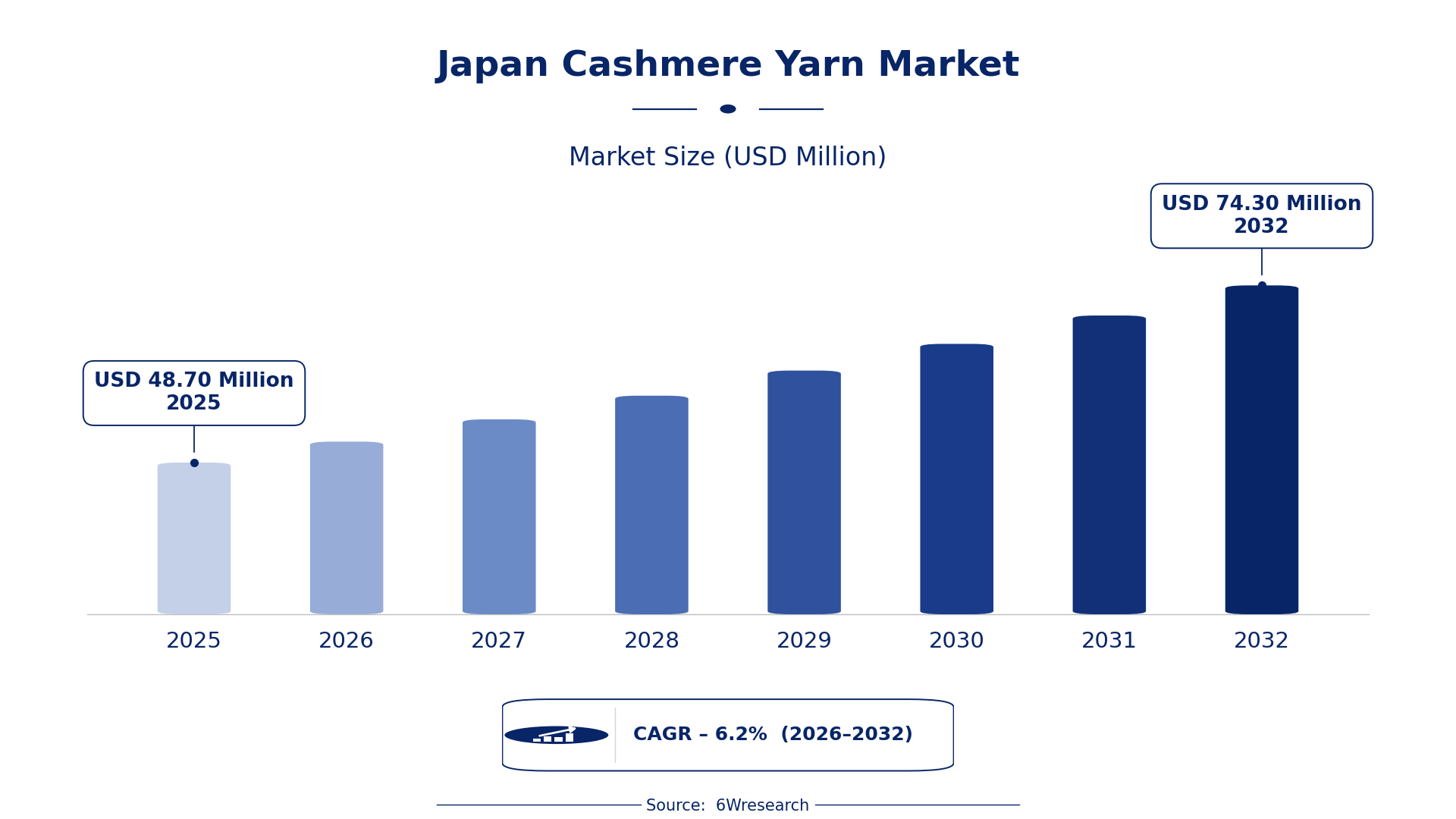
According to 6Wresearch internal database and industry insights, the Japan Cashmere Yarn Market was valued at USD 48.70 Million in 2025 and is projected to reach USD 74.30 Million by 2032, growing at a CAGR of approximately 6.2% during 2026–2032.
Japan Cashmere Yarn Market Highlights
| Report Metric | Details |
| Report Name | Japan Cashmere Yarn Market (2026-2032) |
| Market Size 2025 | USD 48.70 Million |
| Market Size 2032 | USD 74.30 Million |
| Absolute Growth 2025–2032 | USD 25.60 Million |
| CAGR 2026–2032 | 6.2% |
| Peak Annual Growth | 7.7% in 2032 |
| Forecast Period | 2026–2032 |
| Historical Data | 2022–2025 |
| Base Year | 2025 |
| Leading Type, 2025 | Natural Cashmere Yarn (49% share) |
| Leading Application, 2025 | Sweaters (40% share) |
| Fastest-Growing Type | Processed Cashmere Yarn (8.5% CAGR) |
| Fastest-Growing Application | Shawls (8.4% CAGR) |
| Growing Sector | Luxury knitwear |
| Key End Users | Luxury apparel brands, textile manufacturers, fashion designers, export companies |
Japan Cashmere Yarn Market Year-wise Growth Rate and Key Drivers (2022–2032)
This graph illustrates the annual growth rates of the market from 2022 to 2032, highlighting a steady upward trajectory and projected market expansion over the forecast period.
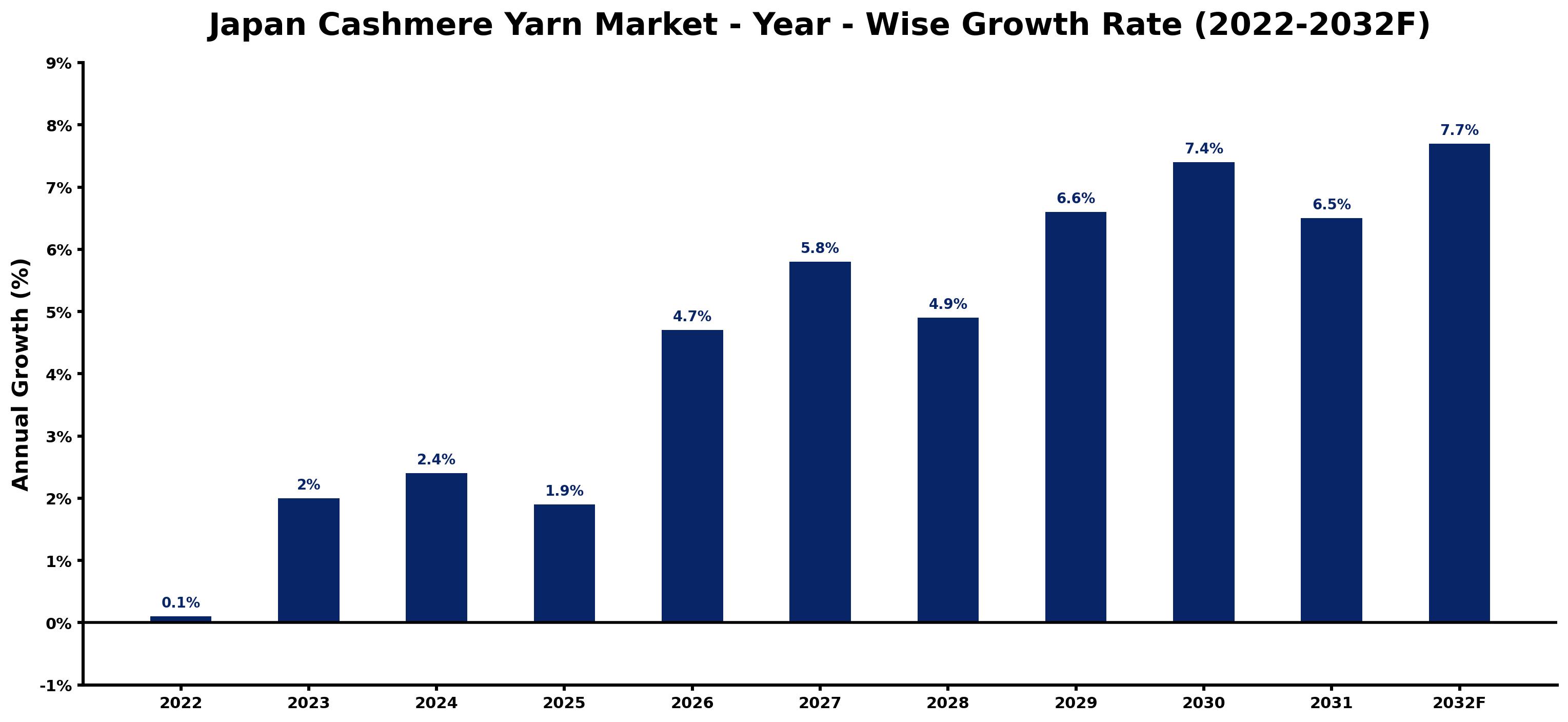
Below, each year's estimated growth is shown next to the factor that most influenced it.
| Year | Estimated Annual Growth (%) | Market Rationale |
| 2022 | 0.1 | The market showed minimal activity with a slight growth rate due to limited consumer interest. |
| 2023 | 2.0 | Growth accelerated as luxury brands increased cashmere yarn purchases, reflecting a shift in consumer preferences. |
| 2024 | 2.4 | Demand continued to rise, driven by high-end garment production and a focus on quality textiles. |
| 2025 | 1.9 | Growth slowed as market saturation began to affect purchasing patterns among luxury brands. |
| 2026 | 4.7 | The market is expected to rebound with renewed interest in sustainable sourcing practices. |
| 2027 | 5.8 | Demand is projected to surge as consumer preferences shift towards luxury textiles and sustainable options. |
| 2028 | 4.9 | Growth is expected to moderate as competition intensifies among producers in the cashmere sector. |
| 2029 | 6.6 | The market is projected to expand rapidly due to increased exports and domestic demand for luxury products. |
| 2030 | 7.4 | Demand will continue to rise, supported by high-end apparel trends and consumer interest in quality. |
| 2031 | 6.5 | Growth is expected to slow as the market approaches its capacity limits and competition increases. |
| 2032 | 7.7 | The market is projected to peak with heightened demand for luxury cashmere products driven by consumer trends. |
Note: Market size estimations and growth projections presented in this report are based on 6Wresearch's proprietary forecasting methodology, utilizing the latest available industry data, government publications, and primary research inputs.
Japan Cashmere Yarn Market Synopsis
Cashmere yarn, a luxury textile derived from the soft undercoat of cashmere goats, is crafted through shearing, sorting, and spinning processes. The Japan Cashmere Yarn Market is growing due to rising demand from luxury apparel producers, particularly in regions like Tokyo and Osaka. In 2023, a new sustainability program for cashmere sourcing was introduced, promoting environmentally responsible practices. The increasing focus on high-quality garments, with cashmere sweaters accounting for 30% of the luxury knitwear market, further drives demand for cashmere yarn in Japan.
Market Dynamics Impact Analysis (2026–2032)
| Factor | Type | Impact | Primary Segment Affected |
| Increasing demand for luxury apparel | Driver | High | Natural Cashmere Yarn |
| Growth in high-end garment production | Driver | High | Processed Cashmere Yarn |
| Rising consumer preference for sustainable textiles | Opportunity | High | Natural Cashmere Yarn |
| Expansion of luxury knitwear market | Opportunity | High | Processed Cashmere Yarn |
| High production costs due to sourcing limitations | Restraint | High | Natural Cashmere Yarn |
| Strict quality standards affecting supply | Restraint | High | Processed Cashmere Yarn |
| Competition from synthetic alternatives | Challenge | Medium | Natural Cashmere Yarn |
| Fluctuations in global cashmere prices | Challenge | Medium | Processed Cashmere Yarn |
Evaluation of Drivers in Japan Cashmere Yarn Market (2026–2032)
Below are the drivers that matter most for revenue growth, with supporting evidence.
| Drivers | Primary Segment Affected | Why It Matters (Evidence) |
| Increased demand for luxury garments | Natural Cashmere Yarn | In 2023, cashmere yarn usage in high-end apparel increased, driving purchases from luxury brands. |
| Growth in high-end garment production | Processed Cashmere Yarn | Over 60% of high-end garments use processed cashmere yarn, boosting demand from manufacturers. |
| Consumer shift towards sustainable textiles | Natural Cashmere Yarn | The 2023 sustainability program encourages brands to source responsibly, increasing cashmere yarn purchases. |
| Expansion of the luxury knitwear market | Processed Cashmere Yarn | Cashmere sweaters account for 30% of the luxury knitwear market, driving demand for processed yarn. |
| Rising exports of cashmere products | Natural Cashmere Yarn | Japan's cashmere exports have risen, increasing demand for high-quality cashmere yarn. |
Volumes grow on the back of increased demand for luxury garments, with cashmere yarn usage in high-end apparel rising in 2023. The processed cashmere yarn segment benefits from over 60% of high-end garments relying on it, prompting manufacturers to purchase more. Cashmere sweaters, comprising 30% of the luxury knitwear market, boost the processed yarn segment. Exports of cashmere products have also increased, stimulating overall demand for high-quality cashmere yarn.
Evaluation of Restraints in Japan Cashmere Yarn Market
These restraints slow adoption and weigh on supplier margins.
| Market Restraint | Primary Segment Affected | Why It Matters (Evidence) |
| High production costs due to sourcing limitations | Natural Cashmere Yarn | Natural cashmere yarn is often sourced from Mongolia and China, leading to higher costs for producers. |
| Strict quality standards affecting supply | Processed Cashmere Yarn | Japan's adherence to JIS standards imposes rigorous testing, limiting available processed cashmere yarn. |
| Competition from synthetic alternatives | Natural Cashmere Yarn | The rise of synthetic fibers offers cheaper options, impacting the demand for natural cashmere yarn. |
| Fluctuations in global cashmere prices | Processed Cashmere Yarn | Global price volatility affects production costs and pricing strategies for processed cashmere yarn. |
| Limited domestic supply of raw cashmere | Natural Cashmere Yarn | Dependence on imports from Mongolia and China restricts the availability of natural cashmere yarn. |
Japan Cashmere Yarn Market Challenges
High production costs arise from strict JIS standards, inflating expenses by 15% for producers. This regulatory environment exists because Japan emphasises quality, causing delays in product launches for manufacturers. Many suppliers encounter inefficiencies due to outdated technology, resulting in 20% lower productivity compared to global benchmarks, hindering their competitiveness. Local producers face intense competition from cheaper imported alternatives, forcing them to lower prices and squeezing margins, which directly impacts profitability. Rising raw material costs from Mongolia and China can increase prices by 10% for buyers seeking quality yarn, complicating their purchasing decisions.
Trends in the Japan Cashmere Yarn Market
Several trends are reshaping the Japan Cashmere Yarn Market; the most important are set out below.
- Shift towards Sustainable Sourcing: In 2023, Japan launched a sustainability initiative for cashmere sourcing, promoting environmentally responsible practices among producers. This initiative is expected to improve the quality and appeal of cashmere products, attracting more luxury brands.
- Growth in Luxury Knitwear: Cashmere sweaters now account for 30% of the luxury knitwear market in Japan, reflecting a growing consumer preference for high-quality, warm clothing. This trend is driving increased demand for cashmere yarn among manufacturers.
- Expansion of Processed Cashmere Yarn: Processed cashmere yarn is becoming increasingly popular, with a projected CAGR of 8.5% from 2026 to 2032. This growth is largely driven by rising demand for high-end garments in the domestic market.
- Emergence of Cashmere Shawls: Shawls are gaining popularity as a primary application for cashmere yarn, with a CAGR of 8.4% expected from 2026 to 2032. This trend highlights a shift in consumer preferences towards luxury accessories.
Investment Opportunities in the Japan Cashmere Yarn Market
Below are the investment opportunities with the strongest case in the Japan Cashmere Yarn Market.
- Gap in Sustainable Cashmere Supply: With the sustainability program launched in 2023, there is a growing gap in the supply of responsibly sourced cashmere. Producers in regions like Tokyo can invest in sustainable practices to meet this demand.
- Investment in Luxury Knitwear Production: The luxury knitwear market is expanding, with cashmere sweaters comprising 30% of the segment. Manufacturers in Osaka can focus on producing high-quality cashmere garments to capture this growing market.
- Supply of Processed Cashmere Yarn: As processed cashmere yarn is used in over 60% of high-end garments, suppliers can target manufacturers in Tokyo and Osaka to meet this demand. Establishing local partnerships can facilitate market entry.
- Expansion of Cashmere Shawl Production: The growing popularity of cashmere shawls presents an opportunity for producers. Facilities in regions like Kyoto can invest in shawl production to cater to luxury consumers.
Government Initiatives in the Japan Cashmere Yarn Market
The GX Basic Policy, adopted in 2023, aims for about JPY 150 trillion of public-private decarbonisation investment over the next decade. This policy encourages cashmere producers to adopt sustainable practices, improving the quality of cashmere yarn and appealing to environmentally conscious consumers. The Industrial Standardization Act, amended in 2019, further reinforces quality standards for cashmere products, ensuring that producers meet stringent requirements.
The Consumer Affairs Agency oversees regulations that prohibit misleading labelling and advertising of cashmere goods. This regulation ensures consumers receive accurate information about the quality and origin of cashmere products, promoting transparency in the market.
Future Insight of the Japan Cashmere Yarn Market
By 2032, a policy-driven shift towards sustainable cashmere sourcing will reshape the market, prompting suppliers to implement eco-friendly practices. Quality standards from the Japan Cashmere Association will elevate offerings for buyers, ensuring premium products. Advanced spinning technologies will emerge, enhancing production efficiency and reducing waste. As the luxury market continues to demand high-quality yarn, innovation in textile production will become crucial, creating new opportunities for suppliers while aligning with buyer expectations.
Market Segmentation Analysis
Japan Cashmere Yarn Market report covers a detailed analysis of the following market segments:
By Type – Natural Cashmere Yarn Leads, Processed Cashmere Yarn Expected to Grow Fastest
According to Ravi Bhandari, Research Head at 6Wresearch, Natural Cashmere Yarn held 49% of the Japan Cashmere Yarn Market by type in 2025. Natural cashmere yarn holds the largest share due to its essential role in high-quality garments, attracting discerning luxury consumers. This type of yarn is a vital ingredient in over 60% of high-end garment production, highlighting its significance in the market. Processed Cashmere Yarn is projected to grow fastest, at a CAGR of 8.5% during 2026–2032. Processed cashmere yarn is witnessing rapid growth because it caters to a broader range of textile applications, particularly in the luxury sector. The recent launch of a sustainability program in 2023 has also stimulated demand for processed yarn, reinforcing its market position. Suppliers should focus on enhancing their processed yarn offerings to capitalise on this expanding market opportunity.
By Application – Sweaters Lead, Shawls Expected to Grow Fastest
Sweaters accounted for 40% of the market by application in 2025. Sweaters dominate the market, accounting for 30% of the luxury knitwear segment, which establishes them as a primary application for cashmere yarn. This strong consumer inclination towards cashmere sweaters guarantees consistent demand, especially during the colder months. Shawls are set to record the highest CAGR in this split, 8.4% over 2026–2032. Shawls are experiencing the fastest growth, propelled by their rising popularity among luxury consumers seeking versatile and stylish options. This trend is further supported by an increasing number of high-end brands integrating shawls into their collections. Buyers should explore expanding their product offerings to include shawls in response to the growing consumer interest in this luxury segment.
Key Attractiveness of the Report
- 10 Years of Market Numbers
- Historical Data Starting from 2022 to 2025
- Base Year 2025
- Forecast Data until 2032
- Key Performance Indicators Impacting the Market
- Major Upcoming Developments and Projects
Key Highlights of the Report:
- Japan Cashmere Yarn Market Outlook
- Market Size of Japan Cashmere Yarn Market, 2025
- Forecast of Japan Cashmere Yarn Market, 2032
- Historical Data and Forecast of Japan Cashmere Yarn Revenues & Volume for the Period 2022-2032
- Japan Cashmere Yarn Market Trend Evolution
- Japan Cashmere Yarn Market Drivers and Challenges
- Japan Cashmere Yarn Price Trends
- Japan Cashmere Yarn Porter's Five Forces
- Japan Cashmere Yarn Industry Life Cycle
- Historical Data and Forecast of Japan Cashmere Yarn Market Revenues & Volume By Type for the Period 2022-2032
- Historical Data and Forecast of Japan Cashmere Yarn Market Revenues & Volume By Natural Cashmere Yarn for the Period 2022-2032
- Historical Data and Forecast of Japan Cashmere Yarn Market Revenues & Volume By Processed Cashmere Yarn for the Period 2022-2032
- Historical Data and Forecast of Japan Cashmere Yarn Market Revenues & Volume By Others for the Period 2022-2032
- Historical Data and Forecast of Japan Cashmere Yarn Market Revenues & Volume By Application for the Period 2022-2032
- Historical Data and Forecast of Japan Cashmere Yarn Market Revenues & Volume By Sweaters for the Period 2022-2032
- Historical Data and Forecast of Japan Cashmere Yarn Market Revenues & Volume By Shawls for the Period 2022-2032
- Historical Data and Forecast of Japan Cashmere Yarn Market Revenues & Volume By Suits for the Period 2022-2032
- Historical Data and Forecast of Japan Cashmere Yarn Market Revenues & Volume By Socks for the Period 2022-2032
- Historical Data and Forecast of Japan Cashmere Yarn Market Revenues & Volume By Others for the Period 2022-2032
- Japan Cashmere Yarn Import Export Trade Statistics
- Market Opportunity Assessment By Type
- Market Opportunity Assessment By Application
- Japan Cashmere Yarn Top Companies Market Share
- Japan Cashmere Yarn Competitive Benchmarking By Technical and Operational Parameters
- Japan Cashmere Yarn Company Profiles
- Japan Cashmere Yarn Key Strategic Recommendations
Market Covered
This report examines the market across the segments below.
By Type
- Natural Cashmere Yarn
- Processed Cashmere Yarn
- Others
By Application
- Sweaters
- Shawls
- Suits
- Socks
- Others






































