Japan Cereal Grains Market Size & Growth Rate
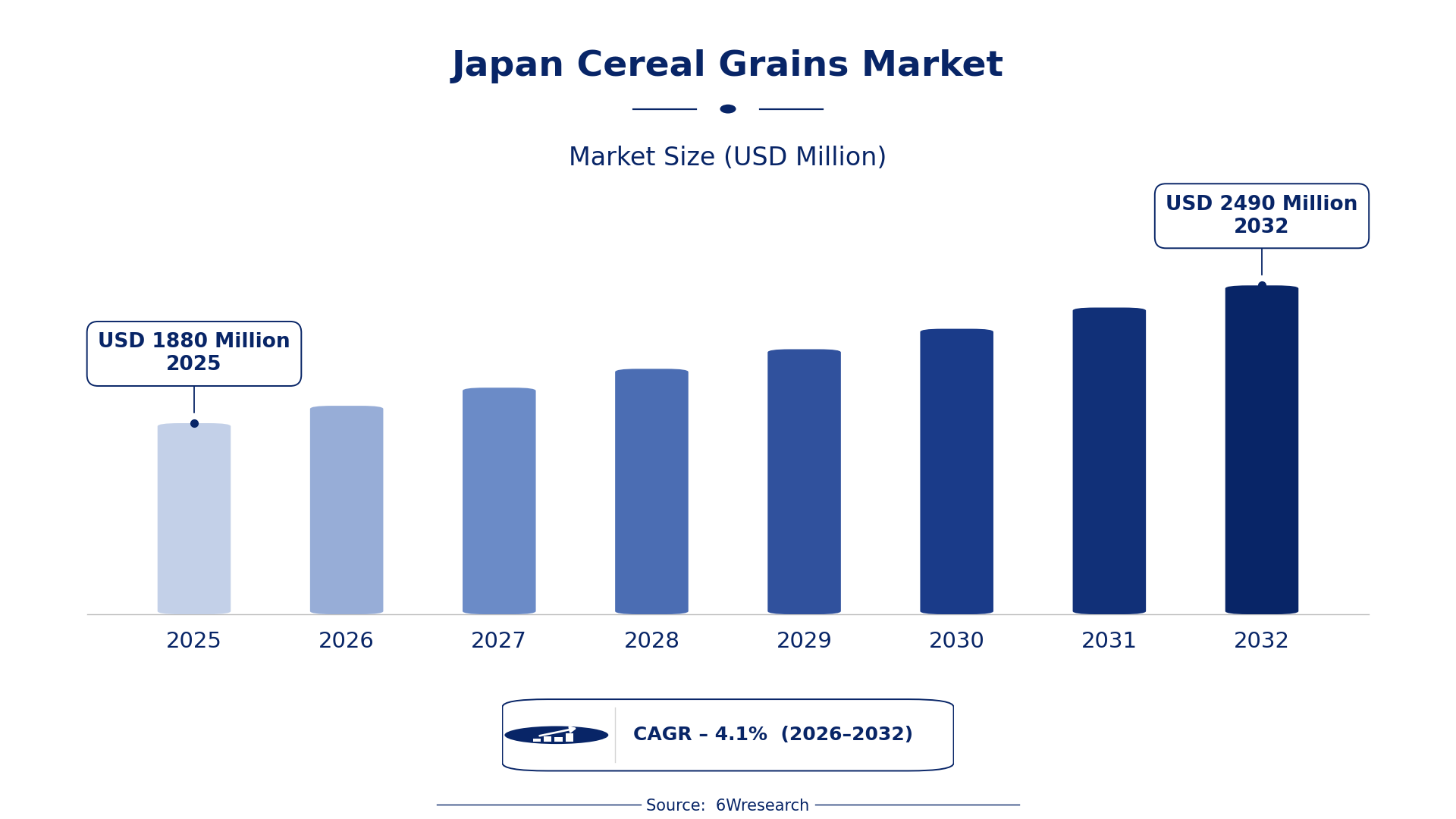
According to 6Wresearch internal database and industry insights, the Japan Cereal Grains Market was valued at USD 1,880 Million in 2025 and is projected to reach USD 2,490 Million by 2032, growing at a CAGR of approximately 4.1% during 2026–2032.
Japan Cereal Grains Market Highlights
| Report Metric | Details |
| Report Name | Japan Cereal Grains Market (2026-2032) |
| Market Size 2025 | USD 1,880 Million |
| Market Size 2032 | USD 2,490 Million |
| Absolute Growth 2025–2032 | USD 610 Million |
| CAGR 2026–2032 | 4.1% |
| Peak Annual Growth | 5.0% in 2032 |
| Forecast Period | 2026–2032 |
| Historical Data | 2022–2025 |
| Base Year | 2025 |
| Leading Grain Type, 2025 | Wheat (38% share) |
| Leading Processing Type, 2025 | Milled (37% share) |
| Leading Form, 2025 | Flour (41% share) |
| Leading End Use, 2025 | Bakery (52% share) |
| Fastest-Growing Grain Type | Corn (5.8% CAGR) |
| Fastest-Growing Processing Type | Rolled (6.1% CAGR) |
| Fastest-Growing Form | Flakes (6.2% CAGR) |
| Fastest-Growing End Use | Breakfast Cereals (5.3% CAGR) |
| Growing Sector | Bakery |
| Key End Users | Food processors, Retailers, Animal feed manufacturers, Consumers |
Japan Cereal Grains Market Year-wise Growth Rate and Key Drivers (2022–2032)
This graph illustrates the annual growth rates of the market from 2022 to 2032, highlighting a steady upward trajectory and projected market expansion over the forecast period.
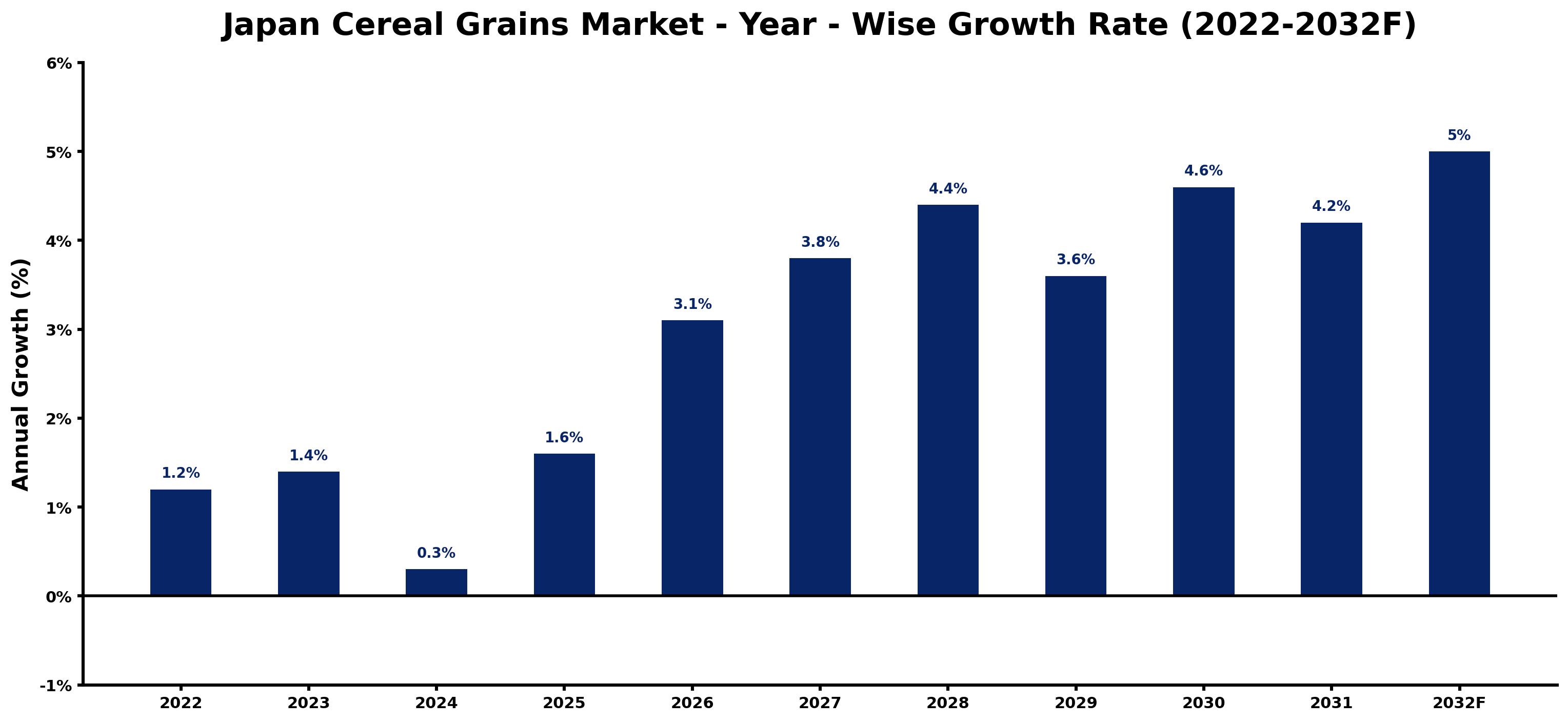
Below, each year's estimated growth is shown next to the factor that most influenced it.
| Year | Estimated Annual Growth (%) | Market Rationale |
| 2022 | 1.2 | The market showed steady growth, reflecting strong domestic demand for staple foods. |
| 2023 | 1.4 | Demand increased due to higher consumption rates in the Tokyo metropolitan area. |
| 2024 | 0.3 | Growth slowed as wheat imports faced challenges in meeting rising needs. |
| 2025 | 1.6 | The market rebounded with increased production and consumption of rice and wheat. |
| 2026 | 3.1 | Demand rises as the 'Food Action Nippon' initiative boosts local grain consumption. |
| 2027 | 3.8 | The market continues to grow with rising health awareness around whole grains. |
| 2028 | 4.4 | Growth accelerates as consumer preferences shift towards convenience foods. |
| 2029 | 3.6 | A slight slowdown occurs as supply chain issues affect grain availability. |
| 2030 | 4.6 | Demand rises again with increased investments in food safety and quality standards. |
| 2031 | 4.2 | The market sees moderate growth as consumer trends stabilise. |
| 2032 | 5.0 | A peak in growth is anticipated as health trends drive cereal grain consumption. |
Note: Market size estimations and growth projections presented in this report are based on 6Wresearch's proprietary forecasting methodology, utilizing the latest available industry data, government publications, and primary research inputs.
Japan Cereal Grains Market Synopsis
Cereal grains serve as staple food products rich in carbohydrates, proteins, and fibre, cultivated and processed for diverse consumption. The Japan Cereal Grains Market is expanding due to rising health consciousness and initiatives like 'Food Action Nippon', which promotes local grain consumption. In 2022, Japan produced 8.2 million tons of rice, highlighting strong domestic demand from food processing and retail sectors. As consumer preferences evolve, investment in local grain production is expected to increase, further supporting market expansion.
Market Dynamics Impact Analysis (2026–2032)
| Factor | Type | Impact | Primary Segment Affected |
| Rising health consciousness among consumers | Driver | High | Whole Grain |
| Increased investments in food safety standards | Driver | High | Milled |
| Growing demand for local grain products | Opportunity | High | Consumer Retail |
| Expansion of breakfast cereal offerings | Opportunity | Medium | Breakfast Cereals |
| Supply chain disruptions affecting imports | Restraint | High | Wheat |
| Fluctuating prices of key grains | Restraint | Medium | Rice |
| Competition from imported grains | Challenge | High | Corn |
| Changing consumer preferences towards alternative grains | Challenge | Medium | Barley |
Evaluation of Drivers in Japan Cereal Grains Market (2026–2032)
Demand rests on the following drivers, each shown with the segment it touches most.
| Drivers | Primary Segment Affected | Why It Matters (Evidence) |
| Increased health awareness | Whole Grain | Health trends are driving consumers to prefer whole grain products, leading to a 5% rise in purchases. |
| Higher consumption rates of rice | Rice | With a consumption rate of 60 kg per capita, demand for rice remains strong in households. |
| Growth in the bakery sector | Bakery | The bakery sector's expansion is fueled by a 52% market share in cereal grains, driving flour demand. |
| Rising demand for animal feed | Corn | The annual consumption of corn in Japan is about 1.5 million tons, supporting livestock production. |
| Investments in food safety | Milled | The implementation of ISO 22000 standards enhances consumer trust and boosts grain purchases. |
What keeps demand rising is the increasing health awareness among consumers, particularly for whole grains, which has led to a 5% rise in purchases. The annual consumption of rice remains strong at 60 kg per capita, indicating robust household demand. The bakery sector, holding a 52% market share in cereal grains, continues to expand, driving flour demand. The consumption of corn for animal feed is approximately 1.5 million tons annually, further supporting grain demand. Investments in food safety standards, such as ISO 22000, build consumer trust and encourage higher grain purchases.
Evaluation of Restraints in Japan Cereal Grains Market
The key brakes on demand, and where they bite hardest, are shown below.
| Market Restraint | Primary Segment Affected | Why It Matters (Evidence) |
| Supply chain disruptions affecting imports | Wheat | Wheat imports were around 5 million tons in 2022, but disruptions have limited availability. |
| Fluctuating prices of key grains | Rice | The average price of milled rice was approximately 2,500 JPY per kg in 2023, impacting affordability. |
| Competition from alternative grains | Corn | Imported corn competes with local production, affecting market share for domestic grains. |
| Limited barley production | Barley | Barley production was approximately 1.2 million tons in 2022, constraining supply for beverages. |
| Consumer preference shifts | Breakfast Cereals | Shifts towards alternative breakfast options have affected the demand for traditional cereals. |
Japan Cereal Grains Market Challenges
Japan's cereal grains market encounters a significant supply challenge due to limited domestic production. Wheat imports reached around 5 million tons in 2022, causing delays in supply for food processors and retailers. Rising costs also impact consumers; the average price of milled rice was approximately 2,500 JPY per kg in 2023, straining household budgets. Technological constraints in grain processing complicate compliance with food safety standards, leading to increased operational costs for producers. Buyers in the Tokyo metropolitan area face unpredictable pricing, making it difficult to plan purchases effectively amid changing consumer demands.
Trends in the Japan Cereal Grains Market
The following changes are redrawing the Japan Cereal Grains Market.
- Shift towards Healthier Breakfast Options: Consumers are increasingly opting for healthier breakfast choices, leading to a rise in demand for whole grain cereals. The breakfast cereals segment is projected to grow at a CAGR of 5.3%, reflecting this trend.
- Increase in Local Grain Consumption: The 'Food Action Nippon' initiative is promoting local grain consumption, resulting in a 10% increase in sales of domestically produced grains in the Tokyo metropolitan area.
- Transition from Traditional to Convenience Foods: There is a growing preference for convenience foods, with ready-to-eat cereal products gaining popularity among busy consumers, contributing to a 20% increase in sales.
- Rising Demand for Organic Grains: Organic grains are becoming increasingly popular, with sales rising by 15% in 2023, driven by health-conscious consumers seeking sustainable options.
Investment Opportunities in the Japan Cereal Grains Market
The openings below show where demand in the Japan Cereal Grains Market is visible and how suppliers can enter.
- Market Gap for Organic Products: With organic grain sales rising by 15%, there is an opportunity for suppliers to invest in organic grain production, particularly in the Kanto region.
- Partnerships for Local Grain Supply: Now is an ideal time to enter the market through partnerships with local producers, especially given the focus on local grain consumption.
- Investment in Food Safety Technologies: Investments in food safety technologies are essential as the government promotes standards, with a potential market growth of 20% by 2025.
- Expansion of Breakfast Cereal Offerings: With breakfast cereals growing significantly, suppliers should focus on innovative product development to capture this expanding market.
Government Initiatives in the Japan Cereal Grains Market
The Industrial Standardization Act of 1949 governs product and test standards, ensuring quality in grain processing. This law requires producers to meet specific guidelines, building consumer confidence in cereal grains. The Food Sanitation Act amendment of 2018 mandates HACCP-based hygiene management for food businesses, ensuring strict hygiene standards in grain processing and improving overall food safety.
The GX Basic Policy, adopted in 2023, aims for JPY 150 trillion in public-private decarbonisation investment over ten years. The Ministry of Agriculture, Forestry and Fisheries oversees this initiative, promoting sustainable practices in grain production.
Future Insight of the Japan Cereal Grains Market
Households will increasingly seek locally sourced grains, driven by initiatives like "Food Action Nippon". By 2032, improvements in grain processing technology will enhance efficiency, benefiting suppliers. The Ministry of Agriculture, Forestry and Fisheries is expected to introduce new policies to boost production capabilities. With Japan's population at approximately 125 million, the demand for cereal grains will escalate, pushing producers to innovate and adapt their offerings to meet evolving consumer preferences.
Market Segmentation Analysis
Japan Cereal Grains Market report covers a detailed analysis of the following market segments:
By Grain Type – Wheat Leads, Corn Expected to Grow Fastest
According to Saurav Kr Singh, Senior Research Analyst at 6Wresearch, in 2025, Wheat led the grain type split with a 38% share. Wheat captures the largest share in Japan as it is extensively used in staple foods like bakery items and noodles, which are integral to Japanese cuisine. The Kanto region's significant wheat production underpins this strong demand. Over 2026–2032, Corn is expected to post the fastest growth, at a CAGR of 5.8%. Corn is rapidly gaining traction due to its rising use in animal feed and various food products, reflecting a shift in consumer preferences towards more diverse food options. The annual consumption of corn in Japan is about 1.5 million tons, highlighting this trend. Suppliers should prioritise expanding corn offerings to satisfy the increasing demand in both animal feed and food sectors.
By Processing Type – Milled Leads, Rolled Expected to Grow Fastest
With 37% of processing type revenue in 2025, Milled was the largest category. Milled grains dominate the market as they are crucial for flour production, a fundamental component in many food products. The average price of milled rice in Japan was approximately 2,500 JPY per kg in 2023, indicating strong consumer value placed on this processing type. Rolled is set to record the highest CAGR in this split, 6.1% over 2026–2032. Rolled grains are experiencing the fastest growth due to their incorporation in breakfast cereals, which are becoming more popular among health-conscious consumers. This trend aligns with initiatives like 'Food Action Nippon' that promote local grain consumption. Buyers should explore sourcing rolled grains to align with the increasing trend in breakfast cereal consumption.
By Form – Flour Leads, Flakes Expected to Grow Fastest
Flour held 41% of the Japan Cereal Grains Market by form in 2025. Flour is the leading form of cereal grains as it is the primary ingredient in baked goods, which are staples in the Japanese diet. The high demand for various baked products ensures flour's continued dominance in the market. Flakes are projected to grow fastest, at a CAGR of 6.2% during 2026–2032. Flakes are rapidly growing in popularity as they are widely used in breakfast cereals, catering to a market that values convenience and nutrition. This shift is evident as breakfast cereals gain traction among consumers seeking quick meal options. Suppliers should enhance their offerings of flakes to capitalise on the rising demand for breakfast cereals.
By End Use – Bakery Leads, Breakfast Cereals Expected to Grow Fastest
Bakery accounted for 52% of the market by end use in 2025. Bakery is the largest end-use segment for cereal grains, driven by the high consumption of bread and pastries in Japan. The Tokyo metropolitan area, with its dense population, significantly boosts the demand for bakery products. The quickest growth will come from Breakfast Cereals, forecast to expand at a CAGR of 5.3% between 2026 and 2032. Breakfast cereals are the fastest-growing end-use segment, reflecting changing consumer preferences towards quick and nutritious meal options. This trend is further supported by initiatives that promote local grain consumption, driving demand. Suppliers must adapt to the growing preference for breakfast cereals to remain competitive in the changing market.
Key Attractiveness of the Report
- 10 Years of Market Numbers
- Historical Data Starting from 2022 to 2025
- Base Year 2025
- Forecast Data until 2032
- Key Performance Indicators Impacting the Market
- Major Upcoming Developments and Projects
Key Highlights of the Report:
- Japan Cereal Grains Market Outlook
- Market Size of Japan Cereal Grains Market, 2025
- Forecast of Japan Cereal Grains Market, 2032
- Historical Data and Forecast of Japan Cereal Grains Revenues & Volume for the Period 2022-2032F
- Japan Cereal Grains Market Trend Evolution
- Japan Cereal Grains Market Drivers and Challenges
- Japan Cereal Grains Price Trends
- Japan Cereal Grains Porter's Five Forces
- Japan Cereal Grains Industry Life Cycle
- Historical Data and Forecast of Japan Cereal Grains Market Revenues & Volume By Grain Type for the Period 2022-2032F
- Historical Data and Forecast of Japan Cereal Grains Market Revenues & Volume By Wheat for the Period 2022-2032F
- Historical Data and Forecast of Japan Cereal Grains Market Revenues & Volume By Corn for the Period 2022-2032F
- Historical Data and Forecast of Japan Cereal Grains Market Revenues & Volume By Rice for the Period 2022-2032F
- Historical Data and Forecast of Japan Cereal Grains Market Revenues & Volume By Barley for the Period 2022-2032F
- Historical Data and Forecast of Japan Cereal Grains Market Revenues & Volume By Processing Type for the Period 2022-2032F
- Historical Data and Forecast of Japan Cereal Grains Market Revenues & Volume By Milled for the Period 2022-2032F
- Historical Data and Forecast of Japan Cereal Grains Market Revenues & Volume By Rolled for the Period 2022-2032F
- Historical Data and Forecast of Japan Cereal Grains Market Revenues & Volume By Polished for the Period 2022-2032F
- Historical Data and Forecast of Japan Cereal Grains Market Revenues & Volume By Crushed for the Period 2022-2032F
- Historical Data and Forecast of Japan Cereal Grains Market Revenues & Volume By Form for the Period 2022-2032F
- Historical Data and Forecast of Japan Cereal Grains Market Revenues & Volume By Flour for the Period 2022-2032F
- Historical Data and Forecast of Japan Cereal Grains Market Revenues & Volume By Flakes for the Period 2022-2032F
- Historical Data and Forecast of Japan Cereal Grains Market Revenues & Volume By Whole Grain for the Period 2022-2032F
- Historical Data and Forecast of Japan Cereal Grains Market Revenues & Volume By Malted for the Period 2022-2032F
- Historical Data and Forecast of Japan Cereal Grains Market Revenues & Volume By End Use for the Period 2022-2032F
- Historical Data and Forecast of Japan Cereal Grains Market Revenues & Volume By Bakery for the Period 2022-2032F
- Historical Data and Forecast of Japan Cereal Grains Market Revenues & Volume By Breakfast Cereals for the Period 2022-2032F
- Historical Data and Forecast of Japan Cereal Grains Market Revenues & Volume By Consumer Retail for the Period 2022-2032F
- Historical Data and Forecast of Japan Cereal Grains Market Revenues & Volume By Beverage Industry for the Period 2022-2032F
- Japan Cereal Grains Import Export Trade Statistics
- Market Opportunity Assessment By Grain Type
- Market Opportunity Assessment By Processing Type
- Market Opportunity Assessment By Form
- Market Opportunity Assessment By End Use
- Japan Cereal Grains Top Companies Market Share
- Japan Cereal Grains Competitive Benchmarking By Technical and Operational Parameters
- Japan Cereal Grains Company Profiles
- Japan Cereal Grains Key Strategic Recommendations
Market Covered
The report covers the following segments.
By Grain Type
- Wheat
- Corn
- Rice
- Barley
By Processing Type
- Milled
- Rolled
- Polished
- Crushed
By Form
- Flour
- Flakes
- Whole Grain
- Malted
By End Use
- Bakery
- Breakfast Cereals
- Consumer Retail
- Beverage Industry






































